






Notion and Airtable are the two best AI database tools for 2026 - Notion suits document-centric, knowledge-heavy teams and starts free (AI from $15 per seat each month), while Airtable suits structured, automation-heavy operational data and starts free (paid plans from $20 per seat each month). This comparison draws on current vendor documentation, published pricing pages, and independent research rather than sponsored placement.
The average knowledge worker wastes 1.8 hours per day searching for and gathering information - nearly a full workday every week. That bottleneck drives the push toward AI tools for data analysis across every department, with many teams asking which AI is best for data analysis free of charge before committing to a paid seat - a question that recurs in any roundup of the best AI tools 2026. AI-powered database tools in 2026 summarize records, generate field values, automate workflows on data changes, and answer natural language questions - so the challenge is picking the right one among the best AI database tools 2026 free of charge options.
TL;DR: Quick Comparison
Notion is the best AI database tool for document-centric teams, while Airtable is the best AI database tool for structured, automation-heavy operational data - both offer free tiers, with Notion AI starting at $15 per seat each month and Airtable paid plans from $20 per seat each month.
| Feature | Notion | Airtable |
|---|---|---|
| Starting Price | Free / $12/mo (Plus) | Free / $24/mo (Team) |
| Best For | Knowledge-heavy databases with docs | Structured data workflows and automation |
| AI Features | Multi-model AI (GPT-5, Claude, o3), AI Agents | AI fields, AI-powered automations |
| Record Limits (Free) | Unlimited pages | 1,000 per base |
| Automation Runs (Free) | Limited | 100/month |
| Learning Curve | 2-3 weeks | 1-2 weeks |
| Rating |
Recommendation: If your databases live alongside documents and wikis, Notion is the better pick. For structured, relational databases with heavy automation, Airtable wins. The decision comes down to whether your work is document-centric or data-centric.
Selection Criteria: What Makes an AI Database Tool Different
An AI database tool is a database that actively works with your data - generating field values, answering natural language questions, automating on context, and surfacing relationships - rather than only storing and retrieving it. Traditional databases store and retrieve data; every insight requires someone to ask the right question in the right format.
AI database tools flip that model: auto-generate field values (summaries, classifications, extracted entities - see the AI tools for data analysts guide), answer natural-language questions like “Which clients haven’t been contacted in 30 days?” without a query, automate based on data patterns, suggest hidden relationships, and fill gaps via AI inference.
Users report 3-7 hours saved per week on data entry and reporting alone, which is why searches for best AI database tools 2026 free of charge keep climbing. “Generative AI’s impact on productivity could add the equivalent of $2.6 trillion to $4.4 trillion annually” across business functions, according to McKinsey’s 2023 report on the economic potential of generative AI - database tooling is one of the clearest places that value lands.
The 2 Best AI Database Tools 2026
Notion and Airtable are the two best AI database tools 2026 - Notion is the all-in-one knowledge database, and Airtable is the no-code database powerhouse, chosen for the widest range of use cases.
1. Notion: The All-in-One Knowledge Database
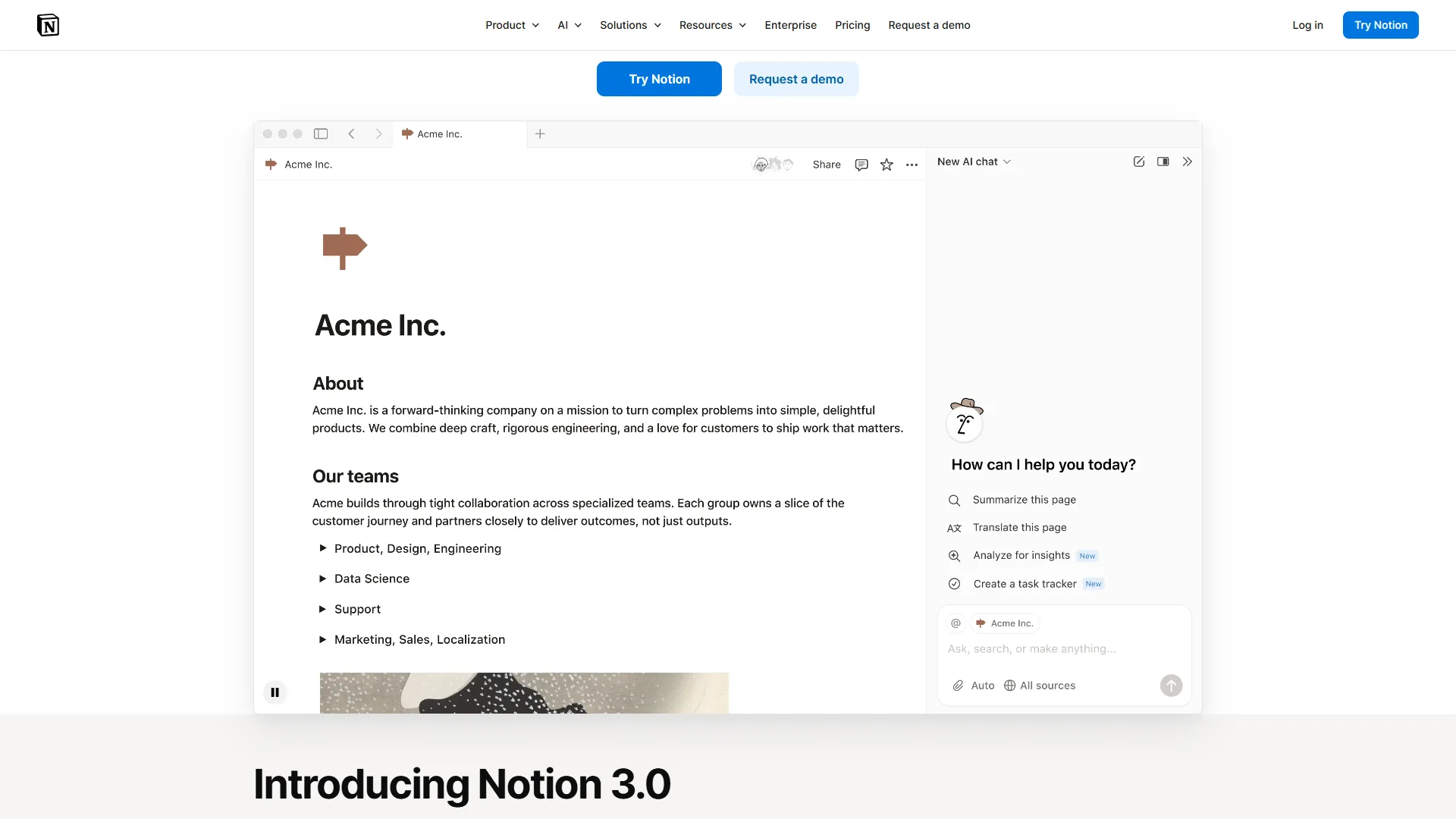
Notion is a workspace platform whose databases are flexible collections of pages - each record is also a full document, which makes Notion uniquely powerful for teams that need context alongside their data.
What sets Notion apart in 2026 is the AI Agents feature, launched with Notion 3.0. As described in Notion’s AI product documentation, these agents read your databases, comments, connected Slack channels, and calendar to take autonomous action. For a hands-on walkthrough, the Notion AI workflows guide covers agent setup step by step.
Pricing (February 2026):
| Plan | Monthly | Annual (per month) | Key Limits |
|---|---|---|---|
| Free | $0 | $0 | Unlimited pages (individual), limited blocks (teams) |
| Plus | $12/seat | $10/seat | Unlimited blocks, 100 guests, 30-day history |
| Business | $18/seat | $15/seat | Unlimited AI with GPT-5/Claude/o3, AI Agents, SAML SSO |
| Enterprise | Custom | Custom | Audit logs, SCIM, advanced permissions |
Notion AI is bundled into Business - Free and Plus no longer include AI unless grandfathered. True cost of AI database features starts at $15/seat/month (annual).
Key AI Database Features: AI Agents (autonomous workflows that read and act on your databases - the Notion AI vs Coda AI breakdown shows how Notion’s agents compare to Coda’s); AI autofill fields (summaries, classifications, translations per record); natural-language Q&A; multi-model access on Business (GPT-5, Claude Opus 4.1, o3); pre-built AI templates for CRM, content calendars, and bug trackers.
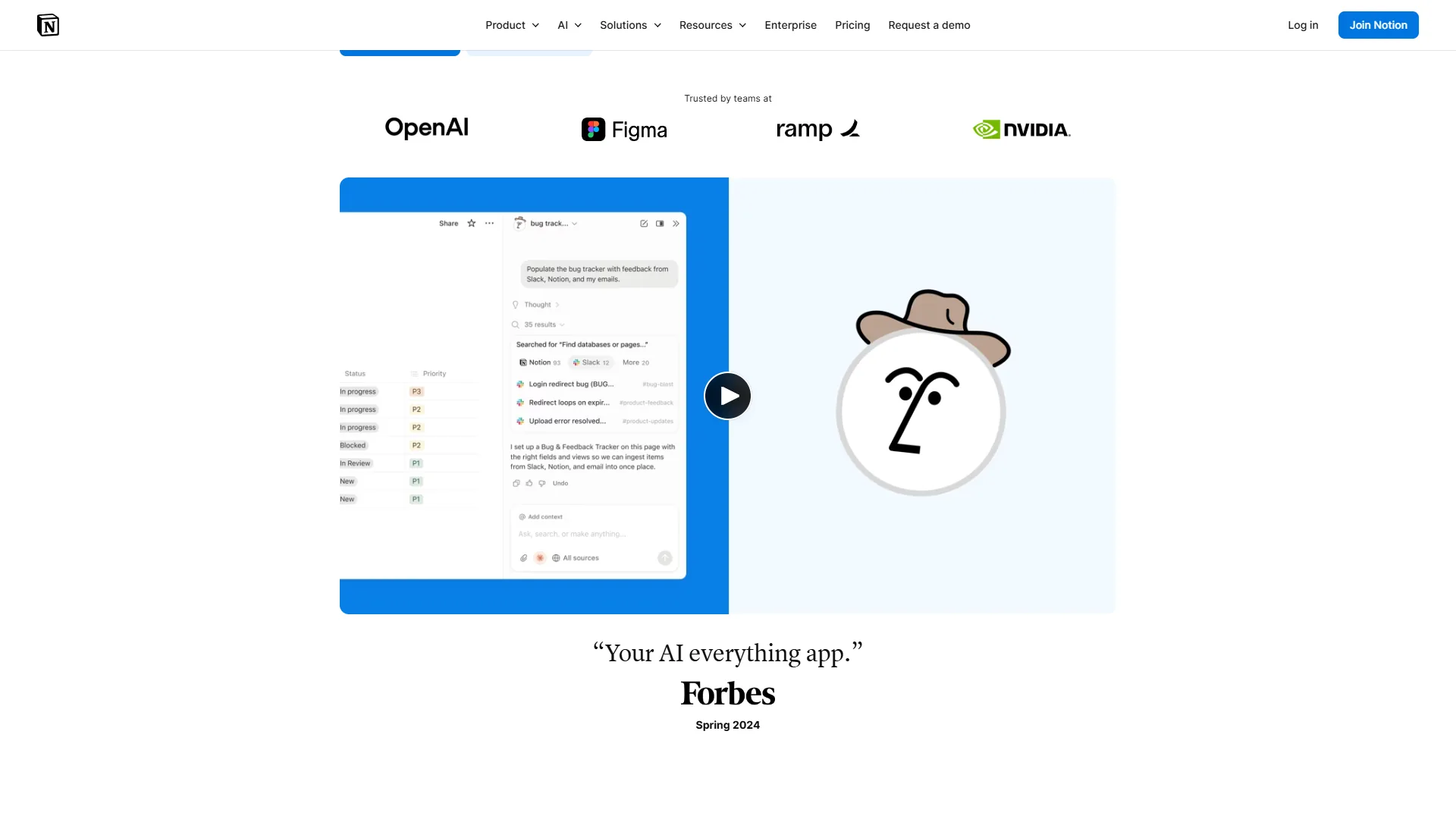
Real-World ROI: Notion’s published case studies back up the productivity claims. Osaka Gas (3,000 employees) reported a 35% reduction in time spent searching for information after consolidating into Notion. Remote.com handles 300 daily AI queries, saving roughly 10 minutes per search. For a team of 10 paying $15/seat/month ($150 per month total), saving 5 hours weekly at $50/hour represents $1,000/month in recovered productivity - a 6.7x return.
Who Should Choose Notion: content teams (each record doubles as a brief), startups under 50 people (one platform replaces docs, wiki, PM, DB), knowledge workers, freelancers (generous free tier), and students (free Plus on .edu).
Limitations: performance degrades past roughly 10,000 records; no foreign keys or referential integrity; AI requires Business plan; mobile lags desktop; advanced features (relations, rollups, formulas) have a steeper learning curve than expected.
Onboarding Time: 2-3 weeks for a team to feel comfortable; individuals are productive within a few days.
2. Airtable: The No-Code Database Powerhouse
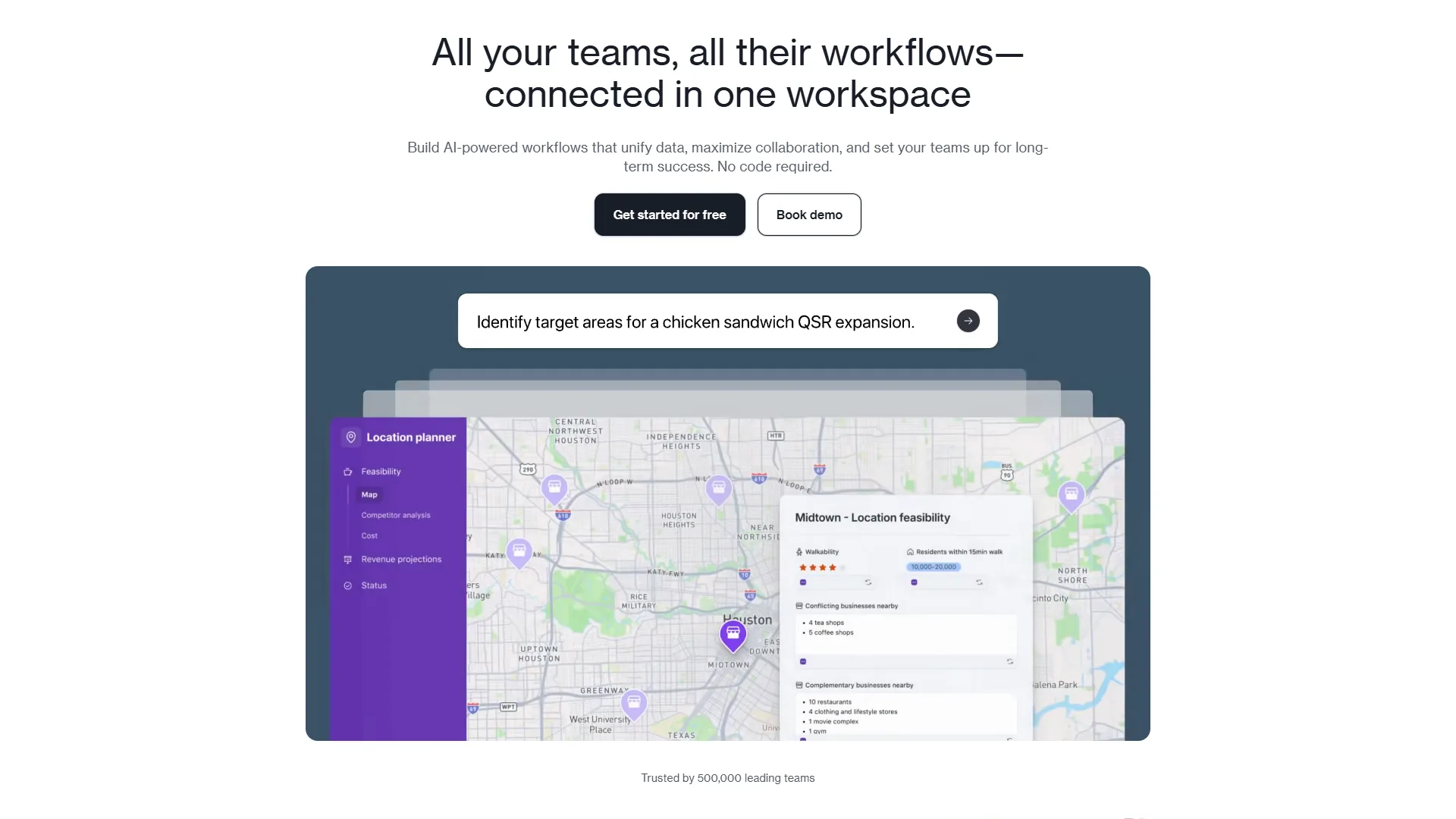
Airtable is a spreadsheet with proper database DNA - the Airtable platform documentation shows familiar rows, columns, and cells, but underneath it supports linked records, rich field types (attachments, checkboxes, barcodes, formulas), and a view system that displays the same data as a grid, kanban, calendar, gallery, or Gantt chart.
Airtable pulls ahead of Notion in structured data: true relational linking between tables, 50,000-record limits on the Team plan (vs Notion’s ~10K performance ceiling), and a powerful automation builder that triggers on data events.
Pricing (February 2026):
| Plan | Monthly | Annual (per month) | Records/Base | Automation Runs |
|---|---|---|---|---|
| Free | $0 | $0 | 1,000 | 100/month |
| Team | $24/seat | $20/seat | 50,000 | 25,000/month |
| Business | $54/seat | $45/seat | 125,000 | 100,000/month |
| Enterprise Scale | Custom | Custom | 500,000 | 500,000/month |
Airtable costs more per seat than Notion - the jump from Free (1,000 records) to Team ($20/seat) is the biggest friction point.
Key AI Database Features: AI fields (categorize, summarize, translate, or extract from other fields - see the Airtable vs Coda deep dive); AI-powered automations (auto-route tickets via sentiment analysis); Interface Designer with AI for custom apps; 200+ third-party AI integrations via the Extensions marketplace; plain-English formula assistant.
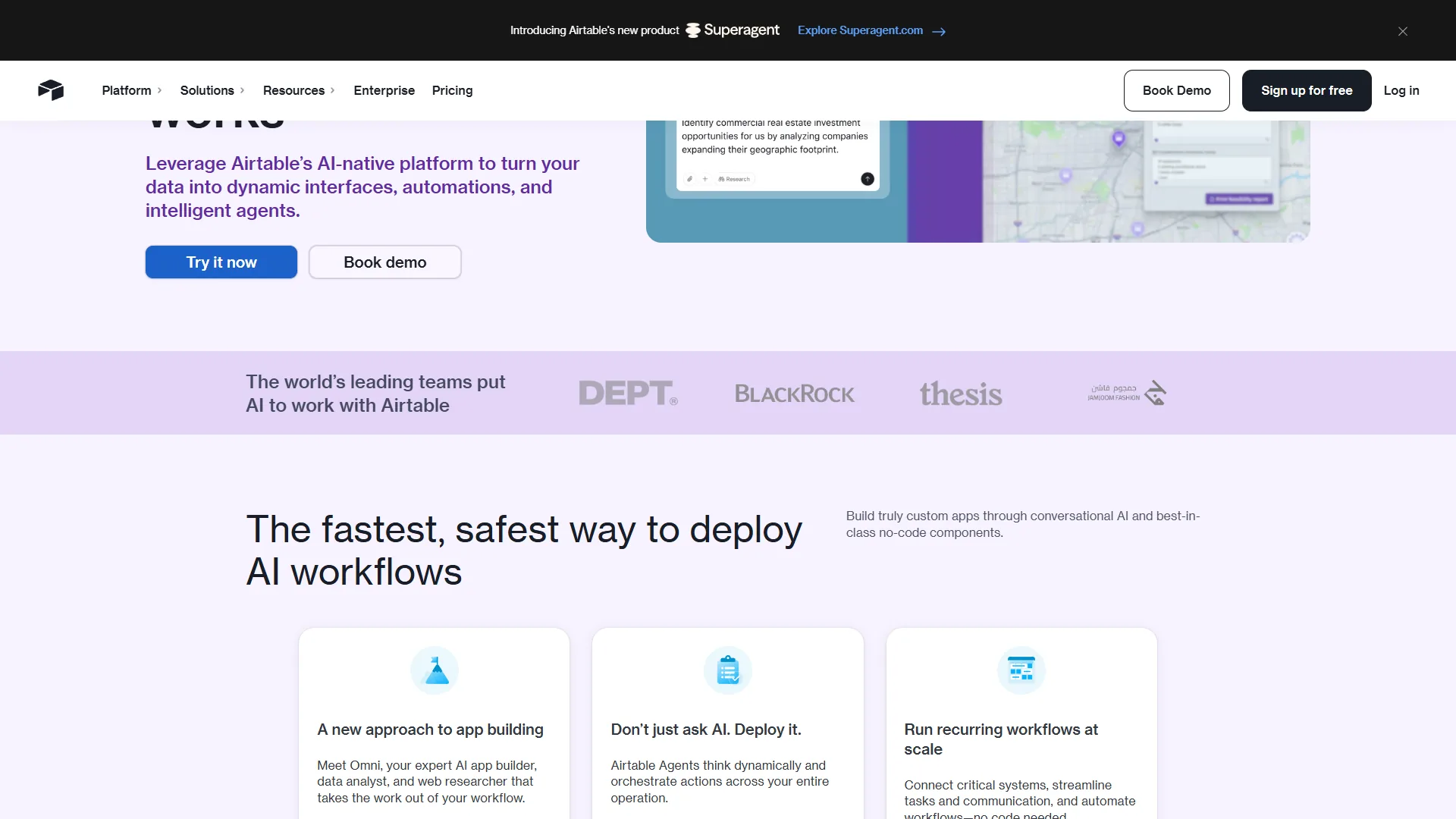
Real-World ROI: Red Bull achieved 70-80% time savings in media planning using Airtable, documented in Airtable’s customer stories. eBay reduced issue resolution from 9 months to days. Code and Theory (1,000 employees) reported saving over 10,000 hours annually. For a 5-person team at $20/seat/month, saving 5 hours per week at $50/hour equals $1,000/month - a 10x return.
Who Should Choose Airtable: operations managers (automations replace engineering), marketing teams (content calendars with AI tagging), sales teams (lightweight CRM with AI enrichment), product managers (linked feature trackers), and agencies (client portals via Interface Designer).
Limitations: free tier capped at 1,000 records; per-seat pricing climbs fast ($20-45); AI usage limits on lower tiers; no native document editing; sync integrations require Business plan; complex formulas rival Excel in difficulty.
Onboarding Time: 1-2 weeks for basics; add 2-3 weeks for linked tables, automations, and custom interfaces.
Feature-by-Feature: Notion vs Airtable
Notion is the winner on content management and knowledge base, Airtable is the winner on CRM and data analysis, and the two tie on project management - choice depends on your primary use case.
Content Management
Notion is the winner. Notion’s page-as-record model suits content workflows - each database entry contains a full draft, embedded images, task checklists, and linked references. AI Agents auto-generate content briefs from a topic title, and the multi-view system shows your pipeline as a kanban or calendar. Airtable tracks content metadata effectively but content creation happens elsewhere - the airtable vs notion databases deep dive walks through this trade-off.
CRM and Sales Pipelines
Airtable is the winner. Airtable’s relational linking, automations, and Interface Designer make it a lightweight CRM that rivals dedicated tools for small teams. AI fields auto-score leads based on engagement signals. Notion builds a basic CRM but lacks the automation depth - dedicated platforms in the best CRM software 2026 roundup outperform both.
Project Management
The two tie. Notion wins for small teams that want project management and documentation in one place; Airtable wins for teams managing hundreds of tasks with complex dependencies and automated status updates.
Data Analysis and Reporting
Airtable is the winner. Airtable’s pivot tables, summary fields, and chart extensions give it a clear edge - dashboards build directly from your database with real-time visual summaries. Notion’s analytics are limited to basic views and sorting; reporting requires exporting to another tool.
Knowledge Base
Notion is the winner. Notion was built for knowledge management - nested pages, wiki-style linking, full-text search across all databases, and AI Q&A make it the default choice for team wikis. The best AI documentation tools 2026 roundup covers dedicated alternatives. Airtable stores knowledge in long-text fields but discovery is far less intuitive.
Pricing Comparison: What Will You Actually Pay
Notion Plus costs a 5-person team roughly $75 per month, Airtable Team costs that same team about $100 per month, and at 50 seats those numbers rise to $750 (Notion Business) versus $1,000 (Airtable Team) - all on annual billing. Real teams pay more than pricing pages suggest once they factor in the features they actually need:
| Scenario | Notion Cost | Airtable Cost | Notes |
|---|---|---|---|
| Solo freelancer | $0 (Free) | $0 (Free) | Notion’s free tier is more useful (unlimited pages vs 1,000 records) |
| 5-person startup | $75/mo (Plus) | $100/mo (Team) | Notion if you need docs+DB; Airtable if automation matters |
| 5-person team with AI | $90/mo (Business) | $100/mo (Team) | Notion Business for AI Agents; Airtable includes AI on all plans |
| 20-person team | $300/mo (Business) | $400/mo (Team) | Cost gap widens with team size |
| 50-person org | $750/mo (Business) | $1,000/mo (Team) | Enterprise negotiation recommended at this scale |
Monthly billing adds 20-30%. Hidden costs: Notion AI requires Business ($15 vs $10); Airtable forces an upgrade past 1,000 records, and sync sits behind Business ($45). Budget 20-40 hours for setup, training, and migration.
What About Other AI Database Tools?
Other AI database tools worth knowing are Supabase and Baserow for self-hosted or developer needs, Stackby and Retool for budget-friendly or internal-tool builds, and Pinecone for AI applications - each fits a specific niche rather than general use:
- Supabase - Open-source PostgreSQL platform with row-level security; not a no-code tool.
- Baserow - Open-source Airtable alternative with self-hosting; suits privacy-sensitive teams.
- Stackby - Budget-friendly Airtable competitor with built-in API connectors.
- Retool - Low-code internal-tool builder that pairs with Notion or Airtable as the data layer.
- Chat2DB - AI-powered SQL client for traditional databases.
- Pinecone - Vector database for teams building AI products.
For most teams searching for the best AI database tools 2026 or database AI tools free of charge, Notion and Airtable remain the most versatile starting points.
Security and Compliance
Notion and Airtable both offer SOC 2 Type II, GDPR, AES-256 at rest, and 2FA on all plans, but SSO sits behind Business and HIPAA is Enterprise-only - which matters when your database holds client data, financial records, or PII.
| Feature | Notion | Airtable |
|---|---|---|
| SOC 2 Type II | Yes | Yes |
| GDPR Compliant | Yes | Yes |
| HIPAA | Enterprise only (BAA available) | Enterprise only (BAA available) |
| SSO (SAML) | Business plan and up | Business plan and up |
| Audit Logs | Enterprise only | Enterprise only |
| Data Encryption | AES-256 at rest, TLS in transit | AES-256 at rest, TLS in transit |
| 2FA | Yes (all plans) | Yes (all plans) |
| Data Residency | US (EU available on Enterprise) | US (EU available on Enterprise) |
Both meet baseline enterprise security - the best knowledge management tools guide covers adjacent trade-offs. For strict data sovereignty, Baserow or Supabase (self-hosted) give more control. Compare against the broader best AI productivity tools field if security is your primary filter.
Integration Ecosystem
Notion offers 100+ native integrations and wins for knowledge integrations, while Airtable offers 50+ native sync integrations plus 200+ Extensions and wins for operational integrations.
Notion: 100+ native integrations (Slack, Google Drive, GitHub, Figma, Jira, Zapier). AI Agents pull context from connected apps.
Airtable: 50+ sync integrations (Salesforce, Google Calendar, Jira, Box) plus the Extensions marketplace. Robust Zapier, Make, and n8n support; RESTful API with webhooks.
Shared limitation: native sync is gated to higher tiers, so cross-tool data flow at scale means paying for Business.
Frequently Asked Questions
FAQs about AI database tools are answered below - whether Notion or Airtable replaces a traditional database, how their AI handles existing data, migration between the two, mobile apps, required skills, and free-tier limits.
Can Notion or Airtable replace a traditional database like MySQL or PostgreSQL?
No - both tools are designed for team collaboration and operational data, not application backends, high-throughput transactional processing, or datasets with millions of records. For a production database, look at Supabase or a managed cloud database.
How do AI features work with my existing data?
Both platforms analyze data within your workspace only. Notion’s AI reads pages and databases you grant access to; Airtable’s AI fields process data within the same table. Neither tool sends your data to train external models, and both offer opt-out provisions.
Can I migrate between Notion and Airtable?
Yes, but manually. Airtable exports to CSV, which Notion imports as a database, and Notion exports to CSV or Markdown. Budget 4-8 hours to rebuild views, automations, and linked records for a database with 1,000+ records.
Which tool has better mobile apps?
Airtable wins on mobile - filter, sort, edit records, and even run automations. Notion’s mobile app handles viewing and quick edits but struggles with complex database interactions.
Do I need technical skills to use these tools?
No coding required for either platform - both use visual interfaces. Advanced features (Notion formulas, Airtable scripting) benefit from technical comfort; basic-use learning curve is about a week.
What happens when I hit the free tier limits?
Notion’s free tier is generous for individuals (unlimited pages) but restricts team features. Airtable’s free tier caps at 1,000 records per base - most real projects outgrow this within the first month, and the jump to $20/seat is steeper than Notion’s $10.
The Bottom Line on Best AI Database Tools in 2026
The best AI database tools 2026 are Notion for document-centric teams and Airtable for structured operational data - both deliver real AI features (agents, autofill, natural language queries) rather than storage alone.
Choose Notion if your work revolves around documents and knowledge - AI Agents, multi-model access, and the page-as-record model suit content teams, startups, and knowledge-heavy workflows. Business ($15/seat/month annual) is the sweet spot for AI.
Choose Airtable for structured, scalable databases with powerful automation - relational linking, Interface Designer, and 50,000+ record capacity suit operations, sales, marketing, and project management. Team ($20/seat/month annual) covers most needs.
Both tools offer free tiers. Build one database, use it for two weeks, and measure time saved - ROI data suggests 5-10x returns within the first quarter.
Disclosure: AI Productivity may earn a commission from links on this page. Our rankings and recommendations are editorially independent and based on research, not sponsored placement.
Related Reading
Related guides include AI database tools, automation, the AI chatbot 2026 landscape, and project management - links below provide further reading.
- Notion Review - Full review of the all-in-one workspace with AI-powered databases
- Airtable Review - Full review of the no-code database and automation platform
- Airtable vs Notion Databases 2026 - Detailed head-to-head comparison of database features
- Best AI Spreadsheet Tools 2026 - When a spreadsheet is the better fit for your data
- Best AI Automation Tools 2026 - Automate workflows between your database and other tools
- Best AI Project Management Tools 2026 - Project management platforms with database features
- Zapier - Automation platform for connecting databases to 7,000+ apps
- Make - Visual workflow builder for database automation
- How to Automate Invoicing with AI: Complete Guide for 2026
External Resources
Primary sources for this comparison include vendor documentation from Notion and Airtable plus independent research from McKinsey on generative AI productivity.
- Notion AI Product Page - Official overview of Notion’s AI features and agent capabilities
- Airtable AI Features - Official documentation on Airtable’s AI field types and automation
- McKinsey: Economic Potential of Generative AI - Research on AI productivity gains across industries