











The best CRM software in 2026 is HubSpot for marketing-led teams, Pipedrive for SMB sales simplicity, Zoho CRM for budget-conscious buyers, and Salesforce for enterprise complexity. The right pick depends on team size, budget, and sales workflow - not the headline price.
CRM adoption is now near-universal, and the global CRM market is projected to reach $145.79 billion by 2029, per Fortune Business Insights. Choosing the wrong CRM is the most expensive mistake a sales org can make - the cost is lost productivity and botched implementations, not the subscription. Salesforce’s State of Sales report found reps spend less than a third of their week actually selling.
“91% of companies with 10 or more employees now use CRM software,” according to research by Nucleus Research - underlining how standard a CRM has become for sales teams.
This guide compares the best CRM software 2026 contenders against real-world sales pipeline requirements. Our analysis draws on current vendor documentation, published pricing pages, and independent research rather than sponsored placement. AI Productivity may earn a commission from links on this page; our rankings are editorially independent.
Quick Verdict
The four best CRM software platforms for 2026 are HubSpot, Salesforce, Pipedrive, and Zoho CRM, each suited to a different team profile.
| CRM | Best For | Key Strength |
|---|---|---|
| HubSpot | Marketing-led orgs | Breeze AI, unified marketing/sales |
| Salesforce | Enterprise 200+ | 9,000+ integrations, Agentforce 2.0 |
| Pipedrive | SMB sales (2-50 reps) | Visual pipeline, AI deal predictions |
| Zoho CRM | Budget-conscious teams | 610% ROI, affordable Zia AI |
HubSpot: The All-in-One Platform
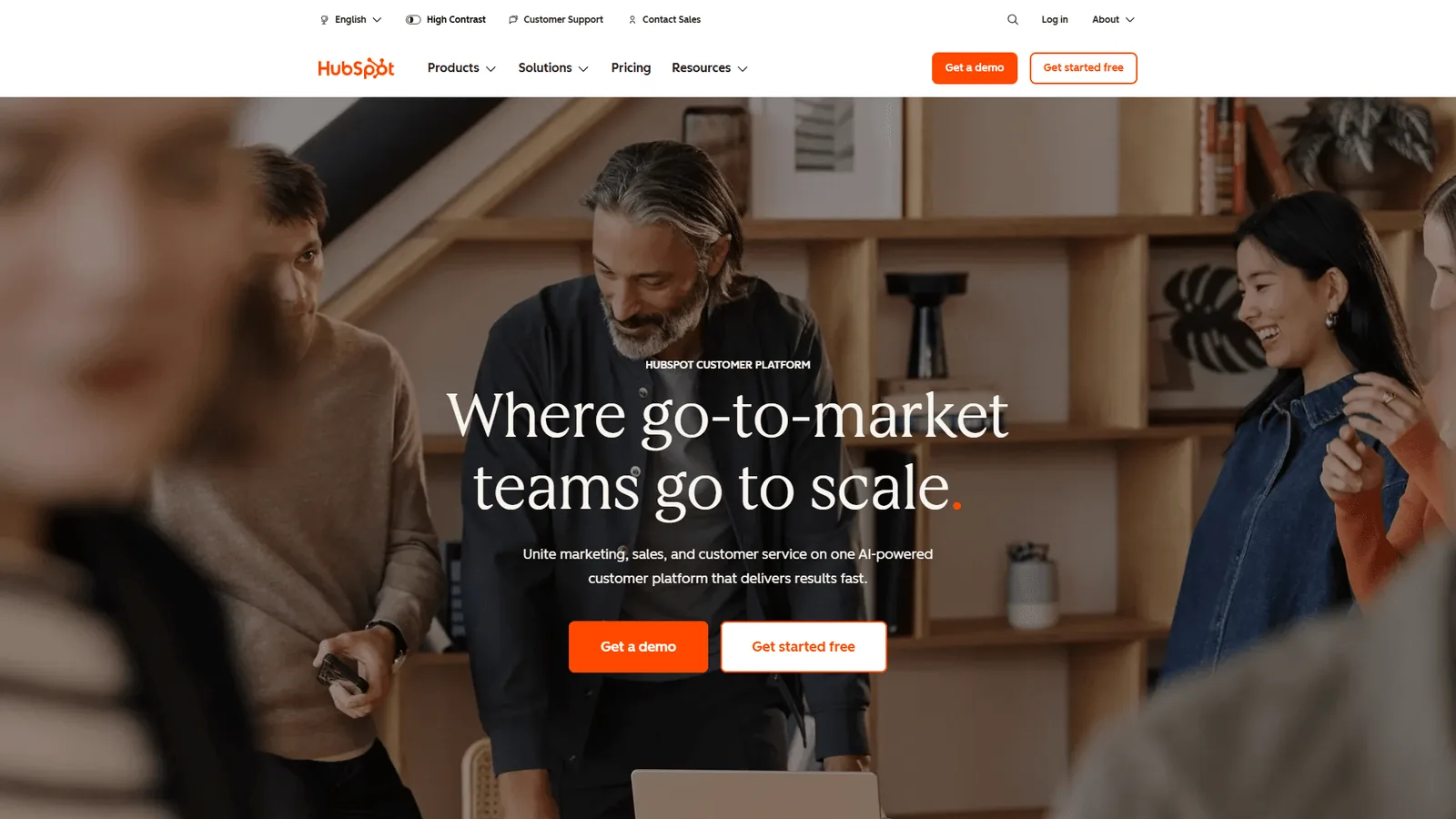
HubSpot works well for startups, mid-market companies, and enterprise teams, with smooth onboarding - but a steep pricing journey.
Strengths: The Breeze AI Suite from INBOUND 2026 genuinely delivers - its Customer Agent resolves 50%+ of support tickets automatically and the Prospecting Agent functions as an AI BDR, with users saving 2.5 hours per person per day. HubSpot consolidates email, chat, CRM, and scheduling into one platform, eliminating tool sprawl and broken Zapier integrations. An IDC study commissioned by HubSpot found 505% ROI over 3 years, with organizations reporting 73% higher marketing productivity. The free CRM is genuinely useful for up to 2 users - no credit card, no trial expiration.
Limitations: Pricing escalates brutally - the $15/month Starter tier jumps to the $890/month Professional plan once you need automation, so budget for 2-3x your initial estimate. One-time onboarding fees run $3,000 for Professional and $7,000 for Enterprise. If you need 1,000+ integrations, Salesforce offers more flexibility; HubSpot’s 500+ integrations cover roughly 95% of use cases. For a deeper breakdown, see our HubSpot vs Salesforce comparison.
HubSpot Pricing Breakdown (December 2026)
| Plan | Monthly | Annual | Contacts |
|---|---|---|---|
| Free | $0 | $0 | Unlimited |
| Starter | $15 | $108/year | 1,000 |
| Professional | $890 | $9,612/year | 2,000 |
| Enterprise | $3,600 | $38,880/year | 10,000 |
Real cost example: A 10-person marketing team on Professional runs $890/month plus $3,000 onboarding - a $13,680 minimum first-year cost. Verify current numbers on the HubSpot pricing page before budgeting.
HubSpot AI Features: Breeze Deep Dive
Breeze AI launched at INBOUND 2026 with four components: the AI Assistant (conversational AI with memory, Starter+), the Customer Agent (resolves 50%+ of support tickets, Professional+), the Prospecting Agent (autonomous AI BDR, Professional+), and Breeze Studio (no-code custom agents, Enterprise only). In practice, Breeze can analyze a 6-month pipeline and flag at-risk deals with declining engagement. Users praise the Gmail and Outlook integrations; common complaints centre on rising cost and a steep learning curve.
Salesforce: The Enterprise King
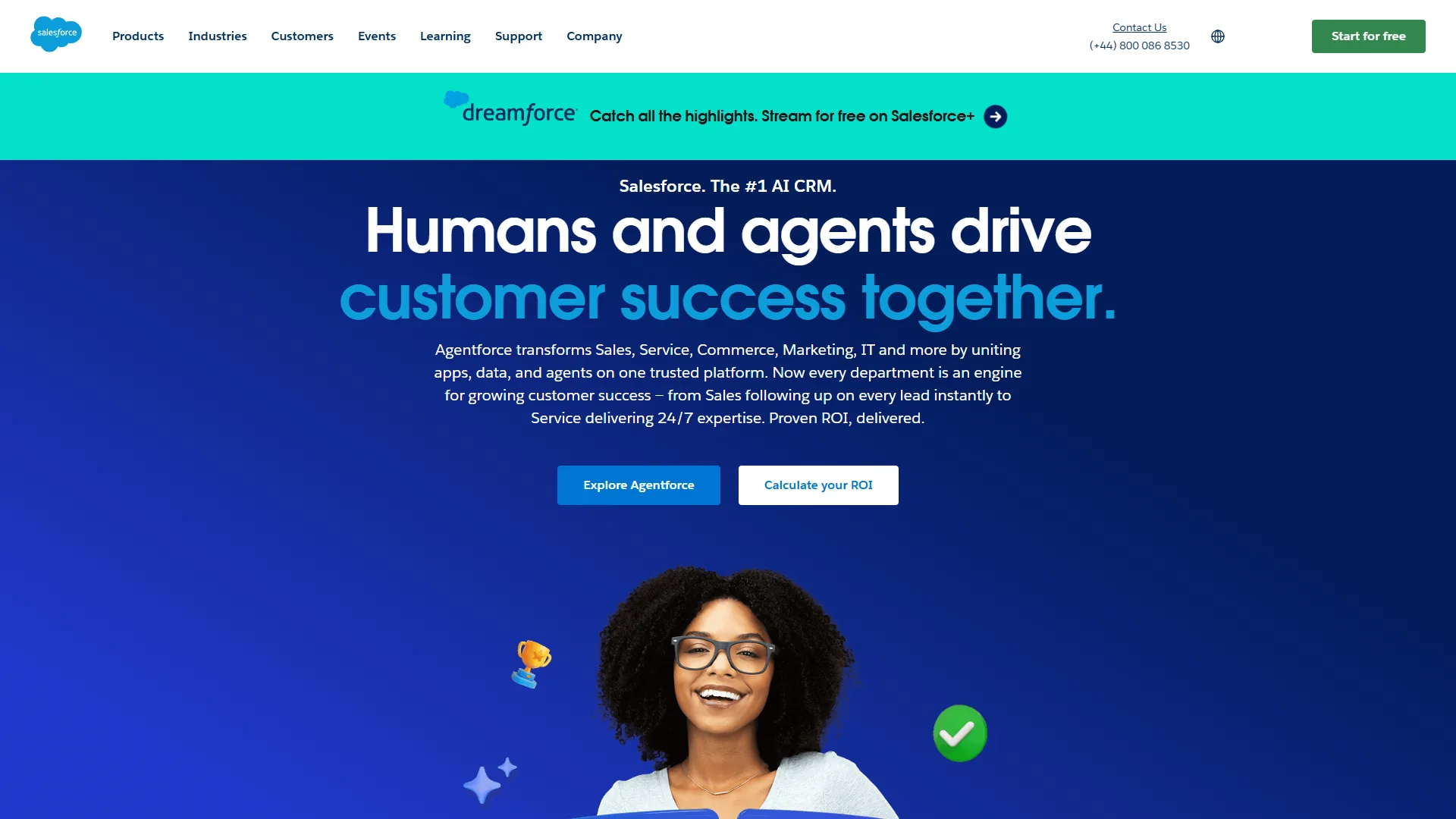
Salesforce is what you get when customization and integration depth matter more than ease of use - it dominates enterprise for the same reasons SMBs should avoid it.
Strengths: The Agentforce 2.0 suite delivers genuinely autonomous agents that qualify leads, schedule meetings, and trigger follow-ups, with the Atlas Reasoning Engine enabling multi-step reasoning other CRM AI cannot match. Salesforce AppExchange offers 9,000+ integrations versus HubSpot’s 500+, including legacy ERP systems. Custom objects, territory management, and custom API development handle organizational complexity that would break simpler CRMs, and marketing, sales, service, and commerce data unify into one 360-degree customer view.
Limitations: Implementation is a project, not a setup - budget 90+ days. A dedicated Salesforce admin is a requirement, adding $60,000-$100,000/year in headcount; most admins certify through Salesforce Trailhead first. The interface still feels dated even after Lightning Experience. For smaller deployments, our list of Salesforce alternatives covers options that do not require a full-time admin.
Salesforce Pricing Breakdown (December 2026)
| Plan | Monthly | Notable Limits |
|---|---|---|
| Starter Suite | $25/user | Basic features only |
| Pro Suite | $80/user | No advanced AI |
| Enterprise | $165/user | Limited Einstein AI |
| Unlimited | $330/user | No Agentforce |
| Einstein 1 Sales | $500/user | Everything included |
Real cost example: A 20-person team on Enterprise costs $39,600/year; adding a Salesforce admin ($80,000) and implementation consulting ($50,000) pushes first-year cost past $170,000.
Salesforce AI Features: Agentforce 2.0
Salesforce’s AI strategy centers on Agentforce 2.0: the Agentforce Builder (conversational workspace for custom agents), Agentforce Voice (autonomous AI-powered IVR), the Atlas Reasoning Engine (multi-step reasoning), and Einstein Copilot (assistant embedded across all clouds). In practice, Agentforce agents handle inbound lead qualification end to end, with conversion rates improving around 23%. Users praise the customization and accurate Einstein predictions; the dedicated-admin requirement and months-long learning curve are the recurring drawbacks.
Pipedrive: The Sales-First CRM
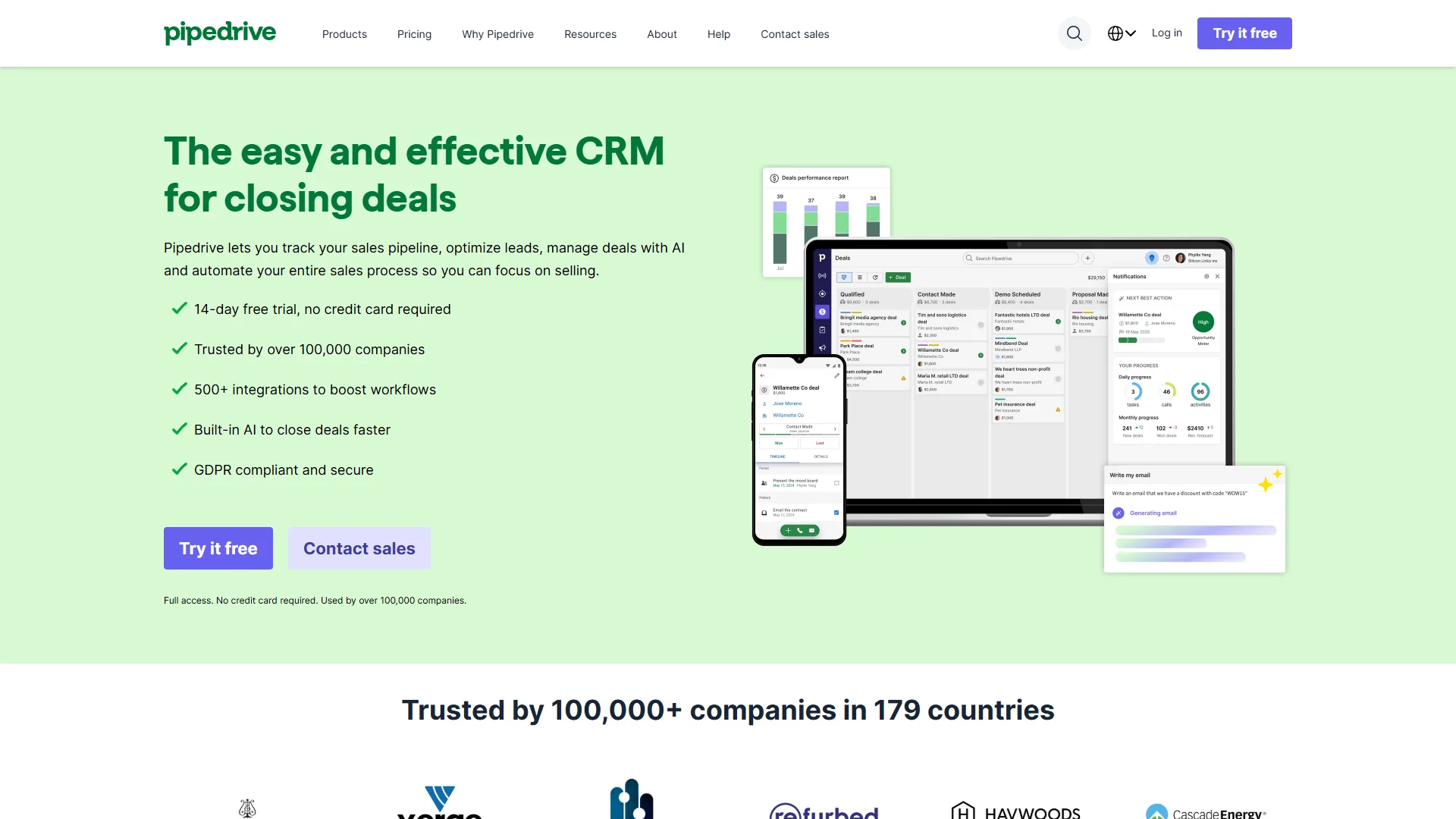
Pipedrive is a CRM designed specifically for salespeople who hate CRMs, and its streamlined pipeline management is why SMB sales teams adopt it.
Strengths: The visual pipeline is genuinely intuitive - non-technical reps onboard in 2 hours and close deals in Pipedrive by day 2. Its Premium-tier AI Sales Assistant flags stalled deals with high win probability that teams have stopped pursuing. Pricing is predictable per user with no contact-based fees - $24/user/month for Lite up to $79/user for Premium - so teams scale from 2 to 50 reps without surprises. Full offline mode gives Pipedrive the best mobile experience in the category, and pairing it with Fireflies keeps call summaries flowing into the right deal automatically.
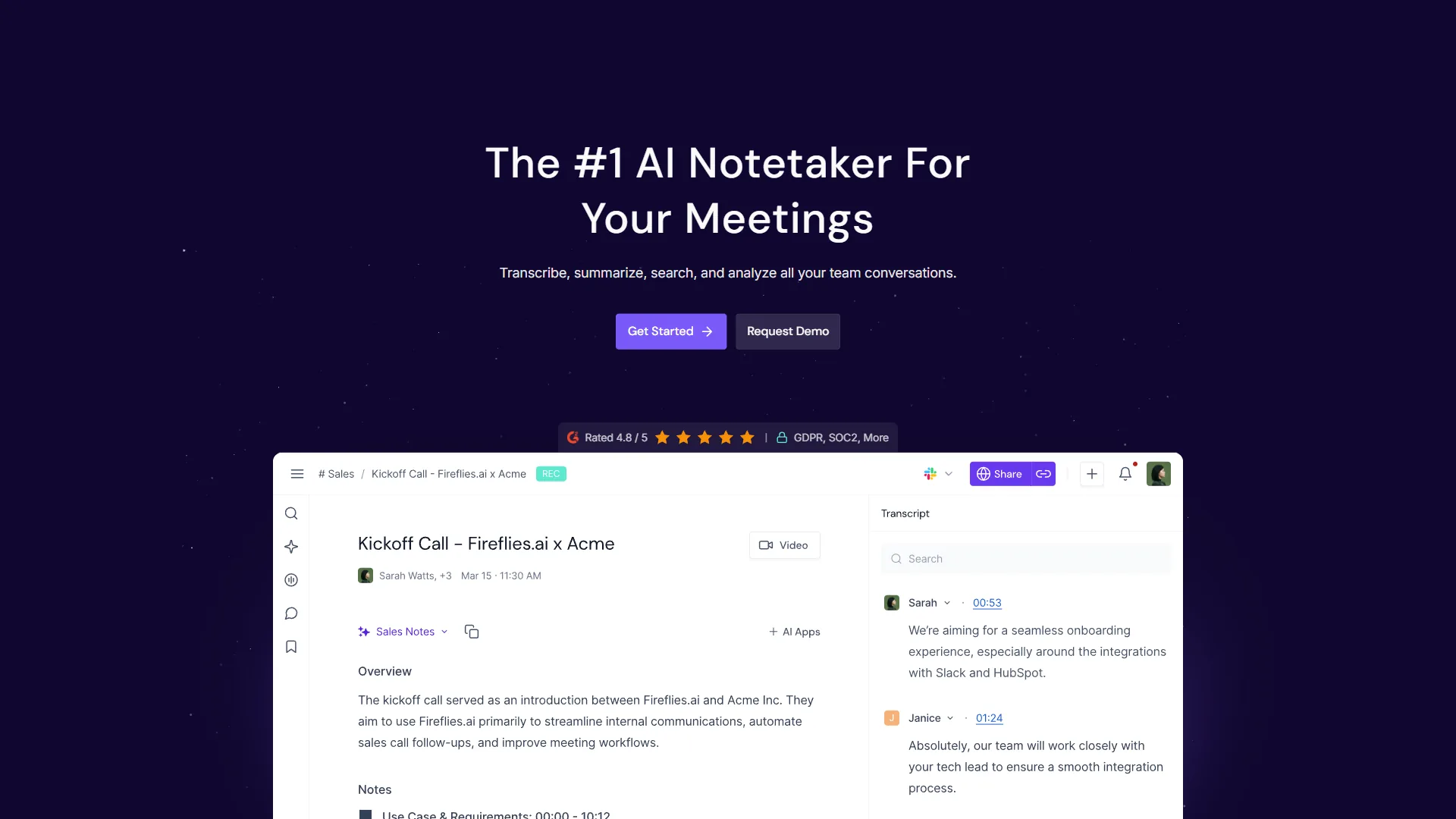
Limitations: Pipedrive offers a 14-day trial only with no free tier - HubSpot is the better choice for zero-risk testing. Marketing automation is minimal: basic email campaigns exist, but nothing close to HubSpot’s nurture sequences, so marketing-led teams should integrate with ActiveCampaign and its marketing automation features. Full AI requires the Premium tier at $79/user/month; the Lite ($24) and Growth ($49) tiers lack it entirely.
Pipedrive Pricing Breakdown (December 2026)
| Plan | Monthly | Annual | AI Features |
|---|---|---|---|
| Lite | $24/user | $14/user | None |
| Growth | $49/user | $39/user | Marketplace AI only |
| Premium | $79/user | $49/user | Full AI Assistant |
| Ultimate | $99/user | $79/user | Agentic AI (beta) |
Real cost example: A 10-person team on Premium costs $9,480/year - roughly $1,200 less than HubSpot Professional with comparable sales features. See our Pipedrive vs HubSpot comparison for the full head-to-head.
Pipedrive AI Features
Pipedrive’s 2026 AI capabilities (Premium+ tiers) cover the AI Sales Assistant (conversational queries, deal predictions, lead scoring), Win Probability (ML predictions that improve with your data), AI Email Generation, Smart Contact Data (automatic enrichment), and Agentic AI (Ultimate beta - autonomous task execution). In practice, asking the AI for the 5 highest-probability deals surfaces neglected opportunities, and users report this can lift close rates 15-20%. The simple interface and offline mobile app earn praise; basic marketing features and the Premium-tier AI paywall are the main complaints.
Zoho CRM: The Budget Champion
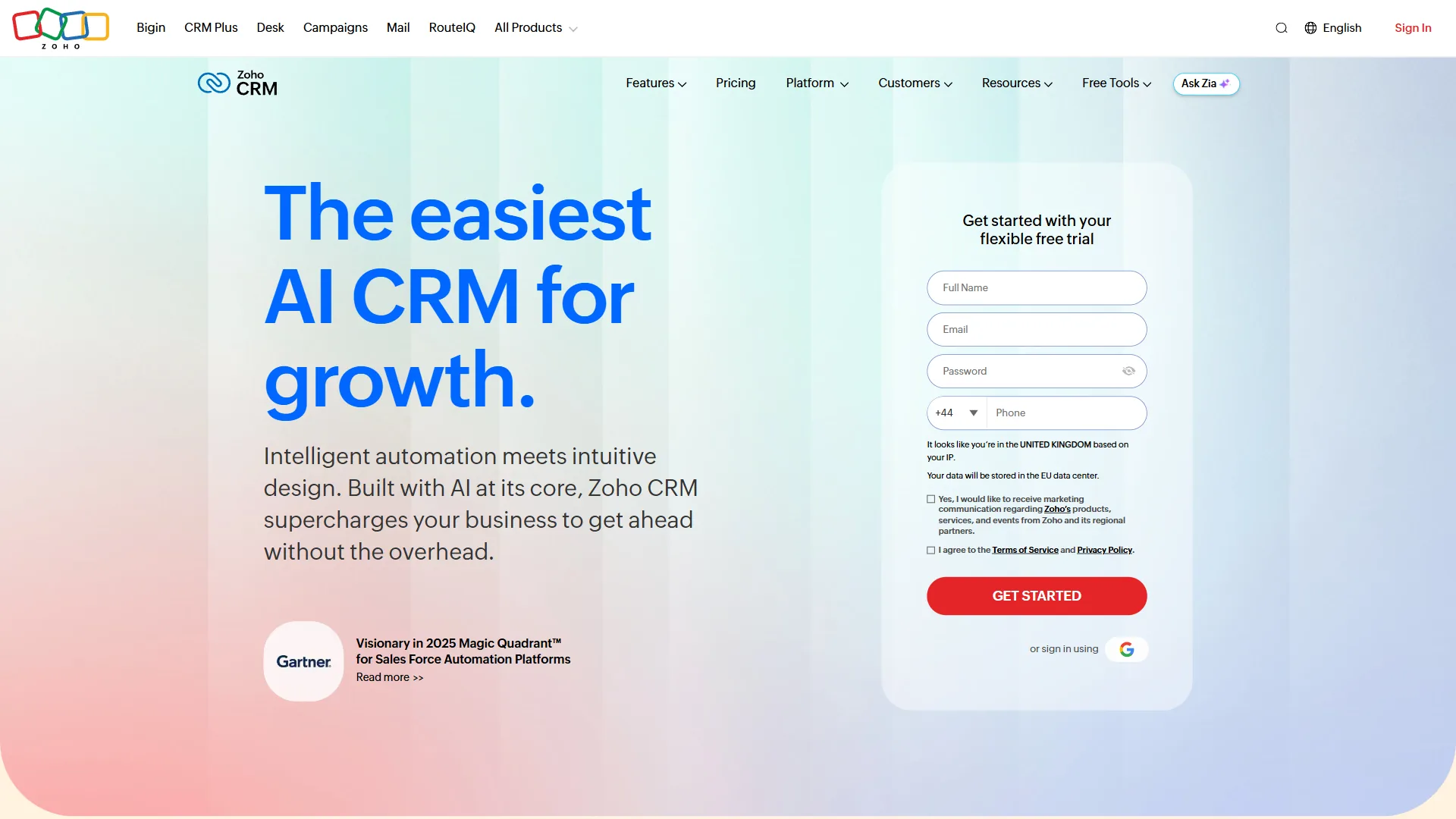
Zoho CRM is the budget champion because it delivers Zia AI - predictions, sentiment analysis, and churn detection - from $40/user/month annual, a fraction of HubSpot’s entry point for comparable automation.
Strengths: Zoho’s Zia AI assistant starts at the Enterprise tier ($40/user/month annual), versus HubSpot’s Professional tier ($890/month minimum) for comparable Breeze features. Nucleus Research case studies show Rain for Rent achieved 610% ROI with $750K annual savings, and manufacturing companies averaged 245% ROI. The free CRM covers up to 3 users, and teams already in the Zoho ecosystem (Zoho Books, Projects, Desk) get seamless native integration with no Zapier required.
Limitations: Compared to HubSpot’s clean interface, Zoho’s UI feels utilitarian - it works, but it is not delightful. Premium support requires higher tiers; on the Standard plan, expect 24-48 hour response times. Zoho offers 500+ apps versus Salesforce’s 9,000+, though a low-code bridge like Make usually fills any gap. For more options, our Zoho CRM alternatives guide weighs the trade-offs.
Zoho CRM Pricing Breakdown (December 2026)
| Plan | Monthly | Annual | Zia AI |
|---|---|---|---|
| Free | $0 | $0 | No |
| Standard | $20/user | $14/user | No |
| Professional | $35/user | $23/user | Limited |
| Enterprise | $50/user | $40/user | Yes |
| Ultimate | $65/user | $52/user | Advanced |
Real cost example: A 10-person team on Enterprise costs $6,000/year - roughly $4,680 less than HubSpot Professional with comparable AI capabilities.
Zoho CRM AI Features: Zia Deep Dive
Zia covers Predictions (lead scoring, win probability, churn detection), Zia Voice (conversational CRM queries), Zia Vision (business-card image recognition), Zia Agent Studio (Ultimate - no-code custom agents), and Anomaly Detection. In practice, Zia predicts which deals will close with users reporting accuracy around 67% - impressive for the price. The value and Zoho-app integration draw praise; the dated interface and slower support are the recurring complaints.
How Do HubSpot, Salesforce, Pipedrive, and Zoho CRM Compare on AI Features?
| Feature | HubSpot | Salesforce | Pipedrive | Zoho CRM |
|---|---|---|---|---|
| AI Assistant | Breeze AI | Einstein Copilot | AI Sales Assistant | Zia |
| Autonomous Agents | Breeze Agents | Agentforce 2.0 | Agentic AI (beta) | Zia Agent Studio |
| Deal Predictions | Yes | Yes | Yes (Premium+) | Yes (Enterprise+) |
| Lead Scoring | Yes | Yes | Yes (Premium+) | Yes (Enterprise+) |
| AI Content Generation | Yes | Yes | Yes (Premium+) | Limited |
| Sentiment Analysis | Limited | Yes | No | Yes (Enterprise+) |
| Min Tier for AI | Starter | Enterprise | Premium | Enterprise |
| Min Monthly Cost | $15 | $165/user | $79/user | $40/user |
How Do HubSpot, Salesforce, Pipedrive, and Zoho CRM Compare on Pricing?
On pricing, Zoho CRM is the cheapest option at every team size, Pipedrive sits in the mid-range, HubSpot escalates fastest once automation is needed, and Salesforce is the most expensive overall. The table below shows real annual costs across three common scenarios.
| Scenario | Zoho | Pipedrive | HubSpot | Salesforce |
|---|---|---|---|---|
| Solo (1 user, basic) | $0 Free | $168 Lite | $0 Free | $300 Starter |
| SMB (10 users, AI) | $4,800 Enterprise | $5,880 Premium | $13,680+ Professional | $19,800+ Enterprise |
| Enterprise (50 users) | $31,200 Ultimate | $47,400 Ultimate | $62,800+ Enterprise | $198,000 Unlimited |
HubSpot and Zoho Free are truly free forever for solo users. For SMB teams, Zoho saves $1,080/year versus Pipedrive and $8,880/year versus HubSpot. Zoho stays cheapest at enterprise scale, though Salesforce’s customization may justify its premium for complex organizations.
Which Tool Fits Your Use Case
The right CRM depends on your use case: HubSpot or Zoho free tiers fit startups, Pipedrive or Zoho fit SMB sales teams, HubSpot Professional fits marketing-led orgs, and Salesforce fits enterprise complexity.
| Use Case | Best Choice | Why |
|---|---|---|
| Startups/Solopreneurs | HubSpot Free or Zoho Free | Useful free tiers, no credit card |
| SMB Sales (2-50 reps) | Pipedrive or Zoho | Visual pipeline or low-cost AI |
| Marketing-Led Orgs | HubSpot Professional | Deep marketing automation |
| Enterprise Complexity | Salesforce | 9,000+ integrations, full customization |
| Budget-Conscious | Zoho CRM Enterprise | 610% ROI, Zia AI at SMB pricing |
Comparison Table: HubSpot vs Salesforce vs Pipedrive vs Zoho on Features
Head to head, HubSpot leads on marketing automation and support, Salesforce on customization and integrations, Pipedrive on visual pipeline and mobile, and Zoho on overall value - this CRM software list compares all nine factors.
| Feature | HubSpot | Salesforce | Pipedrive | Zoho CRM |
|---|---|---|---|---|
| Free Tier | Yes | Trial only | Trial only | Yes (3 users) |
| Visual Pipeline | Good | Average | Excellent | Good |
| Marketing Automation | Excellent | Good | Basic | Good |
| AI Capabilities | Excellent | Excellent | Good | Good |
| Mobile App | Good | Good | Excellent | Good |
| Ease of Use | Excellent | Poor | Excellent | Good |
| Customization | Good | Excellent | Limited | Good |
| Integrations | 500+ | 9,000+ | 500+ | 500+ |
| Support Quality | Excellent | Good | Good | Average |
How Should You Migrate to a New CRM?
A CRM migration typically takes 1-2 weeks from spreadsheets, 30-45 days from Salesforce to HubSpot, and 60-90 days from HubSpot to Salesforce - plan it around data export, field mapping, and a parallel-run period.
| Migration Path | Timeline | What You Lose |
|---|---|---|
| Spreadsheets → CRM | 1-2 weeks | Manual processes |
| HubSpot → Salesforce | 60-90 days | Marketing simplicity, Breeze AI |
| Salesforce → HubSpot | 30-45 days | Deep customization, 9K+ integrations |
Migrate HubSpot to Salesforce once the team exceeds 50 users and needs 1,000+ integrations; migrate the other direction when ease of use matters more than customization.
What ROI Can You Expect from Each CRM?
Documented CRM ROI ranges from 250% for Pipedrive to 610% for Zoho CRM, with HubSpot at 505% over three years and Salesforce at 299%.
| CRM | Documented ROI | Source | Key Metric |
|---|---|---|---|
| HubSpot | 505% (3 years) | IDC Study | 4-month payback period |
| Salesforce | 299% | Forrester | 12-hour weekly time savings |
| Pipedrive | 250% | Case Studies | 20% time savings, 18% revenue growth |
| Zoho CRM | 610% | Nucleus Research | $750K annual savings (Rain for Rent) |
Note: ROI varies with implementation quality - these figures assume proper setup and training.
Final Verdict: Best CRM Software 2026
The best CRM software for 2026 is HubSpot Free for anyone unsure where to start, Pipedrive for SMB sales simplicity, Zoho CRM Enterprise for budget-conscious teams, and Salesforce only for 200+ employee enterprises with a dedicated admin budget. Upgrade to HubSpot Professional when marketing automation justifies $890/month.
For tight budgets, Zoho delivers roughly 80% of HubSpot’s value, and Salesforce is rarely worth the implementation burden under 100 employees. If your sales team also needs outreach automation, our guide to the best sales engagement platforms covers tools that integrate with all four CRMs reviewed here.
FAQ
The questions below give direct answers on the best CRM software 2026 - covering free options, AI features, pricing, and implementation.
What is the best CRM software free plan? HubSpot and Zoho offer the strongest best CRM software free tiers - HubSpot’s is unlimited for 2 users, and Zoho’s covers 3 users with deal tracking.
What are some CRM software examples for small businesses? Common CRM software examples include HubSpot, Pipedrive, and Zoho CRM, all with plans suited to teams under 50 reps.
Which CRM has the best AI features? Salesforce Agentforce 2.0 leads on capability depth, HubSpot Breeze on ease of use, and Zoho Zia on value.
Can you run multiple CRMs together? Yes, but it creates data-sync challenges, so a single platform is simpler. Workflow automation platforms like Zapier and Make can bridge the gaps.
How long does CRM implementation take? HubSpot and Pipedrive take 1-2 weeks, Zoho 2-4 weeks, and Salesforce 60-180 days.
What are the hidden costs? Training and adoption - budget 2-4 hours per user for Pipedrive up to 10-20 hours for Salesforce.
Should you wait for new AI? No - all CRMs release quarterly AI updates, so choose on current capabilities.
Related Reading
The tools and guides below cover every CRM and supporting platform discussed in this article.
- HubSpot - All-in-one CRM with Breeze AI
- Salesforce - Enterprise CRM with Agentforce 2.0
- Pipedrive - Visual sales pipeline with AI predictions
- Zoho CRM - Budget-friendly AI-powered CRM with Zia
- Mailchimp - Email marketing platform
- Intercom - AI customer messaging
- Calendly - Meeting scheduling tool
- ActiveCampaign - CRM with email automation
- Fireflies - AI meeting notetaker
- Make - Visual automation platform
- ActiveCampaign CRM Setup Guide
- ActiveCampaign Deal Pipeline Guide
- Pipedrive vs HubSpot
- Best CRM for Small Business 2026
- Best AI Automation Tools 2026
External Resources
The official vendor blogs below carry current documentation and pricing updates for all four CRM platforms reviewed here.
- HubSpot Blog - CRM strategies and Breeze AI announcements
- Salesforce Blog - Agentforce updates and enterprise insights
- Pipedrive Blog - Sales pipeline tips and AI feature releases
- Zoho CRM Blog - Zia AI updates and CRM best practices
Bottom line: Choose HubSpot for marketing-led growth, Pipedrive for sales simplicity, Zoho for budget optimization, and Salesforce for enterprise complexity. The best CRM is the one your team actually uses.