
Murf AI eLearning narration is a workflow that enables instructional designers to convert course scripts into professional voiceovers using 120+ voices across 20+ languages, with pacing tuned for learning retention and clean MP3 or WAV exports ready for Articulate Storyline, Adobe Captivate, Moodle, Canvas, and other standard LMS platforms.
Hiring a professional voice actor to narrate a 10-module compliance course can cost several thousand dollars, and re-recording a single module when a policy changes adds another session fee on top. For instructional designers and independent educators who need consistent, high-quality Murf AI eLearning narration at a sustainable cost, Murf AI (full Murf review) closes that gap entirely. You paste your script, select a voice trained for instructional delivery, tune the pacing for learning retention, and export clean audio ready for any authoring tool or LMS - in the time it would take to schedule a recording session.
This guide covers the complete murf ai elearning narration workflow, from preparing a course script that works well with text-to-speech engines through fine-tuning pauses and variability for cognitive load, to exporting in formats that integrate cleanly with Articulate Storyline, Adobe Captivate, Moodle, Canvas, and other standard platforms. If you have a Murf account and a course topic ready, you can produce a finished narrated module within 30 minutes of completing this guide.
Why Educators Choose Murf AI eLearning Narration
Murf AI Elearning Narration covers the strategies and tools that deliver real productivity gains in this space. Hiring a professional voice actor to narrate a 10-module compliance course can cost several. This guide walks through the practical steps from setup through advanced optimization.
E-learning narration has specific requirements that general-purpose voice generators often miss. A product demo voiceover can move quickly and drop energy between lines - learners will not notice because they are watching a screen. A course module operates differently. Learners rely entirely on voice pacing, clarity, and rhythm to follow complex concepts without visual anchors (this is well-documented in Mayer’s research on multimedia learning). The narration carries the learning load.
Murf AI addresses these requirements through a combination of features that matter specifically for educational contexts. The platform provides 120+ voices across 20+ languages, with voice categories including narration and professional delivery styles that are tuned for extended listening sessions. The Speech Gen 2 engine handles pacing modulation naturally, producing delivery that slows appropriately on complex sentences without sounding artificially stretched.
For educators producing asynchronous courses - whether on platforms like Teachable, delivered through a corporate LMS, or built in Articulate Storyline - the practical advantage is the ability to update individual sections without re-recording an entire module. This is also why many creators who already use Murf for Canva voiceovers or AI dubbing adopt it as their eLearning narration tool as well. When a regulation changes in your compliance training, you modify that paragraph in Murf, regenerate, and replace the audio file. No studio scheduling, no talent coordination, no production delay.
The workflow in this guide is structured sequentially. Each step builds on the previous one, and skipping steps - particularly the script preparation and pacing fine-tuning steps - produces noticeably worse learning outcomes. Follow the full sequence first, then adapt to your specific content type and learner audience.
Prerequisites
Before starting this workflow, confirm you have the following in place:
-
A Murf AI account - The free tier includes 10 minutes of voice generation and 2 projects, which is enough to work through this guide and evaluate the workflow for your course type. The Creator plan ($29/month, or $19/month annual with annual billing) is the practical choice for ongoing course production, as it unlocks the full voice library, commercial rights, and higher monthly generation limits.
-
A completed or near-complete course script - Murf works best when the script is ready before you open the editor. The first step covers script formatting, but you need source content to work from.
-
An e-learning authoring tool or LMS - Articulate Storyline, Adobe Captivate, iSpring, Lectora, or any platform that accepts MP3 or WAV audio. Moodle, Canvas, Blackboard, TalentLMS, and every major LMS support standard audio formats.
-
A clear module structure - Know how many sections your module contains and roughly how long each should run. This determines how you divide your Murf project into blocks.
You do not need a microphone, recording setup, or audio engineering experience. The workflow is designed for instructional designers and educators who are new to AI voice generation.
What Are the Steps in the Murf AI eLearning Narration Workflow?
The complete Murf AI eLearning narration workflow runs through five stages:
- Prepare your course script for AI delivery
- Set up your Murf course project
- Select a voice suited to educational content
- Fine-tune for e-learning - pauses, emphasis, and variability
- Export for your LMS or authoring tool
Each stage takes between three and eight minutes for a standard 500-word module section. The 30-minute total assumes your script is already written and formatted. If you are writing from scratch, add 15 to 20 minutes for the scripting phase.
Step 1: Prepare Your Course Script for Murf AI eLearning Narration
The quality of your Murf narration depends more on script preparation than on any voice setting. Text-to-speech engines are accurate at reading well-structured prose and noticeably poor at handling dense academic language, unconventional punctuation, and sentences that look fine on a slide but break apart when spoken aloud. A few formatting decisions made before you open Murf Studio eliminate the most common generation problems.
Write for the ear, not the eye. Course content written for slides or handouts often uses passive voice, embedded clauses, and dense information packing that works when learners can re-read a sentence. Spoken narration offers no rewind. Use active voice and direct language. “Complete the form before submitting” reads better than “The form must be completed prior to submission.”
Control sentence length deliberately. The optimal sentence length for AI narration is 12 to 20 words. Sentences under 6 words produce choppy, disconnected delivery. Sentences over 28 words lose natural phrasing in the middle and become difficult to follow without visual reference. Review your script and flag any sentence over 25 words for splitting.
Spell out abbreviations and acronyms on first use. Write “Learning Management System (LMS)” before abbreviating, and use “SCORM” in a context where the AI can see it is an acronym. Better still, write phonetically ambiguous acronyms as they should be spoken: “S-C-O-R-M” if you want it spelled out, “SCORM” if you want it said as a word. Test each one in the voice preview before generating the full module.
Format list content as separate lines. When your module covers multiple related items - three steps, four principles, five benefits - write each as its own paragraph block rather than a single flowing sentence. Murf automatically generates natural spacing between blocks, which gives learners processing time between items.
Mark difficult words in a pronunciation note. Technical terms, product names, researcher names, and domain-specific vocabulary should be flagged before you start generating. You will address these in Step 4 using Murf’s pronunciation editor, but identifying them in your script now makes the fine-tuning step faster.
Script length guide for common e-learning formats:
| Module Format | Target Length | Approximate Audio Duration |
|---|---|---|
| Microlearning segment | 150 - 250 words | 1.0 - 2.0 minutes |
| Standard concept module | 400 - 600 words | 2.5 - 4.0 minutes |
| Full instructional module | 900 - 1,200 words | 6.0 - 8.0 minutes |
| Extended lecture recording | 1,800 - 2,400 words | 12 - 16 minutes |
Once your script is formatted and ready, copy the text to your clipboard. You will paste it directly into Murf Studio in the next step.
Step 2: Set Up Your Murf Course Project
Log into your Murf AI account and navigate to the Studio editor. This is where you will build and manage your narration project.
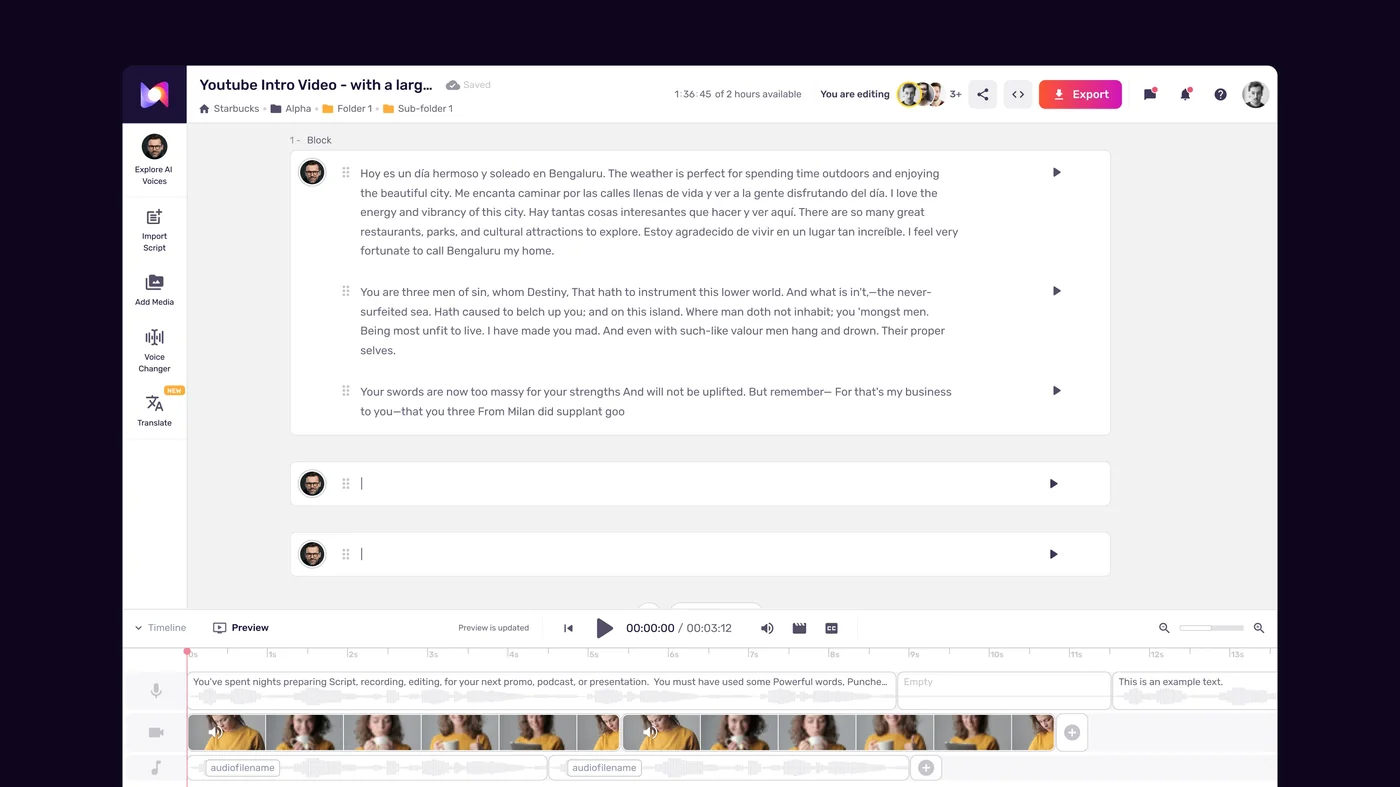
Create a new project:
- Click “Create New Project” from the dashboard
- Select “Voiceover” as the project type
- Name the project using a consistent convention - something like “[CourseName] - Module 03 - Core Concepts” keeps your project library organized and makes it easy to locate specific modules when you need to regenerate updated sections
- Choose your primary language from the dropdown
Paste and organize your script:
- Click into the script editor area in the center of the Studio workspace
- Paste your formatted script using Ctrl+V (or Cmd+V on Mac)
- Murf automatically divides your pasted text into blocks based on paragraph breaks
- Review the block divisions carefully. Blocks that contain more than two to three sentences give you less fine-tuning control in Steps 3 and 4. Manually split any dense paragraph into two blocks by placing your cursor at the split point and pressing Enter
Configure project settings:
- Set your output audio quality to “High Quality” - this produces WAV or high-bitrate MP3, which is the correct starting point for any authoring tool workflow (see our export formats and quality guide). Standard quality is acceptable for internal drafts but not for learner-facing exports
- Confirm the project language matches your script language
- If your module includes multiple speakers - an instructor voice and a character voice for scenario-based learning, for example - enable multi-voice mode now before assigning voices to blocks
The Studio workspace at this stage shows your script divided into blocks on the left and an empty voice panel on the right. The next step fills that panel with a voice suited to educational content delivery.
Step 3: Select a Voice for Educational Content
Murf AI provides 120+ voices, which makes selection feel overwhelming without a clear process. For e-learning, the goal is not finding the most expressive or energetic voice in the library - it is finding the voice that learners can listen to for 6 to 10 minutes without fatigue, that enunciates clearly on technical vocabulary, and that carries enough natural variation to hold attention through extended explanation.
Filter by use case and category:
- Open the voice browser from the right panel in Studio
- Filter by language first - English (US) for most corporate and consumer audiences, English (UK) or Australian English for region-specific programs
- Apply the “Narration” or “Educational” category filter if available - this narrows the library to voices specifically tuned for instructional delivery
- Avoid filtering for “Energetic” or “Conversational” voices at this stage - these work well for short marketing content but become fatiguing over a full module
Audition voices with representative content:
- Copy a mid-module paragraph - not the opening or closing, which are often atypical, but a section that covers a core concept with some technical vocabulary
- Paste this test content into the voice preview input
- Listen to each candidate voice deliver your actual material, not a generic sample sentence
- Note which voices maintain consistent pacing, enunciate clearly on the complex words in your script, and do not drop energy mid-sentence on longer explanations
- Shortlist three to five voices before making a final decision
Voice characteristics by educational content type:
(See our voice selection tips guide for a fuller framework on auditioning voices.)
- Compliance and policy training - Voices tagged as “professional” or “authoritative” with clean, measured delivery. Steady pacing communicates reliability and seriousness without sounding threatening.
- Technical and software training - Voices with clear enunciation and a moderate pace. The learner needs time to absorb each instruction before the next one arrives.
- Soft skills and leadership development - Voices with warmth and natural conversational rhythm. The content is often scenario-based, and a voice that sounds engaged helps learners connect with examples.
- Academic and higher education content - Voices with depth and authority. Avoid overly youthful voices for university-level content, which can undermine credibility with adult learners.
Apply the selected voice:
- Click “Apply to Project” on your chosen voice to apply it across all script blocks
- Generate a preview of the first three to four blocks to confirm the voice performs consistently across continuous content, not just your test sentence
- If you are building a multi-module course, test the same voice on content from a different module to confirm it handles your full vocabulary range
Voice selection is reversible at any point. If after generating the complete module the voice does not feel right, you can switch and regenerate without rewriting your script. For a structured approach to audition and selection, see the dedicated voice selection tips guide and the emotion controls guide.
Step 4: Fine-Tune for E-Learning (Pauses, Emphasis, Variability)
With your script organized and your voice selected, generate the initial narration by clicking “Generate All.” For a 600-word module section, generation typically takes 30 to 60 seconds.
After the initial generation, listen to the complete output before making any changes. Identify systemic issues first - if the pace feels consistently too fast for the content complexity, address that at the project level before fine-tuning individual blocks.
Setting the baseline speed for learning retention:
E-learning narration should target 130 to 150 words per minute - noticeably slower than conversational content, which runs at 160 to 180 words per minute. This lower rate gives learners cognitive processing time, particularly important for abstract concepts and multi-step procedures.
- Select all script blocks using the select-all function in the block panel
- Set the baseline speed to 0.9x to achieve the instructional pace range
- Regenerate to evaluate the adjusted speed
- Identify blocks covering introductory or transition content - these can run at 1.0x since the information load is lower
- Identify blocks introducing new terminology or complex procedures - consider dropping these to 0.85x to give learners additional processing time
Adding strategic pauses for cognitive load management:
(For deep dives into pacing controls, see the pacing tips guide.)
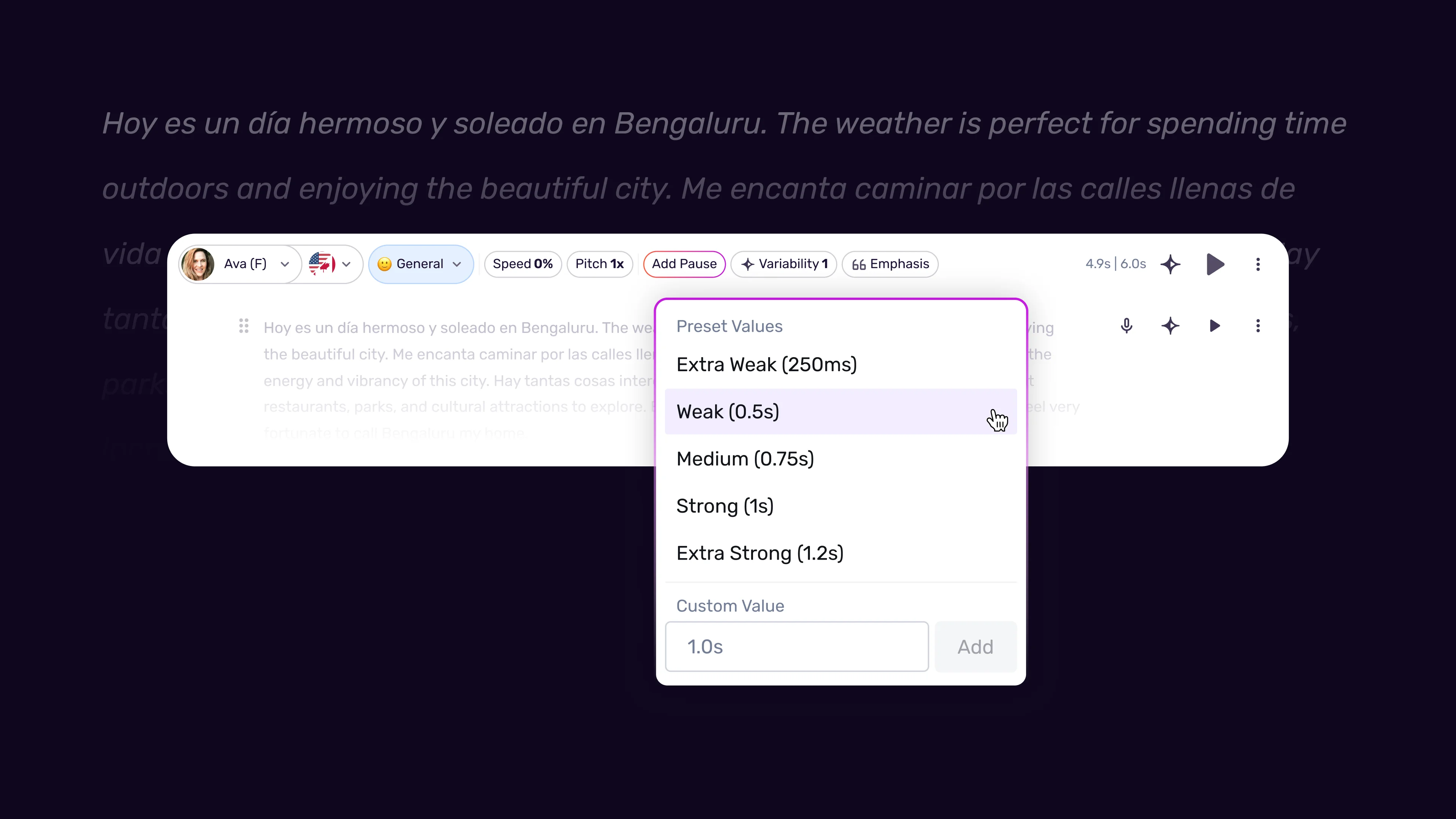
Pauses in e-learning narration serve a different function than in other content types. They are not stylistic - they are cognitive architecture. A well-placed pause after a concept definition gives learners time to file that information before the next idea arrives. Without pauses, even excellent narration at the right speed feels rushed because the content never stops long enough for processing.
- Place your cursor at the end of each concept-ending block - the last sentence before your narration introduces a new idea, term, or procedure
- Open the pause insertion tool from the toolbar
- Insert an 800ms to 1,200ms pause at each major concept transition - longer pauses for genuinely new or complex material, shorter pauses for transitions between related sub-points
- Insert 400ms to 600ms pauses after terminology definitions - “Active learning refers to instructional strategies that engage learners in the material… [pause] …rather than passive listening”
- For step-by-step procedures, insert 600ms pauses between each numbered step so learners can complete the action before the next instruction arrives
- Insert a 500ms pause before your module summary to signal the shift to reinforcement content
Using variability for natural-sounding instruction:
(For more on this control, see variability and natural-sounding tips.)
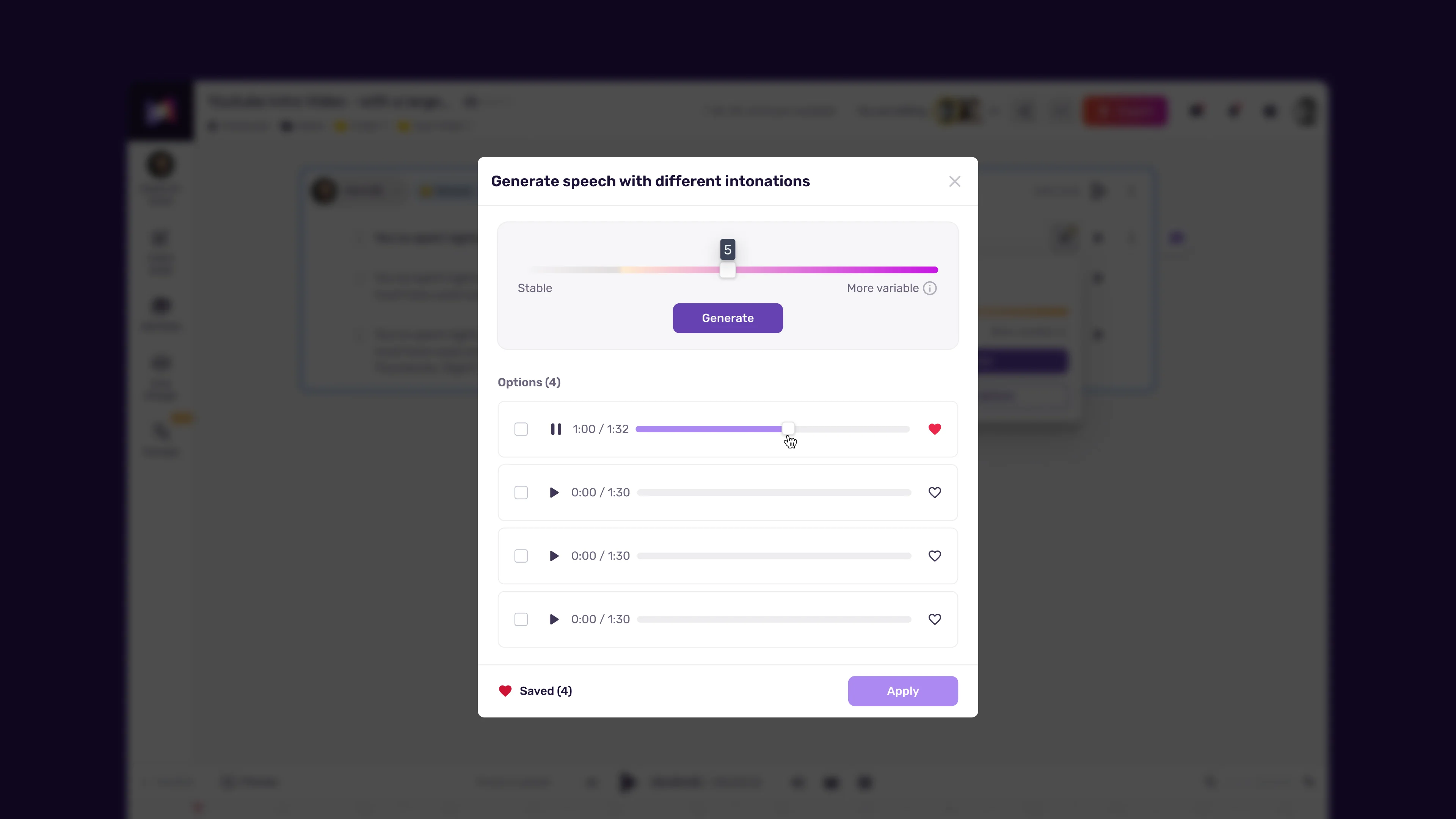
The variability setting controls how much the voice naturally speeds up through less important words and lingers on significant ones - the way a skilled instructor emphasizes meaning through timing rather than volume alone. Low variability produces an even, steady delivery that can feel metronomic over a full module. Medium variability introduces the natural rhythmic fluctuation that keeps extended narration from becoming fatiguing.
- Open the voice settings panel and locate the variability control
- Set variability to medium for most instructional content - this produces natural emphasis variation without sounding informal
- For content with a formal or authoritative tone requirement (compliance training, legal modules), lower variability slightly to maintain the steady, deliberate delivery those contexts require
- Generate a preview of a longer section - at least 90 seconds - to evaluate whether the variability level feels natural across continuous content
Adding emphasis to key learning points:
Use Murf’s emphasis control sparingly and deliberately. Select the specific word or short phrase that learners must remember - a definition keyword, a procedure step number, a critical warning - and increase the stress weight. One to two emphasis markers per paragraph is the appropriate density. Over-emphasizing a script produces narration that sounds like someone reading a highlighted textbook aloud.
Addressing pronunciation problems:
- During your full-playback review, note any mispronounced word with a timestamp
- Select that word in the script block
- Open the pronunciation editor and enter the phonetic spelling or use the built-in phoneme editor
- Common e-learning pronunciation problems: acronyms (SCORM, ADDIE, LMS), researchers’ names (Vygotsky, Csikszentmihalyi), medical and legal terms, and software product names
Final preview before export:
After completing all adjustments, run a full-project preview from start to finish. This is not the same as the individual block previews used during fine-tuning. The project-level playback reveals pacing issues that only appear across consecutive blocks - a speed adjustment in one block that creates a jarring transition with the next, or a pause that is too long relative to the surrounding cadence.
Step 5: Export for Your LMS
When you are satisfied with the complete module narration, export the audio in a format that integrates cleanly with your authoring tool and LMS.
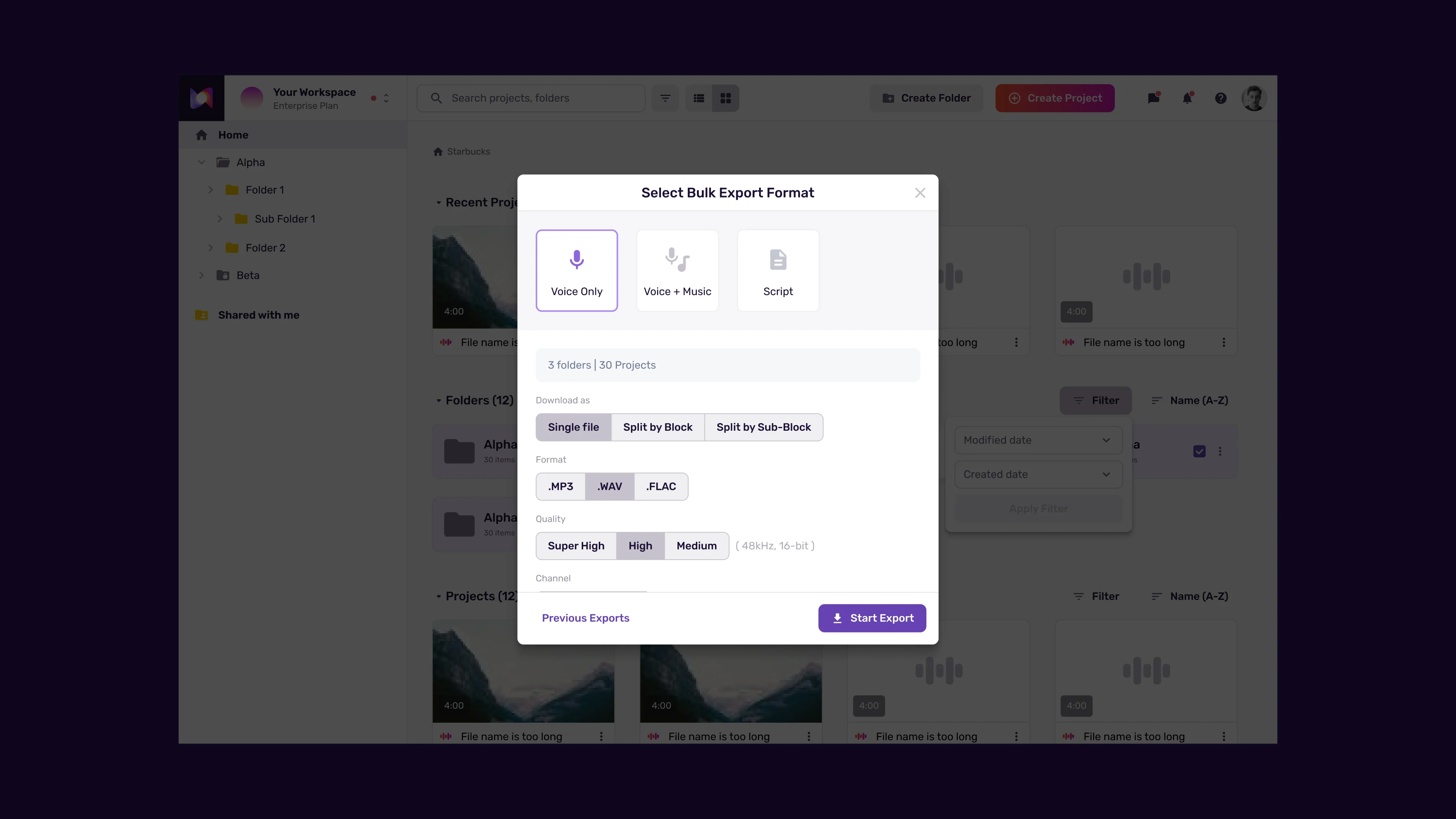
Export settings for LMS production:
- Click the Export button in the top right of Studio
- Select “Audio Only” as the export type - you will sync the audio with your slides, interactions, and media in your authoring tool
- For primary exports, choose WAV format. WAV produces the highest audio quality and gives your authoring tool clean source audio before it applies its own compression for the SCORM package. If file size is a concern, MP3 at 192kbps is the reliable fallback - avoid anything below 128kbps, which introduces artifacts that become fatiguing over extended listening
- Set the sample rate to 48000 Hz - this is the professional standard and matches the default for most authoring tools and video formats. If your authoring tool project is set to 44100 Hz, change the project setting before importing to avoid sample rate mismatch issues
- Confirm the “Export All Blocks” option is selected to produce a single continuous audio file for the module
Organizing exported files:
- Download the audio file to a dedicated course assets folder
- Use a systematic naming convention:
module-03-section-02-core-concepts.wavmakes it straightforward to match files to slides and simplifies replacements when you update individual sections - Maintain a separate
/murf-source/subfolder containing the exported files before any authoring tool compression - this is your reference archive for regenerating updated sections without quality degradation
Importing into your authoring tool:
- In Articulate Storyline, import the audio file to the slide or scene it corresponds to using Insert > Audio > Audio From File
- In Adobe Captivate, import to the project and sync to the slide timeline
- In iSpring or Lectora, use the respective audio import workflow and sync to slide transitions
- For direct LMS upload (e.g., Moodle H5P, Canvas media), upload the audio file directly alongside your slide content or embed it in the page layout
Handling course updates:
When a policy changes, a software UI updates, or a stakeholder requests revisions, the update workflow is straightforward. For audio format decisions on replacement files, consult our Murf export formats guide for LMS-specific recommendations. Open the original Murf project, locate the affected blocks, revise the script text, and regenerate only those blocks. Export the revised audio, replace the corresponding file in your authoring tool, and republish the SCORM package. No re-recording, no production delay, no per-revision cost.
How Do You Narrate a Multi-Module Course Efficiently with Murf AI?
For courses with multiple modules - a typical compliance course might run 8 to 12 modules - the per-module workflow above is efficient, but a few organizational practices make a multi-module production significantly smoother.
Establish a single voice and settings configuration before you start. Run your first module through the complete workflow, finalize the voice selection (see voice selection tips), baseline speed, variability level, and pause conventions, and document these settings explicitly. Apply the same configuration to every subsequent module. Consistent narration across modules is part of the course’s professional quality - learners notice when Module 6 sounds different from Module 3.
Build a course pronunciation dictionary. Create a text file listing every term, acronym, name, and product reference that required a phonetic correction during Module 1. Before generating each new module, scan the script for entries from this list and pre-load the pronunciations in the new Murf project. This saves 5 to 10 minutes of fine-tuning per module and ensures consistent pronunciation throughout the course.
Use Murf projects as source documents. Do not close or delete Murf projects after export (this is essentially a version-control discipline applied to audio assets). Keep them active with the finalized script and settings intact. When Module 4 needs a section revision six months after launch, your source project is available with all pronunciation settings and pause configurations already in place.
Batch similar modules. Group modules with similar content density and vocabulary complexity together in your production schedule. If you are also producing AI-dubbed versions for multilingual delivery, batch the dubbing work after the narration master is finalized for each module to avoid rework. Modules that cover abstract concepts and dense terminology take longer to fine-tune than introductory or summary modules. Batching by complexity type lets you maintain momentum through the production cycle without context-switching between heavy and light content.
Test narration with a representative learner sample before producing all modules. After completing Module 1, share it with two or three representative learners and ask them to complete a short listening evaluation: was the pace comfortable for following and taking notes? Were any words unclear or hard to follow? Their feedback informs pacing and pronunciation decisions that will carry through every subsequent module.
Frequently Asked Questions
What plan do I need for commercial e-learning production with Murf AI?
Commercial use - including selling courses on Teachable, Udemy, or Thinkific, or delivering paid corporate training - requires at minimum the Creator plan. The Creator plan ($29/month, or $19/month annual with annual billing) is the practical choice for most e-learning producers because it includes the full voice library, commercial rights, higher monthly generation limits, and access to advanced voice controls including variability settings. The free tier and Basic plan restrict commercial use. Check the Murf pricing page for current plan details and any active promotions.
What audio format should I use for SCORM packages?
For SCORM packages, export from Murf as WAV at 48000 Hz and let your authoring tool (Articulate Storyline, Adobe Captivate, iSpring) handle the final compression when it publishes the SCORM package. Starting from WAV prevents quality loss from double compression. If your authoring tool has compatibility issues with WAV, MP3 at 192kbps is the reliable fallback. Avoid exporting at anything below 128kbps - compressed audio at low bitrates introduces audible artifacts that become fatiguing over a 6 to 8 minute module.
How do I keep narration consistent when updating an older module?
Open the original Murf project rather than creating a new one. The voice, speed, variability, and pronunciation settings are all saved in the project. Edit only the specific blocks that need revision, regenerate those blocks, and export. If the original project is unavailable, re-create the settings by loading the original exported audio file into an audio analysis tool to measure the approximate words-per-minute rate, then match those settings in a new Murf project with the same voice. The most important consistency factor is the voice itself - select the identical voice name to ensure tonal continuity.
Can I use Murf AI narration on an LMS I do not own (like Moodle Cloud or Canvas)?
Yes. The audio files you export from Murf are standard WAV or MP3 files with no DRM or platform restrictions. They function identically whether you upload them to a self-hosted Moodle instance, a Canvas LMS, a Blackboard site, or a hosted Teachable course. The only consideration is platform-specific: some LMS platforms limit audio file size per upload. If a module’s audio exceeds the limit, export it in two files (first half and second half of the module) and sync each to the appropriate slides in your authoring tool before publishing.
How many voices should I use across a multi-module course?
Use one voice per course, applied consistently across all modules. Multiple voices in the same course - even when each is high quality individually - create a disjointed experience that reduces learner trust and makes it harder to establish the consistent instructional presence that supports learning outcomes. The only justified exception is scenario-based content where different character voices serve a deliberate pedagogical purpose, such as a compliance module where a narrator voice and a customer voice are clearly distinct roles.
Does Murf AI handle technical vocabulary well?
Murf handles standard technical vocabulary reasonably well, but domain-specific terms, acronyms, researcher names, and proprietary product names often need phonetic corrections. The pronunciation editor in Murf Studio lets you define phonetic overrides that persist throughout a project. Build your pronunciation library during Module 1 production, document every correction in a course pronunciation reference file, and apply those corrections to each new module project before generating. Common problem categories include: medical and pharmaceutical terms, legal Latin phrases, software and platform names with non-standard spellings, and names from non-English languages.
Want to learn more about Murf AI?
Related Reading
- Murf AI Review - Full platform review with pricing, features, and ratings
- Best AI Voice Generators for Content Creators - Compare Murf against competing AI voice tools
- AI Voiceover for YouTube Videos: Murf Workflow - Murf narration workflow adapted for video content
Related Guides
- Getting Started with Murf AI
- Murf Studio Interface Walkthrough
- How to Clone Your Voice with Murf AI
- Murf Text-to-Speech Tutorial
- Choosing the Right AI Voice in Murf
- Murf AI Emotion Controls
- Murf AI Pronunciation and Emphasis
- Mastering Pacing in Murf AI
- Murf MultiNative: Multilingual Voiceovers
- Murf AI Dubbing Walkthrough
- AI Voiceover for YouTube Videos: Murf Workflow
External Resources
- Murf AI Help Center - Official documentation for Studio, voice generation, and exports
- SCORM Explained - Reference for the e-learning interoperability standard used by most LMS platforms
- WCAG 2.1 Accessibility Guidelines - W3C standards covering audio transcripts and captions for educational content
Related Guides
- AI Voiceover Corporate Training With WellSaid Labs
- AI Voiceover for YouTube Videos: Murf Workflow Guide 2026
- AI Voiceover Tips: Making Synthetic Voices Sound Human
- ElevenLabs Getting Started: Complete Beginners Guide
- ElevenLabs Voice Cloning Tutorial: Complete 2026 Guide
- Luma Dream Machine Video Tutorial 2026: Text-to-Video & Ray3
- Murf AI Canva Integration: Add Voiceovers to Designs
- Murf AI Custom Pronunciation: Say It My Way Guide (2026)
- Murf AI Dubbing: Complete Walkthrough | Complete Guide 2026
- Murf AI Emotion Control: Voice Guide | Review 2026