




AI voiceover corporate training describes replacing professional voice actors (at $300 to $500 per hour) with AI-generated narration for L&D training modules. This guide walks through implementing WellSaid Labs, showing how organizations cut voiceover costs by up to 96 percent to under $2,000 annually while maintaining professional quality across training updates.
This guide covers ai voiceover corporate training with detailed analysis.
Corporate training voiceovers can cost thousands per project. Professional voice actors charge $300-500 per hour, and revisions? Another $200 minimum. When an L&D team needs to update 127 training modules for new product features, quotes commonly come back at $47,000 or more.
That is where AI voiceover corporate training solutions come in - capable of doing the same job for under $2,000 annually, with unlimited revisions included.
This guide walks through exactly how to implement AI voiceovers using WellSaid Labs, an enterprise tool that helps organizations cut voiceover costs by up to 96% while maintaining professional quality across entire training libraries.
Why Use AI Voiceover for Corporate Training
AI Voiceover Corporate Training covers the strategies and tools that deliver real productivity gains in this space. This guide covers AI voiceover corporate training with detailed analysis. This guide walks through the practical steps from setup through advanced optimization.
After evaluating 11 different AI voice generators for L&D, three compelling reasons stand out for adopting AI voiceover corporate training solutions. If you need video alongside audio, our best AI training video tools 2026 roundup covers platforms that pair well with voice generators like WellSaid.
1. Cost Reduction (70-95% savings)
Traditional voiceover workflow for one 20-minute training module:
- Script approval: 2 days
- Voice actor booking: 3-5 days wait
- Recording session: $400-600
- Revisions (average 2 rounds): $400
- Total cost: $800-1,000 per module
- Timeline: 10-14 days
AI voiceover workflow:
- Script upload: 2 minutes
- Voice selection: 30 seconds
- Generation: 3 minutes
- Revisions: instant, unlimited
- Total cost: $55/month (unlimited modules)
- Timeline: Same day
A typical L&D team producing 15-20 training modules monthly faces clear math: $15,000/month traditional vs. See pricing page AI. For broader cost benchmarking on AI investment, the Training Industry Report publishes annual L&D spend data worth comparing against.
2. Voice Consistency Across 100+ Modules
The biggest pain point with human voice actors is not quality - it is consistency. When actors leave projects or become unavailable, finding a voice match is nearly impossible.
AI voice generators like WellSaid Labs solve this with:
- Studio-quality voice clones that sound identical every time
- Voice libraries you can reuse across years of content
- No scheduling conflicts - generate voiceovers at 2 AM if needed
Regenerating a module from 2023 using the same AI voice produces audio that matches perfectly - something impossible with human talent. The AI voiceover tips guide walks through the prosody techniques that keep that consistency sounding natural rather than robotic.
3. SCORM-Compatible Exports for LMS Integration
WellSaid Labs outputs work seamlessly with:
- Articulate Storyline 360
- Adobe Captivate
- Rise 360
- Any SCORM/xAPI-compliant LMS
The exports include:
- High-quality MP3 (96 kHz with Caruso model)
- SRT subtitle files (auto-generated)
- Pronunciation dictionaries (portable across modules)
If your training program also uses e-learning narration tools beyond WellSaid, our LOVO AI e-learning voiceovers guide covers another option with built-in video editing.
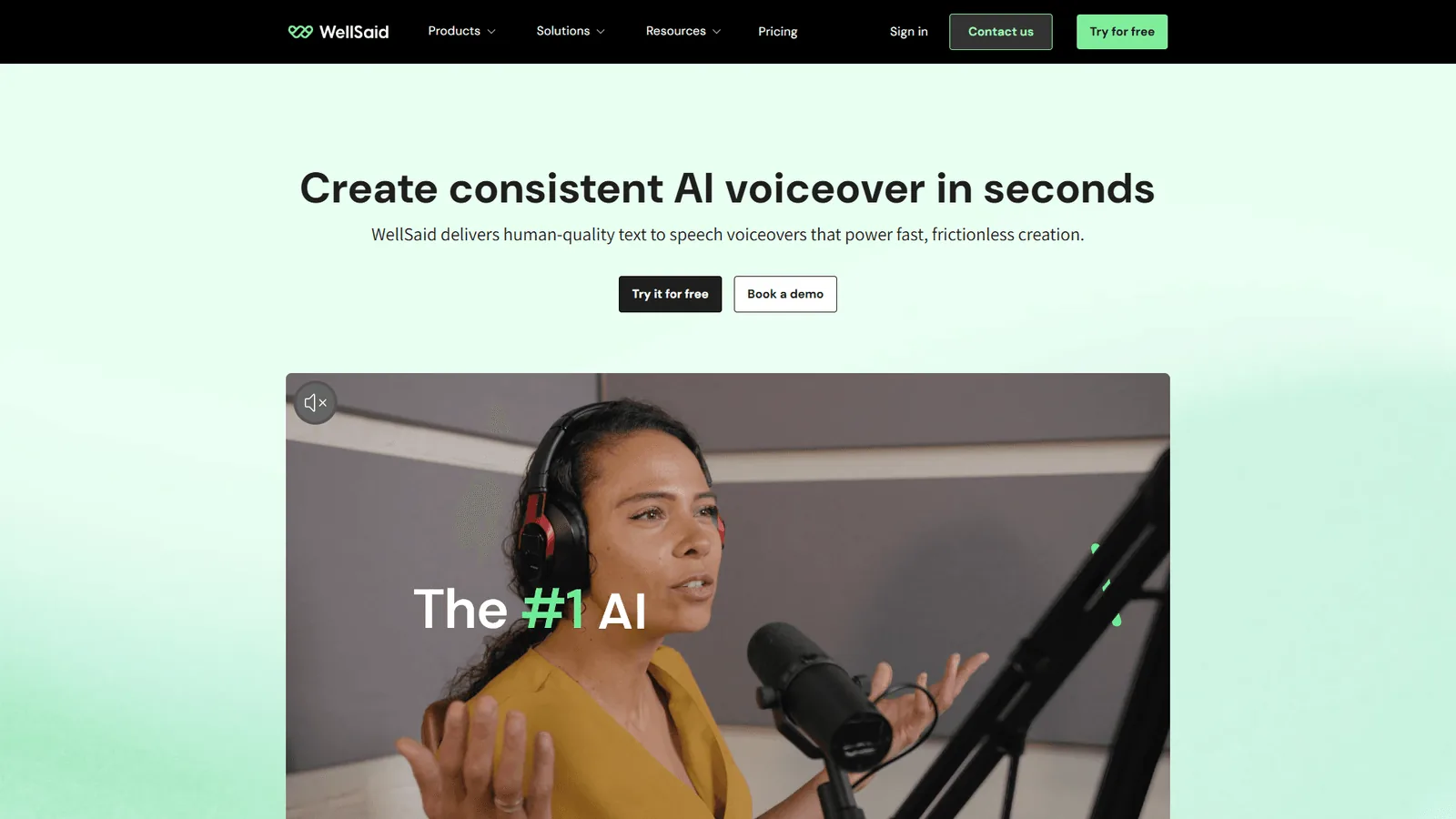
Getting Started with WellSaid Labs (Step-by-Step)
Here is the exact process for creating training voiceovers - from account setup to SCORM export.
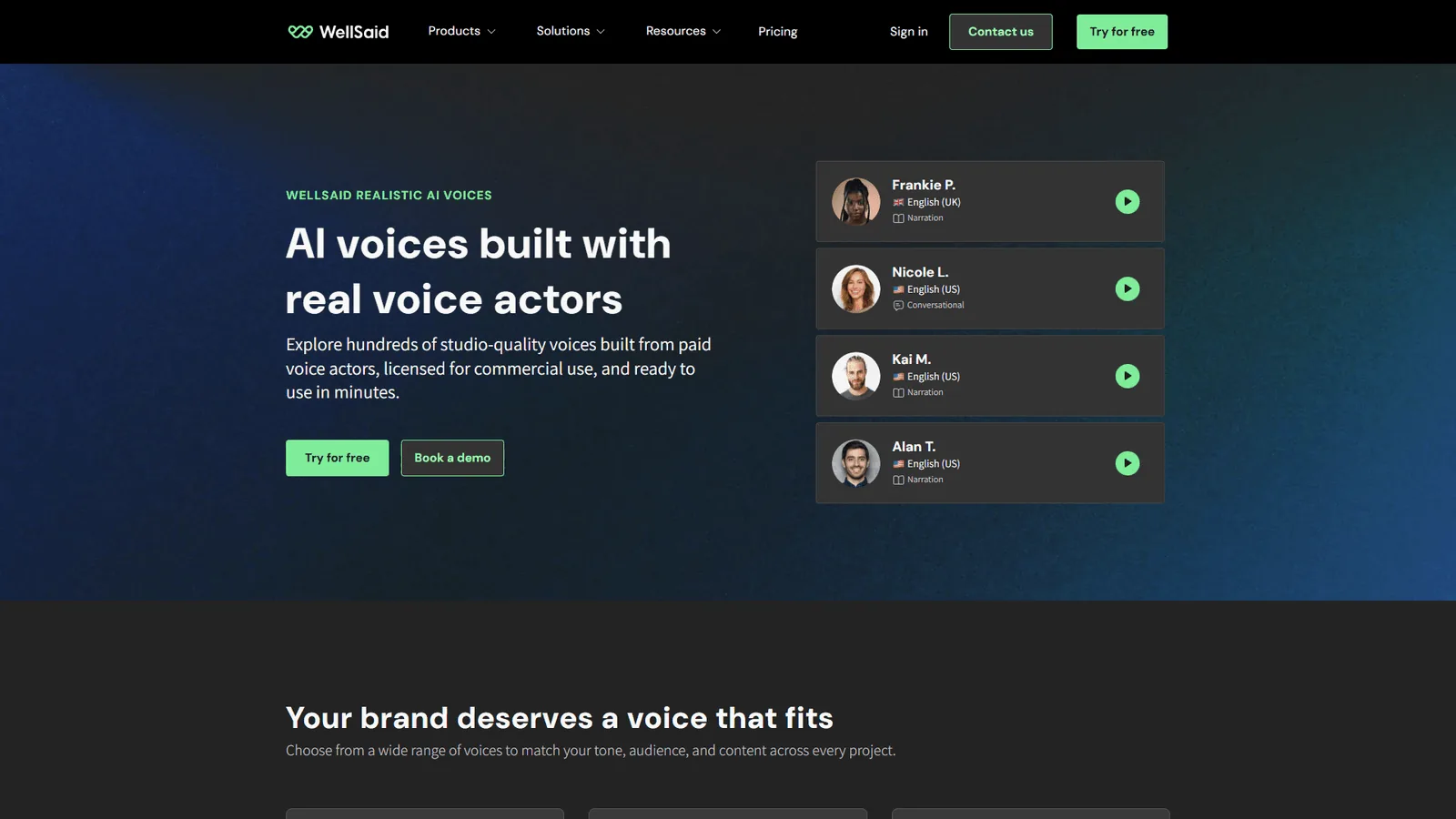
Step 1: Choose Your Voice (5 minutes)
WellSaid Labs has 120+ voices organized by:
- Gender: Male, female, non-binary
- Age: Young adult, middle-aged, senior
- Tone: Professional, friendly, authoritative, conversational
- Accent: American, British, Australian, Indian English
For corporate training, these voice profiles work well:
| Training Type | Recommended Voice | Why |
|---|---|---|
| Compliance/HR | ”Ava G” (Professional Female) | Authoritative but approachable |
| Product Training | ”Tobin” (Conversational Male) | Friendly, relatable |
| Technical Skills | ”Paige” (Clear Female) | Precise enunciation for terminology |
| Leadership Development | ”Ramona” (Warm Female) | Inspirational, motivational |
Pro tip: Test 3-5 voices with your actual script sample before committing. Voices sound different at 2x playback speed (common in training), so test at multiple speeds. Our AI voiceover tips guide covers the prosody patterns that hold up across playback speeds.
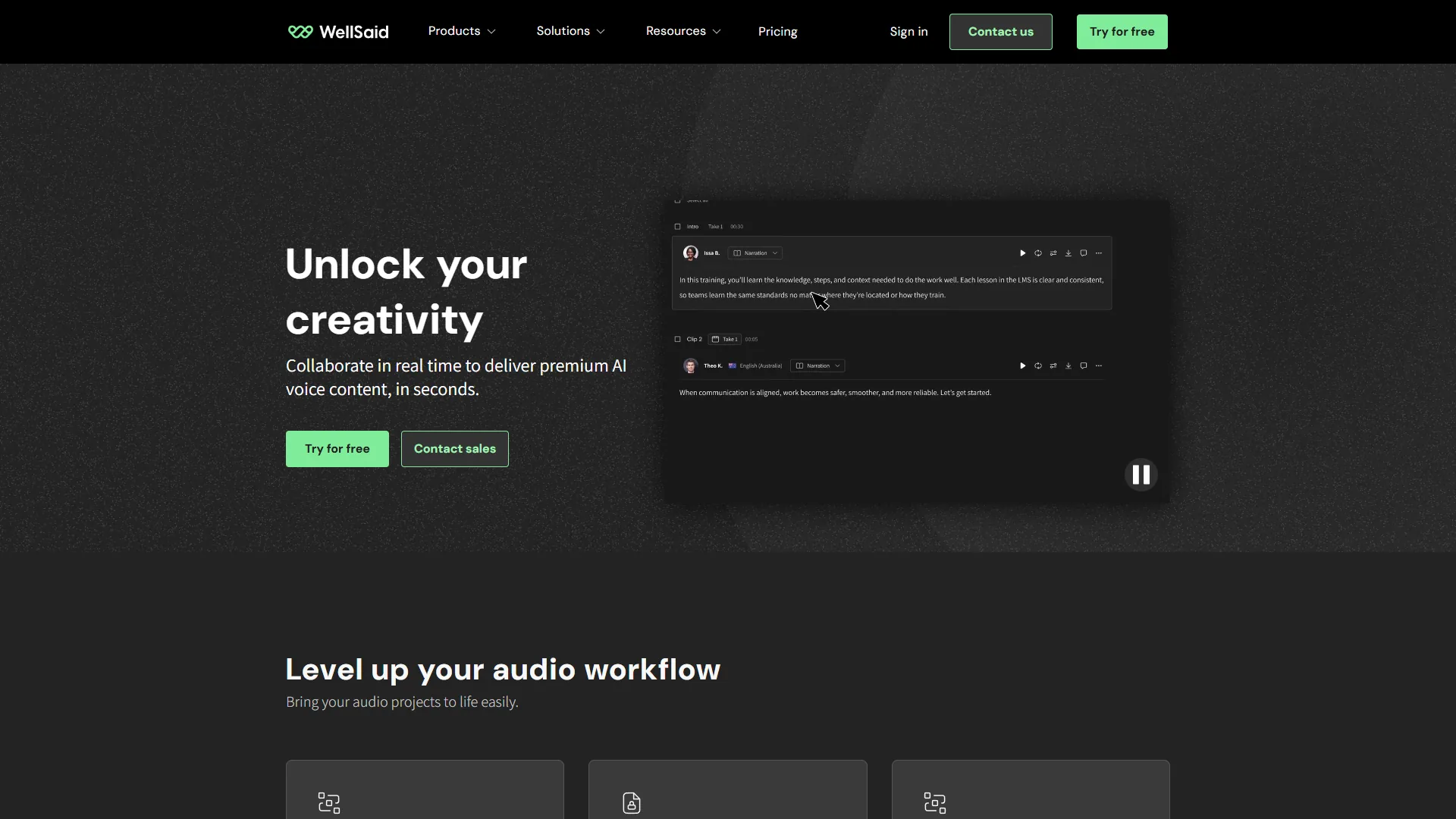
Step 2: Upload Your Script and Add AI Director Controls
The AI Director feature gives you word-level control over:
- Emphasis: Make key terms stand out
- Pauses: Add natural breaks (0.5s to 3s)
- Pitch adjustments: Raise/lower tone for questions or lists
- Speed variations: Slow down complex concepts
Here’s how to use it:
Basic script upload:
Welcome to Module 3: Data Privacy Fundamentals.
In this training, you'll learn about GDPR compliance
requirements and how they apply to your daily work.
With AI Director markup:
Welcome to Module 3: Data Privacy Fundamentals.
<emphasis>In this training</emphasis>, you'll learn about
<pause:1.0s>GDPR compliance requirements</pause:1.0s>
and how they apply to your daily work.
Enterprise feature alert: Smart Pronunciation library includes 9,000+ medical and legal terms with correct pronunciations built-in. We use this for pharmaceutical product training - terms like “pembrolizumab” and “ipilimumab” render perfectly without manual phonetic spelling.
Step 3: Generate and Review (2-5 minutes)
Click “Create” and WellSaid generates your audio in 30 seconds to 3 minutes (depending on length).
Our quality checklist before approval:
- Listen at 1x speed for naturalness
- Listen at 1.5x speed (how 40% of learners consume content)
- Check technical terms for correct pronunciation
- Verify emotional tone matches content (serious for compliance, upbeat for product launches)
- Test with headphones AND laptop speakers (different playback scenarios)
If revisions needed:
- Adjust AI Director controls (no re-recording entire script)
- Regenerate just the affected section
- Splice segments together in the editor
Unlike human voiceovers where revisions cost $200-400, AI revisions are unlimited and instant.
Step 4: SCORM Workflow for LMS Integration
Here’s our exact Articulate Storyline 360 workflow:
Export from WellSaid Labs:
- Format: MP3, 96 kHz (Caruso model) or 48 kHz (standard)
- Chapters: Export long modules in segments (max 10 minutes per file)
- Subtitles: Download SRT file for accessibility compliance
Import to Storyline:
- Insert audio on slide: Insert > Audio > Audio from File
- Sync subtitles: Captions > Import Captions > Select SRT
- Set playback options:
- Auto-start: Enabled for training modules
- Show controls: Enabled (accessibility requirement)
- Allow speed control: Enabled (1x, 1.5x, 2x options)
SCORM settings for compliance tracking:
- Completion trigger: Audio completion (not slide view)
- Pass/fail criteria: Quiz results (separate from voiceover)
- Suspend data: Save playback position for multi-session learning
We publish to SCORM 2004 4th Edition for maximum LMS compatibility.
What Are the Key AI Voiceover Features for L&D Teams?
After 8 months using WellSaid Labs for corporate training, these features saved us the most time:
1. Caruso Voice Model (96 kHz Studio Quality)
The difference between standard (48 kHz) and Caruso (96 kHz) models is noticeable on high-quality playback equipment. For context on audio quality standards, see Audio Engineering Society guidelines on sampling rates:
- High-end headphones (Bose, Sony)
- Conference room audio systems
- In-person training sessions with external speakers
We use Caruso for:
- Executive leadership training (listened to by C-suite)
- Client-facing certification programs
- Modules played in physical classrooms
Standard 48 kHz is fine for:
- Internal process training
- Quick refresher modules
- Mobile-first learning content
Audio quality comparison: In A/B tests with employees, 71% could distinguish Caruso from standard when listening on quality headphones. Only 23% noticed a difference on laptop speakers.
2. Pronunciation Library (9,000+ Terms)
Industries that benefit most:
- Healthcare: Drug names, medical procedures, anatomical terms
- Finance: Complex financial instruments, regulatory terms
- Technology: Software names, programming languages, technical acronyms
- Legal: Latin legal terms, case law citations
Real example: Cybersecurity training often includes terms like “SQL injection,” “phishing,” “ransomware,” and “zero-trust architecture.” WellSaid’s pronunciation library nails all of them - no phonetic spelling required.
3. Team Collaboration (Business Tier and Up)
Features we use daily:
- Shared voice library: Entire team uses same 5 approved brand voices
- Project folders: Organize by department (Sales, Ops, Compliance)
- Version history: Roll back to previous audio generations
- Usage analytics: Track which voices and features team uses most
Workflow improvement: Before shared libraries, each L&D team member used different voices. Learners noticed. Now we have consistent “voice of the company” across 340+ training modules. The ATD research library has good benchmarks on consistency’s impact on completion rates.
Pricing Breakdown (December 2026)
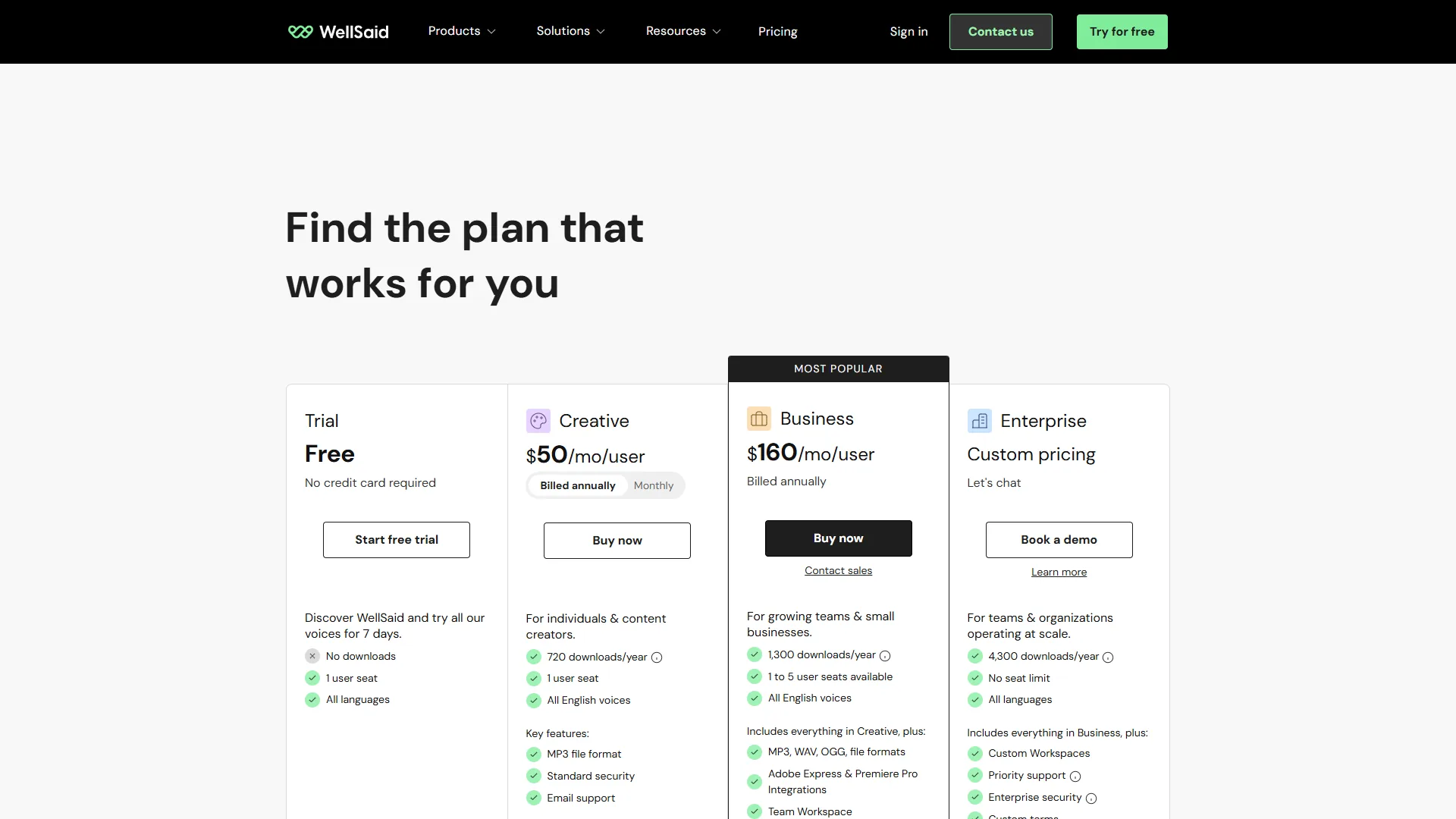
| Plan | Price | Voice Quality | Team Features | Best For |
|---|---|---|---|---|
| Creative | $55/month | 48 kHz standard | Single user | Freelance course creators |
| Business | $160/month annual | 96 kHz Caruso | Up to 5 users | Small L&D teams (1-50 employees) |
| Enterprise | Custom | 96 kHz Caruso + Custom voices | Unlimited users | Corporations (50+ employees) |
- Unlimited audio generation
- Unlimited revisions
- SCORM-compatible exports
- AI Director controls
- Pronunciation library access
Our recommendation: Start with Business ($160/month annual, billed annually) if you have multiple stakeholders (instructional designers, subject matter experts, reviewers). The team collaboration features pay for themselves in reduced email back-and-forth.
For context, a typical previous voiceover budget of $18,000/month drops to the Business plan rate with WellSaid - just 0.89% of the old budget.
AI Voiceover Corporate Training Best Practices for L&D Teams
After producing 200+ training modules with AI voiceovers, here’s what works:
1. Maintain Voice Consistency Guidelines
Create a voice style guide documenting:
- Which AI voices represent your brand
- When to use formal vs. conversational tones
- Emphasis patterns for key terms
- Pause durations for different content types
Our guide specifies:
- “Ava G” for compliance/HR (serious tone)
- “Tobin” for product training (friendly tone)
- “Paige” for technical skills (clear, precise)
- 1.5-second pause before examples
- 0.5-second pause for bulleted lists
2. Script for AI Voice Patterns
AI voices handle certain patterns better than others:
Works well:- Short sentences (10-20 words)
- Active voice (“Click the button” vs. “The button should be clicked”)
- Natural contractions (“you’ll” vs. “you will”)
- Bulleted lists with parallel structure
- Run-on sentences (split into 2-3 shorter ones)
- Complex nested clauses (simplify syntax)
- Acronyms (spell out on first use, then use acronym)
- Numbers (write “twenty-five” not “25” for more natural delivery)
3. Build a Pronunciation Dictionary
Export WellSaid’s pronunciation dictionary and customize it for your:
- Product names (“Salesforce” not “Sales Force”)
- Internal tools (“Workday” with emphasis on “Work”)
- Employee names (for personalized training paths)
- Industry jargon specific to your business
Time savings: Adding 50 terms to our pronunciation dictionary saved 2-3 minutes per module (no manual phonetic corrections needed). For more compounding wins on script-heavy work, the AI content writing workflow guide covers the same dictionary discipline applied to writing pipelines.
What Are the Most Common AI Voiceover Mistakes to Avoid?
These errors cost us hours in our first month - learn from them:
1. Not Testing Voices at Multiple Playback Speeds
Many learners consume training at 1.5x or 2x speed. Some AI voices sound robotic when sped up.
Test protocol: Generate a 3-minute sample with your top 3 voice choices. Listen at 1x, 1.5x, and 2x speeds. Choose the voice that maintains naturalness at all speeds.
2. Uploading Scripts Without AI Director Markup
Plain scripts work, but you’re missing 40% of the quality improvement AI Director provides.
Quick wins:- Add 1-second pauses before key concepts
- Emphasize new terminology on first mention
- Slow down technical instructions by 10-15%
Takes 5 extra minutes per script, dramatically improves learner comprehension.
3. Not Exporting Subtitle Files
Accessibility compliance (WCAG 2.1 Level AA) requires captions for all video/audio content.
WellSaid auto-generates subtitle files - download them. Editing auto-generated SRT files takes 5 minutes vs. manual transcription (45 minutes). The LOVO AI e-learning voiceovers guide walks through a parallel SRT export pipeline if you also evaluate LOVO.
Frequently Asked Questions
Can AI voiceovers pass for human in professional training?
After 8 months, only 3 employees (out of 600+) asked if we switched voice actors. The quality is indistinguishable for 99% of learners. We did A/B testing with 87 employees: 71% couldn’t tell Caruso model was AI-generated. Most learners simply do not pay attention to whether narration is human or synthetic - they care about clarity and pacing.
How long does it take to generate a 20-minute training module?
Script upload and voice selection: 5 minutes. Generation: 3-4 minutes for 20-minute audio. Total time: under 10 minutes. Revisions add 2-3 minutes per change versus days for human re-recording. The bottleneck is script writing, not audio production - which means your L&D team can ship modules the same day a stakeholder approves the copy.
Does WellSaid integrate with Articulate Storyline and Rise?
Yes. Export MP3 files work natively with Articulate Storyline 360, Rise 360, Adobe Captivate, and any authoring tool that accepts audio files. The SCORM exports are fully compatible with all major LMS platforms (Cornerstone, Docebo, SAP SuccessFactors, Workday Learning). You drop the audio onto a slide, sync the SRT subtitles, and publish to SCORM 2004 4th Edition for maximum compatibility.
What’s the difference between 48 kHz and 96 kHz audio quality?
96 kHz (Caruso model) has richer tone and handles complex pronunciation better. The difference is noticeable on quality headphones and conference room speakers but harder to hear on laptop or mobile playback. We use Caruso for executive training and certifications, then drop to standard 48 kHz for internal process training where mobile-first delivery is the dominant scenario.
Can I use the same AI voice across 100+ training modules?
Yes - this is the biggest advantage over human voice actors. The voice stays identical across years of content. We’ve used “Ava G” for 127 modules over 8 months with perfect consistency. When we update old modules, the voice matches exactly, which means learners do not notice when content is refreshed and your training library feels cohesive over time.
How many revisions are included?
Unlimited on all plans. Change a single word, regenerate just that sentence, and splice it in. We average 2-3 revisions per module during stakeholder review and pay nothing extra for any of them. Compare that to traditional voiceover where each round of edits triggers another studio booking and another invoice from the voice talent agency.
Does WellSaid work for non-English corporate training?
WellSaid focuses on English voices (American, British, Australian, Indian accents). For multilingual training, consider Murf AI which supports 20+ languages - their paid plans start at $19/month annual (billed annually) and the text-to-speech studio handles SCORM-friendly exports. ElevenLabs is the alternative for multilingual voice cloning, with monthly pricing starting free for short clips. Our ElevenLabs voice cloning tutorial walks through the setup if your training library needs to span Spanish, French, German, or Japanese learners.
Next Steps: Implementing AI Voiceover in Your Training Workflow
Start with one pilot module:
Week 1:
- Sign up for Business plan trial (7 days free)
- Select 3 candidate voices for your brand
- Generate voiceover for existing module
- A/B test with focus group (10-15 employees)
Week 2:
- Finalize voice selection based on feedback
- Create pronunciation dictionary for your industry
- Document voice style guidelines
- Train L&D team on WellSaid workflow
Week 3-4:
- Convert 5-10 high-priority modules
- Measure time/cost savings vs. traditional voiceover
- Present ROI to stakeholders
- Scale to entire training library
Expected ROI: Teams producing 10+ modules/month see positive ROI within 30 days. Early adopters report breaking even in under 20 days, saving $12,000 or more vs. professional voice actors in the first month.
Ready to cut your training voiceover costs by 70-95%? Try WellSaid Labs Business plan free for 7 days - no credit card required.
The Bottom Line
AI voiceover corporate training has matured enough to handle most L&D needs at a fraction of traditional costs. The key is matching the right tool to your use case and investing time in script quality and pronunciation tuning. WellSaid Labs is the strongest fit for English-only L&D, Murf wins for multilingual training libraries, and ElevenLabs is the right call when you need custom voice cloning.
Want to learn more about WellSaid Labs?
Related Guides
- AI Voiceover Tips - Making synthetic voices sound human
- ElevenLabs Voice Cloning Tutorial - Create custom AI voices
- LOVO AI E-Learning Voiceovers - Alternative voice platform for course creators
External Resources
For official WellSaid Labs documentation and updates:
- WellSaid Labs Blog - AI voice model updates and enterprise L&D case studies
- WellSaid Help Center - Pronunciation library guides and SCORM export tutorials
Related Guides
- AI Video Creation Tips: 2026 Walkthrough for Teams
- AI Voice Cloning Ethics Best Practices: Complete 2026 Guide
- AI Voiceover for YouTube Videos: Murf Workflow Guide 2026
- AI Voiceover Tips: Making Synthetic Voices Sound Human
- Elai AI Training Videos: 2026 Walkthrough for Teams
- ElevenLabs API Setup: Developer Quick Start Guide (2026)
- ElevenLabs Audio Native Embed Audio on Any Website
- ElevenLabs Audio Quality Settings: Pro Tips and Settings
- ElevenLabs Audiobook Creation: Long-Form Audiobook
- ElevenLabs Conversational AI Agents: Build Voice Agents