





The best AI contract review tools in 2026 are DocuSign IAM for enterprise agreement workflows, Notion for collaborative tracking, and Harvey AI, Luminance, or Kira for specialized legal contract analysis. Each delivers first-pass time savings of 20-60% on standard contracts, according to Stanford HAI research on legal language models and the American Bar Association’s 2024 Legal Technology Survey, but every option requires human review for high-stakes clauses.
Contract review is one of the most time-intensive tasks in any business - legal teams, procurement, freelancers, and founders all spend hours hunting for unfavorable clauses, missing terms, or compliance risks. A single auto-renewal clause or non-compete buried on page 14 turns a routine vendor agreement into a costly mistake. AI-powered contract review tools change that by scanning documents in seconds, flagging risky language, and extracting key terms.
This guide evaluates contract review software tools across two categories - dedicated AI contract review platforms and productivity tools adapted for contract workflows - with a focus on practical time savings, pricing transparency, and honest limitations. Our research-based analysis draws on current vendor documentation, pricing pages, and independent research rather than sponsored placement. AI Productivity may earn a commission from links on this page; our rankings are editorially independent.
Selection Criteria for AI Contract Review Tools
The five selection criteria are accuracy, clause detection depth, integration ecosystem, security certifications, and pricing transparency. Each carries different weight depending on whether you are a solo consultant reviewing five NDAs a month or an enterprise legal team processing hundreds of agreements quarterly.
Accuracy and Hallucination Risk
Accuracy is the single most important factor for legal AI - and the one most vendors gloss over. According to Daniel E. Ho, professor of law at Stanford and co-author of the 2024 Stanford HAI study on legal hallucinations, “Legal hallucinations are alarmingly prevalent, occurring between 69% and 88% of the time in response to specific legal queries from state-of-the-art language models.” The best tools are transparent about confidence levels and recommend human review for high-stakes clauses. Legaltech News publishes case studies on legal AI accuracy.
Clause Detection and Risk Scoring
Basic contract AI identifies standard sections (termination, liability, confidentiality). Better tools score risk levels, compare clauses against benchmarks, and flag deviations from your organization’s preferred language - the difference between a search engine and an analyst.
Integration Ecosystem
Tools that live in isolation create friction. Look for native integrations with CRM, e-signature, document storage, and communication tools. Teams using workflow automation platforms can connect contract review into existing approval pipelines.
Security and Compliance
You are uploading confidential legal documents. At minimum, look for SOC 2 Type II compliance, encryption at rest and in transit, and clear data retention policies. For regulated industries, check HIPAA, GDPR, or industry-specific certifications. Critically - confirm whether the vendor uses your documents to train AI models. See AI documentation tools with built-in compliance features.
Pricing Transparency
Legal tech pricing is notoriously opaque - the best AI HR tools 2026 and best CRM software 2026 guides hit similar issues. This guide prioritizes tools that publish pricing and calls out where transparency is lacking.
1. DocuSign - Best for End-to-End Agreement Management with AI
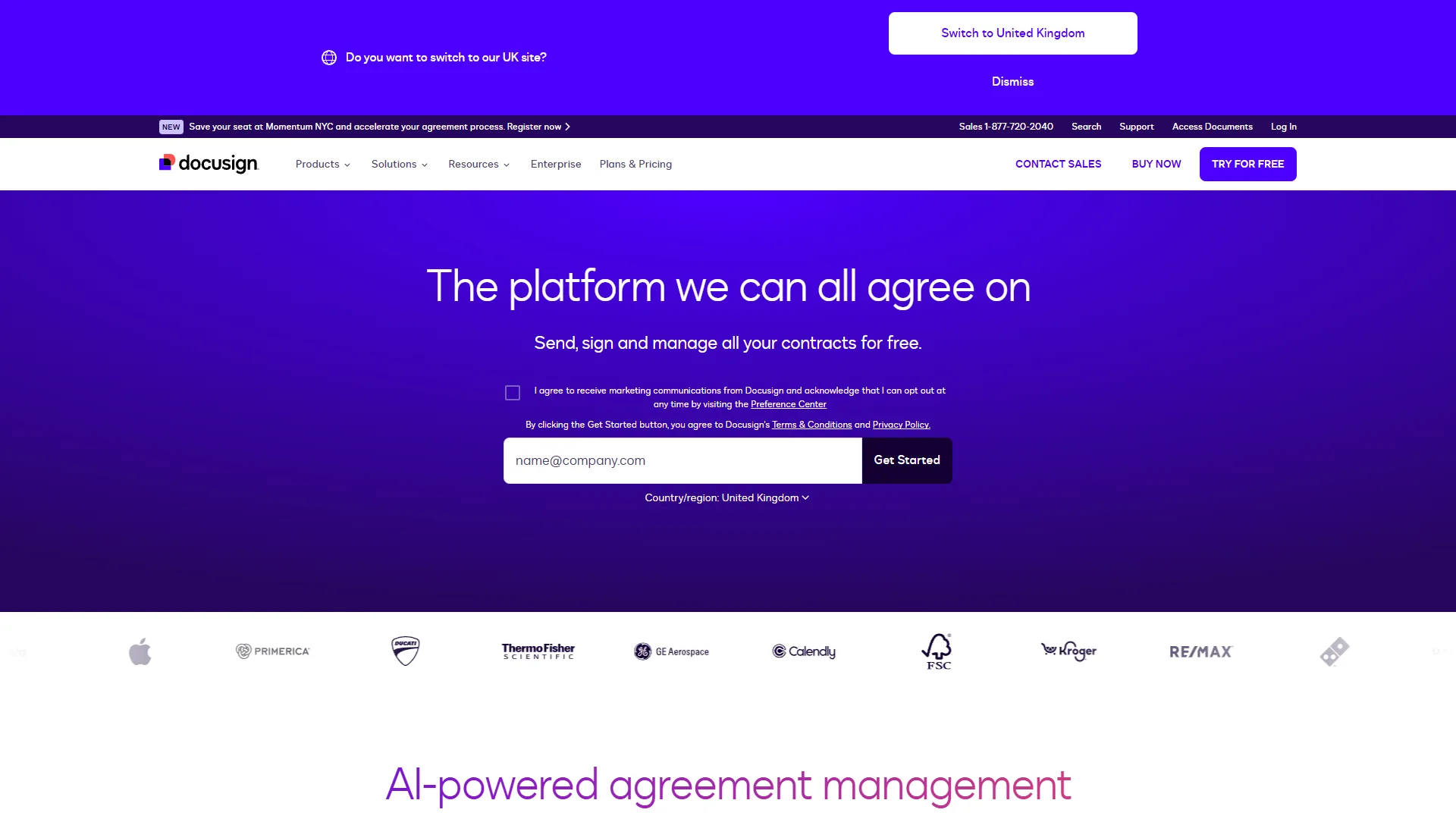
DocuSign () is best known for e-signatures, but the platform has evolved into what it now calls Intelligent Agreement Management (IAM) - the most complete pipeline from draft to signature to storage.
How Does DocuSign Handle Contract Review?
DocuSign’s AI capabilities sit in its IAM platform - a layer built on top of the core e-signature product that analyzes agreements, extracts key terms, flags non-standard language, and feeds insights into workflow automations.
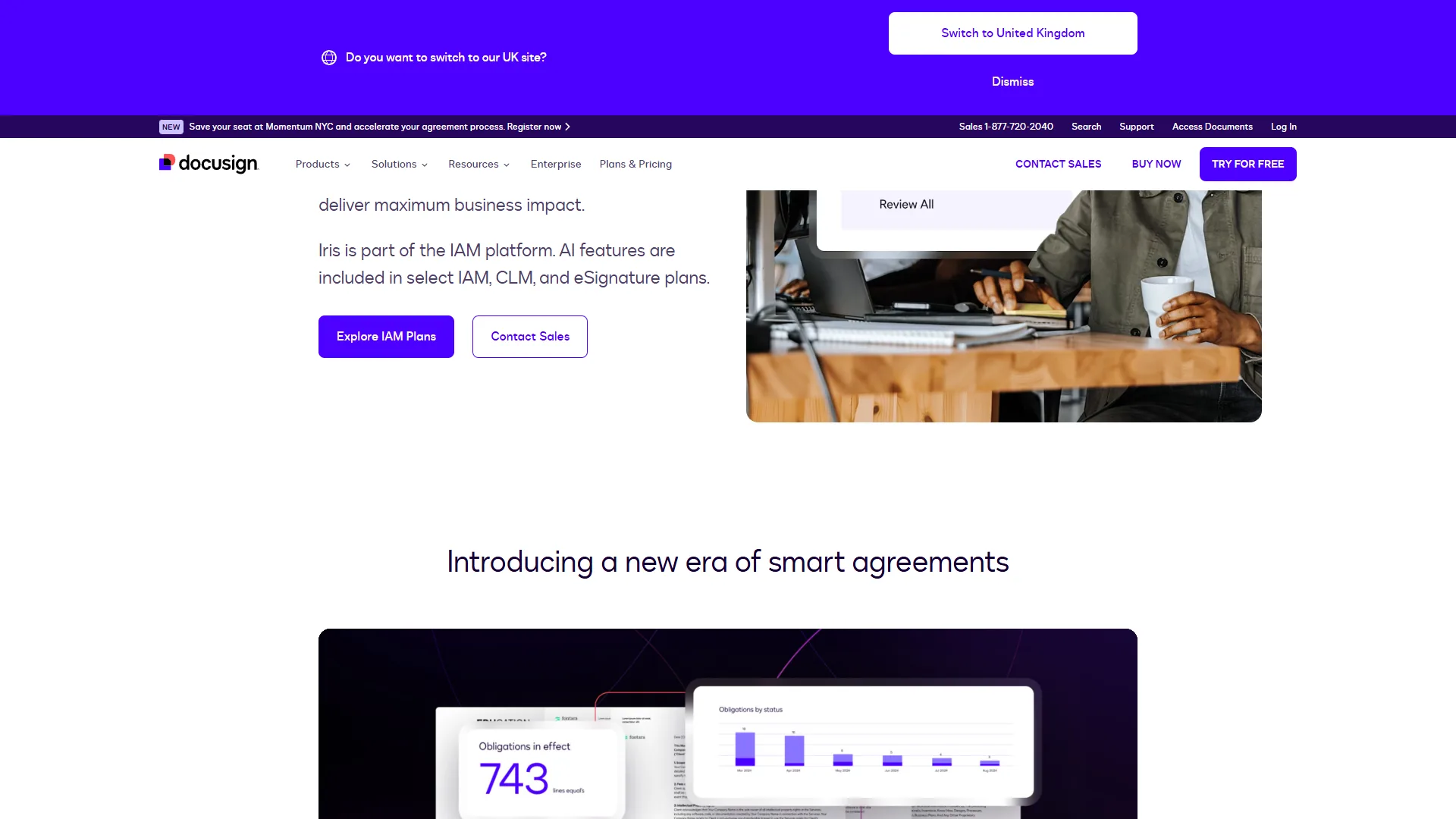
AI-Powered Document Analysis scans uploaded contracts and extracts structured data - parties, dates, obligations, financial terms, and renewal conditions. The best AI legal research tools guide covers complementary research-side AI.
Clause Comparison lets you compare extracted clauses against your organization’s standard templates, flagging deviations from approved language for indemnification, limitation of liability, and data handling.
Workflow Automation connects contract review to downstream actions - the best workflow automation tools 2026 guide covers the broader space. High-risk contracts auto-route to senior counsel; standard agreements move directly to signature.
What Makes It Stand Out
DocuSign’s competitive advantage is the integration between review and execution. Most standalone AI contract review tools hand you an analysis report and leave you to manage signing separately. DocuSign collapses that into one workflow.
Where It Falls Short
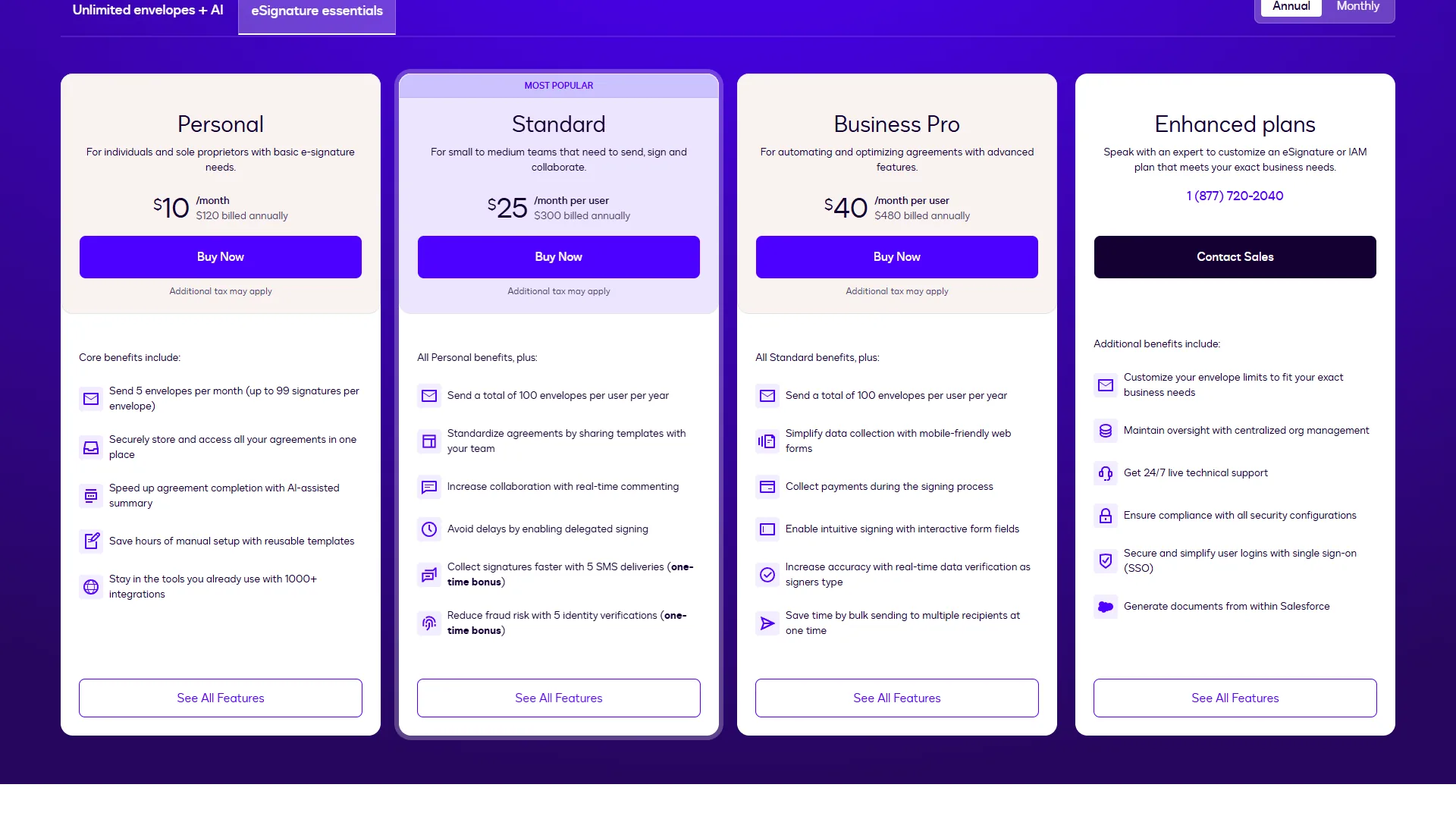
DocuSign’s AI contract review capabilities are only available on the Enhanced (enterprise) tier, which requires custom pricing. Personal ($10/mo), Standard ($25/mo), and Business Pro ($40/mo) plans give you e-signatures - not AI document analysis. The AI also works best with structured, text-based contracts; scanned PDFs with poor OCR can produce less reliable extractions. The best AI OCR tools roundup covers OCR engines that handle messy scans before review.
Pricing
Pricing verified April 2026 from DocuSign's pricing page:
- Personal: $10/user/mo annual ($15 monthly) (No AI review)
- 5 envelopes/month
- Basic signing
- Templates
- Best for: Freelancers
- Standard: $25/user/mo annual ($45 monthly) (No AI analysis)
- Unlimited envelopes
- Shared templates
- Branding
- Best for: SMBs
- Business Pro: $40/user/mo annual ($65 monthly) (No AI review)
- SMS/KBA auth
- Payment collection
- Bulk send
- Best for: Teams with complex workflows
- Enhanced: Contact sales (Custom pricing)
- IAM platform
- AI document analysis
- Advanced workflows
- Best for: Large enterprises
The gap between Business Pro and Enhanced is significant. DocuSign does not publish IAM pricing publicly.
Best For
Enterprise legal teams and procurement departments already using DocuSign for e-signatures who want AI-powered contract intelligence without a new vendor - especially organizations processing 50+ agreements per month.
2. Notion - Best for Contract Tracking and Collaborative Review Workflows
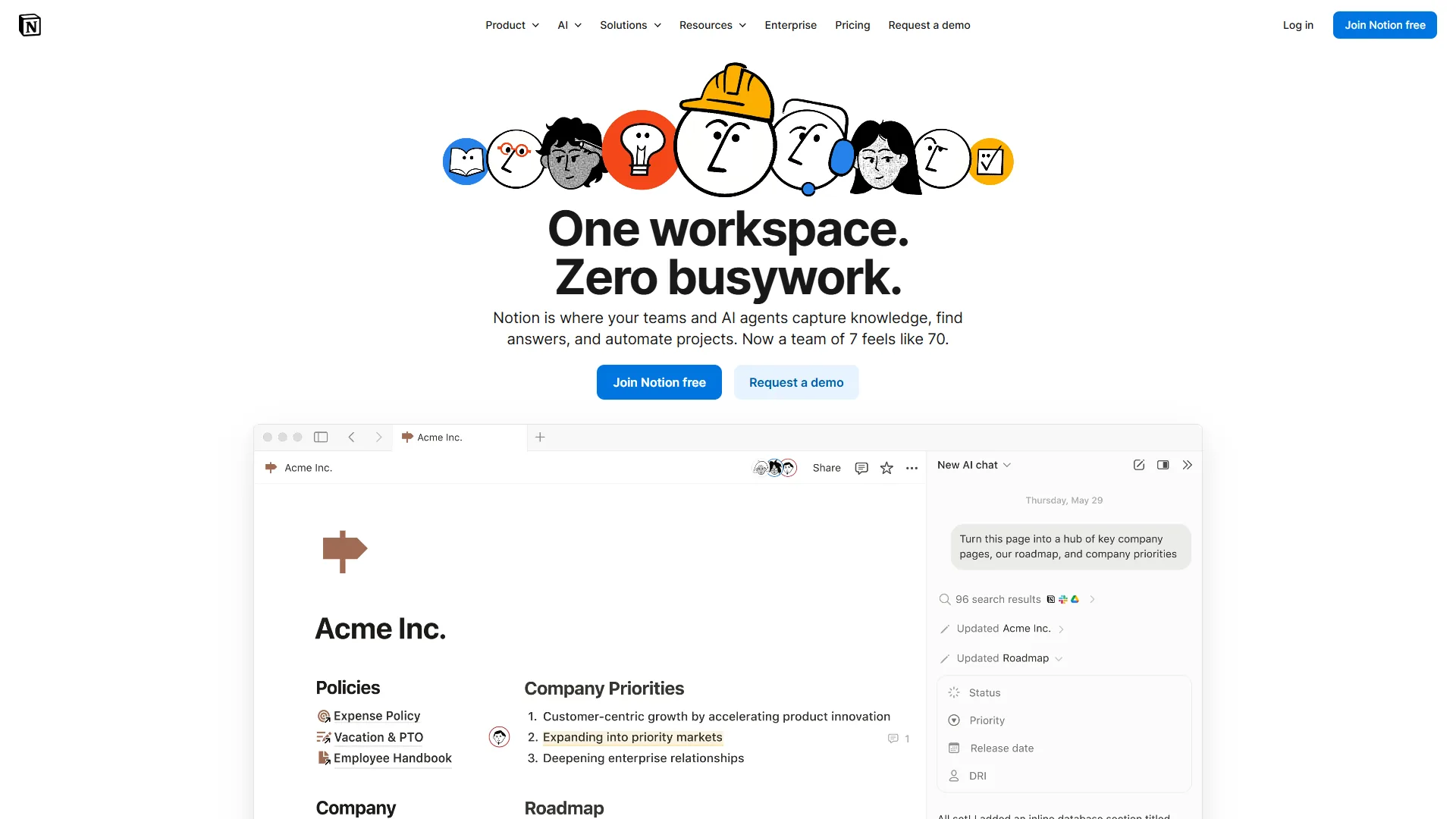
Notion () is not a dedicated contract review tool - and that distinction matters. With Notion AI built in, it bridges basic document management and intelligent review. It will not extract clauses, score risk, or compare language against legal benchmarks - but it provides a flexible workspace for organizing, tracking, and collaboratively reviewing contracts.
How Does Notion Handle Contract Review?
Notion’s contract review approach relies on three capabilities: databases for tracking, AI for summarization, and collaborative editing for team review.
Contract Database - Build a database tracking contract type, counterparty, effective date, renewal date, value, status, and assigned reviewer. Notion databases support linked relations, filtered views (contracts expiring in 90 days), and timeline visualizations.
Notion AI Summarization - Upload or paste a contract and Notion AI generates summaries, extracts key terms, and answers questions like “What are the termination conditions?” The Notion AI vs ChatGPT comparison covers how it stacks up.
Collaborative Review - Team members comment on paragraphs, tag colleagues for input on technical clauses, and track review status through database properties.
What Makes It Stand Out
Notion’s strength is flexibility - while dedicated contract AI tools force you into their workflow, Notion lets you build the system your team needs. See the best AI database tools 2026 guide for the underlying layer.
The economics are compelling. The Plus plan at $10/mo per user gives small teams full database functionality; the Business plan ($15/mo per user) bundles unlimited AI powered by GPT-5 and Claude. Compare to enterprise contract review platforms starting at $500/mo with annual commitments.
Where It Falls Short
Notion AI is a general-purpose assistant, not legal AI. It cannot compare clauses against industry benchmarks, calculate risk scores, or match the precision of purpose-built tools like Harvey AI or Luminance. For M&A agreements, complex licensing, and regulatory compliance, Notion’s AI analysis is a starting point, not a final review - see best AI legal research tools.
There is no automated clause extraction across batches. Security is adequate (SOC 2 Type II, encryption) but lacks legal hold, privilege tagging, and matter-based access controls. The best AI tools for lawyers page covers tools purpose-built for legal practice.
Pricing
Pricing verified April 2026 from Notion's pricing page:
- Free: $0/mo (No AI)
- Unlimited pages (individual)
- Page analytics
- 10 guests
- Best for: Individuals
- Plus: $10/user/mo annual ($12 monthly) (No Notion AI)
- Unlimited team blocks
- 100 guests
- 30-day history
- Best for: Small teams
- Business: $18/user/mo annual ($20 monthly) (250 guests)
- Unlimited Notion AI (GPT-5, Claude)
- AI Agents
- SAML SSO
- Best for: Teams needing AI agents
- Enterprise: Contact sales (Custom pricing)
- Workspace analytics
- SCIM, audit logs
- Success manager
- Best for: Large organizations
The Business plan at $15/mo per user is the practical entry point - full database functionality plus unlimited AI for document summarization and analysis.
Best For
Small teams, freelancers, and startups needing organized contract tracking and collaborative review without enterprise legal AI cost - especially teams already using Notion for project management.
Which Tool Fits Your Workflow: Other AI Contract Review Options
Five dedicated legal AI contract review platforms cover specialized workflows: Harvey AI for large law firms, Luminance for M&A due diligence, Kira (by Litera) for high-volume clause extraction, Clio Duo for integrated practice management, and SpotDraft for in-house legal teams. Each is purpose-built for contract analysis and delivers capabilities general-purpose tools cannot match.
Harvey AI
Harvey AI is the most-talked-about legal AI platform - backed by significant venture capital and built for law firms and legal departments. It uses LLMs fine-tuned on legal data to analyze contracts, draft clauses, and conduct legal research. Harvey is available only through enterprise partnerships and does not publish pricing.
Limitations: Harvey is gated behind enterprise contracts, excluding solo lawyers and teams under 10 seats - see best AI tools for lawyers. The platform leans heavily toward U.S. and UK frameworks.
Luminance
Luminance uses proprietary AI trained on legal documents to automate contract review at scale. Its strength is batch processing - upload hundreds of agreements and extract and compare key terms across the entire portfolio, valuable for M&A due diligence. Luminance offers cloud and on-premise deployment. Pricing is custom, typically mid-five-figures annually.
Limitations: Built for batch portfolio analysis, so teams reviewing 5-20 contracts monthly pay for unused capacity. Setup requires playbook training plus DMS integration.
Kira (by Litera)
Kira specializes in machine-learning contract analysis with over 1,000 built-in provision models, extracting clause types like change of control, assignment restrictions, and governing law across large document sets. Kira integrates with iManage and NetDocuments and has published case studies showing 20-60% time savings.
Limitations: Kira underperforms on novel clause types until you train custom models, adding weeks to deployment. Overkill for general business teams.
Clio Duo
Clio Duo is the AI assistant built into Clio’s legal practice management platform. For firms already using Clio for case management, Duo adds AI-powered contract analysis without a separate tool - summarizing documents and answering questions about contract terms.
Limitations: Only makes sense if you already pay for Clio’s practice suite. Duo lacks deep clause comparison, risk scoring, and batch processing.
SpotDraft
SpotDraft targets in-house legal teams, combining contract drafting, review, and lifecycle management. Its AI reviews contracts against your playbook and flags deviations. Self-serve pricing starts around $99/mo.
Limitations: Built for in-house workflows with a defined playbook - solo practitioners without standardized libraries see less value. Integration depth with Salesforce and HubSpot is lighter than DocuSign IAM.
AI Contract Review: Accuracy, Hallucinations, and What You Should Not Trust
AI contract review accuracy ranges from 85-95% on structured tasks like NDA clause extraction down to materially lower rates on complex M&A and cross-border agreements, and every tool in this guide hallucinates often enough that human verification remains mandatory for high-stakes clauses. Knowing where these platforms fall short matters more than knowing where they shine.
Large language models powering DocuSign IAM, Notion AI, and standalone legal platforms can hallucinate, as Stanford HAI research has documented. They misidentify clause types, overlook material terms, or generate confident-sounding analysis that is factually wrong. Lawyers have been sanctioned for submitting AI briefs containing fabricated citations.
How Accurate Is Legal AI Today?
Modern legal AI achieves 85-95% accuracy on structured tasks like clause extraction from NDAs, employment agreements, and SaaS terms - benchmarks like LegalBench track this rigorously. For complex, non-standard agreements - M&A documents, multi-party joint ventures, international contracts with cross-border provisions - accuracy drops significantly because of nuanced language and nested exceptions.
Practical Guidelines
- Never rely solely on AI for high-stakes contracts. Use it to accelerate the first pass and flag areas for human attention.
- Verify extracted data against source text. When AI says the termination notice is 30 days, click through to confirm.
- Be skeptical of risk scores. Useful for prioritization, not decision-making.
- Understand the model’s training data. U.S.-trained legal AI may perform poorly on UK or EU agreements.
- Document your AI-assisted review process. The ABA Model Rules of Professional Conduct govern technology use in legal work.
Comparison Table: DocuSign vs Notion for Contract Review
| Feature | DocuSign (IAM) | Notion |
|---|---|---|
| Primary purpose | Agreement management + e-signatures | Flexible workspace + databases |
| AI clause extraction | Yes (Enhanced tier) | No (AI summarization only) |
| Risk scoring | Yes (against internal standards) | No |
| Collaborative review | Basic (comments, routing) | Excellent (comments, mentions, databases) |
| Contract tracking | Built-in lifecycle management | Build-your-own with databases |
| E-signature | Native (industry-leading) | None (requires integration) |
| Integrations | Salesforce, SAP, Microsoft 365 | 100+ integrations, strong API |
| Pricing entry point | $10/mo (e-sig only), custom (IAM) | Free (basic), $15/mo (AI) |
| Best for | Enterprise legal + procurement | Small teams + startups |
These two serve fundamentally different users - DocuSign IAM for enterprise-scale automated clause extraction and end-to-end agreement workflows, Notion for flexible, affordable contract organization without specialized legal AI.
How Do You Choose the Best AI Contract Review Tools?
Three factors decide the right AI contract review tool: your monthly contract volume, your risk tolerance on legal accuracy, and your annual budget. Each option below carries different tradeoffs - skip to the segment that matches your team size.
For Solo Practitioners and Freelancers
You review a handful of contracts per month and need help catching obvious issues without $500/mo enterprise software. Start with Notion Business ($15/mo) for tracking and AI-assisted review - see best AI documentation tools 2026. Pair with DocuSign Personal ($10/mo) for e-signatures. Total under $25/mo.
For Small to Mid-Size Business Teams
You process 20-50 contracts monthly across departments with 2-4 reviewers. Build your system in Notion Business ($15/mo per user) with tracking databases, review templates, and AI summarization. Add DocuSign Standard ($25/mo per user) for signing. Evaluate SpotDraft as volume grows.
For Enterprise Legal Teams
You process hundreds of agreements monthly - see the AI search enterprise deep dive. You need automated clause extraction, risk scoring, batch processing, and audit-grade security. DocuSign IAM Enhanced if you already use DocuSign. Evaluate Harvey AI, Luminance, or Kira for specialized legal AI. Budget $50,000+ annually.
For Law Firms
Needs depend on practice area and firm size - see the AI knowledge management tools guide. Transactional M&A practices benefit most from Kira or Luminance. General firms benefit from Clio Duo. Large firms should evaluate Harvey AI for its legal-specific model quality.
The Bottom Line
AI contract review tools save real time but are not magic - every legal AI contract review software tool evaluated here requires human oversight on high-stakes agreements. The vendors that acknowledge this honestly are the ones worth trusting most for AI contract analysis.
The practical path is to start with what you already have. If your team uses Notion, build a contract database and use the AI for summarization. If you are on DocuSign, investigate whether upgrading to IAM fits your volume. For enterprise-scale clause extraction, invest in purpose-built legal AI like Harvey, Luminance, or Kira.
The worst approach is doing nothing - manual contract review is slow, inconsistent, and scales poorly. The best AI tools for accountants guide shows how AI has reshaped adjacent professions. Start with DocuSign for signing plus AI review, or Notion for tracking and organization.
FAQ
Q: What is the most important factor when evaluating AI contract review tools?
Accuracy and hallucination risk is the single most important factor for legal AI. The best tools flag uncertain extractions, cite specific clauses, and let you trace every AI output back to source text.
Q: Does DocuSign include AI contract review on every plan?
No. DocuSign’s AI contract review is only on the Enhanced (enterprise) tier with custom pricing. Personal ($10/mo), Standard ($25/mo), and Business Pro ($40/mo) provide e-signatures but no AI document analysis.
Q: Can Notion be used as an AI contract review tool?
Notion is not a dedicated contract review tool - it will not extract clauses, score risk, or compare language against legal benchmarks. It combines databases, AI summarization, and collaborative editing for small teams without enterprise legal AI pricing.
Q: What security standards should AI contract review tools meet?
At minimum, look for SOC 2 Type II compliance, encryption at rest and in transit, and clear data retention. Regulated industries should check HIPAA or GDPR. Critically, confirm whether the vendor trains models on your uploaded documents.
Q: How does clause detection differ between basic and advanced contract AI?
Basic contract AI identifies standard sections like termination and liability. Advanced tools score risk, compare clauses against benchmarks, and flag deviations from your organization’s preferred language - separating a search engine from an analyst.
Related Reading
These related guides go deeper on adjacent AI workflows that pair well with contract review - automation pipelines, legal research, sales operations, and the individual tool reviews referenced above.
- Best AI Automation Tools 2026 - Broader look at workflow automation platforms
- How to Automate Email with AI - Automate communication workflows around contracts
- Best AI Sales Tools - Tools for sales teams managing deal documents and proposals
- Best AI Legal Research Tools for Lawyers in 2026 - AI tools for legal research and case analysis
- DocuSign - Full review, pricing breakdown, and ROI calculator
- Notion - Full review, features, and productivity analysis
- Salesforce - Enterprise CRM with contract management integrations
- Best AI Tools for Lawyers
External Resources
External resources for further research include the ABA’s annual legal technology survey, Legal Evolution’s industry data, and Stanford CodeX’s academic work on computational law.
- ABA Legal Technology Resource Center - Annual survey on legal technology adoption
- Legal Evolution - Research and data on legal industry innovation
- Stanford CodeX - Academic research on computational law and legal AI