






Legal research is the backbone of every practice area - and it is also one of the biggest time sinks in the profession. Associates at large firms spend an estimated 30-40% of their billable hours on research tasks. Solo practitioners juggle research alongside client management, court appearances, and business development. The result is the same: too many hours spent reading cases, statutes, and secondary sources that may or may not be relevant.
AI-powered legal research tools promise to compress that timeline dramatically. Some can analyze thousands of case documents in minutes, surface relevant precedent based on natural language queries, and even predict litigation outcomes based on historical data. Accuracy is the catch: a 2024 Stanford HAI benchmark found that purpose-built legal AI tools “hallucinate in 1 out of 6 (or more) benchmarking queries”. According to Daniel E. Ho, professor of law at Stanford and senior author of the study, “existing legal AI tools do not eliminate hallucinations” - so every AI-generated citation still needs to be verified against primary sources. The market for the best AI legal research tools is evolving so fast that most comparison articles are outdated within months - and many are thinly disguised vendor content.
This guide takes a practical approach, evaluating legal research AI tools across what actually matters to practicing lawyers: accuracy and hallucination risk, security and compliance posture, pricing transparency, and how well each tool fits different firm sizes and practice areas. Because when client outcomes depend on thorough research, “good enough” is not a standard any lawyer should accept.
Selection Criteria for AI Legal Research Tools
The Best AI Legal Research Tools include Define Your Research Patterns, Run a Parallel Test, Assess Security Against Your Obligations and 1 more. Each tool takes a different approach to AI legal research tools, and the right choice depends on your budget, team size, and the specific workflows you need to optimize. This guide compares them on pricing, features, and real performance.
Before comparing specific platforms, here is the evaluation framework below. Not every firm needs every feature - a solo practitioner handling family law has different priorities than a BigLaw litigation department handling complex commercial disputes.
Which AI Legal Research Tools Have the Most Reliable Citations?
This is non-negotiable for legal work. General-purpose AI tools can hallucinate case citations - producing case names, docket numbers, and holdings that look plausible but do not exist. The best legal AI tools either restrict their outputs to verified legal databases or clearly flag when confidence is low. Any tool you use for substantive legal research must allow you to verify every citation against primary sources.
Key question: Does the tool cite to specific cases, statutes, or regulations? Can you click through to the full source text? Does it distinguish between binding and persuasive authority in your jurisdiction?
Which Security and Data Privacy Standards Should Legal AI Tools Meet?
You are uploading privileged client communications, draft briefs, and confidential case strategies. The security requirements for legal AI go beyond standard SaaS compliance - much like the document processing safeguards needed in other regulated industries. At minimum, look for SOC 2 Type II certification, end-to-end encryption, and explicit guarantees that your data is not used to train the underlying AI models.
For firms handling sensitive matters - trade secret litigation, M&A due diligence, criminal defense - also evaluate whether the tool offers on-premise deployment, regional data residency, and compliance with specific regulatory frameworks like HIPAA or GDPR.
Jurisdictional Coverage
A legal research tool that only covers federal law is not helpful when you need state-specific case law for a premises liability matter in Georgia. Evaluate coverage depth across federal, state, and local jurisdictions. For international firms, check whether the tool supports multi-jurisdictional research across common law and civil law systems.
Integration with Existing Workflows
The best tool in the world creates friction if it does not connect to your document management system, practice management software, or brief-writing workflow. Look for integrations with platforms like Clio, NetDocuments, iManage, and Microsoft 365 - the systems where legal work actually happens.
Pricing Model and Transparency
Legal tech pricing is notoriously opaque. Many vendors require a demo and a conversation with sales before revealing any pricing information. This guide prioritizes tools that publish their rates and flagged where pricing transparency is lacking. For firms evaluating these tools, the total cost of ownership includes not just subscription fees but training time, integration costs, and the productivity ramp-up period.
Comparison Table: Best AI Legal Research Tools
The best AI legal research tools in 2026 are CoCounsel, Harvey AI, Lexis+ with Protege, Lex Machina, Clio Duo, Spellbook, and Perplexity Pro - each priced from $20 to $200,000+ per year and serving a distinct firm size or workflow. The table below compares seven leading AI legal research platforms on pricing, database scope, and security posture for practicing lawyers using AI today.
| Tool | Best For | Pricing | Database | Security |
|---|---|---|---|---|
| CoCounsel | Full-service legal AI | From $100-150/user/mo (enterprise) | Westlaw/Thomson Reuters | SOC 2, no model training |
| Harvey AI | BigLaw research & drafting | $15,000-200,000+/yr (enterprise) | Custom legal corpus | SOC 2, enterprise-grade |
| Lexis+ with Protege | Comprehensive case research | Quote-based (~$128-494/user/mo) | LexisNexis full library | SOC 2, data isolation |
| Lex Machina | Litigation analytics | $150/month per user | Federal + state courts | SOC 2, Lexis infrastructure |
| Clio Duo | Practice management + AI | $49/month per user | Integrated with Clio | SOC 2, bar-compliant |
| Spellbook | Contract drafting AI | $99/month per user | Contract precedent | SOC 2, Word integration |
| Perplexity | General research + citations | Free / $20/month Pro | Web + real-time sources | SOC 2, standard encryption |
A note on pricing: CoCounsel and Harvey AI pricing is enterprise-negotiated. See each tool’s section below for specific ranges.
Perplexity: The Accessible Starting Point for Legal Research
Perplexity is the most accessible AI tool for legal research at $20 per month, useful for preliminary case research, client intake prep, and staying current on legal developments. The platform is not a dedicated legal research database, but its strength is accessibility - any lawyer can start using it today without a procurement process, enterprise contract, or six-figure budget.
Perplexity () is an AI-powered search engine that provides conversational answers with inline citations to source material. Every claim links back to a verifiable source, which is exactly what lawyers need - the ability to trace any assertion to its origin. The Pro plan adds access to advanced reasoning models and deeper sourcing from proprietary databases. For a deeper look at maximizing its capabilities, see our Perplexity tips and tricks guide.
How Lawyers Use Perplexity
Preliminary case research. A query like “what are the elements of a trade secret misappropriation claim under the Defend Trade Secrets Act” returns a structured answer with citations to legal resources and secondary sources - a starting framework before running formal database searches.
Current legal developments. Perplexity surfaces real-time analysis of new regulations, significant rulings, and bar guidance faster than traditional legal databases update their annotations.
Client intake and matter assessment. Perplexity helps attorneys assess the viability of a potential matter during or immediately after an initial consultation - state-specific custody standards, recent settlement trends, jurisdictional quirks.
Opposing counsel and judge research. Perplexity aggregates public information about judicial rulings, law firm profiles, and case histories faster than manual searching.
Pricing

Perplexity offers a genuinely useful free tier and a reasonably priced Pro plan:
- Free: Unlimited basic searches, 5 Pro searches per day. Sufficient for occasional research.
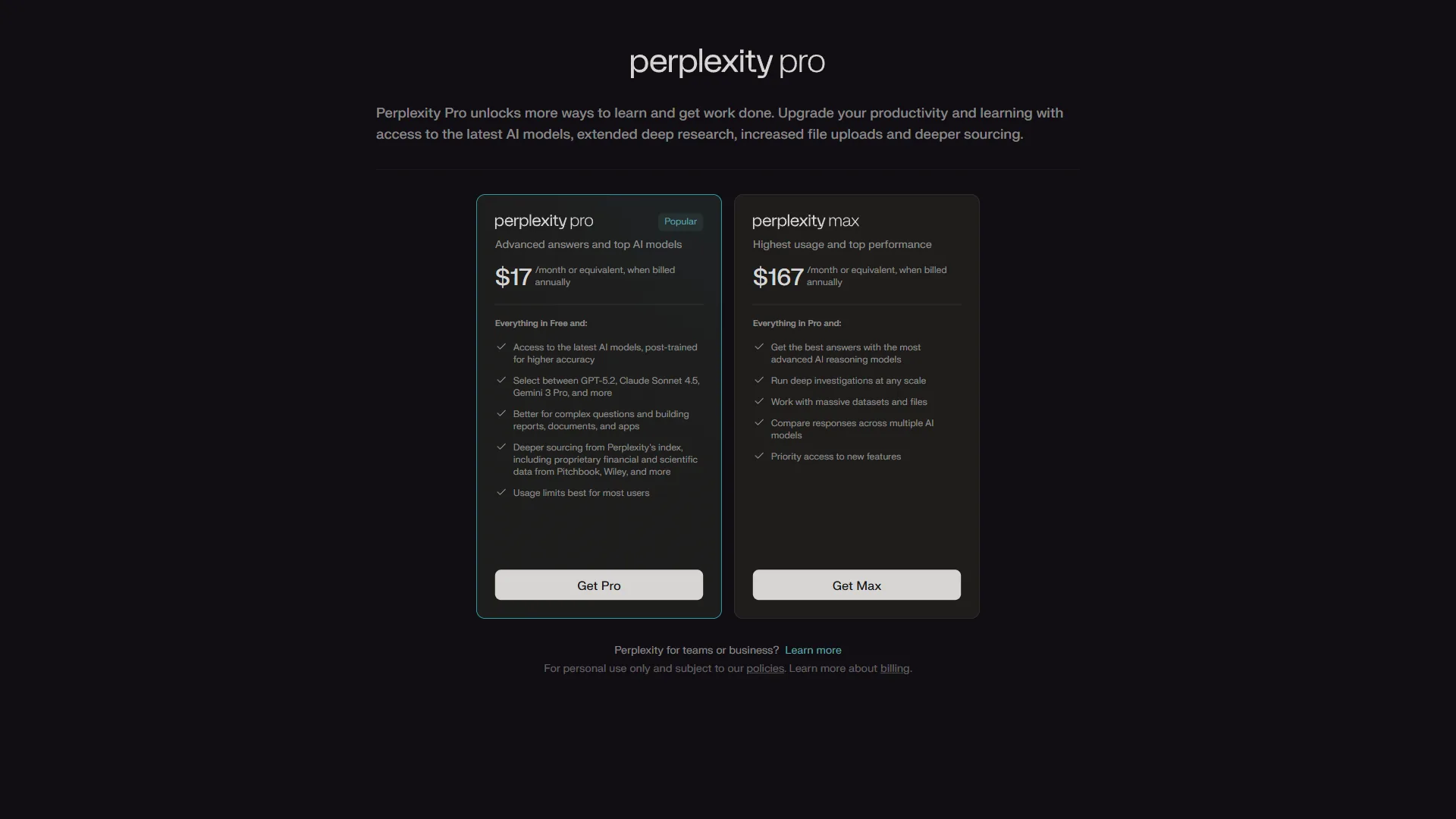
- Pro ($17 per month billed annually): Unlimited Pro searches with multi-step reasoning, access to premium AI models including GPT-5 and Claude, unlimited file uploads for document analysis, and advanced features like collections for organizing research threads.
For a solo practitioner or small firm, $20 per month for unlimited Pro searches is a fraction of what any traditional legal research platform costs. The question is not whether Perplexity is worth $20 - it clearly is. The question is whether it can replace your existing legal research tools, or whether it works best as a supplement.
Where Perplexity Falls Short for Legal Work

Not a legal database. Perplexity searches the open web, not proprietary databases like Westlaw or LexisNexis, and cannot access full-text opinions behind paywalls or KeyCite/Shepard’s citator validation.
Citation verification still required. Perplexity’s sources are web pages, not authoritative legal reporters - always verify citations against primary legal sources before relying on them in filings or client advice.
No practice management integration. Perplexity does not connect to Clio, NetDocuments, or other legal practice management tools.
Best for: Solo practitioners, small firms, in-house counsel, and any lawyer who wants fast preliminary research with citations at a price point that does not require budget approval. Skip Perplexity for substantive legal research, court filings, or any matter where missing a binding precedent could cost the case.
Legal-Specific AI Research Platforms
The following tools are purpose-built for legal work. Unlike general-purpose AI, they are trained on legal corpora, connected to authoritative databases, and designed around legal research workflows. The tradeoff is cost - these tools range from hundreds to thousands of dollars per month.
CoCounsel (by Thomson Reuters)
CoCounsel is Thomson Reuters’ legal AI assistant, built on top of the Westlaw database, and it handles document review, deposition prep, contract analysis, and legal research inside the Westlaw ecosystem. Every CoCounsel citation links to the full Westlaw record with KeyCite status, headnotes, and citing references - which eliminates the hallucination risk that plagues general-purpose AI tools.
Strengths: Deep Westlaw integration, verified KeyCite citations, document review, legal-specific training data; research quality for U.S. federal and state law is best-in-class.
Limitations: Firms report costs of $100-150 per user per month on top of existing Westlaw subscriptions, and CoCounsel cannot be purchased standalone.
Harvey AI
Harvey AI is the BigLaw legal AI platform; it runs on custom models fine-tuned on legal data and is now deployed across several AmLaw 100 firms. Harvey is a full legal work product assistant - attorneys draft memos, analyze contracts, prep depositions, and conduct jurisdictional research in one interface, and Harvey commits to not using client data for model training.
Strengths: Purpose-built legal models, comprehensive workflow coverage beyond pure research, strong security posture, active development with client-firm feedback.
Limitations: Available only to firms that pass Harvey’s onboarding. Annual contracts run $15,000 to $200,000+ depending on size; coverage is strongest in U.S. and U.K. law.
Lexis+ with Protege
Lexis+ with Protege (formerly Lexis+ AI) is LexisNexis’s answer to CoCounsel, layering the Protege AI assistant on natural language search across more than 80,000 legal, news, and business sources - cases, statutes, secondary sources, and public records grounded in verified legal authority.
Strengths: Massive database coverage, established legal research infrastructure, integration with existing Lexis workflows, practice area-specific modules.
Limitations: Pricing is quote-based - entry around $128 per user/month and Professional near $494 per user/month, expensive for small firms; AI capabilities are still maturing relative to the keyword and Boolean search features.
Lex Machina
Lex Machina is a litigation analytics platform, not a traditional research tool; it analyzes federal and state court data to reveal patterns in how specific judges rule, how long cases take, what damages are awarded, and how opposing counsel typically litigate. Knowing that a particular judge grants summary judgment in patent cases 60% of the time - versus a 35% district average - directly informs forum selection and settlement strategy. The ABA’s annual legal technology survey tracks how rapidly these analytics tools are being adopted.
Strengths: Unique litigation analytics, judge and attorney profiling, case outcome prediction, strong federal court coverage.
Limitations: Not a general legal research tool; pricing starts around $150 per user per month; state court coverage is still expanding.
Clio Duo
Clio Duo is the AI layer built into Clio’s practice management platform; for firms already on Clio, Duo adds AI-powered research and drafting without a separate tool or login. Because Duo sits inside the practice management system, it has context about your cases, clients, and matters - ask it to research an issue and it references your existing case files alongside external legal resources. For a complementary workflow, see our AI contract review tools comparison.
Strengths: Deep integration with Clio, accessible pricing at $49 per month per user, built-in time tracking, familiar interface for existing Clio users.
Limitations: Less powerful for pure research than Westlaw or Lexis-based tools; best for solo and small firms that prioritize workflow integration over research depth.
Spellbook
Spellbook focuses on contract drafting and review rather than broad legal research; it integrates directly with Microsoft Word and analyzes contracts against a precedent database to suggest clauses, flag unusual terms, and identify missing provisions. For transactional attorneys who spend most of their time in contracts, Spellbook is more targeted than a general legal research tool.
Strengths: Word integration, contract-specific AI, clause suggestion engine, $99 per month pricing.
Limitations: Not a general legal research tool; focused entirely on contract work.
Security and Compliance Comparison
Data security is not a nice-to-have for legal AI - it is a professional obligation. Bar associations across the country have issued guidance making clear that attorneys have an ethical duty to ensure the confidentiality of client information when using AI tools. Here is how the major platforms compare on the security features that matter most to law firms.
| Security Feature | CoCounsel | Harvey AI | Lexis+ Protege | Clio Duo | Perplexity |
|---|---|---|---|---|---|
| SOC 2 Type II | Yes | Yes | Yes | Yes | Yes |
| Data used for training | No | No | No | No | Not with Pro |
| End-to-end encryption | Yes | Yes | Yes | Yes | Yes (in transit) |
| On-premise option | No | Enterprise only | No | No | No |
| HIPAA compliance | Via BAA | Via BAA | No | No | No |
| Data residency controls | Limited | Yes | Limited | US only | No |
| Audit logging | Yes | Yes | Yes | Yes | Limited |
| Role-based access | Yes | Yes | Yes | Yes | No |
The key takeaway: For matters involving sensitive client data - trade secrets, M&A details, criminal defense strategies - the legal-specific platforms offer meaningfully stronger security postures than general-purpose AI tools. However, for preliminary research on publicly available legal topics, Perplexity’s security is sufficient for most use cases.
Important: Regardless of which tool you use, you should review your state bar’s guidance on AI and professional responsibility - the Thomson Reuters legal AI overview summarizes jurisdiction-by-jurisdiction disclosure requirements as they evolve. Several jurisdictions now require disclosure when AI tools are used in substantive legal work.
Limitations and who it’s not for: The security comparison has tradeoffs to weigh. Only Harvey AI offers on-premise deployment, and HIPAA-eligible BAAs are limited to CoCounsel and Harvey - ruling out the other tools for healthcare-related matters. Perplexity’s training-data carve-out applies only to Pro tier, and free-tier searches feed back into the model. Skip any tool where the data residency, BAA, or training-exclusion guarantees do not match the matter’s confidentiality requirements.
Best Picks by Use Case: Firm Size and Practice Type
The best AI legal research tool depends on firm size: solos pick Perplexity Pro and Clio Duo, mid-size firms add CoCounsel or Lexis+ with Protege, and BigLaw runs Harvey AI. The right choice fits your practice, budget, and workflow.
Solo Practitioners and Small Firms (1-5 Attorneys)
Budget is the primary constraint - solo and small firms need tools that deliver clear time savings without five-figure annual commitments.
Recommended stack:
- Perplexity Pro ($20 per month) for preliminary research, current legal developments, and client intake prep
- Clio Duo ($49 per month) if you use Clio for practice management
- Spellbook ($99 per month) if your practice is primarily transactional
Total monthly cost: $70-170. Skip CoCounsel and Harvey AI - they are not priced for solo practices. Invest in a Westlaw or Lexis basic subscription for authoritative research and use AI tools to accelerate around it.
Mid-Size Firms (6-50 Attorneys)
Mid-size firms have enough volume to justify platform investments but should be strategic about where AI creates the most value across practice groups.
Recommended stack:
- Lexis+ with Protege or CoCounsel as the primary research platform
- Perplexity Pro team accounts for fast general research alongside the primary platform
- Lex Machina for litigation practice groups
Total monthly cost: $300-800 per attorney. If AI saves each attorney 5 hours per week of research time, the subscription pays for itself many times over.
Large Firms and Enterprise Legal Departments (50+ Attorneys)
Large firms prioritize firm-wide deployment, security architecture, and integration with existing legal technology infrastructure.
Recommended stack:
- Harvey AI for comprehensive legal work product capabilities and large-deployment customization
- CoCounsel or Lexis+ with Protege as primary research backbone (most BigLaw firms keep both Westlaw and Lexis)
- Lex Machina across all litigation practice groups
- Spellbook or custom contract AI for transactional practices
Budget: Large firm deployments typically run $200,000-500,000+ annually across all legal AI tools.
In-House Legal Teams
In-house counsel research across multiple practice areas without the budget for multiple specialized tools.
Recommended stack:
- Perplexity Pro ($20 per month) as the daily workhorse for regulatory updates, vendor contract review prep, and general legal questions
- One primary legal database (Westlaw or Lexis) for authoritative research
- Spellbook ($99 per month) if contract review is a significant part of your workload
Every question answered internally instead of being sent to a $500/hour law firm saves significant budget.
Methodology: How to Evaluate Legal AI Tools
Our methodology for evaluating legal AI tools is a four-step process: track research patterns, run a parallel test, assess security obligations, and calculate the true total cost. This analysis is based on each vendor’s current pricing and feature documentation, independent research, and published American Bar Association guidance on generative AI - not sponsored placement, not hands-on benchmarking. Run this same evaluation framework before committing to any platform essential for attorneys.
1. Define Your Research Patterns
Track how attorneys spend research time for two weeks - case law versus statutory analysis versus practical guidance. Pairing a research tool with strong AI note-taking software helps capture insights as attorneys work through sources.
2. Run a Parallel Test
Most legal AI vendors offer trials - run the same 10 research tasks through your current tools and the AI alternative, then compare accuracy, speed, and citation reliability against primary sources.
3. Assess Security Against Your Obligations
Review client engagement letters, firm policies, and applicable bar rules. Matters with heightened confidentiality (trade secrets, M&A, government contracts) narrow the field significantly.
4. Calculate the True Cost
Include subscription fees, training time (10-20 hours per attorney for onboarding), workflow disruption, and ongoing integration costs - then compare against the value of recovered billable hours. For an AI ROI framework, see our guide on writing proposals with AI.
The Bottom Line
Perplexity Pro is the best starting point for most lawyers at $20 per month, while CoCounsel, Lexis+ with Protege, and Harvey AI lead the dedicated legal AI category for firms with the budget. The best AI legal research tools in 2026 range from accessible general-purpose platforms to purpose-built legal AI that costs more than some associates’ monthly student loan payments, and the right choice depends entirely on your practice size, budget, and research patterns.
For most lawyers reading this guide, the practical first step is Perplexity - it is free to start, genuinely useful for preliminary research, and costs just $20 per month for the Pro tier. It will not replace your Westlaw or Lexis subscription, but it will make you faster at the research tasks that precede formal database searches.
For firms ready to invest in dedicated legal AI, the market has matured significantly. CoCounsel and Lexis+ with Protege offer the deepest integration with authoritative legal databases. Harvey AI is pushing the boundaries of what legal AI can do across the full range of legal work product. And tools like Clio Duo and Spellbook are making AI accessible to practices that cannot justify enterprise pricing.
The one approach worth avoiding is doing nothing. Legal AI is not a trend that will fade - it is a fundamental shift in how legal research is conducted. Firms that adopt these tools now are building expertise and efficiency advantages that compound over time. Start small, verify everything, and scale what works.
FAQ
These answers cover the questions lawyers ask most about AI legal research tools - pricing, accuracy, security, and whether Perplexity is good for lawyers.
Q: Do lawyers make $500,000 a year?
Top-tier BigLaw partners and senior in-house counsel routinely earn $500,000 a year or more, but the median U.S. lawyer salary is closer to $148,000, according to the U.S. Bureau of Labor Statistics. AI legal research tools are most often justified at firms where each recovered billable hour is worth $400-$1,200.
Q: Which AI is most accurate for legal research?
Accuracy depends on whether the tool restricts outputs to verified legal databases. Dedicated platforms like CoCounsel (Westlaw), Lexis+ with Protege, and Lex Machina cite primary sources directly, while general-purpose tools can hallucinate case citations that look plausible but do not exist. Always verify every citation against primary sources, regardless of the tool.
Q: Is Perplexity good for lawyers?
Perplexity works well as a starting point for preliminary case research, tracking current legal developments, and client intake assessment. Every claim links to a verifiable source, which is what lawyers need. However, it searches the open web rather than proprietary legal databases like Westlaw or LexisNexis, so it supplements rather than replaces dedicated legal research platforms.
Q: What security should legal AI tools have?
At minimum, look for SOC 2 Type II certification, end-to-end encryption, and explicit guarantees that your data is not used to train the underlying AI models. Firms handling sensitive matters like trade secret litigation, M&A due diligence, or criminal defense should also evaluate on-premise deployment, regional data residency, and compliance with frameworks like HIPAA or GDPR.
Q: How much do AI legal research tools cost?
Clio Duo starts at $49 per month per user and Spellbook at $99 per month. Lex Machina is $150 per month and Lexis+ with Protege is quote-based, with reference points starting around $128 per user/month at the entry tier. Enterprise platforms like CoCounsel ($100-150/user/month) and Harvey AI ($15,000-200,000+/year) require negotiated contracts. Perplexity Pro at $17 per month is the most accessible entry point.
Which AI is most accurate for law?
Purpose-built legal AI is the most accurate for law, because it grounds answers in verified case databases. CoCounsel cites the Westlaw record with KeyCite status and Lexis+ with Protege cites the LexisNexis corpus, both of which dramatically reduce the hallucination rate documented in the Stanford HAI benchmark. General-purpose models like ChatGPT and Claude can still fabricate case citations.
Is Claude or ChatGPT better for lawyers?
Claude tends to be the safer default for lawyers handling long documents because its 200K-token context window can ingest a full deposition or brief in one pass, while ChatGPT’s GPT-5 reasoning is stronger for multi-step analytical questions. Neither model should be used for substantive citation work without a verified legal database in the loop - Claude or ChatGPT better for lawyers depends entirely on whether the task is summarization (Claude) or reasoning (ChatGPT).
What is the B word for lawyer?
The “B word for lawyer” most often refers to “barrister” - the term used in the U.K., Australia, and other common-law jurisdictions for an attorney who argues cases in higher courts. In U.S. usage, the closest equivalent is “trial attorney” or “litigator”. AI legal research tools sold under U.K. branding (such as Lexis+ AI’s U.K. edition) are tuned for the barrister-solicitor split.
Related Reading
These related guides cover adjacent research workflows, contract review, and automation tools that complement AI legal research platforms - a practical guide to the broader stack law firms in 2026 are using.
- Best AI Research Tools 2026 - Broader comparison of AI research tools including Perplexity, Consensus, and Elicit
- Best AI Contract Review Tools - Dedicated guide to AI-powered contract analysis platforms
- How to Research Faster with AI - Practical workflow tips for accelerating any research process
- Best AI Automation Tools 2026 - Workflow automation platforms that complement legal research tools
- Perplexity - Full review, pricing breakdown, and ROI calculator
- Lexis+ with Protege Review - Comprehensive legal AI research platform review
- Best AI Tools for Lawyers
External Resources
These external resources are the primary sources cited above for legal-AI accuracy benchmarks, bar-association guidance, and vendor documentation.
- ABA Legal Technology Resource Center - Annual survey on legal technology adoption and best practices
- Stanford CodeX Center for Legal Informatics - Academic research on computational law and legal AI
- Perplexity Pro Features - Detailed breakdown of Pro tier capabilities and model access