


Finding the best workflow automation tools 2026 is not about crowning a single winner - it is about matching your specific complexity level, budget, and technical comfort to the platform that handles it best. Make, Zapier, and n8n each dominate a different lane, and as McKinsey research shows, successful automation adoption depends on choosing tools that align with organizational maturity - a topic our AI workflow automation maturity model breaks down by team stage.
All three platforms now offer AI agents, but their implementations diverge sharply. Zapier’s linear simplicity wins for beginners, Make’s visual orchestration dominates complex branching logic, and n8n’s code-first approach gives developers unprecedented control - especially with the new Agent-to-Agent feature.
Methodology and disclosure: this comparison draws on each vendor’s official documentation, public pricing pages, and independent industry research from sources including Gartner and Deloitte. We earn affiliate commissions on some links below, but rankings reflect documented capabilities and pricing only - vendor relationships do not influence the verdicts.
Here’s what every automation buyer should know before choosing a platform - a practical workflow automation tools list pulled from each platform’s documented strengths.
Quick Verdict: Which Tool Is Right for You?
The right workflow automation tool in 2026 is Zapier for non-technical beginners, Make for visual high-volume orchestration, and n8n for developers building self-hosted or multi-agent systems.
Choose Zapier if: You’re new to automation, want the easiest setup, and budget isn’t your primary concern. Zapier’s 7,000+ integrations and intuitive interface get you productive in hours, not days.
Choose Make if: You need visual control over complex workflows, branching logic, or high-volume automation at scale. Make’s Pro tier ($18.82 per month) delivers 8 million operations - Zapier charges $69 per month for 2,000 tasks.
Choose n8n if: You’re a developer or technical team wanting full control, self-hosting options, or need to build sophisticated AI agent systems. The free self-hosted Community Edition is genuinely unlimited.
Best Workflow Automation Tools 2026: Platform Overview
Make, Zapier, and n8n are the three leading workflow automation tools in 2026, with Make leading on visual orchestration, Zapier on integration breadth (7,000+ apps), and n8n on developer control and self-hosting.
Make (Formerly Integromat)
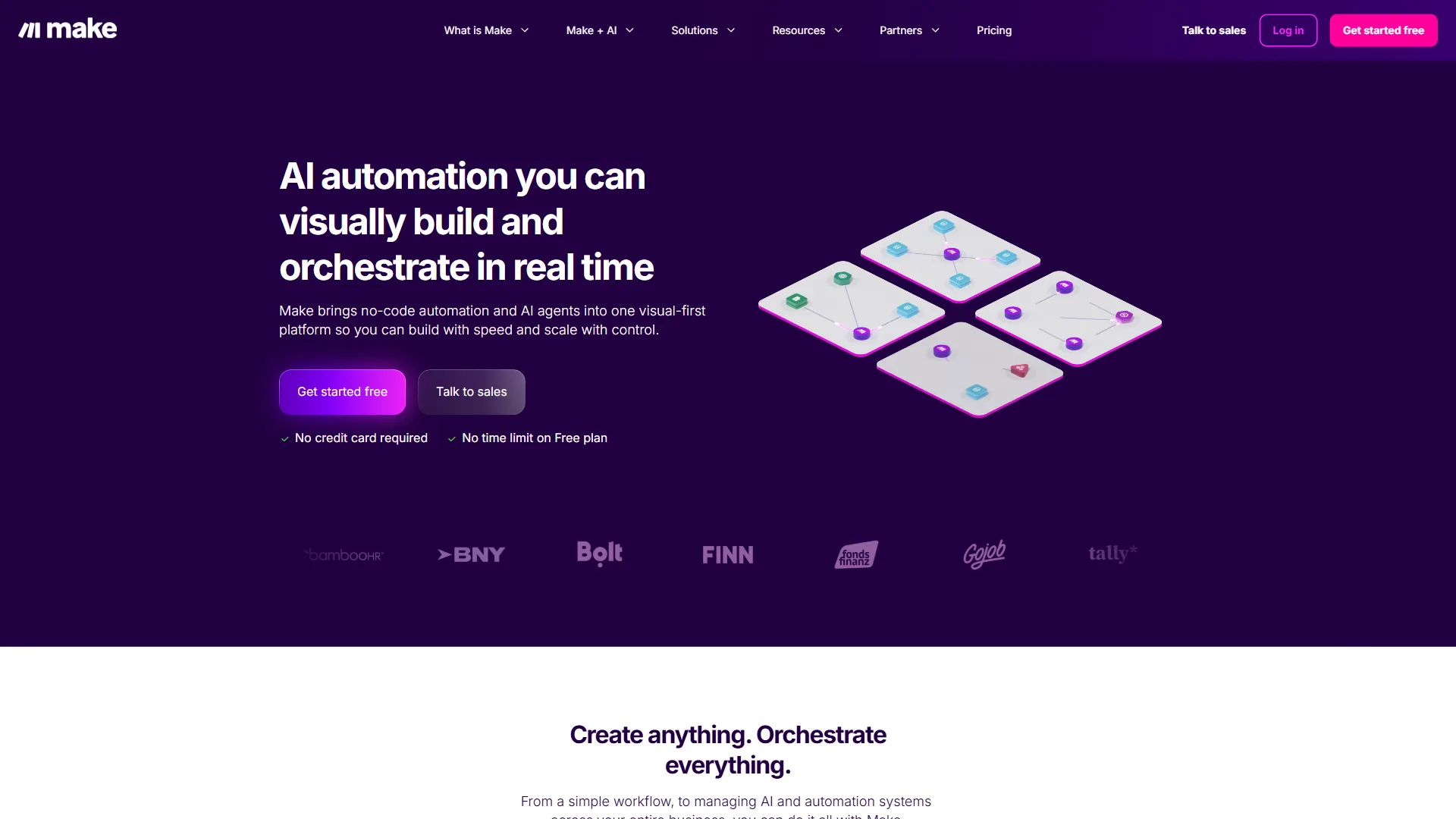
Make transforms complex automation through a visual flowchart interface that surfaces branching logic, data transformations, and conditional paths at a glance.
What sets Make apart:
- Visual orchestration with drag-and-drop modules
- Make AI Agents (beta) for adaptive automation
- Maia AI for natural language scenario building
- 2,000+ app integrations with 30,000+ actions
- Advanced routing, filtering, and iterators
The November 2026 pricing update increased operation limits: Core now includes up to 300,000 ops/month, Pro up to 8 million. Make costs 60-70% less than Zapier at volume.
Make limitations: Skip Make if your team is non-technical and just needs a 3-step “form to Slack” automation - the visual editor has a 4-8 hour learning curve. AI Agents are still beta, and integration breadth lags Zapier (2,000+ versus 7,000+ apps).
Zapier
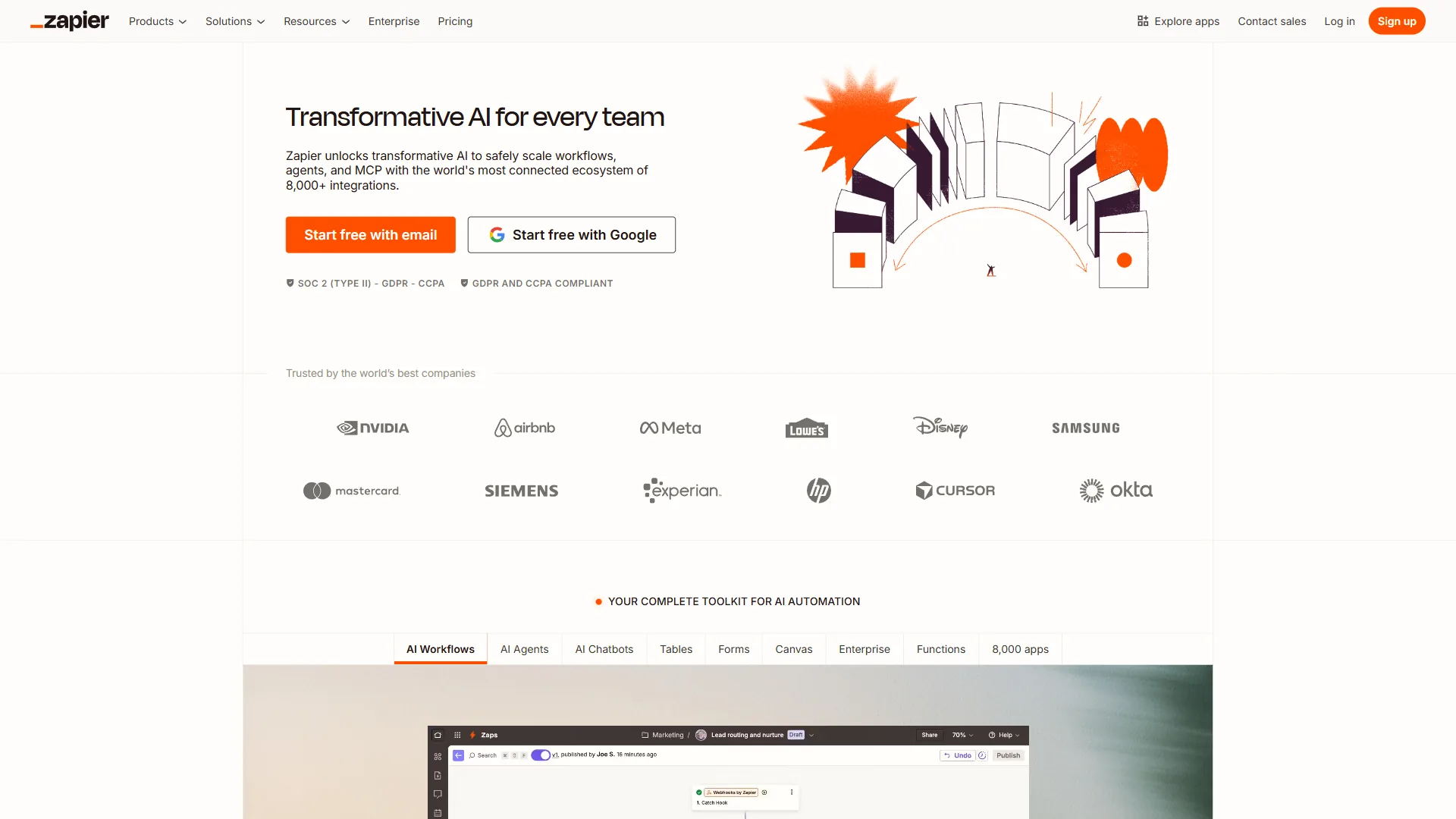
Zapier remains the gateway tool for automation. The “when this happens, do that” paradigm clicks immediately for non-technical users, and 7,000+ app integrations mean you’ll rarely hit an unsupported app.
What sets Zapier apart:
- Easiest learning curve of any automation tool
- 7,000+ app integrations (largest ecosystem)
- Zapier Agents for AI-powered autonomous tasks
- Multi-model AI support (GPT, Claude, Gemini)
- Tables and Interfaces for data management
Zapier Central rebranded to Zapier Agents in January 2026, adding AI teammates that work across connected apps. The Professional tier ($29.99/month) unlocks multi-step Zaps, Filters, and Paths.
Zapier limitations: Skip Zapier if you run more than 5,000 monthly tasks - per-task pricing gets 5-10x more expensive than Make at volume. The linear flow also struggles with branching logic and parallel paths.
n8n
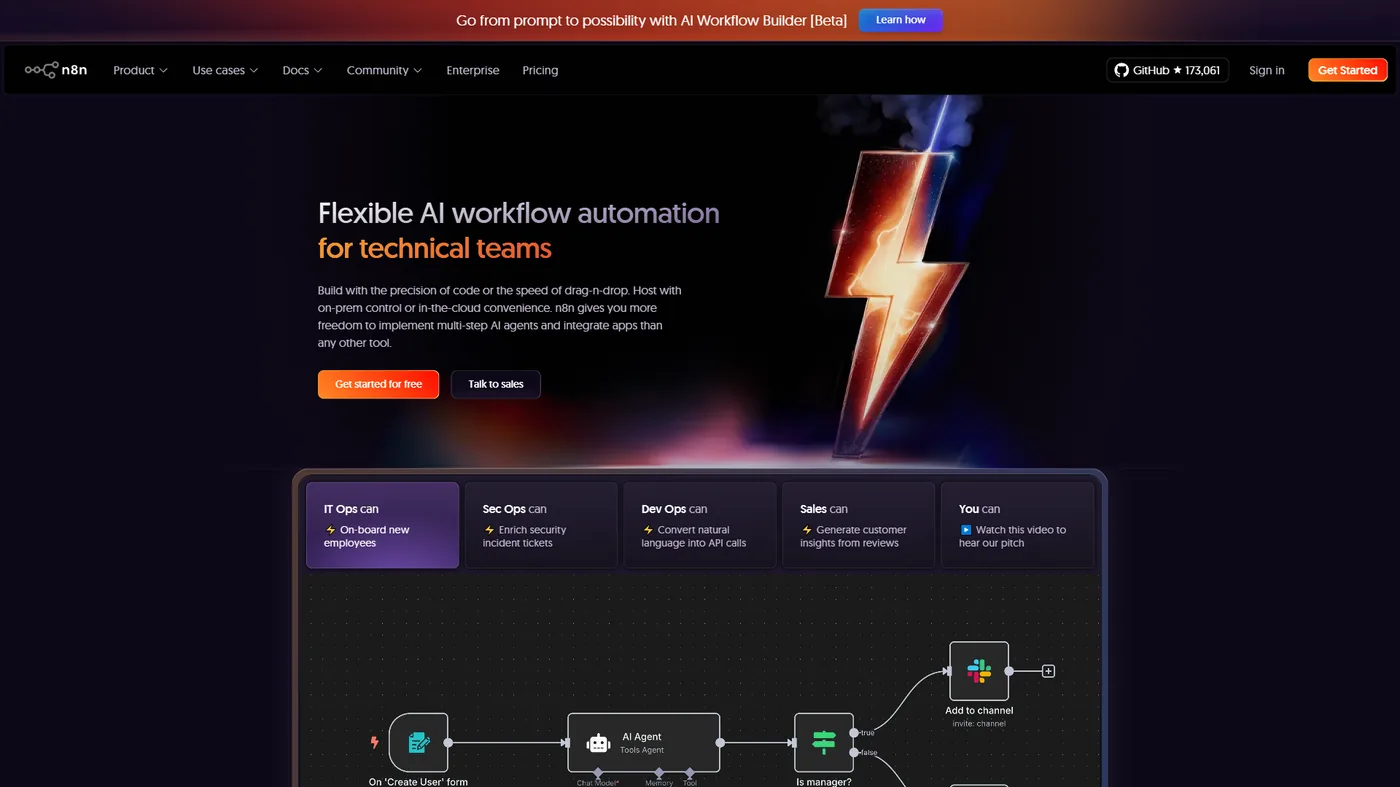
n8n is what happens when developers build an automation tool for developers. The fair-code license means you can self-host for free with unlimited executions - only paying server costs (typically $5-10/month for a basic VPS).
What sets n8n apart:
- Free self-hosted Community Edition (truly unlimited)
- Agent-to-Agent feature (July 2026) - AI agents using other agents as tools
- LangChain-based AI with custom model support
- 400+ integrations with full REST API access
- Mix deterministic automation with AI flexibility
The July 2026 Agent-to-Agent feature lets one AI agent call another as a tool, enabling multi-agent workflows that adapt to complex scenarios.
n8n limitations: Skip n8n if no one on your team writes JavaScript or manages servers - self-hosting needs patching, backups, and uptime monitoring (2-4 hours/month). The 400+ integration library is a fraction of Zapier’s, and the node-based editor intimidates non-developers.
AI Agent Comparison: The 2026 Differentiator
All three platforms now offer AI agents, but the implementations vary dramatically:
| Feature | Make AI Agents | Zapier Agents | n8n AI Agents |
|---|---|---|---|
| Status | Beta (April 2026) | Production | Production |
| Approach | Visual + AI | Linear + AI | Code-first + AI |
| Model Support | GPT-4o, o3, Claude | GPT, Claude, Gemini | OpenAI, Claude, Gemini, DeepSeek |
| Agent Orchestration | Single agent per scenario | Single agent per Zap | Agent-to-Agent (agents as tools) |
| Custom Models | Yes (all paid plans) | Yes (via API keys) | Yes + self-hosted models |
| Learning Curve | Medium | Easy | Advanced |
Make AI Agents adapt workflows in real-time based on data patterns; still beta with occasional decision errors, but visual orchestration shows exactly what decisions the agent makes. Maia AI lets you build scenarios in natural language - our Make AI Agents guide walks through real configurations.
Zapier Agents feel like autonomous assistants across your apps - polished and production-ready, but limited to Zapier’s linear flow paradigm.
n8n AI Agents offer the most sophisticated control. The Agent-to-Agent feature enables true multi-agent systems where specialized agents collaborate - our AI agent orchestration patterns guide explores the architecture. The tradeoff: you need developer skills to configure this properly.
Pricing Comparison: December 2026
Pricing ranges from free (n8n self-hosted, plus Make’s 1,000-ops and Zapier’s 100-task free tiers) to $69 per month for Zapier Team, with Make Pro at $16 per month delivering roughly 100x more executions per dollar than Zapier Team. All figures below are normalized to monthly costs using annual pricing where available:
| Tier | Make | Zapier | n8n Cloud |
|---|---|---|---|
| Free | 1,000 ops/mo | 100 tasks/mo | N/A |
| Entry | $9/mo (Core, 300K ops) | $19.99/mo (Pro, 750 tasks) | $24/mo (Starter, 2,500 exec) |
| Pro | $16/mo (Pro, 8M ops) | $69/mo (Team, 2K tasks) | $50/mo (Pro, 10K exec) |
| Enterprise | Custom | Custom | Custom |
The volume math is brutal for Zapier. Team at $69/month includes 2,000 tasks; Make Pro at $16/month (annual) includes 8 million operations - roughly 100x more executions per dollar.
Self-hosted n8n changes everything for technical teams: unlimited workflows and executions, with only $5-10/month VPS hosting.
Hidden Costs to Consider
- Make: 4-8 hours of onboarding time on the visual interface.
- Zapier: Multi-step Zaps consume one task per action, so a 5-step Zap running 100 times burns 500 tasks.
- n8n Self-Hosted: Server management, backups, and updates take 2-4 hours/month - see the official n8n self-hosting documentation, or use managed hosting ($15-30/month).
Feature-by-Feature Breakdown
Make leads on visual workflow design, Zapier leads on integration breadth and learning curve, and Make plus n8n lead on cost-at-scale across the four core categories. The detailed ratings:
Visual Workflow Design
Make: 5/5 - The flowchart editor is unmatched. See data flow in real-time, debug visually, understand complex logic at a glance.
n8n: 4/5 - Node-based visual editor is powerful but feels more technical. Great for developers, intimidating for non-coders.
Zapier: 3/5 - Linear interface works for simple flows but becomes unwieldy with complex conditional logic. You can’t visualize branching paths.
Integration Ecosystem
Zapier: 5/5 - 7,000+ apps with 450+ AI-specific integrations. You’ll rarely find an app Zapier doesn’t support.
Make: 9/10 - 2,000+ apps with 30,000+ actions. Covers all major platforms; API modules handle the rest.
n8n: 4/5 - 400+ integrations plus HTTP Request node for any REST API. Smaller library but community contributes actively.
Learning Curve
Zapier: 5/5 - Build your first automation in 15 minutes. The paradigm is intuitive; help docs are excellent.
Make: 7/10 - Expect 4-8 hours to feel comfortable. The visual interface is powerful but requires understanding modules, routes, and data structures.
n8n: 5/10 - Steep curve for non-developers. JavaScript knowledge helps significantly. Self-hosting adds another layer of complexity.
Cost at Scale
Make: 5/5 - Core at $9 per month includes 300K operations. Pro at $16 per month delivers 8 million. Exceptional value.
n8n: 5/5 - Self-hosted is free forever. Cloud pricing is competitive at $24-50/month.
Zapier: 2/5 - Gets expensive fast. High-volume automation on Zapier costs 5-10x more than Make.
Best Picks by Use Case Complexity
Zapier is the best pick for simple 1-3 step automations, Make is best for medium 4-10 step workflows with branching logic, and n8n is best for high-complexity multi-agent and self-hosted systems.
Simple Automations (1-3 steps)
Best choice: Zapier
For basic “when this, do that” automations - new lead to CRM, new email to Slack notification, form submission to spreadsheet - Zapier’s simplicity wins. Setup takes minutes, not hours.
- New Stripe payment -> Google Sheet row + Slack notification
- New form submission -> CRM contact + welcome email
- New calendar event -> Slack reminder + attendee prep doc
Medium Complexity (4-10 steps with conditions)
Best choice: Make
When you need conditional logic, data transformation, or multiple decision paths, Make’s visual orchestration becomes invaluable.
- Lead scoring with engagement-based follow-up sequences
- Multi-channel campaign orchestration with behavior-based branching
- Order processing with inventory checks and conditional shipping
Make’s routers branch workflows on any condition, iterators process arrays item-by-item, and aggregators compile data from multiple sources - all visible in the flowchart view.
High Complexity (10+ steps, multi-agent, custom logic)
Best choice: n8n
For systems requiring custom code, multi-agent orchestration, or self-hosted control, n8n provides capabilities the others can’t match.
- AI agent systems with specialized sub-agents (research, writing, analysis)
- Custom ETL pipelines with complex data transformations
- Self-hosted automation for sensitive data (healthcare, finance, legal)
The Agent-to-Agent feature enables coordinator-and-specialist architectures - one agent delegates to research, writing, or analysis agents as tools.
High Volume, Budget-Conscious
Best choice: Make or n8n Self-Hosted
If you’re running 10,000+ operations monthly, Zapier’s pricing becomes prohibitive - our SMB workflow automation guide leans heavily on Make and n8n for this reason.
Cost comparison for 100,000 monthly operations:
- Zapier: $599 per month (Enterprise, custom)
- Make Pro: $16 per month (8M operations included)
- n8n Self-Hosted: $10 per month (VPS only)
Migration Considerations
Migration takes 2-3x the original build time for Zapier-to-Make moves and 3-4x for moves to n8n, because each platform’s module or node paradigm requires a full rebuild rather than an import.
Zapier to Make
Make’s module system differs from Zapier’s action paradigm, so you’ll rebuild rather than import - our Zapier vs Make comparison covers the trade-offs. Worth it when you’re spending $50+/month on Zapier, frustrated by linear-flow limits, or need visibility into complex automations.
Zapier/Make to n8n
Expect 3-4x rebuild time plus a learning curve. Worth it only if you need self-hosting, custom model integrations, or Agent-to-Agent capabilities.
Final Verdict
The best workflow automation tool in 2026 is Make for visual high-volume orchestration, Zapier for non-technical teams running fewer than 5,000 monthly tasks, and n8n for developers needing self-hosting or multi-agent systems - the right choice depends on automation complexity, budget sensitivity, and technical capacity.
According to a 2024 McKinsey & Company report on automation imperatives, “successful scaling of automation requires aligning the technology choice with the organization’s process complexity and talent pool” - a finding that mirrors the platform-fit pattern across Make, Zapier, and n8n.
Zapier wins for: Non-technical users, simple automations, teams prioritizing ease over cost.
Make wins for: Complex visual workflows, high-volume automation, cost-conscious teams outgrowing Zapier. If you’re spending $50+/month on Zapier, Make Pro at $16 per month will likely cut your costs 60-70%.
n8n wins for: Developers, self-hosted requirements, sophisticated AI agent systems.
A recommended setup: Make for production business workflows, n8n self-hosted for AI agent experiments, and Zapier for quick one-off automations. Start with free tiers - Make offers 1,000 operations/month, Zapier provides 100 tasks/month, and n8n’s self-hosted Community Edition is unlimited.
For more productivity insights, explore our guides on Best Ai Automation Tools 2026.
FAQ
Q: What is the best workflow automation tool for beginners in 2026?
Zapier is the best pick for beginners, offering 7,000+ integrations and an intuitive linear interface that gets users productive in hours rather than days.
Q: Is Make cheaper than Zapier for high-volume automation?
Yes. Make’s Pro tier at $18.82 per month delivers up to 8 million operations, while Zapier charges $69 per month for 2,000 tasks - roughly 60-70% less for equivalent volume.
Q: Which workflow automation tool is best for developers?
n8n is the strongest pick for developers, offering a code-first approach, self-hosting, and Agent-to-Agent capability. The Community Edition is genuinely unlimited.
Q: Do Make, Zapier, and n8n all support AI agents?
Yes. Make provides AI Agents in beta plus Maia AI for natural language scenario building, Zapier offers production-ready Agents, and n8n supports multi-agent Agent-to-Agent workflows.
Related Reading
Related resources cover each platform’s setup, AI agent configuration, and migration patterns in detail. Tools covered in this article:
- Make - Visual workflow orchestration with AI Agents
- Zapier - Beginner-friendly automation with linear flows
- n8n - Self-hosted workflow automation for developers
- Slack - Team communication and workflow integration hub
- Linear - Modern project management for teams
More automation and productivity guides:
- Best AI Automation Tools 2026 - AI automation platform comparison
- Best Workflow Automation Tools for SMBs - Small business automation guide
- Automation AI Agents Guide - Building AI agents with automation
- Zapier vs Make 2026: Which Automation Platform Is Right for You?
- 5 Best AI Tools for Developers in 2026
- Best AI Invoice Tools 2026: Automate Your Billing Workflow
External Resources
Each vendor’s primary documentation and engineering blog provides authoritative verification of features, pricing, and AI agent capabilities for Make, Zapier, and n8n:
- Make Blog - Visual workflow tips and AI Agents feature updates
- Zapier Blog - Automation guides and Zapier Agents announcements
- n8n Blog - Self-hosted automation and Agent-to-Agent feature releases