



The best Vercel alternatives in 2026 are Netlify, Cloudflare Pages, Railway, Render, and Fly.io, with AWS Amplify, GitHub Pages, and DigitalOcean App Platform covering AWS-native, static-only, and VPS-style workloads. This guide compares all eight on pricing, edge performance, framework support, and full-stack capability.
Our analysis draws on current vendor documentation, pricing pages, and independent research rather than sponsored placement. AI Productivity may earn a commission from links on this page; rankings are editorially independent.
Vercel earned its position by making deployment frictionless - connect a GitHub repo, push code, get a global CDN deployment in seconds. But Pro plans at $20 per user/month scale linearly, bandwidth and function overages create billing surprises, and the framework-specific lock-in plus US-centric edge network push many developers to evaluate alternatives.
Why People Look for Vercel Alternatives
Teams leave Vercel for five specific reasons: per-seat cost at scale, bandwidth overage charges, vendor lock-in on framework features, US-centric regional compute, and short function execution limits.
Cost at scale. Vercel Pro starts at $20 per user/month, so a 10-person team pays $200 per month before any bandwidth or function usage. According to Vercel’s official pricing documentation, “Each member added to a Pro team costs $20/month and gets full access to all team features.” For teams that deploy frequently without Vercel-specific features, the economics rarely pencil out.
Bandwidth overages. Pro includes 1TB per month; overages are $0.15/GB and add up fast on media-heavy or global sites.
Vendor lock-in. Edge Functions, Edge Config, Image Optimization, and ISR cache control are built for Vercel’s infrastructure. Migrate away and you reimplement them. Some App Router behaviors only work optimally on Vercel. See our version control toolchain guide for lock-in tradeoffs.
Regional compute. Vercel Serverless Functions run in a primary region with global routing, not true global compute.
Function execution limits. Hobby caps at 10 seconds; Pro at 60 seconds. Long-running operations need workarounds.
How Do the Top Vercel Alternatives Compare at a Glance?
The top Vercel alternatives split into five categories at a glance: Netlify and Cloudflare Pages compete head-to-head for JAMstack workloads, Railway and Render serve full-stack apps with databases, Fly.io leads global container deploys, AWS Amplify wins inside AWS, and GitHub Pages plus DigitalOcean App Platform cover static and VPS-friendly use cases.
| Platform | Best For | Free Tier | Starting Price | Edge/Global |
|---|---|---|---|---|
| Netlify | JAMstack, static sites, serverless | Generous | $19/user/mo | Yes (CDN) |
| Cloudflare Pages | Edge-first, Workers integration | Very generous | $20/mo (Pro) | 300+ PoPs |
| Railway | Full-stack, databases, microservices | $5 credit/mo | $5/mo (Hobby) | Limited |
| Render | Simple PaaS, auto-scaling | Yes (limited) | $7/mo | Limited |
| Fly.io | Containers, global deploys | Generous | Pay-per-use | Yes (35+ regions) |
| AWS Amplify | AWS ecosystem, enterprise | Yes | Pay-per-use | Via CloudFront |
| GitHub Pages | Static sites only | Unlimited (public) | Free | Via Fastly |
| DigitalOcean App Platform | VPS owners, simple apps | None | $3/mo | Limited |
1. Netlify - The Closest Vercel Equivalent
Netlify is the most obvious Vercel alternative because it pioneered the git-push deployment workflow, invented deploy previews, and has a mature ecosystem for serverless functions, forms, identity, and CMS integrations. Netlify’s documentation covers Edge Functions, framework configuration, and the full deployment platform reference.
What makes Netlify competitive in 2026: Netlify’s Edge Functions runtime executes Deno-based workers at the CDN level rather than in a single region. The free tier ships 100GB bandwidth and 300 build minutes/month. Netlify’s Deploy Previews remain best-in-class, with the Netlify Drawer letting reviewers leave comments directly on preview deployments - something Vercel does not match natively.
Framework support. Netlify has strong support for Gatsby, Nuxt, SvelteKit, Remix, and Astro alongside Next.js. Teams not all-in on Next.js gain from Netlify’s framework-agnostic approach, often paired with AI-powered code editors.
Pricing:
| Plan | Price | Bandwidth | Build Minutes | Serverless |
|---|---|---|---|---|
| Starter | Free | 100GB | 300/mo | 125,000 invocations |
| Pro | $19/user/mo | 1TB | 25,000/mo | 2M invocations |
| Business | $99/mo (min 3 users) | 1.5TB | 100,000/mo | 3M invocations |
| Enterprise | Custom | Custom | Custom | Custom |
The honest comparison with Vercel: Netlify Pro at $19 per user/month is nearly identical to Vercel Pro at $20 per user/month. Netlify’s Deploy Previews and CMS integrations are stronger; Vercel’s Next.js optimization and Edge Middleware are stronger.
Best for: Teams using multiple frameworks, projects that benefit from the Deploy Preview workflow, and developers who want a mature ecosystem without being tied to Next.js.
Limitations: Tighter Next.js feature parity than Vercel, per-user pricing that scales painfully on Pro, and bandwidth overages that bite high-traffic sites.
2. Cloudflare Pages - Best for Edge-First Deployments
Cloudflare Pages is the strongest Vercel alternative for teams that prioritize global edge performance and cost efficiency. The free tier ships unlimited bandwidth, unlimited requests, unlimited sites, and 500 builds per month. The Cloudflare Pages documentation covers Pages Functions, Workers integration, and framework support.
The edge advantage. Cloudflare Pages Functions run on Cloudflare Workers - actual compute at 300+ points of presence worldwide - while Vercel routes statically via CDN with functions in a primary AWS region. For SSR with dynamic personalization or edge-side A/B testing, the latency difference is measurable.
Workers ecosystem integration. Pages functions have direct access to KV storage, Durable Objects, R2 object storage, D1 SQLite databases, and AI inference via Workers AI. For managed-database options that complement these stores, see our roundup of AI database tools.
Framework support. Astro, Next.js (via @cloudflare/next-on-pages), Nuxt, SvelteKit, Remix, and most static site generators. Next.js support is adapter-based and does not cover every App Router feature; test before migrating.
Pricing:
| Plan | Price | Requests | Bandwidth | Workers |
|---|---|---|---|---|
| Free | $0 | 100K/day | Unlimited | Included |
| Pro | $20/mo | 10M/mo | Unlimited | Included |
| Business | $200/mo | 100M/mo | Unlimited | Advanced |
The free tier’s unlimited bandwidth is the key differentiator - on Vercel or Netlify, heavy traffic triggers overage charges; on Cloudflare Pages, bandwidth is not a billing lever.
Best for: Projects where global latency matters, teams already on Cloudflare, cost-sensitive sites with unpredictable traffic, and developers building edge-native apps.
Limitations: Adapter-based Next.js support that lags App Router features, a Workers runtime without full Node.js compatibility, and a steeper learning curve for KV, D1, and Durable Objects.
3. Railway - Best for Full-Stack Deployments
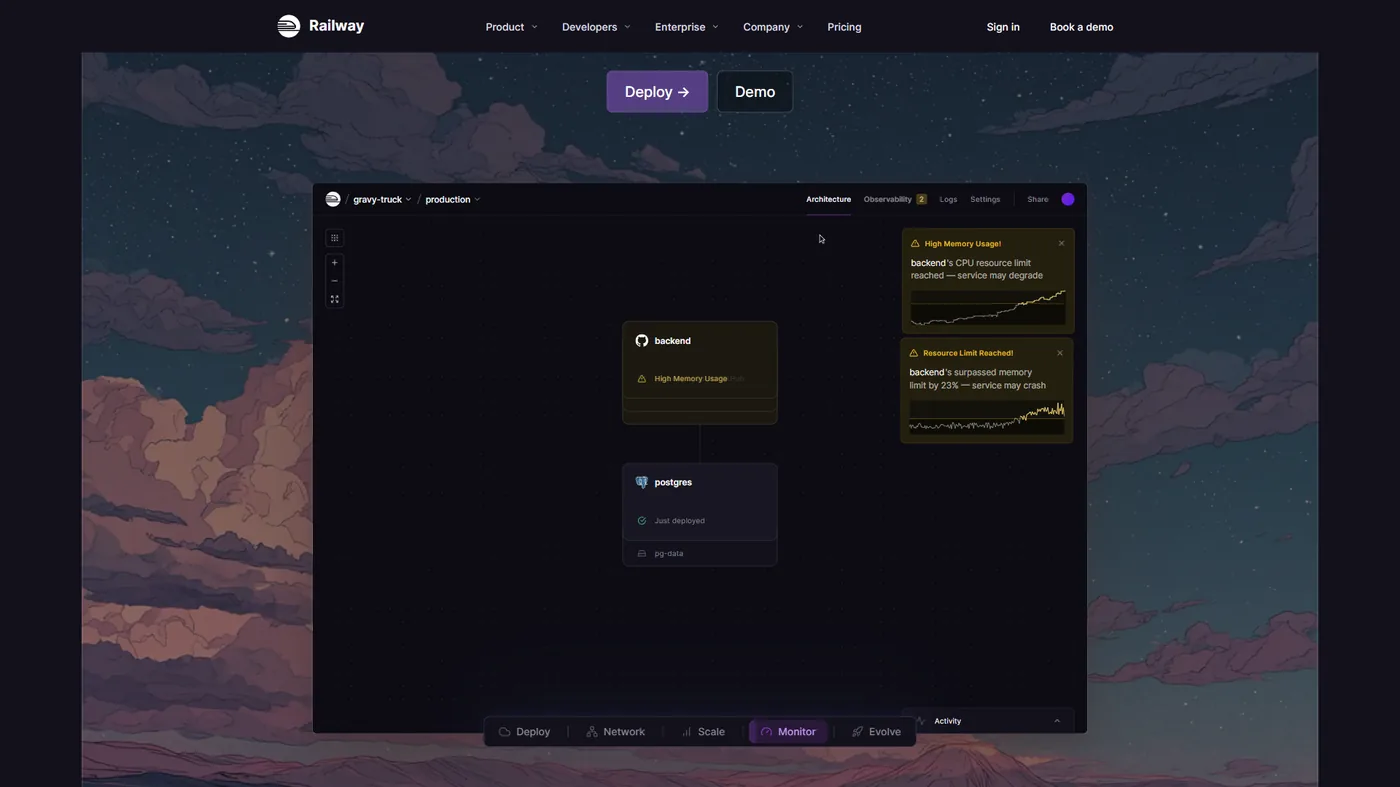
Railway is the best Vercel alternative for full-stack deployments because it runs persistent server processes - Node.js, Python APIs, background workers, cron jobs, and databases - rather than serverless functions, with DX that rivals Vercel’s. It is popular among developers building full-stack AI tools.
Core workflow. Connect a GitHub repo; Railway detects framework and runtime and deploys as a persistent process. No cold starts, no timeout limits - your Next.js app and PostgreSQL database live in the same project with automatic service discovery.
Where Railway wins: Long-running processes. WebSocket connections stay alive, background jobs run for hours, no function timeout to work around.
Database support. One-click PostgreSQL, MySQL, MongoDB, Redis, and a growing template list, all colocated with the app.
Pricing:
| Plan | Price | Usage Included | Overages |
|---|---|---|---|
| Hobby | $5/mo | $5 in usage credits | $0.000231/vCPU-min, $0.0000007/GB RAM |
| Pro | $20/mo | $20 in usage credits | Same per-unit rates |
| Team | $20/user/mo | $20/user in credits | Same per-unit rates |
Railway’s usage-based billing is transparent but can surprise you on memory-heavy workloads. A small Next.js app with Postgres on the Hobby plan typically costs $5-15/month.
Best for: Full-stack applications with persistent server processes, projects combining frontend, database, and background workers, and developers who want Vercel-like DX for non-serverless workloads.
Limitations: Usage-based billing that can spike on memory-hungry apps, no built-in global edge network (single-region only), and a smaller integrations marketplace than Vercel or Netlify.
4. Render - Simple PaaS for Modern Apps
Render is the simplest Vercel alternative for full-stack PaaS workloads, offering Heroku-style web services, static sites, workers, cron jobs, and managed databases with predictable pricing. Compare with platforms in our Replit alternatives roundup.
Static site hosting. Free tier ships unlimited bandwidth, unlimited deployments, automatic HTTPS - competitive with Netlify’s free tier.
Web services. Render deploys actual server processes from Docker or detected runtimes; Express, FastAPI, or Next.js standalone apps run persistently with auto-scaling on paid plans.
The catch: cold starts. Free web services spin down after 15 minutes idle and take 30-60 seconds to cold start. Paid plans from $7/month eliminate cold starts.
Pricing highlights:
- Static sites: Free (unlimited)
- Web services: $7 per month starter (512MB RAM, 0.1 CPU)
- PostgreSQL database: Free for 90 days, then $7 per month
- Redis: $10 per month for the starter instance
Best for: Developers migrating from Heroku, projects mixing static sites and server processes under one account, and teams wanting simpler pricing than Fly.io or Railway’s usage-based models.
Limitations: 30-60 second cold starts on the free web-services tier, an aging UI compared to Railway, and weaker edge performance (single-region only).
5. Fly.io - Containers with Global Edge Compute
Fly.io runs your application as containerized Firecracker VMs distributed across 35+ global regions, replacing serverless functions or managed PaaS with true per-region container deploys. Define fly.toml, run fly deploy, and your app is live in those regions. The Fly.io documentation covers container deployment, multi-region config, and Fly Postgres.
Why developers love Fly.io. Pricing rewards efficiency - pay for actual CPU and memory, not per-request. An idle Node.js app costs almost nothing, and your app runs in Tokyo, Frankfurt, and Chicago simultaneously.
Multi-region databases. Fly.io’s managed Postgres supports multi-region replication - primary in US-East, read replicas elsewhere, all via the Fly CLI.
Learning curve. You configure regions, set machine sizes, manage secrets, occasionally SSH in to debug. Pairing Fly.io with an AI coding assistant speeds config generation.
Pricing:
Fly.io uses pure consumption-based pricing with a free allowance:
- Free: 3 shared-CPU VMs, 160GB bandwidth, 3GB storage
- Paid: $0.0000008/s for shared CPU, $0.000005/s for dedicated CPU, $0.20/GB for persistent storage
For most small-to-medium apps, Fly.io is meaningfully cheaper than Vercel Pro, especially for non-Next.js workloads.
Best for: Teams comfortable with containers, applications needing genuine global distribution, and projects with long-running processes or WebSocket connections.
Limitations: Real operational learning curve (fly.toml, machine sizing, region pinning, SSH debugging), pricing that gets hard to predict on memory-hungry apps, and historical reliability incidents during platform migrations.
6. AWS Amplify - For Teams Already in the AWS Ecosystem
AWS Amplify is Amazon’s opinionated frontend deployment platform, valuable almost entirely if you are already on AWS - Lambda, RDS, DynamoDB, S3, IAM - stitched together with a Vercel-like frontend layer. Teams on Azure DevOps instead of AWS should compare against Azure Static Web Apps.
Framework support. Next.js (App Router, Server Components), Nuxt, SvelteKit, Astro, Vue, React. Amplify Gen 2 now handles App Router reliably with TypeScript-first IaC replacing YAML.
Pricing:
AWS Amplify charges $0.01 per build minute and $0.15/GB served, with a free tier of 1,000 build minutes and 5GB stored per month. Low-traffic sites can run nearly free; high-traffic scales proportionally with Vercel.
Best for: Teams already on AWS, enterprise teams with existing AWS contracts, and projects needing deep AWS service integration.
Limitations: AWS-shaped IAM and config complexity, historically inconsistent Next.js SSR, and pricing that balloons once Cognito, RDS, and CloudFront stack up.
Bonus Tips: Free or VPS-Friendly Vercel Alternatives Worth Knowing
The two best free or VPS-friendly Vercel alternatives are GitHub Pages for pure-static sites and DigitalOcean App Platform for VPS-style flat-rate deploys. Both serve narrow workloads where the eight platforms above are overkill or wrong-shaped.
7. GitHub Pages - Free Static Hosting with Zero Friction
GitHub Pages only serves static files - no serverless functions, no edge compute, no SSR - but for genuinely static sites (docs, blogs, portfolios, marketing pages) it is the simplest and most cost-effective Vercel alternative.
What works well. Public repos get free hosting with a github.io or custom domain, global CDN via Fastly, automatic HTTPS, and deployment via GitHub Actions. For documentation-focused teams using Jekyll, Docusaurus, or Astro static, the workflow is frictionless.
What does not work. No SSR, no serverless functions, no server-side dynamic routing.
Pricing: Free for public repos; private repos require GitHub Pro at $4/month.
Best for: Documentation, blogs, portfolios, and marketing pages with no server-side needs.
8. DigitalOcean App Platform - Simple Deployments for VPS Teams
DigitalOcean App Platform sits between Render and a traditional VPS - a managed PaaS that handles deployments, scaling, and infrastructure while giving more control over the runtime than Netlify or Vercel.
The DigitalOcean advantage. If your team already uses Droplets, Managed Databases, or Spaces object storage, App Platform integrates naturally with consolidated billing.
Static site hosting. Free for up to 3 sites with generous bandwidth and global CDN - competitive with Netlify and Render’s free tiers.
Web services pricing. Basic tier starts at $5/month for 512MB RAM and 0.5 vCPU, with predictable flat pricing rather than usage-based billing.
Best for: Teams already on DigitalOcean infrastructure, projects that benefit from flat-rate pricing, and developers wanting managed PaaS without migrating away from DigitalOcean.
Which Tool Fits: Decision Framework
The right Vercel alternative depends on workload, and seven common scenarios map cleanly to seven winners.
- Next.js app, Vercel-like DX: Netlify - mature framework support, near-identical workflow.
- Edge performance and global distribution: Cloudflare Pages - 300+ PoP network, free bandwidth, Workers ecosystem.
- Persistent servers, databases, background workers: Railway for complex multi-service, Render for simpler stacks.
- Genuine global multi-region compute: Fly.io - containerized VMs with per-region deploy.
- All-in on AWS: AWS Amplify - lowest-friction frontend layer over an AWS backend.
- Purely static (no SSR, no functions): GitHub Pages for public repos or Cloudflare Pages free tier.
- Flat-rate pricing on DigitalOcean: DigitalOcean App Platform.
What Should You Expect When Migrating Away from Vercel?
Migrating away from Vercel is straightforward for static assets but introduces real complexity around Next.js SSR features, environment-variable transfer, preview deployments, and build-time parity.
- Static assets and CDN. Every platform serves static assets via a global CDN - update DNS CNAME and you are done.
- Next.js SSR. App Router features like Partial Prerendering, fine-grained ISR cache tagging, and Edge Middleware have varying support. Netlify and Cloudflare Pages have the most mature adapters after Vercel.
- Environment variables. Plan 30-60 minutes to migrate and verify secrets.
- Preview deployments. Netlify, Cloudflare Pages, Railway, and Render all support branch previews; GitHub Pages does not. Bitbucket Pipelines or GitHub Actions can automate previews regardless of host.
- Build times. Vercel is fast and highly optimized for Next.js; some alternatives are slower. Run benchmark builds before committing.
The Bottom Line
The right Vercel alternative comes down to three factors: framework flexibility (Netlify wins), edge performance and cost (Cloudflare Pages wins), and full-stack capability beyond serverless (Railway and Fly.io win). Vercel itself remains excellent for Next.js-deep teams that accept the per-seat pricing.
Run a proof-of-concept deployment on your top two candidates before committing. Every platform offers a free tier or low-cost entry plan. Deploy your actual app, test the features you rely on, and measure build times and cold-start behavior under real workload.
FAQ
The most common Vercel-alternative questions cover which platform is objectively better, whether Vercel still has a free tier, and how Firebase compares.
Q: What is better than Vercel?
No platform is universally better; the right answer depends on workload. Netlify is closest for Next.js teams wanting similar DX with lower lock-in, Cloudflare Pages wins on edge and bandwidth, Railway and Fly.io win for full-stack and global containers, and AWS Amplify wins inside AWS.
Q: Is Vercel no longer free?
Vercel still offers a free Hobby tier capped at 10-second function execution, 100GB bandwidth, and no commercial use. Production sites need at least Pro at $20 per user per month.
Q: Is Firebase better than Vercel?
Firebase is a backend-as-a-service (auth, database, storage, functions); Vercel is a frontend deployment platform. Many teams pair them rather than choose between them.
Related Reading
These guides extend the comparison into adjacent decisions on version control and CI/CD.
- Vercel - Full review of Vercel’s deployment platform
- GitHub - Code hosting and CI/CD that integrates with every alternative
- GitHub Alternatives 2026 - Version control beyond GitHub
- GitLab vs GitHub - Head-to-head of the two largest Git platforms
- GitHub Actions Tutorial - CI/CD automation
- Aider vs Cursor - AI coding tools for deploy-aware developers
External Resources
These four primary-source documentation sets cover the platforms compared above.
- Vercel Deployment Documentation - Official Vercel deploy docs
- Cloudflare Pages Documentation - Pages Functions, Workers, framework support
- Netlify Documentation - Netlify deployment platform and Edge Functions
- Fly.io Documentation - Container deployment, multi-region, Fly Postgres