



The best GitHub alternatives in 2026 are GitLab for full DevOps teams, Bitbucket for Atlassian shops, Azure DevOps for Microsoft stacks, and Codeberg, Gitea, Forgejo, and SourceHut for privacy-first or self-hosted work. This guide ranks seven GitHub alternatives on pricing, CI/CD, AI integration, and migration difficulty.
Our analysis draws on each vendor’s official documentation, public pricing pages, and independent platform research published in 2025-2026; we do not claim hands-on benchmark testing of every platform. Editorial independence: AI Productivity earns affiliate commissions from some products listed, but rankings reflect documented features and pricing, not commission rates.
Which GitHub Alternatives Compare Best?
The strongest GitHub alternatives in 2026 are GitLab (full DevSecOps), Bitbucket (Atlassian-integrated), Azure DevOps (Microsoft stack), and Codeberg, Gitea, Forgejo, and SourceHut for free, self-hosted, or privacy-focused work. The table below compares the seven platforms on free-tier limits, paid pricing, built-in CI/CD, and self-hosted availability.
| Platform | Best For | Free Tier | Paid Starting Price | CI/CD Built-In | Self-Hosted Option |
|---|---|---|---|---|---|
| GitLab | Full DevOps teams | 5 users | $29/user/mo | Yes | Yes |
| Bitbucket | Atlassian shops | 5 users | $3/user/mo | Yes | Yes (Data Center) |
| Azure DevOps | Microsoft/.NET teams | 5 users | $6/user/mo | Yes | Yes (Server) |
| Codeberg | Open-source projects | Unlimited | Free (donation-funded) | Via Woodpecker CI | N/A (hosted only) |
| Gitea | Small self-hosted teams | Unlimited | Free / $3.25/mo cloud | Via plugins | Yes |
| Forgejo | Privacy-focused orgs | Unlimited | Free | Via Woodpecker CI | Yes |
| SourceHut | Minimalist developers | Limited | $3/mo | Yes | Yes |
Why Are People Moving Away From GitHub?
People are moving away from GitHub for four documented reasons: per-seat pricing that scales aggressively above 50 developers, data sovereignty rules in regulated industries, preference for an integrated DevOps platform over GitHub’s modular tools, and AI ecosystem lock-in. The 2024 Stack Overflow Developer Survey of 65,000+ professional developers reported 14.5% used GitLab and 5.8% used Bitbucket alongside or in place of GitHub (survey results).
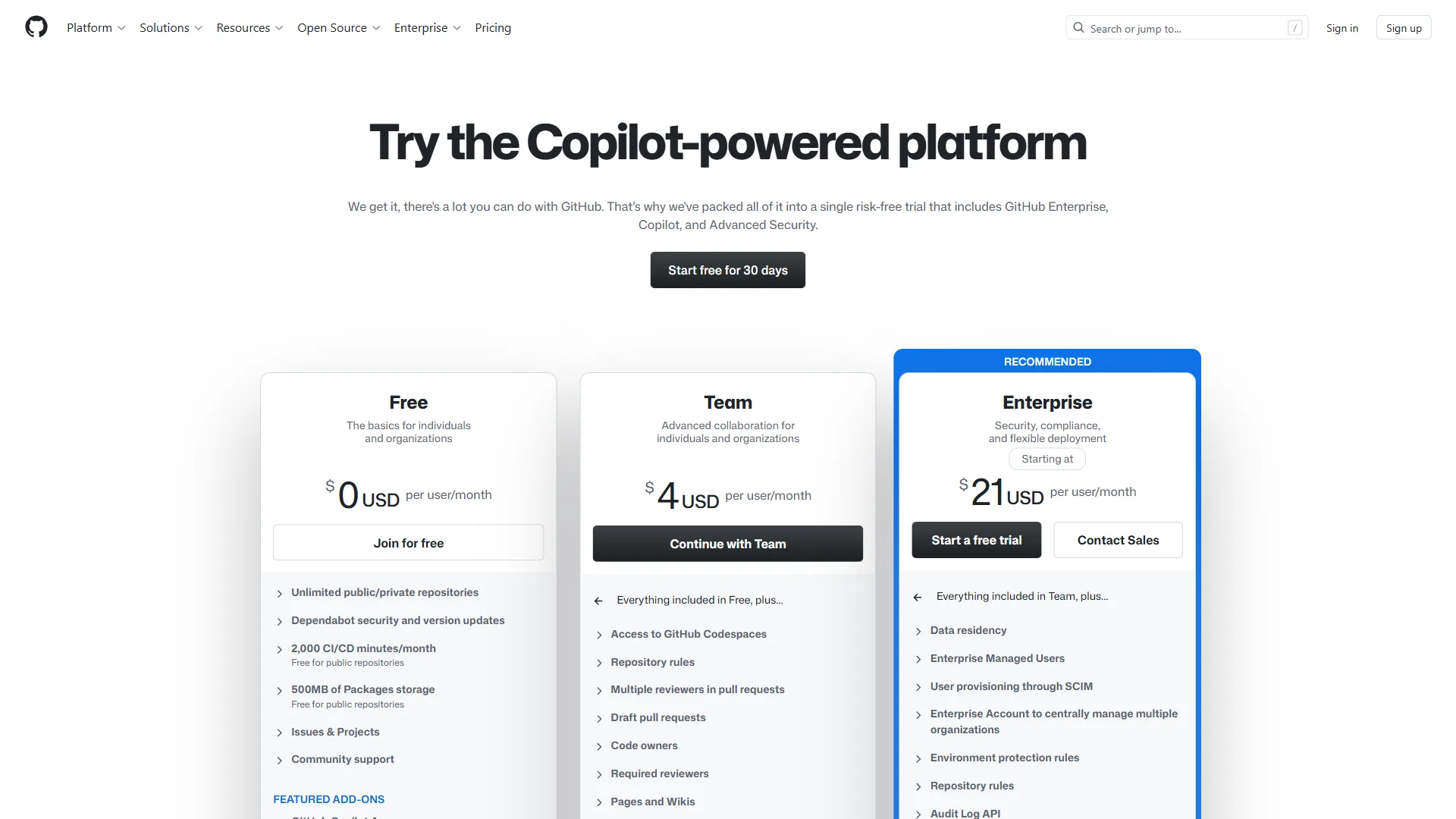
GitHub Team costs $4/user/month and Enterprise jumps to $21 - a 50-person team pays $12,600/year on Enterprise before $19/user Copilot licenses. Regulated industries push to self-hosted Git because GitHub Enterprise Server costs more than alternatives, and AI lock-in concerns are rising because Copilot ties teams to Microsoft’s ecosystem.
According to Sid Sijbrandij, co-founder and former CEO of GitLab, in the 2024 annual letter: “Customers are consolidating from point solutions to platforms - one platform reduces toil, security risk, and total cost of ownership.”
1. GitLab - Best All-in-One DevSecOps Platform
GitLab is the most comprehensive GitHub alternative, covering the entire software lifecycle in one app - source control, CI/CD, container registry, security scanning, and project management.

GitLab’s built-in CI/CD is the standout. GitLab CI pipelines are a first-class feature with Auto DevOps templates that detect your project type and configure build, test, and deploy stages. The GitLab Duo AI assistant ships code suggestions, vulnerability explanations, and merge request summaries on Ultimate.
Pricing: Free for 5 users (400 CI/CD min, 5GB storage). Premium $29/user/mo (10,000 CI/CD min, merge approvals). Ultimate $99/user/mo (50,000 CI/CD min, security dashboards, compliance, Duo AI).
Migration complexity: Medium. The GitHub import tool transfers repos, issues, PRs, and wikis; CI/CD pipelines need a 1-2 day rewrite from Actions to GitLab CI syntax.
Best for: Teams of 10-200 developers who want a unified platform - GitLab replaces GitHub plus Jenkins plus Jira plus SonarQube. Skip GitLab if budget per seat is your top constraint (Premium at $29 is 7x GitHub Team’s $4).
2. Bitbucket - Best for Atlassian Ecosystem Teams
Bitbucket is the best GitHub alternative for teams already on Jira and Confluence - commit messages auto-update Jira tickets and Confluence pages link directly to repository branches.
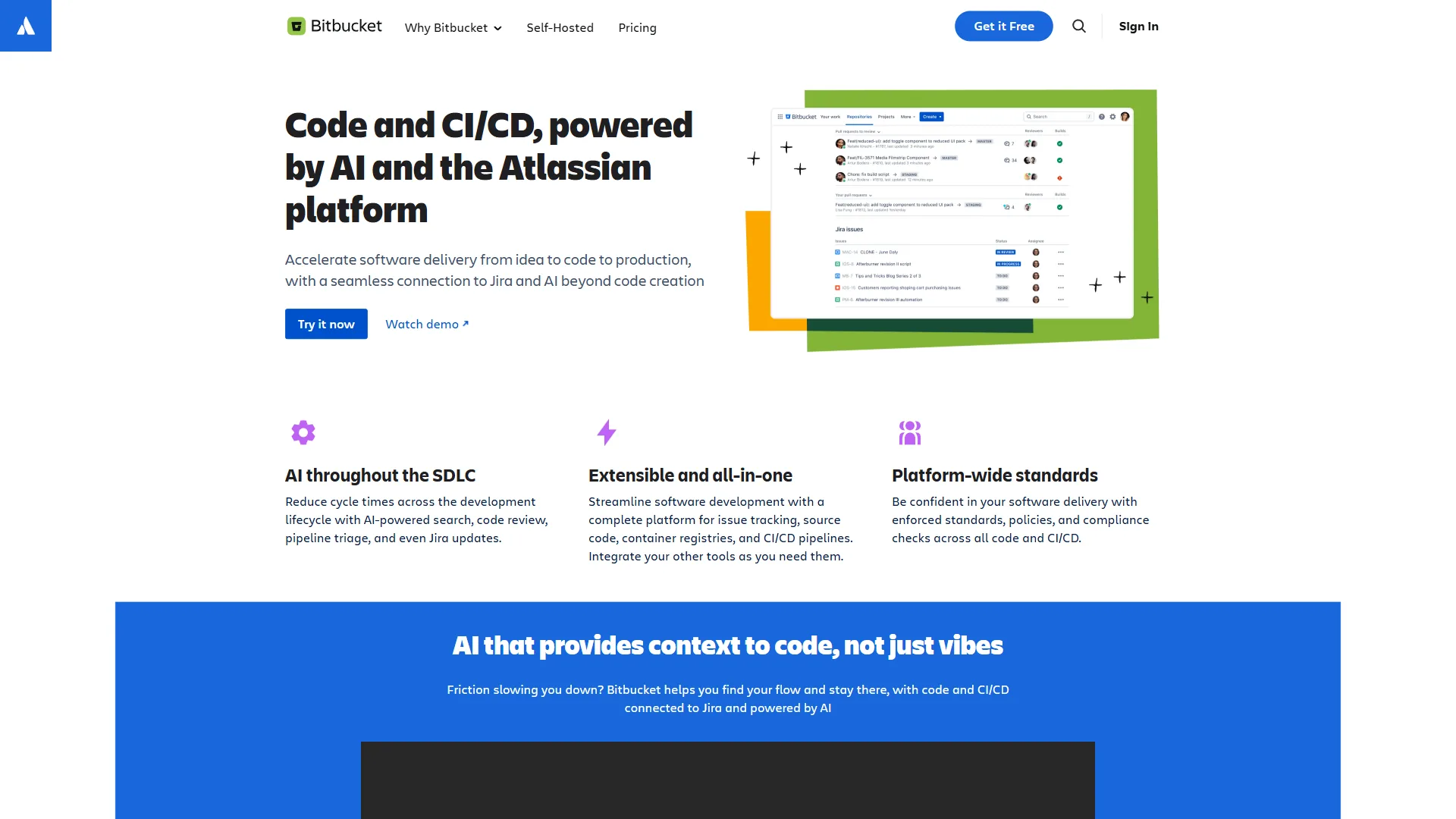
Bitbucket Pipelines offers built-in CI/CD with 50 free build minutes per month (3,500 on Standard) and a straightforward pipeline YAML syntax. At $3 per user/month, Bitbucket Standard is the cheapest paid option among major platforms - a 20-person team pays $720/year vs. GitHub Team’s $960 or GitLab Premium’s $6,960.
Pricing: Free for 5 users (unlimited private repos, 1GB LFS, 50 build min). Standard $3/user/mo (3,500 build min, merge checks). Premium $6/user/mo (required merge checks, IP allowlisting). Data Center is self-hosted with SAML SSO.
Migration complexity: Low. The Bitbucket import docs cover GitHub repos with commit history, branches, and tags; issues require manual migration since Bitbucket relies on Jira.
Best for: Teams of 5-50 developers already invested in the Atlassian ecosystem. Skip Bitbucket if you want a single tool for code plus issues, or need GitHub-scale community reach for open source.
3. Azure DevOps - Best for Microsoft and .NET Teams
Azure DevOps is Microsoft’s enterprise development platform and the strongest GitHub alternative for teams building on .NET, Azure, or hybrid cloud infrastructure.
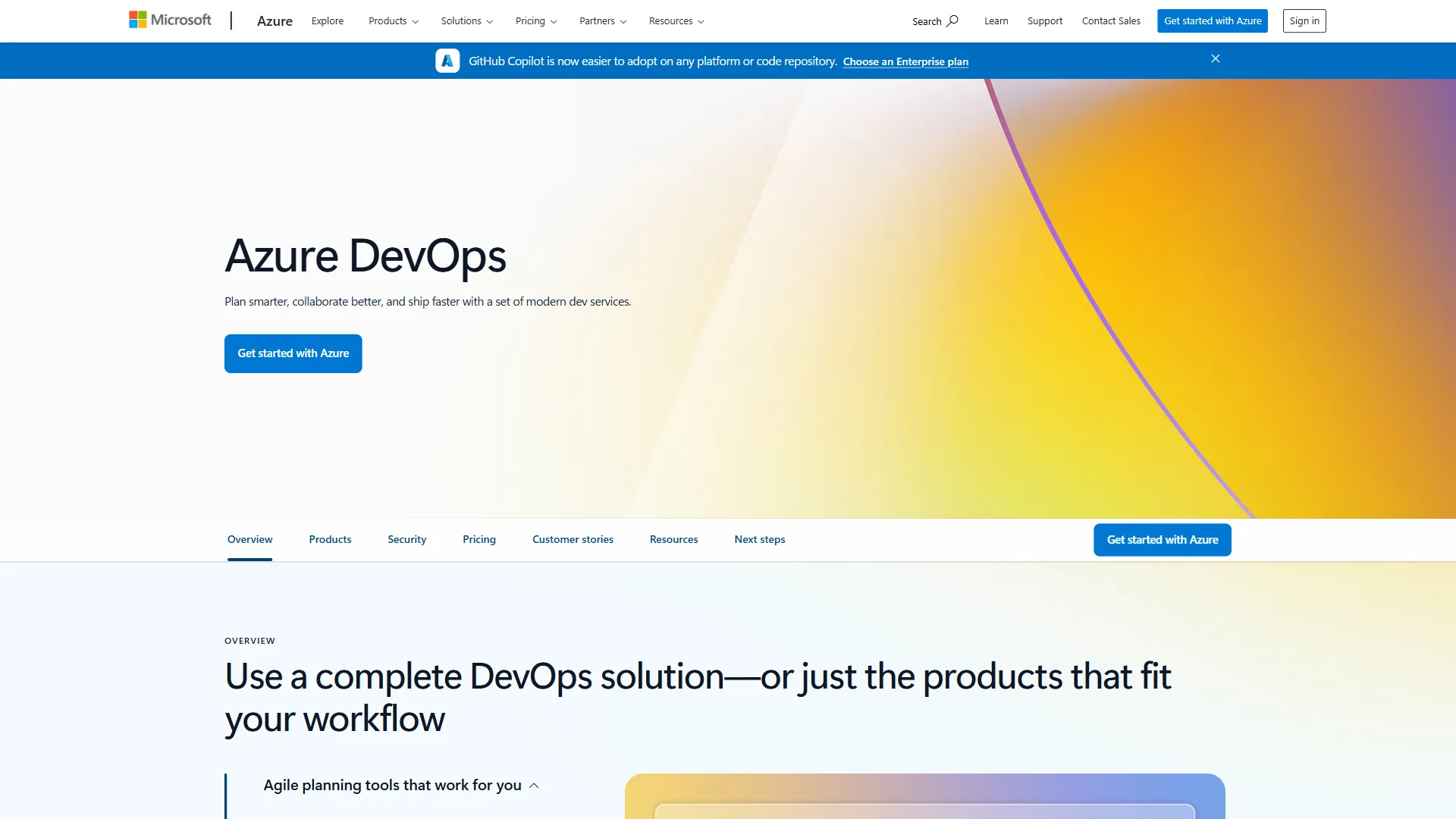
Azure Pipelines is the most powerful CI/CD system on this list - parallel jobs across Linux, Windows, and macOS, native Azure integration, and thousands of marketplace extensions. The platform splits into five services (Boards, Repos, Pipelines, Test Plans, Artifacts) you adopt independently; our GitHub vs Azure DevOps comparison covers the tradeoffs.
Pricing: Free for 5 users (1 parallel job, 1,800 CI/CD min, unlimited repos). Basic $6/user/mo (Boards, Repos, Pipelines, extra parallel jobs). Basic + Test Plans $52/user/mo adds manual and exploratory testing.
Migration complexity: Medium-High. Azure DevOps imports Git repos per the Azure Repos import guide, but moving Issues to Boards and Actions to Pipelines is manual - automated conversion gets only 60-70% of the way.
Best for: Enterprise teams of 20-500+ developers on Microsoft technologies. Skip Azure DevOps if your team is not on Microsoft tooling or wants one opinionated UI rather than five services.
4. Codeberg - Best Free Platform for Open Source
Codeberg is the leading free, donation-funded Git host for open source - operated by Codeberg e.V., a Berlin-based nonprofit, with no paid tiers, no ads, and no data collection.
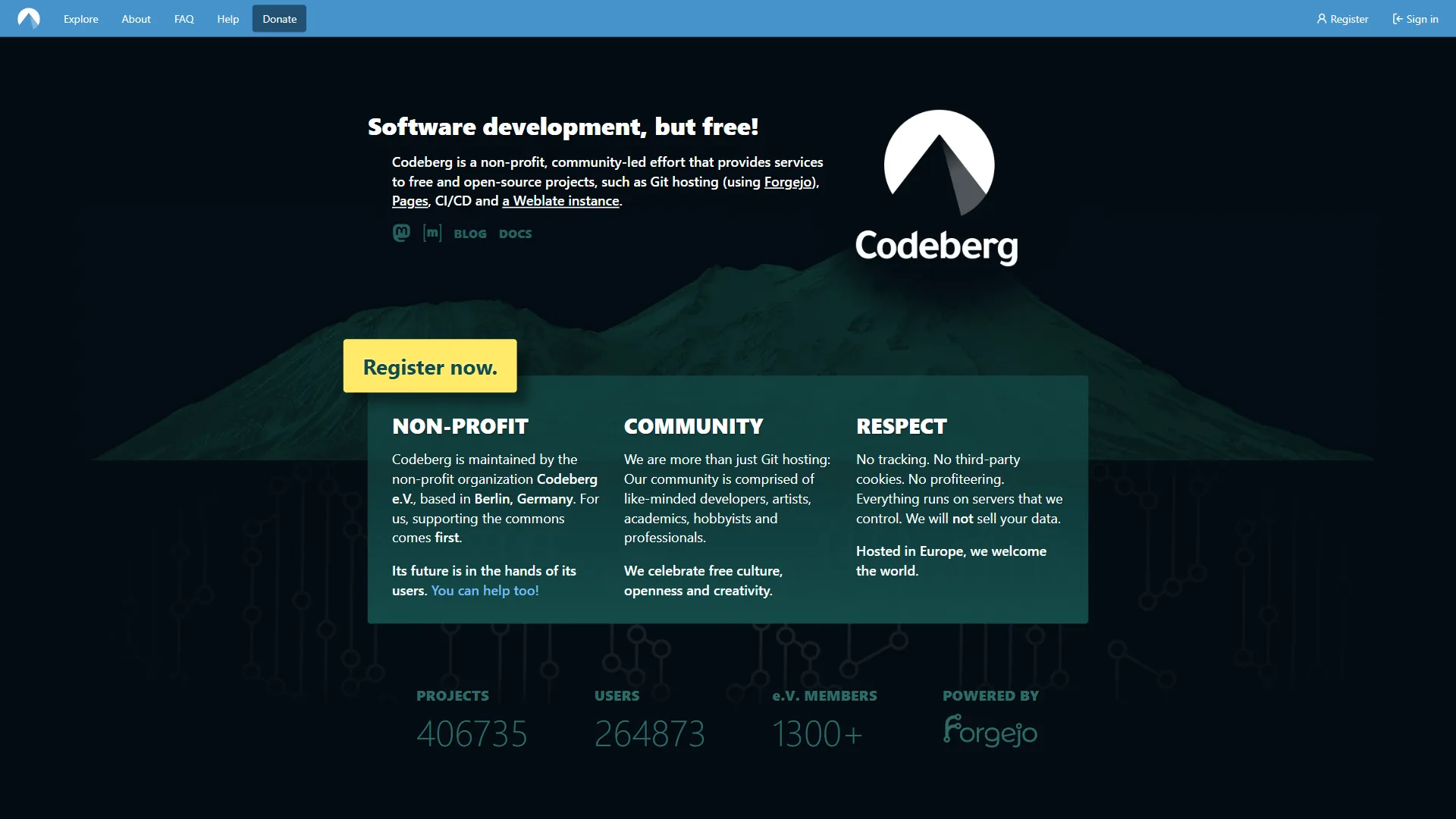
Built on Forgejo, the platform does not train AI models on your code unless you opt in, and has no corporate owner that can change terms to monetize data. The feature set covers Git hosting, issue tracking, pull requests, CI/CD via Woodpecker CI, and a package registry.
Pricing: Completely free with reasonable storage and CI/CD limits.
Migration complexity: Low. One-click migration for GitHub repositories including issues, labels, milestones, and releases.
Best for: Open-source maintainers and small teams searching for github alternatives privacy and nonprofit governance (documented at the Codeberg e.V. organisation page). Skip Codeberg if you need SLA-backed support, AI tooling, or commercial integrations.
5. Gitea - Best Lightweight Self-Hosted Option
Gitea is the best lightweight self-hosted GitHub alternative - a ~100MB Go binary that runs on a Raspberry Pi, $5 VPS, or corporate server rack with minimal RAM vs. GitLab’s 4GB+ self-managed install.

Per the Gitea binary install docs, installation takes 5-10 minutes and updates replace a single binary. The web UI ships repos, issues, pull requests, projects, packages, and a container registry. Gitea Cloud starts at $3.25/month for managed hosting.
Pricing: Self-hosted is free (open source). Gitea Cloud Starter $3.25/mo, Pro $7.25/mo, Enterprise custom (SLA and support).
Migration complexity: Low. The Gitea migration guide covers direct imports from GitHub, GitLab, Bitbucket, and other Gitea instances.
Best for: Small teams of 2-15 developers wanting full control. Skip Gitea if you need native security scanning, AI code review, or a polished marketplace.
6. Forgejo - Best for Privacy and Community Governance
Forgejo is the leading community-governed fork of Gitea, maintained by the Codeberg community and prioritizing software freedom over commercial direction.
Forgejo is nearly identical to Gitea in features and resource use per the Forgejo documentation. The differences are governance (community vs. corporate) and federation: Forgejo is implementing ForgeFed, an ActivityPub protocol that lets users on different instances collaborate on repositories without creating accounts on each server.
Pricing: Free, open source, self-hosted only. Migration complexity: Low - same tools as Gitea.
Best for: Academic institutions, nonprofits, and privacy-conscious teams that prioritize software freedom and federated collaboration. Skip Forgejo if you want a vendor-supported SaaS or first-party AI tooling.
7. SourceHut - Best for Minimalist Developers
SourceHut is the best github alternatives free option for minimalist developers who prefer email-based patches over web-based pull requests - it runs on plain HTML with no JavaScript.
This is deliberate design - the email-patch workflow lets developers contribute without creating accounts, and the platform works in any browser including text-based ones. The build system at builds.sr.ht supports CI/CD manifests across Debian, Ubuntu, Fedora, Alpine, FreeBSD, and OpenBSD.
Pricing: Public alpha; $3/month paid tier planned. Most features are free during alpha.
Migration complexity: High. Email-based workflow differs fundamentally from GitHub’s pull request model - expect 2-4 weeks of team adjustment.
Best for: Individual developers and small teams (2-5) who prefer command-line workflows or contribute to system-level projects. Skip SourceHut if you rely on web-based code review or work with contributors who have never used git format-patch. See commercial alternatives for SLA-backed options.
Best Picks by Use Case: Team Size
The best GitHub alternative for personal use is Codeberg (open source) or Gitea on a $5 VPS (self-hosted control); for teams, the right choice scales with headcount and stack. See our best AI tools for developers page for more.
- Solo/freelancer (1-2): Codeberg (free) for open source, GitLab Free for power, or Gitea on a $5 VPS for self-hosted control.
- Small teams (3-15): Bitbucket Standard ($3/user/mo) for Atlassian, GitLab Premium ($29) for DevOps, or Gitea Cloud ($3.25/mo) for budget.
- Mid-size (15-100): Azure DevOps Basic ($6/user/mo) for Microsoft stacks, GitLab Premium/Ultimate ($29-99) for platform teams, or Bitbucket Premium ($6) plus Jira.
- Enterprise (100+): GitLab Ultimate ($99/user/mo) for full DevSecOps, Azure DevOps for Microsoft enterprise, or a hybrid keeping GitHub for open source and GitLab or Azure DevOps for internal projects.
Feature-by-Feature: AI Coding Assistance
GitLab Duo is the strongest AI alternative to GitHub Copilot among the best github alternatives in 2026 because Duo is bundled into Premium and Ultimate tiers rather than charged separately.
| Platform | AI Assistant | Code Suggestions | Code Review AI | Pricing |
|---|---|---|---|---|
| GitHub | Copilot | Yes (multi-model) | Yes | $10-39/user/mo |
| GitLab | Duo | Yes | Yes (MR summaries) | Included in Premium/Ultimate |
| Bitbucket | Atlassian Intelligence | Limited | Experimental | Included in Premium |
| Azure DevOps | GitHub Copilot (integration) | Yes (separate license) | Limited | $10-39/user/mo add-on |
| Codeberg | None built-in | N/A | N/A | N/A |
| Gitea | None built-in | N/A | N/A | N/A |
| SourceHut | None built-in | N/A | N/A | N/A |
Bitbucket and Azure DevOps teams can still use Copilot via IDE extensions - the AI assistant is not locked to GitHub. See our GitHub Copilot vs Cursor and best AI coding assistants roundup for more.
How Do You Migrate From GitHub Step by Step?
Migration from GitHub takes four steps in a controlled pilot: migrate one non-critical repo first, preserve Git history with git remote set-url and git push, run both platforms in parallel via push mirroring for 2-4 weeks, and budget 1-3 days per pipeline since Actions does not translate directly to GitLab CI, Bitbucket Pipelines, or Azure Pipelines. Our best workflow automation tools 2026 roundup covers CI/CD-adjacent platforms.
The Bottom Line
The best GitHub alternative is the one that disappears into your workflow - GitLab for a complete DevOps platform, Bitbucket if your team lives in Jira, Gitea or Forgejo for self-hosted control, and Codeberg to avoid corporate platforms entirely.
Sign up for free tiers on 2-3 platforms, migrate a test repository, and spend a week with each. Bitbucket, GitLab, and Codeberg all offer no-credit-card free tiers.
FAQ
Common questions cover better alternatives, why teams leave GitHub, the leading alternative to GitHub in 2026, and the best free option for personal use or open source.
Q: Is there anything better than GitHub?
Yes, depending on need. GitLab matches or exceeds GitHub on CI/CD and security scanning for full DevOps teams; Bitbucket wins for Atlassian shops; Codeberg leads for open source; Gitea fits small self-hosted teams. The right platform depends on team size, stack, and budget.
Q: Why are people moving away from GitHub?
The four most cited reasons are per-seat pricing that scales aggressively beyond 50 developers, data sovereignty requirements in regulated industries, preference for an integrated DevOps platform over GitHub’s modular tools, and concern about AI lock-in to Microsoft’s ecosystem.
Q: What is the alternative to GitHub in 2026?
The leading alternatives to GitHub in 2026 are GitLab, Bitbucket, Azure DevOps, Codeberg, Gitea, Forgejo, and SourceHut - GitLab and Azure DevOps target enterprise DevOps, Bitbucket targets Atlassian teams, and the rest serve self-hosted and privacy-focused work.
Q: What is the best free GitHub alternative?
Codeberg, Gitea, and Forgejo all offer unlimited free usage - Codeberg is donation-funded hosted (ideal for open source); Gitea and Forgejo support self-hosting. Bitbucket and GitLab also offer free tiers for up to 5 users.
Related Reading
Related guides cover the leading GitHub alternatives for personal use, individual platform deep-dives, and GitHub-adjacent tooling.
- GitLab Review
- Azure DevOps - Microsoft DevOps platform for .NET and Azure teams
- Best Version Control Tools for 2026
- Bitbucket vs GitHub: Which Git Platform Fits Your Team?
- GitHub Copilot Guide
- Best AI Code Editors 2026
- GitHub Review
External Resources
External resources include the official GitHub, GitLab, and Forgejo migration docs covering repositories, issues, and CI/CD pipelines.