


HubSpot is the better CRM for marketing-led teams under 50 users, while Salesforce is the better CRM for enterprise sales orgs with 200+ users and dedicated admins. HubSpot starts free and includes Breeze AI on every tier; Salesforce starts at $25 per user per month and gates full Agentforce 2.0 access behind a $500 per user per month Einstein 1 tier.
A productivity-focused comparison of HubSpot vs Salesforce covering pricing, AI capabilities, and real-world workflows for teams that care about getting work done - not just managing contacts.
The HubSpot vs Salesforce debate has been going on for over a decade. But in 2026, the comparison looks completely different than it did even two years ago. Both platforms have invested heavily in AI - HubSpot with its Breeze AI suite and Salesforce with Agentforce 2.0 and Einstein Copilot - and the gap between “enterprise CRM” and “growth CRM” has narrowed significantly. The global CRM market is expected to reach $145.79 billion by 2029, according to Fortune Business Insights, and 91% of companies with 10 or more employees now use CRM software, according to Nucleus Research.
Based on analysis of pricing structures, AI features, and feedback from teams that have migrated in both directions, one thing is clear: neither platform is universally better. The right choice depends on your team size, technical resources, and how much you value simplicity over customization.
Editorial note: AI Productivity may earn a commission from links on this page; our rankings are editorially independent. This comparison draws on current vendor documentation, published pricing pages, and independent research rather than sponsored placement.
This guide breaks down every angle so you can make a confident decision.
Comparison Table
The comparison table below summarizes how HubSpot and Salesforce stack up across pricing, AI suites, integrations, and learning curve at a glance.
| Factor | HubSpot | Salesforce |
|---|---|---|
| Rating | ||
| Starting Price | Free (2 users) | $25/user/mo |
| Mid-Tier Price | $500/mo (Sales Pro, 3 seats) | $165/user/mo (Enterprise) |
| Free Tier | Yes - generous | No (30-day trial) |
| AI Suite | Breeze AI (agents, assistant, studio) | Agentforce 2.0 + Einstein Copilot |
| Integrations | 500+ native apps | 9,000+ on AppExchange |
| Setup Complexity | Low - self-service | High - needs admin |
| Best For | Growth teams, marketing-led orgs | Enterprise sales, complex workflows |
| Learning Curve | Moderate | Steep |
Quick Verdict
The quick verdict is that HubSpot wins for growth-stage marketing teams that need fast setup and bundled AI, while Salesforce wins for enterprise sales teams with dedicated administrators and complex customization needs.
Choose HubSpot if you want a platform your team can actually use on day one without hiring a consultant. Its free tier is genuinely useful, the interface is intuitive, and Breeze AI is baked into every hub. Best for marketing-led organizations, small-to-mid-sized teams, and companies that want an all-in-one platform without the administrative overhead.
Choose Salesforce if you need deep customization, complex workflow automation, and an ecosystem of 9,000+ apps. Best for enterprise sales teams, B2B companies with long sales cycles, and organizations with dedicated Salesforce administrators who can unlock the platform’s full potential.
What Is HubSpot?
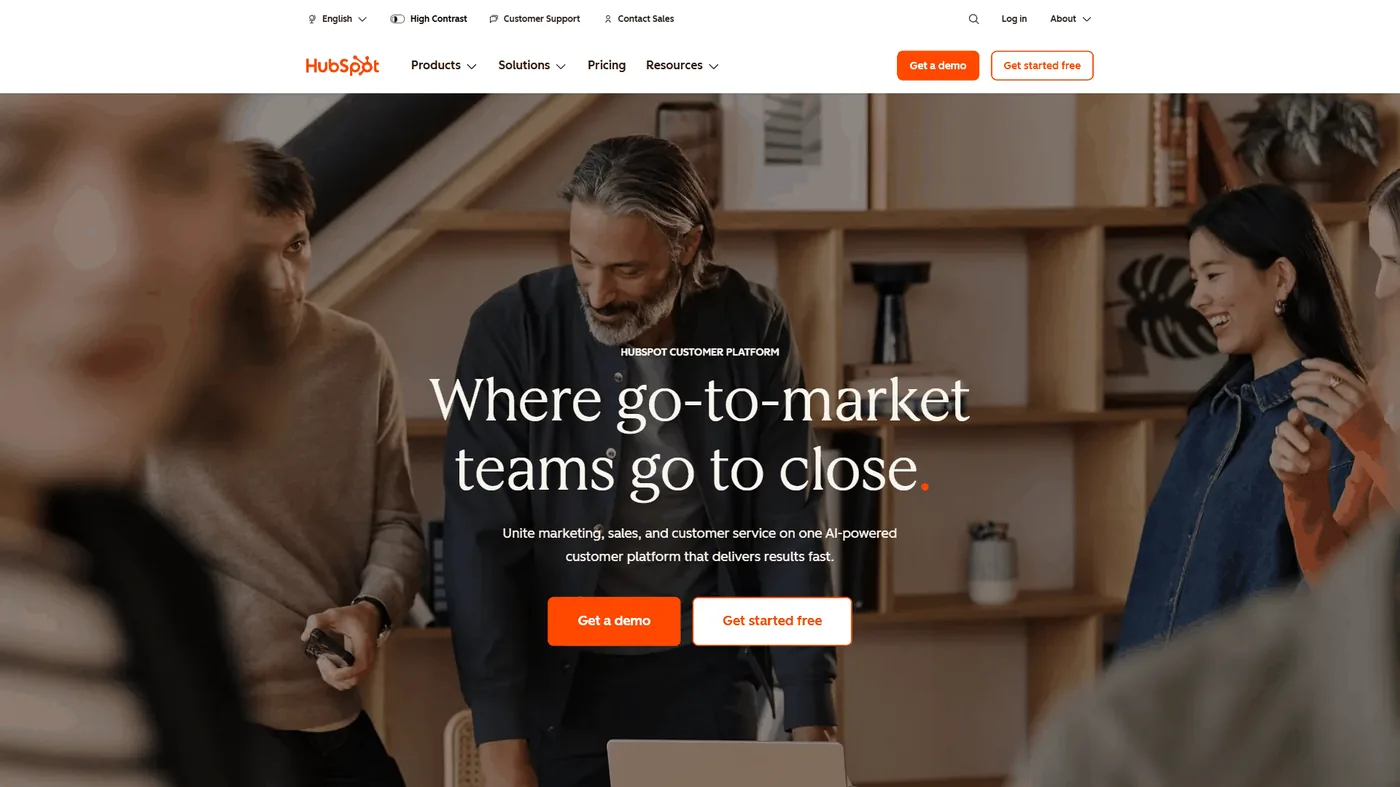
HubSpot is an all-in-one CRM platform built around the idea that marketing, sales, and service should live in a single system. Founded in 2006 as an inbound marketing tool, it has evolved into a full customer platform with five interconnected hubs: Marketing, Sales, Service, CMS, and Operations.
What makes HubSpot stand out in 2026 is its Breeze AI suite, announced at INBOUND. Breeze includes an AI Assistant for content generation, autonomous Agents for tasks like prospecting and customer support, and Breeze Studio for building custom AI workflows. The Customer Agent alone can handle over 50% of support tickets without human intervention, and the Prospecting Agent acts as an AI-powered BDR that identifies and engages leads automatically.
Key strengths:
- Free tier with CRM, email tracking, and meeting scheduling for up to 2 users
- Breeze AI integrated across all hubs - no separate add-on purchase
- Intuitive interface that 70% of users cite as a primary reason for choosing HubSpot
- 505% ROI over three years according to an IDC-commissioned study of 268,000+ customers
Notable limitations:
- Pricing escalates quickly once you outgrow Starter ($15 per month to $890 per month for Marketing Pro). Our HubSpot pricing breakdown walks through each tier with hidden-cost math.
- Mandatory onboarding fees for Professional ($1,500-$3,000) and Enterprise ($3,500-$7,000) tiers
- Contact-based pricing means costs grow as your database grows
- Fewer integrations than Salesforce (500+ vs 9,000+)
What Is Salesforce?
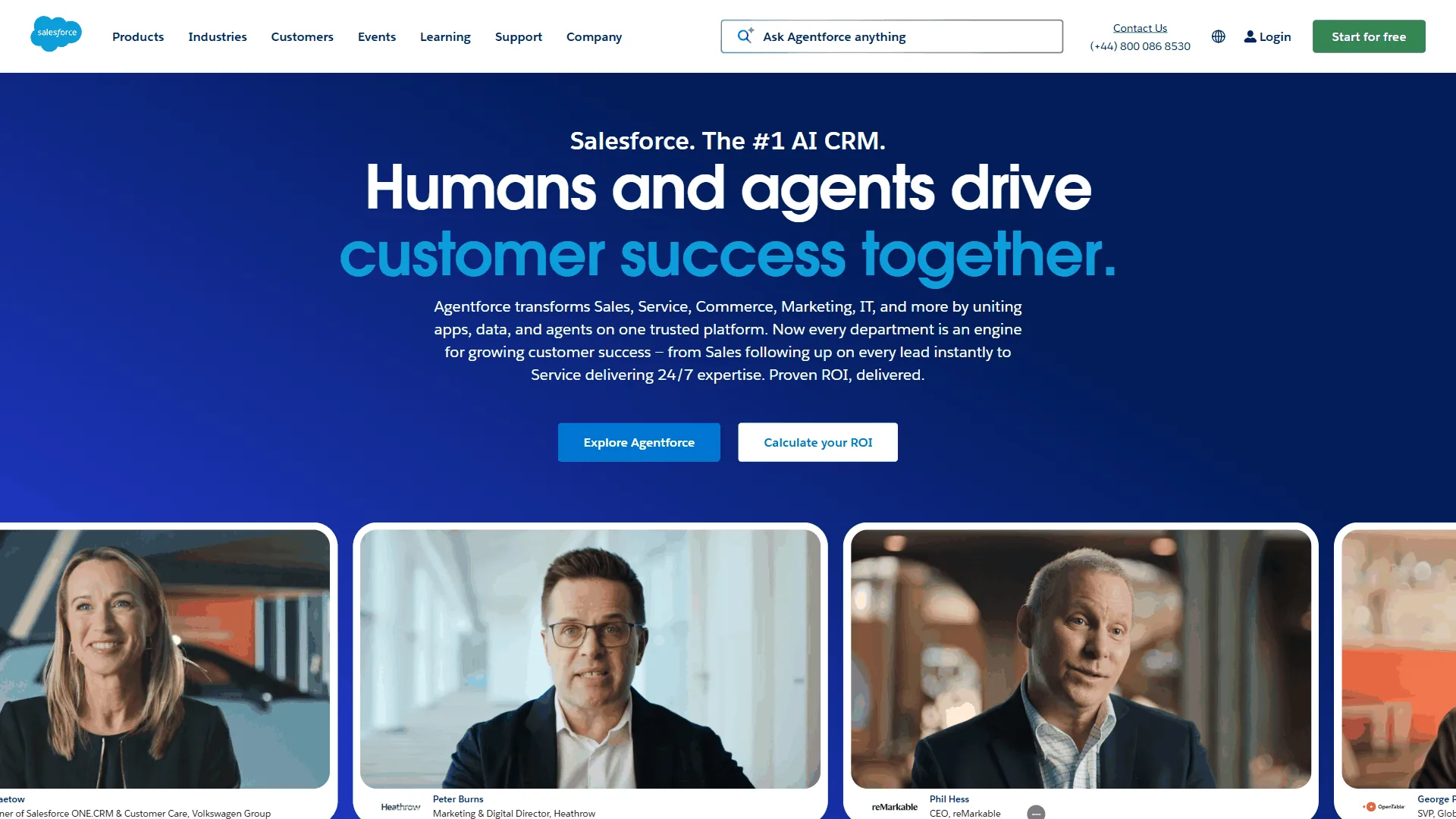
Salesforce is the original cloud CRM and still the market leader by revenue. It powers everything from small sales teams to Fortune 500 enterprises, with a platform so customizable that entire consulting firms exist solely to implement and maintain it.
The big story in 2026 is Agentforce 2.0 - Salesforce’s answer to autonomous AI. These are not just chatbots. Agentforce agents can process unstructured data, reason through complex workflows using the Atlas Reasoning Engine, and take autonomous actions across your CRM. Agentforce Voice adds AI-powered IVR, and MuleSoft Agent Fabric lets you orchestrate agents across multiple systems. Einstein Copilot remains the conversational AI assistant layered on top of everything.
Key strengths:
- 9,000+ apps on AppExchange for virtually any integration need
- Deep customization - custom objects, fields, workflows, and automation rules
- Agentforce 2.0 with autonomous agents for sales, service, and marketing
- Proven at enterprise scale with territory management and advanced forecasting
Notable limitations:
- No free tier - Starter Suite begins at $25 per user/month. Teams comparing budget options should also see our Salesforce alternatives roundup.
- Requires a dedicated administrator for anything beyond basic setup
- User interface is powerful but dense - steep learning curve for new users
- Full AI features (Agentforce) require the $500 per user/month Einstein 1 tier
Pricing Comparison: HubSpot vs Salesforce
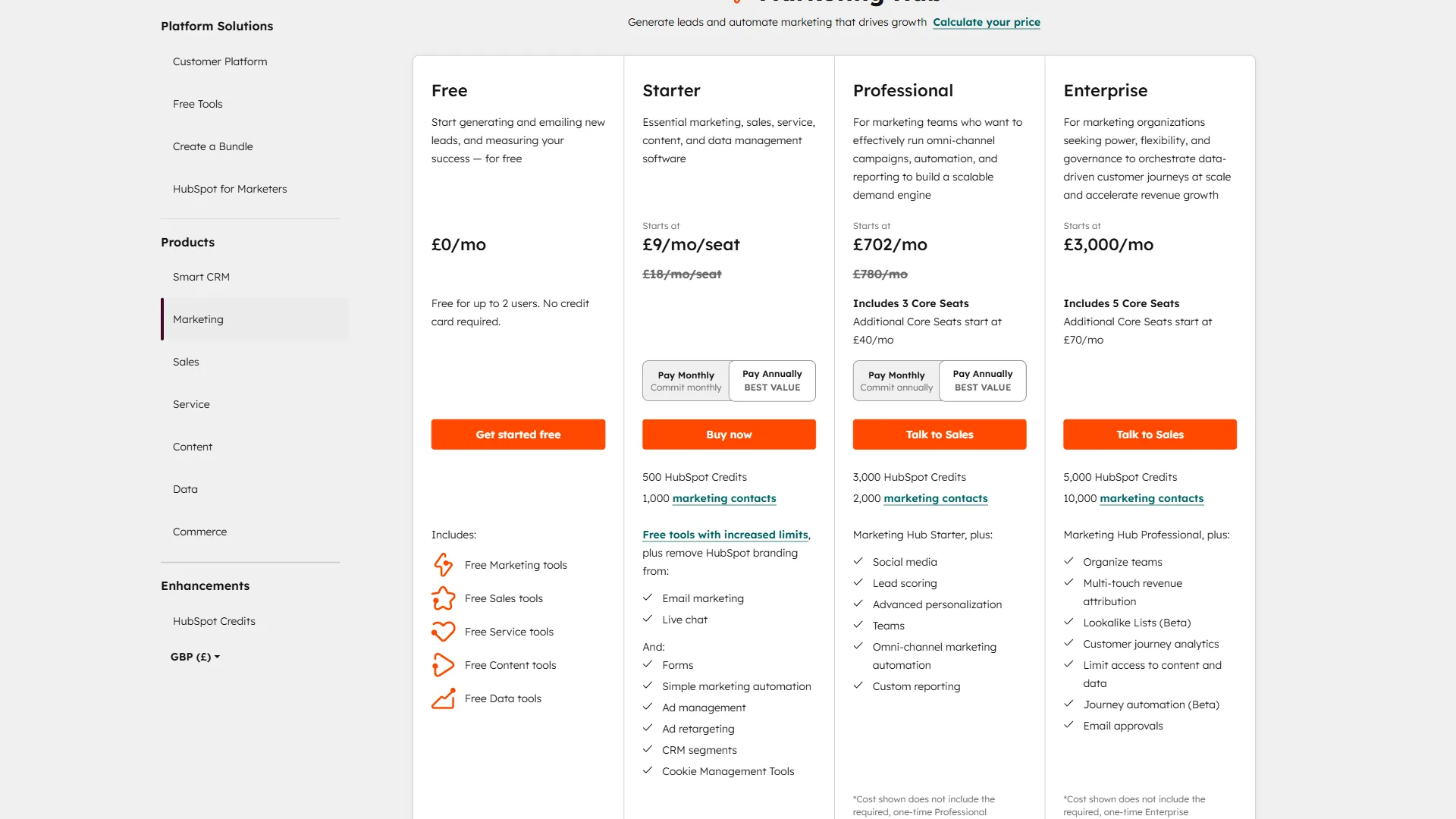
HubSpot pricing starts free and scales to $3,600 per month for Marketing Enterprise, while Salesforce pricing starts at $25 per user per month and scales to $500 per user per month for Einstein 1 Sales with full Agentforce 2.0. Sticker prices tell only part of the story - you need to factor in onboarding, admin costs, and how pricing scales.
HubSpot Pricing
| Tier | Monthly Cost | What You Get |
|---|---|---|
| Free Tools | $0 (2 users) | CRM, email tracking, meeting scheduling, limited Breeze AI |
| Starter | $15/mo | All 5 hubs, 1,000 marketing contacts, basic automation, Breeze Assistant |
| Professional (Sales) | $500/mo (3 seats) | Sequences, playbooks, lead scoring, Breeze Prospecting Agent |
| Professional (Marketing) | $890/mo (3 seats) | Omnichannel automation, A/B testing, custom reporting |
| Enterprise (Sales) | $1,500/mo (5 seats) | Full Breeze Suite, 100+ pipelines, custom objects |
| Enterprise (Marketing) | $3,600/mo (5 seats) | Unlimited automated emails, Breeze Studio, Data Hub |
Hidden costs: Onboarding fees range from $1,500 (Sales Pro) to $7,000 (Marketing Enterprise). Additional core seats cost extra. Marketing contacts above included limits add to your bill. The official HubSpot pricing page lists current contact-tier overages.
Salesforce Pricing
| Tier | Monthly Cost | What You Get |
|---|---|---|
| Starter Suite | $25/user/mo | Basic CRM, task tracking, email marketing |
| Pro Suite | $80/user/mo | Lead scoring, forecasting, workflow automation |
| Enterprise | $165/user/mo | Custom objects, advanced automation, sandbox environments |
| Unlimited | $330/user/mo | 24/7 support, Einstein Copilot, advanced analytics |
| Einstein 1 Sales | $500/user/mo | Agentforce 2.0, Atlas Reasoning Engine, autonomous agents |
Hidden costs: Salesforce’s per-user pricing means a 20-person team at Enterprise pays $3,300/month - before you factor in implementation consulting ($5,000-$50,000+), ongoing admin salary ($70,000-$120,000/year), and premium support plans. The official Salesforce Sales Cloud pricing page documents the per-tier breakdown.
Total Cost of Ownership: A Real Comparison
Here is what a 10-person sales team actually pays in year one:
| Cost Factor | HubSpot (Sales Pro) | Salesforce (Enterprise) |
|---|---|---|
| Software | $6,000/yr ($500/mo) | $19,800/yr ($165/user x 10) |
| Onboarding | $1,500 (one-time) | $10,000-$25,000 (consultant) |
| Admin/Maintenance | $0 (self-service) | $35,000-$60,000 (part-time admin) |
| Training | Included (HubSpot Academy) | $2,000-$5,000 (Trailhead + workshops) |
| Year 1 Total | Approximately $7,500 | Approximately $67,000-$110,000 |
The gap is real. According to an IDC study, HubSpot customers see a 505% ROI over three years. HubSpot’s all-in-one model means your team manages the platform themselves. Salesforce’s power comes with the expectation that you will have technical resources to configure and maintain it. For a small or mid-sized team without a dedicated admin, that difference is not just about money - it is about whether the CRM actually gets used.
AI Features: Breeze AI vs Einstein Copilot and Agentforce
Both platforms have gone all-in on AI in 2026, but their approaches reflect their different philosophies.
HubSpot Breeze AI
HubSpot’s Breeze AI suite has three components:
Breeze Assistant - A conversational AI that helps with content generation, email drafting, and data analysis across all hubs. Available on Starter and above.
Breeze Agents - Autonomous AI agents that handle specific workflows:
- Customer Agent resolves 50%+ of support tickets without human intervention
- Prospecting Agent acts as an AI BDR, identifying and engaging leads
- Data Agent enriches contact records with custom data points
Breeze Studio (Enterprise) - A no-code builder for creating custom AI agents and workflows tailored to your business processes. HubSpot details the rollout in its Breeze AI product page.
The key advantage: Breeze AI is included in your HubSpot subscription. There is no separate AI add-on fee. Even the Starter plan ($15 per month) includes basic Breeze Assistant access.
Salesforce Agentforce 2.0 + Einstein
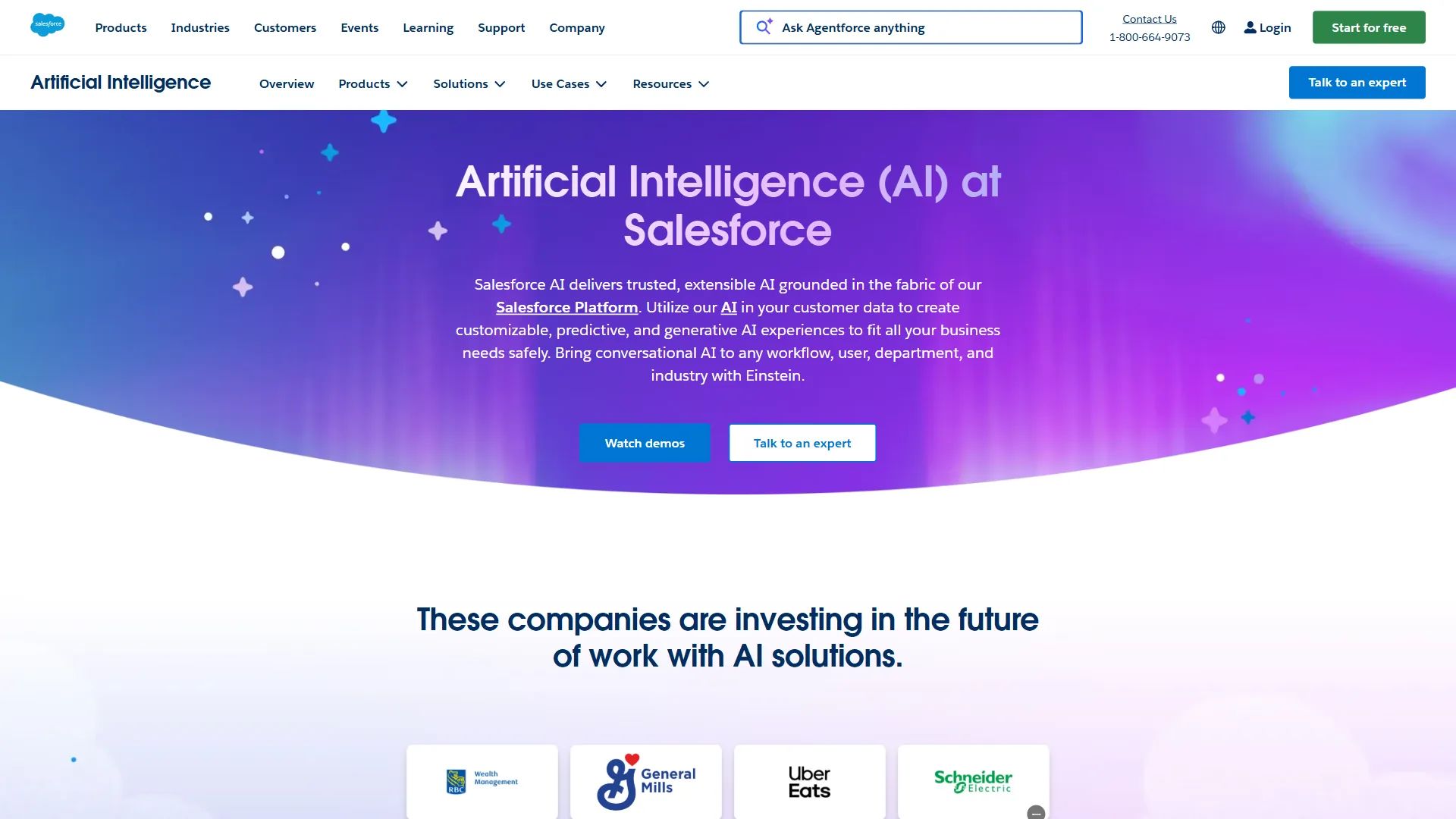
Salesforce’s AI stack is more powerful but also more complex:
Einstein Copilot - A conversational AI assistant that can answer questions about your data, draft emails, summarize records, and execute actions within Salesforce. Available on Unlimited ($330 per user/mo) and above.
Agentforce 2.0 - Autonomous AI agents that can:
- Process unstructured data (emails, documents, voice calls)
- Reason through multi-step workflows using the Atlas Reasoning Engine
- Take autonomous actions (update records, create tasks, escalate issues)
- Handle voice interactions via Agentforce Voice (AI-powered IVR)
Agentforce Builder - A conversational workspace for building custom agents with behavioral controls (Agent Script) and cross-system orchestration (MuleSoft Agent Fabric).
The key limitation: Full Agentforce access requires the Einstein 1 Sales tier at $500 per user/month. For a 10-person team, that is $60,000/year just for the software - before admin and implementation costs.
AI Comparison Summary
| AI Feature | HubSpot Breeze | Salesforce Agentforce |
|---|---|---|
| Content Generation | Included (Starter+) | Einstein Copilot (Unlimited+) |
| Autonomous Agents | Customer, Prospecting, Data | Agentforce 2.0 (full suite) |
| Custom Agent Builder | Breeze Studio (Enterprise) | Agentforce Builder (Einstein 1) |
| Voice AI | Not available | Agentforce Voice (AI IVR) |
| Min. Cost for AI | $15/mo (basic) | $330/user/mo (Copilot) |
| Reasoning Engine | Standard AI models | Atlas Reasoning Engine |
Bottom line: HubSpot democratizes AI by including it at every tier. Salesforce delivers more powerful AI capabilities, but behind a significant paywall. If AI-assisted productivity is a priority and your budget is limited, HubSpot gets you there faster. Our best AI CRM tools roundup ranks more options at every budget.
Feature-by-Feature: Ease of Use and Learning Curve
HubSpot is dramatically easier to use than Salesforce, with most teams productive within the first week versus 30 to 90 days for a full Salesforce rollout. This is where the HubSpot vs Salesforce gap is widest.
HubSpot is designed around the idea that your team should not need training to use basic features. The interface follows modern UX conventions - clear navigation, drag-and-drop editors, and contextual help throughout. HubSpot Academy provides free certification courses, and most teams are productive within the first week. According to research published by Nucleus Research, “91% of companies with 10 or more employees now use CRM software,” and adoption ease is consistently a leading predictor of which deployments actually deliver ROI. That dynamic helps explain why 70% of users cite ease of use as a primary reason for choosing the platform, according to HubSpot’s own customer research.
Salesforce is incredibly powerful but undeniably complex. The interface has improved significantly with Lightning Experience, but configuring custom objects, building automation flows, and managing permissions requires technical knowledge. Trailhead (Salesforce’s free learning platform) is excellent, but “learning Salesforce” is a career path, not a weekend project. Most organizations need 30-90 days to fully implement Salesforce, and ongoing administration is a continuous effort.
The productivity impact is real. A CRM that your sales reps actually use delivers value. A CRM that sits half-configured because nobody understands how to customize it delivers frustration. If your team does not have - or does not want to hire - a dedicated CRM administrator, HubSpot’s self-service model saves you time every single week. The Pipedrive vs HubSpot comparison covers another popular self-service alternative.
Integrations and Ecosystem
Salesforce offers roughly 18 times more integrations than HubSpot - 9,000+ apps on the AppExchange marketplace versus HubSpot’s 500+ native apps - making it the decisive winner for organizations that need niche or industry-specific connectors.
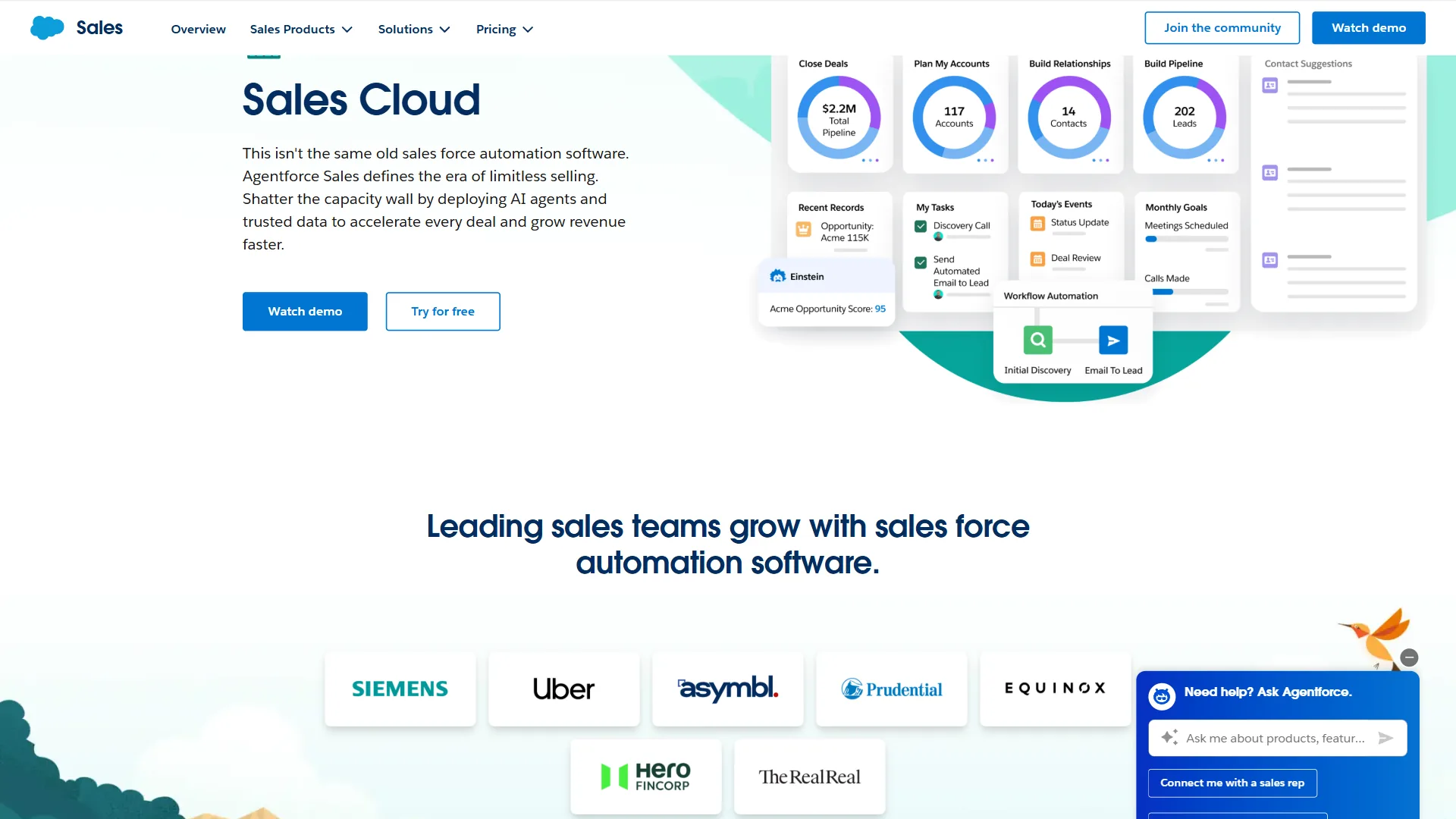
Salesforce wins this category decisively. The AppExchange marketplace has over 9,000 apps covering every conceivable business need - from CPQ and billing to industry-specific compliance tools. If a SaaS product exists, it has a Salesforce integration in most cases.
HubSpot offers 500+ native integrations through its App Marketplace, covering major tools like Slack, Zapier, Gmail, Outlook, and most popular business applications. For most small and mid-sized businesses, this is more than enough. But if you need a niche industry integration or a custom connector, Salesforce’s ecosystem is unmatched.
Integration workflow example: A typical lead-to-customer workflow involves your CRM, email platform, project management tool, and billing system.
- On HubSpot: Most of this lives natively in the platform. Marketing captures the lead, Sales closes the deal, Service manages onboarding - all within HubSpot. Most teams connect Zapier for a few external automations.
- On Salesforce: You will likely connect several specialized tools through AppExchange - a CPQ tool for quotes, a marketing automation platform (Pardot/Marketing Cloud), a customer success tool, and various custom integrations through MuleSoft.
The tradeoff: HubSpot’s all-in-one approach means fewer integration points to manage but less flexibility. Salesforce’s ecosystem approach gives you best-in-class options for every function but requires more configuration and maintenance. Salesforce publishes integration counts and partner data on its official AppExchange marketplace.
Choose HubSpot if you
HubSpot is the right choice if you:
- Are a marketing-led organization - inbound DNA, best-in-class marketing automation and lead nurturing for the price
- Have a small to mid-sized team (under 50 users) - pricing and self-service model are built for this range
- Do not have a dedicated CRM admin - sales and marketing teams can manage HubSpot themselves
- Want AI features without a massive budget - Breeze AI is included from Starter ($15 per month) onward
- Value speed to value over maximum customization - teams typically see productivity gains within the first week
- Are currently using spreadsheets or a basic CRM - HubSpot’s free tier is the easiest on-ramp to a real CRM
Choose Salesforce if you
Salesforce is the right choice if you:
- Have 200+ users or complex org structures - territory management, hierarchical teams, advanced permissions shine at scale
- Run long B2B sales cycles (3-18 months) - advanced forecasting and pipeline analytics are unmatched
- Need extensive customization - custom objects, advanced automation, 9,000+ integrations give virtually unlimited flexibility
- Have dedicated technical resources - a Salesforce admin or consulting partner who can build and maintain your configuration
- Want the most powerful AI agents available - Agentforce 2.0 leads the CRM space in capability at $500 per user per month
- Operate in a regulated industry - advanced compliance, audit trails, governance tools are built for enterprise requirements
Methodology: Migration Considerations
A HubSpot to Salesforce or Salesforce to HubSpot migration typically requires 60 to 90 days and $10,000 to $30,000 in consulting fees for a clean cutover. Our analysis here is based on current vendor documentation, published pricing pages, and migration patterns observed in independent research rather than sponsored placement. If you are switching between platforms, plan carefully:
HubSpot to Salesforce: Common for companies that outgrow HubSpot’s customization limits. Data migration is straightforward for standard objects (contacts, companies, deals). Custom properties require mapping. Budget 60-90 days and $10,000-$30,000 for a clean migration with a consulting partner.
Salesforce to HubSpot: Growing trend among companies seeking to reduce CRM costs and complexity. HubSpot offers free migration assistance for Professional and Enterprise customers. The biggest challenge is replicating complex Salesforce automations - some will need to be simplified or rethought for HubSpot’s workflow model. The best Salesforce alternatives roundup compares the most common landing platforms.
The hybrid approach: Some organizations use both. HubSpot handles marketing and top-of-funnel activities, while Salesforce manages enterprise sales and complex deal cycles. HubSpot offers a native Salesforce integration that syncs contacts, companies, and deals bidirectionally. This works well but adds complexity and cost. The best CRM for small business 2026 guide weighs whether a hybrid is worth the overhead.
The Bottom Line on HubSpot vs Salesforce
The bottom line is HubSpot wins on speed-to-value and total cost of ownership for teams under 50 users, while Salesforce wins on customization, ecosystem, and enterprise-grade AI capability for orgs with dedicated technical resources. The HubSpot vs Salesforce decision in 2026 comes down to a fundamental question: do you need a CRM your team can use immediately, or a CRM that can do anything with enough configuration?
HubSpot is the better choice for growth-stage companies, marketing-led organizations, and teams that want an all-in-one platform without hiring a CRM administrator. The free tier gets you started, Breeze AI adds genuine productivity value at every tier, and the total cost of ownership is dramatically lower. For a 10-person team, you will typically save $60,000-$100,000 per year compared to a fully implemented Salesforce instance.
Salesforce is the better choice for enterprise organizations with complex sales processes, dedicated technical resources, and the budget to invest in deep customization. Agentforce 2.0 is the most capable AI agent platform in the CRM space, the AppExchange ecosystem is unmatched, and no other CRM handles the complexity of territory management, multi-department implementations, and regulatory compliance as well.
If you are genuinely unsure, start with HubSpot’s free tier. It costs nothing, takes minutes to set up, and gives you a real CRM to evaluate against your workflows. If you hit customization limits, that is a good problem to have - and a clear signal that Salesforce is worth the investment. The Salesforce competitors roundup lists every serious challenger if you want broader options.
FAQ
Q: Which one is better, HubSpot or Salesforce?
Neither platform is universally better. The right choice depends on your team size, technical resources, and how much you value simplicity over customization. Based on analysis of pricing structures and AI features, HubSpot fits marketing-led growth teams while Salesforce fits enterprise organizations with complex sales processes and dedicated administrators.
Q: What is the #1 CRM in the world?
Salesforce is the original cloud CRM and still the market leader by revenue. It powers everything from small sales teams to Fortune 500 enterprises, with a platform so customizable that entire consulting firms exist solely to implement and maintain it.
Q: What are the downsides of HubSpot?
HubSpot’s notable limitations include pricing that escalates quickly once you outgrow Starter, with mandatory onboarding fees for Professional and Enterprise tiers. Contact-based pricing means costs grow as your database grows, and HubSpot offers fewer integrations than Salesforce - 500+ native apps versus 9,000+ on Salesforce’s AppExchange.
Related Reading
Related reading on this site includes our deep-dive reviews of the two tools compared above plus the broader CRM and sales-AI roundups that put them in context.
Tools covered in this article:
- HubSpot - All-in-one CRM with Breeze AI
- Salesforce - Enterprise CRM with Agentforce 2.0
More CRM and sales productivity guides:
- Best AI CRM Tools 2026 - Top AI-powered CRMs compared
- Best AI Sales Tools - AI tools that accelerate your pipeline
- Best Marketing Automation Tools 2026 - Marketing platforms for every budget
External Resources
External resources for further verification include each vendor’s official website, pricing page, and free certification academy.
- HubSpot - Official website
- Salesforce - Official website
- HubSpot Academy - Free CRM certifications and courses
- Salesforce Trailhead - Free learning platform for Salesforce skills