



The best Salesforce alternatives are HubSpot for marketing-led teams, Pipedrive for small sales teams, and Close for inside sales - each delivers pipeline management, automation, and AI-assisted selling at a fraction of Salesforce’s cost. Salesforce still leads the CRM market with a 21.7% global share, according to IDC’s worldwide CRM market analysis, and that lead is earned - no other platform matches its 9,000+ AppExchange integrations or its AI depth through Agentforce and Einstein.
But dominance does not mean fit. For every sales team that genuinely needs Salesforce’s enterprise machinery, dozens pay $80 to $330 per user per month for features they never touch. Add implementation consultants, a dedicated administrator, and ongoing AppExchange subscriptions, and the true cost often reaches two to four times the license fee alone.
This guide covers three Salesforce alternatives that deliver what most sales teams actually need without the cost that makes Salesforce overkill for smaller operations. Our analysis draws on each vendor’s current pricing and feature documentation plus independent research rather than sponsored placement, and AI Productivity may earn a commission from links on this page while rankings stay editorially independent. For a broader survey, see our best CRM software roundup.
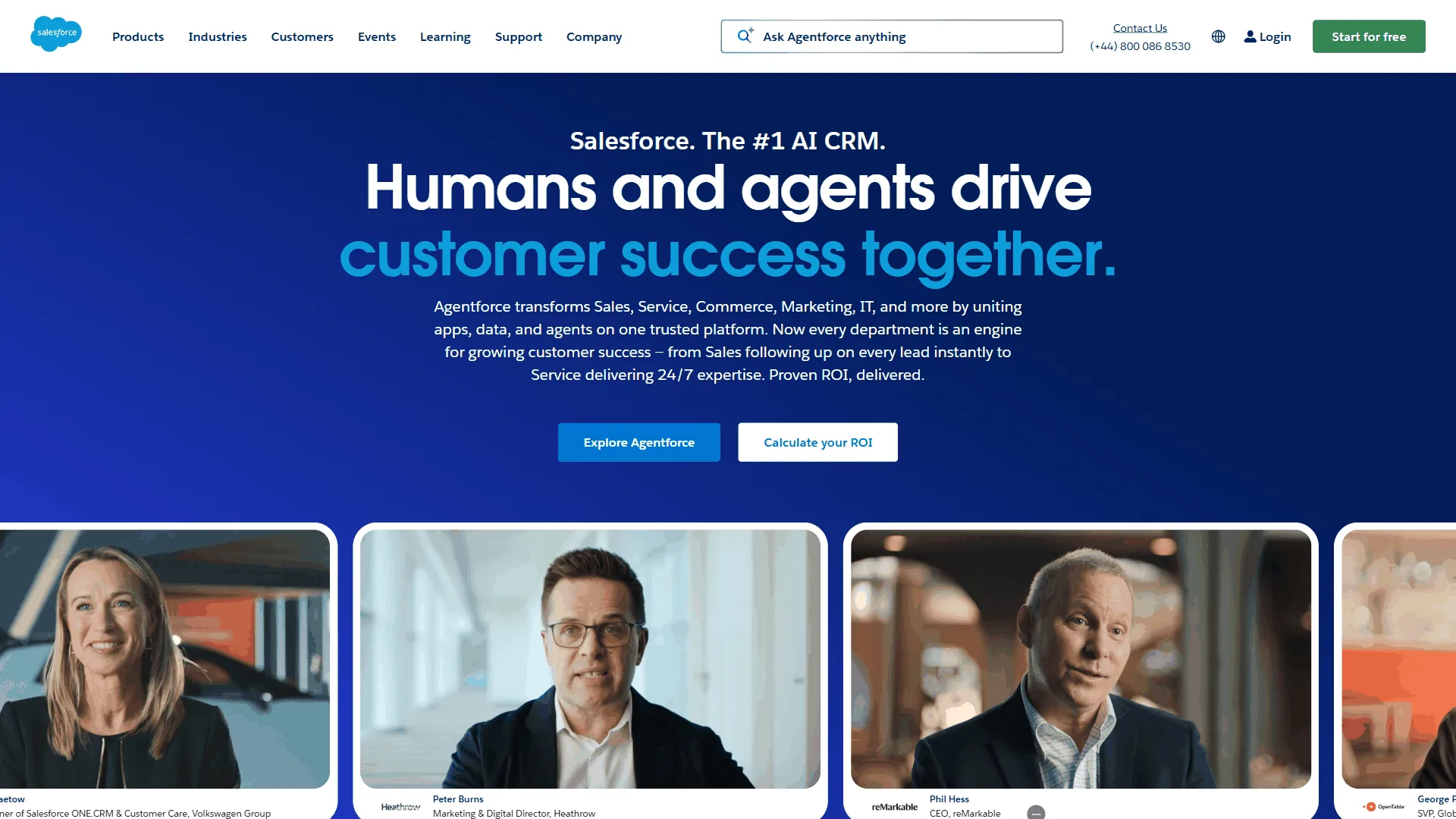
Comparison Table: Best Salesforce Alternatives at a Glance
The three leading Salesforce alternatives - HubSpot, Pipedrive, and Close - start at $0, $14, and $49 per user per month, all undercutting Salesforce once real sales features are included.
| Salesforce | HubSpot | Pipedrive | Close | |
|---|---|---|---|---|
| Starting price | $25/user/mo | Free / $15/mo | $14/user/mo | $49/user/mo |
| Enterprise price | $330/user/mo | $1,500/mo | $64/user/mo | $139/user/mo |
| Free tier | No (30-day trial) | Yes (generous) | No (14-day trial) | No (14-day trial) |
| Best for | Enterprise complexity | Marketing-sales alignment | Small sales teams | Inside sales teams |
| AI features | Agentforce + Einstein | Breeze AI | AI Sales Assistant | AI workflows |
| Setup time | Weeks to months | Hours to days | Hours | Hours |
| 4.4 | 4.4 | 4.3 | 4.7 |
Why People Leave Salesforce
Salesforce earns strong user ratings across review platforms, and companies that deploy it properly see real returns. The issue is not quality - it is fit. Pipedrive frames its own founding around exactly this gap:
“Pipedrive was built by salespeople, for salespeople,” the company states in its official company story, describing a deliberate reaction to CRMs designed for managers rather than reps.
Several consistent pain points push teams toward Salesforce alternatives:
- Cost scales fast - Starter at $25 per user/month is too limited for real sales work; most teams need Professional ($80) or Enterprise ($165) for automation, advanced reporting, and API access. A 10-person team on Professional pays $9,600 per year before add-ons (compare the small business CRM field).
- Implementation overhead - A standard deployment requires an administrator and frequently a consultant, with configuration taking weeks.
- Adoption friction - The dense interface makes reps resist using it, creating the classic CRM failure where data is only as good as the team’s willingness to enter it.
- Hidden costs compound - Advanced reporting, marketing automation, and customer service modules each require separate products (Marketing Cloud, Service Cloud) with their own licensing.
- Feature excess - Multi-currency support, territory management, and approval workflows clutter the interface for teams that do not need them.
If those issues sound familiar, the Salesforce alternatives below address each one directly.
1. HubSpot CRM - Best All-in-One Alternative
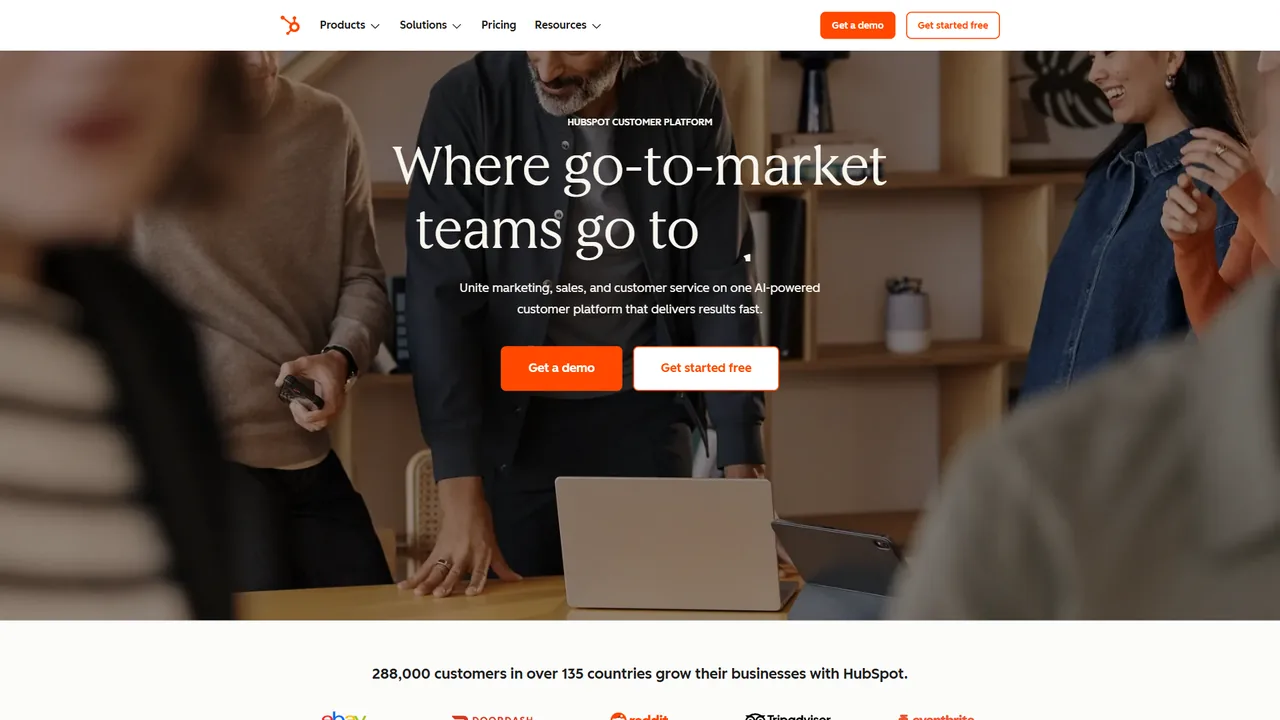
Pricing: Free / $15 per month (Starter) / $500 per month (Professional) / $1,500/mo (Enterprise) Free tier: Yes - unlimited users on the free CRM with contact management, deal tracking, and email integration
HubSpot is the most frequently chosen Salesforce alternative, and the primary reason is the free CRM. Unlike Salesforce’s 30-day trial, HubSpot offers a permanently free tier with record management, deal pipelines, task tracking, email integration, live chat, and basic reporting - removing all financial risk for small teams testing whether they need a CRM at all. The full upgrade ladder lives in our HubSpot pricing breakdown.
The deeper argument for HubSpot is marketing-sales alignment. Its CRM and marketing tools share a single database natively, so sales reps see which emails a lead opened and what content they downloaded - in the same record where they log calls. In Salesforce, that visibility requires buying Marketing Cloud separately and integrating it with Sales Cloud, a project that typically takes weeks.
Breeze AI Suite
HubSpot’s AI offering - launched at INBOUND 2025 - includes the AI Assistant with conversational memory, a Customer Agent for support ticket resolution, and a Prospecting Agent that functions as an AI-powered BDR. The full suite is documented on HubSpot’s AI product page, and it competes directly with Salesforce’s Einstein Copilot at a fraction of the price.
Key Strengths
- Free CRM is genuinely functional, not a stripped-down demo
- Native marketing automation eliminates marketing-sales integration overhead
- Breeze AI handles email drafting, deal summaries, and conversation intelligence
- Sequences for automated outreach without a separate sales engagement tool
- Clean interface that drives adoption without lengthy training
- 1,500+ app marketplace integrations including Slack, Zoom, and major ERPs
Where It Falls Short
- Professional tier ($500 per month) is a steep jump from Starter ($15 per month)
- Mandatory onboarding fees on Professional ($3,000) and Enterprise ($7,000)
- Contact-based pricing means costs scale with database size, not just seats
- Heavy customization needs still favor Salesforce
- Free-plan reporting is basic; meaningful analytics require paid tiers
Best For
Marketing-led organizations where content, email campaigns, and inbound lead generation drive the pipeline, and teams that want CRM, marketing automation, and customer service in one platform without data sync between separate products. The Pipedrive vs HubSpot comparison covers when sales-only tools win instead.
2. Pipedrive - Best for Small Sales Teams
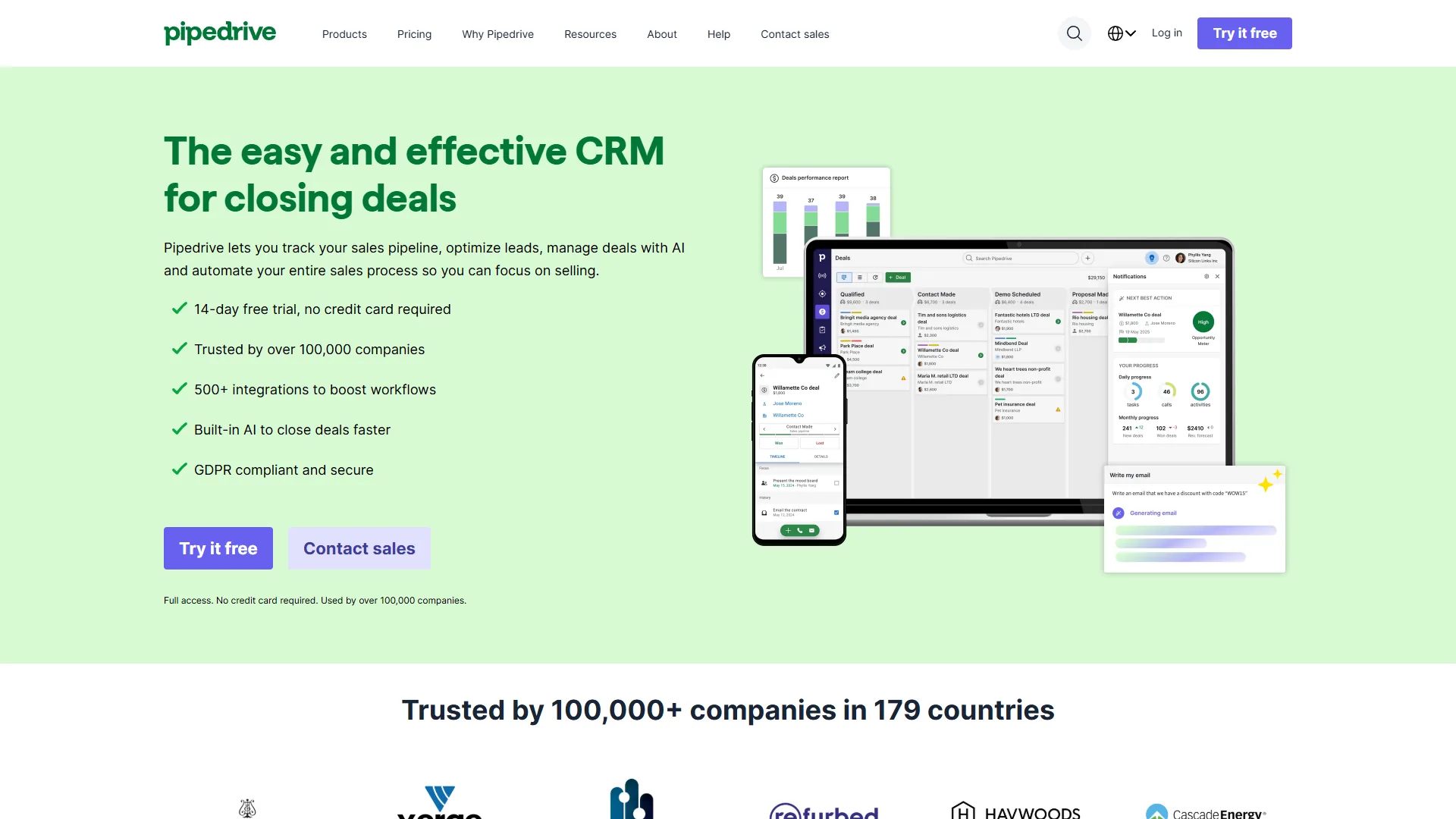
Pricing: $14 per user/mo (Essential) / $39 per user/mo (Advanced) / $49 per user/mo (Professional) / $64 per user/mo (Power) Free tier: 14-day trial
Pipedrive was built by salespeople frustrated with CRMs designed for managers rather than reps. As described in their features overview, the result is a pipeline-first interface where deals are the primary object and the daily workflow is visible at a glance without clicking through layers of menus.
The signature view is the Kanban pipeline: deals as cards, stages as columns, drag to advance. Pipedrive executes this better than any competitor, including Salesforce. New reps go from zero to productive within hours, not the weeks Salesforce implementations demand - so where adoption has been the bottleneck, Pipedrive’s simplicity matters most (AI CRM tools covers the broader AI-first category).
AI Sales Assistant
Pipedrive’s AI capabilities arrive at the Professional tier ($49 per user/month). The AI Sales Assistant provides win probability predictions, identifies at-risk deals, and suggests next steps based on historical patterns, while Smart Contact Data enriches records with job titles, company information, and LinkedIn profiles. At $49 per user/month, these features cost roughly one-third of comparable Einstein features on Salesforce Enterprise ($165 per user/month).
Key Strengths
- Best-in-class visual pipeline for drag-and-drop deal management
- Activity-based selling guides reps to their next action, not just history
- AI Sales Assistant predicts deal outcomes and flags at-risk opportunities
- Email sync with conversation history attached to contact and deal records
- Smart Docs for proposal creation with real-time open tracking
- LeadBooster add-on for chatbot and live chat lead capture
- Strong mobile app with offline mode for field sales teams
Where It Falls Short
- No marketing automation - Pipedrive is sales-only, requiring a separate tool
- Reporting is functional but not as deep as Salesforce or HubSpot Professional
- Advanced fields and workflows require Professional ($49 per user/month)
- No built-in email sending sequences on the base plan
- Customer support features are minimal - not built for post-sale management
Best For
B2B sales teams of 5 to 50 reps with a clear pipeline process who need a tool reps will actually use daily - particularly strong for field sales teams relying on mobile access and organizations where CRM adoption, not features, has been the primary challenge. The top CRM tools shortlist places Pipedrive among rep-favorite picks.
3. Close - Best for Inside Sales
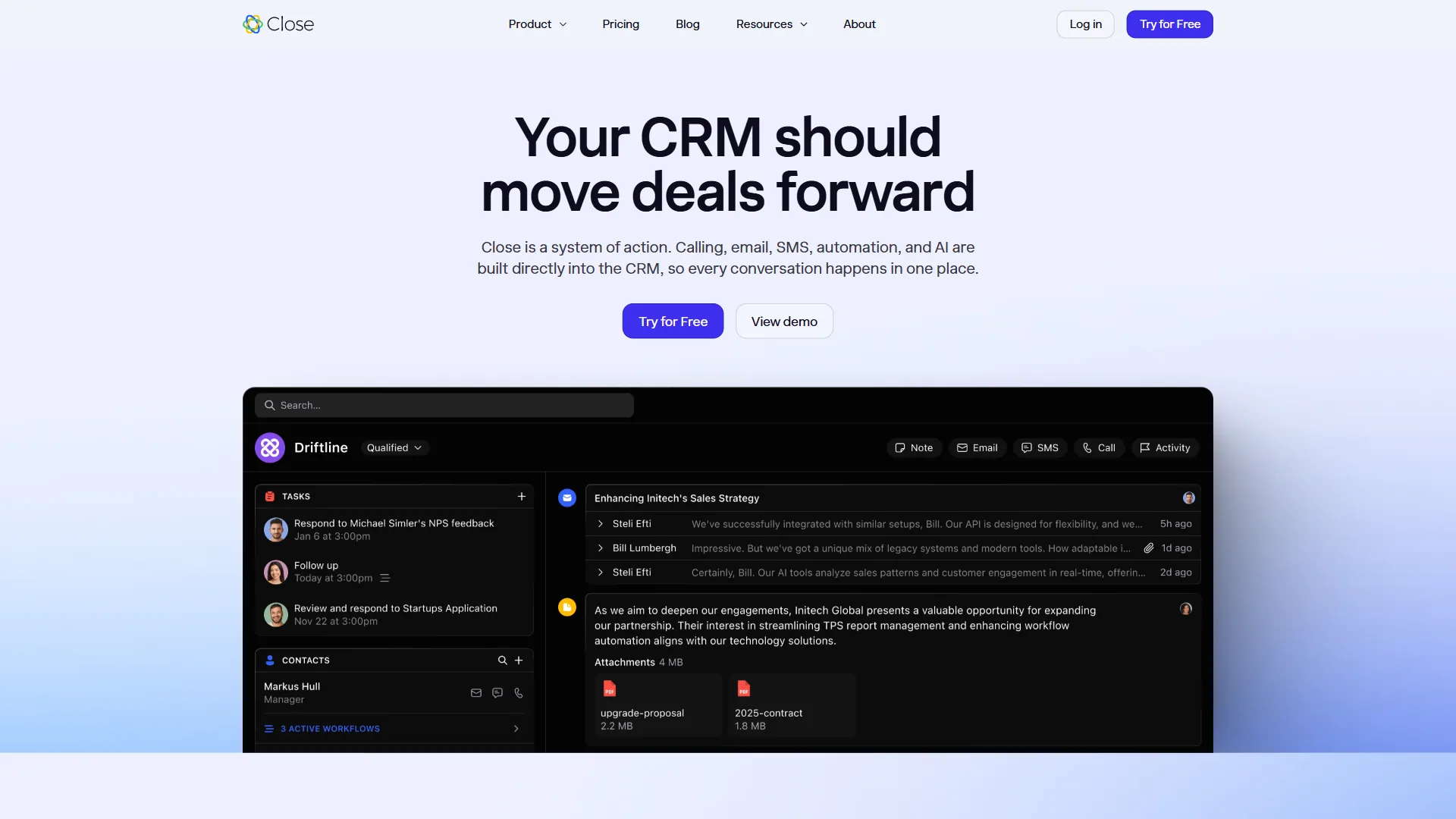
Pricing: $49 per user/mo (Startup) / $99 per user/mo (Professional) / $139 per user/mo (Enterprise) Free tier: 14-day trial
Close CRM is purpose-built for inside sales teams that spend their day on the phone and in email. Their built-in calling features set it apart: where Salesforce treats calling as a bolt-on integration and HubSpot includes it as one capability among many, Close makes calling and email sequencing the core of the experience.
The built-in power dialer, predictive dialer (on Professional and above), and call coaching tools eliminate the need for separate sales engagement platforms like Outreach or SalesLoft. For teams paying for Salesforce plus a dialer plus a sequence tool, Close consolidates those costs into a single subscription - often below the Salesforce stack price alone.
AI Workflows
Close’s AI capabilities focus on practical automation rather than broad intelligence. AI-powered workflows handle lead assignment, follow-up scheduling, and activity logging automatically, and the system learns from rep behavior to suggest optimal contact times and cadences. While less sophisticated than Salesforce’s Agentforce platform, Close’s AI is tuned for high-velocity sales motions where speed of follow-up matters more than depth of analysis.
Key Strengths
- Built-in power dialer and predictive dialer replace third-party calling tools
- Email sequences with A/B testing for automated outreach within the CRM
- Call coaching and recording features for sales manager review
- Unified inbox combining email, calls, and SMS in a single timeline per contact
- Fast setup - most teams are fully operational within a day
- Strong API for custom integrations and workflow automation
- Highest user rating (4.7) among all four tools in this comparison
Where It Falls Short
- No free tier - the $49 per user/month start is higher than HubSpot or Pipedrive
- Marketing automation is minimal; Close is built for sales execution, not nurturing
- Reporting is adequate but lacks the depth of Salesforce or HubSpot Professional
- Fewer integrations than HubSpot’s 1,500+ marketplace
- Not designed for complex multi-stakeholder enterprise deal processes
Best For
Inside sales teams running high-volume outbound operations where phone calls and email sequences are the primary sales motions. SDR and BDR teams currently juggling a CRM, a dialer, and a sequence tool see the most value from Close’s consolidated approach (the broader salesforce competitors field offers more options).
Final Verdict: When to Stick with Salesforce
Salesforce remains the right choice over its alternatives in five specific situations: complex enterprise sales cycles, multi-department deployments, strict regulatory compliance, deep existing ecosystem investment, and sales teams above 200 reps. Salesforce alternatives make sense for most small and mid-size teams, but some situations genuinely require what only Salesforce delivers:
- Complex enterprise sales cycles - Deals involving 6 to 18 months of multi-stakeholder engagement with territory management and approval workflows make Salesforce’s depth hard to replace
- Multi-department unification - When Sales Cloud, Service Cloud, and Marketing Cloud must share one data model across hundreds of users, Salesforce’s architecture is purpose-built for it
- Regulatory compliance - Industries requiring HIPAA, SOC 2, ISO 27001, or FedRAMP need Salesforce’s enterprise certification portfolio
- Existing ecosystem investment - Years of customization and AppExchange dependencies create migration costs that may exceed switching savings - the salesforce-native sales tools roundup shows why teams stay
- 200+ sales reps - At scale, territory management, forecasting, and role-based access controls justify the cost
If none of those describe the situation, the alternatives above serve most teams better at significantly lower cost.
Total Cost: How Much Do Salesforce Alternatives Actually Cost
A 10-person sales team spends roughly $1,800 to $6,000 a year on HubSpot, $5,880 to $8,000 on Pipedrive, and $11,880 to $13,000 on Close - against $15,000 to $25,000-plus on Salesforce once admin salary and consultants are counted. The sticker price tells only part of the story. Here is what a 10-person team pays annually at the most commonly purchased tier:
| Tier | Per User/Mo | 10 Users/Year | Add-On Costs | Estimated Total | |
|---|---|---|---|---|---|
| Salesforce | Professional | $80 | $9,600 | Admin salary, consultants, AppExchange | $15,000 - $25,000+ |
| HubSpot | Starter | $15 | $1,800 | Professional upgrade if needed | $1,800 - $6,000 |
| Pipedrive | Professional | $49 | $5,880 | LeadBooster, Smart Docs add-ons | $5,880 - $8,000 |
| Close | Professional | $99 | $11,880 | Minimal (calling included) | $11,880 - $13,000 |
Key insight: Salesforce’s real cost advantage only kicks in at enterprise scale. For teams under 50 users, total cost of ownership - including an administrator salary ($60,000 to $90,000 annually), implementation consulting, and ongoing customization - makes it the most expensive option by a wide margin. Close has the highest per-seat price among the alternatives but includes calling tools that would otherwise cost $30 to $50 per user per month through platforms like Outreach or SalesLoft - the Zoho CRM alternatives breakdown shows similar consolidation math.
HubSpot’s free tier makes it the lowest-risk starting point, but teams should plan for the jump to Professional ($500 per month) once they need serious marketing automation - one of the steepest price escalations in the CRM market.
Pipedrive offers the most predictable total cost: no mandatory onboarding fees, no contact-based pricing, and a per-user model that stays flat as the database grows, so budget planning is straightforward - the same predictability shows up across salesforce alternatives at the lower end of the market.
The Bottom Line
Choose HubSpot if marketing drives the pipeline, Pipedrive if rep adoption is the bottleneck, and Close if high-volume calling is the core sales motion - the right Salesforce alternative comes down to what makes Salesforce wrong for the team in question:
HubSpot is the strongest choice for marketing-led organizations that want CRM and marketing automation in one platform. The free tier is the most generous entry point on this list, and the Breeze AI suite delivers meaningful productivity gains without enterprise pricing.
Pipedrive wins for sales teams that prioritize simplicity and rep adoption. The visual pipeline interface is the best in the CRM market, and the AI Sales Assistant provides practical intelligence at a price that undercuts Salesforce by 60% or more.
Close is the right pick for inside sales teams running high-volume phone and email outreach. The built-in dialer and sequence tools eliminate separate sales engagement platforms, and the 4.7 user rating reflects genuine satisfaction.
Salesforce remains the right answer for large enterprise operations with complex requirements, multi-department deployments, and the technical resources to manage the platform. For everyone else, the alternatives above deliver better value with less friction.
FAQ
Q: Who is the biggest competitor to Salesforce?
HubSpot is the most prominent competitor, especially for teams wanting marketing-sales alignment. Pipedrive leads for small sales teams with pricing starting at $14 per user per month, and Close is strong for inside sales teams. This guide covers three salesforce alternatives - HubSpot, Pipedrive, and Close - that deliver pipeline management, automation, and AI-assisted selling without enterprise complexity.
Q: Which CRM is better than Salesforce?
The signature view is the Kanban pipeline: deals as cards, stages as columns, drag to advance. Pipedrive executes this better than any competitor, including Salesforce.
Q: How much does Salesforce really cost compared to alternatives?
Salesforce Starter runs $25 per user per month but is too limited for real sales work; most teams need Professional at $80 or Enterprise at $165. A 10-person team on Professional pays $9,600 per year before add-ons, and the true cost often reaches two to four times the license fee once consultants and AppExchange subscriptions are added.
Q: Why do teams switch from Salesforce to alternatives?
Teams switch because of fit, not quality. Cost scales fast - Starter at $25 per user per month is too limited, so teams jump to Professional at $80 or Enterprise at $165. Implementation overhead requires an administrator and frequently a consultant, and the dense interface creates adoption friction for smaller operations that do not need enterprise machinery.
Q: How long does it take to set up a Salesforce alternative?
HubSpot, Pipedrive, and Close all deploy in hours to days, compared to weeks or months for a standard Salesforce implementation. Salesforce typically requires an administrator and often a consultant, while the three alternatives let sales teams self-onboard without dedicated technical staff.
Related Reading
These guides go deeper on individual CRM platforms and the wider market.
- Salesforce Review - Full review of the enterprise CRM platform
- HubSpot Review - All-in-one CRM with free tier and marketing automation
- Pipedrive Review - Pipeline-first CRM for small sales teams
- Close Review - Inside sales CRM with built-in calling
- HubSpot vs Salesforce - Head-to-head of the two largest CRM platforms
- Best CRM Software 2026 - Full market overview of all major CRM platforms
- Best AI CRM Tools 2026 - How AI is changing CRM across the market
External Resources
The official vendor pricing pages below are the primary sources behind every figure here.
- Salesforce Sales Cloud Pricing - Official pricing for all tiers
- HubSpot Pricing - Full breakdown including onboarding fees
- Pipedrive Pricing - Tier comparison by plan
- Close Pricing - Startup, Professional, and Enterprise details