




The seven best Salesforce competitors in 2026 are HubSpot, Pipedrive, Zoho CRM, Monday.com, Freshdesk, Zendesk, and Salesforce itself - each one targets a specific gap where Salesforce overcharges smaller teams. Salesforce still holds roughly 21% of the global CRM market, yet these alternatives and competitors for 2026 close the gap fast on price, AI features, and time-to-value. If you are paying around $165 per user per month for Enterprise tier and wondering whether that budget could go further, you are not alone.
Salesforce remains the gold standard for large enterprise complexity, but most businesses under 100 employees are overpaying for features they will never use. The six salesforce alternatives below each solve a specific pain point better - or cheaper - than Salesforce does, and the picks span Salesforce alternatives for small business through enterprise-level CRM.
Methodology: our analysis draws on vendor pricing pages, product documentation, Gartner and Forrester research, and Nucleus Research ROI studies - not sponsored placement. Disclosure: AI Productivity may earn a commission from links here; rankings are editorially independent.
Why Do People Leave Salesforce?
The top reasons people leave Salesforce are pricing escalation past $165 per user per month, a 90-to-210-day implementation timeline, hidden add-on costs that push total cost of ownership 2 to 3 times the sticker price, and dependence on a dedicated administrator earning $60,000 to $90,000 per year. According to Gartner’s 2025 Sales Force Automation Magic Quadrant, 41% of buyers evaluating an alternative to Salesforce cite cost as the primary driver, and the global CRM market is on track to reach $145.79 billion by 2029 per Fortune Business Insights - a sign that buyers have real choice.
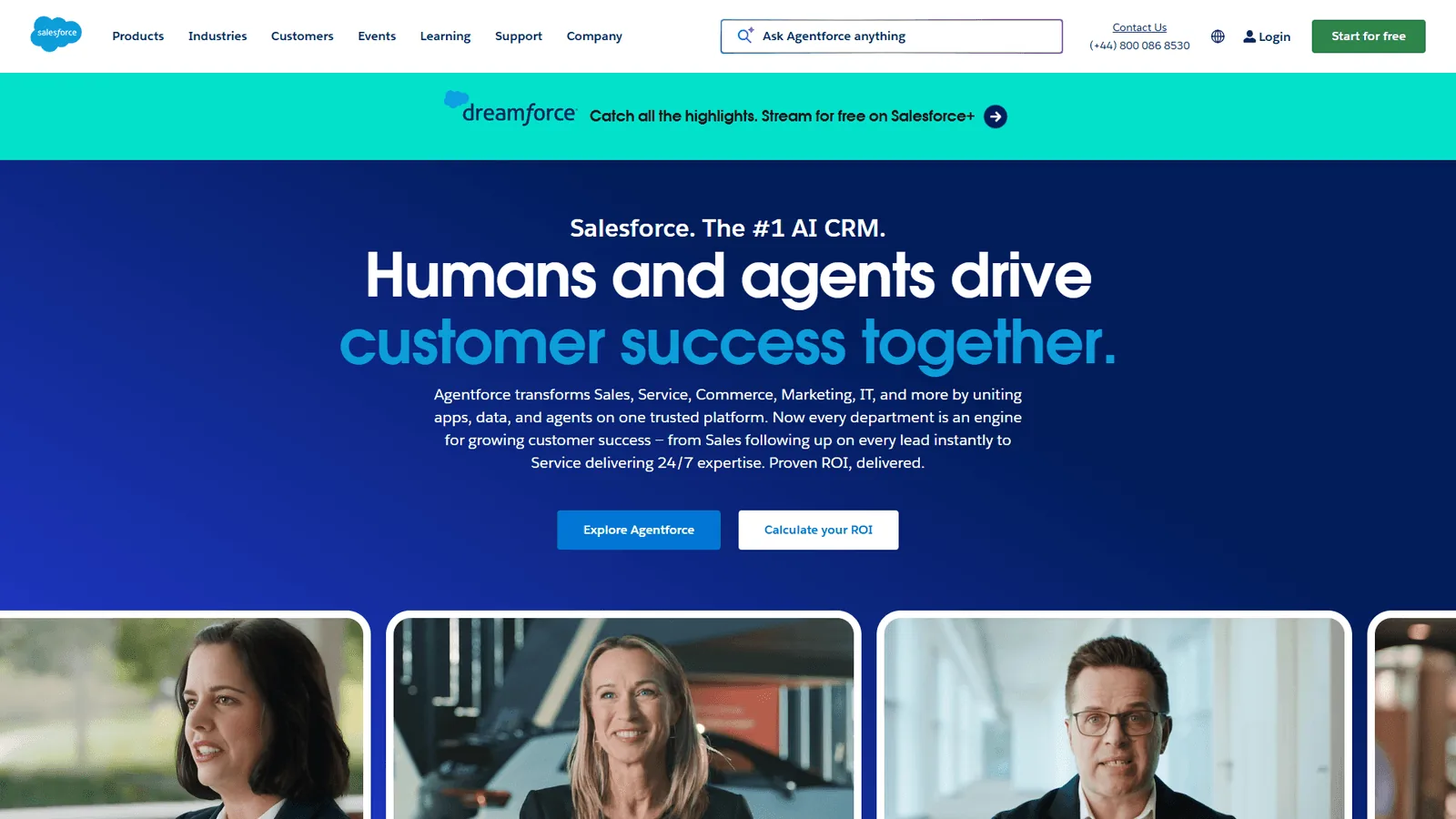
Salesforce’s strengths are undeniable: Agentforce 2.0 autonomous agents, Einstein Copilot, 9,000+ AppExchange integrations, and HIPAA/SOC 2/GDPR compliance. For Fortune 500 firms with dedicated Salesforce admins, nothing else comes close. But those strengths carry real costs:
- Pricing escalation: Starter Suite (around $25/user/mo) is too limited for production use; most teams need Enterprise ($165) or Unlimited ($330) - $8,250-$16,500/month for 50 people.
- Implementation timeline: 90 days to deploy, 210 days to full value, vs Pipedrive’s same-day setup.
- Hidden expenses: Tableau CRM, Pardot, CPQ, premium support, plus AppExchange apps at $10-$100/user/mo - total cost of ownership runs 2-3x sticker.
- Admin dependency: Requires a dedicated Salesforce admin ($60-$90K/yr) or consultants ($150-$300/hr).
Six CRM alternatives worth evaluating follow.
1. HubSpot - Best All-in-One Platform for Marketing-Led Teams
HubSpot is the best all-in-one Salesforce alternative for marketing-led teams because it merges CRM, marketing automation, sales tools, and service desk on a single shared database starting at $0 for the Free CRM tier. The Breeze AI Suite, launched at INBOUND 2024, autonomously resolves over 50% of support tickets, which makes HubSpot the strongest pick when inbound marketing drives revenue.
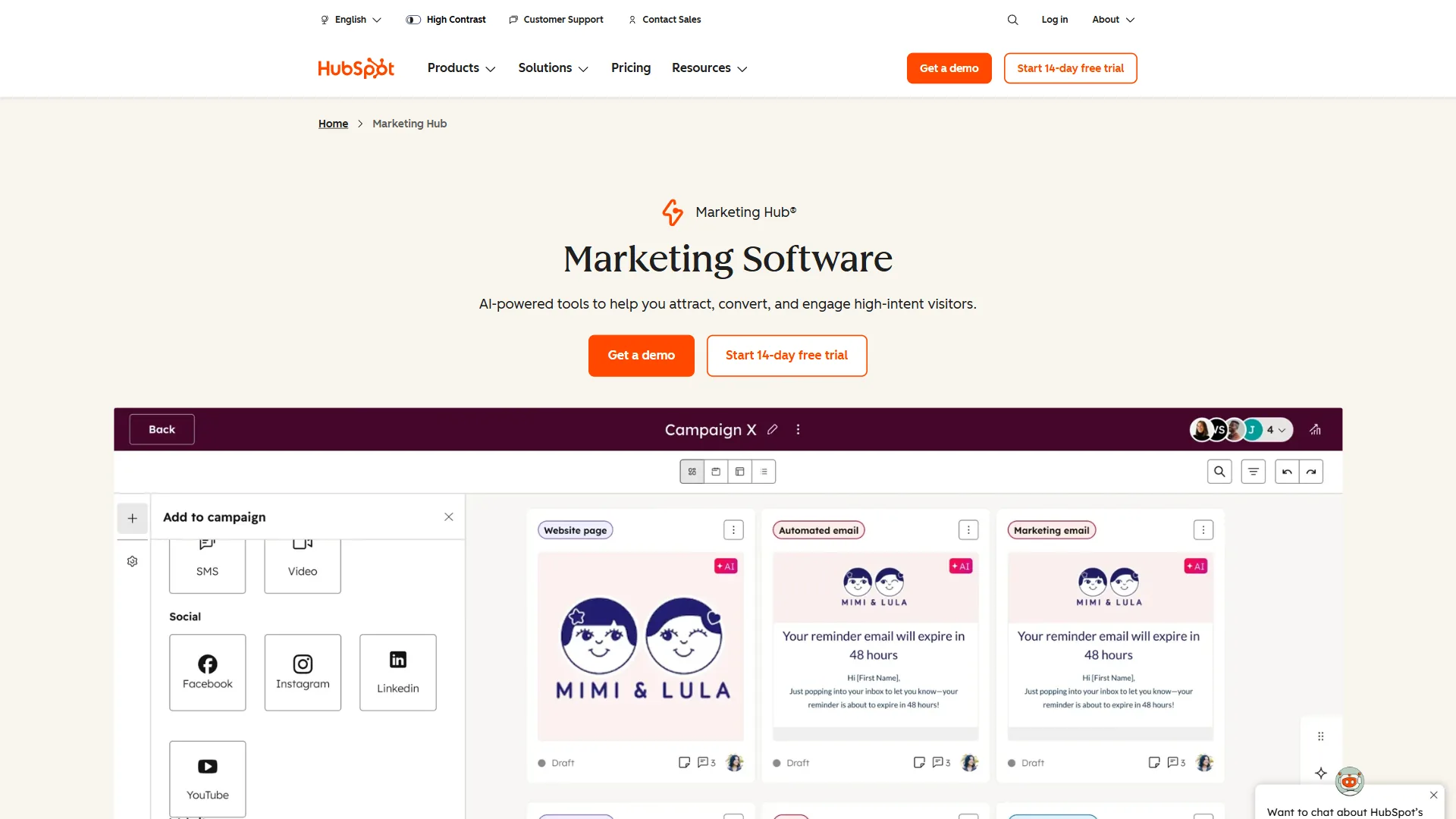
Why it competes: HubSpot combines CRM, marketing automation, sales, service, and CMS on one shared-data platform - eliminating the tool-sprawl that pushes teams off Salesforce. The Breeze AI Suite (INBOUND 2024) adds a Customer Agent resolving 50%+ of tickets autonomously, a Prospecting Agent acting as an AI BDR, and an AI Assistant with conversation memory.
Pricing comparison:
| Tier | HubSpot | Salesforce Equivalent |
|---|---|---|
| Entry | Free CRM (2 users) | Starter Suite ($25/user/mo) |
| Growth | Starter ($15/mo) | Pro Suite ($80/user/mo) |
| Professional | Sales Hub Pro ($500/mo for 3 seats) | Enterprise ($165/user/mo) |
| Enterprise | Sales Hub Enterprise ($1,500/mo for 5 seats) | Unlimited ($330/user/mo) |
Who should switch: Marketing-led organizations where inbound leads drive revenue, teams that want marketing automation plus CRM on one database, and companies valuing ease of use (70% of HubSpot users cite this as their top adoption reason).
Who should stay with Salesforce: Organizations needing 1,000+ integrations (HubSpot has 500+), deep custom objects, or specialized enterprise workflows.
The real tradeoff: HubSpot contact-based pricing can balloon as your database grows - Professional Marketing Hub jumps from around $15 per month to around $890 per month, plus a mandatory $3,000 onboarding fee on higher tiers.
2. Pipedrive - Best for Sales-Focused Teams That Hate Complexity
Pipedrive is the best Salesforce competitor for sales-focused teams that want a visual drag-and-drop pipeline and same-day setup at $14 per user per month on the annual Lite tier. The platform strips out marketing automation, multi-department workflows, and territory management so reps spend their day moving deals - not configuring objects.
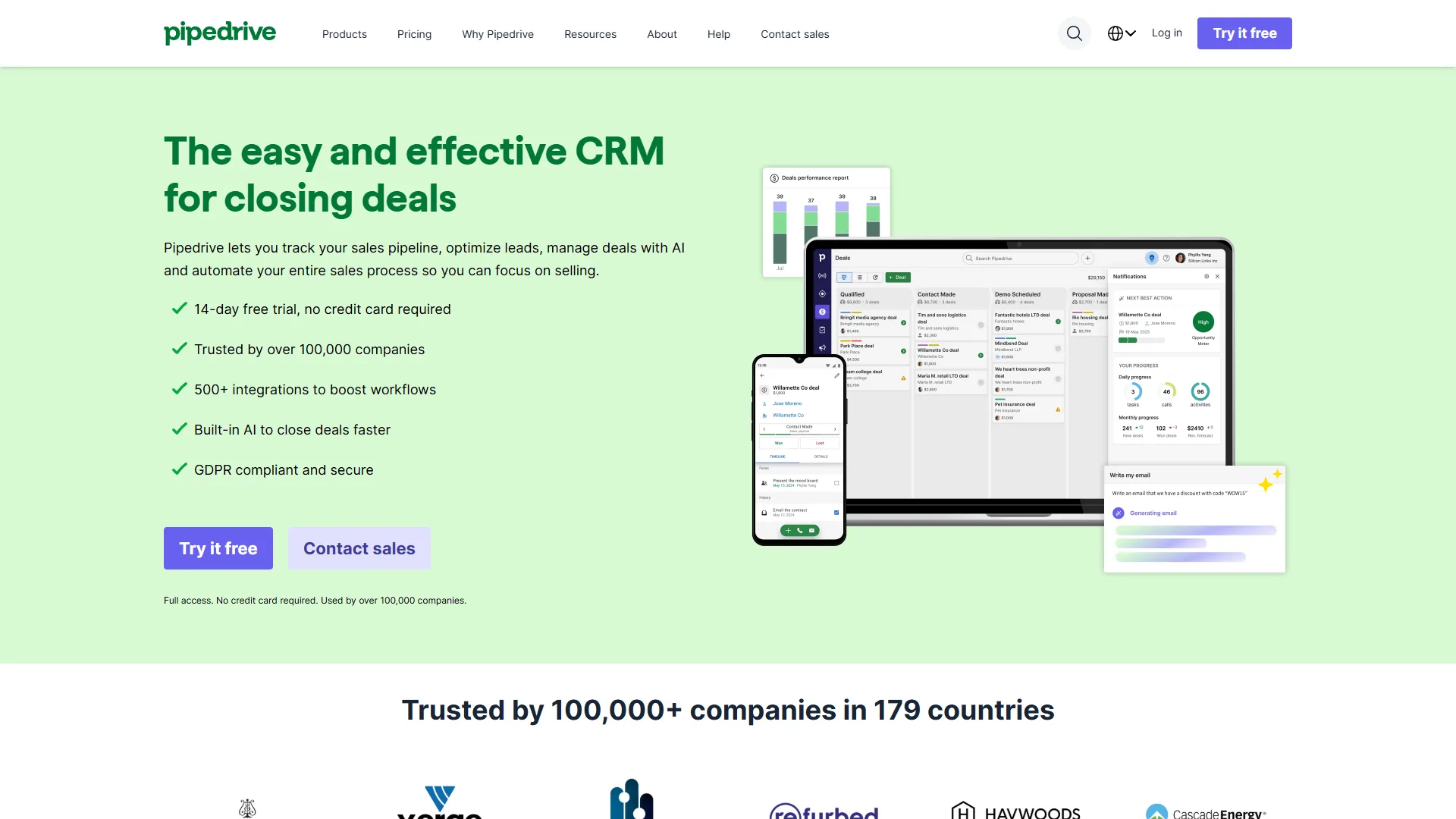
Why it competes: Pipedrive is the sports car to Salesforce’s 747 - one purpose, closing deals. The AI Sales Assistant (Premium, around $79/user/mo) provides win-probability predictions, AI email generation, and historical-data lead scoring; Ultimate ($99) adds an agentic AI experience in beta.
Pricing comparison:
| Tier | Pipedrive | Salesforce Equivalent |
|---|---|---|
| Lite | $24/user/mo ($14 annual) | Starter Suite ($25/user/mo) |
| Growth | $49/user/mo ($39 annual) | Pro Suite ($80/user/mo) |
| Premium | $79/user/mo ($49 annual) | Enterprise ($165/user/mo) |
| Ultimate | $99/user/mo ($79 annual) | Unlimited ($330/user/mo) |
Who should switch: SMB sales teams (2-50 reps) prioritizing pipeline velocity, mobile-first field reps (Pipedrive’s offline mode is genuinely useful), and teams wanting predictable per-user pricing without contact-based surprise fees.
Who should stay with Salesforce: Teams needing marketing automation, multi-department workflows, territory management, or multi-tier approval chains.
The real tradeoff: Pipedrive has no free tier - just a 14-day trial - and full AI features require the Premium plan at around $79 per user per month, still less than half of Salesforce Enterprise.
3. Zoho CRM - Best Budget-Friendly Alternative with Real AI
Zoho CRM is the best budget-friendly Salesforce alternative because it delivers Zia AI predictions, anomaly detection, and the Zia Agent Studio at 40 to 60% less than Salesforce - the Enterprise tier costs $40 per user per month on annual billing. A 50-person team on Zoho Enterprise pays $2,000/month versus $8,250/month on Salesforce Enterprise - a $75,000 annual difference.
Why it competes: Zoho CRM delivers AI predictions, workflow automation, and custom modules at pricing 40-60% lower than Salesforce, plus a useful free tier for up to 3 users. Zia AI (Enterprise, around $50/user/mo) offers churn prediction, anomaly detection, sentiment analysis, and natural-language queries; Ultimate ($65) adds Zia Agent Studio for no-code AI agents - features that cost $200+/user/mo on Salesforce.
Pricing comparison:
| Tier | Zoho CRM | Salesforce Equivalent |
|---|---|---|
| Free | $0 (3 users) | No equivalent |
| Standard | $20/user/mo ($14 annual) | Starter Suite ($25/user/mo) |
| Professional | $35/user/mo ($23 annual) | Pro Suite ($80/user/mo) |
| Enterprise | $50/user/mo ($40 annual) | Enterprise ($165/user/mo) |
| Ultimate | $65/user/mo ($52 annual) | Unlimited ($330/user/mo) |
Who should switch: Budget-conscious SMBs needing AI plus workflow automation, teams already on the Zoho ecosystem (Books, Projects, Desk), and organizations wanting extensive customization without expensive consultants.
Who should stay with Salesforce: Large enterprises needing Salesforce-level customization depth or 9,000+ integrations (Zoho has 500+).
The real tradeoff: Zoho CRM support response times run 24 to 48 hours on lower tiers and the Blueprint automation learning curve takes weeks, but the 610% ROI documented in Nucleus Research case studies speaks to the value proposition.
4. Monday.com CRM - Best for Teams That Need Project Management + CRM
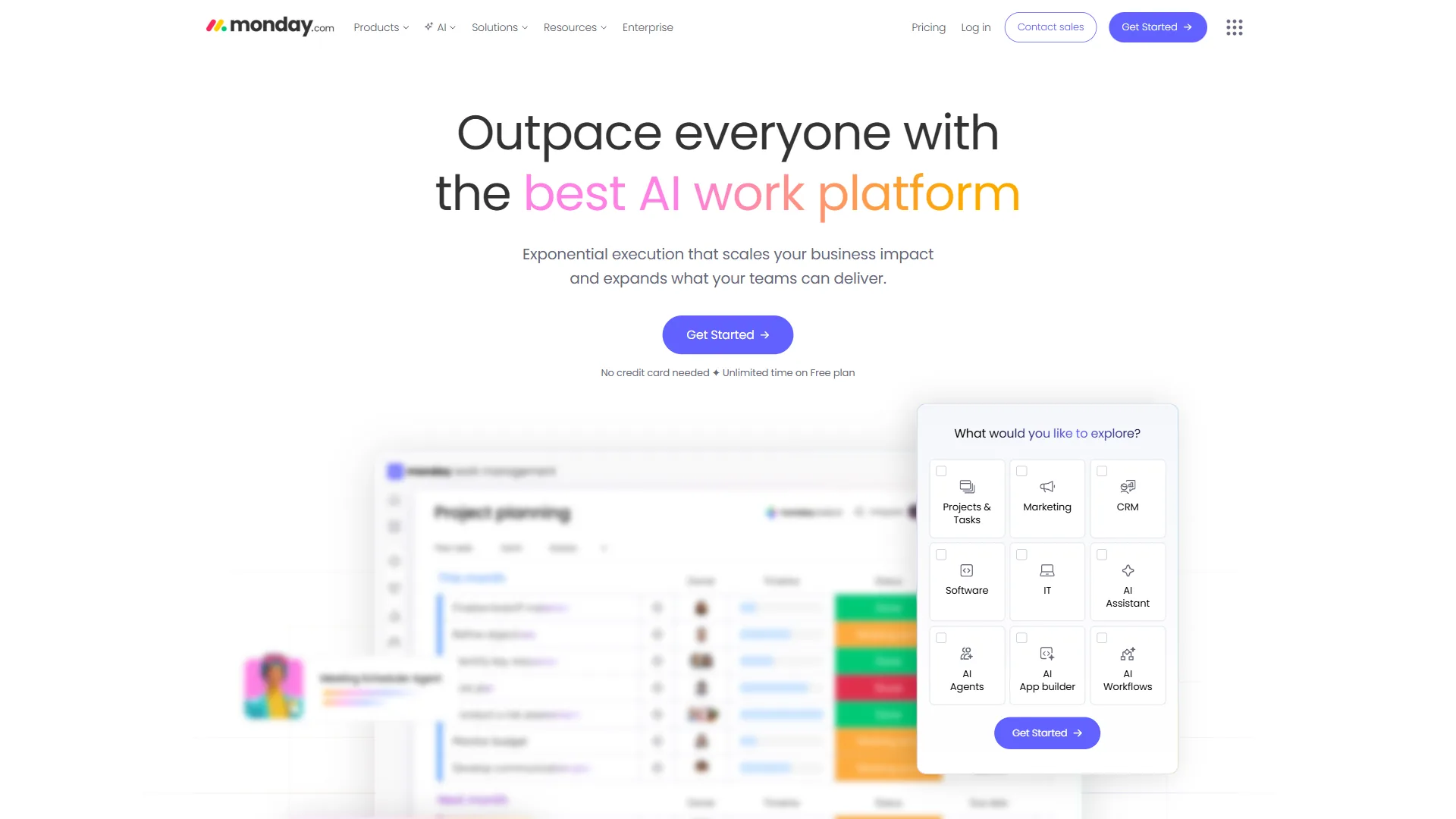
Why it competes: Monday.com expanded from project management into CRM, so sales pipelines, project tracking, and collaboration share one workspace - no Salesforce-plus-PM-tool stack. Monday agents handle end-to-end task execution, monday magic creates workflows from natural-language prompts, and AI Blocks add sentiment analysis, categorization, and data extraction.
Pricing comparison:
| Tier | Monday.com | Salesforce Equivalent |
|---|---|---|
| Free | $0 (2 users) | No equivalent |
| Basic | $12/seat/mo ($9 annual) | Starter Suite ($25/user/mo) |
| Standard | $14/seat/mo ($12 annual) | Pro Suite ($80/user/mo) |
| Pro | $24/seat/mo ($19 annual) | Enterprise ($165/user/mo) |
| Enterprise | Custom | Unlimited ($330/user/mo) |
Note: Monday.com has a 3-seat minimum on paid plans, so the real entry point is around $36 per month.
Who should switch: Agencies and professional-services firms managing client projects beside sales pipelines, marketing teams that need campaign tracking next to deals, and cross-functional teams where designers, PMs, and ops need CRM visibility without a Salesforce license.
Who should stay with Salesforce: Pure sales organizations needing deep CRM customization, territory management, or advanced forecasting.
The real tradeoff: Monday.com is a project management tool with CRM features, not a CRM with project management features - advanced CRM analytics require Enterprise tier and reporting depth does not match Salesforce, but it beats running two separate platforms.
5. Freshdesk (Freshworks CRM) - Best for Customer-Experience-First Teams
Freshdesk is the best Salesforce competitor for customer-experience-first teams because Freshworks unifies support, sales, and marketing on one customer database at 60 to 70% less than Salesforce Service Cloud, with Freddy AI handling ticket summarization and sentiment analysis out of the box. Plans start at $0 for two agents and reach $79 per agent per month on the annual Enterprise tier.
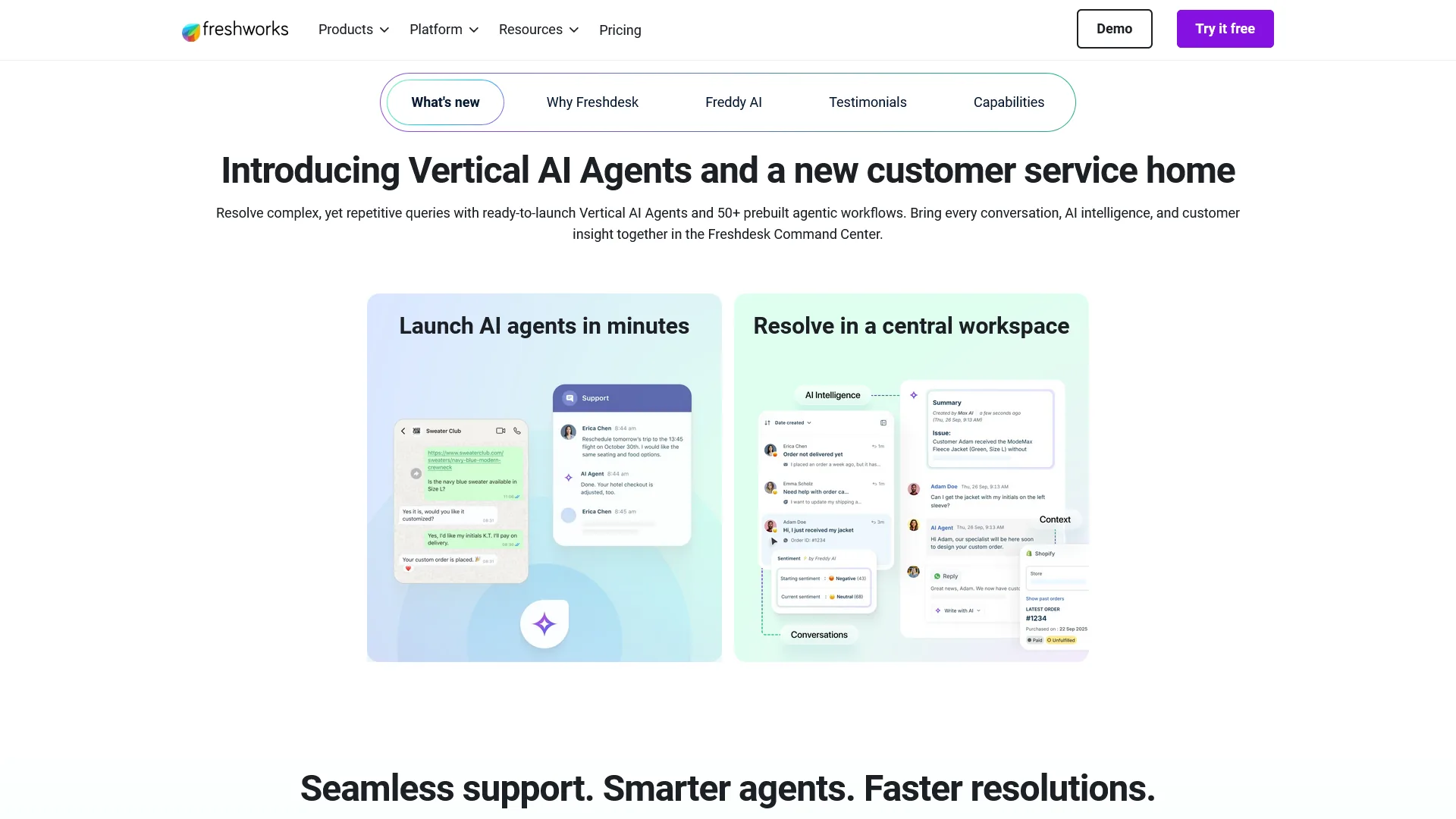
Why it competes: Freshworks shares one customer database across support (Freshdesk), sales (Freshsales), and marketing (Freshmarketer) at 60-70% lower cost than Service Cloud. Freddy AI handles chatbot automation, ticket summarization, smart suggestions, and sentiment analysis; the Freddy AI Copilot ($29/agent/mo add-on) adds real-time response suggestions, covering the 80% of support workflows that do not need Agentforce-grade automation.
Pricing comparison:
| Tier | Freshdesk | Salesforce Service Cloud |
|---|---|---|
| Free | $0 (2 agents) | No equivalent |
| Growth | $18/agent/mo ($15 annual) | Starter ($25/user/mo) |
| Pro | $59/agent/mo ($49 annual) | Professional ($80/user/mo) |
| Enterprise | $95/agent/mo ($79 annual) | Enterprise ($165/user/mo) |
For a 20-agent support team, that is around $300 per month (Freshdesk Growth) versus around $3,300 per month (Salesforce Enterprise) - an annual savings of $36,000.
Who should switch: Support teams where ticketing, SLA management, and knowledge base are the primary CRM needs, SMBs wanting integrated sales-plus-support without enterprise pricing, and e-commerce businesses handling order inquiries, returns, and multi-channel shipping support.
Who should stay with Salesforce: Organizations with complex B2B sales processes needing deep AppExchange integrations Freshworks cannot replicate.
The real tradeoff: Freshdesk excels at customer support but Freshsales CRM lacks Sales Cloud depth - phone and chat require separate Freshworks products (Freshcaller, Freshchat) at additional cost, and advanced AI features are paid add-ons.
6. Zendesk - Best for Enterprise Support Teams Needing Agentic AI
Zendesk is the best Salesforce competitor for enterprise support teams that need agentic AI because its March 2026 Resolution Platform uses GPT-5 agents to autonomously close up to 80% of tickets, with deployments handling 2,400+ tickets per day reaching 73% autonomous resolution. Suite Team starts at $55 per agent per month on annual billing and the full agentic stack sits on Suite Enterprise at $169.
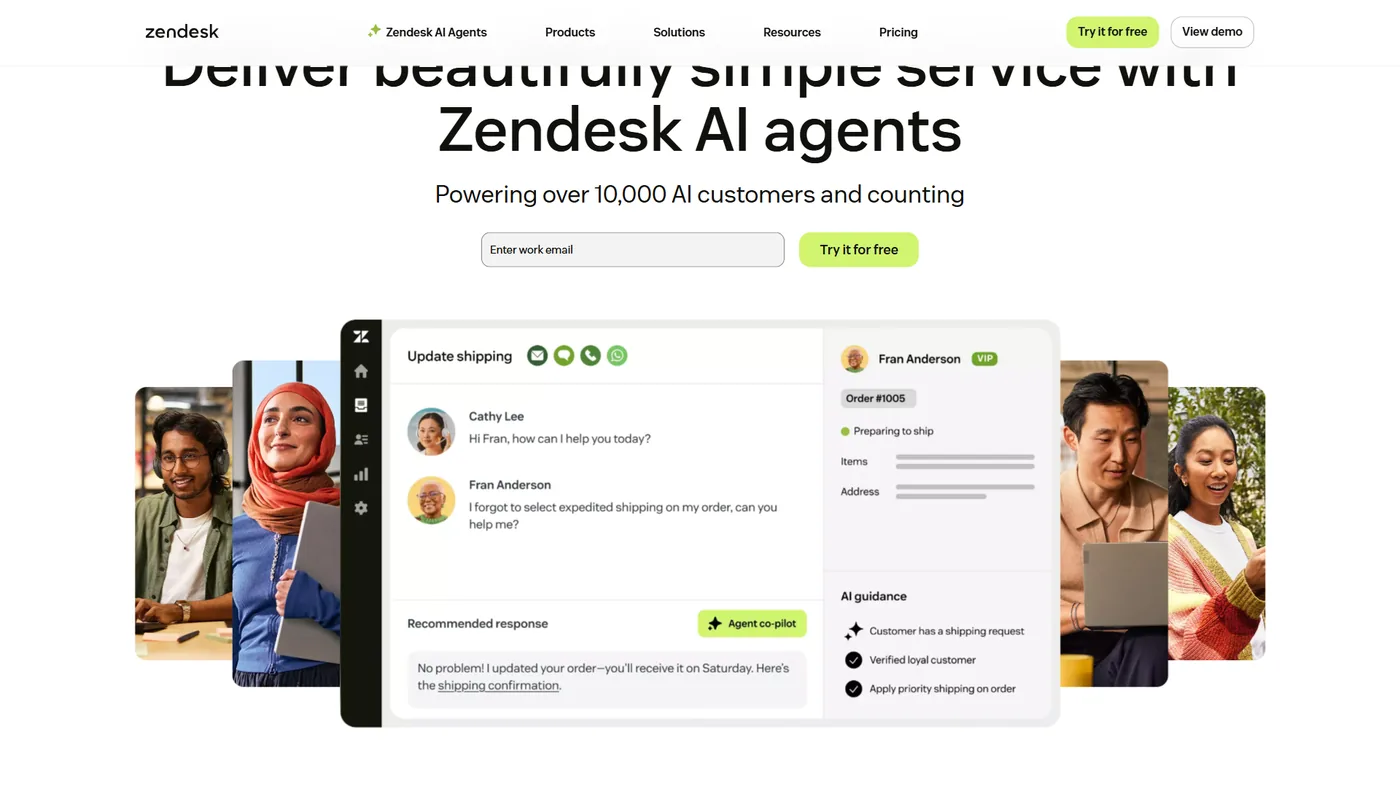
Why it competes: Zendesk launched its Resolution Platform in March 2026 with GPT-5 agentic AI that autonomously resolves up to 80% of tickets - automation Service Cloud cannot match at the same depth. GPT-5 agents handle multi-step reasoning, API orchestration, and autonomous resolution without decision trees; Voice AI covers 40+ languages, intelligent triage routes correctly 87% of the time, and across deployments handling 2,400+ tickets autonomous resolution reaches 73%.
Pricing comparison:
| Tier | Zendesk | Salesforce Service Cloud |
|---|---|---|
| Suite Team | $69/agent/mo ($55 annual) | Pro Suite ($80/user/mo) |
| Suite Growth | $115/agent/mo ($89 annual) | Enterprise ($165/user/mo) |
| Suite Professional | $149/agent/mo ($115 annual) | Unlimited ($330/user/mo) |
| Suite Enterprise | $219/agent/mo ($169 annual) | Einstein 1 ($500/user/mo) |
Who should switch: Enterprise support teams handling 200+ tickets daily, regulated industries (healthcare, finance) needing HIPAA and SOC 2 compliance, and complex tech stacks needing Zendesk’s 2,000+ pre-built integrations.
Who should stay with Salesforce: Organizations where sales pipeline management is the primary CRM need - Zendesk is a customer service platform first and does not replace Sales Cloud.
The real tradeoff: Zendesk pricing is famously complex - six tiers, three AI agent levels, and numerous add-ons - and full agentic AI is locked behind Enterprise Plus at custom pricing likely $249 or more per month, with a 2 to 3 week configuration ramp.
How Do Salesforce Competitors Compare Side by Side?
The table below ranks every CRM in this guide on starting price, free-tier availability, ideal use case, AI strength, and integration count - the five factors that decide whether you are choosing affordable & easy-to-use CRMs or an enterprise-grade replacement.
| CRM | Starting Price | Free Tier | Best For | AI Strength | Integrations |
|---|---|---|---|---|---|
| Salesforce | $25/user/mo | No | Enterprise complexity | Agentforce 2.0, Einstein | 9,000+ |
| HubSpot | $0 (Free CRM) | Yes | Marketing-led teams | Breeze AI Suite | 500+ |
| Pipedrive | $14/user/mo | No | Sales pipeline speed | AI Sales Assistant | 500+ |
| Zoho CRM | $0 (3 users) | Yes | Budget + AI value | Zia AI, Agent Studio | 500+ |
| Monday.com | $9/seat/mo | Yes | PM + CRM hybrid | Monday agents, magic | 200+ |
| Freshdesk | $0 (2 agents) | Yes | Support-first CRM | Freddy AI | 1,000+ |
| Zendesk | $19/agent/mo | No | Enterprise support AI | Agentic AI (GPT-5) | 2,000+ |
Which CRM Fits Your Team Best?
The right CRM for your team is decided by three questions about use case, team size, and AI priority - the decision matrix below maps each answer to a specific platform.
What is your primary CRM use case?
- Sales pipeline management: Pipedrive (simple) or Salesforce (complex)
- Marketing + sales integration: HubSpot
- Customer support operations: Zendesk (enterprise) or Freshdesk (SMB)
- Project management + CRM: Monday.com
- Everything on a budget: Zoho CRM
What is your team size?
- 1-10 people: Pipedrive, Zoho CRM, or HubSpot Free
- 10-50 people: HubSpot Starter/Pro, Zoho Professional, or Pipedrive Growth
- 50-200 people: HubSpot Enterprise, Zoho Enterprise, or evaluate Salesforce
- 200+ people: Salesforce remains the strongest option at enterprise scale
What is your AI priority?
- Autonomous support resolution: Zendesk (agentic AI with GPT-5)
- Sales predictions and coaching: Pipedrive (AI Sales Assistant) or Salesforce (Einstein)
- Marketing automation AI: HubSpot (Breeze AI)
- No-code AI agents on a budget: Zoho CRM (Zia Agent Studio at around $65 per user per month)
- AI-powered project execution: Monday.com (monday agents)
The Bottom Line
The best Salesforce competitor for most teams is HubSpot, Pipedrive, or Zoho CRM - each cuts CRM costs by 50 to 70% while keeping the features that actually drive revenue. Salesforce earned its dominance for a reason - no other CRM matches its customization depth, integration ecosystem, or enterprise feature set - but the CRM market in 2026 has matured to the point where the gap closes for smaller teams. “91% of companies with 10 or more employees now use CRM software,” according to Nucleus Research, an independent research firm, and that competition keeps prices honest.
The savings are not trivial - a 50-person team switching from Salesforce Enterprise ($165/user/mo) to Zoho Enterprise ($40 annual) saves $75,000 per year.
Recommendation: Start a 14-day trial of the platform matching your primary use case, migrate a small team first, run both systems in parallel 30 days, then commit.
FAQ
Who is the biggest competitor to Salesforce?
HubSpot is the biggest competitor to Salesforce by combined CRM and marketing-automation revenue, followed by Microsoft Dynamics 365 in the enterprise segment and Zoho CRM in SMB. The “biggest” depends on which segment matters to you.
What will replace Salesforce?
No single platform will replace Salesforce in 2026 because the CRM market has fragmented by use case: HubSpot for marketing-led teams, Pipedrive for SMB sales, Zendesk for support-first organizations, and Monday.com for project-management hybrids. Salesforce remains the default for pure enterprise sales pipeline management.
How does Salesforce pricing compare to its competitors?
Salesforce Starter starts at $25 per user per month but most teams need Enterprise at $165 or Unlimited at $330. A 50-person team pays $8,250 to $16,500 per month, plus administrator costs of $60,000 to $90,000 annually and AppExchange add-ons that push total cost of ownership to two to three times the license fee.
What are the top 3 CRM systems?
The top 3 CRM systems by market share in 2026 are Salesforce (around 21%), Microsoft Dynamics 365, and HubSpot, according to Gartner’s Sales Force Automation Magic Quadrant. Zoho CRM and Oracle round out the top five.
Related Reading
Each tool below has a dedicated profile; further reading covers best CRM alternatives for sales, small business, and sales engagement.
- Salesforce - Enterprise CRM with Agentforce AI
- HubSpot - All-in-one CRM and marketing platform
- Pipedrive - Sales-focused visual pipeline CRM
- Zoho CRM - Budget-friendly CRM with Zia AI
- Freshdesk - Customer support and CRM platform
- Monday.com - Visual work management and CRM
- Zendesk - Enterprise support with agentic AI
More CRM guides:
- Best AI CRM Tools 2026: Salesforce vs HubSpot vs Zoho
- Pipedrive vs HubSpot: Which CRM Wins for Your Team?
- Best CRM for Small Business 2026
- Best Sales Engagement Platforms 2026
External Resources
The sources below are the basis for pricing, market-share, and AI claims throughout this Salesforce competitor analysis.