



AI product discovery ecommerce is the use of machine learning and natural language processing to help shoppers find products they are likely to buy. Unlike basic keyword search - or a simple search product discovery on ChatGPT prompt - these platforms understand shopper intent, context, and behavior, adjusting results in real time and optimizing for business outcomes like conversion rate, average order value, and revenue per visit.
Most online stores lose revenue before a shopper even reaches the product page. The culprit is outdated search and filtering that shows irrelevant results, buries best-selling items, and ignores the signals a visitor is sending with every click, scroll, and query. Any honest AI product discovery ecommerce review surfaces this same pattern: platforms fix it by replacing static catalog navigation with systems that learn what each shopper actually wants - and surface it in real time.
The shift matters because discovery is no longer a backend concern. It directly impacts conversion rate, average order value, and revenue per visit. Stores that get this right report measurable lifts in all three metrics. Stores that rely on basic keyword search and manual merchandising rules leave money on the table every day. For a broader look at the tools driving these gains, see the best ecommerce personalization tools roundup.
This guide covers how AI product discovery works, what capabilities to evaluate, the revenue impact you can realistically expect, and which platforms lead the category in 2026.
What Is AI Product Discovery?
AI product discovery is the use of machine learning and natural language processing to help shoppers find products they are likely to buy - even when they cannot articulate exactly what they want. It goes beyond traditional site search and filtering in several fundamental ways.
Basic search matches keywords against product titles and descriptions. Type “blue running shoes” and you get every product with those words in its metadata. Results are ranked by text relevance, not purchase likelihood. Synonyms, misspellings, and vague queries often return nothing useful.
AI-powered discovery understands intent, context, and behavior. It knows that a shopper who searched for “lightweight trail shoes” and then browsed waterproof jackets is probably an outdoor runner preparing for wet conditions. It adjusts results, recommendations, and even category page rankings accordingly. The system optimizes for business outcomes - revenue, conversion, margin - not just text matching accuracy.
The distinction is critical for ecommerce teams - including those seeking a product finder AI free trial before committing budget, or evaluating an AI product finder for dropshipping catalogs. Traditional search improvements deliver incremental gains. AI product discovery ecommerce platforms deliver compounding gains because the system gets smarter as it processes more behavioral data. Gartner’s digital commerce research identifies AI-powered search as one of the highest-impact investments for online retailers.
Three capabilities separate AI discovery from conventional search:
- Behavioral learning - The system adapts to individual and aggregate shopper signals in real time
- Semantic understanding - Queries are interpreted by meaning, not just keyword overlap
- Business objective optimization - Results are ranked by revenue impact, not just relevance scores
For broader context on how machine-learning systems handle ranking trade-offs, see Google Research’s information-retrieval publications and the Ecommerce Times newsroom for vendor announcements.
How AI Product Discovery Works
Under the hood, AI discovery platforms process several layers of data to predict which products a given shopper is most likely to buy.
Personalization Signals
For a deeper read on signals that move conversion, see our ecommerce conversion optimization guide and the broader best ecommerce search tools roundup.
Every interaction generates signals. Click patterns reveal category preferences. Time spent on product pages indicates genuine interest versus casual browsing. Add-to-cart behavior without purchase suggests price sensitivity. Return history shapes future recommendations. The best platforms combine hundreds of these micro-signals into individual shopper profiles that update in real time.
Behavioral Data at Scale
Individual signals become powerful when combined with aggregate patterns. If shoppers who buy a specific running shoe also tend to buy a certain brand of moisture-wicking socks within the same session, the system learns to surface those socks during checkout or on the product page. This collaborative filtering approach powers recommendation engines across the category.
Natural Language Processing
Modern NLP allows search to handle queries the way humans actually type them. The same NLP advances that power ChatGPT and other consumer assistants are now integrated into ecommerce search engines. “Dress for a summer wedding under $200” is not a keyword query - it is a natural language request with multiple constraints. AI discovery platforms parse intent, extract attributes (occasion, season, price range), and return filtered results without requiring the shopper to use the faceted navigation manually.
Dynamic Ranking
Perhaps the most impactful capability is dynamic result ranking. Instead of showing products in a fixed order based on manual merchandising rules, AI systems re-rank results in real time based on what is most likely to convert. A high-margin product with strong conversion rates gets boosted. A product with high return rates gets suppressed. The ranking logic continuously adapts as new data flows in.
Which AI Product Discovery Capabilities Should You Evaluate?
When assessing AI product discovery ecommerce solutions, focus on these five capabilities that separate serious platforms from those that are simply rebranding basic search with an AI label.
Intelligent Search
The foundation of any discovery platform. Look for typo tolerance, synonym handling, and semantic understanding that goes beyond keyword matching. The search bar should function as a product advisor, not just a lookup tool. Test it with vague queries like “gift for dad who has everything” - the results reveal how deep the NLP actually goes.
Personalized Recommendations
Recommendations should adapt based on real-time behavior, not just static segments or “customers also bought” rules created weeks ago. The platform should offer multiple recommendation types - homepage personalization, product page cross-sells, cart page upsells, and post-purchase suggestions - each driven by different optimization goals.
Visual Search
The principles behind effective visual search overlap with image generation prompting - see our AI image generation tips for related vocabulary.
Visual search lets shoppers upload a photo and find similar products in the catalog. Forrester analysts project growing adoption of visual commerce across retail. While still emerging, it is particularly valuable in fashion, home decor, and any category where aesthetic preference is difficult to describe with words. Adoption is growing as smartphone cameras improve and shoppers become comfortable with the interaction pattern.
Guided Selling and Quizzes
Interactive quizzes and guided selling flows help shoppers narrow choices when the catalog is overwhelming. A skincare brand with 200 products benefits from a quiz that recommends a routine based on skin type, concerns, and budget. These flows generate rich preference data that feeds back into the personalization engine.
Browse and Category Optimization
Adjacent automation areas like the AI customer service automation workflow and the Baymard Institute UX research library reinforce the same principle: surface relevance fast or shoppers leave.
Discovery is not limited to the search bar. AI can optimize category pages, collection layouts, and browse experiences by personalizing which products appear first, which filters are highlighted, and how the grid is sorted. For stores where most shoppers browse rather than search, this capability often delivers the largest revenue impact.
Revenue Impact: What the Data Shows
The business case for AI product discovery centers on three metrics: conversion rate, average order value (AOV), and revenue per visit (RPV).
Conversion Rate Lifts - Platforms like Constructor report consistent 3%+ improvements in controlled A/B tests against incumbent search solutions. For a store processing $100M in annual revenue, a 3% conversion lift translates to millions in additional sales without increasing traffic spend.
Average Order Value - Effective cross-sell and upsell recommendations directly increase basket size. Case studies across the category show 5-15% AOV improvements when AI-powered recommendations replace rule-based alternatives.
Revenue Per Visit - This composite metric captures both conversion and AOV gains. Constructor customers have documented $10M+ in incremental revenue lifts, with brands like Sephora, Backcountry, and Bonobos publicly attributing search-driven improvements to their AI discovery implementation.
The caveat - Results vary significantly based on catalog size, traffic volume, and baseline conversion rates. The Shopify research portal publishes representative ecommerce baselines worth comparing your numbers against. Stores with fewer than 1,000 SKUs or under 50,000 monthly sessions may not generate enough behavioral data for the AI to outperform well-configured manual merchandising. The technology delivers the most value for mid-market and enterprise retailers with complex catalogs.
It is also worth noting that according to a 2025 Salesforce study, 77% of consumers still prefer shopping on brand websites over third-party AI recommendation tools. This means investing in on-site discovery is not competing with external AI - it is meeting customers exactly where they already want to shop.
Leading AI Product Discovery Ecommerce Platforms
Constructor
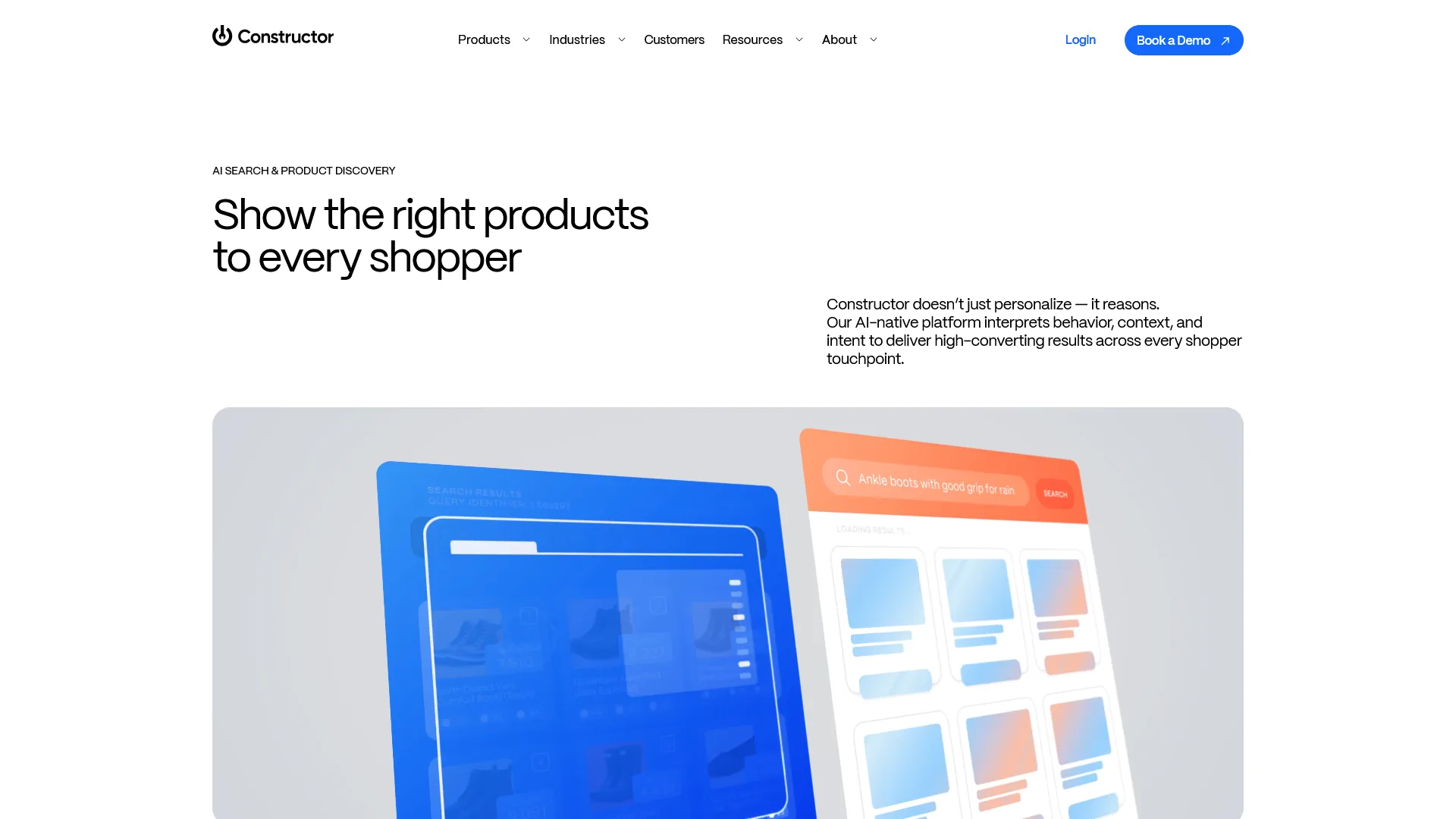
Constructor is purpose-built for ecommerce product discovery with a singular focus: optimizing search and browse experiences for revenue, not just relevance.
What sets Constructor apart is its machine learning approach. While most search platforms train their models on click data, Constructor trains on actual purchase behavior. This distinction matters because what shoppers click is not always what they buy. The result is consistently measurable lift in A/B tests - Constructor claims to outperform competitors by 3%+ in head-to-head tests.
The platform covers search, browse, recommendations, and quizzes through a unified AI layer. Enterprise customers including Sephora, Backcountry, Bonobos, and Petco use it to power their complete discovery experience. Pricing is custom and enterprise-focused, with a 30-day trial available for qualified retailers.
Best for: Mid-market to enterprise retailers with 100K+ SKUs where search and browse directly impact revenue.
Algolia
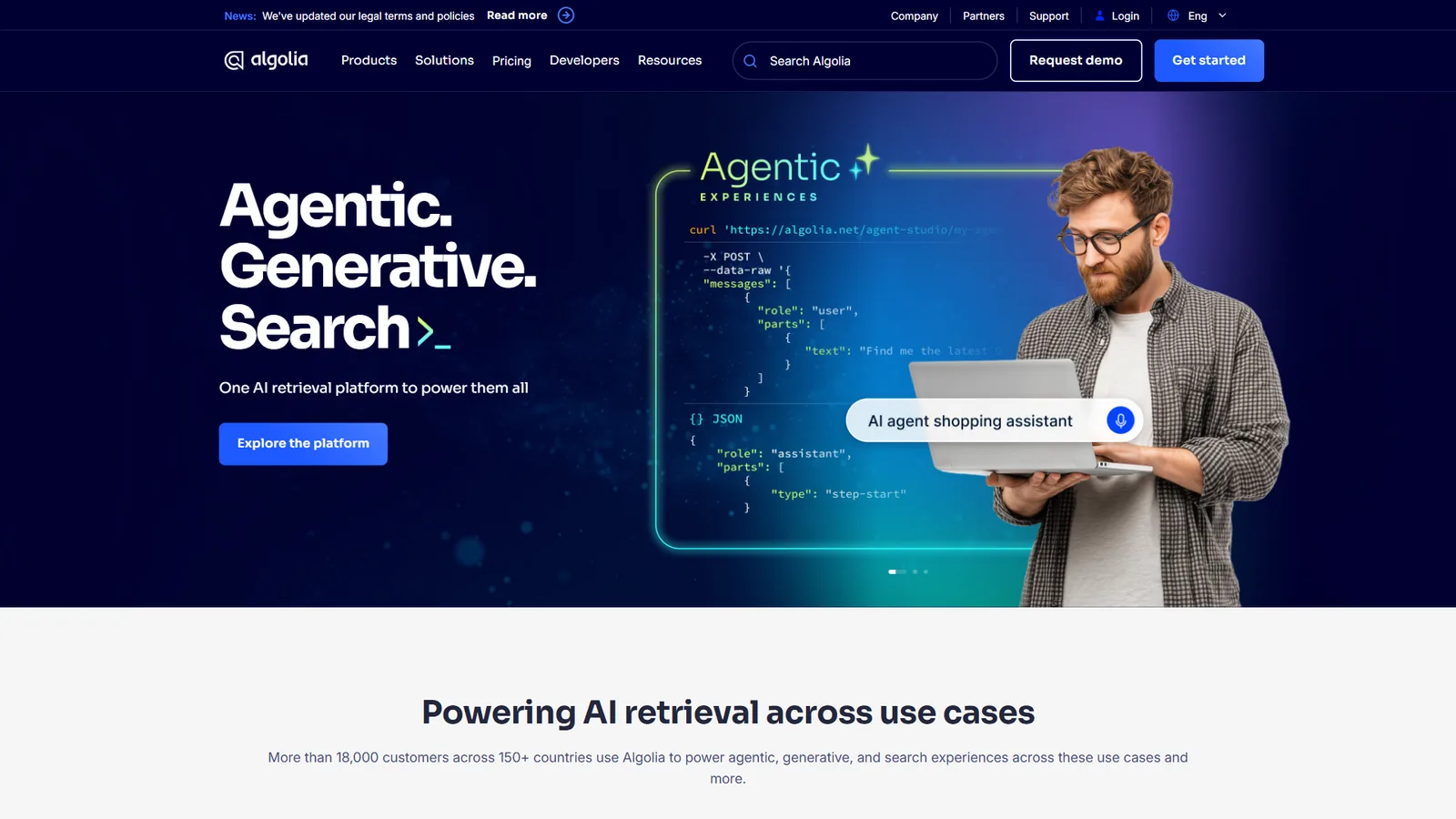
Algolia is the developer-first search platform that serves over 17,000 companies across ecommerce, SaaS, and media. Its core strength is speed - sub-millisecond response times that deliver results as users type.
Algolia’s NeuralSearch combines traditional keyword matching with vector-based semantic search, available on Grow Plus and Premium tiers. The platform offers 200+ integrations and InstantSearch UI libraries that dramatically reduce implementation time. A generous free tier (10,000 requests/month) makes it accessible for smaller stores and testing.
The trade-off is that Algolia is a general-purpose search platform, not an ecommerce-specific discovery engine. It excels at fast, relevant search but does not optimize for revenue the way Constructor does. For stores where search speed and developer experience matter more than revenue-per-query optimization, Algolia is a strong choice.
Best for: Developer-led teams needing fast, scalable search with a low barrier to entry.
Other Notable Platforms
Bloomreach combines AI search with a full commerce experience platform. Its Discovery module handles product search, recommendations, and SEO with deep personalization. Best suited for enterprise retailers willing to invest in a comprehensive platform - pricing is enterprise-tier and contact-sales only.
Klevu delivers semantic NLP search across 30+ languages with strong Shopify integrations. It is a practical choice for mid-market stores that need multilingual discovery without enterprise complexity. Pricing is custom and usage-based - contact sales for a quote.
Nosto approaches discovery through personalization rather than search. Its Commerce Experience Platform handles product recommendations, content personalization, and UGC integration. Particularly effective for brands with visual catalogs in fashion and home decor.
How to Choose the Right Platform
Selecting an AI product discovery ecommerce platform requires matching your technical resources, catalog complexity, and business goals to the right solution. Here is a framework for evaluating options.
Catalog size matters. Stores with under 1,000 SKUs can often achieve strong results with well-configured Algolia or even native platform search. The AI advantage becomes pronounced at 10,000+ SKUs where manual merchandising cannot scale.
Technical resources determine implementation paths. API-first platforms like Algolia and Constructor require developer involvement. Platforms like Nosto and Klevu offer more marketer-friendly interfaces with faster time-to-value but less customization.
Measure what matters to your business. Revenue-focused retailers should prioritize platforms that optimize for purchase outcomes (Constructor). Content-heavy sites should prioritize semantic search quality (Algolia, Coveo). Omnichannel brands should prioritize platforms with cross-channel personalization (Bloomreach, Insider). For a head-to-head breakdown of two of these leaders, see Constructor vs Algolia.
Request A/B test data. Any credible platform should be able to show controlled test results demonstrating measurable lift against your current solution. Be skeptical of case studies that only show vanity metrics like “search engagement” without tying results to revenue.
Check the integration ecosystem. Verify compatibility with your ecommerce platform (Shopify, Magento, BigCommerce, custom), analytics stack, and existing martech tools before entering a trial.
What Should You Know Before Implementing AI Product Discovery?
Deploying an AI product discovery ecommerce solution is not a plug-and-play exercise. Understanding the realistic timeline, data requirements, and integration complexity helps set proper expectations.
Timeline
- Basic search replacement (Algolia, Klevu): 1-4 weeks for a standard ecommerce implementation using pre-built connectors and UI components
- Full discovery suite (Constructor, Bloomreach): 4-12 weeks for enterprise deployments with custom integrations, data pipeline configuration, and merchandiser training
- Omnichannel personalization (Insider, Bloomreach): 3-6 months for full deployment across web, email, mobile app, and in-store touchpoints
Data Requirements
AI discovery platforms need behavioral data to perform well. Expect a learning period of 2-4 weeks after launch where the system collects interaction data before personalization meaningfully improves results. Stores with existing analytics data (Google Analytics, session recordings) can sometimes accelerate this by importing historical behavioral data.
Catalog data quality is equally important. Product titles, descriptions, attributes, and images need to be consistent and complete. The AI can only surface relevant products if the underlying catalog data is accurate. Many implementation projects spend 30-40% of their timeline on data cleanup before the discovery platform even goes live. Teams already using a customer data platform can accelerate this step by feeding clean, unified profiles directly into the discovery engine.
Integration Complexity
The biggest hidden cost in discovery platform adoption is integration work beyond the search bar itself. Consider:
- Product feed synchronization - Keeping inventory, pricing, and availability current across your catalog and the discovery platform
- Analytics integration - Connecting discovery events to your analytics and attribution stack
- Merchandising workflows - Training your team to use the platform’s merchandising tools alongside existing processes
- Mobile optimization - Ensuring the discovery experience works across devices, particularly on mobile where over 60% of ecommerce traffic originates
Common Failure Points
Implementations fail for predictable reasons. Incomplete catalog data leads to poor result quality. Insufficient training leaves merchandising teams unable to use the platform effectively. Launching without A/B testing means you cannot prove ROI to stakeholders. Setting unrealistic timeline expectations creates organizational friction when the 2-week project stretches to 8 weeks.
Plan for these failure modes explicitly. Budget for data cleanup, allocate training time, and build A/B testing into the launch plan from day one.
The Bottom Line
AI product discovery is becoming table stakes for ecommerce retailers competing on experience rather than price alone. The technology has matured to the point where measurable revenue lifts are well-documented and achievable for stores with sufficient catalog complexity and traffic volume.
Constructor leads the category for revenue-focused retailers with complex catalogs. Algolia offers the most accessible entry point for developer-led teams. Bloomreach, Klevu, and Nosto each serve specific segments well depending on your technical resources and business priorities.
Start by quantifying where your store loses customers in the discovery funnel - search abandonment, zero-result queries, low category page engagement. That data tells you which type of platform will deliver the fastest return. Then run a controlled A/B test against your current solution before committing to an annual contract.
The stores winning in 2026 are not just selling products. They are using AI to make sure the right product finds the right shopper at the right moment.
Frequently Asked Questions
What is AI product discovery in ecommerce?
AI product discovery uses machine learning and natural language processing to help shoppers find products they are likely to buy - even when they cannot clearly describe what they want. Unlike basic keyword search, it understands intent, context, and real-time behavior, then surfaces relevant products and adjusts rankings to optimize for revenue and conversion rather than text matching accuracy. The end result is a search bar that behaves more like a knowledgeable store associate than a database lookup tool.
How much revenue lift can AI product discovery deliver?
Platforms like Constructor report consistent 3%+ conversion rate improvements in controlled A/B tests. Case studies across the category show 5-15% average order value improvements when AI-powered recommendations replace rule-based alternatives. Results vary based on catalog size, traffic volume, and baseline conversion rates - stores with fewer than 1,000 SKUs or under 50,000 monthly sessions may see limited gains. Always demand controlled A/B test results from any vendor before signing.
How is AI-powered search different from basic site search?
Basic search matches keywords against product titles and descriptions, ranking results by text relevance rather than purchase likelihood. AI-powered discovery understands intent and behavior - recognizing, for example, that a shopper browsing waterproof jackets after searching trail shoes is likely an outdoor runner. It re-ranks results in real time to optimize for conversion, margin, and revenue rather than keyword accuracy. The difference becomes most pronounced on vague or natural-language queries where keyword search returns zero results.
Which AI product discovery platform is best for ecommerce?
Constructor leads for revenue-focused retailers with complex catalogs, training its models on purchase behavior rather than clicks. Algolia suits developer-led teams prioritizing search speed and a generous free tier. Bloomreach fits enterprise retailers wanting a full commerce experience platform. Klevu is practical for mid-market stores needing multilingual discovery, and Nosto works well for fashion and home decor brands focused on personalization. Match the platform to your catalog size, technical resources, and primary KPI rather than chasing the most featureful option.
How long does an AI product discovery implementation take?
Expect a learning period of 2-4 weeks after launch while the system collects behavioral data before personalization meaningfully improves. Catalog data cleanup - ensuring product titles, descriptions, attributes, and images are consistent and complete - often consumes 30-40% of the total implementation timeline. Projects frequently stretch from an estimated two weeks to eight weeks when these factors are not planned for upfront. Budget for data hygiene, merchandiser training, and A/B test setup from day one.
Want to learn more about ChatGPT?
Related Guides
- AI Customer Service Automation - Automate post-purchase support
- AI Chatbot Customer Service - On-site shopping assistants
- AI Image Generation Tips - Generate product imagery at scale
- AI Content Writing Workflow - Produce SEO-rich product copy
Related Reading
- Constructor - Our full review with pricing, features, and alternatives
- Algolia - Developer-first search and discovery platform
- Best Ecommerce Search Tools in 2026 - Head-to-head comparison of Algolia, Constructor, Coveo, and Klevu for site search
- Ecommerce Conversion Optimization: 5 AI Tools That Drive Revenue - Broader look at personalization and conversion tools including Nosto and Insider
- Best AI Search Tools for Websites and Apps in 2026 - General-purpose AI search comparison covering ecommerce, SaaS, and enterprise use cases
External Resources
- Constructor Resources - Case studies and benchmarks on AI-driven product discovery ROI
- Baymard Institute - Ecommerce UX Research - Independent research on search usability and product finding patterns
- McKinsey - The Value of Personalization - Data on how personalization drives ecommerce revenue growth
Related Guides
- Activecampaign AI Content Generation: Complete 2026 Guide
- AI Content Writing Workflow: 2026 Walkthrough for Teams
- AI Productivity Trends 2026: 6 Real Shifts, No Hype
- AI Workflow Automation Maturity Model: 5 Levels
- Building AI First Workflows: A Practitioner's 2026 Guide
- ChatGPT Custom GPTs Guide - Save 130+ Hours a Year
- ChatGPT Prompts 2026: Basic vs Engineered, 18 Examples
- ChatGPT Tips And Tricks: 2026 Walkthrough for Teams
- Craft Tips and Tricks: 12 Expert Hacks for Faster Docs
- Elai AI Training Videos: 2026 Walkthrough for Teams