

Constructor and Algolia are both AI-powered site-search platforms, with Constructor the better choice for mid-to-large ecommerce retailers that need revenue-optimized ranking and per-shopper personalization, while Algolia is the better choice for developer teams that need a fast, flexible, hosted search API with broad framework support and quick time-to-launch. Constructor treats search as a revenue engine; Algolia treats it as an infrastructure layer.
Our analysis draws on vendor documentation, the Baymard Institute ecommerce search research, and independently published case studies - we do not run live A/B tests on either platform. This page contains affiliate links; our editorial position is set before any partner relationship is considered. For broader context, see our best AI search tools roundup and best ecommerce search tools comparison.
As Baymard Institute lead UX researcher Edward Scott has written, “search is one of the most important elements on a large ecommerce site,” and Baymard’s benchmark studies repeatedly find that the majority of leading ecommerce sites still have mediocre on-site search performance - which is the gap both platforms in this comparison try to close.
Quick Verdict: Constructor vs Algolia
| Aspect | Constructor | Algolia |
|---|---|---|
| Best For | Enterprise ecommerce revenue optimization | Developer-first search across any use case |
| Pricing | Enterprise-only (custom quotes) | Freemium: free tier, then usage-based |
| Rating | ||
| Search Approach | Revenue-optimized AI ranking | Speed-optimized keyword + NeuralSearch |
| AI Focus | AI-native behavioral learning | AI-enhanced (NeuralSearch add-on) |
| Target Market | Mid-to-large ecommerce retailers | Developers, startups to enterprise |
| Notable Customers | Sephora, Backcountry, Bonobos | Stripe, Twitch, Under Armour |
Both platforms deliver strong search experiences, but they were built to solve different problems. The Constructor platform was purpose-built for ecommerce product discovery from day one. Algolia was built as a universal search API that happens to serve ecommerce well among many other verticals.
Which Platform Delivers Better Search Quality and Relevance?
Constructor wins on ecommerce search quality and Algolia wins on general-purpose search quality, because Constructor ranks by predicted revenue per visit while Algolia ranks by transparent, configurable relevance signals - the gap shows up in how each defines “relevant,” and is also reflected in Constructor io pricing decisions. According to Baymard Institute lead UX researcher Edward Scott, “search is one of the most important elements on a large ecommerce site,” and that framing is exactly where Algolia and Constructor diverge.
Constructor: Revenue-Optimized Ranking
Constructor ranks search results by what drives revenue, not keyword relevance alone. Every Constructor API query considers behavioral history, clickstream data, product margin, inventory, and conversion probability, then learns continuously from every interaction.
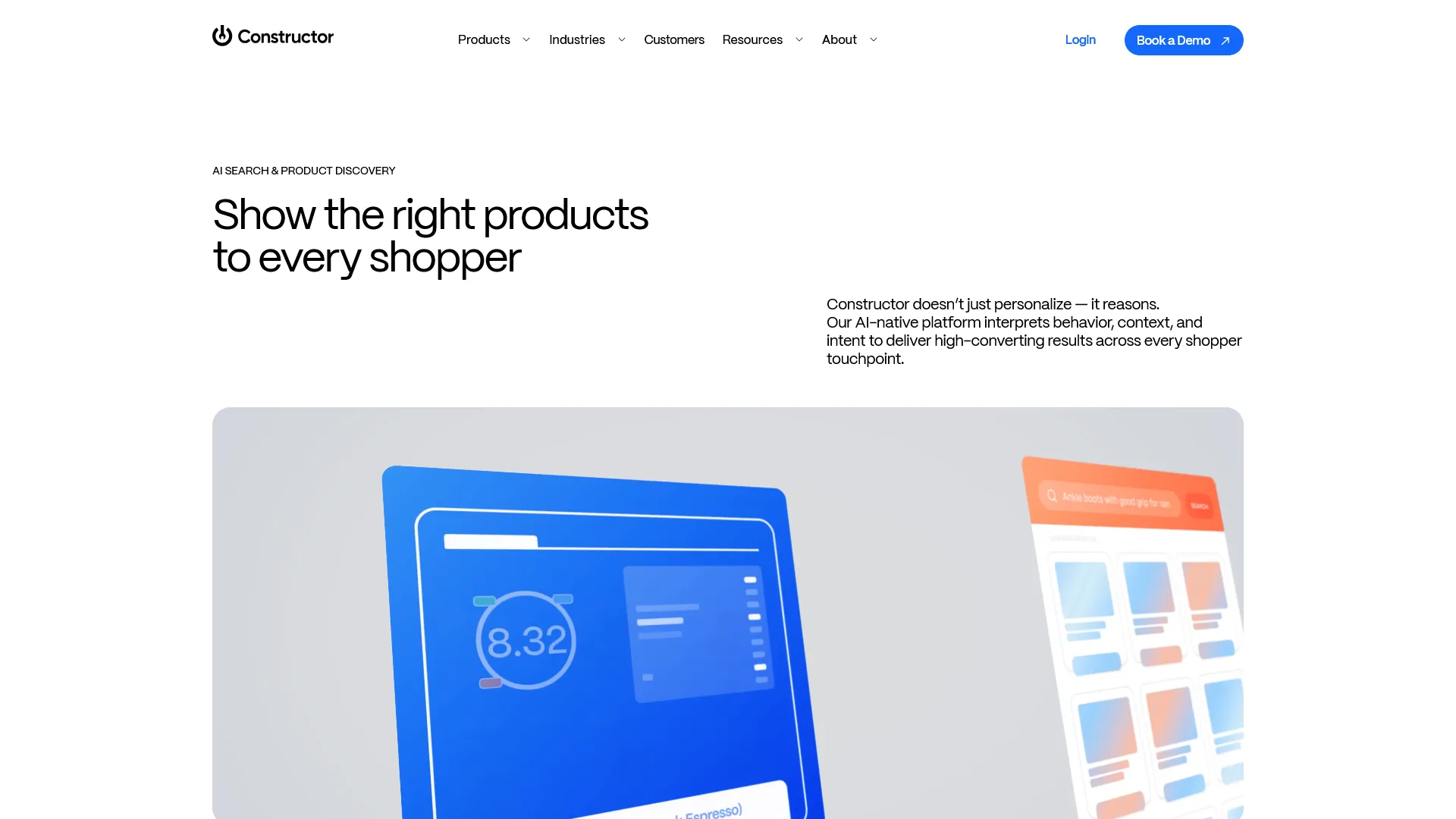
Per Baymard Institute research, optimizing for purchase intent matters more than keyword matching. Constructor reports 3%+ A/B-test lifts vs. competitors and $10M+ annual revenue lifts for large retailers in its published case studies.
Key capabilities: revenue-per-visit optimization, behavioral learning from clicks/carts/purchases in real time, per-shopper personalized rankings, visual merchandising rules (boost/bury/pin), and zero-result rate reduction via query understanding.
The trade-off is volume: Constructor needs meaningful traffic and transaction data to train its models, so sites with under a few thousand daily sessions will see smaller lifts.
Algolia: Speed-Optimized Keyword Matching
Algolia built its reputation on raw search speed and developer experience. The platform returns results in single-digit milliseconds - often under 5ms - with built-in typo tolerance, synonym handling, and faceted filtering that works out of the box.
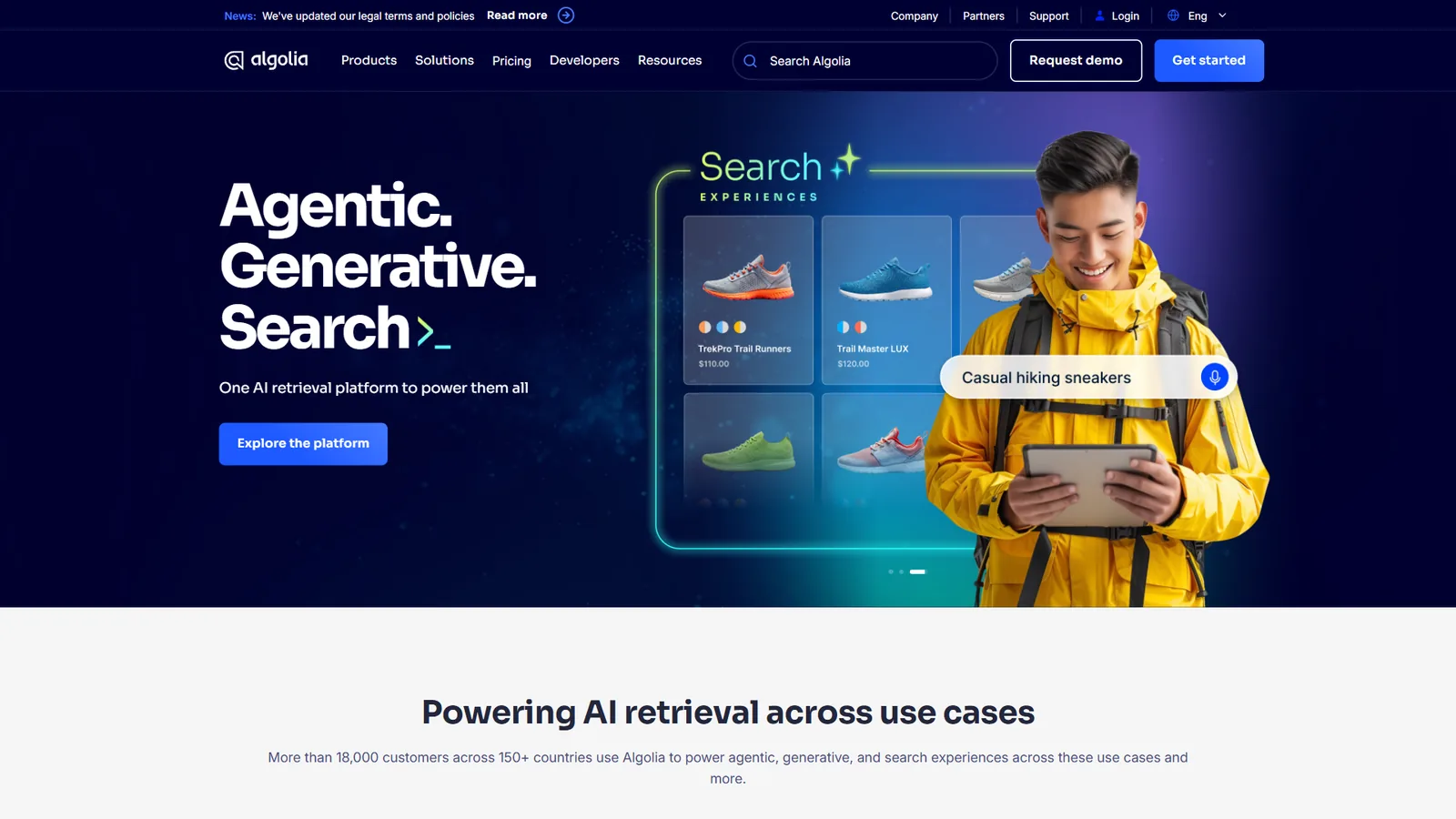
Algolia’s core engine is keyword-based with configurable ranking formulas - you define what matters (textual relevance, attributes, geo, recency) and Algolia applies those rules at scale. It is predictable, transparent, and easy to debug.
Key capabilities: sub-millisecond response across 70+ data centers, built-in typo tolerance, faceted filtering, InstantSearch UI libraries for React/Vue/Angular/iOS/Android, NeuralSearch as a semantic AI add-on, and custom ranking formulas. NeuralSearch sits on top of the core engine rather than replacing it.
Search Quality Verdict
Constructor wins for ecommerce-specific search relevance because its rankings are optimized for the metric that matters most to retailers: revenue. Algolia wins for speed, flexibility, and predictability because its ranking logic is transparent, configurable, and works across any content type - not just products. For an architecture-level view, see the Algolia ranking criteria documentation.
Tradeoffs: Constructor underperforms on low-traffic stores (insufficient training data); Algolia does not understand purchase intent without paid NeuralSearch + Dynamic Re-Ranking add-ons.
Product Discovery and Recommendations
Constructor offers a unified discovery suite - Search, Browse (per-visitor personalized category pages), Recommendations-style flows, and guided Quizzes - all powered by the same behavioral AI. Algolia covers the essentials with Algolia Recommend (collaborative filtering plus content-based models for “Frequently Bought Together,” “Related Products,” and “Trending Items”), configurable Browse pages, and Query Suggestions, but the components are less tightly integrated and Browse does not personalize per visitor without significant engineering. See our AI product discovery guide for the broader merchandising playbook.
Tradeoffs: Skip Constructor’s discovery stack if you only need recommendations; Algolia Recommend works well but lacks per-visitor browse personalization out of the box.
How Do Constructor and Algolia Use AI and Machine Learning?
Constructor uses AI as the core ranking engine and Algolia uses AI as an optional enhancement layer, because every Constructor result is produced by behavioral machine learning trained on clickstream and purchase data, while Algolia layers NeuralSearch, Dynamic Re-Ranking, and AI Synonyms on top of a keyword-first engine.
Constructor: AI-Native Architecture
Machine learning is the Constructor engine, not a feature layer on top of one. Every interaction trains the model; rankings adjust continuously without manual intervention. AI capabilities include clickstream learning detailed on the AI search product page, individual-level personalization, automated A/B testing of ranking strategies, revenue-attributed feedback loops, and long-tail natural language understanding. Depth comes from narrow focus: training only on commerce signals (purchase intent, price sensitivity, product affinity).
Algolia: AI-Enhanced Search
Algolia layers AI on a keyword-first core: NeuralSearch (keyword + vector), Dynamic Re-Ranking, AI Synonyms, Query Categorization, and user-level Personalization. This trades some autonomy for transparency - teams can see why a result ranked where it did, edit the formula, or override with manual rules.
Tradeoffs: Constructor’s ranking is opaque, so merchandising teams that need to audit individual rankings will struggle; Algolia’s AI features (NeuralSearch, AI Synonyms, AI Ranking) are gated behind Grow Plus or Premium tiers, so the cheapest plans get no intelligence layer.
Developer Experience
Algolia offers a clearly better developer experience than Constructor, with a free tier, public SDKs in 9+ languages, the InstantSearch UI component libraries for React/Vue/Angular/iOS/Android, and self-service onboarding - whereas Constructor requires a sales conversation and a solutions engineer for almost every implementation.
Algolia: Best-in-Class Developer Tools
Algolia ships comprehensive docs with examples in every major language, official SDKs for JavaScript/Python/Ruby/PHP/Go/Java/Kotlin/Swift, the InstantSearch UI library, a free tier with 10,000 monthly searches and 1M records, and a clean REST API. A developer can ship a working search prototype in under an hour.
Constructor: Enterprise-Focused Integration
Constructor provides REST APIs with JavaScript/iOS/Android SDKs, thorough but less publicly accessible documentation, feed-based catalog sync, and dedicated solution engineers - but no free tier and no self-service onboarding. Time-to-value is fast for complex enterprise requirements but the entry barrier is high.
Tradeoffs: Skip Constructor if your team prefers to prototype independently; Algolia’s usage-based pricing means a feature-heavy InstantSearch UI can spike bills during traffic surges without observability around query volume.
Pricing Comparison
Pricing is where Constructor vs Algolia diverges most dramatically - one is enterprise-only with custom quotes, the other publishes tiered usage-based pricing starting at $0.
| Plan / model | Constructor | Algolia |
|---|---|---|
| Free tier | None | 10,000 searches/mo, 1M records |
| Entry paid | Custom quote (annual) | Grow: $0.50 per 1,000 extra searches |
| Mid tier AI | (all plans AI-native) | Grow Plus: $1.75 per 1,000 extra searches (AI Synonyms, AI Ranking) |
| Enterprise | Volume-based custom contracts | Premium/Elevate custom (incl. NeuralSearch) |
| Trial | 30-day for qualified prospects | Free tier doubles as trial |
Algolia’s pricing page publishes all tier rates; Constructor publishes none. Enterprise ecommerce search contracts in Constructor’s category typically start in the tens of thousands of dollars annually and scale into six figures for high-traffic retailers.
Choose Constructor if You Need Revenue Optimization
Choose Constructor when revenue per visit is your primary KPI, you operate a mid-to-large ecommerce store with tens of thousands of sessions per day, and you want search, browse, recommendations, and quizzes unified under one AI-native discovery platform.
Constructor fits if: revenue per visit is your primary KPI; you have tens of thousands of sessions to train behavioral AI; you manage thousands of SKUs; you want one unified discovery platform; you prefer managed AI over hand-tuned ranking formulas; and budget is not the primary constraint.
Reported outcomes: 3%+ A/B-test lifts vs. competitors, $10M+ annual revenue lifts for large retailers, fewer zero-result searches. See our ecommerce conversion optimization guide for measurement frameworks.
Choose Algolia if You Need Speed and Flexibility
Algolia is the right choice when sub-millisecond response time, developer experience, and cross-vertical flexibility matter more than ecommerce-specific revenue tuning, because it scales from a free tier to enterprise and serves search needs across ecommerce, media, SaaS, and documentation use cases that a pure Constructor platform cannot. Independent reviewers at rfp.wiki tried Algolia and Constructor head to head in 2026 - see who wins on developer ergonomics versus revenue lift.
Algolia fits if: developer experience is a priority; you need search beyond ecommerce (content, docs, marketplaces, media, SaaS); budget matters and you need a free or usage-based path; sub-millisecond global speed is critical; you want control over ranking rules; or you are building from scratch and want to ship in days.
Reported outcomes: named Enterprise Search Leader 13 consecutive times, sub-millisecond search at global scale, and broad applicability across ecommerce, media, SaaS, and documentation (see Algolia’s customer showcase).
The Bottom Line
Constructor is the better Constructor vs Algolia pick for AI-native, revenue-optimized ecommerce search at enterprise scale, and Algolia is the better pick for fast, developer-friendly search that runs across any use case with transparent usage-based pricing. Independent buyer guides from Composable.com evaluating Algolia, Bloomreach Discovery, and Constructor reach the same split conclusion - the right tool depends on whether the primary KPI is revenue per visit or developer velocity.
If your biggest opportunity is more revenue per visitor through smarter rankings, personalized browse, and AI recommendations - Constructor is the stronger platform. The trade-off is enterprise pricing and a narrower focus.
If you need search across multiple use cases, world-class developer tools, and a path from free to enterprise - Algolia is the more versatile choice. The trade-off is that ecommerce revenue tuning needs paid AI add-ons.
For teams in the middle - established ecommerce with budget sensitivity - start with Algolia to validate requirements, then evaluate Constructor once traffic justifies the investment. Compare more options in our best AI search tools roundup.
FAQ
What is the main difference between Constructor and Algolia?
The main difference is that Constructor is an AI-native ecommerce search engine that ranks results by predicted revenue per visit, while Algolia is a general-purpose search API that ranks results by configurable keyword relevance and offers NeuralSearch as an optional AI add-on. The two platforms were built to solve fundamentally different problems.
How does Constructor rank search results differently from Algolia?
Constructor ranks results based on what drives revenue, not just keyword relevance. Every query considers the shopper’s behavioral history, real-time clickstream data, product margin, inventory levels, and conversion probability. The platform learns continuously from every interaction and adjusts rankings automatically, rather than relying on speed-optimized keyword matching alone.
Which platform is better for enterprise ecommerce versus developers?
Constructor targets mid-to-large ecommerce retailers focused on revenue optimization, with enterprise-only custom pricing and customers like Sephora, Backcountry, and Bonobos. Algolia targets developers from startups to enterprise with a freemium usage-based model, serving customers like Stripe, Twitch, and Under Armour across many verticals beyond ecommerce.
How do Constructor and Algolia compare on pricing in 2026?
Constructor uses enterprise-only custom quotes, with no public pricing or self-serve tier, reflecting its focus on mid-to-large retailers. Algolia offers a freemium model starting with a free tier and moving to usage-based pricing, which makes it accessible to developers, startups, and growing teams without requiring an enterprise sales conversation.
Related Reading
Related Reading covers the two tools compared in this article plus supporting guides on ecommerce search and AI-powered product discovery, so readers can branch from the Constructor vs Algolia decision into adjacent platform research and Constructor API or Constructor Shopify integration questions.
Tools covered in this article:
- Constructor - AI-powered product discovery platform for ecommerce revenue optimization
- Algolia - AI-powered search and discovery platform with developer-first approach
More ecommerce search and discovery guides:
- Best Ecommerce Search Tools - Top search platforms for online stores compared
- AI Product Discovery for Ecommerce - How AI is transforming product discovery
- Ecommerce Conversion Optimization Guide - Strategies to improve online store performance
- Best AI Search Tools for Websites and Apps in 2026 - AI-powered search solutions compared
External Resources
External Resources lists the authoritative third-party sources used to research this Constructor vs Algolia comparison, alongside primary vendor documentation, so readers can verify every claim and dive deeper into comparing Algolia & Constructor on independent ground.
- Baymard Institute Ecommerce Search UX Research - Independent benchmark studies on on-site search performance
- Gartner Top Constructor Alternatives & Competitors 2026 - Peer reviews and competitive landscape data from verified enterprise buyers
- TrustRadius Algolia vs Constructor.io Search - Side-by-side feature, pricing, and satisfaction scoring from end users
- Composable.com Evaluating Algolia, Bloomreach Discovery, and Constructor - Independent agency analysis of three leading discovery platforms
- Constructor Resources - Case studies, whitepapers, and ecommerce search benchmarks
- Algolia Documentation - API reference, guides, and InstantSearch library documentation