



Site search is no longer a “nice to have” feature you bolt on at the end of a project. In 2026, AI-powered search tools directly impact revenue, user retention, and support costs. A visitor who searches is 2-3x more likely to convert than one who browses - but only if the search actually works. The Baymard Institute’s ecommerce search UX research finds many leading sites still fail basic query variations, and the Nielsen Norman Group’s search usability guidelines rank search relevance among the top friction points in digital experiences.
The problem is that most built-in search implementations are terrible. They return irrelevant results, can’t handle typos, and treat every query like a keyword-matching exercise from 2010. Modern AI search tools fix this with semantic understanding, behavioral learning, and real-time personalization - but they vary wildly in pricing, complexity, and ideal use case.
This guide evaluates four of the best AI search tools across ecommerce, SaaS documentation, and enterprise knowledge base scenarios: Algolia, Constructor, Coveo, and Klevu. Here is what the analysis reveals, including the pricing context and implementation realities that vendor pages skip.
Disclosure: AI Productivity may earn a commission from links on this page; our rankings are editorially independent and based on vendor documentation, pricing pages, and independent research.
Quick Picks: Best AI Search Tools by Use Case
The Best AI Search Tools include Algolia, Constructor, Coveo and 1 more. Each tool takes a different approach to AI search tools, and the right choice depends on your budget, team size, and the specific workflows you need to optimize. This guide compares them on pricing, features, and real performance.
Best for developers and general-purpose search: Algolia - Free tier, sub-millisecond speed, 200+ integrations
Best for revenue-focused ecommerce: Constructor - AI optimized for purchases, 3%+ A/B test wins
Best for enterprise knowledge management: Coveo - 30+ content connectors, unified search across internal systems
Best for mid-market ecommerce stores: Klevu - Semantic NLP search across 30+ languages, Shopify-friendly
Methodology
Our methodology evaluates each AI search tool against five criteria - search quality, speed, implementation complexity, pricing transparency, and ROI path - using vendor documentation and independent research. Every search vendor claims “AI-powered relevance” and “instant results.” This analysis focused on criteria that separate real capabilities from marketing language:
- Search Quality - Does the AI understand intent, or just match keywords? How well does it handle typos, synonyms, and vague queries?
- Speed - Response time under real-world conditions with production-scale datasets
- Implementation Complexity - Time from signup to a working search experience. Can your team manage it without dedicated DevOps?
- Pricing Transparency - What does it actually cost at your traffic level? How predictably do costs scale?
- ROI Path - Can you tie search improvements to measurable business outcomes like conversion rate, support ticket deflection, or time-to-answer?
Research from the Baymard Institute, an independent ecommerce UX firm that has benchmarked site search across hundreds of top retailers, consistently finds that on-site search is a primary conversion driver. That framing shaped how this guide weights AI quality and ROI evidence over marketing claims.
1. Algolia - Best for Developer-First Search with AI Relevance
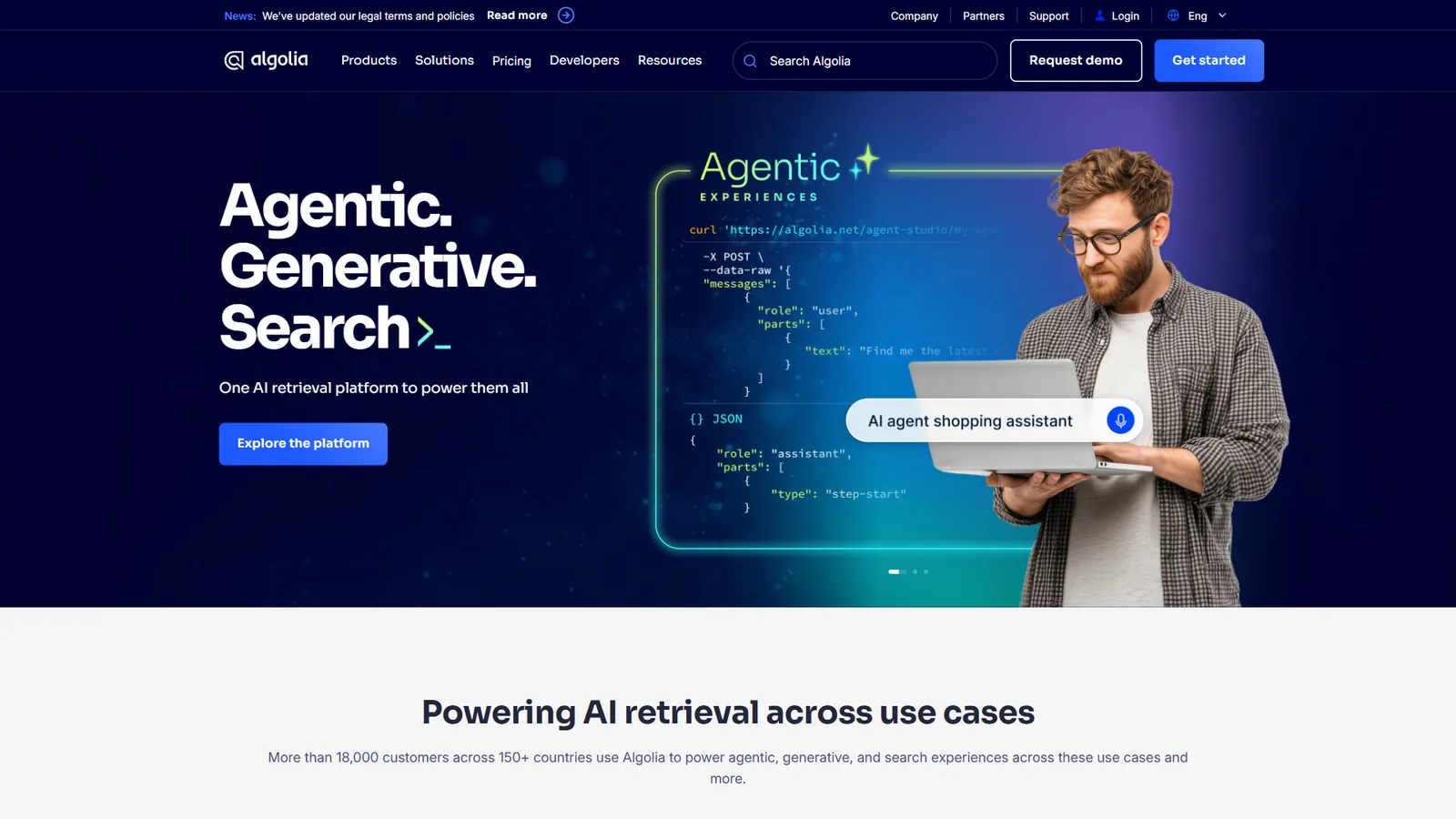
Algolia is the benchmark for fast, API-first search. Founded in 2012 and now serving over 17,000 companies, it has earned a 13-time Enterprise Search Leader designation for a reason: the speed is genuinely best-in-class.
What Makes It Stand Out
Sub-millisecond response times set Algolia apart from every competitor in this space. We are talking about results appearing as users type - not after they press enter. For documentation sites and SaaS applications where users expect instant feedback, this speed difference is immediately noticeable.
NeuralSearch combines traditional keyword matching with vector-based semantic search. A query for “running shoes” also surfaces results for “jogging sneakers” without manual synonym configuration. The AI handles intent, not just text matching - though this feature requires the Grow Plus tier or above.
Developer experience is where Algolia genuinely excels. The API documentation is so good that Stripe uses Algolia to power their own docs search. With 200+ integrations and InstantSearch UI libraries for React, Vue, Angular, and vanilla JavaScript, most teams can ship a working search experience in hours rather than weeks.
Limitations and Drawbacks
Usage-based pricing creates budget uncertainty. The Grow tier charges $0.50 per 1,000 extra requests, and Grow Plus charges $1.75 per 1,000 requests. For high-traffic sites, costs can spike unpredictably during traffic surges. Reviewers consistently flag pricing as Algolia’s biggest weakness.
AI features are locked behind premium tiers. The free Build tier only includes keyword-based search. NeuralSearch, AI Synonyms, and advanced personalization all require Grow Plus or Premium - meaning the most compelling features come at the highest cost.
Pricing
| Tier | Price | Includes |
|---|---|---|
| Build | Free | 10K requests/month, 1M records, keyword search |
| Grow | Usage-based ($0.50/1K requests) | Query suggestions, manual synonyms |
| Grow Plus | Usage-based ($1.75/1K requests) | AI Synonyms, AI Ranking, personalization |
| Premium | Custom | Dynamic re-ranking, SLA guarantees, dedicated support |
Best For
E-commerce sites, SaaS applications with in-app search, documentation sites, and developer teams that want a fast, flexible search API without managing infrastructure. The free tier makes it easy to prototype before committing budget.
2. Constructor - Best for Revenue-Optimized Ecommerce Search
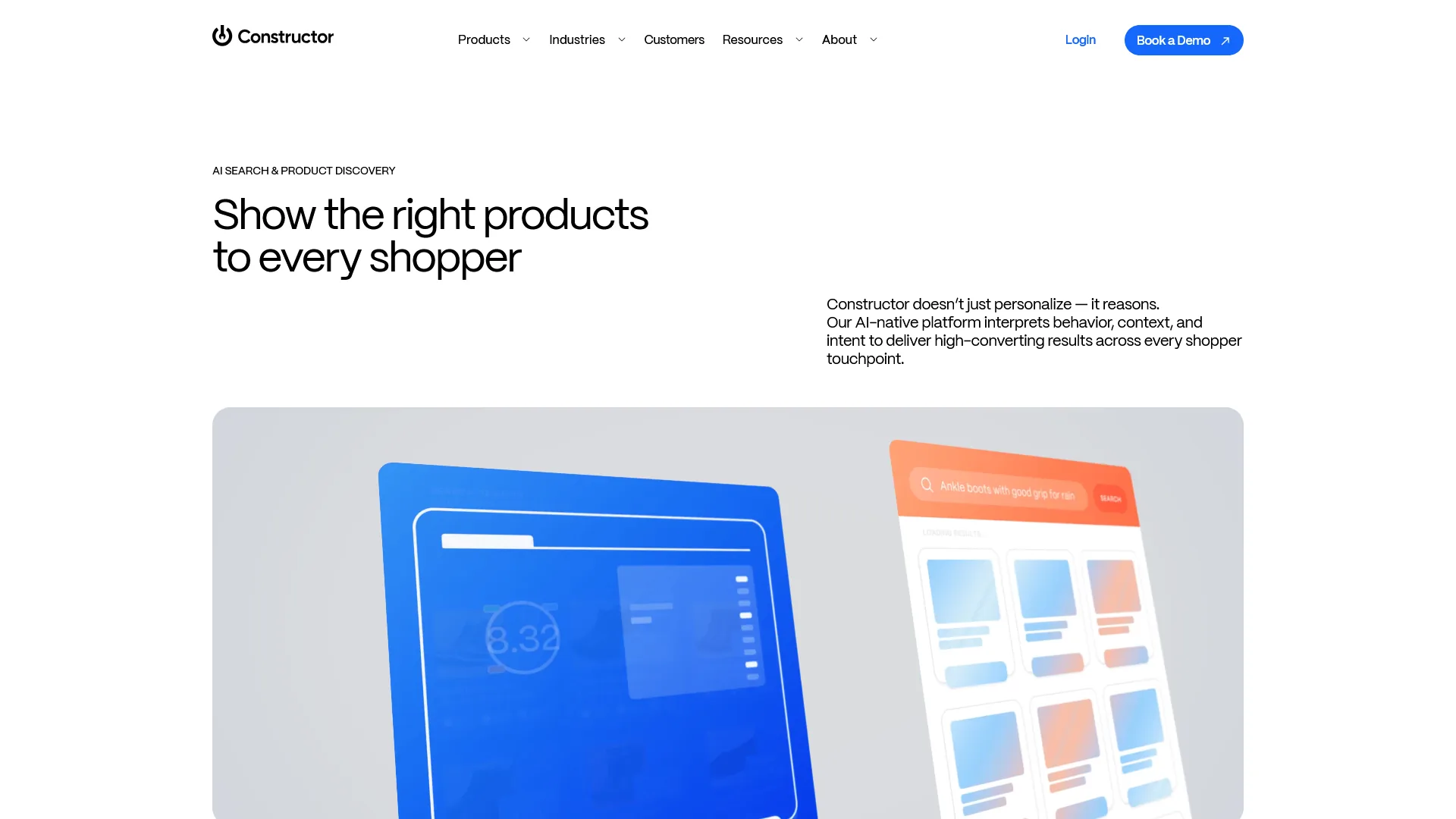
Constructor is the best AI search tool for revenue-optimized ecommerce, using behavioral purchase data rather than click signals to surface products that actually convert. Constructor takes a fundamentally different approach than Algolia. Where most search tools optimize for relevance - returning results that match the query - Constructor’s AI optimizes for revenue, learning from actual purchase behavior to surface products that convert.
What Makes It Stand Out
Revenue-first AI is the core differentiator. Constructor’s algorithms learn from what shoppers actually buy, not just what they click. This is a meaningful distinction: a search that surfaces products with high click rates but low purchase rates is actively losing you money. Constructor’s approach consistently wins A/B tests by 3%+ against incumbents, translating to documented $10M+ revenue lifts for enterprise customers like Sephora and Backcountry.
Comprehensive discovery suite extends beyond the search bar. Autosuggest, browse pages, product recommendations, and interactive product quizzes all use the same behavioral AI - creating a unified discovery experience where every touchpoint is optimized for conversion.
Exceptional satisfaction scores. Constructor consistently earns top marks for customer satisfaction and support quality. These aren’t vanity metrics - they indicate a vendor that invests heavily in customer success.
Limitations and Drawbacks
Enterprise-only access is the primary barrier. No free tier, no self-service signup, no published pricing. Every evaluation requires a sales conversation and custom quote. For teams wanting to quickly test a search solution, this procurement friction is significant.
Newer market entrant. Constructor has fewer user reviews than established players like Algolia, though its high ratings are promising. It’s still building its track record in the broader market.
Pricing
| Tier | Price | Includes |
|---|---|---|
| Growth | Custom | AI search, autosuggest, basic analytics |
| Enterprise | Custom | Advanced personalization, recommendations, dedicated success manager |
A 30-day free trial is available. Annual contracts are standard.
Best For
Enterprise ecommerce brands with 100K+ SKUs and the budget for premium search. If your primary goal is maximizing revenue from product discovery rather than just returning relevant results, Constructor delivers measurable ROI. Smaller stores should look elsewhere.
3. Coveo - Best for Enterprise Knowledge Management and Unified Search
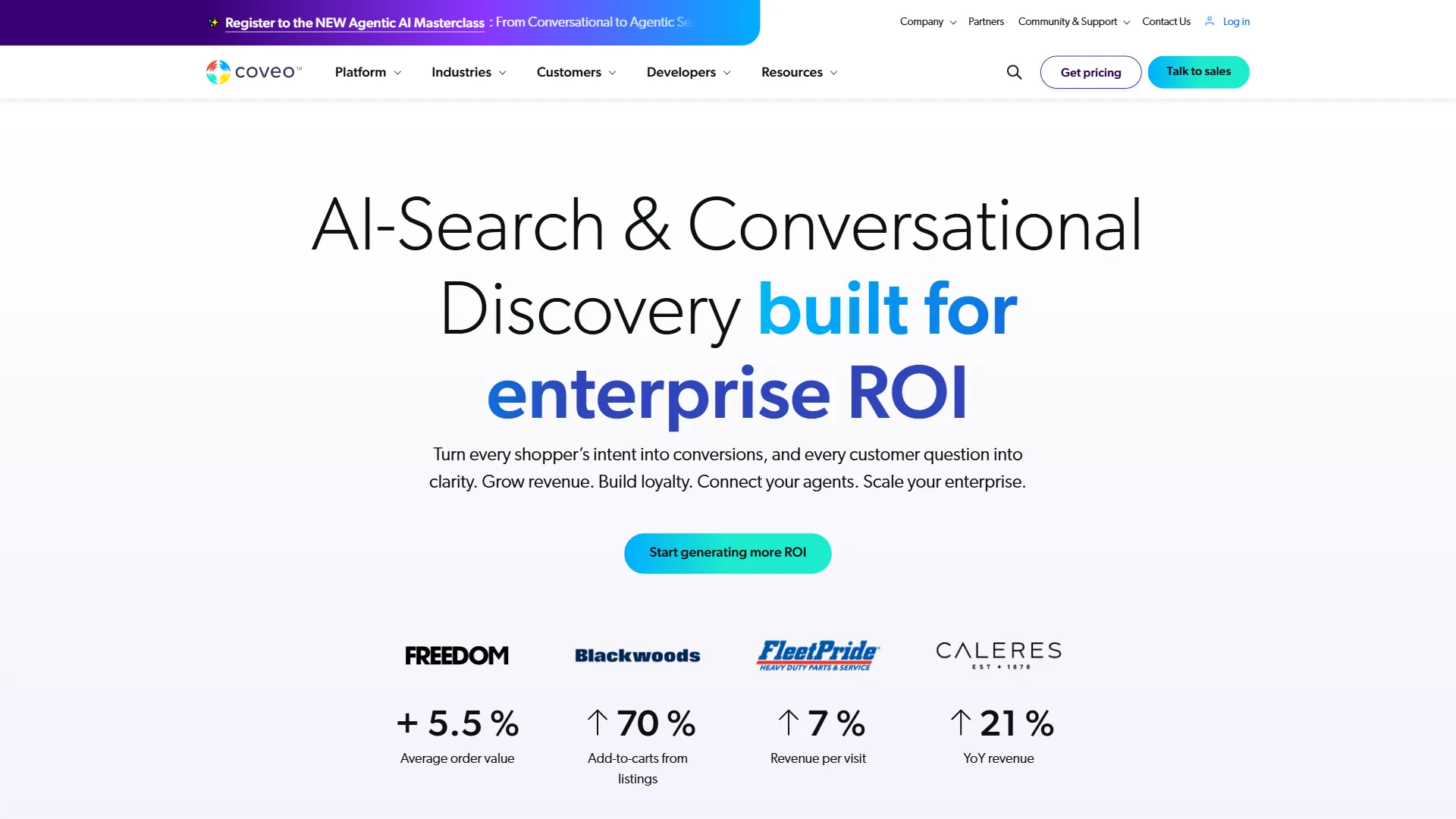
Coveo is the best AI search tool for enterprise knowledge management, unifying search across 30+ content sources including Salesforce, ServiceNow, SharePoint, and Sitecore from a $600 per month Base tier. Coveo solves a different problem than Algolia or Constructor. Where those tools power customer-facing search on a single site, Coveo unifies search across your entire digital ecosystem - websites, intranets, knowledge bases, Salesforce, ServiceNow, and more. For organizations where information lives in 15 different systems and nobody can find anything, Coveo is purpose-built.
What Makes It Stand Out
30+ content connectors index and unify information from Salesforce, Sitecore, ServiceNow, SharePoint, and dozens of other enterprise platforms. Instead of employees searching five different systems, Coveo provides a single search interface with AI-ranked results from everywhere.
Machine learning ranking improves over time based on user behavior. The AI learns which results are most useful for specific query patterns, automatically boosting relevant content without manual tuning. Customers like Dell and Tableau report 40%+ improvements in search success rates.
Customer service search is a standout use case. Coveo powers knowledge base search that deflects support tickets by helping customers find answers themselves - or helps agents surface the right resolution faster during live interactions.
Limitations and Drawbacks
The learning curve is steep. Coveo is enterprise software with enterprise complexity. Reviewers note that configuration and optimization require technical expertise, and smaller teams without dedicated search administrators will struggle.
Premium pricing limits accessibility. The Base tier starts at $600 per month, and Pro at $1,320/month. For organizations that need unified search across multiple systems, the value is clear - but the entry point excludes smaller companies.
Indexing speed for new content can lag, according to reviewer feedback. If your content changes rapidly, there may be a gap between publication and searchability.
Pricing
| Tier | Monthly Price | Includes |
|---|---|---|
| Base | $600 | AI-powered search, basic connectors, standard analytics |
| Pro | $1,320 | Advanced ML ranking, more connectors, enhanced analytics |
| Enterprise | Custom | Custom integrations, advanced security, SLA, dedicated success manager |
A 30-day free trial is available. Annual billing is standard.
Best For
Mid-to-large enterprises with search needs spanning multiple content systems - especially organizations using Salesforce, ServiceNow, or Sitecore. Particularly strong for customer self-service and internal knowledge management.
4. Klevu - Best for Mid-Market Ecommerce and Multi-Language Stores
Klevu is the best AI search tool for mid-market ecommerce and multi-language stores, offering semantic NLP search across 30+ languages with native Shopify integration. Klevu occupies the space between Algolia’s developer-centric approach and Constructor’s enterprise-only model. Built specifically for ecommerce, it delivers AI-powered semantic search with strong multi-language support and Shopify integration - at a price point more accessible than Constructor for mid-market retailers.
What Makes It Stand Out
Semantic NLP search understands shopper intent, not just keywords. When someone searches for “warm jacket for hiking,” Klevu returns insulated outdoor jackets even if product titles don’t contain those exact words. The AI handles vague queries, misspellings, and natural language patterns that trip up basic keyword search.
30+ language support makes Klevu particularly strong for retailers serving international markets. Unlike competitors where multi-language search requires significant additional configuration, Klevu handles it natively - a genuine differentiator for European and global ecommerce brands.
Smart merchandising lets merchandising teams boost, bury, or pin products without developer involvement. A/B testing is built in, so you can measure the impact of merchandising decisions on conversion rates.
Limitations and Drawbacks
Setup complexity is the most consistent criticism in reviews. While the backend is straightforward once configured, initial implementation requires more effort than Algolia’s developer-friendly API approach.
Custom-only pricing means no quick evaluation path. Unlike Algolia’s free tier, Klevu requires a sales conversation (though a 14-day free trial is available).
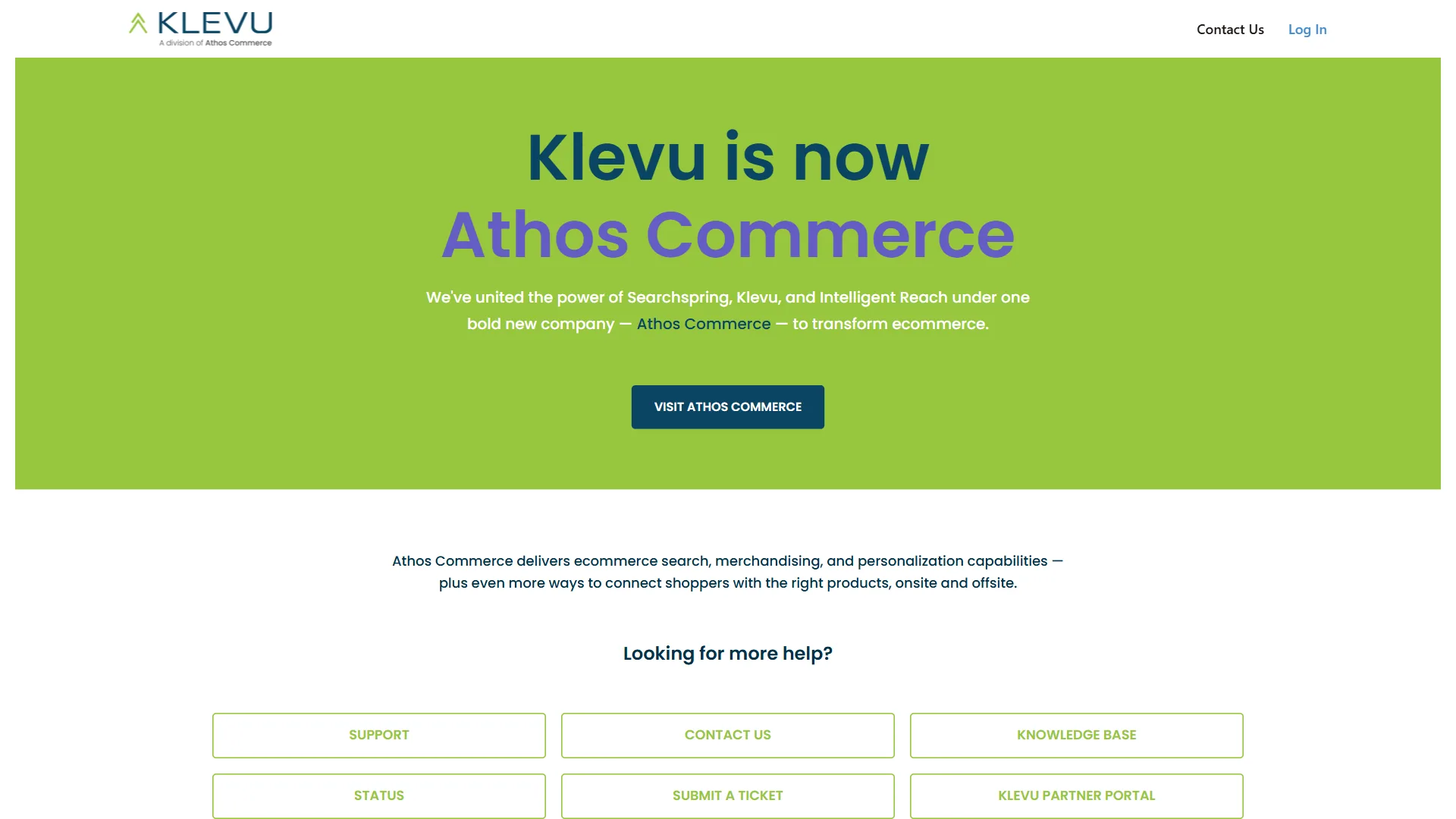
Smaller review base with limited independent reviews means less community validation than more established competitors. Klevu was acquired by Searchspring (now Athos Commerce) in January 2025, which adds uncertainty about long-term product direction.
Pricing
| Tier | Price | Includes |
|---|---|---|
| Growth | Custom | AI search, smart merchandising, basic analytics |
| Enterprise | Custom | Advanced personalization, category navigation, dedicated success manager |
A 14-day free trial is available. Annual contracts are standard.
Best For
Mid-market ecommerce retailers - especially those with multi-language requirements or Shopify stores that need AI search without enterprise pricing. Klevu fills the gap between Algolia’s general-purpose API and Constructor’s enterprise-only approach.
Comparison Table
The comparison table maps Algolia, Constructor, Coveo, and Klevu across pricing, AI approach, languages, and implementation time at a glance.
| Feature | Algolia | Constructor | Coveo | Klevu |
|---|---|---|---|---|
| Rating | ||||
| Primary Focus | Developer-first search API | Revenue-optimized ecommerce | Enterprise unified search | Mid-market ecommerce |
| AI Approach | NeuralSearch (keyword + semantic) | Behavioral purchase learning | ML ranking + NLP | Semantic NLP search |
| Free Tier | Yes (10K requests/mo) | No (30-day trial) | No (30-day trial) | No (14-day trial) |
| Starting Price | Free | Custom enterprise | $600/month | Custom |
| Best For | SaaS, docs, e-commerce dev teams | Enterprise retailers (100K+ SKUs) | Knowledge bases, multi-system orgs | Shopify, multi-language stores |
| Languages | 70+ | Not specified | Multiple | 30+ |
| Key Strength | Speed (sub-millisecond) | Revenue lift (3%+ A/B wins) | 30+ connectors | Semantic intent matching |
| Implementation | Hours (API-first) | Weeks (enterprise onboarding) | Weeks-months | Days-weeks |
Best Picks by Use Case
The best AI search tool for each use case is Algolia for developer-first websites and apps, Constructor for enterprise ecommerce revenue optimization, Coveo for unified enterprise knowledge management, and Klevu for Shopify and multi-language stores. These tools serve different segments and solve different problems. Start with your use case, not features.
Choose Based on Your Situation
“I need fast, flexible search for my website or app.” Start with Algolia. The free tier lets you build and test without commitment, the API documentation is excellent, and sub-millisecond speed is hard to argue with. Upgrade to Grow Plus when you need AI-powered relevance.
“I need search that maximizes ecommerce revenue.” Constructor is built for this. If your catalog exceeds 100K SKUs and you can justify enterprise pricing, the revenue-optimized AI delivers measurable ROI. For smaller catalogs, Klevu offers revenue-aware search at a more accessible price point.
“I need to unify search across multiple enterprise systems.” Coveo is the clear choice. No other tool in this guide matches its connector ecosystem for Salesforce, ServiceNow, and enterprise content platforms. The $600 per month starting price is steep, but the alternative - employees spending hours searching fragmented systems - costs more.
“I run a Shopify store with international customers.” Klevu is purpose-built for this scenario. Native 30+ language support, Shopify integration, and smart merchandising without requiring a developer for every change.
Budget Reality Check
| Scenario | Recommended Tool | Annual Cost Estimate |
|---|---|---|
| Early-stage startup or MVP | Algolia Build (free) | $0 |
| Growing SaaS (50K searches/mo) | Algolia Grow | $300-600/year |
| Mid-market ecommerce | Klevu Growth | Custom (contact sales) |
| Enterprise ecommerce (100K+ SKUs) | Constructor | Custom (significant investment) |
| Enterprise knowledge management | Coveo Base | $7,200+/year |
The Bottom Line
The best AI search tools in 2026 are not interchangeable. Algolia wins on speed, developer experience, and accessibility - it is the safest starting point for most teams. Constructor delivers measurable revenue impact for enterprise ecommerce, but the enterprise-only model limits who can access it. Coveo solves the enterprise unification problem that no other tool here addresses. Klevu fills the mid-market gap with strong multi-language support and ecommerce-native features.
Start with your primary use case. Test with a free tier or trial where available. Measure the impact before scaling your investment.
FAQ
Q: What is the most accurate AI search tool?
The best AI search tools in 2026 are not interchangeable. Algolia wins on speed, developer experience, and accessibility - it is the safest starting point for most teams. Constructor delivers measurable revenue impact for enterprise ecommerce, but the enterprise-only model limits who can access it. Coveo solves the enterprise unification problem that no other tool here addresses. Klevu fills the mid-market gap with strong multi-language support and ecommerce-native features.
Q: What is the best search in AI?
Algolia is the benchmark for fast, API-first search. Founded in 2012 and now serving over 17,000 companies, it has earned a 13-time Enterprise Search Leader designation for a reason: the speed is genuinely best-in-class.
Q: Which search engine is better than ChatGPT?
Enterprise ecommerce brands with 100K+ SKUs and the budget for premium search. If your primary goal is maximizing revenue from product discovery rather than just returning relevant results, Constructor delivers measurable ROI.
Related Reading
Related reading covers full reviews of each tool plus adjacent AI search and discovery comparisons.
- Algolia - Our full review with pricing, features, and alternatives
- Constructor - Our full review with pricing, features, and alternatives
- Coveo - Our full review with pricing, features, and alternatives
- Klevu - Our full review with pricing, features, and alternatives
- AI-Powered Enterprise Search: Bloomfire vs Guru vs Glean - Enterprise knowledge management search tools for internal teams
- Best AI Chatbots for Ecommerce in 2026 - Conversational AI tools that complement your site search
- Best AI Research Tools 2026 - AI-powered research and information retrieval tools
- Best Workflow Automation Tools 2026 - Automation platforms that integrate with your search stack
External Resources
External resources include primary vendor documentation and independent UX research that informed this guide.
- Algolia Documentation - Developer guides and API reference for search implementation
- Baymard Institute: Ecommerce Search UX Research - Independent research on site search best practices and conversion impact
- Nielsen Norman Group: Search Usability Guidelines - Independent UX research on search interface design