




The best ecommerce search tools in 2026 are Constructor, Algolia, Coveo, Klevu, and Bloomreach - each engineered for a different mix of revenue, developer speed, and personalization. Your ecommerce search bar is either making you money or losing it. According to Baymard Institute research, shoppers who use site search convert at 2-3x the rate of browsers - but only when the search actually understands what they want. According to a Baymard Institute usability study, “Forty-two percent of large e-commerce sites have major usability issues in their on-site search.” Type “warm winter boots size 10” into most default search implementations and you will get irrelevant noise, zero-result pages, or a dump of every boot in the catalog.
Our analysis draws on current vendor pricing pages, public case studies, and independent research rather than sponsored placement. AI Productivity may earn a commission from links on this page; our rankings are editorially independent.
The best ecommerce search tools 2026 fix this with AI that understands intent, learns from purchase behavior, and personalizes results in real time. But these platforms vary dramatically in pricing, implementation complexity, and who they are actually built for. A tool that drives $10M+ in revenue lift for an enterprise retailer with 200K SKUs may be completely wrong for a mid-market Shopify store.
This guide evaluates five leading ecommerce search platforms - Constructor, Algolia, Coveo, Klevu, and Bloomreach - across search quality, revenue impact, pricing transparency, and implementation difficulty. Here is what separates each one, the tradeoffs each carries, and which fits your situation.
Quick Verdict: Best Ecommerce Search Tool by Use Case
The Best eCommerce Search Tools 2026 include Constructor, Algolia, Coveo and 2 more. Each tool takes a different approach to ecommerce search tools, and the right choice depends on your budget, team size, and the specific workflows you need to optimize. This guide compares them on pricing, features, and real performance.
Best for revenue-optimized enterprise search: Constructor - AI learns from purchases, 3%+ A/B test wins, $10M+ documented revenue lifts
Best for developer-first search with a free tier: Algolia - Sub-millisecond speed, 200+ integrations, free Build plan
Best for enterprise search unification: Coveo - 30+ connectors, ML ranking, starts at $600 per month
Best for mid-market ecommerce: Klevu - Semantic NLP across 30+ languages, Shopify-native
Best for full-stack personalization: Bloomreach - Loomi AI, CDP + search + marketing automation in one platform
Selection Criteria
Our selection criteria are five tests that separate marketing claims from real impact: conversion lift, search intelligence, pricing transparency, implementation difficulty, and integration ecosystem. Every vendor claims AI-powered relevance, so this analysis focuses on what actually matters for ecommerce teams measuring bottom-line impact:
- Conversion Impact - Does the search optimize for revenue, or just keyword matching? Can you tie search improvements to measurable sales outcomes?
- Search Intelligence - How well does the AI handle typos, synonyms, vague queries, and natural language? Does it learn and improve over time?
- Pricing Transparency - What does it actually cost at your traffic level? Are there hidden usage-based charges that spike unpredictably?
- Implementation Difficulty - How long from signup to production search? Does your team need dedicated DevOps, or can a developer ship it in days?
- Integration Ecosystem - Does it connect with your ecommerce platform, analytics stack, and existing tools without custom middleware?
1. Constructor - Best for Revenue-Optimized Enterprise Search
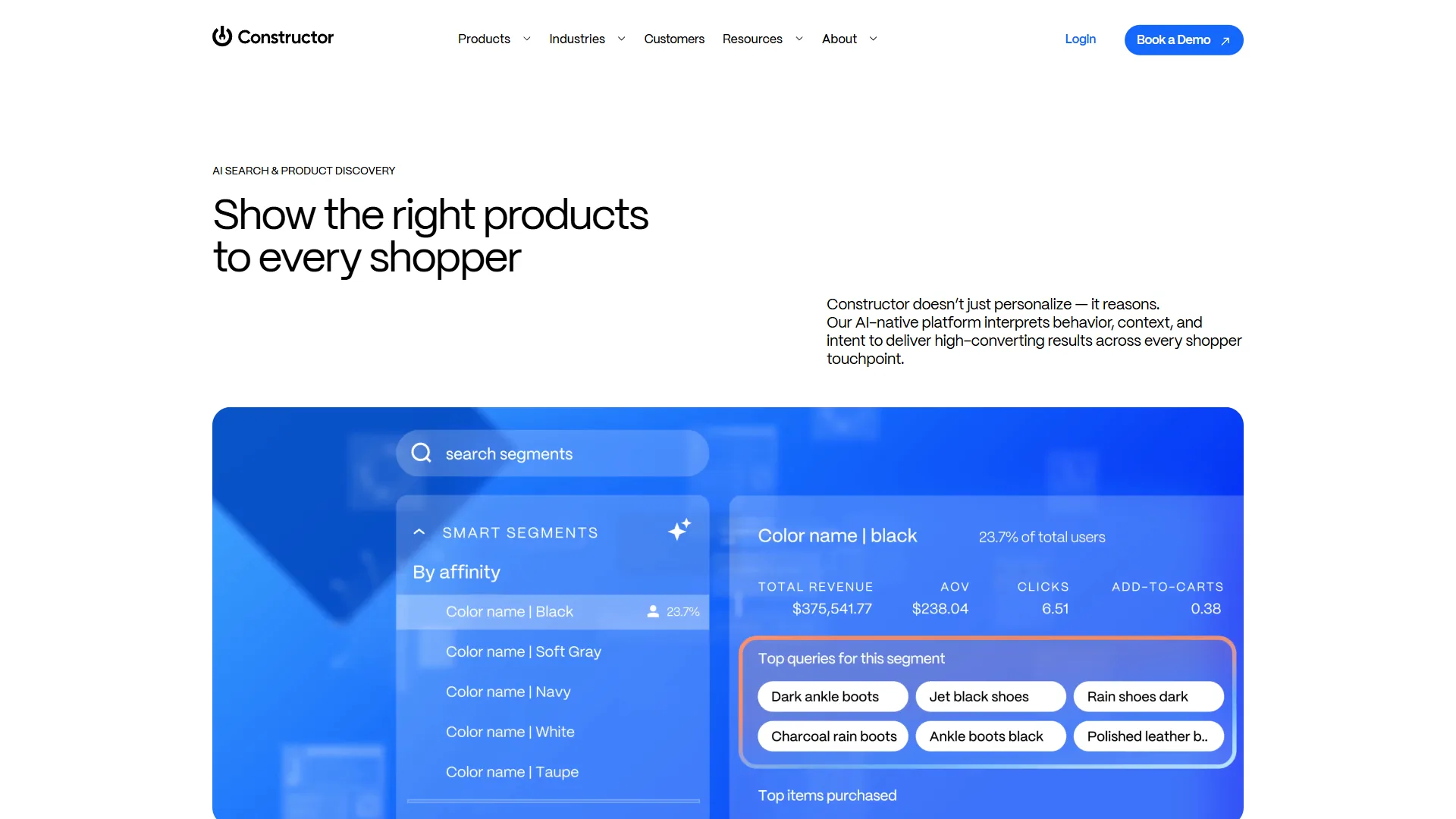
Constructor is an enterprise ecommerce search platform that optimizes for revenue rather than relevance, learning from actual purchase behavior to surface products that convert. While competitors return results that match the query, Constructor takes a fundamentally different approach than every other tool on this list.
What Makes It Stand Out
Revenue-first AI is the core differentiator. Constructor’s algorithms learn from what shoppers actually buy, not just what they click. A search that surfaces high-click, low-purchase products is actively costing you money. Constructor’s approach consistently wins A/B tests by 3%+ against incumbents, creating documented $10M+ revenue lifts for enterprise customers like Sephora and Backcountry.
Comprehensive discovery suite goes beyond the search bar. Autosuggest, browse pages, product recommendations, and interactive quizzes all use the same behavioral AI - meaning every touchpoint on your site is optimized for conversion, not just the search results page.
Exceptional satisfaction scores. Constructor earns 9.8/10 for customer satisfaction and 9.7/10 for ease of use on independent review platforms. For enterprise software, those numbers are unusually high and indicate a vendor that invests heavily in customer success.
What Needs Work
Enterprise-only access is the main barrier. No free tier, no self-service signup, no published pricing. Every evaluation requires a sales conversation and custom quote. For teams wanting to test quickly, this friction is real.
Smaller review base compared to Algolia. With fewer independent reviews than Algolia’s established user base, there is less community validation - though the scores Constructor does have are consistently high.
Pricing
| Tier | Price | Includes |
|---|---|---|
| Growth | Custom | AI search, autosuggest, basic analytics |
| Enterprise | Custom | Advanced personalization, recommendations, dedicated success manager |
A 30-day free trial is available. Annual contracts are standard.
Best For
Enterprise ecommerce brands with 100K+ SKUs and the budget for premium AI search. If maximizing revenue from product discovery is your primary goal, Constructor delivers measurable ROI that justifies the investment.
Limitations and who it’s not for: Skip Constructor if you need self-service signup, published pricing, or a free tier - every evaluation runs through sales. Smaller catalogs (under ~50K SKUs) won’t generate enough behavioral signal for the purchase-learning AI to outperform simpler keyword tools, and the smaller independent review base means less community validation than Algolia.
2. Algolia - Best for Developer-First Search with Free Tier
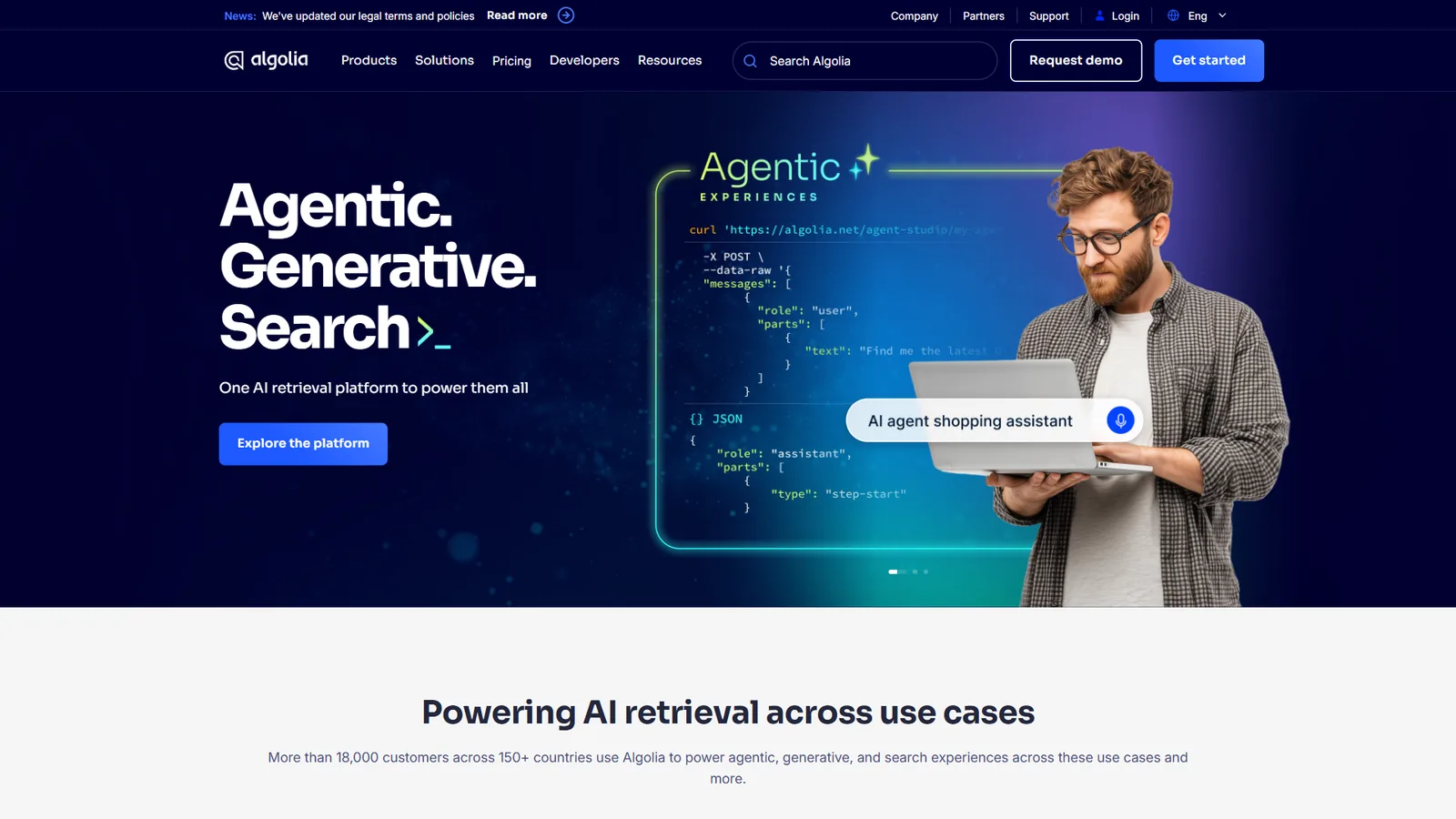
Algolia is the benchmark for fast, API-first search. Serving over 17,000 companies including Stripe and Twitch, it has earned 13 consecutive Enterprise Search Leader designations for a reason: the speed is genuinely best-in-class, and the developer experience is unmatched.
What Makes It Stand Out
Sub-millisecond response times set Algolia apart from every competitor in this category. Results appear as users type - not after they press enter. For ecommerce sites where speed directly impacts bounce rates, this difference is measurable and meaningful.
NeuralSearch combines traditional keyword matching with vector-based semantic search. A query for “running shoes” also surfaces results for “jogging sneakers” without manual synonym configuration. The AI handles intent, not just text matching - though this feature requires the Grow Plus tier or above.
Developer experience is where Algolia genuinely excels. With 200+ integrations and InstantSearch UI libraries for React, Vue, Angular, and vanilla JavaScript, most teams can ship a working search experience in hours rather than weeks. The free Build tier makes prototyping risk-free.
What Needs Work
Usage-based pricing creates budget uncertainty. The Grow tier charges $0.50 per 1,000 extra requests, and Grow Plus charges $1.75 per 1,000 requests. For high-traffic ecommerce sites, costs can spike unpredictably during sales events or seasonal surges.
AI features are gated behind premium tiers. The free Build tier only includes keyword-based search. NeuralSearch, AI Synonyms, and advanced personalization all require Grow Plus or Premium - meaning the most compelling features come at the highest cost.
Pricing
| Tier | Price | Includes |
|---|---|---|
| Build | Free | 10K requests/month, 1M records, keyword search |
| Grow | $0.50/1K requests | Query suggestions, manual synonyms |
| Grow Plus | $1.75/1K requests | AI Synonyms, AI Ranking, personalization |
| Premium | Custom | Dynamic re-ranking, SLA guarantees, dedicated support |
Best For
Ecommerce teams that want fast, flexible search with a low-risk starting point. The free tier is ideal for prototyping, and the API-first approach gives developers full control. Best for teams with technical resources who value speed and customization over out-of-the-box ecommerce features.
Limitations and who it’s not for: Skip Algolia if you have unpredictable traffic spikes you can’t budget for - usage-based pricing ($0.50-$1.75 per 1K requests on paid tiers) creates real cost uncertainty during sales surges. Teams without engineering resources will struggle, and the most compelling AI features (NeuralSearch, AI Synonyms) are gated behind Grow Plus, so the free tier alone won’t beat purchase-behavior tools like Constructor.
3. Coveo - Best for Enterprise Search Unification
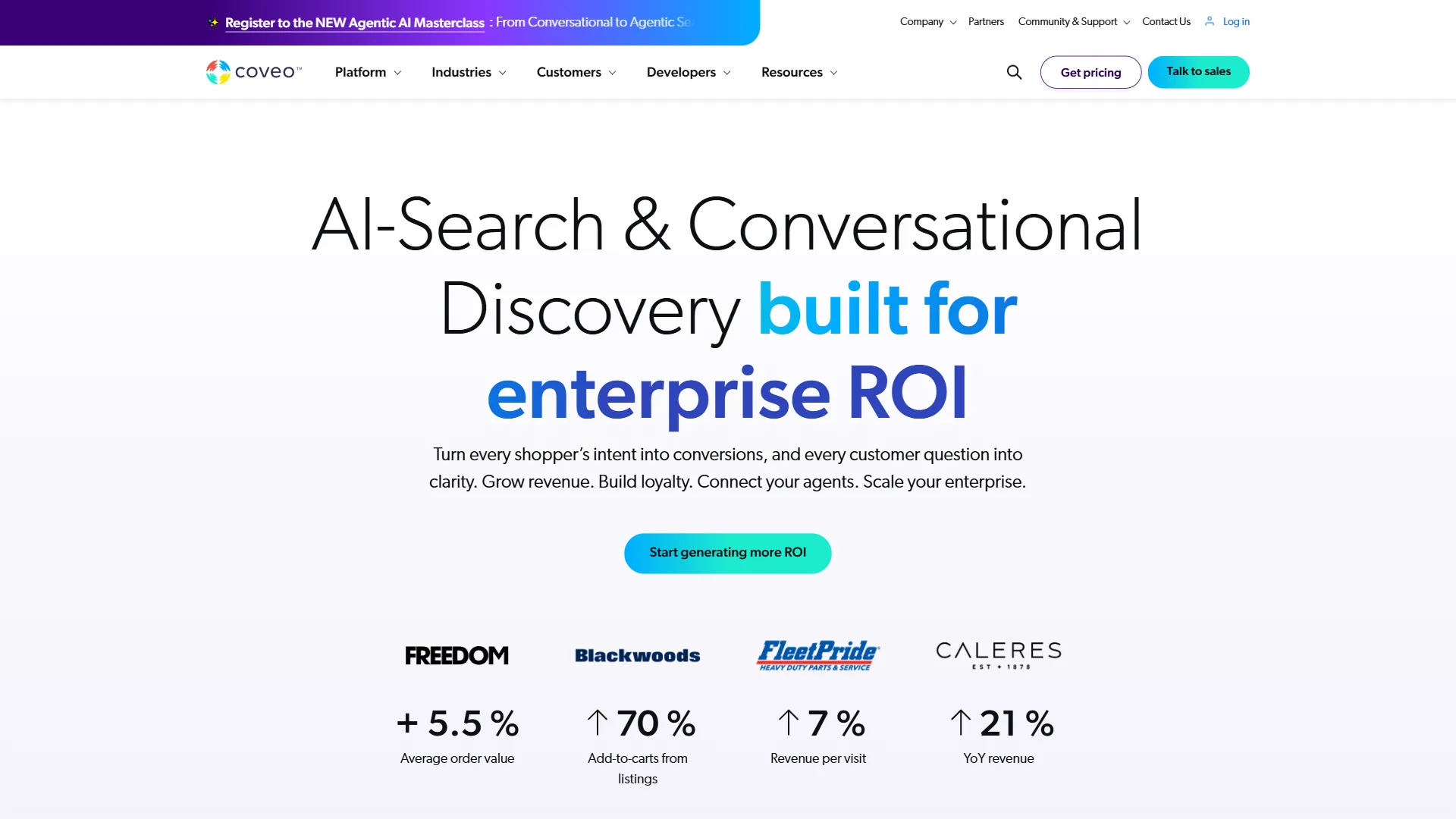
Coveo is an enterprise search platform that unifies product, knowledge, and service content across Salesforce, ServiceNow, Sitecore, and 30-plus other systems behind a single AI-ranked search layer. Where Constructor and Algolia focus on powering search within a single storefront, Coveo solves a different problem for enterprise retailers with information scattered across dozens of systems.
What Makes It Stand Out
30+ content connectors index and unify content from Salesforce, Sitecore, ServiceNow, SharePoint, and dozens of other enterprise platforms. For retailers where product information, support articles, and customer data live in separate systems, Coveo creates a single intelligent search layer across everything.
Machine learning ranking improves over time based on user behavior. The AI learns which results are most useful for specific query patterns, automatically boosting relevant content. Customers like Dell and Tableau report 40%+ improvements in search success rates.
Customer service search is a standout use case. Coveo powers knowledge base search that deflects support tickets by surfacing answers before customers contact your team - reducing support costs while improving the post-purchase experience.
What Needs Work
Steep learning curve. Coveo is enterprise software with enterprise complexity. User reviews note that configuration requires technical expertise, and smaller teams without dedicated search administrators will struggle with setup and ongoing optimization.
Premium pricing limits accessibility. The Base tier starts at $600 per month and Pro at $1,320/month. For organizations that genuinely need unified search across multiple systems, the value is clear - but the entry point excludes mid-market retailers.
Indexing speed for new content can lag according to reviewer feedback. If your product catalog changes rapidly, there may be a gap between updates and searchability.
Pricing
| Tier | Monthly Price | Includes |
|---|---|---|
| Base | $600 | AI-powered search, basic connectors, standard analytics |
| Pro | $1,320 | Advanced ML ranking, more connectors, enhanced analytics |
| Enterprise | Custom | Custom integrations, advanced security, SLA, dedicated support |
A 30-day free trial is available. Annual billing is standard.
Best For
Enterprise retailers with search needs spanning multiple content systems - especially those using Salesforce or ServiceNow alongside their ecommerce platform. Coveo is the right choice when search unification matters as much as product discovery.
Limitations and who it’s not for: Skip Coveo if you only need ecommerce product search - the $600 per month Base tier and the configuration overhead are a poor fit for single-storefront retailers. Smaller teams without dedicated search administrators will struggle with the steep learning curve, and indexing lag for rapidly changing catalogs has been a recurring complaint in reviews.
4. Klevu - Best for Mid-Market Ecommerce
Klevu is an AI-powered semantic search platform built specifically for mid-market ecommerce, with native support for 30-plus languages and a Shopify-first integration path. Klevu fills the gap between Algolia’s developer-first approach and Constructor’s enterprise-only model, at a price point more accessible than Constructor or Bloomreach for mid-market retailers.
What Makes It Stand Out
Semantic NLP search understands shopper intent, not just keywords. When someone searches “warm jacket for hiking,” Klevu returns insulated outdoor jackets even if product titles use different words. The AI handles vague queries, misspellings, and natural language patterns that trip up basic keyword search - across 30+ languages.
Multi-language support makes Klevu particularly strong for retailers serving international markets. Unlike competitors where multi-language search requires significant configuration, Klevu handles it natively. For European and global ecommerce brands, this is a genuine differentiator.
Smart merchandising lets merchandising teams boost, bury, or pin products without developer involvement. A/B testing is built in, so you can measure the conversion impact of every merchandising decision directly.
What Needs Work
Setup complexity is the most consistent criticism in reviews. While the backend is straightforward once configured, initial implementation requires more effort than Algolia’s drop-in API approach.
Custom-only pricing means no quick evaluation path. Unlike Algolia’s free tier, Klevu requires a sales conversation - though a 14-day free trial is available for hands-on testing.
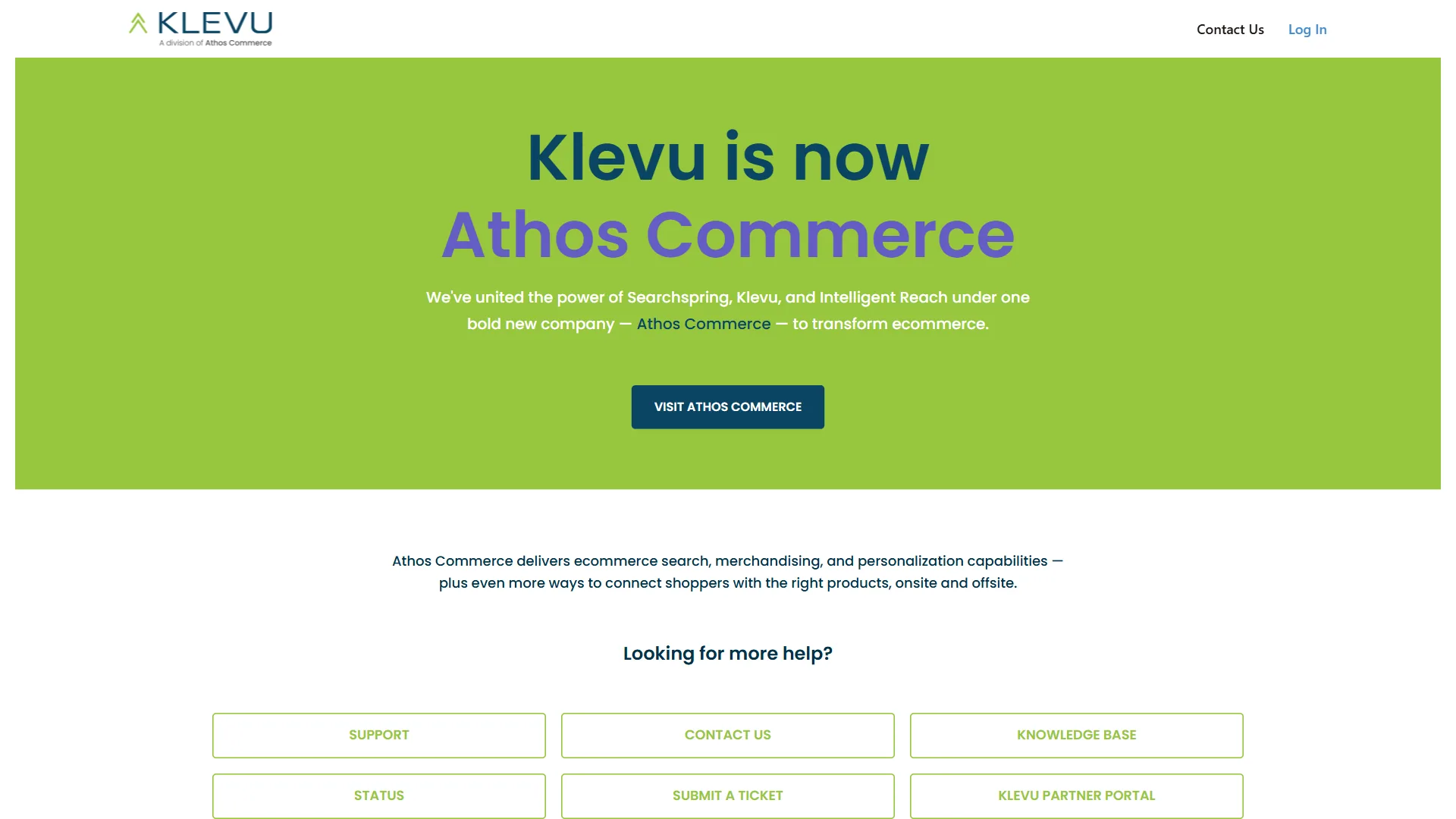
Smaller review base with limited independent reviews provides less community validation than Algolia or Bloomreach. Klevu was acquired by Searchspring (now Athos Commerce) in January 2025, which introduces some uncertainty about long-term product direction.
Pricing
| Tier | Price | Includes |
|---|---|---|
| Growth | Custom | AI search, smart merchandising, basic analytics |
| Enterprise | Custom | Advanced personalization, category navigation, dedicated success manager |
A 14-day free trial is available. Annual contracts are standard.
Best For
Mid-market ecommerce retailers - especially those with international customers or Shopify stores that need AI-powered search without enterprise pricing. Klevu fills the practical middle ground that most retailers actually occupy.
Limitations and who it’s not for: Skip Klevu if you want a quick API-first prototype - initial setup takes more effort than Algolia’s drop-in libraries, and there’s no free tier for hands-off evaluation. The Searchspring/Athos Commerce acquisition introduces some product-direction uncertainty, and the smaller review base offers less community validation than larger platforms.
5. Bloomreach - Best for Full-Stack Ecommerce Personalization
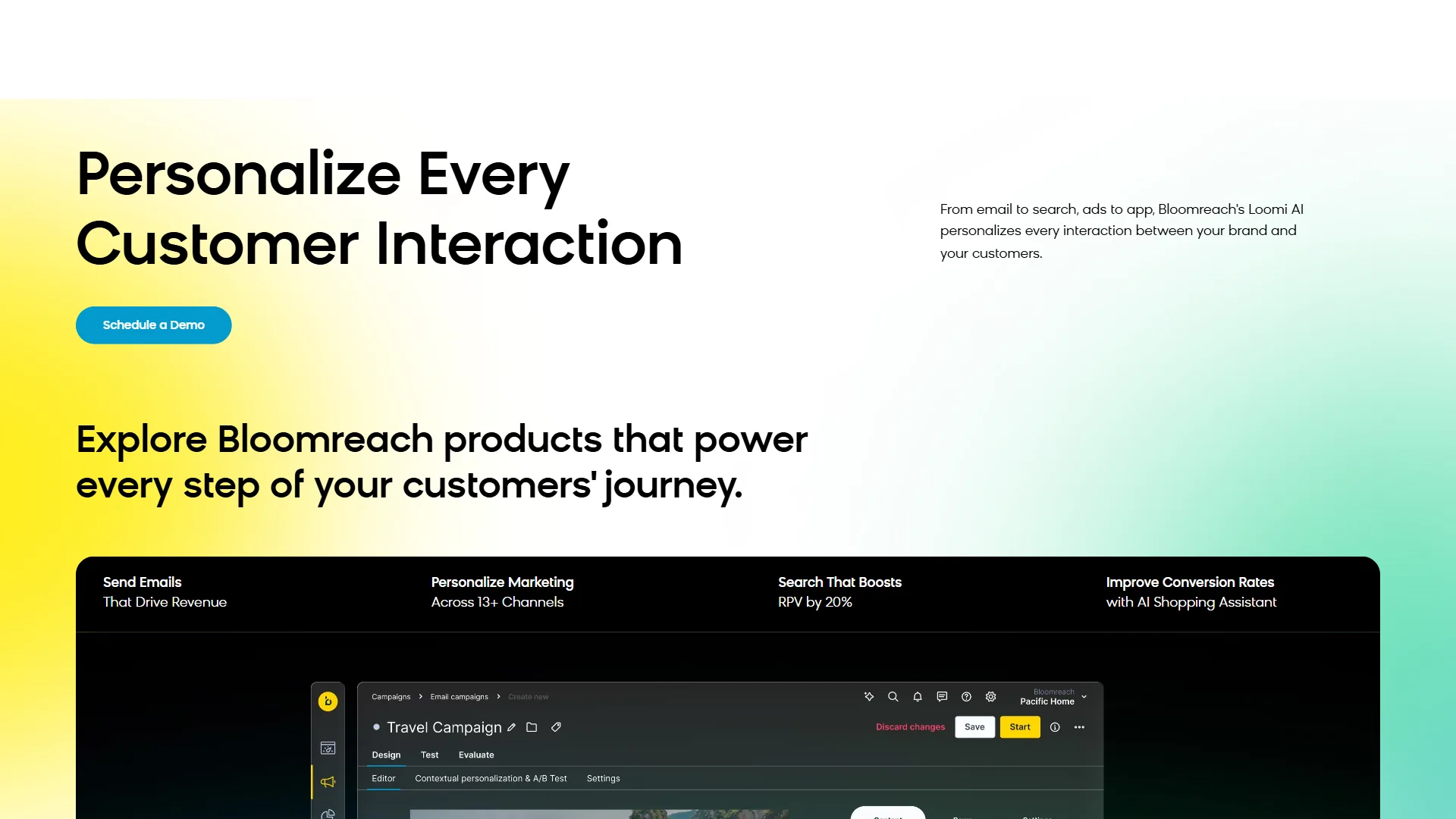
Bloomreach is the only platform on this list that goes beyond search into full-stack ecommerce personalization. Its Loomi AI engine - trained on 350M+ transactions with 30+ patents - powers search, recommendations, marketing automation, and conversational shopping from a single platform. If you need more than just a search bar, Bloomreach offers an integrated suite.
What Makes It Stand Out
Loomi AI is the core differentiator. Unlike competitors that focus narrowly on search relevance, Bloomreach’s AI personalizes the entire customer journey - from search results and browse pages to email campaigns and on-site recommendations. The 350M+ transaction training creates genuine product affinity understanding that general-purpose AI cannot match.
Proven ROI at scale. A Forrester TEI study documented 251% ROI over three years with $2.3M in cost savings. Case studies include a 59.73% increase in revenue per search user (N Brown) and a 10% conversion rate improvement in two months (Hornby Hobbies). These are not hypothetical projections.
Visual and conversational search set Bloomreach apart. Shoppers can upload images for AI-powered product discovery, and the Clarity conversational agent provides guided shopping assistance. These capabilities move beyond traditional keyword search into the kind of experience modern consumers expect.
What Needs Work
Enterprise pricing is prohibitive for most. Expect $4,000-$36,000/month ($50K-$430K annually) depending on your scale and feature requirements. This puts Bloomreach firmly in enterprise territory - well beyond what mid-market retailers can justify.
Implementation complexity is significant. Budget 3-6 months for full deployment. The platform requires dedicated technical resources for setup, data integration, and configuration. This is not a plug-and-play solution.
The breadth is a double-edged sword. If you only need better search, paying for Bloomreach’s full CDP, marketing automation, and content management capabilities means you are funding features you may not use.
Pricing
| Tier | Price | Includes |
|---|---|---|
| Essentials | Custom | Product search, merchandising, Loomi AI, basic analytics |
| Growth | Custom | Personalization, A/B testing, advanced analytics |
| Enterprise | Custom | Multi-site, advanced APIs, private cloud options |
All tiers require custom quotes. Annual contracts are standard.
Best For
Large enterprise ecommerce brands that need search as part of a broader personalization strategy. If you are already investing in CDP capabilities, marketing automation, and omnichannel personalization, Bloomreach consolidates those needs into a single AI-powered platform. For search-only needs, other tools on this list offer better value.
Limitations and who it’s not for: Skip Bloomreach if your only goal is better search - paying $4,000-$36,000/month for the full CDP plus marketing automation suite means funding modules you may never touch. Implementation runs 3-6 months with dedicated technical resources, and mid-market retailers without enterprise budgets won’t break even on the investment.
Comparison Table: Best Ecommerce Search Tools 2026 at a Glance
The comparison table below summarizes how Constructor, Algolia, Coveo, Klevu, and Bloomreach stack up on rating, primary focus, AI approach, free tier, starting price, languages, implementation time, and key strength.
| Feature | Constructor | Algolia | Coveo | Klevu | Bloomreach |
|---|---|---|---|---|---|
| Rating | |||||
| Primary Focus | Revenue-optimized search | Developer-first API | Enterprise unification | Mid-market ecommerce | Full-stack personalization |
| AI Approach | Purchase behavior learning | NeuralSearch (keyword + semantic) | ML ranking + NLP | Semantic NLP search | Loomi AI (350M+ transactions) |
| Free Tier | No (30-day trial) | Yes (10K requests/mo) | No (30-day trial) | No (14-day trial) | No |
| Starting Price | Custom enterprise | Free | $600/month | Custom | Around $4,000/month |
| Languages | Not specified | 70+ | Multiple | 30+ | Multiple |
| Implementation | Weeks | Hours-days | Weeks-months | Days-weeks | 3-6 months |
| Key Strength | 3%+ A/B test wins | Sub-ms speed | 30+ connectors | Multi-language NLP | 251% ROI (Forrester) |
Best Picks by Use Case
The best ecommerce search tool depends on your scenario: Constructor for revenue optimization, Algolia for fast prototyping, Coveo for enterprise unification, Klevu for mid-market international stores, and Bloomreach for full-stack personalization. These tools serve different segments and solve different problems, so start with your situation, not a feature checklist.
Choose Based on Your Scenario
“I want search that directly maximizes revenue.” Constructor is purpose-built for this. If your catalog exceeds 100K SKUs and you can justify enterprise pricing, the revenue-optimized AI delivers measurable ROI. The 3%+ A/B test wins against incumbents are well-documented across enterprise deployments.
“I need fast search with a low-risk starting point.” Start with Algolia. The free Build tier lets you prototype without commitment, the API documentation is excellent, and sub-millisecond speed is hard to beat. Upgrade to Grow Plus when you need AI-powered relevance and personalization.
“I need search across multiple enterprise systems.” Coveo is the clear choice. No other tool here matches its connector ecosystem for unifying product catalogs with Salesforce, ServiceNow, and internal knowledge bases. The $600 per month entry point is steep, but the alternative - fragmented search across a dozen platforms - costs more in lost productivity.
“I run a mid-market store with international customers.” Klevu is built for this scenario. Native 30+ language support, ecommerce-specific semantic search, and smart merchandising without enterprise pricing make it the practical choice for retailers in the mid-market.
“I need search as part of a broader personalization strategy.” Bloomreach consolidates search, recommendations, marketing automation, and CDP capabilities into one platform. If you are already spending on separate tools for each of those functions, Bloomreach’s integrated approach may reduce total cost of ownership at scale.
Budget Reality Check
| Scenario | Recommended Tool | Annual Cost Estimate |
|---|---|---|
| Early-stage or MVP | Algolia Build (free) | $0 |
| Growing store (50K searches/mo) | Algolia Grow | $300-600/year |
| Mid-market ecommerce | Klevu Growth | Custom (contact sales) |
| Enterprise ecommerce (100K+ SKUs) | Constructor | Custom (significant investment) |
| Enterprise multi-system search | Coveo Base | $7,200+/year |
| Enterprise full-stack personalization | Bloomreach | $50,000+/year |
The Bottom Line
The best ecommerce search tools 2026 are not interchangeable. Each solves a different problem for a different type of retailer.
Constructor wins when revenue optimization is the primary goal - its purchase-behavior AI consistently outperforms competitors in A/B tests. Algolia is the safest starting point for most teams, combining speed, developer experience, and a genuine free tier. Coveo solves the enterprise unification problem that no other tool here addresses. Klevu fills the mid-market gap with strong multi-language support and ecommerce-native features. Bloomreach is the right choice when search is one piece of a broader personalization strategy - but only if you have the budget and technical resources for enterprise-grade software.
Start with your use case. Test with a free tier or trial where available. Measure conversion impact before scaling your investment. The best ecommerce search tools 2026 deliver real ROI - but only when matched to the right business.
Frequently Asked Questions
What is the best ecommerce search tool for small businesses?
Algolia is the best starting point for small to mid-size ecommerce stores. Its free Build plan handles up to 10,000 search requests per month, and the Grow plan scales affordably as traffic increases. The developer-friendly API and 200+ pre-built integrations (including Shopify, Magento, and WooCommerce) mean most teams can go live within a week without a dedicated search engineer.
How much does ecommerce search software cost?
Costs range widely across these platforms. Algolia offers a free tier and paid plans starting around $300-600/year for growing stores. Klevu and Constructor use custom pricing that typically starts in the low thousands per year for mid-market retailers. Coveo starts at $600 per month ($7,200/year). Bloomreach is the most expensive at $50,000+/year for enterprise deployments. Most vendors offer free trials or demos before committing.
Does ecommerce search really improve conversion rates?
Yes. Industry research consistently shows that shoppers who use site search convert at 2-3x the rate of browsers. Constructor reports documented revenue lifts exceeding $10M for enterprise retailers through their AI-powered search. The key factor is search quality - a search bar that returns irrelevant results can actually hurt conversions compared to no search at all. Modern AI-powered tools learn from purchase behavior to surface products shoppers are most likely to buy.
What is the difference between Algolia and Constructor?
Algolia is developer-first with blazing speed (sub-millisecond responses), a generous free tier, and broad use cases beyond ecommerce. Constructor is built specifically for ecommerce revenue optimization - its AI learns from actual purchase behavior rather than just clicks, consistently producing 3%+ conversion lifts in A/B tests. Choose Algolia for flexibility and developer experience; choose Constructor when maximizing revenue per search is the primary goal.
Related Reading
Related reading covers in-depth tool reviews and adjacent guides on ecommerce search, personalization, conversion optimization, and chatbots.
- Constructor - Our full review with pricing, features, and alternatives
- Algolia - Our full review with pricing, features, and alternatives
- Coveo - Our full review with pricing, features, and alternatives
- Klevu - Our full review with pricing, features, and alternatives
- Bloomreach - Our full review with pricing, features, and alternatives
- Best AI Search Tools for Websites and Apps in 2026 - Broader AI search comparison across ecommerce, SaaS, and enterprise use cases
- Best E-commerce Personalization Tools 2026 - Enterprise CDP and personalization platform comparison
- Ecommerce Conversion Optimization: 5 AI Tools That Drive Revenue - How AI tools improve ecommerce conversion rates
- Best AI Chatbots for Ecommerce in 2026 - Conversational AI tools that complement your site search
External Resources
External resources include primary vendor documentation and customer case studies you can verify directly with each platform.
- Constructor Customer Stories - Case studies showing revenue impact from AI-powered product discovery
- Algolia Documentation - Developer guides and API reference for search implementation
- Coveo Customer Success Stories - Enterprise search unification case studies
- Klevu Resources - Ecommerce search best practices and product guides
- Bloomreach Customer Stories - Enterprise personalization ROI case studies