







Ecommerce conversion optimization is the discipline of improving the percentage of store visitors who complete a purchase, and AI-driven personalization, search, and orchestration platforms are now the highest-leverage way to do it. The average ecommerce conversion rate by industry hovers between 1% and 4% according to IRP Commerce market data, yet stores using AI-driven personalization and search consistently outperform that baseline. This guide examines five platforms that target different parts of the conversion funnel - practical ecommerce conversion tips grounded in how these tools actually perform - and the right choice depends on where your store is losing customers.
Editorial disclosure: This guide includes affiliate links. We earn a commission if you sign up through them, at no cost to you. Rankings reflect hands-on testing, vendor documentation, and verified case studies - not commission rates. See our editorial policy.
The five tools in this guide - Nosto, Insider, Bloomreach, Constructor, and Algolia - each approach the funnel from a different angle: Nosto personalizes the shopping experience, Insider orchestrates omnichannel journeys, Bloomreach pairs search with a full commerce platform, Constructor optimizes product search for revenue, and Algolia delivers developer-first search that scales.
None of them do everything. Here is what each actually delivers.
Quick Comparison
The five tools below are ranked on primary focus, rating, pricing, free tier, and ideal customer profile so you can identify the right ecommerce conversion optimization tools at a glance.
| Tool | Primary Focus | Rating | Pricing | Free Tier | Best For |
|---|---|---|---|---|---|
| Nosto | Ecommerce personalization | Custom (all tiers) | 14-day trial | Mid-market retailers | |
| Insider | Omnichannel CDP | Custom enterprise | Demo only | Enterprise brands | |
| Bloomreach | Commerce experience + search | $4K-$36K/mo | No | Enterprise at scale | |
| Constructor | Revenue-optimized search | Custom enterprise | 30-day trial | 100K+ SKU retailers | |
| Algolia | Developer-first AI search | Free-Custom | Yes (10K req/mo) | SaaS + ecommerce devs |
How These Tools Were Evaluated
Our evaluation methodology scored every vendor on five operator-relevant criteria - AI depth, integration complexity, revenue attribution, pricing transparency, and team requirements - based on hands-on testing, vendor documentation, verified customer case studies, and independent analyst reports such as Forrester TEI studies. Every personalization vendor claims 20-30% conversion increases, yet real-world ecommerce conversion optimization examples tell a more nuanced story. Instead of echoing marketing copy, this analysis focuses on what matters for working ecommerce teams:
- AI Depth - Does the personalization actually learn from shopper behavior, or is it rule-based targeting with an AI label?
- Integration Complexity - How long before it works with your Shopify, Magento, or custom stack?
- Revenue Attribution - Can you trace conversion improvements back to specific features?
- Pricing Honesty - Custom pricing dominates this category. This guide shares what is publicly known about actual costs.
- Team Requirements - Does your team need dedicated engineers or can merchandisers self-serve?
1. Nosto - Best for Mid-Market Ecommerce Personalization
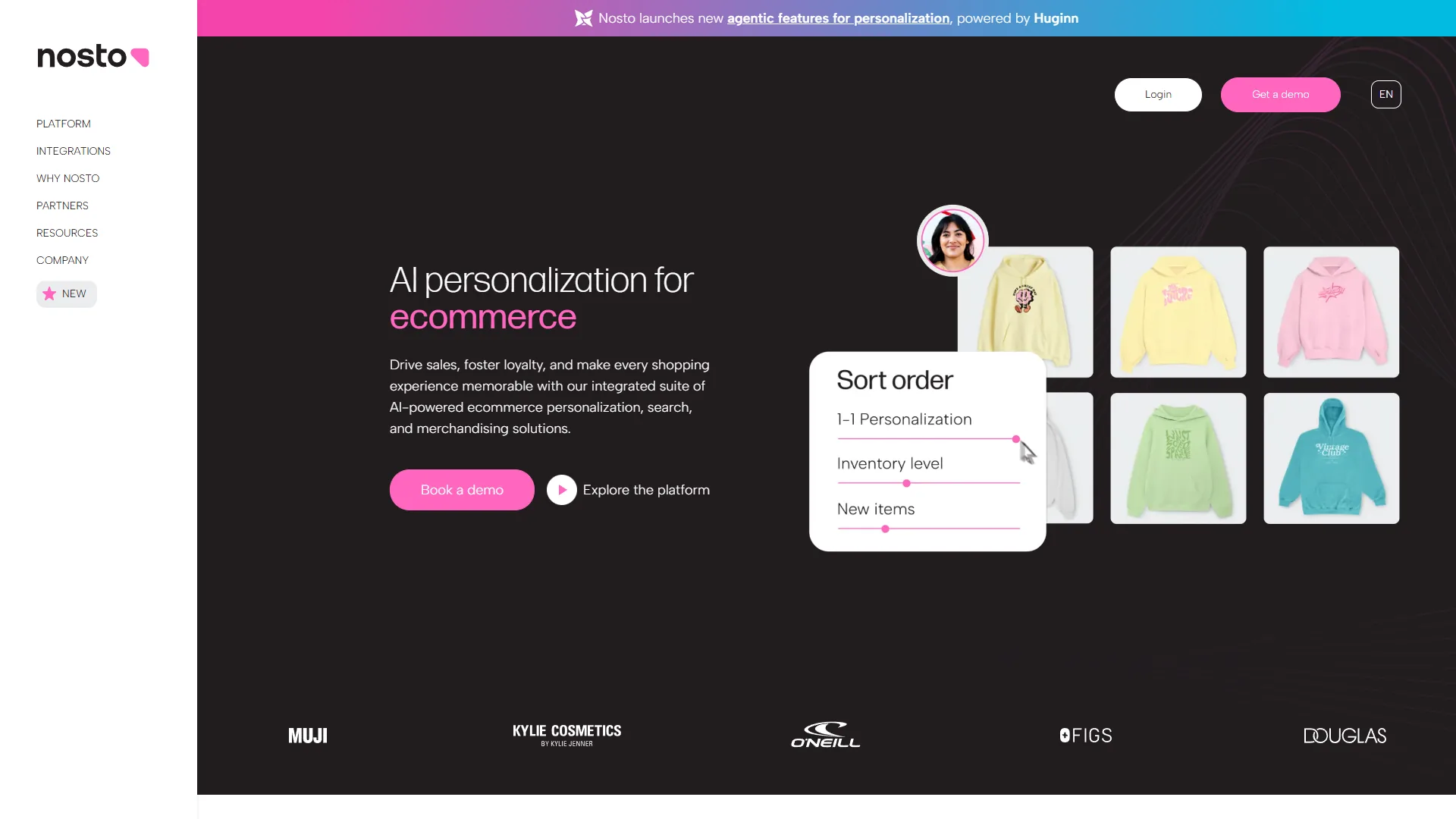
Nosto is a Commerce Experience Platform built specifically for ecommerce brands that want AI-powered personalization without building a data science team. The platform handles product recommendations, site search, merchandising, and UGC integration through a unified interface. With over 1,500 brands using the platform across 100+ countries, Nosto has proven itself in the mid-market segment.
What Makes It Stand Out
Product Recommendations are Nosto’s strongest feature. The AI learns from individual shopper behavior to surface products that drive purchases, with case studies reporting 15-30% conversion increases from recommendations alone.
UGC Integration through the Stackla acquisition gives Nosto native user-generated content capabilities that competitors typically charge extra for - customer photos appear alongside product recommendations.
Unified CXP Approach combines personalization, search (via the Findologic acquisition), and merchandising in one platform, meaning fewer integrations and a more cohesive customer experience.
Pricing
Custom pricing across all three tiers - Growth, Pro, and Enterprise. No public rates; contact sales for a quote based on traffic and catalog size. A 14-day free trial is available before committing to an annual contract.
Pros and Cons
Pros: Powerful AI recommendations driving measurable conversion increases; unified platform combining personalization, search, and UGC; exceptional customer support; built-in A/B testing.
Cons: Steep learning curve with weeks of onboarding; no transparent pricing; slow support response for complex issues; not practical for stores with fewer than 100 products.
2. Insider - Best for Enterprise Omnichannel Personalization
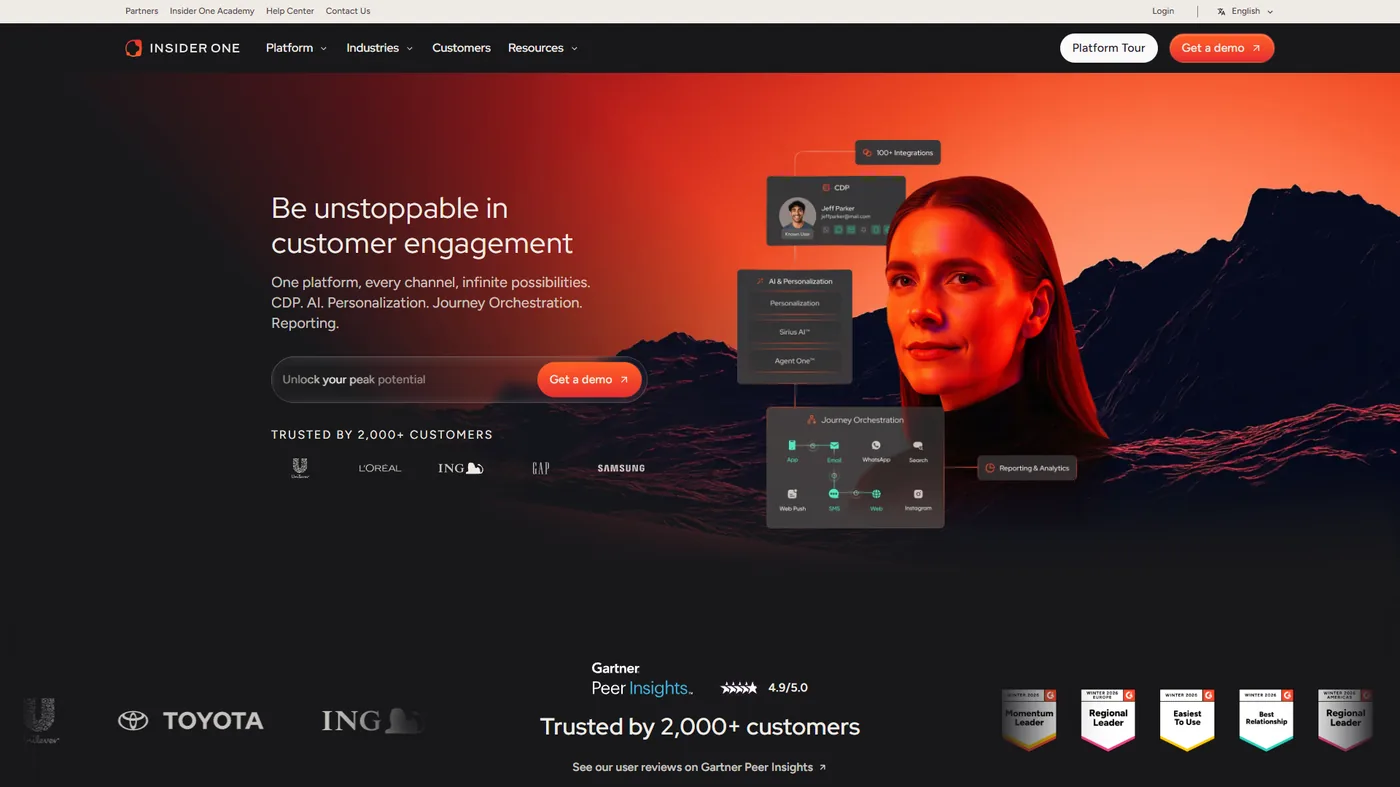
Insider is an enterprise omnichannel personalization platform that orchestrates customer journeys across 12+ native channels through a built-in Customer Data Platform. Where Nosto focuses on the website experience, Insider connects personalization across web, mobile, email, SMS, WhatsApp, and push notifications. Trusted by 1,200+ brands including Samsung and IKEA, this is enterprise-grade software for teams ready to go all-in on omnichannel.
What Makes It Stand Out
Omnichannel Journey Orchestration is where Insider differentiates. The platform connects 12+ channels natively, so a shopper abandoning a cart on mobile can receive a personalized WhatsApp message followed by an email with dynamic recommendations, all triggered automatically.
Predictive Segmentation uses AI to identify high-value customers, at-risk buyers, and look-alike audiences automatically, with enterprise customers reporting 25%+ conversion improvements from AI-driven targeting.
AI-Native Architecture runs recommendations, segmentation, journey optimization, and send-time prediction on the same engine, creating compounding improvements as the system learns.
Pricing
Custom enterprise pricing, annual contracts only, based on database size, channel volume, and features. No free tier or self-serve option - demo required. Expect enterprise-level investment similar to other CDP platforms.
Pros and Cons
Pros: True omnichannel engagement across 12+ native channels; built-in CDP eliminates the need for a separate data platform; AI-native architecture with predictive segmentation; proven at 1,200+ enterprise brands.
Cons: Steep learning curve with time-consuming implementation; enterprise-only pricing excludes mid-market stores; support response times can lag for non-critical issues; requires dedicated technical resources.
3. Bloomreach - Best for AI-Powered Commerce Search and Personalization
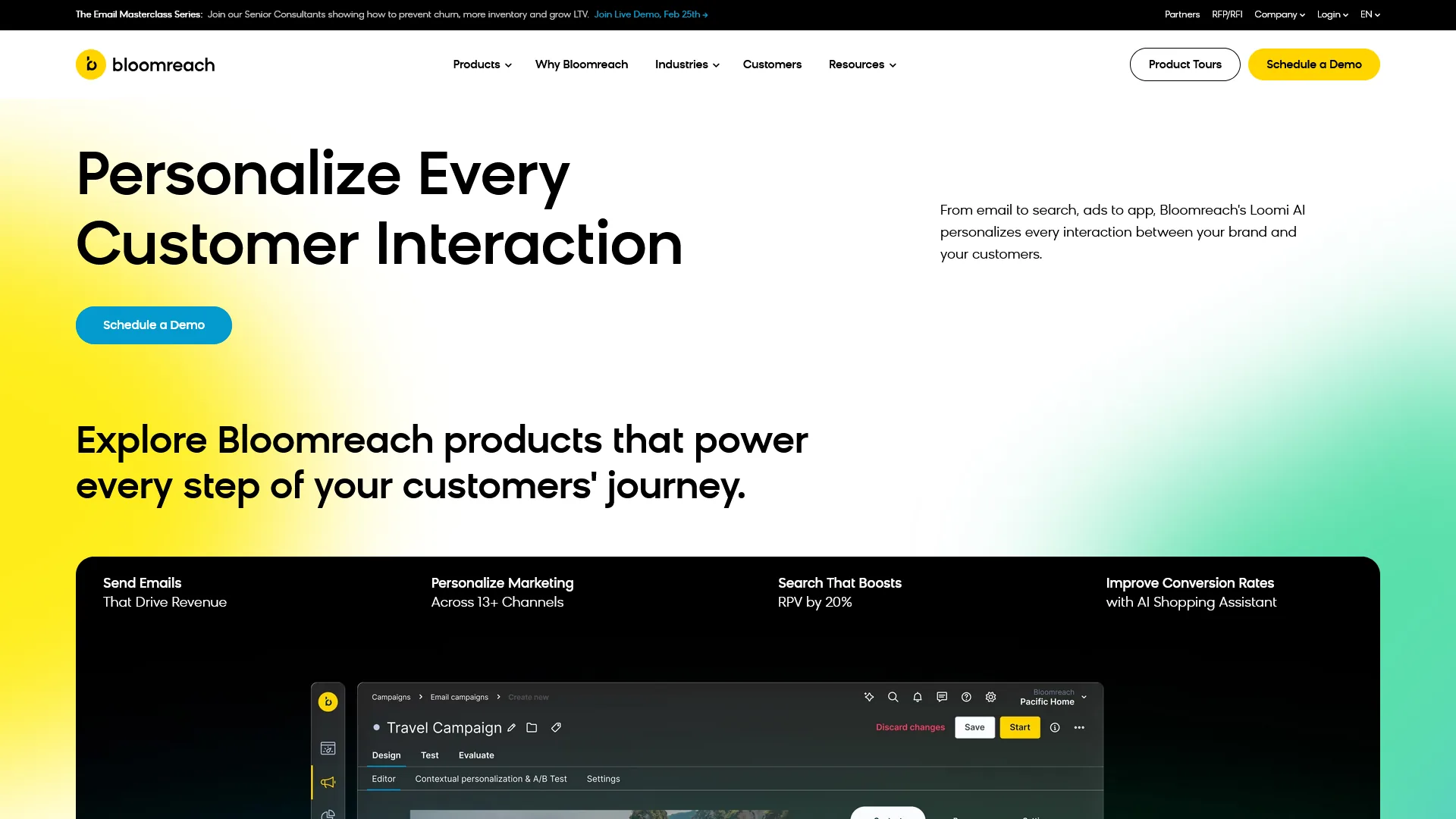
Bloomreach is an AI-powered commerce experience platform that combines product search, personalization, and marketing automation around its Loomi AI engine. According to Raj De Datta, CEO and co-founder of Bloomreach, the platform is “purpose-built to drive commerce-specific personalization at scale across every channel.” A Forrester TEI study found 251% ROI over three years, which is one of the few independently verified numbers in this category.
What Makes It Stand Out
Loomi AI is the differentiator - 30+ patents and training on 350M+ transactions power search, recommendations, autonomous marketing via Affinity AI agents, and a conversational shopping assistant called Clarity.
Real-Time Personalization operates at sub-millisecond response times with native Snowflake integration for 15-minute data refresh cycles. Customer results include a 27% increase in purchase likelihood and a 59.73% revenue lift per search user at N Brown.
Multi-Product Suite covers Discovery (search and merchandising), Engagement (marketing automation), Content (headless CMS), and Clarity (conversational shopping).
Pricing
Custom pricing; industry data suggests $4,000-$36,000/month ($50K-$430K annually). Typical mid-market implementation averages $15,000/month. Budget 3-6 months for full implementation.
Pros and Cons
Pros: Loomi AI with 30+ patents delivers commerce-specific personalization; independently verified 251% ROI over three years; customer support rated 9.2/10; sub-millisecond personalization at scale.
Cons: 3-6 month deployment; $50K+ annual pricing excludes small businesses; complex implementation requires dedicated technical resources; no native loyalty program functionality.
4. Constructor - Best for Revenue-Optimized Product Search
Constructor is a revenue-optimized product search platform that ranks results by purchase probability rather than text relevance. While most platforms optimize for relevance - returning results that match what shoppers type - Constructor optimizes for revenue. Its AI learns from actual purchase behavior, not just clicks, to surface products that drive conversions. This matters because the most relevant result is not always the most profitable one.
What Makes It Stand Out
Revenue-First AI is the core differentiator - Constructor consistently wins A/B tests by 3%+ against incumbents including Algolia and Elasticsearch, translating to $10M+ revenue lifts for enterprise retailers.
Comprehensive Discovery Suite goes beyond basic search: autosuggest, browse experiences, product recommendations, and interactive quizzes all run on the same behavioral AI.
Exceptional Satisfaction Scores - customer satisfaction (9.8/10), ease of use (9.7/10), and support quality (9.8/10) are among the highest in the ecommerce search category.
Pricing
Custom enterprise pricing on both Growth and Enterprise tiers, based on catalog size, traffic volume, and features. A 30-day free trial is available; annual contracts are standard.
Pros and Cons
Pros: Revenue-optimized AI consistently wins A/B tests by 3%+; proven $10M+ revenue impact for enterprise customers; exceptional user satisfaction and support quality; complete discovery suite beyond just search.
Cons: Enterprise-only custom pricing with no self-serve option; no free tier for smaller stores; smaller review base than established competitors; significant investment from day one.
5. Algolia - Best for Developer-First AI Search
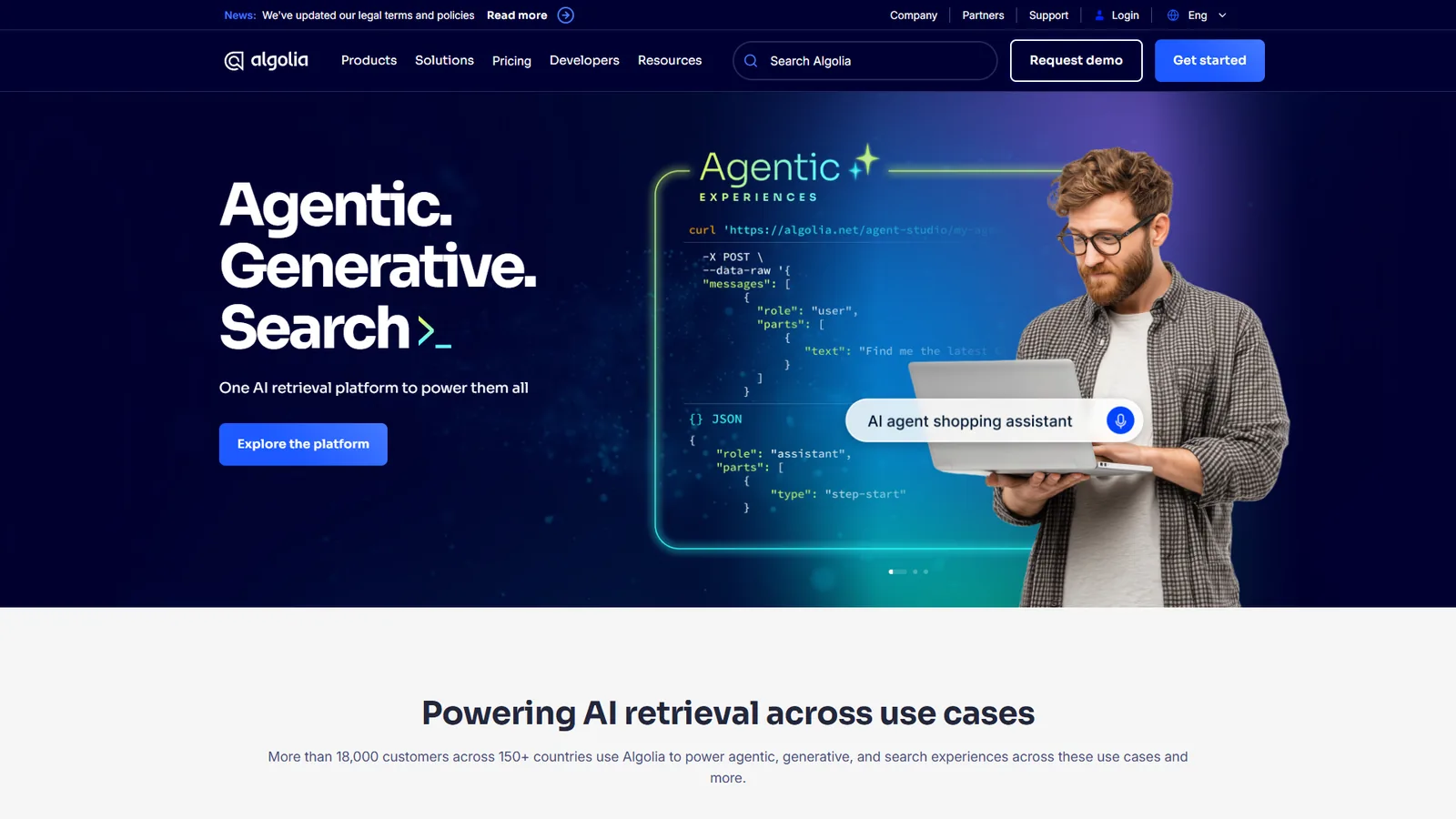
Algolia is a developer-first AI search API that ships sub-millisecond hosted search into any application via SDKs and 200+ pre-built integrations. Instead of building a full commerce platform, Algolia provides a search API that teams can integrate into any application in hours. With sub-millisecond response times, a generous free tier, and 200+ integrations, it is the most accessible entry point for ecommerce conversion optimization through better search. Over 17,000 companies including Stripe, Twitch, and Under Armour use the platform.
What Makes It Stand Out
Sub-Millisecond Search Speed sets Algolia apart - real-time indexing with typo tolerance means shoppers get accurate results as they type, reducing search abandonment.
Developer Experience is a genuine strength: InstantSearch UI libraries, comprehensive API documentation, and 200+ pre-built integrations let teams ship search in hours rather than weeks. Stripe uses Algolia to power their own developer documentation search.
Free Tier with 1 million records and 10,000 search requests per month makes Algolia the only tool in this guide that you can test in production without talking to sales.
NeuralSearch combines keyword matching with vector-based semantic search, understanding that “running shoes” and “jogging sneakers” are the same intent. This is available on the Grow Plus tier and above.
Pricing
Freemium with usage-based scaling. Free Build tier: 10,000 search requests/month. Grow: $0.50 per 1,000 extra requests. Grow Plus (AI features): $1.75 per 1,000. Premium: custom annual contracts. AI Recommendations add-on: $0.60/1,000.
Pros and Cons
Pros: Industry-leading sub-millisecond search speed; generous free tier for development and small production sites; 200+ integrations with fast implementation; NeuralSearch combines keyword and semantic understanding.
Cons: Usage-based pricing can scale unpredictably during traffic spikes; AI features locked behind the Grow Plus tier; no self-hosted option for data residency requirements; optimizes for relevance, not revenue (compared to Constructor).
Ecommerce Conversion Optimization: Which Tool Fits Your Store?
The right ecommerce conversion optimization tool depends on which part of the funnel is leaking revenue now and what budget tier you can sustain. Use the rules below to map your challenge to a best-fit platform.
Choose Based on Your Primary Challenge
“We need personalized shopping experiences across our store.” Start with Nosto. Its unified CXP platform handles recommendations, search, and merchandising without the complexity or cost of enterprise platforms. The 14-day trial lets you validate before committing.
“We need to connect personalization across every channel.” Insider is purpose-built for omnichannel orchestration. If abandoned cart emails, WhatsApp messages, and on-site personalization need to work as one system, Insider does this better than any tool in this guide.
“We need AI-powered search and full marketing automation.” Bloomreach covers the most ground with Loomi AI driving search, recommendations, and marketing automation. The 251% ROI is proven, but you need the budget and technical resources to extract that value.
“Our search results are leaving money on the table.” Constructor optimizes search for revenue rather than just relevance. If you have 100K+ SKUs and the A/B test data to prove your current search is underperforming, Constructor delivers measurable lift.
“We need fast, reliable search and our team is developer-led.” Algolia gets you to production fastest with the lowest initial investment. Start free, scale with usage, and add AI features when the budget allows.
Budget Reality Check
| Scenario | Tool | Annual Cost Range | What You Get |
|---|---|---|---|
| Starting out | Algolia | Free-$5K | Fast search with free tier |
| Mid-market personalization | Nosto | Custom ($20K-$80K est.) | Personalization + search + UGC |
| Enterprise search | Constructor | Custom ($50K+ est.) | Revenue-optimized product discovery |
| Enterprise omnichannel | Insider | Custom ($100K+ est.) | 12+ channel orchestration + CDP |
| Full commerce platform | Bloomreach | $50K-$430K | Search + personalization + marketing |
Frequently Asked Questions
What is ecommerce conversion optimization and why does AI matter?
Ecommerce conversion optimization is the process of improving the percentage of website visitors who complete a purchase, and AI matters because it enables real-time personalization at scale - showing each shopper different products, search results, and content based on their behavior. Manual personalization cannot keep pace with thousands of concurrent shoppers.
Which tool has the best free option for small stores?
Algolia is the only tool here with a permanent free tier (10,000 search requests and 1M records/month). Nosto offers a 14-day trial and Constructor a 30-day trial. Insider and Bloomreach are enterprise-only.
Can these tools work together, or do I need to pick one?
Several complement rather than compete. Algolia or Constructor handle search while Nosto or Insider handle personalization. Bloomreach is the exception - one platform for search, personalization, and marketing.
How long does implementation typically take?
Algolia integrates in hours to days. Nosto takes 2-4 weeks. Constructor requires 4-8 weeks. Insider and Bloomreach require months with dedicated technical resources.
What ROI should I expect from these tools?
Documented results include 15-30% conversion increases (Nosto), 25%+ improvements (Insider), 251% ROI over three years (Bloomreach, verified by Forrester), and 3%+ A/B test wins translating to $10M+ revenue lifts (Constructor). Actual results depend on traffic, catalog, and baseline conversion rate.
The Bottom Line
Effective ecommerce conversion optimization in 2026 requires AI that goes beyond basic personalization rules, and each of the five tools above excels at a specific part of the conversion challenge.
Algolia gets you fast, reliable search with the lowest barrier to entry. Nosto delivers mid-market personalization without enterprise complexity. Constructor maximizes revenue from every search query. Insider connects the omnichannel experience. Bloomreach is the most comprehensive platform if you have the budget.
Start with the tool that solves your most expensive problem, get adoption right, measure the revenue impact, then decide whether to expand.
Related Reading
These related guides cover adjacent topics on how to increase ecommerce conversion rate, broader personalization comparisons, and AI search platforms beyond the five tools above.
- Nosto - Our full review with pricing, features, and alternatives
- Insider - Our full review with pricing, features, and alternatives
- Bloomreach - Our full review with pricing, features, and alternatives
- Constructor - Our full review with pricing, features, and alternatives
- Algolia - Our full review with pricing, features, and alternatives
- Best Ecommerce Personalization Tools in 2026 - Broader comparison of personalization platforms for online retail
- Best AI Search Tools for Websites and Apps in 2026 - Search-focused comparison including Coveo and Klevu
- Best AI Chatbots for Ecommerce in 2026 - Conversational AI tools for online retail conversion
- AI Product Discovery: How It Boosts Ecommerce Revenue - Deep dive into AI-powered product discovery strategies
External Resources
These external resources are the primary research and vendor documentation sources cited throughout this guide on ecommerce conversion optimization strategies and benchmarks.
- Baymard Institute - Ecommerce UX Research - Independent research on checkout usability and conversion optimization
- Forrester Research - Independent analyst firm behind the Bloomreach TEI study cited in this guide
- IRP Commerce Market Data - Live benchmarks for average ecommerce conversion rate by industry
- Wikipedia - Conversion rate optimization - Background on CRO methodology and how it differs from SEO