


Zapier is the default choice for workflow automation - 7,000+ app integrations, a dead-simple interface, and a decade of proven reliability earned it that spot. But teams routinely hit a wall around the third billing cycle or fifteenth multi-step Zap and start asking whether the best Zapier alternatives deliver more for less. If you are hitting the 750-task ceiling, need branching logic Zapier’s linear interface does not visualize, or want to self-host your automation engine, the 2026 market offers genuine alternatives that outperform Zapier in specific, measurable ways.
This guide breaks down each Zapier alternative by the pain point it solves - a targeted look at why you should switch and which alternative addresses your exact frustration. Our best AI automation tools 2026 roundup covers the broader category for AI-native options.
Our analysis draws on vendor documentation and independent industry research, including the Gartner Magic Quadrant for Integration Platform as a Service and the Forrester Wave on iPaaS. Some links on this page are affiliate links; our analysis remains independent.
Comparison Table: Top Zapier Alternatives at a Glance
The top Zapier alternatives in 2026 are Make, n8n, Power Automate, and IFTTT, each comparable to Zapier on core automation features but with lower pricing, open-source flexibility, or specialized strengths. The table below ranks them on pricing, integration count, workflow style, self-hosting, and AI capabilities:
| Feature | Zapier | Make | n8n | Power Automate | IFTTT |
|---|---|---|---|---|---|
| Free Tier | 100 tasks/month | 1,000 ops/month | Unlimited (self-hosted) | 750 runs/month (with M365) | 2 applets |
| Starting Price | $29.99/month | $10.59/month | Free (self-hosted) or EUR 24/month (cloud) | $15/user/month | $3.49/month |
| Integrations | 7,000+ | 2,000+ | 400+ | 1,000+ (Microsoft-heavy) | 800+ |
| Workflow Style | Linear chain | Visual flowchart | Visual + code | Visual + templates | Simple triggers |
| Self-Hosting | No | No | Yes | No (cloud only) | No |
| AI Features | Zapier Agents, multi-model AI | Make AI Agents (beta), Maia AI | AI agent workflows, code nodes | Copilot integration | Limited |
| Best For | Simplicity, breadth | Complex logic, cost savings | Self-hosting, developers | Microsoft teams | Simple personal automations |
Why People Leave Zapier
Teams outgrow Zapier for three primary reasons - cost at scale, linear workflow limits, and a need for data sovereignty - and each alternative below maps to one of those pain points.
Cost at scale. Zapier Professional starts at $29.99/month for 750 tasks and escalates past 2,000 tasks. Make delivers 300,000 operations for $10.59/month - roughly 28,000 operations per dollar versus Zapier’s 25 tasks per dollar. This matters most for small businesses on fixed budgets.
Linear workflow limits. Zapier’s trigger-action chain works for simple automations, but conditional branching, parallel paths, and error handling become unwieldy in a linear interface. You cannot see your entire workflow as a connected diagram.
Data sovereignty and self-hosting. Healthcare, finance, and EU organizations need their automation engine on infrastructure they control. Zapier is cloud-only. The HHS HIPAA reference outlines the compliance constraints that drive self-hosting decisions.
1. Make - Best Zapier Alternative for Cost and Complexity
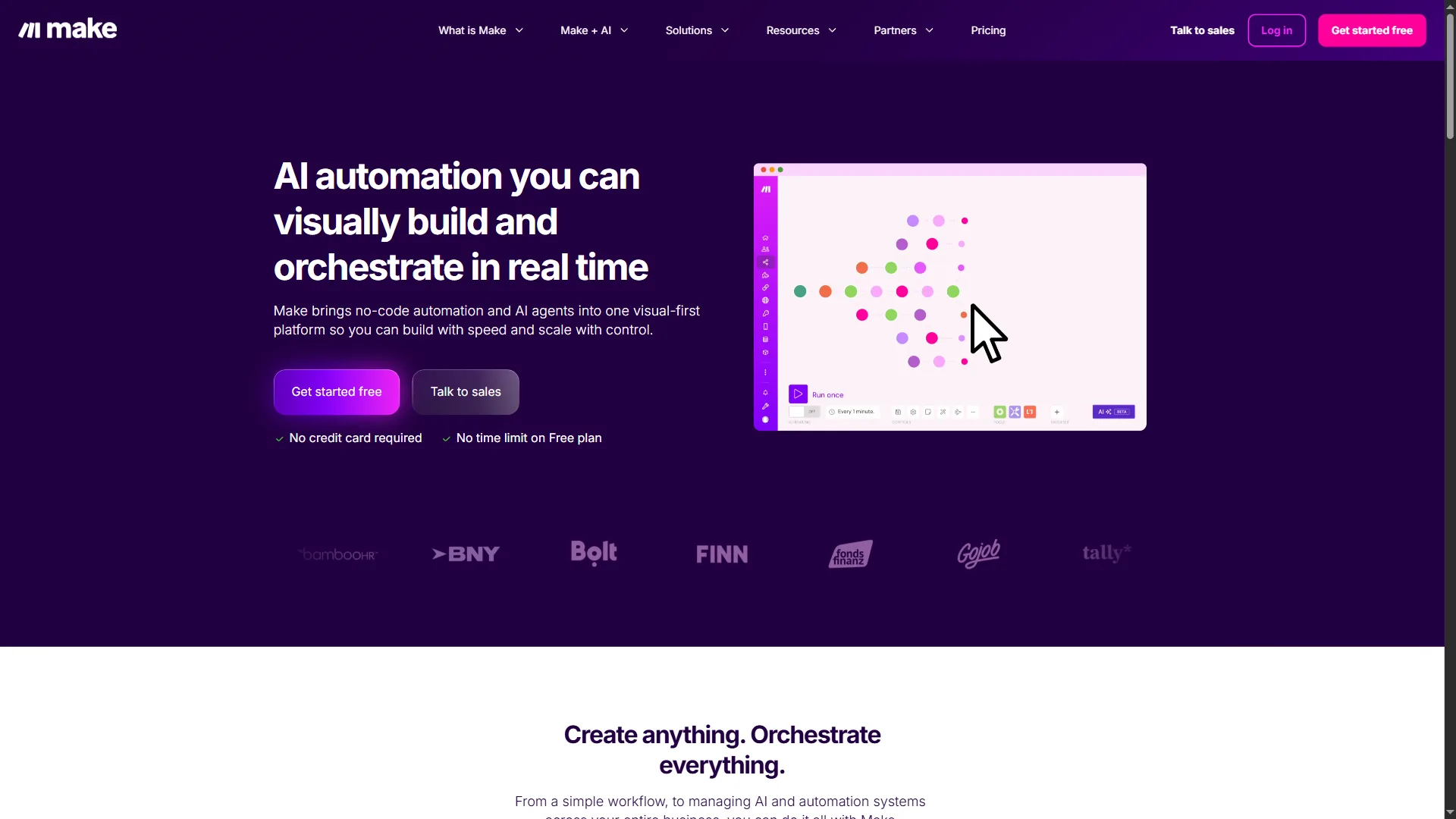
Make (formerly Integromat) is the best Zapier alternative for cost-conscious teams running complex branching workflows, delivering 60-70% cost savings at scale on a visual flowchart-style builder. You drag modules, connect routes, and see your entire automation as a flowchart instead of a linear chain.
Where Make Beats Zapier
Pricing that scales. Make’s Core plan at $10.59/month includes 300,000 operations versus Zapier Professional’s 750 tasks at $29.99. At Pro, Make delivers 8 million operations for $18.82/month - 60-70% less than Zapier. Our Zapier vs Make automation breakdown digs into the per-operation math.
Visual workflow design. The flowchart editor shows branching logic, parallel paths, and error handlers simultaneously. According to Make’s engineering blog, the visual builder handles 100+ module scenarios without performance degradation.
AI features catching up. Make AI Agents launched in beta in April 2026 for autonomous decision-making. The Maia AI assistant generates scenarios from plain English. The Make blog tracks AI capabilities as they ship.
Where Zapier Still Wins Over Make
Make’s integration library covers 2,000+ apps versus Zapier’s 7,000+, so niche CRMs and industry-specific SaaS connectors are more reliably native on Zapier. Make also has a steeper learning curve - plan on 4-8 hours to get comfortable with the module system, data structures, and routing logic.
Make Pricing Summary
| Plan | Monthly | Annual | Operations |
|---|---|---|---|
| Free | $0 | $0 | 1,000/month |
| Core | $10.59 | $9/month | Up to 300,000/month |
| Pro | $18.82 | $16/month | Up to 8,000,000/month |
| Teams | $34.12 | $29/month | Pooled across team |
| Enterprise | Custom | Custom | Custom |
Bottom line: Make is the best Zapier alternative for teams running high-volume automations with branching logic. If you spend $50+ per month on Zapier, test Make first. Skip Make if your team is non-technical, your stack relies on niche tools, or you need same-day onboarding. The Make AI agents guide walks through building adaptive automations from scratch.
2. n8n - Best Zapier Alternative for Self-Hosting and Developers
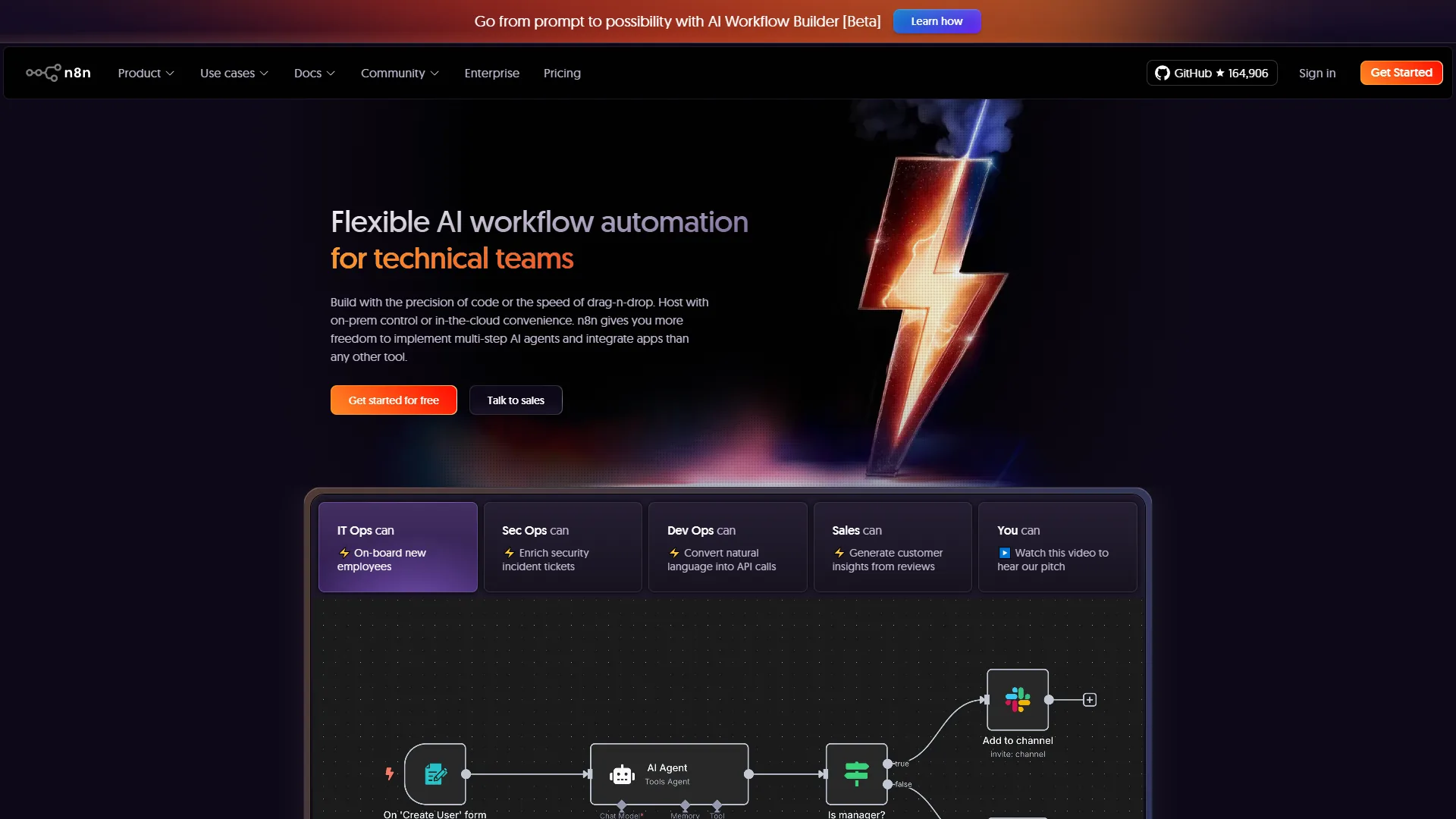
n8n is the best Zapier alternative for self-hosting and developers, offering a fair-code workflow automation platform you run on your own infrastructure for free, with unlimited executions, workflows, and users. According to Jan Oberhauser, founder and CEO at n8n, the platform now powers more than 200,000 active workflows across self-hosted and cloud deployments, with zero per-task billing on the Community edition.
Where n8n Beats Zapier
True self-hosting. Deploy n8n on your own servers, cloud infrastructure, or a Raspberry Pi - your data never leaves your network. For organizations bound by GDPR, HIPAA, or internal security policies, this is a hard requirement; Zapier and Make are cloud-only.
Zero per-task costs. The self-hosted Community edition is free. Infrastructure runs $5-20/month on a basic cloud instance. At 100,000+ automations/month, savings versus cloud alternatives are dramatic.
Code-first flexibility. n8n includes JavaScript and Python code nodes alongside its visual builder, so you mix no-code modules with custom scripts in the same workflow. The n8n code examples documentation covers common transformations.
Native AI workflows. n8n supports AI agent workflows with LangChain integration. With 150,000+ GitHub stars, the community actively ships AI automation templates.
Where Zapier Still Wins Over n8n
n8n’s integration library is smaller - around 400+ native nodes versus Zapier’s 7,000+ apps - so HTTP request nodes and custom integrations are common for less popular tools. Self-hosting also means you handle maintenance, updates, and uptime monitoring. n8n Cloud (from EUR 24/month for 2,500 executions) solves that at a higher per-execution cost than Make.
n8n Pricing Summary
| Plan | Price | Executions |
|---|---|---|
| Community (Self-Hosted) | Free | Unlimited |
| Starter (Cloud) | EUR 24/month | 2,500/month |
| Pro (Cloud) | EUR 60/month | 10,000/month |
| Enterprise | Custom | Custom |
Bottom line: n8n is the best Zapier alternative for developers and technical teams who want full control over their automation stack. If data sovereignty, self-hosting, or unlimited executions matter to your organization, n8n wins. Skip n8n if your team is non-technical or you want a polished SaaS experience without DevOps overhead. The best workflow automation tools 2026 roundup covers other technical-friendly options.
3. Zapier - The Benchmark
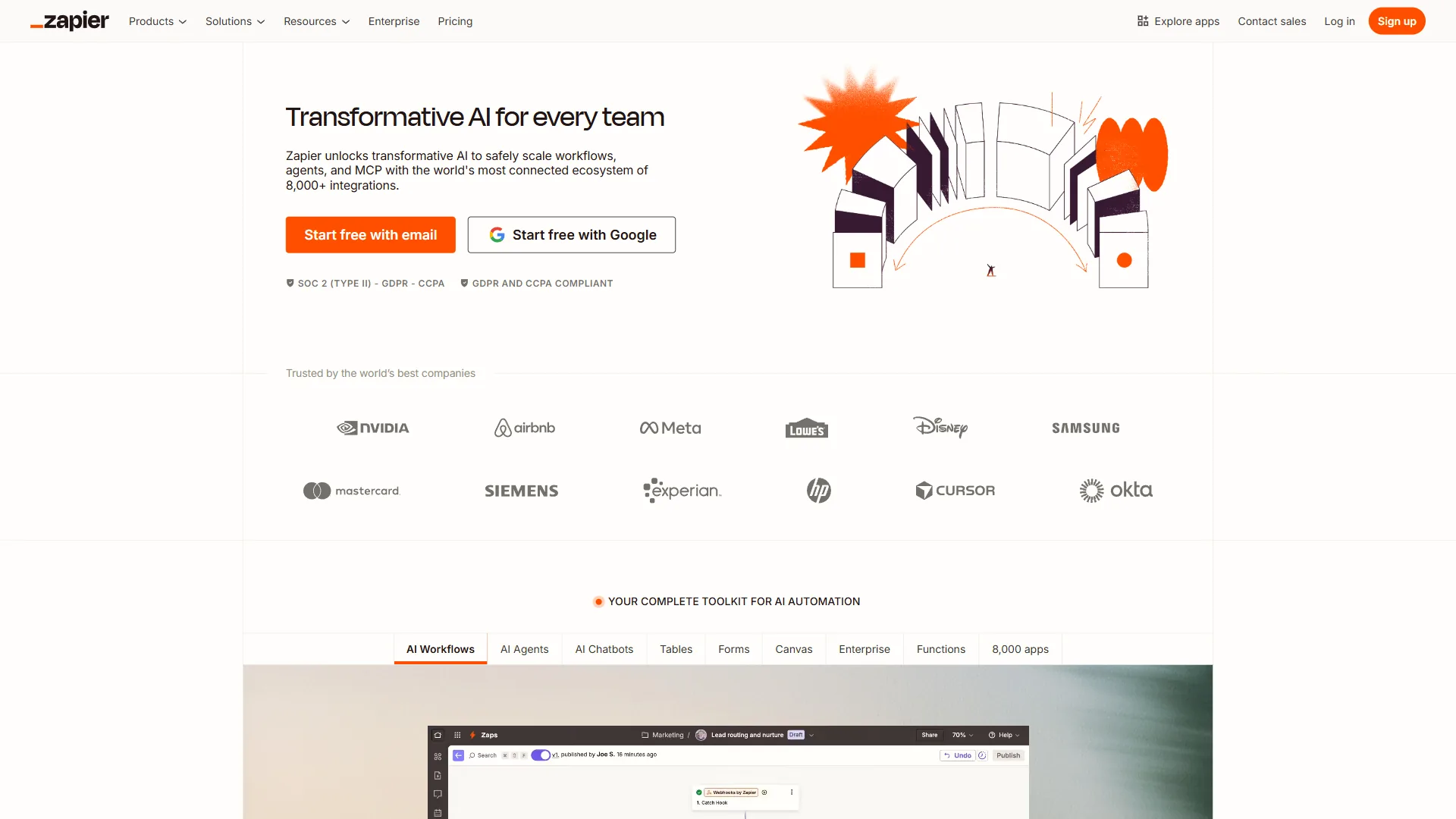
Zapier remains the benchmark workflow automation platform in 2026, with 7,000+ app integrations, 2.2 million active users, and the lowest learning curve in the category. Understanding Zapier’s genuine strengths helps you decide whether switching actually makes sense for your situation.
What Zapier Does Best
Unmatched integration breadth. 7,000+ app integrations with 450+ AI-specific connections. If an app exists, Zapier has a native connector.
Lowest learning curve. A non-technical user builds a working automation in under five minutes. Select trigger, select action, map fields, done.
AI features ahead of competitors. Zapier Agents (rebranded from Zapier Central in January 2026) offer autonomous AI teammates across your connected apps. Multi-model support covers GPT, Claude, and Gemini.
Reliability at scale. Founded in 2011, Zapier processes billions of tasks monthly with 99.9% documented uptime and 2.2 million+ active users - see the official Zapier status page for near-real-time metrics.
Zapier’s Limitations and Pain Points
The Professional plan at $29.99 per month for 750 tasks is roughly 3x more expensive per operation than Make. The free tier caps at 100 tasks/month and 2-step Zaps only - useful for testing, not production. Complex branching workflows are harder to build and debug in Zapier’s linear interface.
Skip Zapier if cost-at-scale, self-hosting, or workflow complexity is your real constraint.
Zapier Pricing Summary
| Plan | Monthly | Annual | Tasks |
|---|---|---|---|
| Free | $0 | $0 | 100/month |
| Professional | $29.99 | $19.99/month | 750+/month |
| Team | $103.50 | $69/month | 2,000+/month |
| Enterprise | Custom | Custom | Annual allocation |
Honorable Mentions
Two platforms cover edge cases the main three miss: Power Automate for Microsoft 365 shops and IFTTT for consumer automations.
Power Automate - Best for Microsoft Ecosystem Teams
Power Automate is the best Zapier alternative for Microsoft 365 organizations, with native integration into Outlook, Teams, SharePoint, Excel, and Dynamics 365. It starts at $15/user/month standalone but is included at no extra cost in many M365 Business and Enterprise plans. The desktop flow feature adds RPA for legacy Windows applications - Microsoft’s documentation covers licensing. Limitations: non-Microsoft integrations are weaker; M365 tiers are confusing.
IFTTT - Best for Simple Consumer Automations
IFTTT is the best Zapier alternative for personal automations and smart-home triggers (not business workflows), with the Pro+ plan at $3.49/month. It excels at single-trigger flows: log Fitbit data, turn on smart lights, cross-post to social. Limitations: no complex logic, minimal business features, variable connector quality.
Which Tool Fits Your Workflow
Choose Make for cost and branching, n8n for self-hosting, Power Automate for Microsoft 365 stacks, and IFTTT for personal automations. Map your top pain point to the right platform below.
Choose Make If…
- You need visual workflow design with branching logic
- Cost at scale is your primary concern (60-70% cheaper than Zapier)
- Your team has 4-8 hours for the learning curve
The Zapier vs Make head-to-head goes deeper on side-by-side analysis.
Choose n8n If…
- Data sovereignty or self-hosting is a requirement
- You want zero per-task costs with unlimited executions
- Your team includes developers comfortable with JavaScript or Python
Choose Power Automate If…
- Your organization runs on Microsoft 365 with E3/E5 licenses
- You need RPA for desktop applications
- Most integrations sit inside the Microsoft ecosystem
Choose IFTTT If…
- You need simple personal automations, not business workflows
- Smart home integration is a priority and budget is under $5/month
The official IFTTT applet directory shows what is feasible on the platform today.
Stay with Zapier If…
- You need the widest integration library (7,000+ apps)
- Your team is non-technical and values simplicity above all
- You want the most mature AI automation features (Zapier Agents)
The Zapier Agents announcement covers what those AI features do today.
How Do You Migrate from Zapier to an Alternative?
Migrate from Zapier to an alternative in four steps - audit, run parallel, tackle the expensive Zaps first, and skip low-value workflows - to keep risk low and ROI high.
Audit before you migrate. Export your active Zaps and categorize by complexity. Simple 2-3 step automations recreate easily; complex multi-branch Zaps need careful planning.
Run both platforms in parallel. Build your highest-volume workflows on the new platform first, let them run alongside Zapier for two weeks, then compare results.
Tackle the expensive Zaps first. Sort by task consumption. A single high-volume Zap consuming 5,000 tasks/month saves $30-50/month on Make. The best workflow automation tools for SMB breakdown shows which platforms are cheapest at small-business volumes.
Do not migrate everything. If a Zap runs 10 times per month and works reliably, migration effort exceeds savings. Focus on high-volume, high-complexity, or high-cost workflows.
The Bottom Line
No single platform wins everywhere in the 2026 automation market. Make delivers 60-70% cost savings with a visual builder for complex branching logic. n8n gives technical teams self-hosting, unlimited executions, and code nodes. Power Automate is the natural fit for Microsoft-first organizations. IFTTT handles personal automations where Zapier is overkill.
If Zapier is working for you, switching wastes time. If you have hit a ceiling on cost, complexity, or control, the alternatives above each close a real gap. Start with a free tier, build your most painful workflow on it, and compare.
FAQ
The most common questions buyers ask about Zapier alternatives center on cost, free tiers, open-source options, and Microsoft compatibility.
Q: Is there anything better than Zapier?
Yes, for specific pain points: Make is cheaper at volume, n8n is self-hostable and free at the Community tier, Power Automate is best inside Microsoft 365, and IFTTT handles personal automations. Zapier still wins on integration breadth and onboarding speed.
Q: What’s cheaper, Zapier or Make?
Make is significantly cheaper per operation. Make’s Core plan delivers 300,000 operations for $10.59 per month versus Zapier Professional’s 750 tasks for $29.99 - a 60-70% cost reduction at equivalent volumes.
Q: Is n8n cheaper than Zapier?
The self-hosted n8n Community edition is free with unlimited executions, so it is dramatically cheaper than Zapier at high volume. n8n Cloud starts at EUR 24/month for 2,500 executions - more expensive per execution than Make but cheaper than Zapier at most production volumes.
Q: What is the best free automation tool?
n8n is the best free automation tool overall because the self-hosted Community edition has unlimited workflows and executions. For cloud-only free tiers, Make offers 1,000 operations/month, Zapier offers 100 tasks/month with 2-step Zap limits, and IFTTT offers 2 free applets.
Q: Does Microsoft have anything similar to Zapier? Open-source options?
Power Automate is the Microsoft equivalent, included at no extra cost in many Microsoft 365 Business and Enterprise plans. For open-source Zapier alternatives, n8n (fair-code, self-hostable) and Apache Airflow are the most actively maintained options on GitHub.
Related Reading
These related reviews and comparisons go deeper on the platforms covered above:
- Zapier Review, Make Review, and n8n Review - Full tool reviews with pricing and ratings
- Zapier vs Make: Which Automation Tool Is Actually Better?
- Best AI Automation Tools 2026
- Best Workflow Automation Tools 2026
- Make AI Agents Guide: Build Adaptive Automations
External Resources
Primary vendor documentation and integration directories for each platform covered above:
- Zapier Integration Directory - Full list of 7,000+ app integrations
- Make Integration Library - Browse 2,000+ app connectors
- n8n Documentation - Self-hosting guides and workflow tutorials
- Power Automate Documentation - Microsoft’s official automation docs