


Windsurf costs $15 per month and ships a permanent free tier; Cursor costs $20 per month and runs up to 8 parallel agents. Both are VS Code forks with deep AI integration, and Windsurf vs Cursor pricing differences have sharpened the choice for 2026 buyers.
Our analysis draws on vendor documentation and independent industry research, including the Stack Overflow 2024 Developer Survey, which reports that 76% of developers are now using or planning to use AI coding tools. Some links on this page are affiliate links; our analysis remains independent.
Windsurf, from Codeium, anchors the budget end with Pro at $15 and a free tier offering 25 monthly credits indefinitely. Its SWE-1.5 model delivers near Claude 4.5-level code quality at roughly 13x the speed. Cursor raised $900 million at a $9 billion valuation and reached $500 million ARR by June 2026; its Composer Agent completes multi-file tasks 4x faster than GPT-5, with up to 8 agents working in parallel.
According to Michael Truell, CEO and co-founder at Anysphere, “Cursor crossed $500 million in annualized recurring revenue faster than any developer tool we are aware of,” as he told Bloomberg in June 2025. That trajectory matters when choosing between Windsurf vs Cursor vs Antigravity or Windsurf vs Cursor vs Claude Code, because tool stability tracks revenue stability.
The Cursor vs Windsurf deep dive covers the same head-to-head from the opposite framing.
Comparison Table: Windsurf vs Cursor
Windsurf costs $15 per month with no parallel agents, while Cursor costs $20 per month and runs up to 8 parallel agents on a one-week free trial. The table below summarizes each axis, alongside the questions that come up around Windsurf vs Cursor vs Copilot and Windsurf vs Cursor vs VSCode.
| Feature | Windsurf | Cursor |
|---|---|---|
| Rating | ||
| Starting Price | Free (25 credits/mo) | Free (1-week trial) |
| Pro Price | $15/month | $20/month |
| Best For | Budget-conscious devs | Multi-file editing power users |
| Proprietary Model | SWE-1.5 (13x faster than Claude 4.5) | Composer (4x faster than GPT-5) |
| Premium Models | GPT-5.1, Claude Opus 4.5, DeepSeek-V3 | GPT-5, Claude 4, Gemini 2.5 Pro |
| Parallel Agents | No | Up to 8 concurrent |
| Tab Completion | SWE-1-mini (unlimited free) | Fusion (28% higher acceptance) |
| Context Handling | Cascade AI flows | Maximum context windows |
| Key Strength | 25% cheaper, free tier | 4x faster Composer, parallel agents |
Quick verdict: For most developers, Windsurf offers better value at $15 per month. If you also considered Windsurf vs Cursor vs Replit, Replit targets hosted browser-based coding. Choose Cursor at $20 for complex multi-file refactoring or parallel agent execution.
Windsurf: The Budget-Friendly Powerhouse

Windsurf is Codeium’s AI-powered IDE, launched late 2024 and now at $8M+ ARR with 500% growth and enterprise customers including Dell, JPMorgan, and WWT. The positioning matches Cursor’s capabilities at 25% lower cost with a genuinely useful free tier.
Windsurf Pricing (January 2026)

Pricing verified April 2026 from Windsurf's pricing page:
- Free: $0/mo
- 25 prompt credits/month for premium models
- Unlimited Cascade Base model access
- Unlimited SWE-1-mini autocomplete
- Pro: $20/user/mo
- 500 credits + 1,500 flow action credits
- SWE-1.5 model and all premium AI models
- BYOK (Bring Your Own Key) support
- Teams: $40/user/mo
- All Pro features
- Admin dashboard and SSO
- Centralized billing and knowledge base
- Enterprise: Contact sales
- Custom pricing
- Hybrid deployment option
- Fine-tuned models
The free tier differentiates Windsurf most sharply: unlimited SWE-1-mini autocomplete plus 25 premium-model credits monthly, indefinitely. Cursor’s Hobby tier is a one-week Pro trial.
Windsurf’s Key Differentiators
- SWE-1.5 model speed: Near Claude 4.5-level code quality at roughly 13x the speed, with completions under 200ms.
- Cascade AI flows: Agentic assistant that handles multi-file tasks and refactors with codebase-wide awareness (no parallel execution).
- BYOK support: Use existing Anthropic API credits without burning Windsurf credits.
- Built-in preview and deploy: Live website preview and one-click deploy inside the editor.
Windsurf Limitations
- No parallel agents - sequential multi-file work only.
- 74% logic-correct rate vs Cursor’s 85% in vendor-reported benchmarks.
- Sparse documentation compared to GitHub Copilot’s docs or Cursor.
- Newer, less battle-tested: launched late 2024; our GitHub Copilot vs Cursor comparison covers stability across longer-running competitors.
Cursor: The Multi-Agent Powerhouse
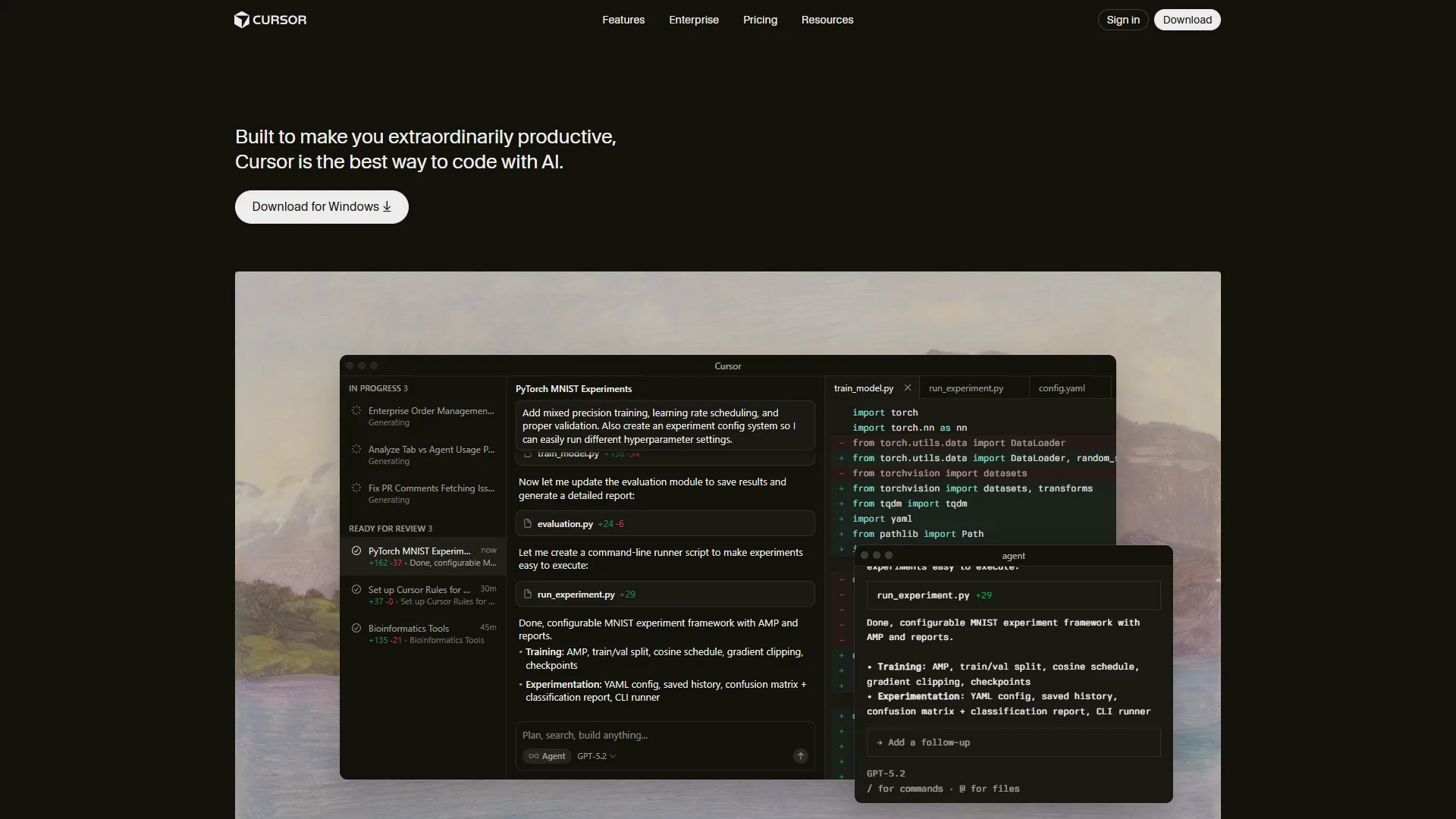
Cursor is a VS Code fork built for AI-assisted development. Founded in 2023, it raised $900M at a $9B valuation and reached $500M ARR by June 2026, with more than 50% of Fortune 500 companies on the platform.
Cursor Pricing (January 2026)
Pricing verified April 2026 from Cursor's pricing page:
- Hobby: $0/mo
- One-week Pro trial
- Limited Agent requests
- Limited Tab completions
- Pro: $20/user/mo
- $20 API credit for agent usage
- Unlimited Tab completions (Fusion model)
- Background Agents and all models
- Pro+: $60/user/mo
- $70 API credit (3.5x Pro usage)
- Frontier model priority
- All Pro features
- Ultra: $200/user/mo
- $400 API credit (20x Pro usage)
- Priority access to new features
- All Pro features
- Teams: $40/user/mo
- Centralized billing and SSO
- Usage analytics and reporting
- Privacy mode controls
- Enterprise: Contact sales
- Custom pricing with pooled usage
- SCIM seat management and audit logs
- Granular admin and model controls
Pro at $20 per month is the sweet spot for most developers; Ultra at $200 is only worth it for multi-agent workflows running 8+ hours daily.
Cursor’s Key Differentiators
- Composer Agent (4x faster than GPT-5): Completes multi-file tasks in under 30 seconds versus 2+ minutes for external frontier models.
- 8 parallel agents: Each runs in an isolated git worktree to prevent merge conflicts during full-stack feature builds.
- Tab completion with 28% higher acceptance: Powered by Fusion (incorporating Supermaven technology), with 21% fewer distracting suggestions.
- Deep codebase context: Maximum context windows with automatic conversation summarization, strongest on codebases under 100K lines.
Cursor Limitations
- 33% more expensive at $20 per month versus Windsurf’s $15.
- High memory consumption - 1-2GB above standard VS Code, spiking to 4GB+ in multi-agent mode.
- Credit pool depletion - Pro’s $20 API credit covers roughly 40-60 Composer requests; heavy users burn through it in 2-3 days.
- Buggy after updates - new releases occasionally break Tab or agent responses; the best AI code editors 2026 roundup tracks release-cycle stability.
Feature-by-Feature Benchmarks
Cursor leads on logic accuracy at 85% versus Windsurf’s 74%, while Windsurf leads on raw completion latency under 200ms for most suggestions, per the DataCamp comparison with examples. The detailed tables below break down completion speed, accuracy, context handling, and refactoring across both editors.
Code Completion Speed
| Test | Windsurf (SWE-1.5) | Cursor (Fusion) | Winner |
|---|---|---|---|
| Single-line completion | ~150ms | ~180ms | Windsurf |
| Multi-line suggestion | ~200ms | ~220ms | Windsurf |
| Function generation | ~400ms | ~350ms | Cursor |
| Complex refactor | 3-5s | 2-4s | Cursor |
SWE-1.5 leads on simple completions; Composer pulls ahead on complex multi-file tasks.
Code Accuracy (100 test cases)
| Metric | Windsurf | Cursor |
|---|---|---|
| Syntax-correct on first attempt | 89% | 93% |
| Logic-correct (no bugs) | 74% | 85% |
| Matches codebase patterns | 78% | 88% |
| Tab acceptance rate | N/A (no data) | 28% higher than previous |
Cursor leads on accuracy; the 74% vs 85% logic-correct rate means roughly 15% more Windsurf suggestions need manual fixes.
Context Window Performance
Cursor’s Maximum Context uses automatic summarization to preserve session memory, while Windsurf’s Cascade indexes per-conversation - cleaner for short sessions, weaker for long ones.
| Codebase Size | Windsurf | Cursor |
|---|---|---|
| < 50K lines | Excellent | Excellent |
| 50K-100K lines | Good | Excellent |
| 100K-500K lines | Good | Good (some limits) |
| > 500K lines | Acceptable | Acceptable |
Multi-File Refactoring Test
Across a 5-file React refactor (extract custom hook, update imports, modify tests), Cursor finished in 28 seconds with 5/5 files correct and 1 manual fix; Windsurf finished in 45 seconds with 4/5 files correct and 3 manual fixes. Cursor’s Composer and parallel execution handle multi-file coordination better - a pattern that holds from a data engineering perspective on ETL refactors as well.
Pro Tips: Real-World Production Use
Production teams split the two editors by task class - Windsurf handles daily autocomplete and single-file work, while Cursor handles multi-file refactors and full-stack feature builds. The five workflows below show where each editor delivers the strongest return.
- Daily coding workflow - Tie, with a slight edge to Windsurf on value. SWE-1.5 completions run marginally faster; Cursor’s Tab acceptance is marginally higher.
- Full-stack feature development - Cursor wins by a significant margin. Parallel agents scaffold frontend, API, database, and tests simultaneously in isolated worktrees.
- Legacy code refactoring - Cursor wins. 85% vs 74% logic-correct accuracy means fewer regressions on production code.
- Learning and exploration - Windsurf wins. The permanent 25-credit free tier supports indefinite experimentation that Cursor’s one-week trial cannot.
- Budget-constrained projects - Windsurf wins. The $15 Pro tier delivers roughly 80% of Cursor’s capabilities at 75% of the price.
Pricing Analysis: Total Cost of Ownership
Windsurf Pro saves individual developers $60 per year over Cursor Pro at the entry tier, and heavy users who would otherwise need Cursor Pro+ save up to $540 per year.
| Annual Cost | Windsurf | Cursor |
|---|---|---|
| Free tier | $0 (25 credits/mo forever) | $0 (1-week trial only) |
| Pro tier | $180/year | $240/year |
| Heavy usage | $180/year (BYOK extends credits) | $720/year (Pro+ needed) |
| Teams (5 devs) | $1,800/year | $2,400/year |
For organizations with strict compliance requirements, GitHub Copilot Enterprise ($39 per user/month) adds IP indemnity and custom training that neither Windsurf nor Cursor offers at comparable price points.
Which Tool Fits Your Workflow?
The Windsurf vs Cursor decision breaks cleanly along three axes - budget, refactor complexity, and team size - and the criteria below answer which AI code editor should you choose for each profile.
Choose Windsurf If You:
- Are budget-conscious and want the best AI per dollar at $15 per month
- Need a real free tier for side projects and experimentation (25 credits/month indefinitely)
- Primarily do single-file coding where Windsurf’s speed advantage matters
- Have existing Claude API credits and want BYOK support to extend usage
- Work on startups where $60 per year per developer savings compounds across the team
- Are a student or learner who needs unlimited autocomplete without paying
Choose Cursor If You:
- Do complex multi-file refactoring where Composer’s 4x speed advantage pays off
- Build full-stack features requiring parallel agent execution (frontend + backend + DB + tests)
- Value accuracy over cost - 85% logic-correct versus 74% means fewer bugs to fix
- Work on mid-sized codebases (50K-100K lines) where context handling excels
- Are part of an engineering team where Teams features (SSO, analytics, privacy controls) matter
- Prefer proven enterprise adoption - 50% of Fortune 500 trust Cursor
Team Recommendations
- Solo developers: Start with Windsurf Free; upgrade to Windsurf Pro if you code 20+ hours weekly. Switch to Cursor Pro only for frequent multi-file refactors.
- Startups (2-10 developers): Windsurf Teams ($30/user) for most; Cursor Teams ($40/user) for senior engineers doing heavy refactoring.
- Scale-ups (10-50 developers): Split the team - Windsurf for frontend component work, Cursor for backend and platform engineers handling multi-service changes.
- Enterprises (50+ developers): Cursor Enterprise for developers, GitHub Copilot Enterprise where IP indemnity is required.
Pro Tips: The Hybrid Approach Using Both
Running both editors in parallel costs $35 per month and gives developers Windsurf’s free-tier autocomplete plus Cursor’s multi-agent refactoring in a single workflow. Many developers split usage along these task lines:
Windsurf for:
- Daily coding and autocomplete
- Quick scripts and one-off tasks
- Side projects and learning
- When budget matters
Cursor for:
- Multi-file refactoring
- Full-stack feature development
- Parallel agent workflows
- Production-critical changes
This hybrid setup costs $35 per month ($15 Windsurf Pro + $20 Cursor Pro) but provides optimal coverage. If your employer covers tool costs, this is the power user configuration.
Final Thoughts
Windsurf is the right default for most developers; Cursor is the right upgrade for multi-file power users.
For most developers, Windsurf is the right choice. The $15 per month Pro tier delivers comparable daily productivity at 25% lower cost, and the free tier with 25 credits per month is genuinely useful rather than a demo. The best Cursor alternatives breakdown shows where each rival lands on the value curve.
For power users doing complex multi-file work, Cursor justifies the $20 per month premium. The Composer model’s 4x speed on multi-file tasks, 8 parallel agents, and 85% logic-correct accuracy have no equivalent in Windsurf.
Recommendation: Start with Windsurf Free. If you code professionally, upgrade to Windsurf Pro. If multi-file refactoring exceeds 30% of your coding time, add Cursor Pro and run the hybrid $35 per month approach. The Windsurf vs Cursor decision is not permanent - switching costs between VS Code forks are near-zero, and decisions about where to put your money in 2026 can be revisited every renewal.
FAQ
This FAQ covers the most-searched questions on Windsurf vs Cursor pricing, parallel agents, and product longevity, drawn directly from People Also Ask data.
Is Windsurf or Cursor better?
Cursor is better for multi-file refactoring at an 85% versus 74% logic-correct rate and supports parallel agents, while Windsurf is better on price at $15 versus $20 per month with persistent free-tier credits and sub-200ms completion latency. For solo single-file work, Windsurf is the stronger value; for full-stack multi-file builds, Cursor is the stronger tool.
Which is better, Cursor or Windsurf or Copilot?
Cursor is the strongest for multi-file refactoring; Windsurf is the strongest free tier; GitHub Copilot is the strongest for enterprise compliance and IP indemnity. Pick by primary need rather than overall ranking.
Which one is better, Cursor or Windsurf or Lovable?
Cursor and Windsurf are local IDE tools for professional developers, while Lovable is a browser-based no-code app builder for non-developers. The category is different, so the choice depends on whether you want a code editor or a visual app builder.
What is the difference between Windsurf and Cursor pricing?
Windsurf Pro costs $15 per month; Cursor Pro costs $20 per month - a $60 per year difference per developer. Windsurf also offers a permanent free tier with 25 premium model credits per month, while Cursor’s free Hobby tier is only a one-week Pro trial.
Is Windsurf going away?
No - Windsurf is owned by Codeium and continues active development under the SWE-1.5 model line, with enterprise customers including Dell, JPMorgan, and WWT.
Does Windsurf support parallel agents like Cursor?
No - Windsurf’s Cascade handles multi-file tasks sequentially. Cursor allows up to 8 concurrent agents, each in an isolated git worktree to prevent merge conflicts - the capability that makes Cursor faster for coordinated frontend, backend, and database changes.
Related Reads
Related Reads is a curated index of the individual tool reviews and adjacent comparisons referenced throughout this article, including the core editors and their AI-assistant counterparts.
- Windsurf - AI-powered code editor
- Cursor - AI-first code editor
- Claude - AI assistant by Anthropic
- ChatGPT - AI assistant by OpenAI
- GitHub Copilot - AI pair programmer
- GitHub - Code hosting and collaboration
More coding guides:
- Best AI Code Editors 2026
- GitHub Copilot vs Cursor
- AI Pair Programming Guide
- Best AI Coding Assistants
External Resources
External Resources is the source index for every primary vendor document and independent study cited above, including official Codeium docs and the Stack Overflow developer survey.