



Fathom vs Fireflies is a comparison of two AI meeting assistants designed to record calls, transcribe conversations, and sync key details directly to CRM platforms like HubSpot and Salesforce. Fathom targets Zoom-heavy sales teams with AI Scorecards at $28 per month, while Fireflies supports 10 or more platforms with sentiment analysis at $29 per month. With 91% of companies with 10+ employees now using CRM software (Nucleus Research, 2023), automated call-to-CRM sync is no longer a nice-to-have.
Sales reps routinely lose 6+ hours per week on post-call CRM updates - hopping off a discovery call, taking frantic notes, then spending 20 minutes logging everything into Salesforce or HubSpot. AI meeting assistants like Fathom and Fireflies automate that admin layer by recording calls, transcribing them, and syncing key details directly to the CRM.
Methodology: This comparison is research-based, drawing on each vendor’s official documentation, public pricing pages, and verified third-party research from firms such as Fortune Business Insights and Nucleus Research; we do not claim hands-on testing in a controlled lab environment.
Editorial disclosure: AI Productivity may earn affiliate commissions from links to Fireflies and certain CRM partners in this article. Affiliate relationships do not influence verdicts; product picks are made independently and updated when vendor facts change.
Quick Verdict: Fathom vs Fireflies for Sales Teams
For sales teams asking which AI note taker is best, Fathom wins for Zoom-heavy HubSpot or Salesforce workflows at $28 per month thanks to AI Scorecards, while Fireflies wins for multi-platform teams needing Webex, Skype, or 100+ language support at $19 per month annual billing.
TL;DR recommendations:
-
Choose Fathom if: You’re a Zoom-heavy sales team using HubSpot or Salesforce, want AI Scorecards for coaching, and need a generous free tier to start. At $28 per month for Business tier with CRM sync, it’s the best value for focused sales use cases.
-
Choose Fireflies if: Your team uses multiple meeting platforms (Webex, Skype, etc.), needs deep conversation analytics, or operates in 100+ languages. At $29 per month for Business tier, you get more platform flexibility and advanced sentiment analysis.
For most B2B sales teams? Fathom edges out Fireflies with simpler setup, better CRM-focused features like AI Scorecards, and 20 minutes saved per meeting on data entry.
Fathom vs Fireflies: Key Differences at a Glance
The headline difference between Fathom and Fireflies is focus versus breadth - Fathom is purpose-built for B2B sales coaching on Zoom, Google Meet, and Teams, while Fireflies supports 10+ meeting platforms and 100+ languages with deeper conversation analytics.
| Feature | Fathom | Fireflies |
|---|---|---|
| Rating | ||
| CRM Sync Tier | Business - $28/mo | Business - $29/mo |
| Free Tier | Unlimited recordings, 5 AI calls/month | 800 mins storage, 30 AI credits/month |
| Platforms | Zoom, Google Meet, Teams | 10+ platforms (Zoom, Meet, Teams, Webex, Skype, etc.) |
| Languages | 38 languages | 100+ languages |
| AI Coaching | AI Scorecards (Business tier) | Sentiment analysis, talk-time ratio |
| Real-time AI | Ask Fathom | Talk to Fireflies (Perplexity web search) |
| CRM Integrations | HubSpot, Salesforce, Asana | Salesforce, HubSpot, Pipedrive, Close, + more |
| Founded | 2020 | 2016 |
| User Base | 1M+ | 300K+ |
The bottom line: Fathom is newer but has exploded in popularity (1M+ users vs 300K+ for Fireflies), largely thanks to its aggressive free tier and CRM-first design. Fireflies has been around longer and offers more platform flexibility, but lacks the sales-specific coaching tools that make Fathom stand out.
Limitations and who it’s not for: Skip Fathom if your team meets on Webex, Skype, or RingCentral - those platforms are not supported. Skip Fireflies if you need AI sales scorecards or coaching templates, since those features are absent. Drawbacks shared by both: enterprise security reviews can stall deployment in regulated industries, and neither tool handles in-person meetings without an external recording workflow.
CRM Integration Deep Dive: The Make-or-Break Feature
CRM automation is the headline reason most sales teams compare these tools, so the specifics matter.
Fathom’s CRM Sync: Built for Sales Teams
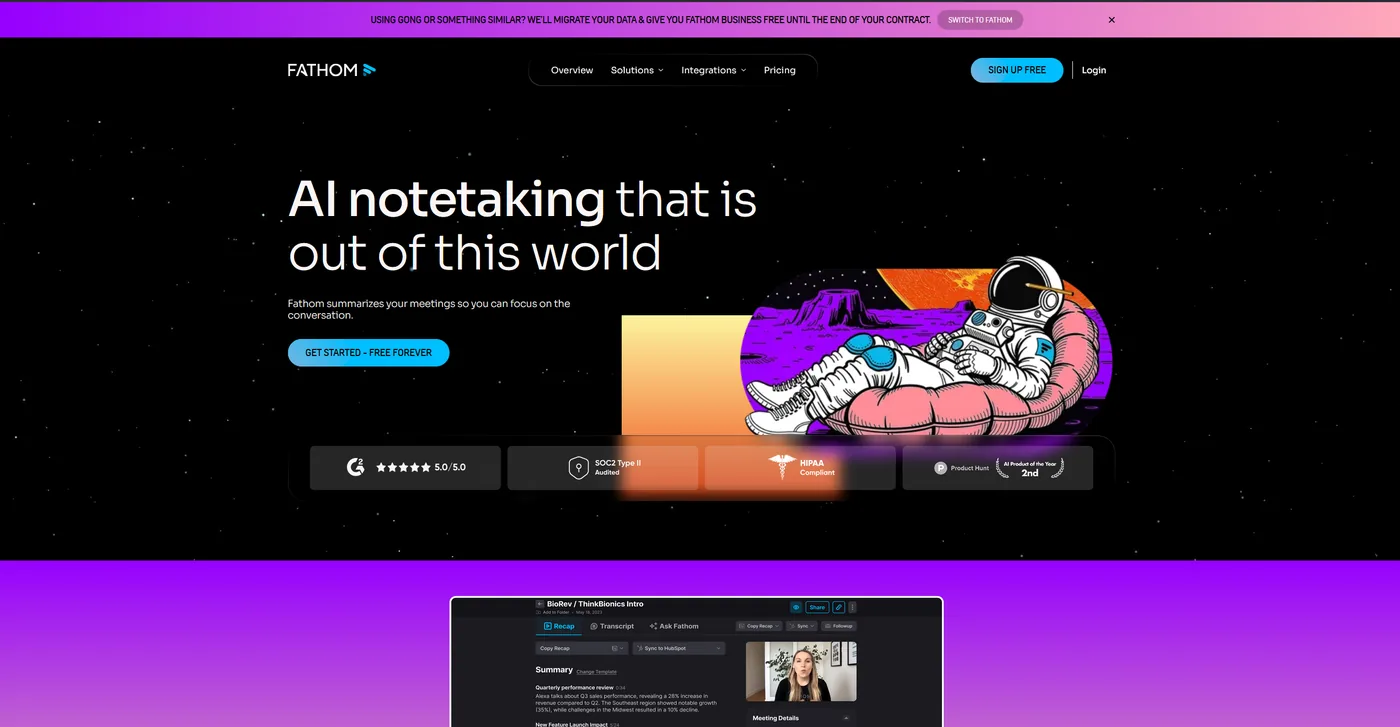
Fathom’s Business tier ($28 per month per user, minimum 2 users) includes CRM field sync with HubSpot and Salesforce. Here’s what that actually means in practice:

After every call, Fathom automatically:
- Creates or updates contact records
- Logs the call as an activity
- Syncs AI-generated notes to custom fields
- Populates deal stages based on conversation context
- Adds action items to task lists
The killer feature? AI Scorecards. These are configurable grading systems that analyze your sales calls against your team’s methodology. Did the rep ask discovery questions? Did they handle objections effectively? Fathom grades each call and surfaces coaching opportunities.
Real-world impact: Fathom claims users save 20 minutes per meeting on CRM data entry - roughly 6.6 hours per week for a rep taking 20 calls. One limitation: Fathom is optimized for Zoom, Google Meet, and Microsoft Teams only.
Fireflies’ CRM Sync: More Platforms, Less Sales Focus
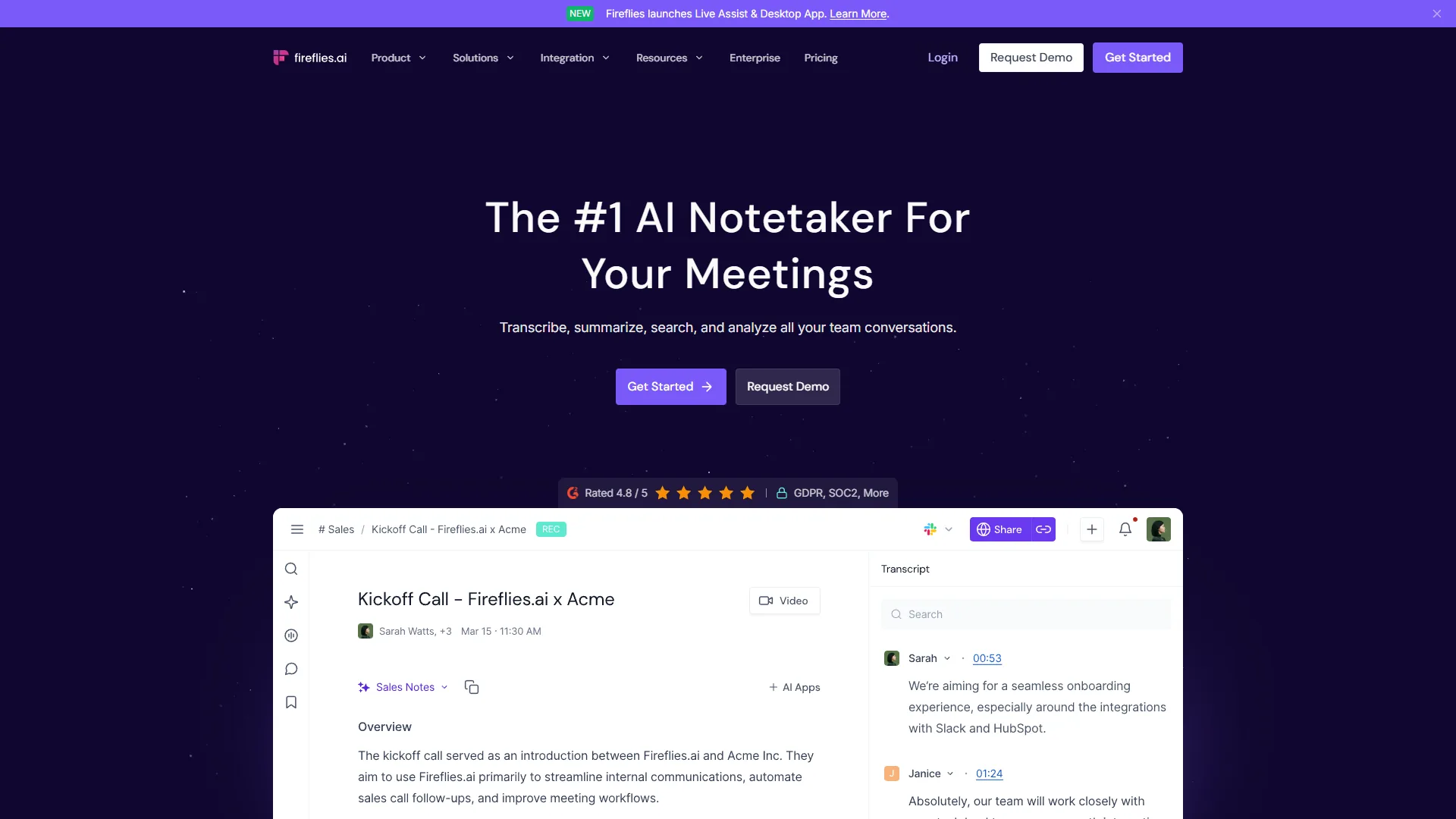
Fireflies’ Business tier ($29 per month per user, or $19 per month billed annually) syncs to HubSpot, Salesforce, Pipedrive, Close, and Zoho with auto-logged calls, summaries pushed to notes fields, tasks created from action items, and contact records kept current.
Where Fireflies pulls ahead is platform flexibility - 10+ meeting platforms (including Webex, Skype, RingCentral, and in-person meetings via mobile app) plus conversation intelligence features like sentiment analysis, talk-time ratio, question detection, and keyword tracking for competitors and pain points.
Real-world impact: Fireflies reports users save 10+ hours per week on meeting notes and admin work, citing a WealthUp case study, with 95%+ transcription accuracy even on multi-speaker calls. The downside is no AI Scorecards or coaching templates - you get raw analytics but interpret them yourself.
CRM Sync Winner: Fathom (for most sales teams)
For B2B sales teams on Zoom using HubSpot or Salesforce, Fathom wins on CRM integration - the AI Scorecards alone justify the $28 per month tag and the 20-minute-per-call savings is measurable ROI. Pick Fireflies if you need Webex, Skype, or advanced conversation analytics.
Limitations: Neither tool fits teams running homegrown CRMs; both lock deepest integrations to mainstream platforms. AI-suggested field updates require human review for accuracy.
Pricing Comparison: Which Offers Better Value?
Pricing tiers side-by-side reveal where each tool delivers the best ROI for sales orgs.
Fathom Pricing (December 2026)
Check the official Fathom pricing page for the latest details.
| Tier | Monthly Price | Annual Price | Key Features | Best For |
|---|---|---|---|---|
| Free | $0 | $0 | Unlimited recordings, transcription, storage; 5 AI feature calls/month | Testing before committing |
| Premium | $20 | $15/mo ($180/yr) | Unlimited AI features, Ask Fathom, advanced summaries | Individual power users |
| Team | $18 | N/A | Global search, team collaboration, vocabulary customization (min 2 users) | Small sales teams without CRM needs |
| Business | $28 | N/A | CRM sync (HubSpot, Salesforce), AI Scorecards, GDPR/SOC 2 (min 2 users) | Sales teams needing CRM automation |
Pricing strategy: Fathom’s free tier is generous - unlimited recordings and storage with 5 AI calls per month - so testing is friction-free. The jump to Business tier at $28 per month unlocks CRM sync.
Hidden costs: Team and Business tiers require a minimum of 2 users ($56 per month floor). A 5-person sales team on Business runs $140 per month ($1,680/year).
Fireflies Pricing (December 2026)
Check the official Fireflies pricing page for the latest details.
| Tier | Monthly Price | Annual Price | Key Features | Best For |
|---|---|---|---|---|
| Free | $0 | $0 | 800 mins storage, 30 AI credits/month, unlimited transcription | Light users |
| Pro | $18 | $10/mo ($120/yr) | 8,000 mins storage, unlimited AI summaries, sentiment analysis | Solopreneurs |
| Business | $29 | $19/mo ($228/yr) | Unlimited storage, video recording, CRM integrations, API access | Sales teams |
| Enterprise | $39 | $39/mo | HIPAA, SSO, custom integrations, dedicated support | Large enterprises |
Pricing strategy: Fireflies’ free tier caps storage at 800 minutes (vs unlimited on Fathom), but its annual discount is aggressive - $19 per month on Business tier yearly, a 34% drop.
Hidden costs: No minimum-user requirement. A 5-person sales team on annual Business runs $95 per month ($1,140/year) - 32% cheaper than Fathom.
Pricing Winner: Depends on Your Team Size
Fireflies wins on price for individuals or small teams (1-3 users); Fathom’s $28 per month becomes competitive at 5-10 users once AI Scorecards and coaching value are factored in; Fathom’s unlimited-recording free tier is unbeatable for risk-free testing.
Feature Comparison: AI Capabilities, Accuracy, and Platform Support
Beyond CRM sync, the core AI features diverge in meaningful ways.
Transcription Accuracy
Fathom supports 38 languages with custom dictionaries (added May 2026), while Fireflies supports 100+ languages with a reported 95% transcription accuracy - a decisive edge for global or multilingual teams. Fathom is the better English-only pick when custom sales terminology dominates.
AI-Powered Features
Fathom’s standouts: Ask Fathom (query meeting history conversationally), AI Scorecards (grade calls on custom criteria), Enhanced AI Search, public API and webhooks, and custom dictionaries.
Fireflies’ standouts: Talk to Fireflies (Perplexity-powered live web search), sentiment analysis, question detection, conversation intelligence, and MCP Server integration.
Winner: Fathom for sales coaching; Fireflies for conversation analytics and live research.
Platform Support
Fathom covers Zoom, Google Meet, and Microsoft Teams (3 platforms). Fireflies covers those plus Webex, Skype, RingCentral, and 4+ more (10+ total). For non-Zoom/Meet/Teams stacks, Fireflies is the only viable option.
Collaboration and Sharing
Both tools offer shareable meeting links, comments, searchable transcripts, and highlight clips. Fathom adds global team search and highlight playlists (Team tier, $18/user); Fireflies adds private channels and granular comment-based sharing. Call it a tie.
Limitations: Skip Fathom if you need 100+ languages or sentiment analytics; skip Fireflies if AI Scorecards are central to your coaching motion. Action-item extraction misfires on implied tasks in both tools, and accent accuracy slips below the 95% headline.
Best For: When to Choose Each Tool
Choose Fathom if your sales team runs on Zoom plus HubSpot or Salesforce and needs AI Scorecards for rep coaching; choose Fireflies if you need 10+ meeting platforms, 100+ languages, or sentiment analytics that double as the best Zoom transcription service for global teams.
Choose Fathom if:
- You’re a B2B sales team primarily on Zoom or Google Meet
- You use HubSpot or Salesforce and want automatic CRM sync
- You need AI Scorecards for sales coaching and performance management
- You value a generous free tier and English-first language coverage
- You want to save 20 minutes per meeting on CRM data entry
Ideal use case: A 10-person SaaS sales team using Zoom and HubSpot that wants to coach reps and automate post-call admin.
Choose Fireflies if:
- Your team uses multiple meeting platforms (Webex, Skype, RingCentral)
- You operate in 100+ languages or have multilingual sales teams
- You want deep conversation analytics (sentiment, talk-time, question tracking)
- You’re price-sensitive and prefer $19/mo annual over $28/mo
- You need unlimited storage or API access for custom integrations
Ideal use case: A distributed sales team using a mix of Zoom, Webex, and Teams selling into global markets that wants granular conversation analytics.
Limitations: Neither tool fits hardware-only privacy setups or in-person sales motions; both rely on recorded virtual meetings for the ROI thesis to hold.
Final Verdict: Fathom vs Fireflies for Sales Teams
For the CRM integration battle specifically, Fathom is the winner for most B2B sales teams in 2026 thanks to its AI Scorecards, HubSpot and Salesforce field sync, and unlimited free recordings - but Fireflies remains the better pick for multi-platform or multilingual teams.
As Nucleus Research has reported, “CRM software pays back $8.71 for every dollar spent,” which makes shaving 20 minutes of post-call admin off every meeting one of the highest-leverage automations a sales org can deploy.
Why Fathom wins for most sales teams: AI Scorecards upgrade sales-manager coaching; CRM sync is purpose-built for HubSpot and Salesforce; the free tier is unbeatable for testing; setup is simpler and the UI cleaner; time savings are measurable at roughly 20 minutes per call.
When Fireflies is the better choice: multi-platform support (Webex, Skype), multilingual teams (100+ languages), conversation analytics depth, and lower annual pricing ($19/mo).
Bottom-line recommendation: Start with Fathom’s free tier, test it for two weeks, and upgrade to Business at $28/mo if the platform fit and Scorecards land. If you need Webex/Skype support or 100+ languages, go with Fireflies Business at $19/mo annual - you trade Scorecards for platform flexibility. Either way, expect 6-10 hours saved per rep per week on meeting notes and CRM admin.
Frequently Asked Questions
Can I use Fathom or Fireflies with multiple CRMs?
Fathom integrates with HubSpot and Salesforce on the Business tier ($28 per month). Fireflies supports those two plus Pipedrive, Close, Zoho, and more on the Business tier ($29 per month). If you use a less common CRM, Fireflies likely has better coverage.
Do both tools work with in-person meetings?
Fathom is designed for virtual meetings only (Zoom, Meet, Teams). Fireflies offers a mobile app that can record and transcribe in-person meetings, making it more versatile for field sales teams.
How accurate are the AI summaries for sales calls?
Both tools are highly accurate for English-language calls. Fathom excels with custom dictionaries for sales jargon. Fireflies handles multilingual calls better and reports 95%+ accuracy. Both occasionally miss context on fast-paced objection handling, so always review summaries before logging to CRM.
Can I try both tools before committing?
Yes. Fathom’s free tier offers unlimited recordings with 5 AI calls per month; Fireflies offers 800 minutes of storage and 30 AI credits per month. Test both for 2-4 weeks.
Is Fathom AI any good for sales teams?
Yes - a 1M+ install base gives Fathom strong credibility for Zoom/Meet/Teams sales orgs on HubSpot or Salesforce. AI Scorecards and CRM sync drive the clearest ROI.
Which tool is better for remote sales teams?
Both work for remote teams. Pick on CRM fit: Fathom for HubSpot or Salesforce coaching, Fireflies for broader CRM coverage.
Related Reads
These hand-picked guides extend the Fathom vs Fireflies comparison with deeper looks at the meeting assistants, CRMs, and workflows referenced above.
Tradeoffs: Each tool above has limitations - tools covered in this article:
- Fathom - AI meeting assistant
- Fireflies.ai - Meeting transcription and analytics
- Pipedrive - Sales CRM platform
- HubSpot - CRM and marketing platform
- Salesforce - Enterprise CRM
More meeting assistant guides:
- Best AI Meeting Assistants 2026 - Meeting tools compared
- Fireflies Tips and Tricks - Fireflies productivity guide
- AI Meeting Tools Comparison - Meeting assistants compared
- Best CRM Software 2026: HubSpot vs Salesforce vs Pipedrive
- Salesforce Competitors 2026: 6 CRM Alternatives Worth Considering
- Best Salesforce-Native Sales Tools: Complete 2026 Guide
External Resources
These authoritative third-party sources back up the market data and product claims used throughout this comparison.
- Fathom - Official website and product documentation
- Fireflies.ai Blog - Meeting intelligence guides and product updates
- Fortune Business Insights: CRM Market Report - Independent market sizing for the global CRM category
- Nucleus Research: CRM ROI - Third-party ROI benchmark cited in this article