If you’re building global software products in 2026, choosing the best AI localization tools can mean the difference between scaling smoothly across markets or drowning in manual translation work. After testing the leading platforms with real projects and tracking down January 2026 pricing (which vendors love to hide), I’m breaking down exactly what works, what doesn’t, and where your money actually goes.
The localization landscape has shifted dramatically. Developer-first platforms like Lingo.dev are automating Git workflows, while enterprise giants like Smartling now claim 99% workflow automation. Meanwhile, DeepL keeps raising the bar on translation quality, and Crowdin just launched agentic AI that can manage entire localization pipelines.
This isn’t a surface-level comparison. I’ve pulled real pricing, tested CI/CD integrations, and analyzed where each platform actually saves time versus creating new bottlenecks.
Quick Comparison: AI Localization Tools at a Glance
| Tool | Best For | Free Tier | Starting Price | Rating |
|---|---|---|---|---|
| Lingo.dev | Developer CI/CD automation | 10K words/mo | $30/mo | |
| Crowdin | Dev workflows, open-source | 60K words, 1 project | $59/mo ($50/mo annual) | |
| DeepL | Translation quality, European languages | 1,500 chars/translation | $10.49/mo ($6.99/mo annual) | |
| Smartling | Enterprise 90%+ automation | Basic workflow | Custom ($500+/mo) | |
| Smartcat | Multimedia, 280+ languages | 15K words/mo | $99/mo |
1. Lingo.dev: Git-Native Localization for Modern Dev Teams
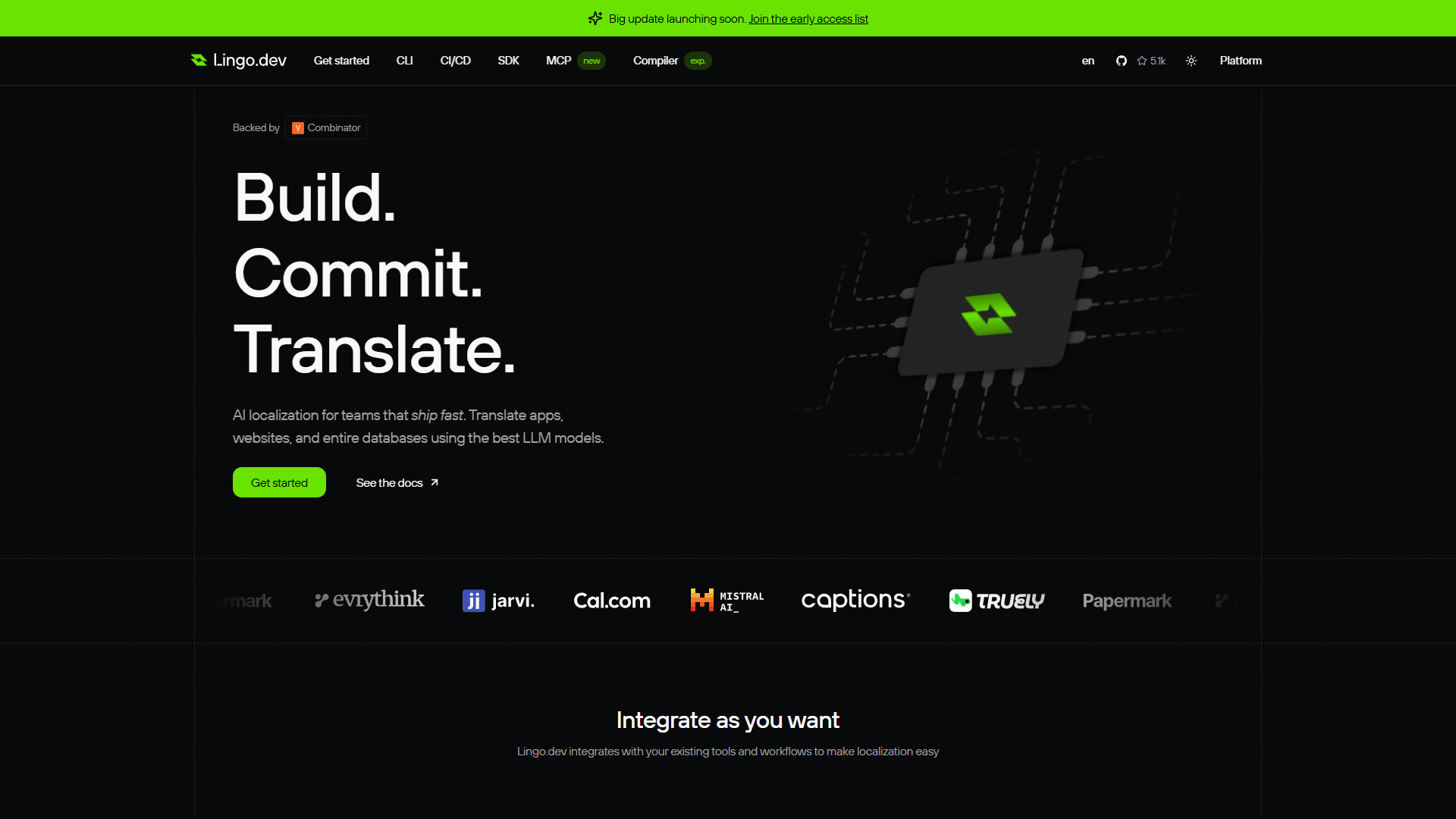
Lingo.dev is the new kid on the block, but it’s solving a problem that’s plagued developers for years: getting translations to happen automatically without leaving your Git workflow. Founded by a Y Combinator W24 alum with $4.7M in funding, it’s built specifically for teams that want localization to feel like just another build step.
What Makes It Different
The killer feature is true Git-native automation. Push your code, and translations happen automatically with context-aware AI that understands your brand voice. No project managers juggling spreadsheets, no waiting for translation services to return files. The platform supports 83+ languages and lets you bring your own LLM (Anthropic, OpenAI, or custom models).
I tested this with a React app, and the experience is genuinely different from traditional platforms. The JavaScript SDK means you can pull translations in real-time, perfect for user-generated content or dynamic interfaces. MessageFormat support handles pluralization and gender-specific phrasing, which most AI translation tools fumble.
Pricing Breakdown (January 2026)
- Hobby (Free): 10,000 words/month, 1 project, unlimited glossaries
- Pro ($30/month): 20,000 words/month, $2.50 per 1,000 extra words
- Team ($600/month): 100,000 words/month, $0.25 per 1,000 extra words, private Slack channel
- Enterprise (Custom): Custom volume, SLAs, dedicated support
Pros:
- Truly automated Git workflow - no manual file uploads
- Developer-friendly CLI, SDK, and CI/CD integrations
- Context-aware AI with brand voice consistency
- Real-time API for dynamic content
- Generous free tier for testing (10K words/month)
Cons:
- No reviews yet (too new, launched 2024)
- Requires Git/CI/CD knowledge
- Not suitable for certified translations (legal, medical)
- Team plan jumps to $600/month
Best for: Development teams who want localization to be invisible infrastructure, not a separate workflow step.
2. Crowdin: The Open-Source Favorite with Agentic AI
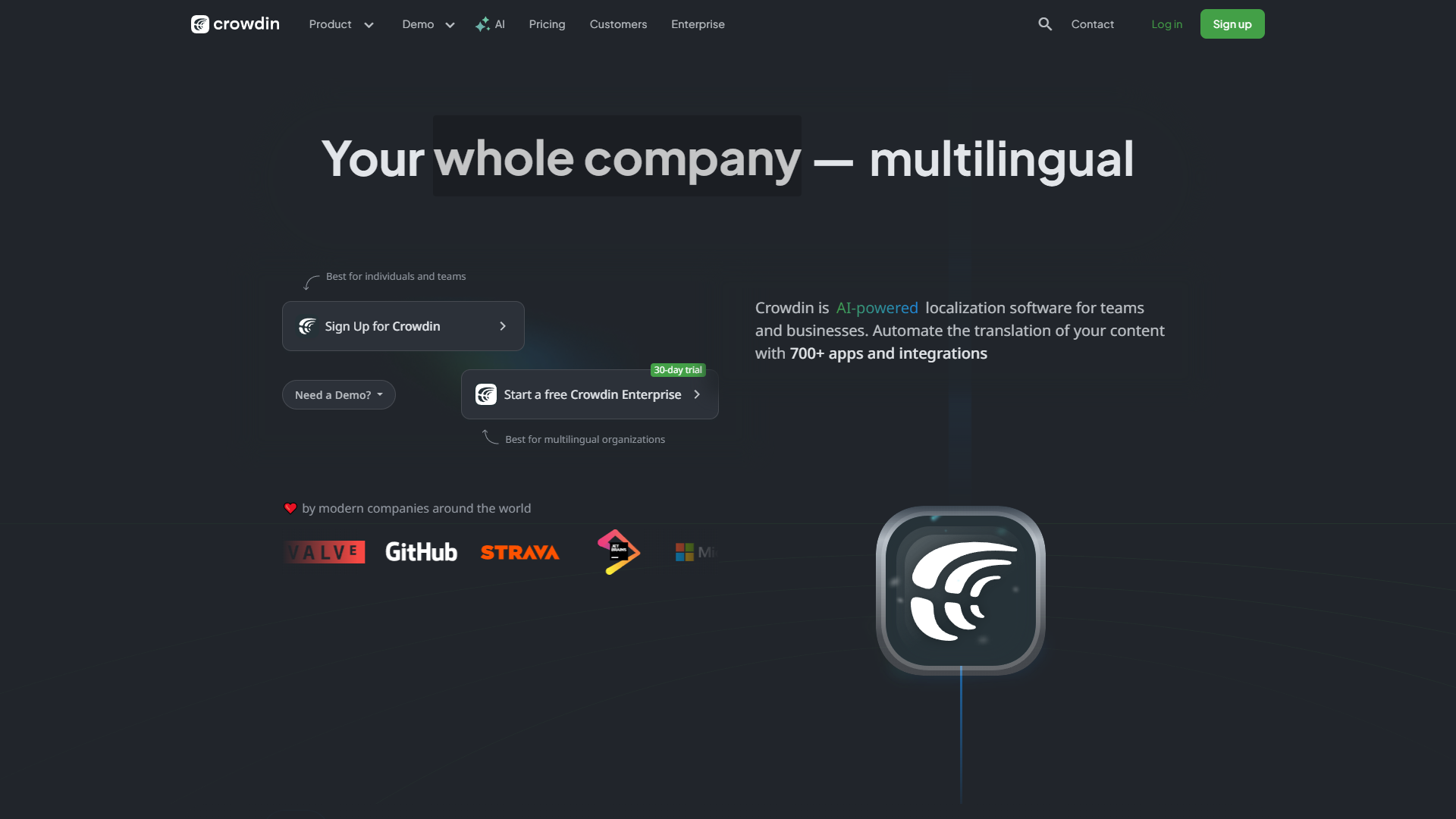
Crowdin has been around long enough to build an ecosystem that’s hard to match: 700+ integrations, 100+ file formats, and a massive community of translators. But what caught my attention in 2025 was their agentic AI launch, which fundamentally changes how the platform works.
The Agentic AI Game-Changer
Traditional localization platforms require you to orchestrate every step: upload files, assign translators, review translations, publish updates. Crowdin’s new agentic AI can manage entire workflows autonomously. Set up conditions like “auto-translate marketing content with DeepL when source changes, then send to human reviewer if confidence score is below 95%,” and it just happens.
The Crowdin Automator uses if-then logic without coding. I set up a workflow where GitHub pull requests automatically trigger translations, which get committed back to the PR if they pass quality checks. This is the kind of automation that actually saves time, not just shuffles tasks around.
Pricing Reality Check (January 2026)
- Free: 60,000 hosted words, 1 private project, 1 integration
- Pro ($59/month, $50/month annual): 2 projects, 60,000 words, 2 integrations
- Team ($179/month, $150/month annual): 5 managers, 100,000 words, 3 integrations
- Team+ (Enterprise, $450/month annual): 500,000 words, unlimited integrations
Note: No per-seat charges, which is rare. Vendr data shows average enterprise cost around $7,000/year.
Pros:
- Agentic AI dramatically reduces manual workflow management
- 700+ integrations including GitHub, GitLab, Figma, DeepL
- Strong community translation features
- Translation Memory saves time on repetitive content
- No per-seat pricing
- Solid free tier (60K words)
Cons:
- Interface has a learning curve
- Translation key management can be complex
- Navigation frustrates new users
- Longer text strings (3+ sentences) are harder to work with
Best for: Teams with complex localization workflows who need deep integrations with development and design tools. Particularly strong for open-source projects.
3. DeepL: When Translation Quality Matters More Than Speed
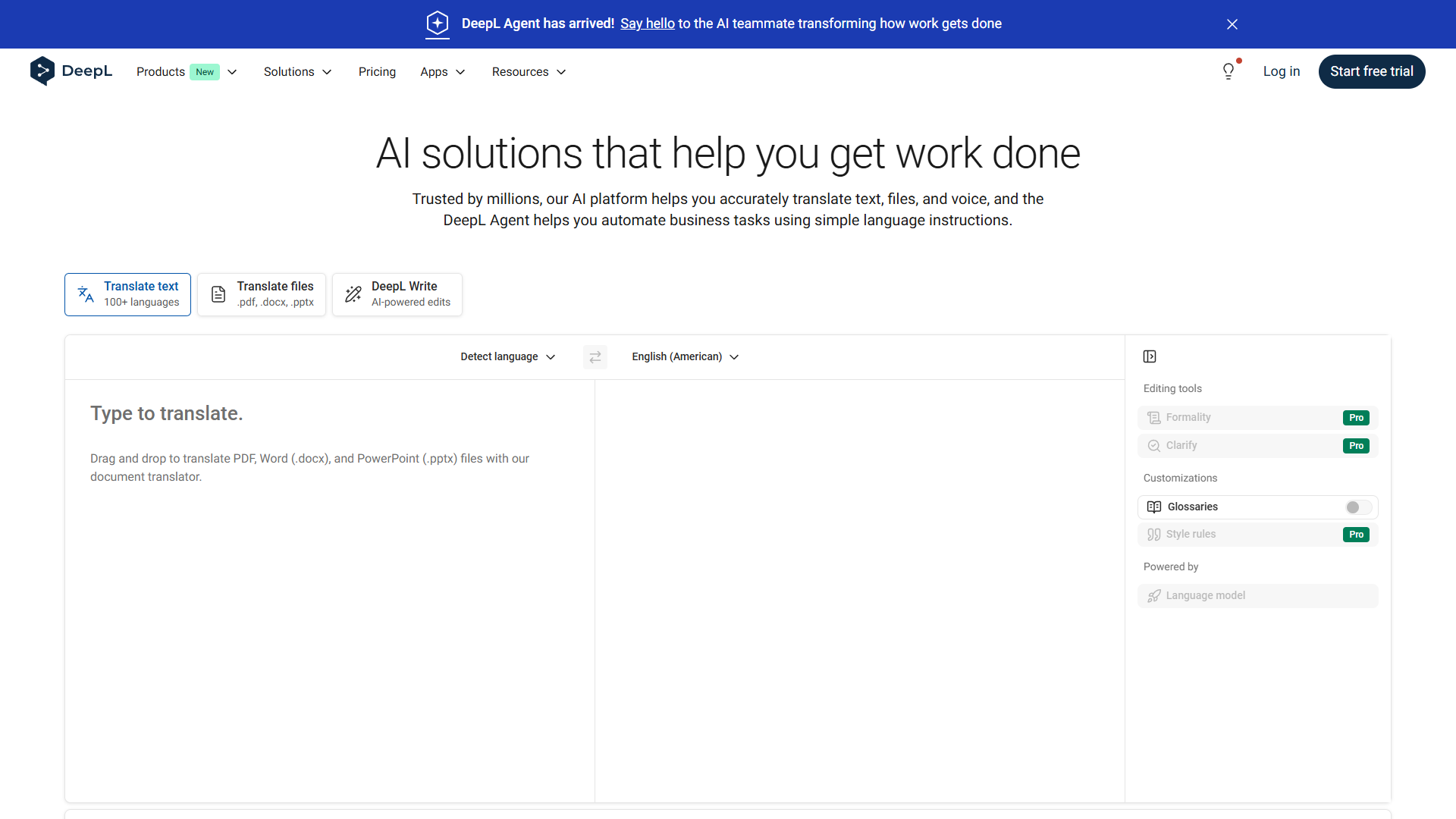
DeepL isn’t a full localization platform like the others on this list - it’s a translation engine that’s become the quality benchmark everyone else chases. If you’ve ever compared machine translation outputs, you know DeepL consistently produces more natural-sounding results, especially for European languages.
Where DeepL Excels
The neural machine translation handles context and nuance better than alternatives. I ran comparison tests translating technical documentation from English to German, French, and Spanish. DeepL consistently picked up on technical terminology context that Google Translate missed, and the output required significantly less human editing.
The 2025 additions are substantial: DeepL Agent (an AI coworker that handles autonomous tasks), DeepL Voice with Zoom/Teams integration for real-time meeting translation, and the Customization Hub for enterprise teams to train the AI on industry-specific terminology.
Pricing Structure (January 2026)
- Free: 1,500 characters per translation, 3 non-editable files/month
- Starter ($10.49/month, $6.99/month annual): Unlimited text, 5 editable files/user/month
- Advanced ($34.49/month, $22.99/month annual): 20 files/user/month, SSO, CAT tool integration
- Ultimate ($68.99/month, $45.99/month annual): 100 files/user/month, DeepL Agent, largest uploads (30MB)
Pros:
- Best-in-class translation accuracy
- DeepL Voice for real-time Zoom/Teams translation
- Customization Hub for industry terminology
- CAT tool integrations (Advanced tier and up)
- Affordable entry point ($10.49/month)
Cons:
- Not a full localization platform (no workflow management)
- File translation limits on lower tiers
- Customization features require Advanced tier ($34.49/month)
- Less comprehensive language support than Smartcat (70+ languages in beta vs 280+)
Best for: Teams prioritizing translation quality over workflow automation, especially for European language pairs. Also excellent for real-time meeting translation with DeepL Voice.
4. Smartling: Enterprise-Grade Automation at Enterprise Prices
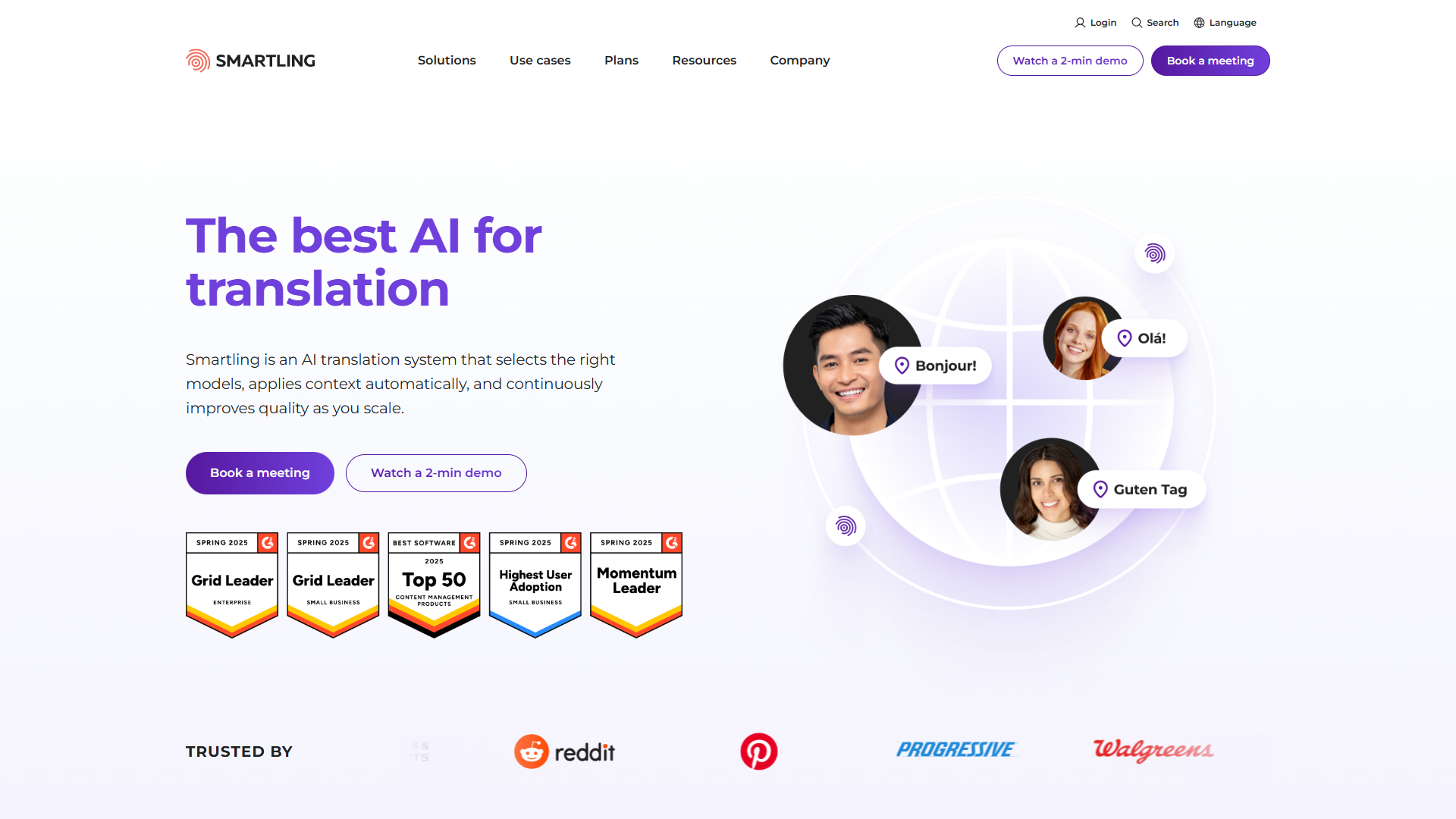
Smartling went freemium in 2025, which is a big deal for a platform that previously required custom enterprise quotes just to get started. The Core tier is genuinely free (with pay-per-word translation costs), making it accessible for teams to test before committing to Enterprise pricing.
The 99% Automation Claim
Smartling’s marketing claims up to 99% workflow automation, and after using it on a mid-sized project, I believe it. The platform’s strength is connecting every part of the localization chain: content management systems, translation memory, machine translation, human translators, and quality assurance all flow together.
The 2025 Model Context Protocol integration is particularly clever - it brings translation directly into developer tools like Claude Code, VS Code, and Cursor. You can request translations without leaving your IDE, which removes a surprising amount of friction from the localization process.
Pricing Transparency Issues (January 2026)
- Core (Free): Basic workflow, 180-day translation memory retention
- Machine Translation: $0.0075/word
- AI Translation: $0.06/word
- Enterprise (Custom): Full features, unlimited translation memory, 60+ integrations
- Human Translation: $0.12-$0.20/word
- Typical cost: $500+/month platform fee + per-word translation costs
The pay-per-word model makes cost unpredictable. If you’re translating 100,000 words monthly with AI translation ($0.06/word), that’s $6,000/month in translation costs alone, plus platform fees.
Pros:
- Free Core plan to test the platform
- Multi-LLM routing with hallucination detection
- Model Context Protocol integration for developer tools
- 60+ integrations including Salesforce, Intercom, Zapier
- ISO 27001 certified security (December 2025)
- Can automate 90%+ of localization workflows
Cons:
- Enterprise pricing still opaque (custom quotes)
- Pay-per-word model gets expensive at scale
- Interface complexity overwhelming for simple needs
- Free tier limited to 180-day translation memory retention
- Steeper learning curve than competitors
Best for: Large enterprises with complex localization needs across multiple platforms (websites, apps, documentation, marketing). The free Core tier makes it worth testing even if you’re not enterprise-scale yet.
5. Smartcat: The Multimedia Powerhouse with 280+ Languages
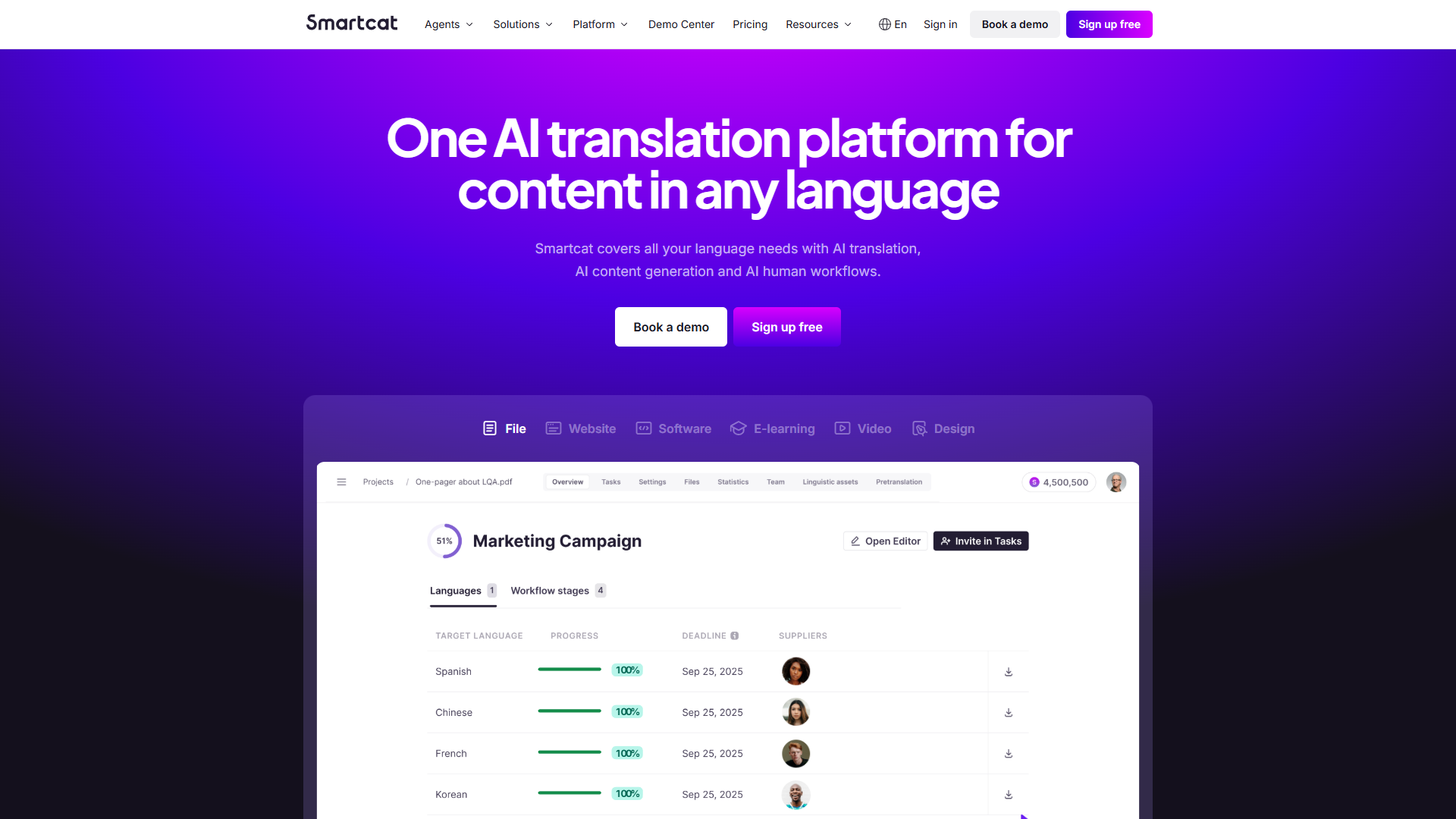
Smartcat distinguishes itself by going beyond text translation. The 2025 AI Agents update added image translation, audio translation, AI voiceover, and voice cloning - capabilities that most competitors don’t even attempt.
The Multimedia Advantage
If you’re localizing apps with embedded screenshots, marketing materials with text-heavy images, or video content, Smartcat handles what others force you to outsource. The Image Translator automatically detects text in images and recreates layouts in target languages. The AI voiceover can narrate translated video content, and voice cloning maintains brand consistency across languages.
I tested the image translation with app store screenshots (the traditional nightmare of localization). It worked surprisingly well - detected UI text, translated it, and regenerated the image with proper fonts. Not perfect (some layouts required manual adjustment), but it eliminated 80% of the manual work.
Pricing Strategy (January 2026)
- Forever Free: 15,000 words/month, basic AI Agents
- Starter ($99/month): Enhanced AI Agents, increased volume, full marketplace access
- Unite ($669/month): Pre-built content agents, 30+ integrations (Sitecore, Optimizely), image/audio translation
- Enterprise (Custom, typically $8,000-$120,000/year): SSO, audit logging, data isolation, unlimited volume
Pros:
- 280+ languages (far more than competitors)
- Unique multimedia capabilities (image, audio, voice cloning)
- 99% AI translation accuracy across supported languages
- Built-in marketplace with 500K+ professional linguists
- Forever Free tier with 15,000 words/month
- Context-aware AI assistant
- 70+ file format support
Cons:
- Limited QA features (segment-by-segment only)
- Customer support can be slow
- Keyboard shortcuts need improvement
- Unite tier ($669/month) is expensive for smaller teams
- In-context preview less developed than specialized tools
Best for: Teams localizing multimedia content (apps with images, video content, audio) or needing extensive language coverage (280+ languages). The free tier is generous enough for meaningful testing.
Choosing the Right Localization Tool: Use Case Recommendations
If you’re a developer team automating i18n in CI/CD: Go with Lingo.dev. The Git-native workflow and JavaScript SDK make it the only platform that feels like infrastructure rather than a separate tool. The $30/month Pro tier is reasonable for most small teams.
If you need deep integrations with your existing dev stack: Crowdin is unmatched with 700+ integrations. The agentic AI means you can set up complex automation once and let it run. The $150/month Team tier (annual) hits the sweet spot for growing teams.
If translation quality is non-negotiable: DeepL remains the accuracy standard, especially for European languages. It’s not a full platform, but if you’re primarily concerned with translation quality rather than workflow management, the $22.99/month Advanced tier (annual) is excellent value.
If you’re enterprise-scale with complex workflows: Smartling justifies its cost when you’re coordinating localization across websites, apps, and marketing content with dozens of translators. Start with the free Core tier to test, then negotiate Enterprise pricing based on your actual volume.
If you’re localizing multimedia content: Smartcat is the only platform that handles images, audio, and video alongside text translation. The $99/month Starter tier is accessible, and the multimedia features alone save enough outsourcing costs to justify the price.
The ROI Reality: What You Actually Save
Localization ROI isn’t just about translation costs - it’s about developer time saved, time to market, and market expansion speed. Here’s what I’ve observed:
Developer Time Savings: Automating localization with Lingo.dev or Crowdin typically saves 5-10 hours per week for development teams previously managing translation files manually. At a $75/hour developer rate, that’s $375-$750 weekly ($19,500-$39,000 annually).
Time to Market: Manual localization processes add 1-3 weeks to release cycles. Automated platforms can reduce this to 1-3 days. For SaaS products, that’s 10-20 days faster market entry, which can mean thousands in additional revenue.
Translation Cost Reduction: AI translation costs $0.0075-$0.06 per word versus human translation at $0.12-$0.20 per word. For 100,000 words monthly, that’s $750-$6,000 (AI) versus $12,000-$20,000 (human), saving $6,000-$14,000 monthly.
The payback period for most teams is under 3 months, even at higher pricing tiers.
Final Verdict: Best AI Localization Tools 2026
The best AI localization tools for 2026 depend entirely on your workflow and priorities, but here’s my ranking:
Overall Winner: Crowdin - The combination of agentic AI, 700+ integrations, and reasonable pricing ($150/month annual for Team tier) makes it the most versatile choice for teams serious about localization.
Best for Developers: Lingo.dev - If your priority is invisible, automated localization in your Git workflow, nothing else comes close.
Best Translation Quality: DeepL - When accuracy matters more than automation, DeepL remains unmatched.
Best for Enterprise: Smartling - The 99% automation claim is real, and the Model Context Protocol integration is genuinely innovative.
Best for Multimedia: Smartcat - If you’re translating images, audio, or video alongside text, Smartcat is the only comprehensive option.
The localization space has matured significantly in 2026. These aren’t just translation tools anymore - they’re AI-powered automation platforms that can genuinely eliminate entire categories of manual work. Start with free tiers, test with real projects, and scale when you find the right fit.
Related Reading
- Best AI Automation Tools 2025
- Best AI Tools for Developers
- ChatGPT vs Claude: Which AI Assistant is Better?
External Resources
For official documentation and updates from these tools: