



Writesonic GEO AI search is a set of Generative Engine Optimization features designed to help content get cited by AI search engines like Perplexity and ChatGPT Search. Unlike traditional SEO, which targets Google’s ranking algorithm, GEO focuses on content structure, specificity, and factual density - the factors AI systems prioritize when selecting sources for generated answers.
If you have spent the last year watching your organic traffic plateau while AI search engines quietly redirect attention away from traditional results, you are not alone. Google AI Overviews, Perplexity, and ChatGPT Search are fundamentally changing how people find information online. The question is no longer just “how do I rank on Google?” but “how do I get cited when an AI generates an answer?”
This is the problem Writesonic’s GEO (Generative Engine Optimization) features are designed to solve. I have been testing Writesonic specifically for its AI search visibility capabilities, and this guide walks through exactly how to use them to get your content cited by AI search engines. This is not a general Writesonic tutorial. This is a focused walkthrough of the writesonic geo ai search optimization workflow that most users never fully explore.
Writesonic currently holds across review platforms, reflecting strong adoption among SEO professionals and content marketers who need both traditional and AI search optimization.
Why Writesonic Geo AI Search Matters More Than Traditional SEO Alone
Writesonic Geo AI Search covers the strategies and tools that deliver real productivity gains in this space. If you have spent the last year watching your organic traffic plateau while AI search engines. This guide walks through the practical steps from setup through advanced optimization.
Traditional SEO optimizes content for Google’s ranking algorithm. GEO optimizes content so AI systems select it as a source when generating answers. These are related but distinct problems, and solving one does not automatically solve the other.
Here is what makes AI search engines different from traditional search:
- AI search synthesizes answers - Instead of showing ten links and letting users choose, AI search engines read multiple sources and compose a response. Your content either gets cited as a source or it gets ignored entirely.
- Citation authority differs from ranking authority - A page ranking fifth on Google might get cited more often by Perplexity than the page ranking first, because citation depends on content structure, specificity, and factual density rather than backlink profiles.
- Conversational queries are exploding - Users ask AI search engines full questions like “what is the best approach for optimizing content for AI search” rather than typing keyword fragments. Content structured around answering specific questions gets cited more frequently.
Search Engine Land’s analysis of AI Overviews confirms that content optimized for AI citation requires different structural choices than content optimized purely for traditional rankings.
This dual optimization challenge is exactly where writesonic geo ai search features provide genuine value. Rather than treating SEO and GEO as separate workflows, Writesonic integrates both into a single content optimization pipeline.
Understanding Writesonic’s AI Visibility Action Center
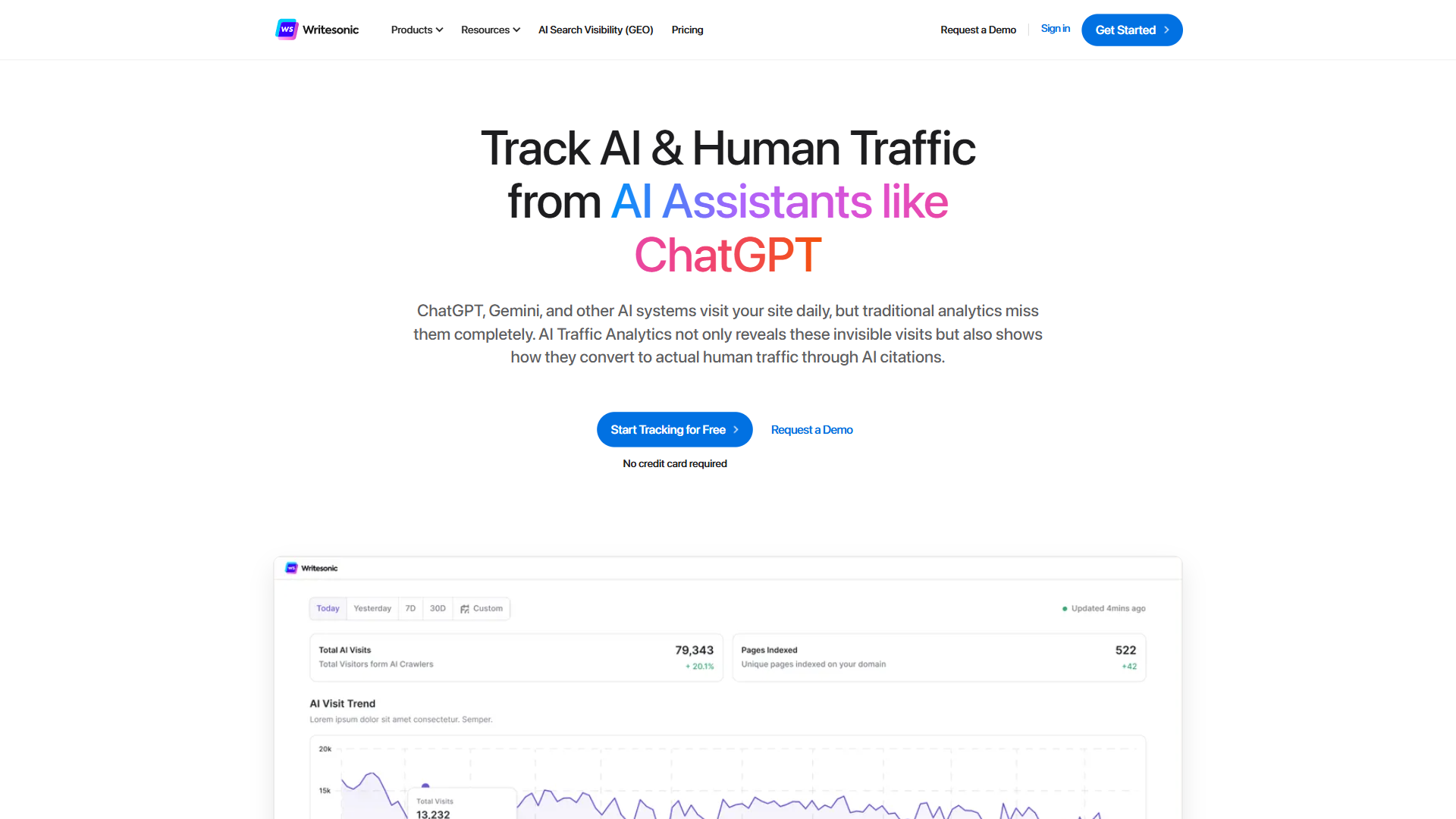
The AI Visibility Action Center is the command hub for Writesonic’s GEO features. It tracks your brand’s presence across three major AI search platforms: ChatGPT, Google Gemini, and Perplexity. Before you can optimize, you need to understand where you stand.
Setting Up Visibility Tracking
Getting started with AI visibility tracking takes about ten minutes:
- Enter your brand and domain - Writesonic needs to know what entity to monitor across AI platforms
- Define tracking queries - Add the search queries your target audience uses. Focus on questions and problem statements rather than single keywords
- Set competitor brands - Add 3-5 competitors so you can benchmark your AI visibility against theirs
- Run your first scan - Writesonic queries each AI platform with your tracking terms and reports which brands get mentioned in the responses
Reading Visibility Reports
The visibility reports show three critical metrics:
- Brand mention frequency - How often your brand appears in AI-generated responses for your tracked queries. This is the baseline metric that everything else ties back to.
- Citation context - When your brand is mentioned, what context does the AI provide? Are you cited as the best option, one of several alternatives, or mentioned only in passing? Context quality matters as much as mention count.
- Competitive gap analysis - Where competitors get cited and you do not. These gaps represent your highest-priority optimization targets because they show specific queries where AI search engines have already chosen someone else as the authority.
The competitive gap analysis is where the real value lives. Writesonic surfaces query gaps that would be nearly impossible to identify manually, particularly for long-tail conversational queries that traditional keyword tools miss entirely.
Optimizing Content Structure for AI Citations
AI search engines do not read content the way humans do. They parse structure, extract specific claims, and evaluate whether a source provides a complete, authoritative answer to the query. Writesonic’s content optimization tools help you structure content that AI systems prefer to cite.
Heading Structure That AI Can Parse
AI systems rely heavily on heading hierarchy to understand what each section of your content covers. Writesonic’s GEO recommendations push you toward heading structures that function as standalone answer containers.
What works for AI citations:
- Question-based H2s - “How does X work?” or “What is the best approach for Y?” These directly match conversational AI search queries
- Self-contained sections - Each H2 section should fully answer one specific aspect of the topic. AI systems cite sections, not entire articles
- Logical progression - Move from definition to explanation to application. AI systems favor content that builds understanding sequentially
What does not work:
- Vague headings - “More information” or “Things to know” give AI systems nothing to match against queries
- Fragmented answers - Spreading the answer to a single question across multiple sections makes it harder for AI to extract a complete citation
- Clickbait headings - “You Won’t Believe What Happened Next” tells AI nothing about the content’s substance
Citation-Optimized Content Patterns
Based on Writesonic’s GEO analysis, content patterns emerge that consistently earn AI citations:
The definitive answer pattern. Start each major section with a clear, direct answer to the implied question, then expand with supporting detail. AI systems extract the direct answer for citations and use the supporting detail to evaluate authority.
The structured comparison pattern. When covering multiple options, use consistent formatting for each. AI systems parse parallel structures efficiently and can extract specific comparisons when users ask “what is better, X or Y?”
The data-backed claim pattern. Include specific numbers, percentages, and timeframes. AI systems prefer citing sources that provide concrete data over sources that make general claims. “Saves 60% of content creation time” is more citable than “significantly reduces content creation time.”
Using Chatsonic for GEO Research
Chatsonic, Writesonic’s conversational AI, serves a specific purpose in the GEO workflow: researching what AI search engines currently say about your topics so you can identify where your content needs to provide better answers. Our AI content writing workflow guide breaks down how to slot this research step into a broader publishing pipeline.
Research Workflow for GEO Optimization
Here is the research process for creating content intended for AI search visibility:
- Query Chatsonic with your target topic - Ask the same questions your audience would ask AI search engines. Note which sources get cited in the response.
- Analyze the cited sources - Visit the pages Chatsonic and other AI platforms reference. What do they have in common? Structured data, specific statistics, clear definitions, comprehensive coverage.
- Identify citation gaps - Look for questions where the AI response is vague, incomplete, or cites weak sources. These represent opportunities where your content can become the preferred citation.
- Map content to query intent - For each target query, outline exactly what your content needs to cover to be the most complete, authoritative answer available.
This research loop feeds directly into content creation. Instead of guessing what AI search engines want, you reverse-engineer the citation criteria from actual AI responses.
Brand Voice Consistency Across AI-Optimized Content
One concern with GEO optimization is that structuring content for AI parsability might make it feel robotic to human readers. Writesonic’s brand voice feature addresses this by maintaining your publication’s tone while incorporating GEO structural elements.
Set up your brand voice profile with examples of your existing content, and Writesonic’s AI Article Writer will generate drafts that match your style while following GEO best practices. The key is providing at least 3-5 writing samples that represent your target tone, so the model has enough signal to maintain consistency.
Structured Data and Schema Markup for AI Visibility
AI search engines use structured data to understand content at a machine-readable level. Writesonic helps generate schema markup that improves how AI systems interpret your pages.
Key Schema Types for GEO
- FAQ Schema - Marks up question-and-answer pairs so AI systems can extract individual answers directly. FAQPage schema is the highest-impact schema type for AI search visibility.
- How-To Schema - Structures step-by-step instructions in a format AI systems can cite as procedural answers.
- Article Schema - Provides metadata about author, publication date, and topic that AI systems use to evaluate source recency and authority.
Writesonic’s content generation pipeline can output schema markup alongside your content, but you should review it before implementation. AI-generated schema sometimes includes markup for content that does not actually exist on the page, which can trigger Google’s structured data guidelines violations.
Content Formatting That AI Crawlers Prefer
Beyond heading structure and schema markup, the micro-formatting choices in your content affect how well AI crawlers extract and cite information.
Formatting Best Practices
Lists and tables for comparative data. When presenting options, features, or comparisons, use HTML tables or structured lists. AI systems extract tabular data more reliably than information buried in prose paragraphs.
Explicit definitions for key terms. When you introduce a concept, define it explicitly in the same sentence or the immediately following sentence. AI systems looking for definitions will cite the source that provides the clearest, most concise definition.
Source attribution for claims. When citing statistics or research, include the source inline. AI search engines evaluate source credibility partly based on whether claims are attributed to verifiable sources.
Short, focused paragraphs. AI crawlers segment content at paragraph boundaries. Paragraphs that mix multiple topics make it harder for AI to extract clean citations. Keep each paragraph focused on a single point.
Writesonic’s AI Article Writer for GEO Content
Writesonic’s AI Article Writer 5.0 generates long-form content with GEO principles baked in. When you create an article using the GEO-optimized template, the tool automatically:
- Structures headings as question-answer pairs where appropriate
- Includes specific data points and statistics to increase citation potential
- Formats content with clear section boundaries for AI parsing
- Generates FAQ sections that map to common conversational queries
The output requires editing - no AI writer produces publish-ready content - but the structural foundation saves significant time compared to retrofitting GEO principles onto content written without them.
Pricing: Which Plan Unlocks GEO Features?
Not all Writesonic plans include the full GEO feature set. Here is how the plans break down for AI search optimization specifically:
| Plan | Monthly Price | AI Articles | GEO Features | Best For |
|---|---|---|---|---|
| Starter | $99/month | 15 | Basic content optimization | Testing the platform |
| Basic | $249/month | 25 | Full AI Search Visibility | Serious GEO optimization |
| Growth | $499/month | 50 | Full AI Search Visibility | Agency-scale operations |
| Enterprise | Custom | Custom | Full AI Search Visibility | Large organizations |
The critical distinction is that full AI Search Visibility (GEO) features are available starting at the Basic plan ($249/month). The Starter plan includes Writesonic’s content creation and basic SEO tools, but the AI Visibility Action Center, competitive gap analysis, and advanced GEO optimization recommendations require Basic or higher.
For SEO specialists who are serious about AI search optimization, the Basic plan represents the entry point. The cost is significant, but consider that monitoring your brand across three AI search platforms manually would consume hours of analysis time weekly.
Annual billing reduces costs by 20% across all tiers. Writesonic also offers a 7-day free trial, though the trial may not include full GEO features - verify during signup.
Practical GEO Optimization Workflow
Here is the complete workflow with Writesonic for optimizing content for AI search visibility, from research through publication:
Phase 1: Research and Gap Analysis
- Run AI Visibility tracking for your target queries
- Identify queries where competitors get cited and you do not
- Use Chatsonic to research what current AI responses look like for those queries
- Map the specific information gaps your content needs to fill
Phase 2: Content Creation
- Use AI Article Writer 5.0 with GEO optimization enabled
- Structure content with question-based headings that match target queries
- Include specific data, definitions, and structured comparisons
- Generate FAQ schema for the most common query variations
Phase 3: Optimization and Review
- Run the content through Writesonic’s GEO analysis
- Check that each major section provides a self-contained answer
- Verify structured data markup is accurate
- Review brand voice consistency
Phase 4: Monitoring
- Publish and wait 2-4 weeks for AI search engines to index
- Re-run AI Visibility tracking to measure citation changes
- Identify which optimizations produced results and which did not
- Iterate on content that is close to getting cited but has not broken through yet
This cycle is not a one-time process. AI search engines update their source preferences regularly, so monitoring and iteration are ongoing. The brands that win in AI search are the ones that treat GEO as a continuous optimization discipline, not a one-time project.
Common GEO Mistakes to Avoid
These are the most frequent mistakes teams make when using writesonic geo ai search optimization:
Optimizing for keywords instead of questions. Traditional keyword targeting does not translate directly to GEO. AI search queries are conversational and question-based. Optimize for the full question, not just the keyword fragment.
Ignoring content freshness. AI search engines weigh recency heavily when selecting citation sources. Content published two years ago with no updates loses citation priority to fresher sources covering the same topic. Writesonic’s content calendar helps you schedule updates to existing high-value pages.
Treating all AI search engines the same. ChatGPT Search, Perplexity, and Google AI Overviews each have different citation criteria. Perplexity tends to cite the most recent, most specific sources. Google AI Overviews favors sources that already rank well in traditional search. ChatGPT Search weighs source diversity. Writesonic’s platform-specific tracking helps you optimize differently for each, and our topic authority SEO strategy guide explains how cluster planning amplifies these signals.
Over-optimizing at the expense of readability. If your content reads like it was written for machines rather than humans, both human readers and AI search engines will notice. Google’s helpful content guidelines still apply to AI search optimization. Write for people first, then ensure the structure supports AI parsing.
The Bottom Line
Writesonic’s GEO features address a genuine gap in the content optimization market. While most SEO tools are still focused exclusively on traditional Google rankings, Writesonic is building tools for the parallel challenge of AI search visibility. The AI Visibility Action Center, competitive gap analysis, and GEO-optimized content generation give SEO professionals and content creators a structured workflow for a problem that most teams are still solving through guesswork. Compared with traditional research suites like Surfer SEO and Ahrefs, Writesonic is the only option in this lineup that closes the loop from citation gap to published content in a single platform.
The Basic plan at $249/month is the practical entry point for serious GEO work, which puts it in the premium tier for content optimization tools. Whether that price point makes sense depends on how much of your traffic comes from search and how quickly AI search engines are eating into your click-through rates.
For teams already feeling the impact of AI search on their organic traffic, writesonic geo ai search tools provide a systematic approach to a problem that is only going to become more important. If you want to compare Writesonic against other platforms in this space, our best AI SEO tools roundup benchmarks the leading options side by side. Start with the free trial to evaluate the AI Visibility tracking, then decide whether the optimization tools justify the Basic plan investment.
Frequently Asked Questions
What is GEO and how is it different from SEO?
Traditional SEO optimizes content for Google’s ranking algorithm. GEO - Generative Engine Optimization - optimizes content so AI systems select it as a source when generating answers. These are related but distinct problems, and solving one does not automatically solve the other.
Which Writesonic plan includes full GEO features?
Full AI Search Visibility features start at the Basic plan ($249/month). The Starter plan includes basic content optimization, but the AI Visibility Action Center, competitive gap analysis, and advanced GEO recommendations require Basic or higher. Annual billing reduces costs by 20% across all tiers.
Which AI search engines does Writesonic track?
Writesonic’s AI Visibility Action Center tracks your brand’s presence across ChatGPT, Google Gemini, and Perplexity. Each platform has different citation criteria - Perplexity favors recent and specific sources, Google AI Overviews favors traditionally well-ranked content, and ChatGPT Search weighs source diversity.
How should content be structured to get cited by AI search engines?
AI systems parse structure and extract specific claims. Effective patterns include starting sections with a direct answer before expanding with detail, using parallel formatting for comparisons, including specific numbers and percentages, keeping paragraphs focused on a single point, and defining key terms explicitly where they are introduced.
Does Writesonic help with schema markup for AI search?
Yes - Writesonic can generate schema markup alongside your content to improve how AI systems interpret your pages. However, the output should be reviewed before implementation, as AI-generated schema can sometimes include markup for content that does not actually exist on the page, which may trigger structured data guideline violations.
Want to learn more about Writesonic?
Related Guides
- Writesonic SEO Content Guide: AI Article Writer 5.0
- NeuronWriter Guide: Optimize Content for Google and AI Search
- Building Topic Authority: SEO Strategy Guide
- Surfer SEO Tips and Tricks
- Content Optimization Guide
External Resources
- Writesonic AI Search Visibility - Official GEO features overview and product documentation
- Search Engine Land: AI Overviews Impact on SEO - Industry analysis of how AI search is reshaping content strategy
- Google Structured Data Documentation - Technical reference for schema markup that supports AI visibility
Related Guides
- Activecampaign AI Content Generation: Complete 2026 Guide
- AI Content Writing Workflow: 2026 Walkthrough for Teams
- AI Product Discovery Ecommerce: Lift Revenue in 2026
- AI Productivity Trends 2026: 6 Real Shifts, No Hype
- AI Workflow Automation Maturity Model: 5 Levels
- Building AI First Workflows: A Practitioner's 2026 Guide
- ChatGPT Custom GPTs Guide - Save 130+ Hours a Year
- ChatGPT Prompts 2026: Basic vs Engineered, 18 Examples
- ChatGPT Tips And Tricks: 2026 Walkthrough for Teams
- Content Optimization Guide: 2026 Walkthrough for Teams