



Zendesk costs $55 per agent each month for omnichannel support with 2,000+ integrations, while Help Scout costs $50 per month total with unlimited users and contact-based pricing. Zendesk fits enterprise teams that need autonomous AI and complex routing; Help Scout fits 5-50 person teams that want a shared inbox without weeks of configuration.
The customer support market has split into two camps - enterprise-grade suites with deep automation, and focused tools built for growing teams that need support working without months of configuration. Zendesk and Help Scout represent these camps almost perfectly; both appear in our best customer support software roundup. This comparison is based on each vendor’s current pricing pages, product documentation, and independent industry research rather than sponsored placement, and is cross-checked against Forrester’s customer service technology research on AI-first support platforms.
The right choice depends on team size, technical capacity, and whether you need enterprise customization or frictionless simplicity. This guide covers pricing, AI features, and a clear decision framework; our Zendesk alternatives breakdown widens the field further.
Comparison Table: Zendesk vs Help Scout
Zendesk starts at $55 per agent per month with 2,000+ integrations and autonomous AI, while Help Scout starts at $50 per month for unlimited users with contact-based pricing.
| Zendesk | Help Scout | |
|---|---|---|
| Starting price | $55/agent/mo (Suite Team, annual) | $50/mo (Standard, annual, unlimited users) |
| Free plan | No (14-day trial) | Yes (up to 50 contacts, 5 users) |
| Pricing model | Per agent/seat | Per contact volume (unlimited users) |
| AI features | AI agents, voice AI, intelligent triage | AI Answers, AI Drafts, AI Summarize |
| Channels | Email, chat, voice, social, WhatsApp, SMS | Email, live chat, Beacon widget, Facebook |
| Integrations | 2,000+ | 100+ |
| Best for | Enterprise teams with high ticket volume | SMB and SaaS teams prioritizing simplicity |
| User rating | ||
| HIPAA compliance | Suite Enterprise ($219/mo) | Pro plan ($65/mo annual) |
Zendesk Overview
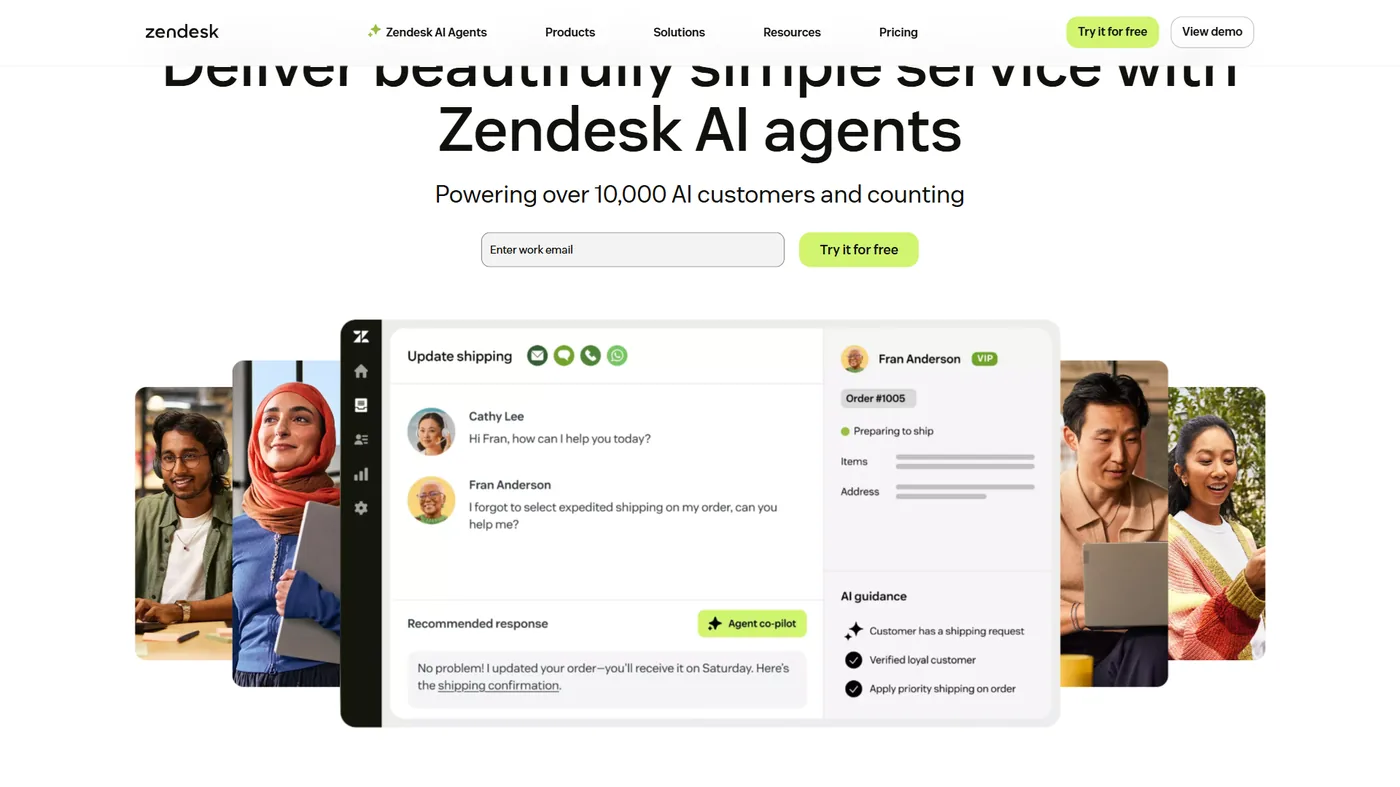
Zendesk has been the default enterprise support platform for over a decade, and recent investment in agentic AI has widened its lead. The platform handles support across email, chat, voice, social, WhatsApp, and SMS in one interface, with intelligent routing and AI that scales from generative replies to autonomous ticket resolution.
Zendesk Pricing
Zendesk has six pricing tiers, and the entry-level Support Team plan at $19/agent/month is effectively email-only. The practical starting point for omnichannel support is Suite Team at $55/agent/month (annual billing), which includes chat, voice, social, basic AI agents, and a branded help center.
| Plan | Annual Price | What you get |
|---|---|---|
| Support Team | $19/agent/mo | Email support only, basic reporting |
| Suite Team | $55/agent/mo | All channels, AI agents (Essential), help center |
| Suite Growth | $89/agent/mo | SLAs, skills-based routing, advanced analytics |
| Suite Professional | $115/agent/mo | Custom roles, sandbox, contextual workspaces |
| Suite Enterprise | $169/agent/mo | Voice AI agents, email automation, HIPAA |
| Suite Enterprise Plus | Custom | Full agentic AI with GPT-5 reasoning |
The AI feature split is the main pricing complexity: Suite Team gets Essential AI agents, Enterprise unlocks Advanced AI with conversation flows, and the top-tier agentic AI - which can autonomously resolve up to 80% of tickets using GPT-5 reasoning - requires Enterprise Plus at custom pricing (around $249+/agent/month). Annual billing saves roughly 20-23%, and the official Zendesk pricing page documents the current per-tier breakdown.
What Are Zendesk’s Key Strengths?
Omnichannel breadth. Suite Team ($55 per month) includes email, chat, voice, social, WhatsApp, and SMS in one interface with no per-channel add-ons - genuinely rare at the price point.
Integration ecosystem. With over 2,000 pre-built integrations, Zendesk connects to nearly any business tool; Salesforce, Shopify, Jira, Slack, and custom APIs configure in under an hour.
Agentic AI at the top end. The Enterprise Plus agentic AI uses GPT-5 reasoning to handle multi-step scenarios - refund processing, troubleshooting, complex escalations - without fixed decision trees, a meaningful step beyond standard chatbots.
Intelligent triage. Across all Suite tiers, Zendesk’s AI automatically detects intent, sentiment, and language to route tickets, saving hours of daily manual triage. The Zendesk intelligent triage documentation explains the underlying detection model.
Zendesk’s Limitations
Pricing complexity is the most cited complaint - the six-tier structure with AI split across three sub-levels makes it hard to know what any plan includes, and many AI capabilities require add-ons or top tiers.
Configuration takes significant time - workflows, triggers, automations, and macros are powerful but require 2-4 weeks of setup, so teams without a dedicated admin will struggle.
There is no free plan; the $19 per month Support Team tier is email-only and not useful as a real deployment. Our LiveChat alternatives breakdown highlights cheaper chat-first options.
Help Scout Overview
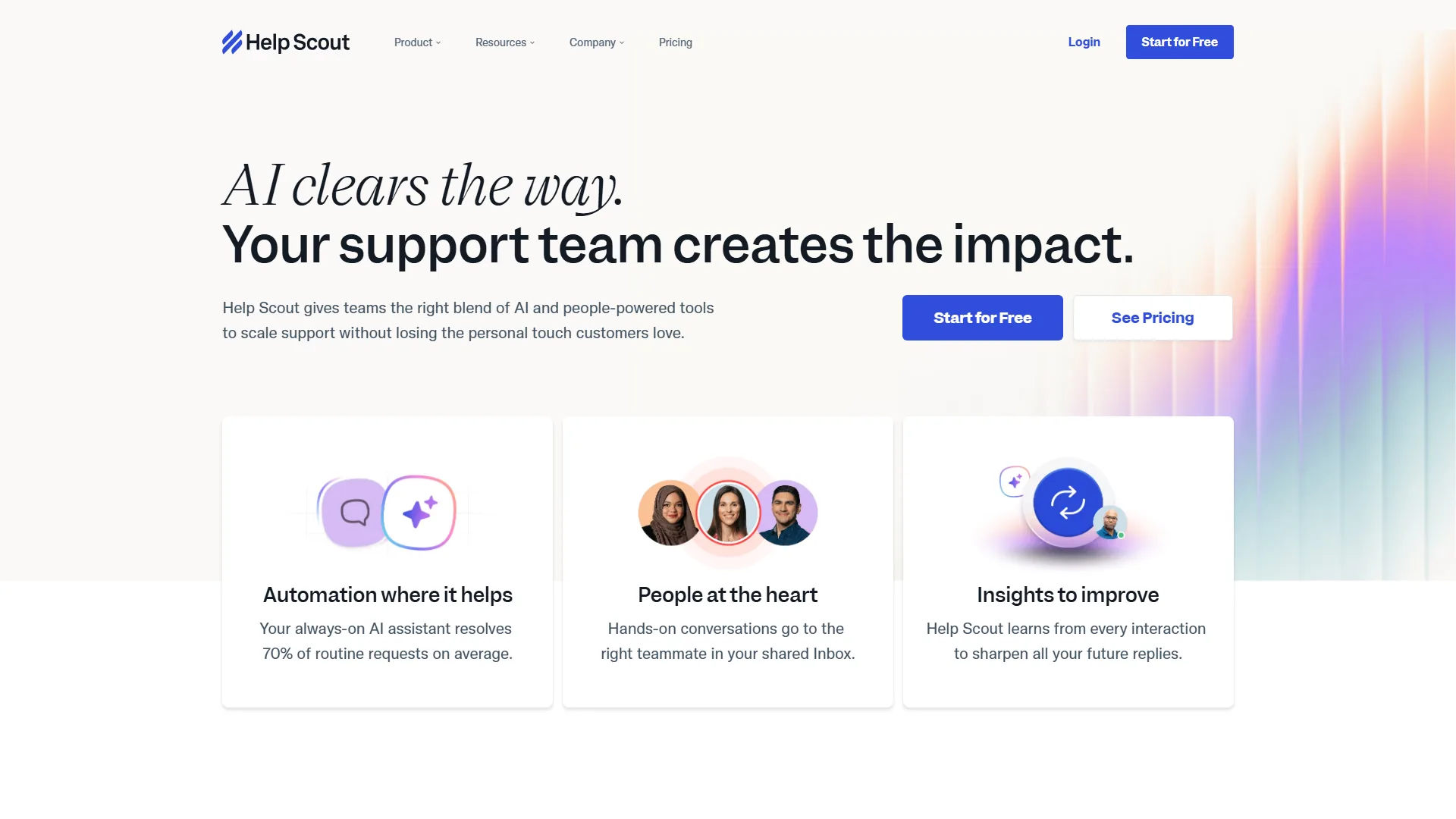
Help Scout is a shared-inbox customer support platform that charges by contact volume - not per agent seat - so all paid plans include unlimited users. Rather than chasing enterprise breadth, Help Scout does shared inbox support extremely well for small and mid-sized teams, with an email-like interface and setup that takes hours rather than weeks.
Help Scout Pricing
Help Scout pricing starts at $50 per month for the Standard plan with unlimited users and 100 contacts, scaling by contact volume rather than per agent seat - which keeps costs flat as headcount grows.
| Plan | Monthly Price | Annual Price | Key limits |
|---|---|---|---|
| Free | $0 | $0 | 50 contacts/mo, 5 users, 1 inbox |
| Standard | $55/mo | $50/mo | 100 contacts (scales), unlimited users, 2 mailboxes |
| Plus | $88/mo | $75/mo | 5 mailboxes, Facebook Messenger, Salesforce/Jira/HubSpot apps |
| Pro | $65/mo (annual only) | $65/mo | 25 mailboxes, HIPAA, enterprise security, dedicated account manager |
The contact-based model matters for ecommerce and SaaS teams: during peak seasons you can add agents without the per-seat cost Zendesk or Intercom would charge. AI Drafts costs an extra $50 per 100 conversations and requires 100 historical conversation replies as training data. Buyers can verify tiers on the Help Scout pricing page.
What Are Help Scout’s Key Strengths?
Shared inbox done right. Help Scout’s core product is excellent - collision detection prevents duplicate replies, private notes and @mentions enable internal collaboration, and the email-like interface makes agents productive within hours.
Beacon help widget. Beacon combines live chat, AI Answers (an always-on support bot), and knowledge base search in one configurable widget; AI Answers resolves around 70% of routine requests automatically. The Help Scout alternatives breakdown shows how rivals approach widget-based deflection.
AI Drafts. Powered by OpenAI GPT-4, AI Drafts generates response suggestions from your conversation history and knowledge base content. The OpenAI GPT-4 model documentation covers the underlying capabilities.
Contact-based pricing advantage. For growing teams the unlimited-user model is a structural advantage - a 20-person team costs $50 per month on Help Scout Standard, versus $1,100/month on Zendesk Suite Team.
Help Scout’s Limitations
The integration library is significantly smaller than enterprise alternatives. With around 100 integrations, Help Scout covers most common workflows (Salesforce, HubSpot, Jira, Slack, Pipedrive), but complex tech stacks may need custom API work.
Channel coverage stops short of enterprise expectations - no native SMS, WhatsApp, Instagram, or Twitter DM support, so teams managing social support at scale need additional tools.
Reporting is functional but not deep. Response times, resolution rates, and satisfaction scores are covered, but there are no custom dashboards, advanced SLA tracking, or skill-based routing - a meaningful gap for large support operations with performance-based SLAs.
Feature-by-Feature Comparison: Zendesk vs Help Scout
How Do Zendesk and Help Scout Compare on AI and Automation?
Zendesk’s AI is more autonomous; Help Scout’s AI is more assistive. At Suite Team, Zendesk AI agents generate contextual replies; at Enterprise they follow multi-step conversation flows and connect to external APIs; at Enterprise Plus the agentic AI with GPT-5 reasoning handles complex issues end-to-end. Intelligent triage runs across all Suite tiers.
Help Scout’s AI accelerates agents rather than replacing them - AI Answers handles routine self-service via Beacon, AI Drafts suggests responses for agents to review, AI Summarize condenses long threads, and AI Assist adjusts tone, grammar, and translation inline.
The shift toward autonomous support AI is industry-wide. “Agentic AI will autonomously resolve 80% of common customer service issues without human intervention by 2029,” according to Gartner’s research - a trajectory that favors Zendesk’s autonomous model.
Winner for AI depth: Zendesk - autonomous resolution at higher tiers is a genuine step beyond assistance. Winner for AI approachability: Help Scout - its AI works without complex configuration. Our best AI chatbot platforms 2026 roundup tracks the broader landscape.
How Do Zendesk and Help Scout Handle Ticket Management and Routing?
Zendesk’s ticketing system is more sophisticated - the main reason it also ranks highly in the Freshdesk vs Zendesk comparison. Skills-based routing, SLA enforcement, custom ticket forms, and contextual workspaces give operations teams fine-grained control - necessary for tiered support, specialist teams, or complex escalation paths.
Help Scout’s shared inbox handles routing through automated workflows but lacks skills-based routing, problem-incident linking, and advanced SLA enforcement - usually sufficient for straightforward operations, but not for complex enterprise ones.
Winner: Zendesk for anything beyond basic routing; Help Scout for teams that do not need it. The best customer support software 2026 roundup covers other platforms.
How Do Zendesk and Help Scout Compare on Reporting and Analytics?
Zendesk includes pre-built analytics dashboards at Suite Team and unlocks advanced analytics on Suite Growth and above; the Explore product provides deep querying of ticket data, agent performance, and channel metrics.
Help Scout provides essential metrics - response times, resolution rates, conversation trends, and customer satisfaction scores - covering what most growing teams need, but lacks custom dashboards, granular SLA reporting, and the performance attribution large operations require.
Winner: Zendesk, for teams with reporting needs beyond standard metrics. The best live chat software 2026 roundup adds context for chat-focused teams.
Integrations
Zendesk offers 2,000+ pre-built integrations, so practically any tool your team uses has a native connector. Help Scout offers 100+ integrations covering the most common workflows - Salesforce, HubSpot, Jira, Slack, Pipedrive, Notion, Shopify - which most teams will not outgrow.
Winner: Zendesk, by a significant margin. The Salesforce alternatives breakdown shows how integration breadth shapes adjacent CRM purchases.
When Should You Consider Intercom or HubSpot Instead?
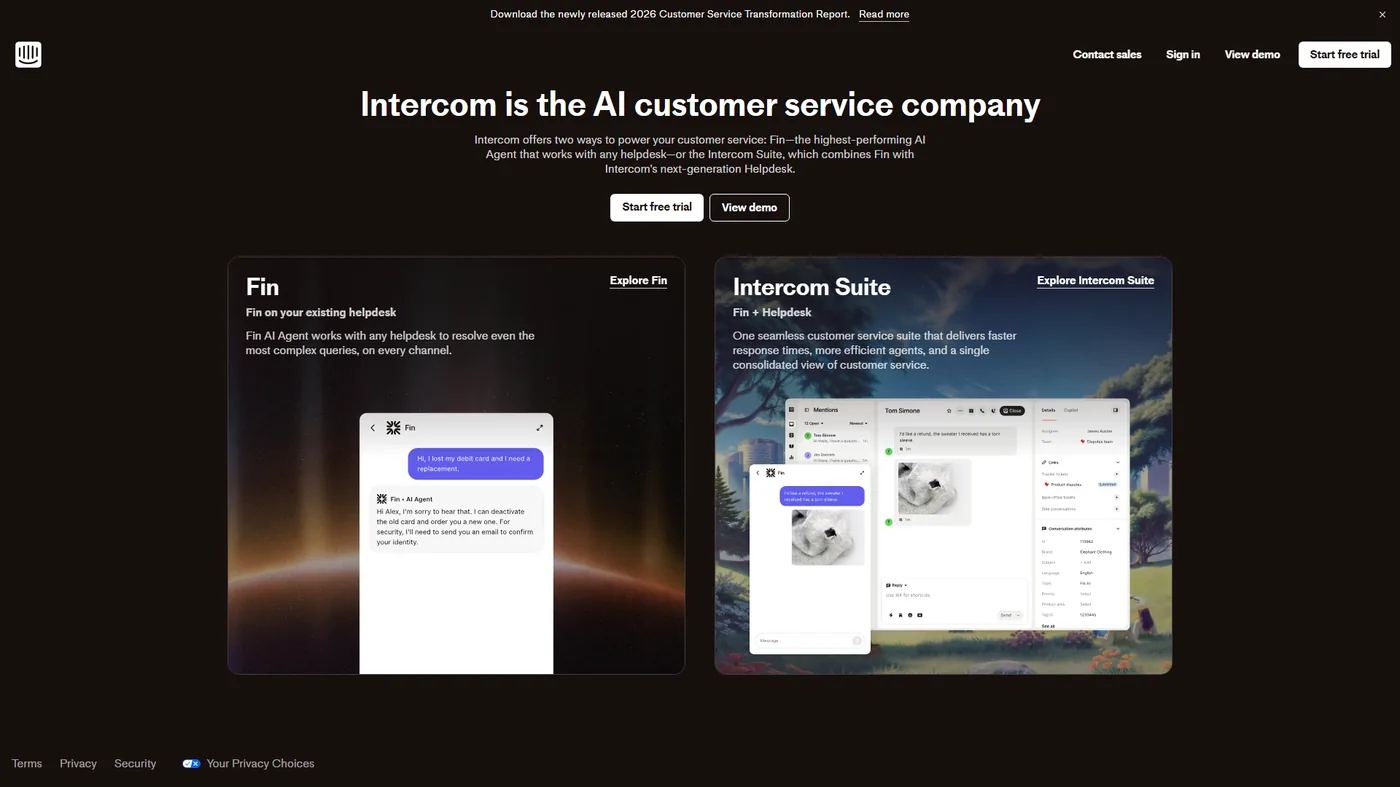
Intercom is the better choice for SaaS teams that want autonomous AI ticket resolution at a per-resolution price, and HubSpot Service Hub is the better choice for teams already running HubSpot CRM that want support data unified with sales and marketing records.
According to Daniel O’Connell, VP Analyst at Gartner, “By 2029, agentic AI will autonomously resolve 80% of common customer service issues without human intervention, leading to a 30% reduction in operational costs.” That trajectory is why Intercom’s Fin AI and HubSpot’s Breeze Customer Agent are gaining ground against assistive-AI platforms.
Intercom
Intercom is the AI-first customer service platform for SaaS teams. Its Fin AI Agent handles support across chat, email, voice, and social at $0.99 per resolution - a usage-based model that can beat fixed monthly plans at high deflection rates - and its unified inbox consolidates Slack, Discord, WhatsApp, and social alongside email and chat.
Where Intercom beats Zendesk is proactive customer engagement: it pioneered in-app messaging that reaches customers at the right moment in their product journey, not just when they open a chat window.
Intercom starts at $29/seat/month (annual) for Essential, with Fin AI resolution costs on top; plans with workflow automation start at $85/seat/month. Choose Intercom over Zendesk if you are a SaaS team that wants conversational support over structured ticketing, or over Help Scout if you need AI autonomous resolution rather than AI-assisted agents. Buyers can verify tiers on the official Intercom pricing page.
HubSpot Service Hub
HubSpot Service Hub is the right answer when customer support needs to live inside your CRM. If your team already uses HubSpot for marketing and sales, adding Service Hub keeps conversation history, deal data, and contact records in one unified database - a meaningful difference from the integration Zendesk and Help Scout offer.
HubSpot’s Breeze Customer Agent resolves over 50% of support tickets automatically and is available from the Professional tier at $450 per month ($90/seat for 5 agents), which includes a knowledge base, customer portal, NPS surveys, and full Breeze AI access. The HubSpot Service Hub product page details the included features.
The catch: HubSpot works best for teams already in its ecosystem, and mandatory onboarding fees ($1,125-$3,500) add to the initial investment. Choose it if your team runs HubSpot CRM and wants support data alongside sales and marketing data. Buyers can verify the full tier breakdown via the official HubSpot Service Hub pricing; our best AI CRM tools 2026 roundup covers other CRM-led stacks.
Who they are not for: Intercom is not ideal for budget-conscious teams - its $85/seat/month workflow tier and per-resolution Fin AI costs add up quickly. HubSpot Service Hub is not ideal for teams outside the HubSpot ecosystem - as a standalone tool it lacks Zendesk’s integration breadth and Help Scout’s simplicity. The Intercom alternatives breakdown covers cheaper paths.
Final Verdict: Which Platform Fits Your Team
Zendesk is the right platform for enterprise and high-volume teams that need omnichannel routing, compliance, and autonomous AI, while Help Scout is the right platform for 5-50 person teams that want a simple shared inbox with unlimited users.
Choose Zendesk if: you manage 100+ tickets per day across multiple channels, need HIPAA / SOC 2 / GDPR compliance, have a dedicated admin for configuration, and want voice AI or autonomous ticket resolution at scale.
Choose Help Scout if: your team has 5-50 people, you want unlimited users without per-seat scaling costs, email and live chat are your primary channels, and you need to launch in days rather than weeks.
Choose Intercom if: you run a SaaS product, want AI that resolves tickets autonomously at a per-resolution price, and value proactive in-app messaging as much as reactive support.
Choose HubSpot Service Hub if: your team already runs HubSpot CRM and wants support data in the same database as marketing and sales.
The Bottom Line
Zendesk is the winner for enterprise teams that need omnichannel automation, and Help Scout is the winner for growing teams that want a simple shared inbox - the choice comes down to team size and workflow complexity.
Zendesk suits mid-size and enterprise teams that need omnichannel management, sophisticated routing, and AI automation that handles tickets without human intervention. A 10-agent Suite Team deployment costs $550 per month annually - significant, but high-volume teams with complex workflows see productivity gains that justify it. Start with Suite Team and upgrade when AI or routing limits bite.
Help Scout suits growing teams that want excellent shared inbox support without enterprise configuration overhead. Contact-based pricing with unlimited users is a structural advantage for teams scaling headcount without scaling costs. Start with the free plan, move to Standard when contact volume warrants it.
Intercom suits SaaS teams wanting AI-first support with proactive engagement; HubSpot suits teams already running HubSpot CRM that want unified support data.
AI Productivity may earn a commission from links on this page; our rankings and recommendations are editorially independent.
FAQ
Q: How much does Zendesk cost compared to Help Scout?
Zendesk Suite Team starts at $55/agent/month annual, so a 10-agent team costs $550 per month. Help Scout Standard is $50 per month with unlimited users. A 20-person team pays $1,100/month on Zendesk but $50/month on Help Scout Standard, since Help Scout prices on contact volume rather than seats.
Q: Does Help Scout have AI features?
Yes. Help Scout offers AI Answers via its Beacon widget, AI Drafts for response suggestions powered by OpenAI GPT-4, AI Summarize for condensing long threads, and AI Assist for inline tone and grammar adjustments. AI Drafts costs an extra $50 per 100 conversations and requires 100 historical conversation replies before generating suggestions.
Q: Is Zendesk or Help Scout better for small teams?
Help Scout is typically better for teams of 5-50 people - its shared inbox feels like email, agents become productive within hours, and contact-based pricing gives unlimited users on all paid plans. Zendesk’s six-tier pricing and 2-4 week configuration make it heavier than most small teams need.
Q: Which platform has better integrations?
Zendesk has 2,000+ pre-built integrations covering nearly any business tool - Salesforce, Shopify, Jira, Slack, and custom APIs configure in under an hour. Help Scout offers around 100 integrations covering common workflows. For complex tech stacks, Zendesk wins by a significant margin.
Related Reading
Related Reading covers four adjacent customer support guides that compare Zendesk, Help Scout, and rival platforms in more depth.
- Help Scout Alternatives 2026: Best Customer Support Tools
- LiveChat Alternatives 2026: Best Customer Support Tools
- Salesforce Alternatives 2026: Best CRM Tools
- Zendesk - Enterprise omnichannel support with AI agents
- Help Scout - Shared inbox built for growing teams
- Intercom - AI-first customer service for SaaS teams
- HubSpot - CRM with integrated service hub
External Resources
External Resources are primary vendor pricing pages that let buyers verify the Zendesk, Help Scout, Intercom, and HubSpot pricing and feature claims used in this comparison.