








The best live chat software 2026 is Tawk.to for budget teams, Tidio for e-commerce, and LiveChat for enterprise support - each letting businesses answer customers in real-time through website widgets and chatbots. Live chat is a direct revenue driver: 44% of online shoppers say instant answers via live chat are the most important website feature, according to Forrester Research, and a Kayako and Econsultancy study found that live chat users spend 60% more on average than those who do not use chat.
With over 400 vendors in the live chat market, the right pick depends on volume, team size, and budget rather than marketing claims. The wrong platform brings hidden costs while the right one turns support into a revenue driver. The global live chat software market is projected to grow from $1.14 billion in 2025 to $2.09 billion by 2033 at a 7.86% CAGR, according to Grand View Research, and Zendesk reports that average live chat response times can be as fast as 30 seconds.
Eight leading live chat platforms were evaluated below - from lightweight widgets to enterprise platforms with advanced automation. This comparison draws on current vendor pricing, feature documentation, and independent research rather than sponsored placement; AI Productivity may earn a commission from links on this page, but rankings are editorially independent.
Quick Picks: Top 3 Live Chat Software for 2026
The top three live chat software picks for 2026 are Tidio (best for e-commerce and SMBs), LiveChat (best for enterprise teams), and Tawk.to (best free live chat for budget teams), chosen to improve customer support across the most common buyer use cases:
-
Best for E-commerce & SMBs: Tidio ($0-29+/mo) combines ease of use with powerful chatbot features and Shopify integration.
-
Best for Enterprise Teams: LiveChat ($20-59/agent/mo) delivers robust analytics, omnichannel support, and enterprise-grade security.
-
Best for Budget-Conscious Teams: Tawk.to (100% FREE) offers unlimited agents and conversations - ideal for startups that need professional support without monthly fees.
Comparison Table: Best Live Chat Software 2026
The best live chat software 2026 ranges from $0 per month (Tawk.to, HubSpot, Crisp, and Tidio free tiers) to $55 per agent per month for enterprise omnichannel platforms like Zendesk, with LiveAgent the cheapest paid option at $9 per agent and the eight tools below ranked by features for support teams in 2026:
| Software | Starting Price | Best For | Free Plan | Key Feature |
|---|---|---|---|---|
| LiveChat | $20/agent/mo | Enterprise teams | No | Advanced analytics |
| Tidio | Free | E-commerce, SMBs | Yes | AI chatbot |
| Zendesk | $55/agent/mo | Enterprise support | No | Omnichannel ticketing |
| Intercom | $29/seat/mo | Sales & marketing | No | Product tours |
| Tawk.to | FREE | Budget teams | Yes (unlimited) | 100% free forever |
| HubSpot | Free | CRM users | Yes | CRM integration |
| Crisp | Free | Small teams | Yes | Shared inbox |
| LiveAgent | $9/agent/mo | Help desk | No | Ticket management |
Individual Tool Reviews
1. LiveChat - Best for Enterprise Customer Support
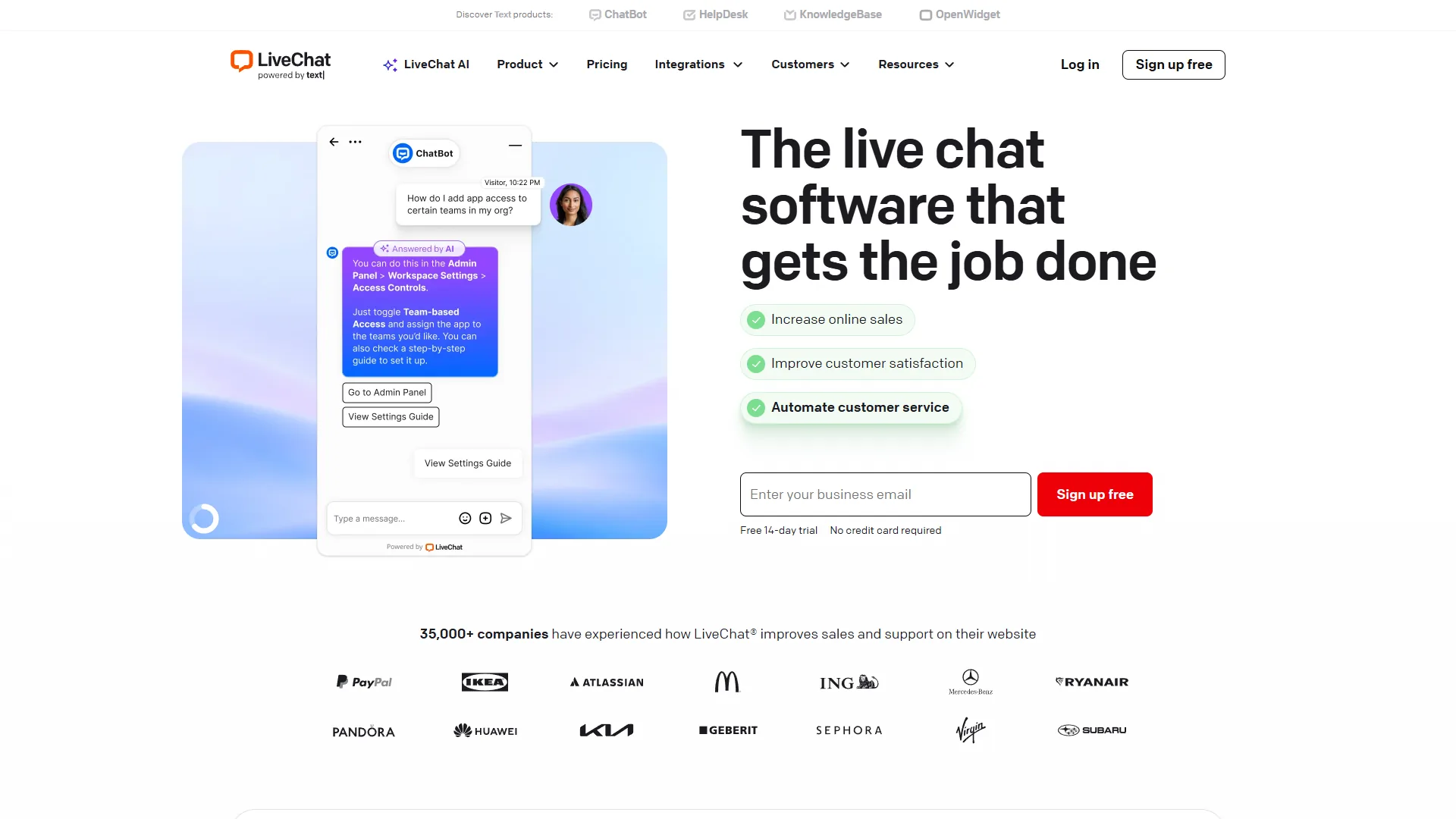
LiveChat is one of the most reliable platforms for enterprise customer engagement, processing millions of conversations.
Key Features: Real-time visitor monitoring, chat analytics dashboard, 200+ integrations (Salesforce, Slack, WordPress), customizable widget, automated responses and chatbots, iOS/Android apps.
Pricing: Starter $20/agent/mo (60-day history) - Team $41/agent/mo - Business $59/agent/mo (staffing prediction).
Pros: 99.99% uptime, powerful team analytics, advanced routing, strong mobile app.
Cons: Higher price, learning curve for advanced features, no free plan.
Best For: Mid-size to enterprise companies handling 100+ daily conversations. LiveChat’s official pricing includes a 14-day trial.
2. Tidio - Best for E-commerce and Small Businesses
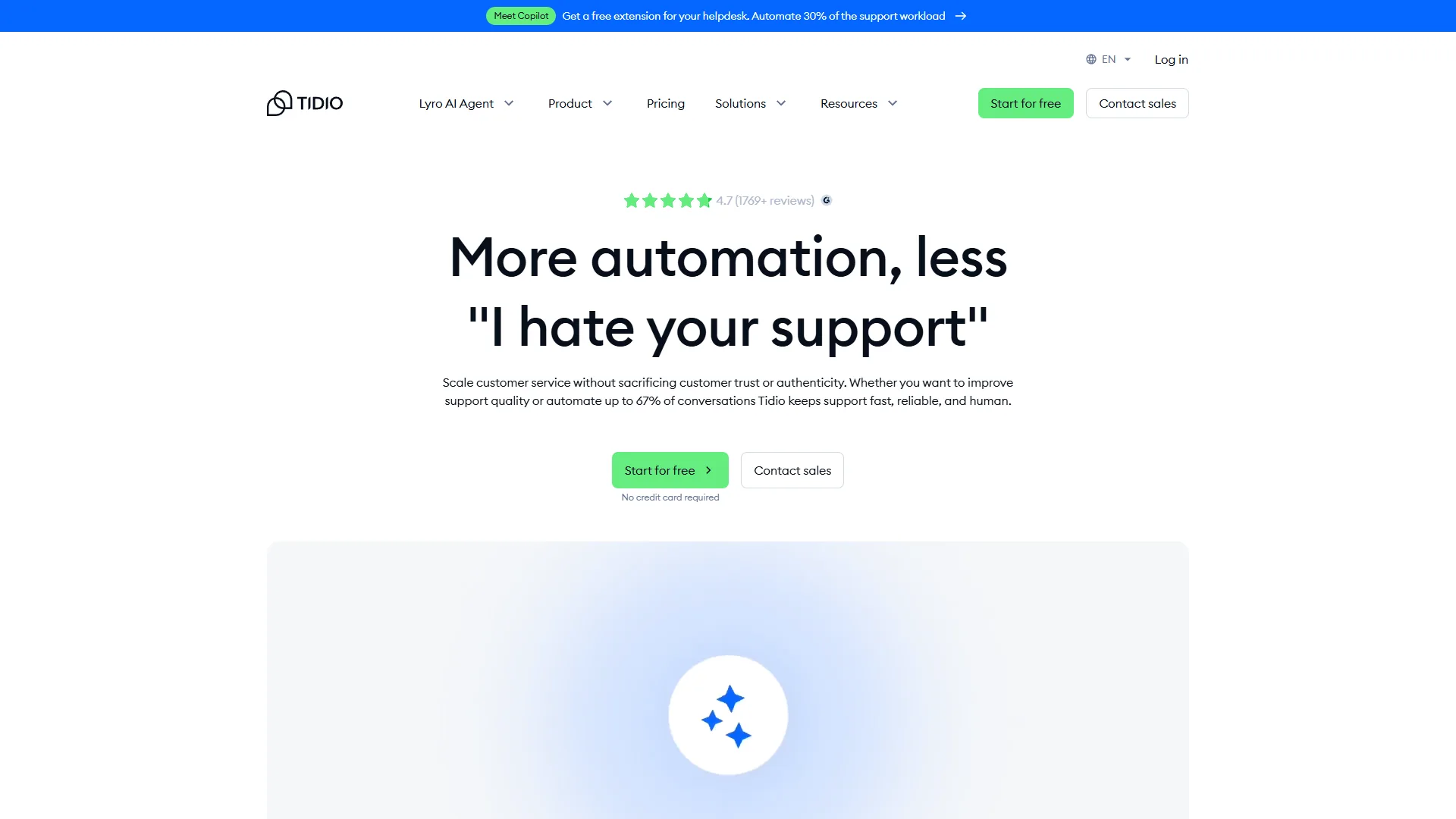
Tidio combines live chat with AI chatbot capabilities, automating common questions for online stores.
Key Features: AI chatbot with pre-built templates, native Shopify/WooCommerce/WordPress integrations, real-time visitor tracking, mobile app, shared inbox.
Pricing: Free (50 convos/mo, 3 operators) - Communicator $19/mo (unlimited convos) - Chatbots $29/mo (AI automation) - Tidio+ custom.
Pros: Generous free plan, intuitive interface, excellent e-commerce integrations, drag-and-drop chatbot builder.
Cons: 50-conversation free limit fills quickly, advanced features require higher tiers, customization limited versus enterprise tools.
Best For: E-commerce stores and small businesses that need quick setup with smart automation for product and order-status questions.
3. Zendesk - Best for Omnichannel Enterprise Support
Zendesk integrates live chat with a help desk and ticketing system, hard to beat for multi-channel support.
Key Features: Omnichannel support (chat, email, social, phone), ticketing with automation rules, AI answer bot, analytics, CRM integration, customizable widget branding.
Pricing: Suite Team $55/agent/mo - Suite Growth $89/agent/mo (advanced AI) - Suite Professional $115/agent/mo (custom roles).
Pros: Seamless cross-channel integration, powerful automation, 1,000+ integrations, enterprise-grade security.
Cons: Expensive for small teams, overkill for basic chat, meaningful setup investment.
Best For: Large organizations managing support across multiple channels, with ticketing integration so no conversation slips through. Check our Zendesk review for the complete feature analysis.
4. Intercom - Best for Sales and Marketing Teams
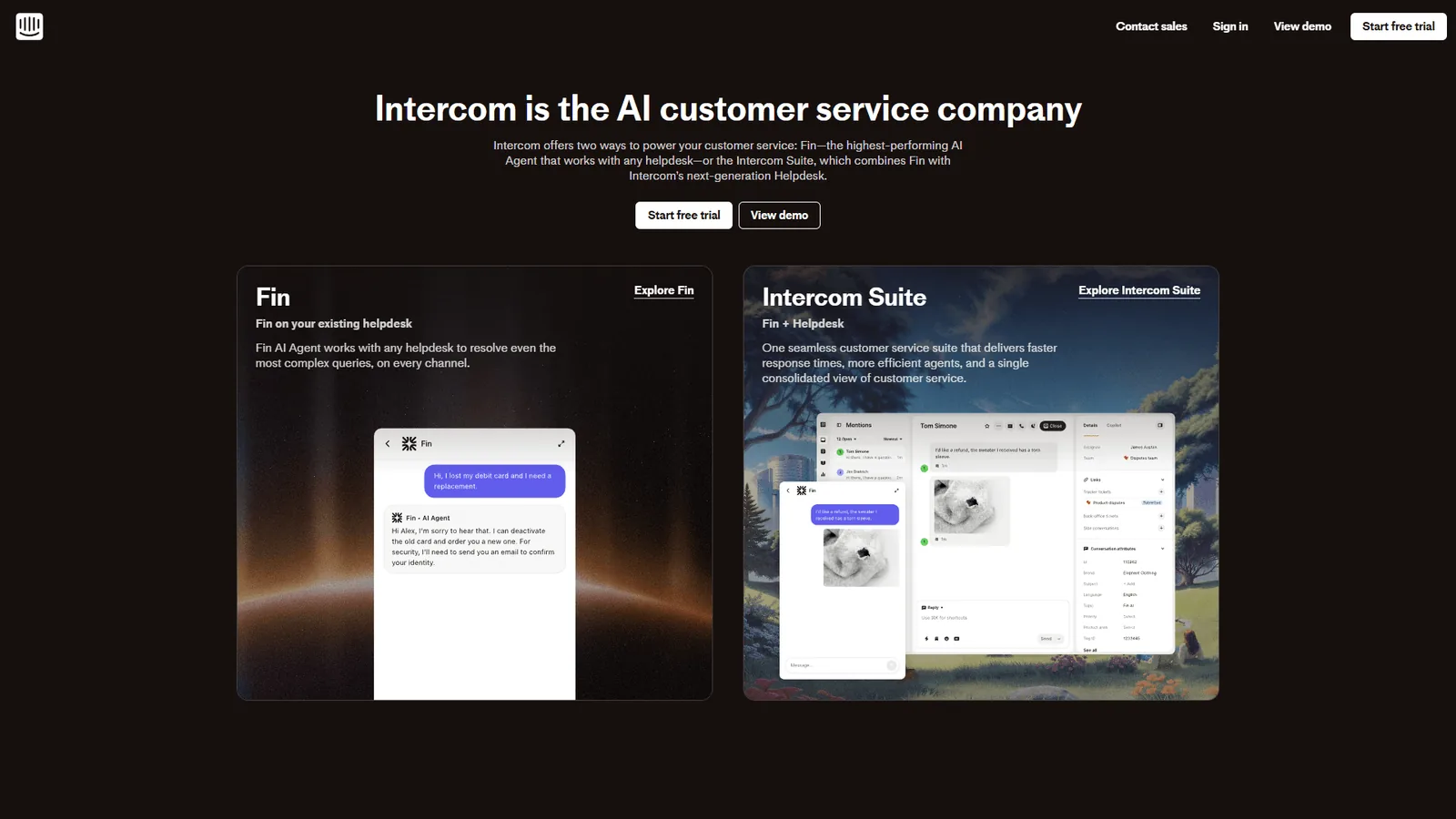
Intercom is a customer communication platform that excels at both support and conversion, shining when you combine support with proactive sales.
Key Features: Product tours and onboarding flows, behavior-targeted messaging, advanced customer segmentation, collaborative team inbox, custom bots for qualification and routing, detailed customer profiles.
Pricing: Essential $29/seat/mo - Advanced $85/seat/mo (custom bots, A/B testing) - Expert $132/seat/mo (analytics, SLAs).
Pros: Exceptional engagement beyond support, powerful automation and personalization, great in-app messaging for SaaS.
Cons: Most expensive option reviewed, complex pricing with add-ons, overkill for basic chat support.
Best For: SaaS companies and growth-focused businesses that want to combine support with marketing automation. Read our Intercom review for the detailed pricing breakdown.
5. Tawk.to - Best Free Live Chat Software
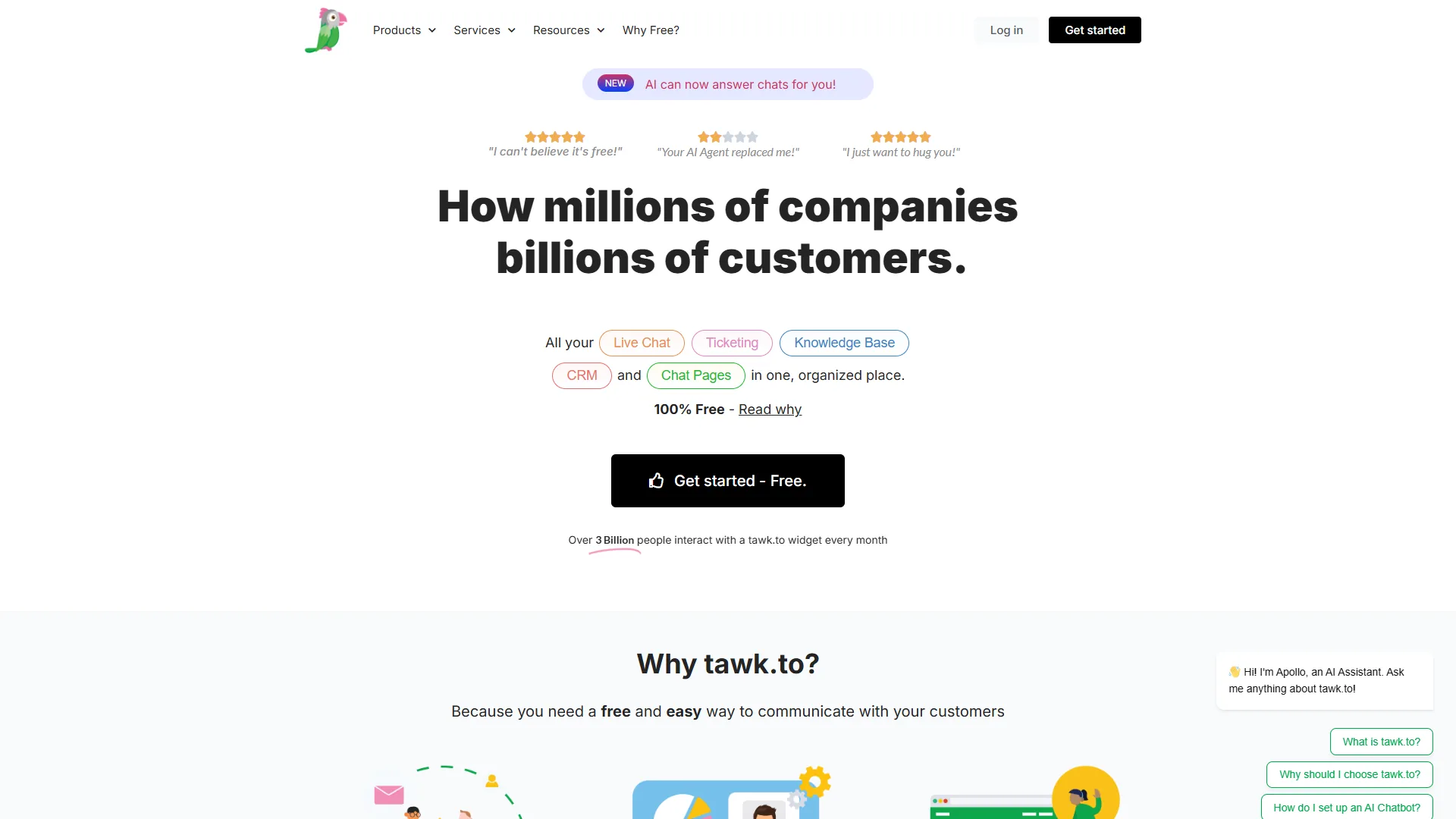
Tawk.to offers completely free live chat software with unlimited agents and conversations - no hidden fees, genuinely free forever.
Key Features: Unlimited free agents and conversations, real-time visitor monitoring, canned responses, file sharing, iOS/Android apps, widget customization.
Pricing: Core features 100% FREE forever - Optional dedicated chat agents at $1/hour.
Pros: Unbeatable value with no monthly costs, no artificial limits, surprisingly feature-rich for a free platform.
Cons: Limited integrations versus paid platforms, basic analytics, revenue model built on optional agent hiring.
Best For: Startups and small businesses that need professional support without a monthly fee, or anyone testing live chat before committing to a paid solution.
6. HubSpot - Best for CRM Users
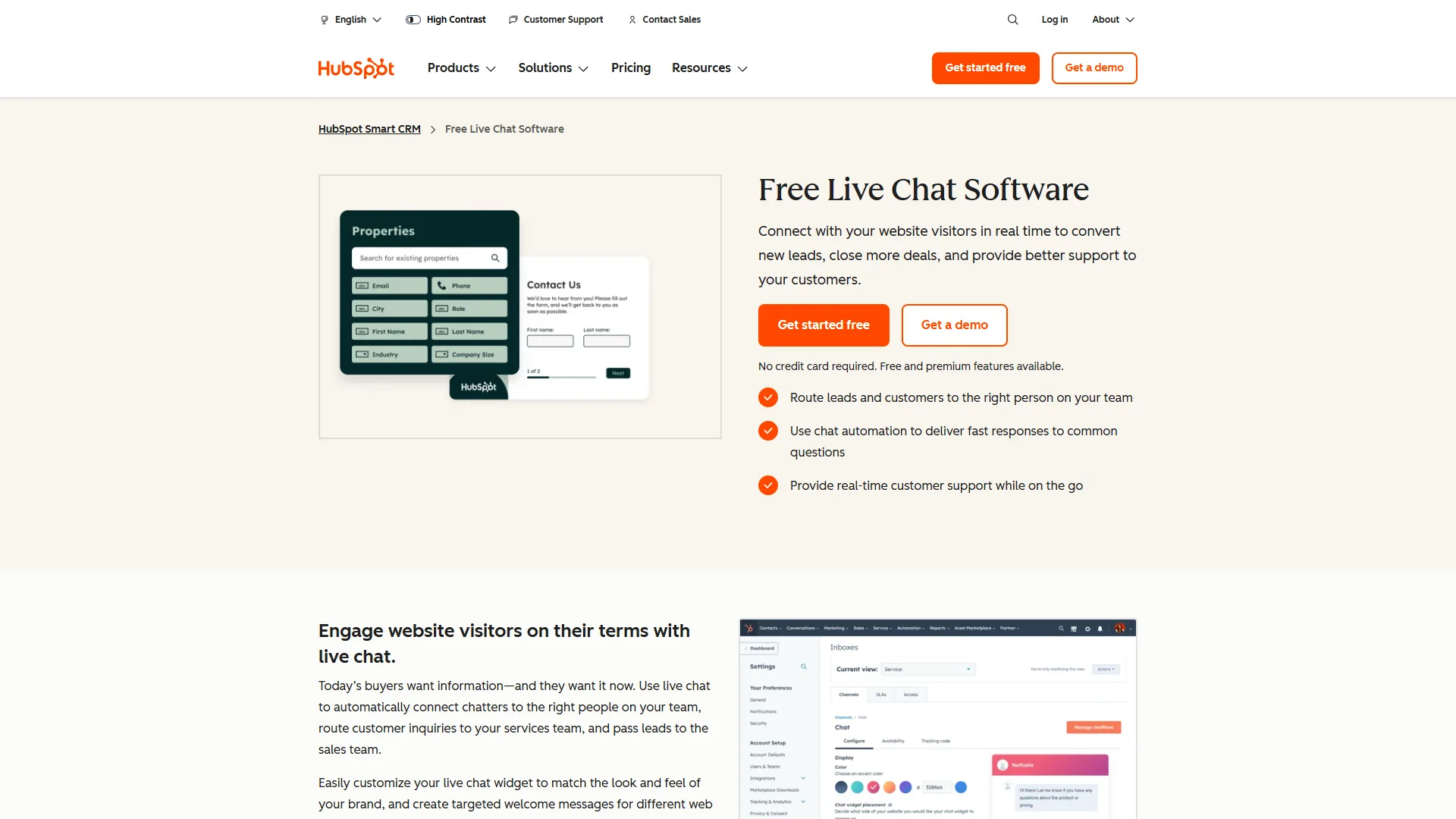
HubSpot’s live chat makes the most sense when you already use HubSpot CRM - every conversation syncs with contact records.
Key Features: Native CRM integration with automatic contact creation, chatbot builder, in-chat meeting scheduler, ticket creation from chat, contact-property-based routing.
Pricing: Free Tools include basic live chat forever - Starter $18/mo (remove branding) - Professional $800/mo (custom bots, reporting).
Pros: Excellent free tier, seamless CRM integration saves manual data entry, easy setup for existing HubSpot users.
Cons: Best value only for HubSpot CRM users, steep jump from Starter to Professional, some features require other HubSpot hubs.
Best For: Companies already using HubSpot CRM or considering a comprehensive customer platform. Our HubSpot review covers the full platform.
7. Crisp - Best for Small Teams with Shared Inbox
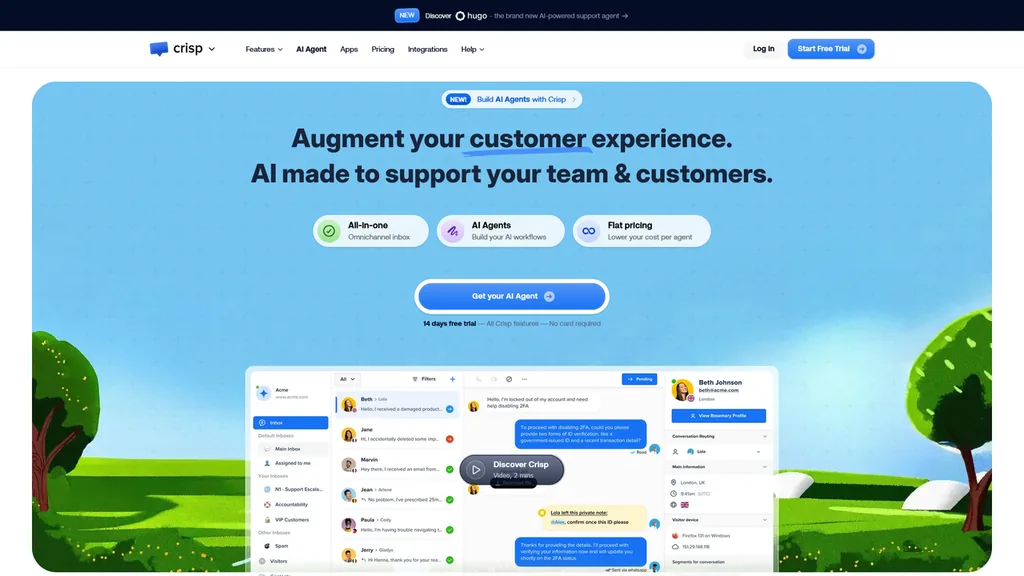
Crisp unifies all customer conversations into one shared inbox - live chat, email, messenger, and more - with a clean, modern interface.
Key Features: Unified shared inbox across channels, co-browsing for visual support, MagicBrowse visitor context, real-time visitor tracking, chatbot, screen sharing.
Pricing: Basic free (2 seats) - Pro $25/mo per workspace (unlimited seats) - Unlimited custom pricing.
Pros: Generous free plan with 2 members, modern interface, co-browsing, flat-rate per-workspace pricing.
Cons: Free plan limited to 2 seats, fewer integrations than competitors, advanced features gated to highest tier.
Best For: Small support teams (2-5 people) who need a clean workspace. The per-workspace pricing in our Crisp overview becomes economical as you add members.
8. LiveAgent - Best for Help Desk Integration
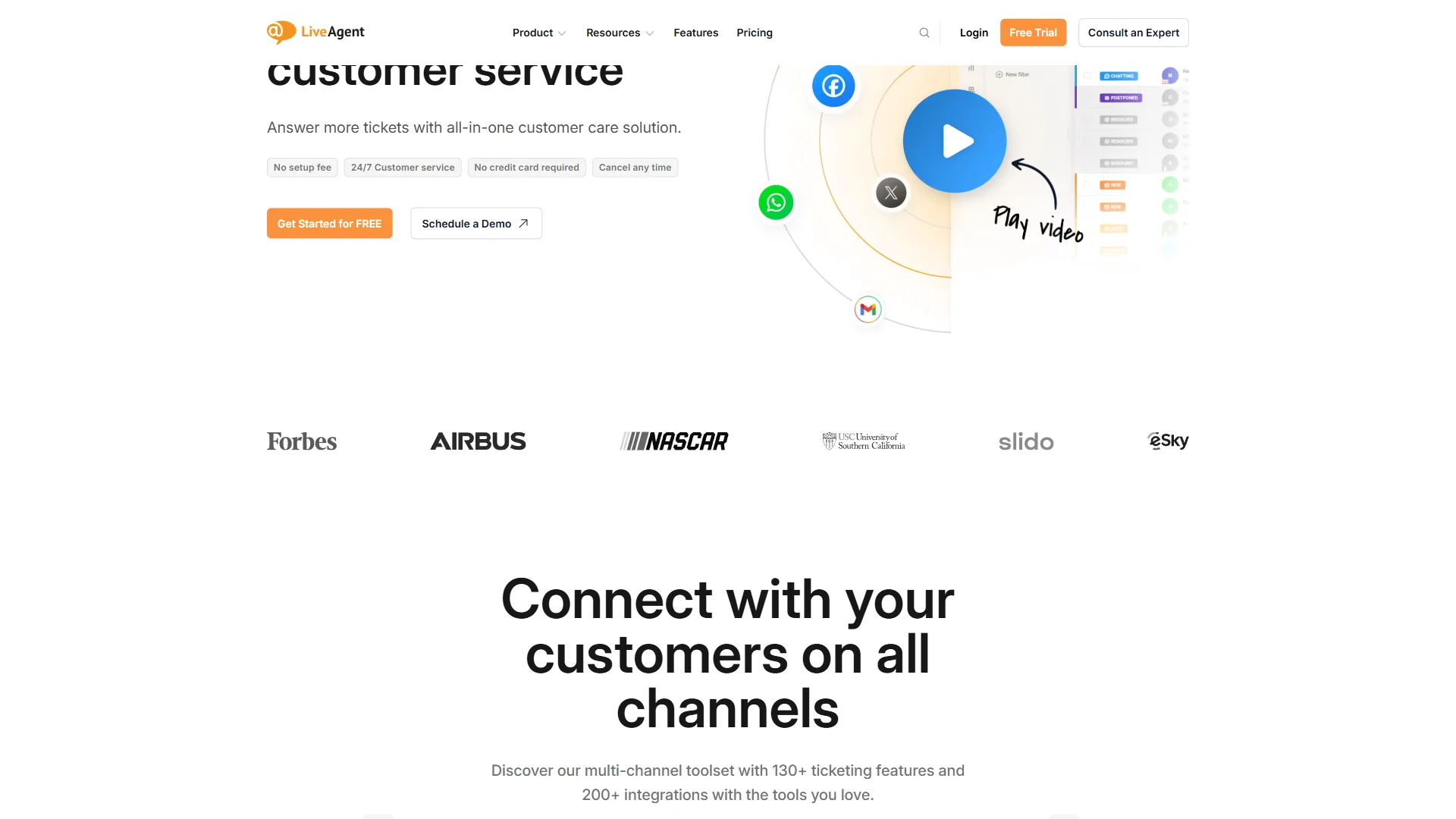
LiveAgent bridges live chat with full help desk functionality, handling email, chat, phone, and social in one interface.
Key Features: Unlimited ticket history, hybrid ticketing (chat, email, phone, social), advanced automation, customer portal and knowledge base, built-in call center features.
Pricing: Small $9/agent/mo - Medium $29/agent/mo - Large $49/agent/mo (unlimited) - Enterprise $69/agent/mo.
Pros: Affordable for small teams, comprehensive help desk features, unlimited ticket history at all tiers, built-in call center.
Cons: Interface feels dated, advanced features have steeper learning curve, lower tiers limit customization.
Best For: Support teams that need help desk features beyond live chat. The ticketing, chat, and call center combination in our LiveAgent breakdown makes it a complete service solution - pair it with the best customer support software comparison.
Free vs Paid Live Chat Software: Which Delivers Better ROI?
Free live chat software delivers better ROI for teams under 50 conversations per month, while paid plans win once volume passes roughly 100 conversations monthly - the point where automation, analytics, and CRM integration pay for themselves.
“Live chat has the highest satisfaction levels of any customer service channel,” according to Zendesk.
When Free Plans Work Well:
Free plans work well at low volume (under 50 conversations per month), small teams (1-3 agents), and during a testing phase. The strongest free options are Tawk.to (unlimited everything, forever), HubSpot (best features for free), and Tidio (good for very small e-commerce).
When Paid Plans Make Sense:
Paid plans make sense once volume, automation needs, or analytics requirements outgrow a free tier. For a store handling 200+ conversations monthly, live chat typically lifts conversion 3-5% and saves 2-3 minutes per conversation versus email. CRM integration also saves 5-10 hours a month of manual data entry.
How Do You Choose the Best Live Chat Software?
You choose the best live chat software by matching your primary goal - cost, ease of use, enterprise scale, sales conversion, CRM integration, or e-commerce fit - to the platform’s strength, the same selection framework used to rank live chat software in 2026 for support teams of every size:
- Most affordable: Tawk.to (free forever) or LiveAgent ($9/agent/mo)
- Ease of use: Tidio or Crisp for modern, intuitive interfaces
- Enterprise features: LiveChat or Zendesk for reliability and scalability
- Sales conversion: Intercom or HubSpot for proactive engagement
- Already use a CRM: HubSpot, or Zendesk for broader integrations
- E-commerce store: Tidio for Shopify/WooCommerce, or LiveChat for high volume
Key Questions to Ask Before Deciding:
- Volume: Under 50 conversations a month suits free plans, 50-200 needs basic paid plans ($20-30/mo), and 200+ calls for professional plans.
- Team size: Per-agent pricing fits 1-2 agents, workspace pricing (Crisp) suits 3-5, and 5+ agents should seek volume discounts.
- Integration needs: Check native integrations, verify two-way CRM sync, and confirm API availability for custom builds.
- Automation level: Canned responses suit basic needs, a chatbot handles FAQ-heavy volume, and AI routing serves advanced requirements.
- Channel requirements: Chat-only fits any platform, chat plus email needs a shared inbox (Crisp, HubSpot), and full omnichannel points to Zendesk or Intercom.
Red Flags to Watch For:
Watch for hidden per-conversation pricing that can explode, “unlimited” plans that cap concurrent agents, essential features gated to the highest tiers, no trial period, and poor mobile apps.
Frequently Asked Questions
The most common questions about live chat software cover four buyer concerns: the chat-versus-chatbot distinction, mobile-app support, how many concurrent conversations one agent can handle, and how to pick the best free live chat app for a growing website. “Live chat has the highest satisfaction levels of any customer service channel,” according to Zendesk’s customer service research, which is why these questions repeat across SaaS companies in 2026 and small e-commerce teams alike.
What’s the difference between live chat and chatbot?
Live chat connects customers to human agents in real-time, while chatbots use automation to answer questions without human intervention. Most modern platforms (like Tidio and HubSpot) combine both - chatbots handle simple FAQs 24/7, complex questions route to live agents, and the hybrid approach cuts response times while controlling costs. For automation-first options, see our roundup of the best AI chatbot platforms 2026.
Can I use live chat software on mobile?
Yes, all eight platforms reviewed offer mobile apps for agents, and visitor-facing chat widgets work seamlessly on mobile websites. Notifications, canned responses, and file sharing are typically available in mobile apps, though advanced analytics may require desktop.
How many conversations can one agent handle?
Industry benchmarks suggest one agent can handle 2-3 simultaneous chat conversations effectively. Simple questions allow higher concurrency, while technical support requires more focus. LiveChat and Zendesk offer staffing prediction to optimize team size against traffic.
Do I need live chat if I already have email support?
Live chat complements email rather than replacing it. Customers prefer chat for quick questions (billing, product availability) and email for detailed issues requiring documentation. The best practice is offering both.
Can live chat really increase sales?
Yes - data consistently shows live chat users spend 60% more on average, because answering pre-purchase questions immediately reduces buying friction. Proactive chat can lift conversion rates 3-5%, though ROI depends on having trained staff available to engage visitors.
What’s the best free live chat software?
Tawk.to is the best free live chat software, offering unlimited agents and conversations forever. HubSpot’s free tier delivers the strongest feature set at zero cost, while Tidio’s free plan suits very low volume (under 50 conversations/month). For most businesses starting out, Tawk.to is recommended for testing viability before upgrading to a paid platform.
How do I prevent spam and abuse in live chat?
Most platforms include spam protection such as pre-chat forms requiring name and email, automatic bot detection and blocking, IP banning for repeat offenders, CAPTCHA for suspicious visitors, and agent controls to block and report users. LiveChat and Zendesk offer the most robust security, including rate limiting and advanced filtering rules.
Which live chat software is best for customer service?
LiveChat and Zendesk are the strongest picks for customer service, pairing real-time chat with analytics, routing, and ticketing. For smaller teams, Tidio and Crisp deliver a polished customer service experience without enterprise overhead.
What is the best live chat for website use?
The best live chat for website use depends on the site: Tidio leads as the top live chat for website storefronts on Shopify or WooCommerce, Tawk.to suits a simple brochure site, and LiveChat fits high-traffic websites that need reliability.
What is the best live chat software 2026 free of cost?
For the best live chat software 2026 free of cost, Tawk.to leads with genuinely unlimited free use, and HubSpot’s free tier follows for teams that also want CRM features. For a growing store, Tidio’s free plan is the best livechat software 2026 free option to start with.
Conclusion: Find Your Best Live Chat Software 2026
The best live chat software 2026 for most teams is Tawk.to for zero-cost unlimited use, Tidio for e-commerce automation, and LiveChat for enterprise reliability - the right choice depends on conversation volume, team size, and budget, and the same three picks anchor most rankings of live chat software in 2026.
For e-commerce stores, Tidio’s chatbot automation and Shopify integration deliver immediate value - our Tidio Shopify setup guide walks through it. Enterprise teams benefit from LiveChat’s reliability and Zendesk’s omnichannel approach, while SaaS companies should explore Intercom.
Recommendation: Start with Tawk.to or HubSpot’s free tier, track conversation volume for 30 days, then upgrade to Tidio (for SMBs) or LiveChat (for enterprise) once you hit free-plan limits.
Related Reading
The eight live chat tools compared in this guide each have a dedicated review on AI Productivity, with feature analysis, pricing breakdowns, and ratings drawn from independent research rather than vendor placements. Tools covered in this article:
- Tidio - E-commerce chat with AI chatbot automation
- Zendesk - Enterprise omnichannel support platform
- Intercom - Customer engagement with Fin AI
- HubSpot - Free CRM with live chat and service hub
- LiveChat - Enterprise live chat with advanced analytics
- Tawk.to - Free live chat with unlimited agents
- Crisp - Shared inbox for small teams
- LiveAgent - Help desk with live chat integration
More customer support and chat guides:
- Shopify Chat Setup Guide - E-commerce chat configuration
- Best Customer Support Software 2026 - Full helpdesk comparison
- Best AI Chatbot Platforms 2026 - AI-powered chat solutions
- Best AI Chatbots for Ecommerce 2026: Tidio vs Drift vs Intercom
External Resources
The three official vendor blogs below are the primary sources for current pricing, feature updates, and customer service research from the live chat platforms reviewed here, and they remain the most-cited references for better customer service guidance across the industry:
- LiveChat Blog - Customer service best practices and feature updates
- Tidio Blog - E-commerce chat automation and chatbot guides
- Intercom Blog - Customer engagement strategies and product releases