




The best LiveChat alternatives in 2026 are Intercom for SaaS teams that need AI deflection, Zendesk for enterprise omnichannel support, and Tidio for SMBs and ecommerce shops that need a real free plan. LiveChat itself remains functional, but AI-powered resolution, proactive messaging, and omnichannel support are now table stakes - and LiveChat’s AI capabilities have not kept pace.
This guide covers Intercom, Zendesk, and Tidio with detailed pricing, feature breakdowns, and clear recommendations for different use cases. According to Salesforce’s State of Service report, 88% of customers say good customer service makes them more likely to buy again - making your support platform a direct revenue lever. Our analysis draws on current vendor documentation and independent research rather than sponsored placement, and AI Productivity may earn a commission from links on this page while rankings remain editorially independent.
Comparison Table: LiveChat Alternatives at a Glance
The top LiveChat alternatives are Intercom at $29 per seat per month, Zendesk at $19 per agent per month, and Tidio with a free tier covering 50 conversations.
| Tool | Starting Price | Free Plan | AI Agent | Best For |
|---|---|---|---|---|
| LiveChat | $20/agent/mo | No (14-day trial) | Limited | Mid-market chat teams |
| Intercom | $29/seat/mo | No (14-day trial) | Fin AI ($0.99/resolution) | SaaS customer success |
| Zendesk | $19/agent/mo | No (14-day trial) | Built-in (AI agents) | Enterprise omnichannel |
| Tidio | $0/mo | Yes (50 conversations) | Lyro AI | SMBs and ecommerce |
Selection Criteria: Why Teams Are Looking Beyond LiveChat
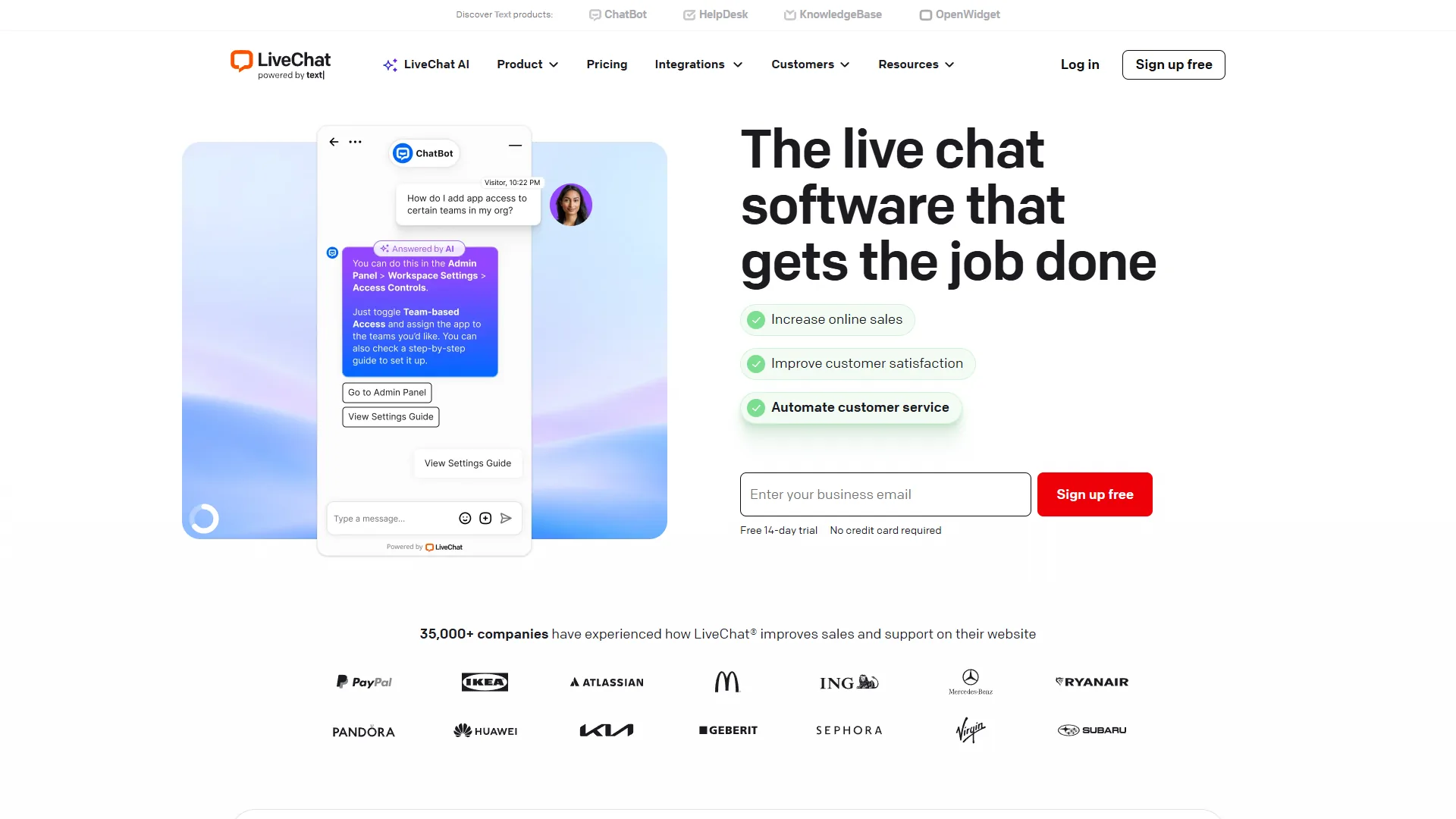
Teams are looking beyond LiveChat because the category has shifted to AI-first resolution, omnichannel coverage, and proactive engagement while LiveChat’s roadmap has stayed incremental rather than transformational.
AI resolution rates. Competitors like Intercom and Zendesk now offer autonomous AI agents that resolve a substantial portion of incoming tickets without human involvement. IBM research shows AI-powered support tools can deflect up to 80% of routine customer inquiries, a benchmark LiveChat’s rule-based bot functionality cannot yet reach. “Generative AI is shifting customer service from a cost center to a value driver,” according to Caitlin Halferty, AI Strategy and Operations Leader at IBM Consulting, summarizing why incumbent chat tools face pressure.
Pricing at scale. LiveChat charges per agent per month, which becomes expensive quickly as teams grow. At five agents, you’re already paying $100+/month before accessing advanced features. Tools like Tidio offer a different model that can work out significantly cheaper for certain team sizes.
Proactive engagement. Intercom pioneered the shift from reactive chat (waiting for customers to click the widget) to proactive engagement (reaching out at the right moment with the right message). LiveChat’s proactive chat features exist but feel comparatively underdeveloped.
Self-service infrastructure. Zendesk and Intercom both include robust help center and knowledge base tools as first-class features. LiveChat’s knowledge base is a bolt-on that requires a separate subscription. Teams shopping the broader market often start with our best customer support software 2026 roundup before zeroing in on a single vendor.
Intercom: Best for SaaS Teams Prioritizing AI and Customer Engagement
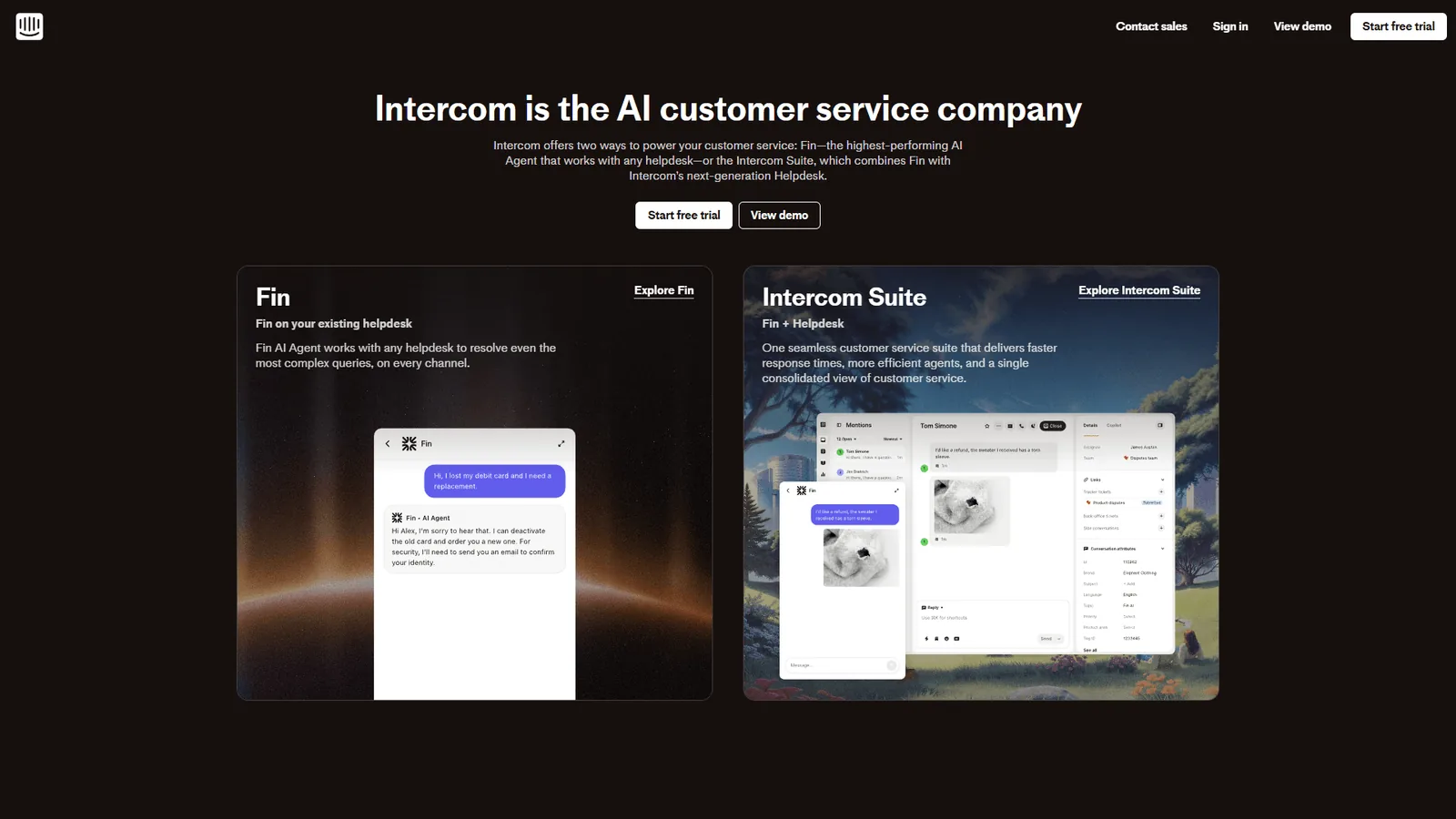
Intercom is the best LiveChat alternative for SaaS teams that need AI deflection and proactive in-app messaging. Its Fin AI Agent operates across chat, email, and other channels to resolve common questions without human intervention, learning from your knowledge base and previous conversations rather than requiring manual rule creation.
What Makes Intercom Stand Out
Fin AI Agent. Fin is Intercom’s standout feature. Unlike rule-based chatbots that need hand-holding through conversation flows, Fin uses generative AI to understand customer questions and pull answers from your help documentation, FAQs, and conversation history. It charges per resolution ($0.99 per resolution on most plans), which aligns costs directly with value delivered.
Messenger and product tours. Intercom’s in-app messenger triggers contextual messages based on user behavior, sends product tours to new users, and engages customers at the moment they are struggling - before they even open a chat window.
Unified inbox with AI Inbox Translation. The Advanced plan includes real-time translation across 45 languages, transformative for global customer bases. Intercom’s Fin AI Agent documentation details how the resolution model is billed.
Shared inbox and ticketing. Intercom handles live conversations and async ticketing in a single interface, eliminating context-switching between systems.
Lite seats. The Advanced plan includes 20 free Lite seats (view-only access with limited actions), useful for CS managers and stakeholders who need visibility without being active agents.
Intercom Pricing
| Plan | Monthly Price | Annual Price | What’s Included |
|---|---|---|---|
| Essential | $39/seat/mo | $29/seat/mo | Messenger, shared inbox, ticketing, help center, Fin AI |
| Advanced | $99/seat/mo | $85/seat/mo | Everything + workflows, round-robin, multilingual help center, 20 Lite seats |
| Expert | $139/seat/mo | $132/seat/mo | Everything + SSO, HIPAA, SLAs, 50 Lite seats |
Fin AI is available across all plans at $0.99 per AI resolution, so cost scales with actual usage rather than a flat rate. For teams with high deflection rates this is cost-effective; for teams with complex queries that Fin frequently escalates, the per-resolution cost adds up. A 14-day free trial is available, and Intercom runs a startup program with significant discounts for qualifying companies.
Where Intercom Falls Short
Limitations and who it’s not for: Intercom’s biggest drawbacks are unpredictable per-resolution Fin AI billing, dense product complexity that punishes light users, and pricing that scales aggressively as seat count grows. Skip Intercom if you only need a simple live chat widget or if you cannot commit to setup hours wiring workflows, series, and product tours.
Intercom is expensive once you add seats plus Fin AI resolutions: a five-agent team on the Essential plan costs $145 per month annually before Fin resolutions. Enterprise deployments scale further. The feature depth - workflows, series, product tours, in-app messages, outbound campaigns - also takes time to implement well; teams that want simple live chat will find Intercom overwhelming.
Who Should Choose Intercom
- SaaS companies focused on customer success and proactive engagement
- Teams with knowledge bases and FAQs that can power effective AI resolution
- Businesses with international customers who benefit from multilingual support
- Organizations where the CS team is closely integrated with product and growth
Zendesk: Best for Enterprise Omnichannel Support
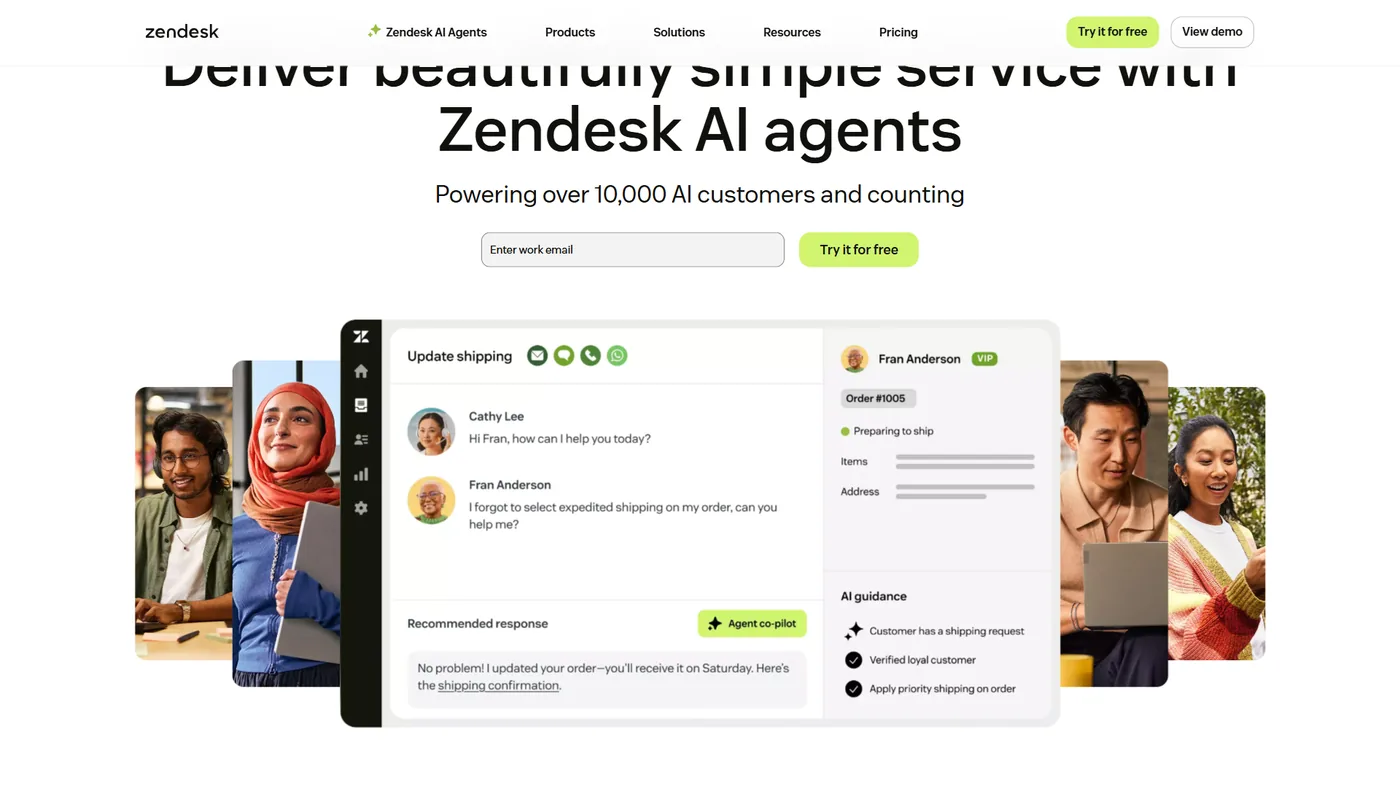
Zendesk is the best LiveChat alternative for enterprise omnichannel support, built for organizations managing high ticket volumes across many channels with complex routing, compliance, and reporting requirements.
What Makes Zendesk Stand Out
AI agents with real autonomous resolution. Zendesk’s AI agents - from Suite Team upward - resolve tickets by generating contextual responses, following conversation flows, and orchestrating actions via API. The Enterprise plan adds autonomous reasoning across complex multi-step issues.
True omnichannel reach. Email, chat, voice, social media (X, Facebook), WhatsApp, and more all feed into a single unified workspace with shared routing and reporting.
2,000+ integrations. CRM, ecommerce, project management, and vertical solutions all have native connectors in the Zendesk marketplace.
Workforce management. Zendesk includes workforce management to forecast staffing, track agent performance, and optimize scheduling around expected ticket volume.
HIPAA compliance. Available from the Enterprise tier, this makes Zendesk viable for healthcare companies and regulated industries other tools cannot serve. For a head-to-head with another helpdesk leader, see our Freshdesk vs Zendesk comparison.
SLAs and skills-based routing. The Suite Growth plan adds SLA management for teams with contractual support commitments and skills-based routing.
Zendesk Pricing
| Plan | Monthly Price | Annual Price | Users | Notes |
|---|---|---|---|---|
| Support Team | $19/agent/mo | $19/agent/mo | Per agent | Email-first, basic |
| Suite Team | $69/agent/mo | $55/agent/mo | Per agent | Multi-channel + AI agents |
| Suite Growth | $115/agent/mo | $89/agent/mo | Per agent | SLAs, skills routing |
| Suite Professional | $149/agent/mo | $115/agent/mo | Per agent | Custom roles, sandbox |
| Suite Enterprise | $219/agent/mo | $169/agent/mo | Per agent | Advanced AI, HIPAA |
| Suite Enterprise Plus | Custom | From $249/agent/mo | Per agent | Full autonomous AI |
The Support Team plan at $19/agent/month is the most affordable platform in this comparison, accessible for smaller teams needing email ticketing without chat. The Suite Team plan at $55/agent/month annually is where Zendesk becomes genuinely competitive - omnichannel support plus AI agents for email, messaging, and web forms.
Where Zendesk Falls Short
Limitations and who it’s not for: Zendesk’s biggest drawbacks are a steep configuration curve, frequent paid add-ons that inflate the real cost beyond the sticker price, and an interface that feels enterprise-grade rather than approachable. Skip Zendesk if you are a small team that needs to be live in a day or if you do not have an ops resource to maintain triggers, views, and routing rules.
Zendesk’s breadth comes with a learning curve - configuring routing rules, triggers, automations, and views takes meaningful setup time. Advanced AI features, workforce management tools, and quality assurance modules also often require add-on purchases on top of the base plan. For small businesses and startups, Zendesk feels like enterprise software that assumes enterprise resources.
Who Should Choose Zendesk
- Enterprise organizations with complex omnichannel support needs
- Teams handling thousands of tickets per month who need sophisticated routing and automation
- Regulated industries requiring compliance features (HIPAA, SOC 2)
- Companies with complex integrations needs across many enterprise tools
- Support teams with dedicated ops resources to configure and maintain the platform
Tidio: Best for SMBs and Ecommerce Teams
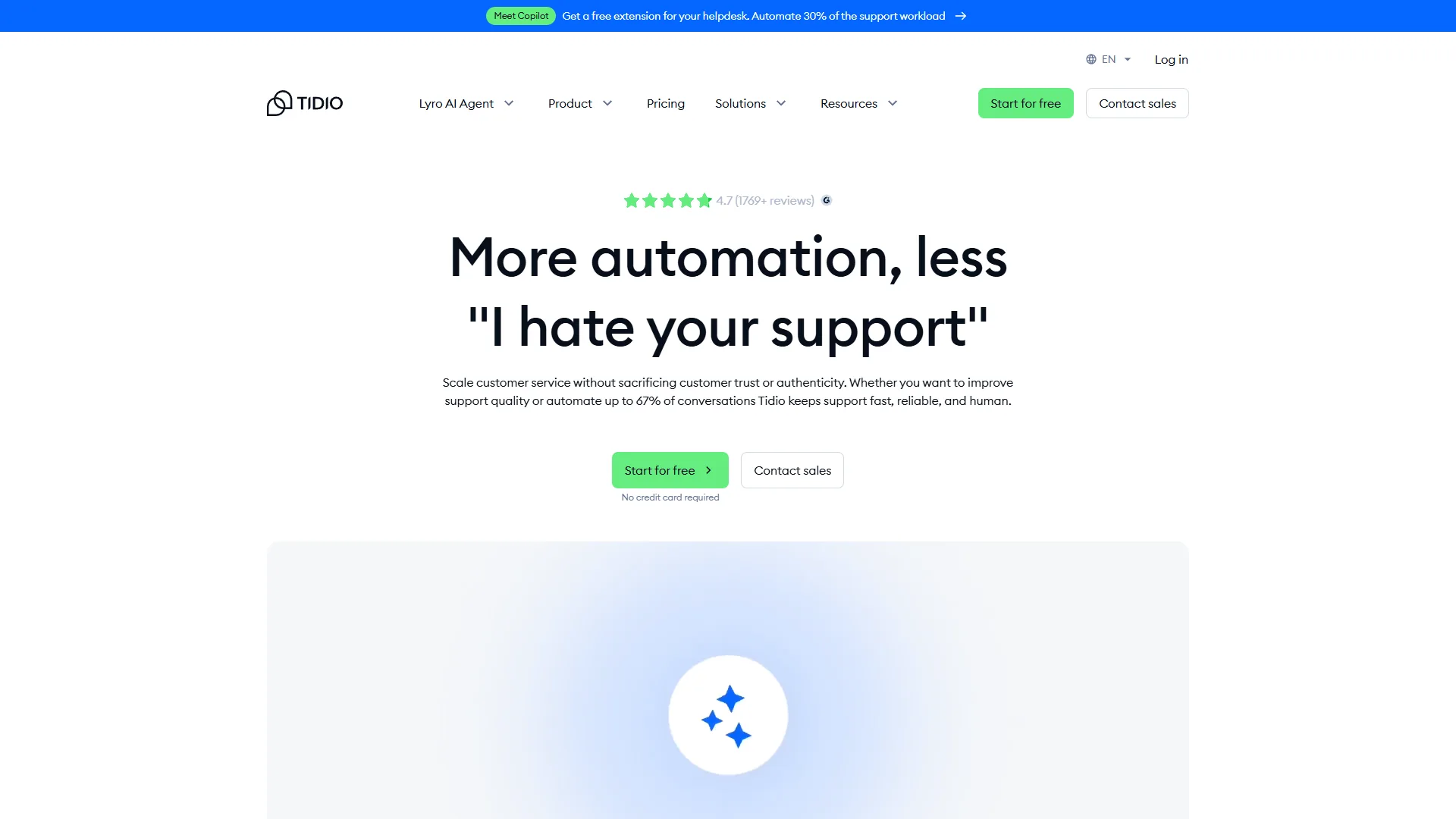
Tidio is the best LiveChat alternative for SMBs and ecommerce teams, offering a free plan covering 50 conversations per month, Lyro AI, and native Shopify and WooCommerce integrations. It also has a strong ecommerce focus that makes it particularly compelling for online retailers without an enterprise-sized budget.
What Makes Tidio Stand Out
Functional free plan. Tidio’s free tier includes 50 conversations per month, up to three operators, live chat, and basic analytics - small businesses genuinely run customer support on it.
Lyro AI. Tidio’s Lyro AI agent is an AI chatbot trained on your content that handles common questions autonomously. Free and Starter plans include 50 one-time Lyro conversations; higher plans offer expanded quotas. Lyro focuses on ecommerce questions - order status, product information, return policies - where automated resolution rates are high.
Flows (visual chatbot builder). Tidio’s visual flow builder lets non-technical users build chatbot sequences without code, complementing Lyro with guided pathways for situations where you want predictable responses.
Ecommerce integrations. Tidio has deep Shopify and WooCommerce integrations - agents see order history, initiate refunds, and check inventory directly within the chat interface. Online retailers comparing Lyro to other store-aware bots should also browse our best AI chatbots for ecommerce 2026 shortlist.
Live visitors list. Even at the Starter tier, Tidio shows a real-time list of visitors browsing your site, enabling proactive chat outreach.
Tidio Pricing
| Plan | Monthly Price | Annual Price | Conversations | Operators |
|---|---|---|---|---|
| Free | $0/mo | $0/mo | 50/month | Up to 3 |
| Starter | $29/mo | Around $24/mo | 100/month | Up to 10 |
| Growth | $59/mo | Around $49/mo | 250/month | Up to 10 |
| Plus | $749/mo | $749/mo | Custom | Up to 10 |
| Premium | From $2,999/mo | Custom | Custom | Custom |
Tidio’s conversation-based pricing model differs from the per-agent pricing used by Intercom, Zendesk, and LiveChat. For small teams with moderate chat volume, this is significantly cheaper; for high-volume operations the model becomes expensive as you upgrade through conversation tiers.
Where Tidio Falls Short
Limitations and who it’s not for: Tidio’s main drawbacks are a hard conversation cap that can shut off chat mid-month, a steep $59 to $749 jump between Growth and Plus that breaks scaling, and analytics that fall short of Zendesk-grade reporting. Skip Tidio if you run a high-volume support team, need SLAs, SSO, or HIPAA, or expect detailed CSAT trends across long time horizons.
Running out of conversations mid-month means customers hit a wall - poor UX for anyone expecting live support. Tidio’s analytics are less sophisticated than Zendesk or even LiveChat, so teams needing detailed CSAT trends or agent performance reports will feel constrained. The Plus plan at $749 per month is also a significant jump from Growth at $59 per month, and enterprise features like SLAs, SSO, and compliance certifications are not Tidio’s focus - large organizations will outgrow it.
Who Should Choose Tidio
- Ecommerce businesses on Shopify or WooCommerce who want chat integrated with order management
- Small businesses that need a functional free plan before they can justify a monthly expense
- Teams that want a visual chatbot builder without technical resources
- SMBs looking for simple, approachable customer support software at a reasonable price
Feature-by-Feature Deep Dive: LiveChat Alternatives Compared
Intercom leads on AI sophistication, Zendesk leads on omnichannel channel breadth, and Tidio leads on price and setup speed across the four feature dimensions that matter most for LiveChat alternatives.
AI and Automation
Intercom leads on AI sophistication. Fin AI understands natural language questions, draws answers from your documentation, and handles multi-turn conversations. Per-resolution pricing aligns costs with results.
Zendesk provides robust AI agents that can autonomously resolve tickets and perform actions via API. The Enterprise tier adds autonomous reasoning for complex issues that would normally require human judgment.
Tidio offers Lyro for generative AI resolution plus a visual flow builder for structured automation. Well-suited to ecommerce query types. Less capable for complex, unstructured support scenarios.
Omnichannel Coverage
Zendesk covers the most channels: email, chat, voice, social media, WhatsApp, and more - all unified.
Intercom focuses on digital channels: in-app messenger, email, and chat. Voice support is limited compared to Zendesk.
Tidio handles chat and email well. Social media integration is available but less central to the platform.
Ease of Setup
Gartner research indicates that implementation complexity is the top barrier to switching customer service platforms, which makes ease of setup a legitimate differentiator worth weighing alongside features and pricing.
Tidio is the easiest to get live. Install the widget, connect your knowledge base, and Lyro starts working within minutes.
Intercom requires more configuration to realize its potential - setting up Fin properly, building workflows, and connecting your documentation takes time but pays off.
Zendesk has the steepest setup curve. Enterprise-grade systems require enterprise-grade configuration.
Pricing for a 5-Agent Team (Annual Billing)
| Tool | Monthly Cost (5 agents, annual) |
|---|---|
| Intercom Essential | $145/mo |
| Zendesk Suite Team | $275/mo |
| Tidio Growth | $59/mo (conversation-based) |
| LiveChat Starter | $100/mo |
The Bottom Line
All three LiveChat alternatives offer better AI capabilities and competitive pricing for their respective market segments.
Choose Intercom for a SaaS product that needs AI deflection, proactive in-app messaging, and a unified support/CS platform. Per-resolution Fin pricing aligns cost with value.
Choose Zendesk at enterprise scale with complex omnichannel needs, compliance requirements, or a large support organization needing sophisticated routing, SLAs, and reporting.
Choose Tidio as a small business or ecommerce team that wants a genuinely useful free plan, simple setup, and AI automation without a major budget commitment - especially for Shopify and WooCommerce stores.
FAQ
Q: What are the alternatives to free LiveChat?
LiveChat does not offer a free plan - only a 14-day trial. The closest free alternative is Tidio, with a genuine free tier covering 50 conversations per month and Lyro AI included. Intercom and Zendesk also run trial-only models, so no-cost teams typically land on Tidio.
Q: What is the best LiveChat platform?
The best LiveChat platform depends on your team. Intercom at $29/seat/mo suits SaaS customer success teams thanks to Fin AI. Zendesk from $19/agent/mo suits enterprise omnichannel support. Tidio from $0 per month is best for SMBs and ecommerce. LiveChat at $20/agent/mo remains a solid mid-market pick when AI sophistication is lower priority.
Q: How does Intercom’s AI compare to other LiveChat alternatives?
Intercom leads on AI sophistication with Fin AI Agent, which understands natural language questions, draws answers from your documentation, and handles multi-turn conversations. Fin charges $0.99 per resolved conversation. Zendesk also offers autonomous AI agents from the Suite Team plan upward, and Tidio provides Lyro focused on ecommerce query types.
Q: Is Zendesk more expensive than LiveChat?
Zendesk’s Support Team plan starts at $19 per agent per month - comparable to LiveChat’s $20 Starter. The Suite Team plan at $55 per agent per month annually is where Zendesk’s omnichannel and AI capabilities unlock, making it more expensive than LiveChat for equivalent feature sets. A five-agent Suite Team deployment costs $275 per month annually.
Related Reading
These related guides expand on individual tool reviews, broader customer support software roundups, and head-to-head helpdesk comparisons for teams still narrowing their shortlist.
- Intercom Review
- Zendesk Review
- Tidio Review
- LiveChat Review
- Best Customer Support Software 2026
- Freshdesk vs Zendesk
- Best Live Chat Software 2026: Complete Comparison Guide
- AI Chatbot Customer Service Tools Compared
External Resources
These external resources link directly to each vendor’s primary pricing page so readers can verify current rates and plan inclusions against this comparison.