

Freshdesk is the better choice for ticket-based help desk support with a free tier for up to ten agents, while Intercom is the better choice for in-app live chat, proactive messaging, and AI-first customer service starting around thirty-nine dollars per seat. The two platforms approach customer service from opposite philosophies - one starts free and grows with your help desk, the other charges per seat and turns every visitor into a conversation.
Introduction
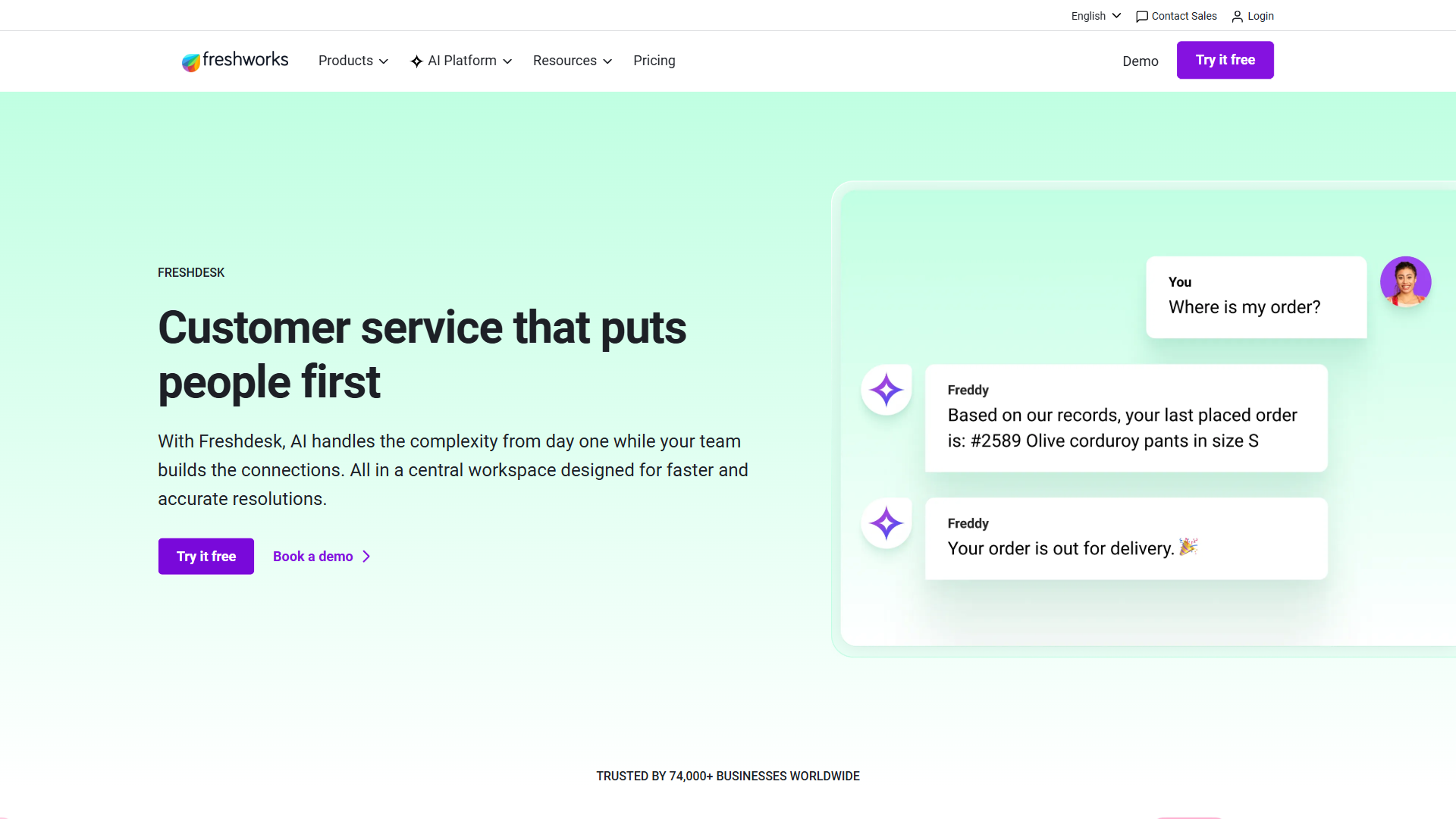
Picking between Freshdesk and Intercom is rarely about feature checklists - it is about which side of the support equation you live on. Freshdesk, from Freshworks, built its reputation on inbound ticketing with a free tier small teams use to get organised without a credit card. Intercom came at the same problem from the opposite direction, treating every web session as a chance to start a conversation. By 2026, both have layered serious AI on top (Freddy AI for Freshdesk, Fin AI Agent for Intercom).
This comparison walks through where each platform wins, where they tie, and which type of business should pick which. (For broader context, see our roundup of best customer service software for 2026.)
Our analysis draws on each vendor’s current pricing and feature documentation rather than sponsored placement. AI Productivity may earn a commission from links on this page; rankings are editorially independent.
Freshdesk vs Intercom comes down to this: Freshdesk is the better choice for traditional ticket-based support and SMB price sensitivity, while Intercom wins for in-app live chat, proactive messaging, and AI-first workflows. Freshdesk starts free for 10 agents; Intercom starts around $39 per seat with no free tier.
TL;DR: Who Should Pick Which
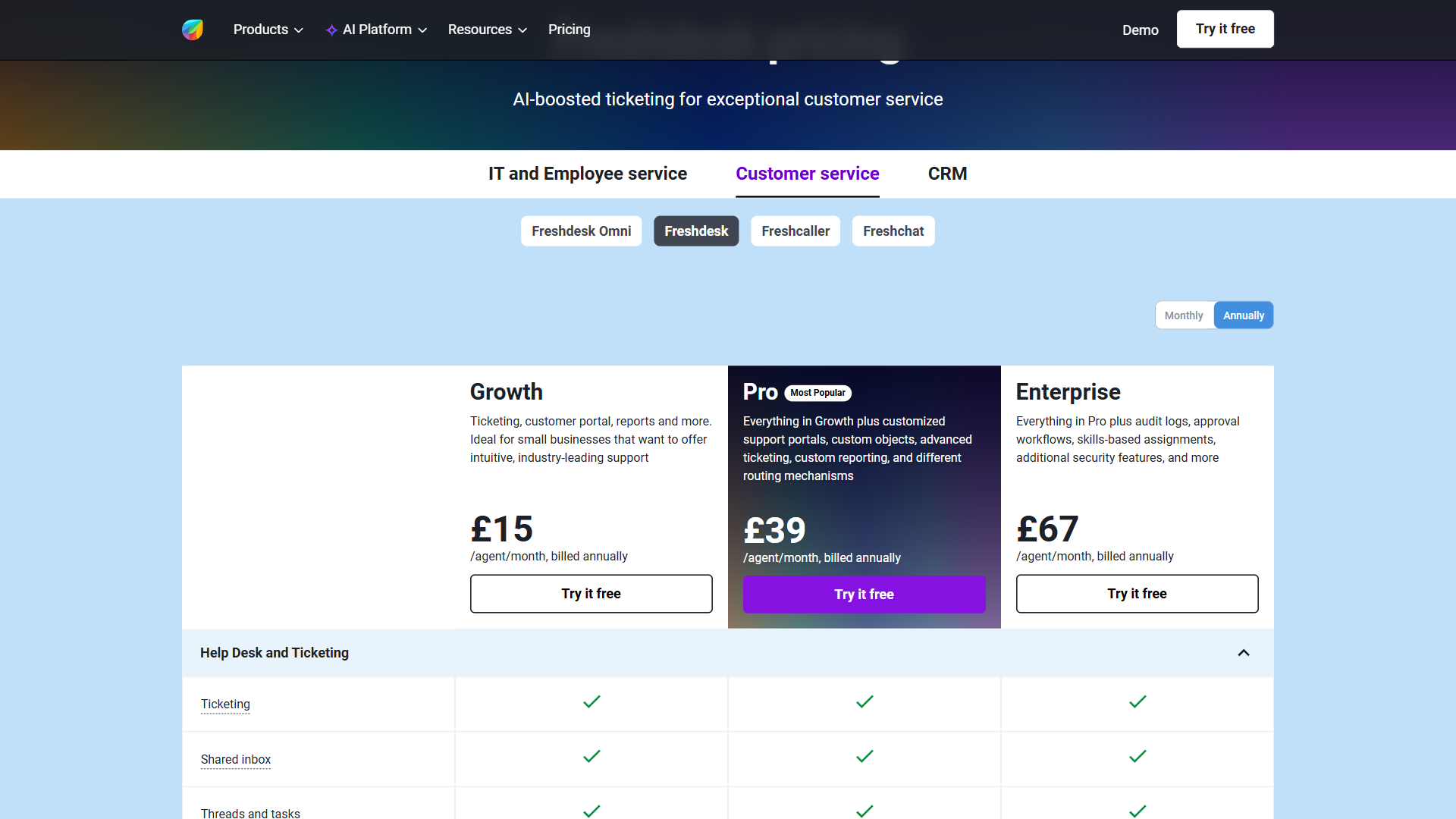
Choose Freshdesk if you are a price-sensitive support team running ticket-based inbound support; choose Intercom if you are a product-led business that needs in-app live chat and proactive messaging. For a small team that needs to organise inbound tickets, route emails, and offer a knowledge base without paying to start, Freshdesk is the easier yes - the free plan covers up to ten agents with core ticketing, social channels, and a basic knowledge base, then Growth at roughly fifteen dollars per agent per month.
For a product-led SaaS or ecommerce business where the website is the front door, Intercom is built for you. The Messenger sits inside your product, fires behaviour-triggered campaigns, and runs Fin AI Agent against live customers in real time. Essential starts around thirty-nine dollars per seat per month with no free tier, but the messaging engine is one Freshdesk cannot match.
Freshdesk vs Intercom: Head-to-Head Comparison
Freshdesk is the better value on price and ticketing depth, and Intercom is the leader on live chat and AI-driven proactive messaging.
| Dimension | Freshdesk | Intercom |
|---|---|---|
| Free tier | Yes - up to 10 agents | No - 14-day free trial |
| Cheapest paid | Growth around $15/agent/mo | Essential around $39/seat/mo |
| Core strength | Ticketing and omnichannel support | Live chat and proactive messaging |
| AI agent | Freddy AI (assistant + copilot) | Fin AI Agent (autonomous resolution) |
| Best for small business | Yes - free tier covers basics | No - per-seat pricing climbs fast |
| Best for sales motion | Limited (CRM is separate product) | Strong (built for product-led growth) |
| Knowledge base | Included on free tier | Included on Essential and above |
| Aggregate rating | 4.5 / 5 | 3.8 / 5 |
| Onboarding speed | Fast - days for SMB | Moderate - weeks for full deployment |
| Best for | SMB support teams, ticket-first workflows | Product-led teams, in-app messaging |
The headline numbers tell the story. Freshdesk wins on price accessibility - a support team of ten can run on the free plan indefinitely. Intercom wins on engagement depth - the Messenger, behaviour triggers, and Fin AI Agent are best in class.
Not ideal for: Buyers fixated on aggregate ratings alone will pick the wrong tool - both platforms have real limitations the rating averages don’t capture (Freshchat’s bolt-on feel and Intercom’s billing complexity, respectively).
Pricing: Free Tier vs Per-Seat
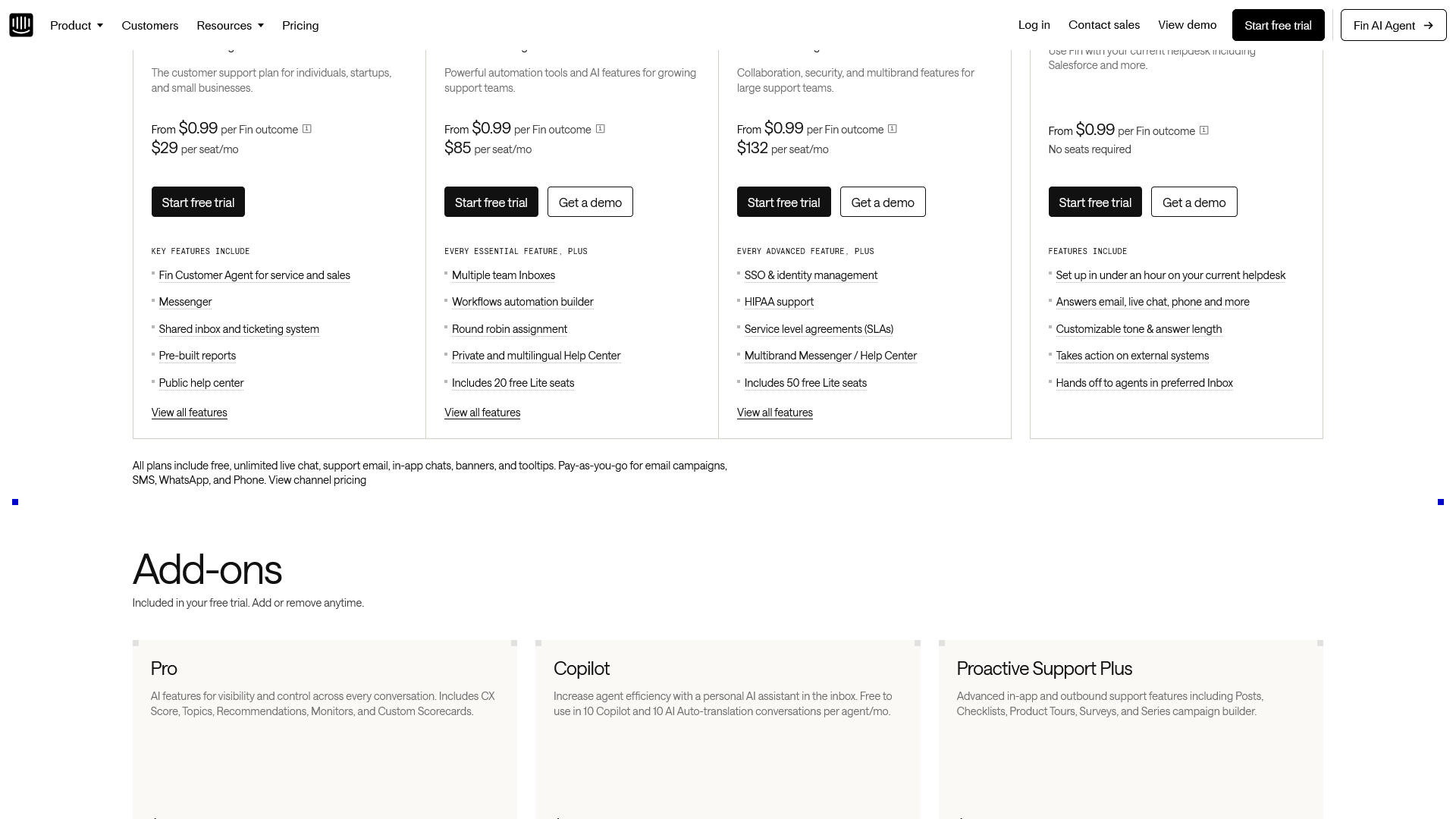
Freshdesk uses a freemium model that is free for up to ten agents and charges roughly fifteen dollars per agent per month on its cheapest paid tier, while Intercom uses per-seat pricing with no free tier, starting around thirty-nine dollars per seat per month after a fourteen-day trial.
Pricing data unavailable for .
Freshdesk’s free plan is the strongest in the category - it covers email and social ticketing, a basic knowledge base, and team collaboration for up to ten agents. Growth (around fifteen dollars per agent per month) adds automation, SLA management, and business hours; the Freshdesk pricing page lists exact figures.
Pricing data unavailable for .
Intercom’s pricing changed materially when the company repositioned around AI. Essential starts around thirty-nine dollars per seat per month and includes the Messenger, basic Fin AI access (charged separately per resolution), and core ticketing. The Intercom pricing page walks through current tiers - per-resolution Fin charges can dwarf seat costs at scale.
The practical math: a 5-agent SMB pays $0 on Freshdesk Free versus roughly $195 per month on Intercom Essential, before any Fin resolutions - at scale Freshdesk typically lands 30-40% below Intercom in total cost of ownership. Price alone should not pick the platform; fit should. See our best help desk software roundup and Zendesk vs Intercom comparison for alternatives.
Not ideal for: Teams expecting linear cost scaling - Intercom’s per-resolution Fin charges can spike unpredictably; Freshdesk’s free tier is hard-capped at 10 agents with no expansion path inside the tier.
Which Has Better Live Chat and Proactive Messaging?
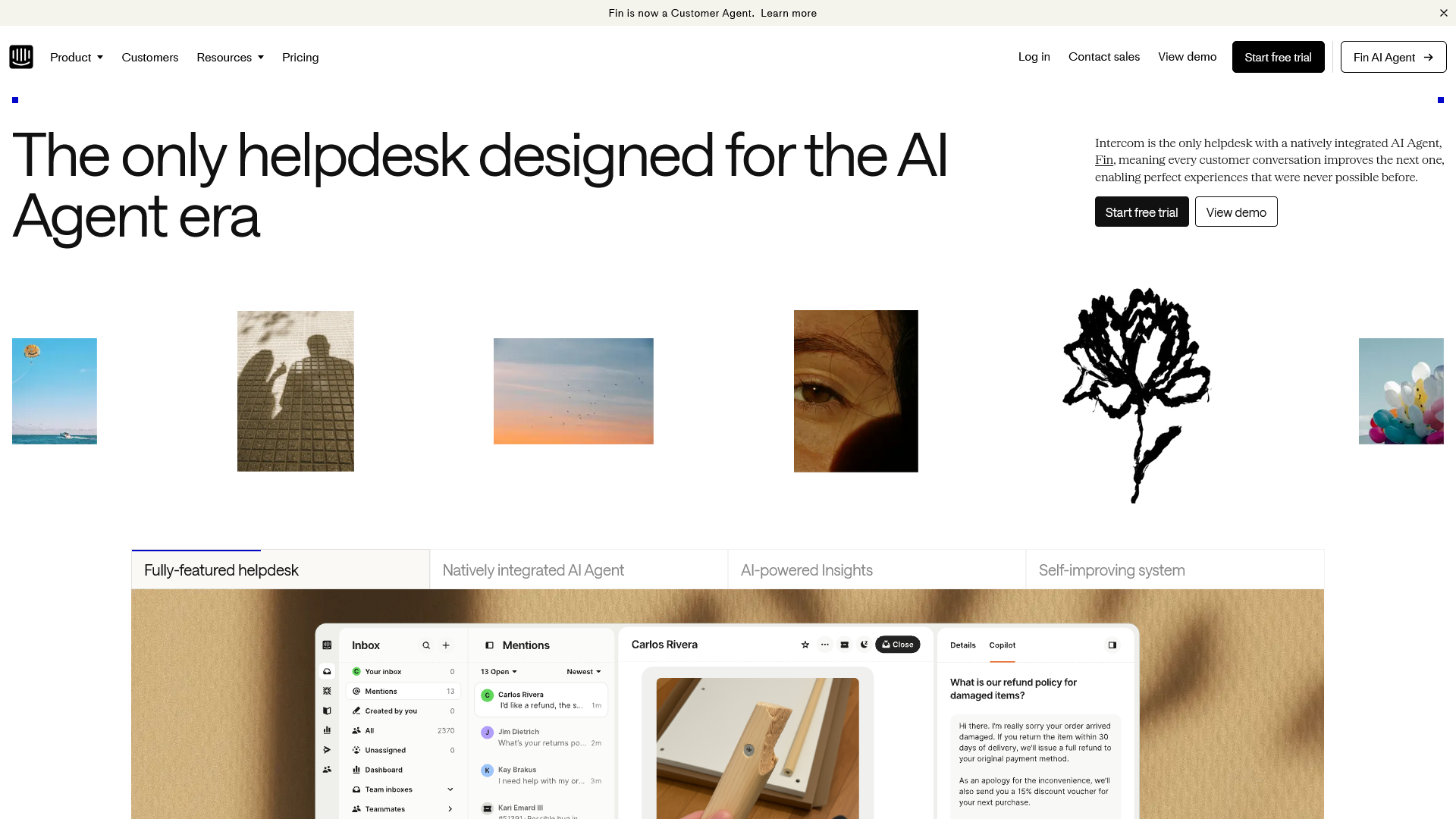
Intercom has clearly better live chat and proactive messaging than Freshdesk, and the gap is not close. The Intercom Messenger is the gold standard for in-product chat - it loads fast, supports rich messaging, and integrates with user attributes so conversations are personalised from the first turn. Proactive messages can be triggered by behaviour (visited pricing page twice, abandoned cart, hit a feature limit) and routed through chatbots before reaching a human (see Intercom’s proactive support documentation).
Freshdesk has live chat through the Freshchat add-on, but it is a bolt-on. Proactive triggers, behaviour targeting, and product-tour functionality that Intercom treats as table stakes are either missing or weaker in Freshdesk. For an conversational AI agent running the first turn inside a SaaS product, Intercom Fin paired with the Messenger is in a different league.
Not ideal for: Intercom’s Messenger-first design is overkill for support teams whose customers contact them mostly by email; Freshdesk’s Freshchat add-on disappoints anyone expecting the same in-product engagement Intercom delivers natively.
Ticketing Workflows
Freshdesk has stronger ticketing workflows than Intercom, with more granular SLA management, automation, and routing built for a queue-driven help desk. Multi-channel ticket capture (email, social, web forms, phone) feeds into a unified queue with round-robin assignment, load balancing, and skill-based routing as standard (see the official Freshdesk support documentation).
Intercom’s modern Inbox handles ticket-style workflows well, but it carries the design DNA of a conversation tool, not a help desk. For email-ticket queues that need triage, assignment, and SLA resolution, Freshdesk feels purpose-built (see the Freshdesk feature breakdown). For real-time chats that occasionally convert into tickets, Intercom feels native.
Not ideal for: Freshdesk’s ticket-first model frustrates real-time chat teams; Intercom’s ticketing disappoints help desk managers expecting deep SLA dashboards.
AI: Freddy AI vs Intercom Fin AI Agent
Both platforms have invested heavily in AI, but in different things. Freddy AI on Freshdesk is positioned as an assistant and copilot - it suggests responses, summarises long ticket threads, drafts replies in the agent’s voice, and routes tickets based on intent. The new Freddy AI Agent runs autonomous resolution against your knowledge base, but the centre of gravity is agent productivity rather than full deflection.
Fin AI Agent on Intercom is the opposite - an autonomous resolver that handles customer conversations end to end, only handing off to humans when it cannot answer. According to Eoghan McCabe, CEO at Intercom, “Fin is the most advanced AI agent in customer service, resolving up to 50% of customer questions instantly and accurately.” Intercom pricing puts Fin on a per-resolution model, which aligns vendor and customer incentives but can add up fast at high volume.
For teams keeping humans in the loop and using AI to make agents faster, Freddy AI is the natural fit. For teams wanting AI to deflect conversations before they reach a person, Fin AI Agent is the more aggressive bet. (See how HubSpot’s Breeze AI compares.)
Not ideal for: Freddy AI is too conservative for teams that want aggressive deflection at high ticket volume; Fin AI’s per-resolution pricing is wrong for teams whose tickets are mostly complex and human-required - you pay regardless of whether it actually resolves.
How Do the Knowledge Base and Self-Service Options Compare?
Both platforms include knowledge base functionality on most paid tiers. Freshdesk’s Knowledge Base supports multi-language articles, version control, SEO meta-fields, and a brandable public help centre - the free plan includes a basic version, which is unusual in the category.
Intercom’s Help Center is similarly capable, with the wrinkle that articles automatically feed Fin AI Agent’s knowledge - improving docs directly improves AI deflection. This dimension is closer to a tie; the decision driver is the rest of the platform.
Not ideal for: Teams that need a public-facing knowledge base with extensive theming and localisation - both platforms are competent here but lag dedicated KB tools like Help Scout.
Integrations & Ecosystem
Freshdesk offers over a thousand integrations through the Freshworks Marketplace, while Intercom offers a smaller App Store with deeper API support. Native Freshdesk connectors cover Salesforce, HubSpot, Slack, Microsoft Teams, Shopify, and Jira.
Intercom’s App Store is smaller but curated, with deep integrations for Salesforce, HubSpot, Segment, Mixpanel, Stripe, Shopify, and Calendly. The Intercom API and webhook system are exceptionally well-built; for piping product events into support, Intercom’s API depth is a meaningful advantage.
Not ideal for: Freshdesk’s breadth means many integrations are third-party-built with variable quality; Intercom’s smaller App Store may not cover niche industry tools.
Reporting & Analytics
Freshdesk’s reporting is comprehensive on paid tiers - SLA performance, agent productivity, ticket volume by source, first response time, resolution time, and CSAT come standard, with Pro and Enterprise adding custom report builders.
Intercom’s reporting is built around conversations rather than tickets, and edges ahead in connecting conversation data to user behaviour - you can segment performance by customer cohort, product usage, or company attribute in ways Freshdesk struggles with. For traditional help desk KPIs (SLA, AHT, FCR), Freshdesk has the more familiar dashboards; for conversation outcomes tied to product engagement, Intercom is more native.
Not ideal for: Freshdesk’s reporting is shallow for cohort metrics; Intercom’s frustrates executives wanting classic SLA dashboards.
Setup Speed & Time to Value
Freshdesk is fast to stand up - a small team can sign up for the free plan, connect a support email, import tickets, and be answering customers within an afternoon. The Freshdesk onboarding flow is one of the better ones in the category and the default settings are sensible enough to skip a long configuration project.
Intercom takes longer because doing it right means installing the Messenger in your product, configuring user attributes, mapping events, designing proactive campaigns, and training Fin on your knowledge base. A solo founder can get a basic Messenger live in 1 day; a serious deployment typically takes 2 to 4 weeks. For long-term value, the slower setup pays back if you actually use the proactive and AI features.
Not ideal for: Freshdesk’s fast setup is a trap for teams that need deep customisation - they end up boxed into defaults; Intercom’s long deployment is impractical for solo founders or pre-funding startups without engineering capacity.
User Reviews & Ratings
Freshdesk has a 4.5 out of 5 aggregate user rating, while Intercom has a 3.8 out of 5 average that reflects pricing complaints more than product quality.
Freshdesk reviews trend positive on ease of use, free tier value, and ticketing depth. Common complaints centre on Freshchat feeling bolted on, UI inconsistencies between modules, and pricing creep as teams move up tiers.
Intercom reviews are more polarised. Power users love the Messenger, behaviour triggers, and Fin AI Agent. Critics flag per-seat pricing climbing aggressively as teams grow, billing complexity around Fin per-resolution charges, and a steep learning curve. Both critiques are fair; the platform is genuinely powerful and genuinely expensive.
Not ideal for: Buyers who weight aggregate ratings as the deciding factor - Intercom’s lower rating reflects pricing complaints from non-target customers, not product quality.
When to Choose Freshdesk
Freshdesk is the right pick when support is ticket-first, the team fits inside the free tier or needs predictable per-agent pricing, and you want a mature help desk rather than an in-app messaging engine. Pick Freshdesk when:
- You are running an SMB support team and the free tier covers your headcount (ten agents or fewer)
- Your support motion is ticket-first - email, web forms, and back-office resolution dominate
- You want deep automation, SLA management, and round-robin routing without per-conversation pricing surprises
- You have price sensitivity and need predictable per-agent costs
- Your AI strategy is augmenting agents rather than fully replacing them on the first turn
- You already use other Freshworks products (Freshsales CRM, Freshchat, Freshcaller)
Freshdesk is the pragmatic choice for organisations that want a help desk to do help desk things without paying for messaging features they will not use.
Not ideal for: Product-led SaaS teams whose engagement model relies on in-app messaging - the Freshchat add-on cannot match Intercom’s depth regardless of how much you pay.
When to Choose Intercom
Intercom is the right pick when customer engagement happens inside your product and proactive AI messaging is core to your strategy. Pick Intercom when:
- You run a product-led SaaS, ecommerce store, or web app where conversations happen in-product
- Proactive messaging - behaviour-triggered campaigns, in-app announcements, product tours - is core to your engagement strategy
- You want an autonomous AI agent handling the first turn of conversations and are comfortable with per-resolution pricing
- You have engineering resources to install the Messenger and integrate product events
- Best-in-class live chat matters more than the cheapest possible per-seat cost
- You measure success in conversation outcomes tied to product engagement, not traditional help desk KPIs
Intercom rewards investment - teams that get the most out of it treat it as a customer messaging engine, not just a chat widget.
Not ideal for: Cost-sensitive SMB support teams under 20 agents whose workflow is mostly email - Intercom’s per-seat pricing plus Fin per-resolution charges add up fast and most of the platform’s value is locked behind features you will not use.
The Bottom Line
Freshdesk is the better choice for inbound ticket-based help desk support; Intercom is the better choice for in-product live chat and proactive AI messaging. Freshdesk is cheaper, faster to deploy, deeper on ticketing, and free up to ten agents. Intercom is more expensive and slower to deploy but unmatched on in-product chat, proactive engagement, and autonomous AI resolution.
Frequently Asked Questions
Is Freshdesk cheaper than Intercom?
Yes - significantly. Freshdesk offers a free tier for up to 10 agents, while Intercom has no free plan and starts around $39 per seat per month. Freshdesk Growth at around $15 per agent per month is roughly a third of Intercom Essential’s per-seat cost; at scale Freshdesk typically lands 30-40% below Intercom in total cost of ownership.
Is Intercom better than Freshdesk for live chat?
Yes. Intercom was built around its Messenger, and the live chat experience - proactive messaging, behaviour triggers, rich messaging cards, and Fin AI Agent integration - is best in class. Freshdesk’s chat (via Freshchat) is competent but feels bolted on. For teams where live chat is the primary support channel, Intercom is the stronger choice.
Can you replace Intercom with Freshdesk?
Partially. Freshdesk replaces Intercom for ticketing, email support, knowledge base, and basic chat - many teams switch when costs become prohibitive. But Freshdesk cannot fully replicate Intercom’s proactive messaging, behaviour-triggered campaigns, and autonomous AI agent resolution. If those features drove your engagement, the switch leaves gaps; if they were unused, the switch saves money.
Which is better for SaaS - Freshdesk or Intercom?
It depends on your SaaS motion. Product-led SaaS companies that rely on in-app messaging and behaviour-triggered campaigns are usually better served by Intercom. Sales-led SaaS companies with traditional inbound support and ticket-first workflows prefer Freshdesk. A useful tiebreaker: if your team thinks in conversations, pick Intercom; if they think in tickets, pick Freshdesk.
Related Reading
The following guides are deeper references on Freshdesk, Intercom, and the wider customer service software landscape.
- Freshdesk - Full Freshdesk review with ratings, pricing, and feature analysis
- Intercom - Full Intercom review covering Messenger, Fin AI Agent, and pricing
- Zendesk vs Intercom - Intercom against the enterprise help desk leader
- Freshdesk vs Zendesk - the classic SMB versus enterprise help desk matchup
- Freshdesk vs HubSpot Service Hub - Freshdesk against an all-in-one CRM-attached service tool
- Best Live Chat Software 2026 - the broader live chat landscape
- Freshdesk Alternatives - other help desk options if neither fits
External Resources
Freshdesk and Intercom offer official vendor pages with current pricing, Fin AI Agent documentation, and feature references.