



Zendesk wins for enterprise omnichannel and compliance-heavy support orgs, and Intercom wins for chat-first SaaS teams that prefer per-resolution AI pricing. This 2026 software comparison has both AI agents put to the test on pricing, deflection economics, and best use cases, with the support tool wins sorted by company stage below. Our research draws on vendor documentation and independent analyst notes - a detailed comparison guide for 2026 buyers, not sponsored placement.
Introduction
Zendesk is better for enterprise omnichannel and compliance-heavy teams, while Intercom is better for SaaS teams that want chat-first AI priced per resolution. Zendesk and Intercom are the two names that come up in almost every shortlist, and the gap between them in 2026 is sharper than it has been in years. Zendesk has rebuilt itself around Agentic AI and a GPT-5 backbone, while Intercom’s Fin 3 launch doubles down on a per-resolution AI agent that prices itself like a contractor instead of a seat.
Zendesk vs Intercom comes down to architecture and billing. Zendesk bundles AI into per-agent Suite tiers starting at $69 and scaling to enterprise GPT-5 agents, ideal for omnichannel and compliance-heavy teams. Intercom prices Fin AI at $0.99 per resolution on top of seat costs starting at $39, which favors SaaS teams with chat-first workflows. This comparison draws on each vendor’s current pricing and product documentation plus aggregated user reviews rather than sponsored placement, and AI Productivity may earn a commission from links on this page - our rankings are editorially independent. Our best customer support software roundup covers the broader market if neither fits.
Quick Comparison
| Factor | Zendesk | Intercom |
|---|---|---|
| Pricing entry tier | Support Team $19/agent/mo | Essential $39/seat/mo |
| AI agent model | Agentic AI (GPT-5 on Enterprise Plus) | Fin 3 ($0.99 per resolution) |
| Best for | Enterprise omnichannel, compliance | SaaS teams, real-time chat |
| Free trial | 14 days | 14 days |
Neither platform offers a free tier in 2026. Both run paid-only with limited free trials, so the real question is which paid floor you can stomach. Shared limitations: no free plan, no truly cheap entry tier under $39/seat, and migration between the two is painful enough that switching mid-stream is rarely worth it.
Zendesk Overview
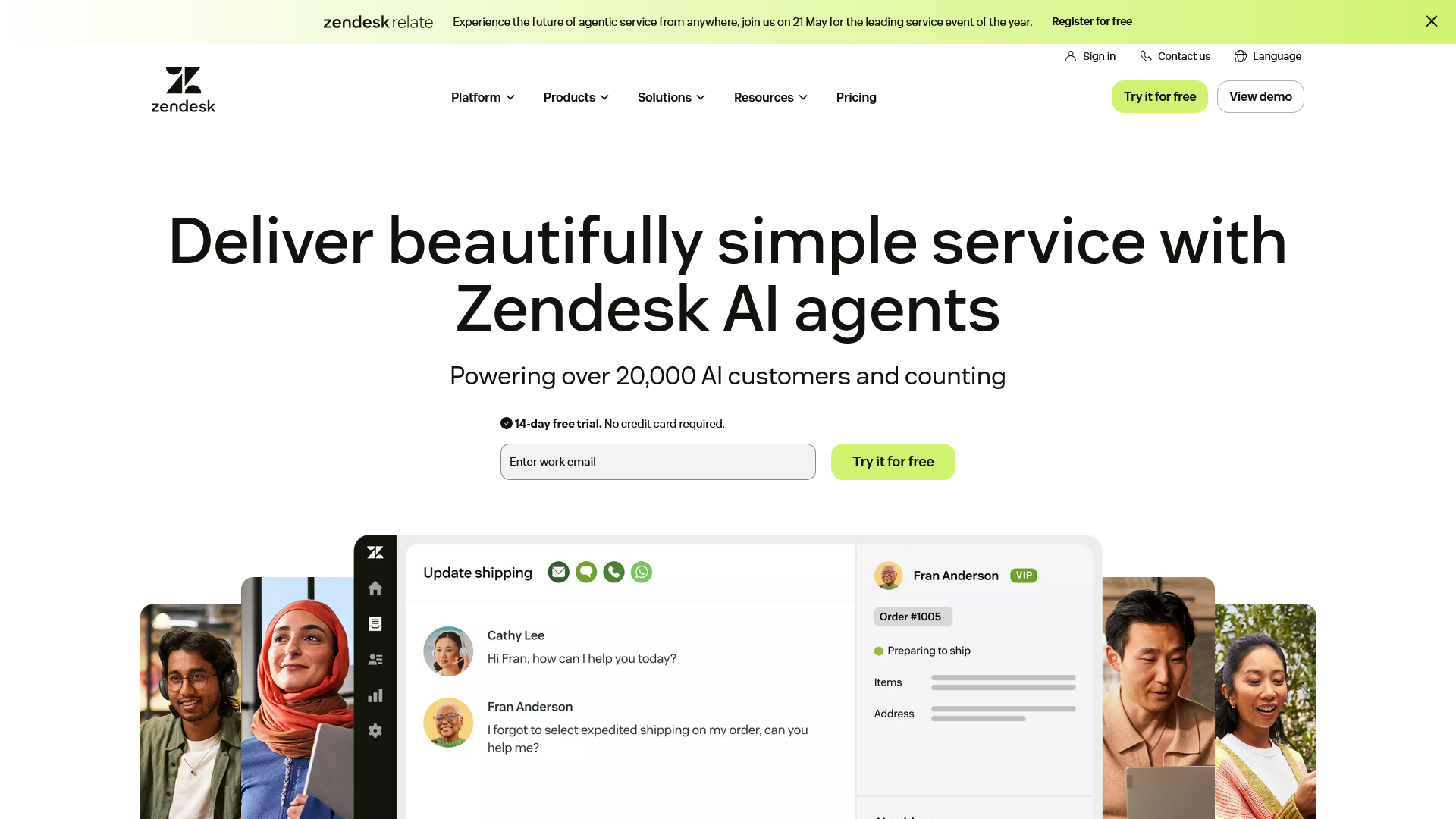
Zendesk is the incumbent enterprise help desk. It started as a ticketing system and has expanded into a full Resolution Platform that covers email, chat, voice, social, and self-service knowledge bases. Its 2026 stack centers on Agentic AI agents - autonomous workflows that triage, draft, and resolve tickets without a human in the loop until escalation is needed. The Suite Enterprise Plus tier ships with GPT-5 integration, voice AI for phone deflection, and a claim of more than 50% email automation in deployments analyzed in customer case studies.
Who it is for: enterprise teams running omnichannel support, regulated industries that need HIPAA and SOC 2 coverage, and operations with 2000+ integrations across Salesforce, Jira, and proprietary CRMs. Based on aggregated user reviews, Zendesk wins on customization depth and reporting granularity but loses on setup speed - the Suite Professional and Enterprise tiers can take weeks to configure properly. Teams comparing further down the stack should also check our Zendesk alternatives breakdown.
Who it’s not for: small teams under five agents, founders looking for a free plan, or anyone wanting to be live in a day. Zendesk has no free tier, the entry Suite Team plan starts at $69/agent, and configuration complexity is a recurring complaint in onboarding feedback. If you mostly need a polished in-app chat widget, see our best live chat software round-up for lighter alternatives.
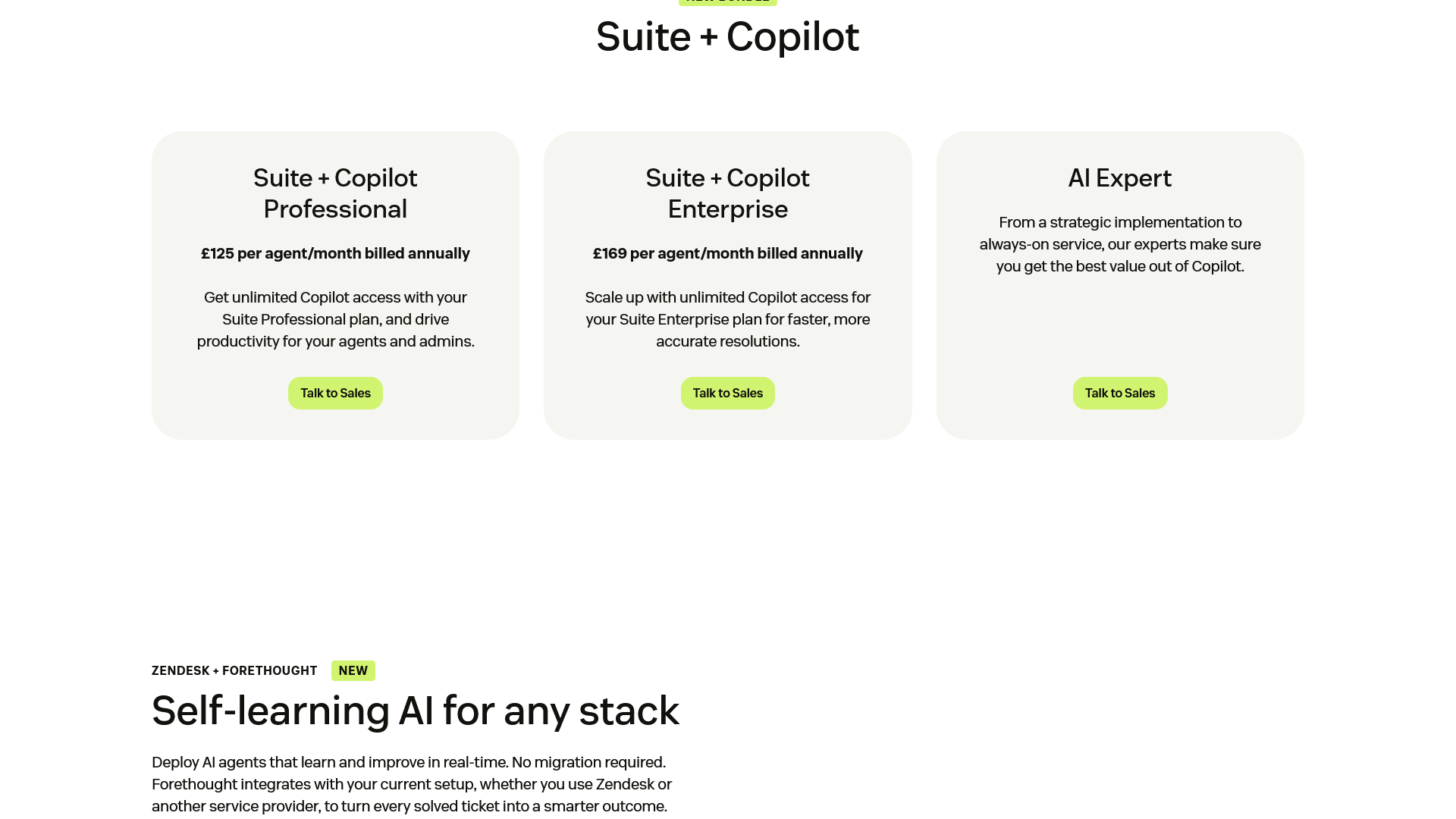
Zendesk pricing is per-agent, per-month, and the gap between tiers is significant. The Support Team plan at $19 covers ticketing only. The Suite Team plan at $69 is the realistic starting point for most teams because it adds chat, voice, social, and basic AI agents. Suite Enterprise at $219 unlocks the Advanced AI agents and HIPAA, and Suite Enterprise Plus is a custom quote for the GPT-5 Agentic AI tier.
Pricing verified April 2026 from Zendesk's pricing page:
- Support Team: $19/user/mo (Entry-level, email-first support)
- Email support
- Ticketing system
- Basic help center
- Suite Team: $55/user/mo annual ($69 monthly) (Multi-channel support for small teams)
- Email, chat, voice, social support
- Branded help center
- Prebuilt analytics dashboards
- Suite Growth: $89/user/mo annual ($115 monthly) (Growing teams with advanced needs)
- All Suite Team features
- Skills-based routing
- SLAs
- Suite Professional: $115/user/mo annual ($149 monthly) (Professional teams requiring customization)
- All Suite Growth features
- Custom roles and permissions
- Advanced security
- Suite Enterprise: $169/user/mo annual ($219 monthly) (Enterprise-grade with full compliance)
- All Suite Professional features
- AI agents - Advanced (conversation flows, API orchestration, advanced analytics)
- Voice AI agents
- Suite Enterprise Plus: Contact sales (Highest tier with premium support - contact sales)
- All Suite Enterprise features
- Agentic AI with GPT-5 integration (autonomous reasoning and action)
- Voice AI agents with natural speech understanding
Intercom Overview
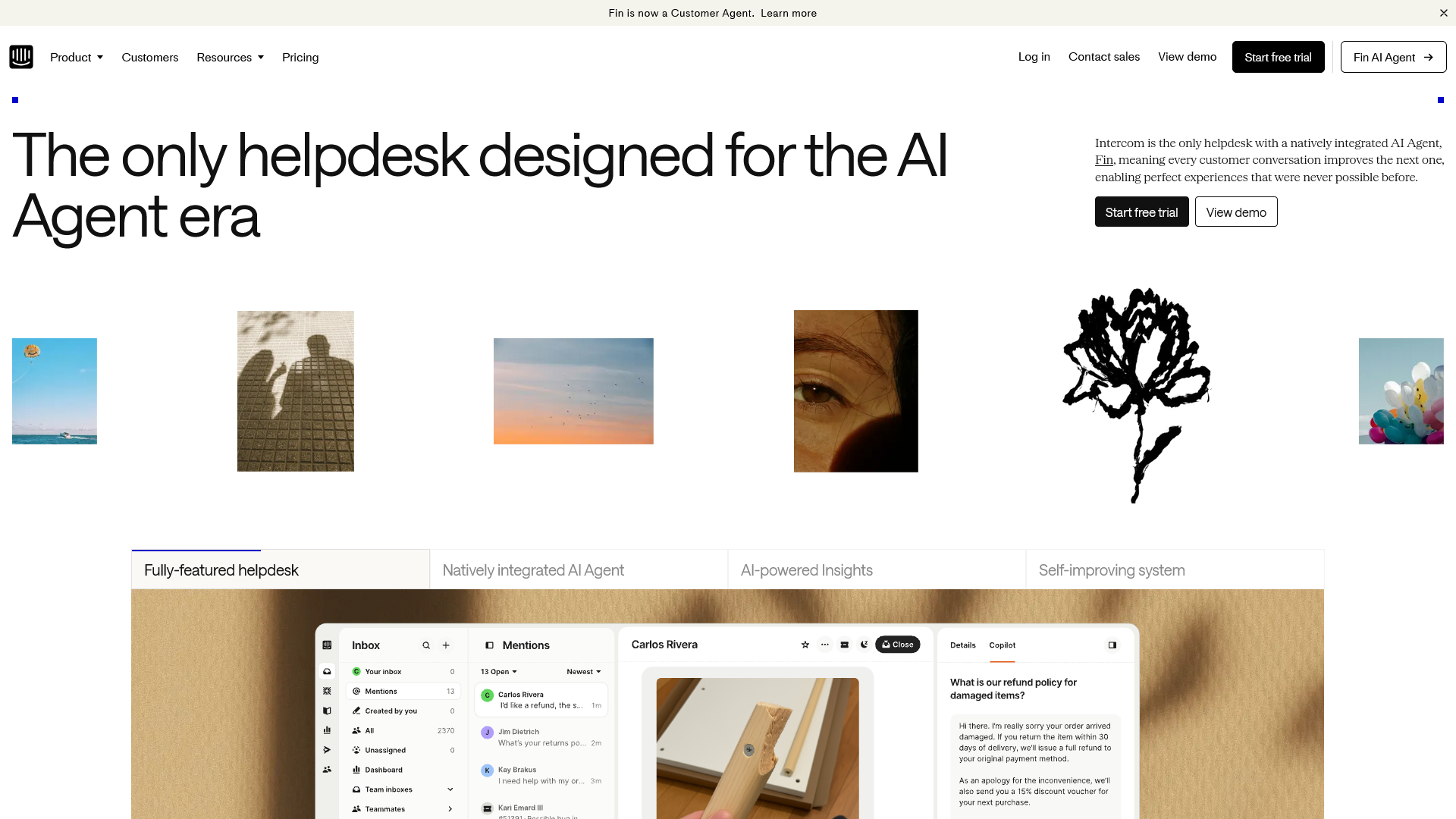
Intercom is an AI-first customer service platform built around an in-app messenger and the Fin AI Agent, priced per resolution rather than per seat. Intercom built its name on that messenger and has spent the last two years repositioning around AI. The product everyone is talking about in 2026 is Fin 3, the third generation of its AI Agent. Fin 3 ships with Fin Voice for phone, Fin Vision for image recognition (think customer screenshots and product photos), and 45-language inbox translation built into the agent inbox.
Who it is for: SaaS companies, growing support teams under 50 agents, and product-led businesses that already lean on in-app chat. Intercom’s startup program offers up to 90% off for early-stage companies, which makes the real intercom cost dramatically lower than the list price suggests for venture-backed teams. In practice, larger support orgs sometimes outgrow Intercom on omnichannel depth and switch to Zendesk; smaller teams that try Zendesk often bounce back to Intercom for the cleaner messenger UX.
Who it’s not for: high-volume support orgs running 10,000+ monthly tickets - Fin’s $0.99-per-resolution model can balloon past $10K/month at that scale. Compliance-heavy industries also tend to need Zendesk’s deeper HIPAA and SOC 2 controls. If you want a broader category survey, our customer support software guide covers more options. Comparison shoppers may also want our Freshdesk vs Zendesk breakdown.
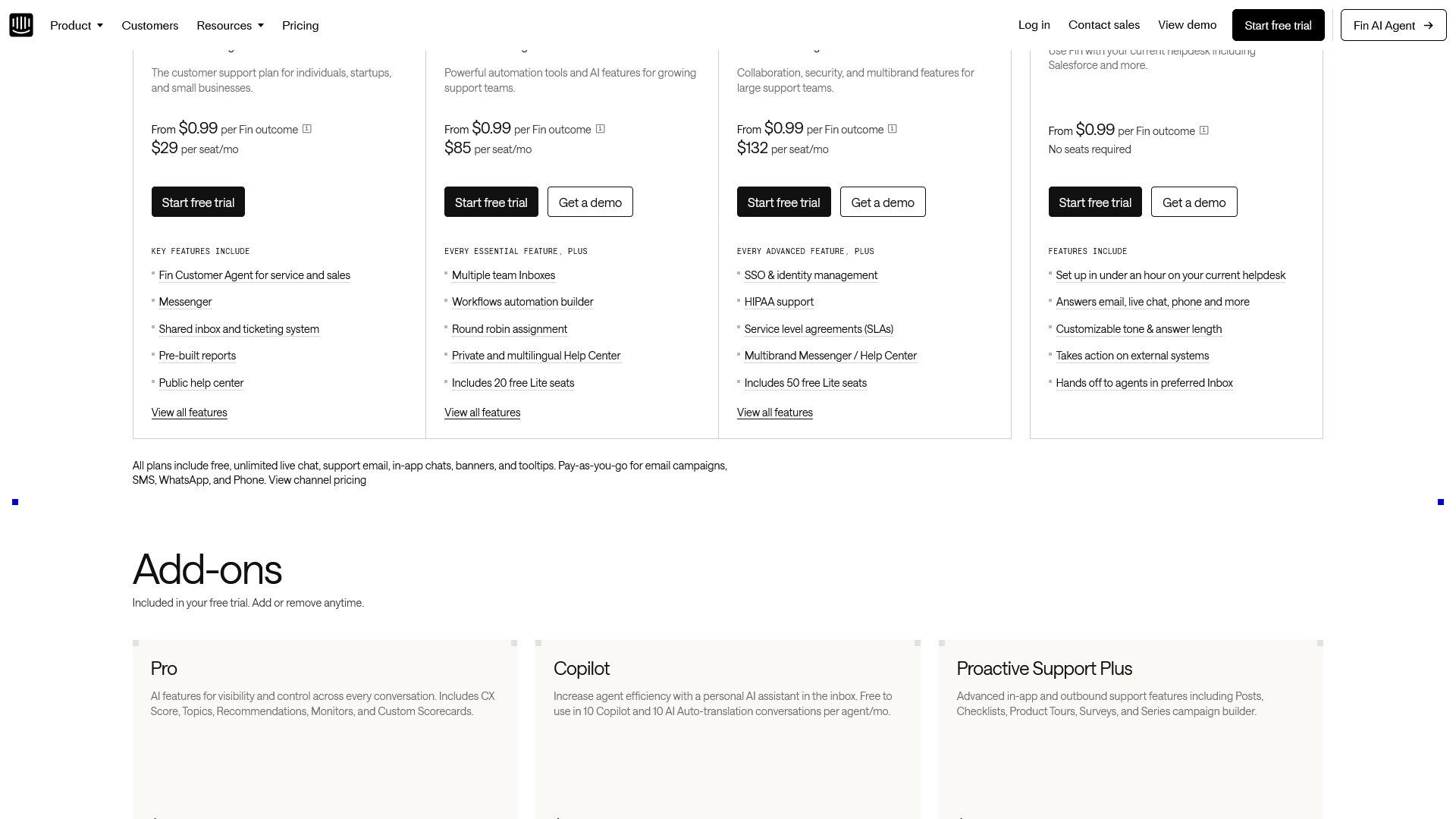
Intercom’s pricing model is what makes this comparison interesting. Seat costs are per-seat, per-month: Essential at $39, Advanced at $99, Expert at $139. But Fin AI is billed separately at $0.99 per resolution - a resolution being a customer interaction Fin closes without human handoff. That decoupling is a feature for some teams and a budget hazard for others.
Pricing verified April 2026 from Intercom's pricing page:
- Essential: $29/user/mo (Per seat/month, Fin AI Agent at $0.99 per outcome)
- Messenger
- Shared Inbox and Ticketing
- Pre-built reports
- Advanced: $85/user/mo (Per seat/month, 20 free Lite seats included, Fin AI Agent at $0.99 per outcome)
- All Essential features
- Multiple team Inboxes
- Workflows automation
- Expert: $132/user/mo (Per seat/month, 50 free Lite seats included, Fin AI Agent at $0.99 per outcome)
- All Advanced features
- SSO & identity management
- HIPAA support
- Fin AI Agent (standalone): Contact sales (Pay-per-outcome at $0.99, no seats required, minimum monthly commitment applies)
- Standalone Fin AI Agent for existing helpdesks (e.g., Salesforce, Zendesk)
- $0.99 per resolved outcome (customer confirms resolution, no follow-up, or workflow completes)
- No seat license required
Zendesk vs Intercom Pricing Compared
Zendesk is cheaper than Intercom for high AI-ticket volume, and Intercom is cheaper for low volume, with the breakeven around 2,000-2,500 AI-resolved tickets per month for a 10-seat team. The honest answer on zendesk pricing vs intercom pricing depends on volume. Run the numbers for a 10-agent team with 5,000 monthly tickets and 60% AI resolution (3,000 AI-handled, 2,000 human-handled).
On Intercom Advanced at $99/seat: 10 seats x $99 = $990 per month in seats. Add Fin at 3,000 resolutions x $0.99 = $2,970 per month. Total: $3,960 per month, or about $396 per agent.
On Zendesk Suite Enterprise at $219/seat: 10 seats x $219 = $2,190/month. AI agents are bundled, so there is no per-resolution surcharge. Total: $2,190/month, or about $219 per agent. At 5,000 monthly tickets with high AI resolution, Zendesk Enterprise is roughly 45% cheaper than Intercom Advanced + Fin.
Flip the volume to 500 monthly tickets with the same 60% resolution rate (300 AI-handled), and Intercom flips: $990 in seats + $297 Fin = $1,287 per month vs Zendesk Enterprise at $2,190 per month. Intercom is 41% cheaper at low volume.
The breakeven point lands somewhere around 2,000-2,500 AI-resolved tickets per month for a 10-seat team. Below that, Intercom’s per-resolution model is cheaper. Above it, Zendesk’s bundled AI wins on predictability. This is the buying-decision difference that almost no comparison post surfaces clearly.
Pricing tradeoffs to know: Zendesk’s drawback is annual contract pressure and per-agent pricing that punishes growth on the seat side. Intercom’s drawback is the unpredictable Fin bill - a viral content piece that pushes 8x normal chat volume can blow your monthly budget overnight. Skip Zendesk if you cannot commit to annual billing; skip Intercom if your finance team needs forecastable monthly costs.
AI Agents Compared
Fin 3 vs Zendesk Agentic AI is the headline matchup. Both are autonomous - they take a customer message, search internal knowledge and connected systems, draft a response, and either send it directly or route to a human with context attached.
Fin 3 is more polished as a chat-native agent. It handles natural conversation flow, asks clarifying questions, and switches between voice and vision modalities mid-conversation. Intercom has been training Fin on its own customer base for three years, which shows in the response quality on chat-first workflows. Pricing transparency is also stronger - $0.99 per resolution is easy to forecast even if the total bill can shock at high volume.
Zendesk Agentic AI is broader but younger. The GPT-5 integration on Enterprise Plus gives it raw reasoning headroom that Fin 3 does not match on complex multi-step ticket workflows, and Zendesk’s depth of integrations (2000+) means the agent can pull from far more downstream systems. Voice AI for phone deflection is a Zendesk strength - Intercom’s Fin Voice is newer and currently limited to fewer languages. For enterprise teams already running Salesforce Service Cloud or ServiceNow alongside their help desk, Zendesk’s agent has more places to act.
Vendor maturity matters here. Zendesk has been a public company since 2014 and has the budget to keep pace with model upgrades. Intercom is private, smaller, and has bet the company on Fin - which is either focus or fragility depending on your risk appetite.
One overlooked dimension is the human-agent experience around the AI. Zendesk’s agent workspace surfaces AI suggestions inline but keeps the ticket-centric layout that long-tenured support teams already know. Intercom’s inbox is conversation-centric, which fits chat workflows naturally but can feel cramped for agents juggling 30+ open tickets at once. Based on user reviews, Zendesk wins on agent productivity at scale, while Intercom wins on first-response speed for chat-driven volume.
Knowledge base integration is another differentiator. Both AI agents pull from internal help center articles, but Zendesk’s connector catalog reaches into Notion, Confluence, Guru, and SharePoint out of the box, which matters for teams whose product docs do not live in the help desk. Intercom’s Fin reads from Intercom Articles, public URLs, and a smaller set of native connectors, with custom sources possible via API. For organizations with sprawling internal documentation, Zendesk’s reach is the practical advantage.
AI agent limitations on both sides: Fin 3 still struggles with multi-system workflows that require orchestrating actions across non-Intercom tools, and its voice quality lags Zendesk’s voice AI on accent diversity. Zendesk Agentic AI’s drawback is that the polish lags Fin on chat - the agent feels more “ticket-shaped” than conversational, and the GPT-5 Agentic tier is locked behind a custom-quoted Enterprise Plus contract that makes it inaccessible to most teams.
Use Case Winners
Intercom wins use cases for chat-first SaaS startups and product-led teams, and Zendesk wins use cases for enterprise omnichannel and compliance-first deployments. The breakdown below shows where each platform is the clear pick.
SaaS startup, under 20 agents, chat-first: Intercom wins. The messenger is better, the startup discount is real, and Fin’s per-resolution pricing keeps costs proportional to growth.
Enterprise omnichannel, 50+ agents, mixed channels: Zendesk wins. The 2000+ integration count, voice AI maturity, and bundled enterprise AI make total cost predictable.
Real-time chat focus, product-led growth: Intercom wins. Nobody touches Intercom on in-app messenger UX, and Fin Vision unlocks customer-screenshot workflows that Zendesk cannot match yet.
Compliance-first, regulated industry: Zendesk wins. HIPAA is available on Suite Enterprise, SOC 2 is standard, and the audit logging on enterprise tiers is more thorough than Intercom Expert. Intercom does ship HIPAA on Expert, but Zendesk’s compliance documentation is denser.
Mid-market team, 20-50 agents, mixed channels: it is genuinely close. Teams in this segment often run a 90-day evaluation on both platforms before committing. The deciding factor is usually whether existing tooling skews toward Salesforce and Jira (favors Zendesk) or toward Slack and product analytics like Mixpanel (favors Intercom). Our Freshdesk vs Zendesk comparison covers a related budget-conscious matchup.
Skip both if you only need a basic chat widget without AI - the cheapest tier here is $39/seat and that is still expensive for a single-purpose use case. The drawback of either platform for one-off chat is that you pay for a whole helpdesk to get the chat. Lighter alternatives like simpler live chat tools may fit better.
The Bottom Line
Choose Intercom for low-volume chat-first SaaS support and Zendesk for high-volume omnichannel or compliance-heavy operations - the billing model, not the feature list, is the deciding factor. If you are starting a new support function in 2026, the question is not which platform is better in the abstract - it is which billing model fits your volume curve. The shift toward outcome-based pricing is industry-wide. According to Eoghan McCabe, CEO at Intercom, “We are moving to a future where you pay for results, not for software,” describing the per-resolution model that now defines this comparison.
Pick Intercom Essential at $39/seat if you are a SaaS team under 20 agents and your monthly AI-resolved ticket volume is below 2,000. The total cost will be lower and Fin will feel like a teammate rather than a tool. Move to Advanced at $99 once you need workflow automation and round-robin routing.
Pick Zendesk Suite Team at $69/agent if you need omnichannel from day one but cannot justify Enterprise. Move to Suite Enterprise at $219 once you need Advanced AI agents and HIPAA, or to Enterprise Plus once GPT-5 Agentic AI starts paying for itself in deflection.
Neither has a free plan, so the cheapest paid tier is your entry point in both cases. The 14-day trials are enough to validate UX fit - the AI economics only become real after 60 days of live volume.
FAQ
Is Intercom better than Zendesk?
Intercom is better than Zendesk for SaaS teams under 50 agents that prioritize real-time chat and want per-resolution AI pricing. Zendesk is better for enterprise omnichannel, compliance-heavy industries, and teams with high AI-resolved ticket volume where bundled AI is cheaper than $0.99 per resolution. Neither wins universally - the better choice depends on volume and channel mix.
What is Zendesk’s biggest competitor?
Intercom is Zendesk’s biggest competitor in the modern AI customer service category, particularly for SaaS and mid-market teams. Salesforce Service Cloud is a larger competitor by enterprise revenue, and Freshdesk competes on price-sensitive deals. But in 2026, the head-to-head sales cycles Zendesk loses most often go to Intercom on chat-first workflows.
Who competes with Intercom?
Intercom’s main competitors are Zendesk, HubSpot Service Hub, Freshdesk, and Help Scout. Zendesk is the closest direct competitor on AI agents and enterprise feature depth. HubSpot competes for inbound-marketing-aligned support teams. Freshdesk and Help Scout compete on price for smaller teams. In the AI-native segment, newer entrants like Ada and Forethought also overlap on agentic capabilities.
Can you migrate from Zendesk to Intercom?
Yes. Intercom offers a Zendesk import tool that handles tickets, contacts, and macros, and most teams complete migration in 2-4 weeks for under 10,000 tickets. Knowledge base content typically needs manual review because article structures differ. Going the other direction, Zendesk has importer tooling for Intercom data on Suite Professional and above.
Which is easier to set up?
Intercom is easier to set up. The messenger installs with a single snippet, Fin AI can be live within a day on a knowledge base, and most teams reach productive use in under a week. Zendesk Suite Team is workable in a few days, but Suite Professional and Enterprise often require 2-4 weeks of configuration to use the advanced workflows, custom roles, and AI routing properly.
Related Reading
Related reading covers Zendesk, Intercom, and the wider customer-support category in deeper detail.
- Zendesk Tool Page - full Zendesk review with pricing, ratings, and ROI calculator
- Intercom Tool Page - Intercom review with Fin AI breakdown
- Zendesk Alternatives - 8 platforms worth a look if Zendesk is too pricey
- Best Customer Support Software 2026 - broader category overview
- Best Live Chat Software 2026 - chat-first comparison
- HubSpot Service Hub Tool Page - alternative customer-support hub for inbound-aligned teams
- Help Scout Tool Page - lighter shared-inbox option for small teams
- BILL.com Tool Page - finance-side AP companion for support orgs managing AI-spend overages
External Resources
External resources include primary vendor pages and one third-party breakdown that let you verify the pricing and feature claims in this comparison.