


The best productivity suites are platforms that unify documents, spreadsheets, databases, and project management for a specific team. This guide compares traditional office suites like Google Workspace and Microsoft 365 with modern all-in-one workspaces like Notion, ClickUp, Monday.com, and Asana, helping you choose based on workflow style, AI features, and per-user pricing.
The best productivity suites landscape has evolved dramatically. What once meant choosing between Microsoft Office and Google Workspace now includes an entirely new category of all-in-one workspace platforms that combine documents, databases, project management, and AI-powered automation in ways traditional office suites never imagined.
In 2026, you’re choosing between two fundamentally different approaches to productivity: traditional office suites that excel at documents, spreadsheets, and presentations (Google Workspace, Microsoft 365), and modern all-in-one workspaces that treat your entire workflow as an interconnected system (Notion, ClickUp, Monday.com, Asana).
This guide to the best productivity suites breaks down both categories - covering best productivity suites free options, best productivity apps free picks, and best productivity apps for students alongside paid plans - helping you understand when each type makes sense, what you’ll pay, and which AI features justify the investment. Whether you’re a solo founder looking for your first productivity stack or an enterprise evaluating a workspace migration, you’ll find the data you need to make an informed decision.
Comparison Table: Best Productivity Suites at a Glance
The Best Productivity Suites include ClickUp, Monday.com, Asana and 2 more. Each tool takes a different approach to productivity suites, and the right choice depends on your budget, team size, and the specific workflows you need to optimize. This guide compares them on pricing, features, and real performance - five AI productivity tools for work tested for 2026 deployment, ranked & reviewed across pricing, AI capability, and Forrester-measured ROI.
| Suite | Monthly Price | Type | Rating | Best For |
|---|---|---|---|---|
| Google Workspace | $7-22/user | Traditional Office Suite | Teams needing familiar docs/sheets with Gemini AI | |
| Notion | $10-15/user | All-in-One Workspace | Knowledge bases and flexible databases | |
| ClickUp | $7-12/user | All-in-One Workspace | Complex project management with 35+ views | |
| Monday.com | $9-19/user | Visual Work OS | Visual workflow builders and automations | |
| Asana | $10.99-24.99/user | Project Management | Timeline-based project planning |
Feature-by-Feature: Traditional vs Modern Productivity Suites
Traditional productivity suites are document-first toolkits with separate apps, while modern suites are database-first workspaces where every block links to every other - the table below shows the practical contrast.
| Aspect | Traditional (Google Workspace) | Modern (Notion, ClickUp) |
|---|---|---|
| Architecture | Separate apps for docs, sheets, email | Connected database with blocks, views |
| Learning curve | Minimal (familiar metaphors) | Steeper (new paradigm) |
| Workflow | Write in Docs, track in Sheets, store in Drive | Everything interconnected in one place |
| Best for | Document-heavy work, distributed teams | Complex projects, knowledge bases |
Hybrid approach: Many organizations use Google Workspace for external documents/email while running operations in Notion or ClickUp.
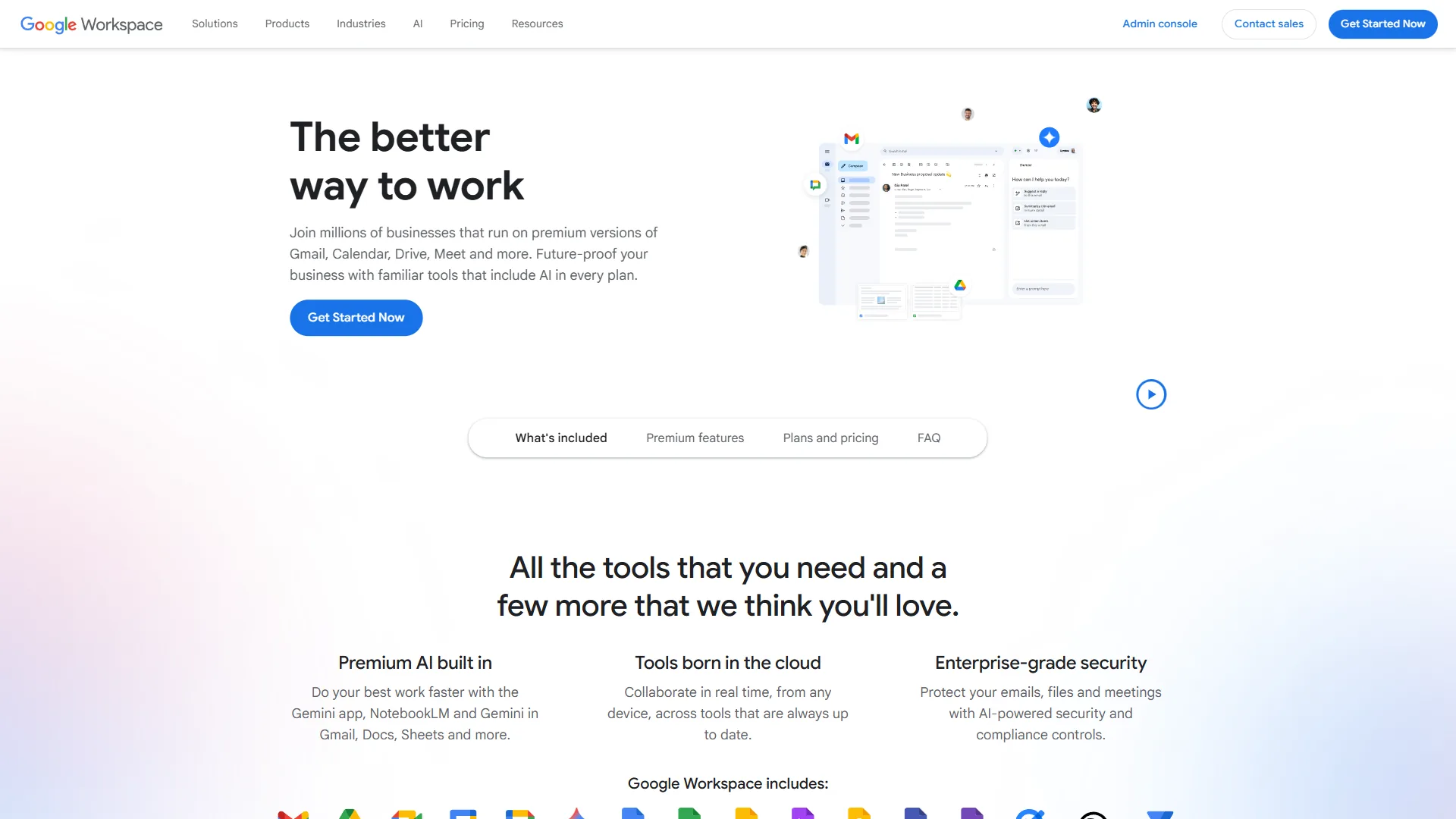
Google Workspace
Google Workspace is Google’s traditional office suite that serves 11 million+ organizations with Gmail, Docs, Sheets, Slides, Drive, Meet, Calendar, and Chat at $7-22/user/month, with Gemini AI woven across every app.
Pricing: Starter $7 per month (30GB) | Standard $14 per month (2TB) | Plus $22 per month (5TB) | Enterprise $24+/mo (unlimited)
Gemini AI writes emails, generates presentations, analyzes spreadsheets via natural language, and summarizes docs - understanding context across your entire workspace. According to Forrester research, AI-powered productivity tools can deliver 300%+ ROI through time savings and improved collaboration.
Key strengths: Real-time collaboration with live cursors, automatic revision history, inline comments. 336% ROI over 3 years (Forrester). 84 hours saved per user annually.
Best for: Document-heavy teams, video conferencing needs, external collaborators.
Limitations: Storage limits on lower tiers, no custom databases or workflows without third-party tools, basic project management.
Notion
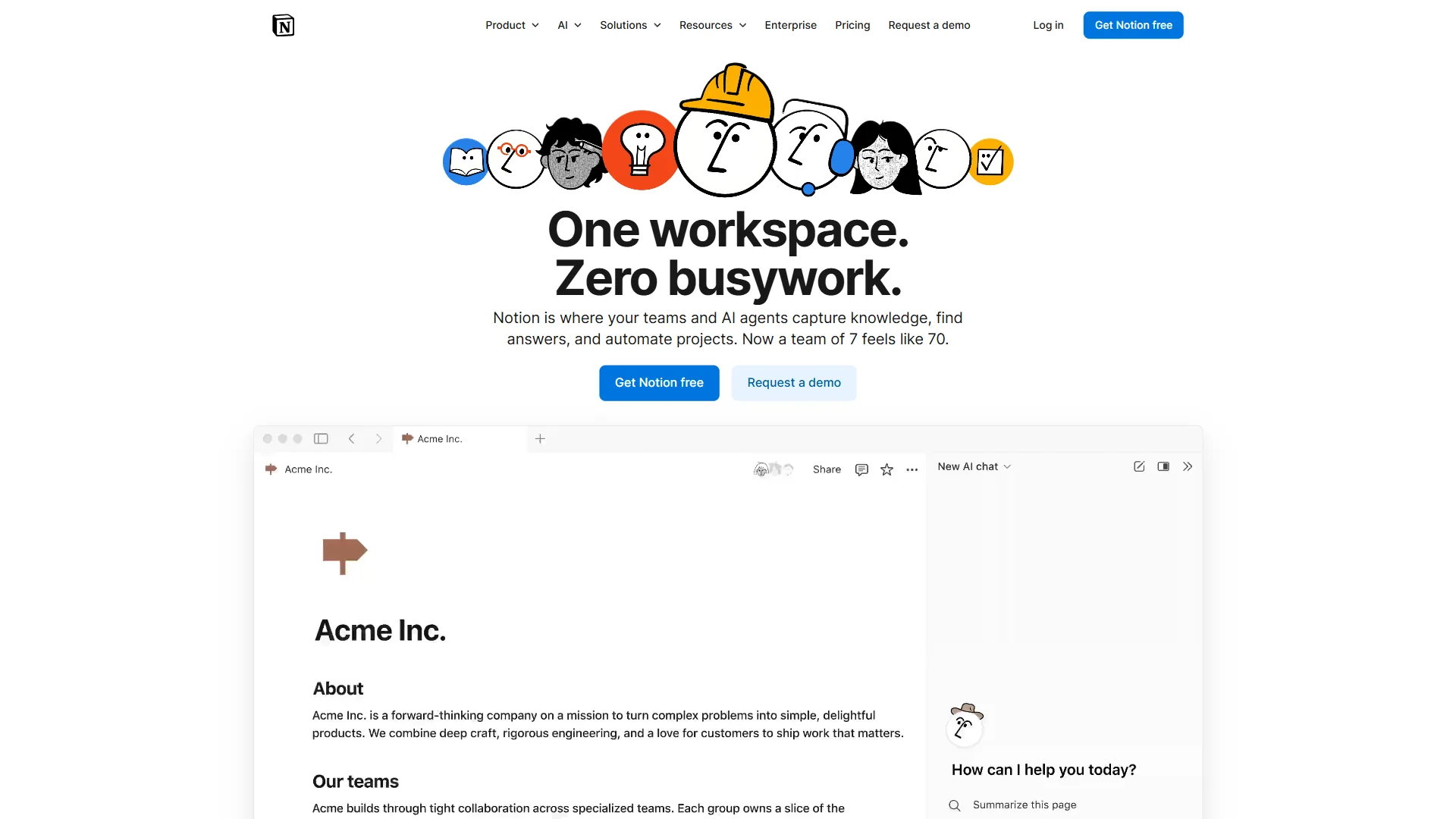
Notion is an all-in-one workspace that serves 35 million+ users by combining docs, wikis, databases, and project management at $10-15/user/month, with autonomous AI Agents on the Business tier.
Pricing: Free (individuals) | Plus $10 per month (file uploads, version history) | Business $15 per month (unlimited AI agents, SSO)
AI Agents take actions autonomously - monitor project databases, update stakeholders on milestones, create task lists from meeting notes, answer questions by searching your knowledge base.
Architecture: Everything is a block that can be nested, linked, and rearranged. Create a database once, display it as kanban, timeline, or table in different views - data syncs everywhere.
Key strengths: Ultimate flexibility (build CRM, content calendar, wiki, roadmap), granular permissions, powerful knowledge management with hierarchical and lateral page connections.
Best for: Knowledge bases, flexible databases, interconnected information, teams willing to invest in setup.
Limitations: Learning curve, performance slows with 10,000+ entries, limited mobile features, no built-in time tracking.
ClickUp
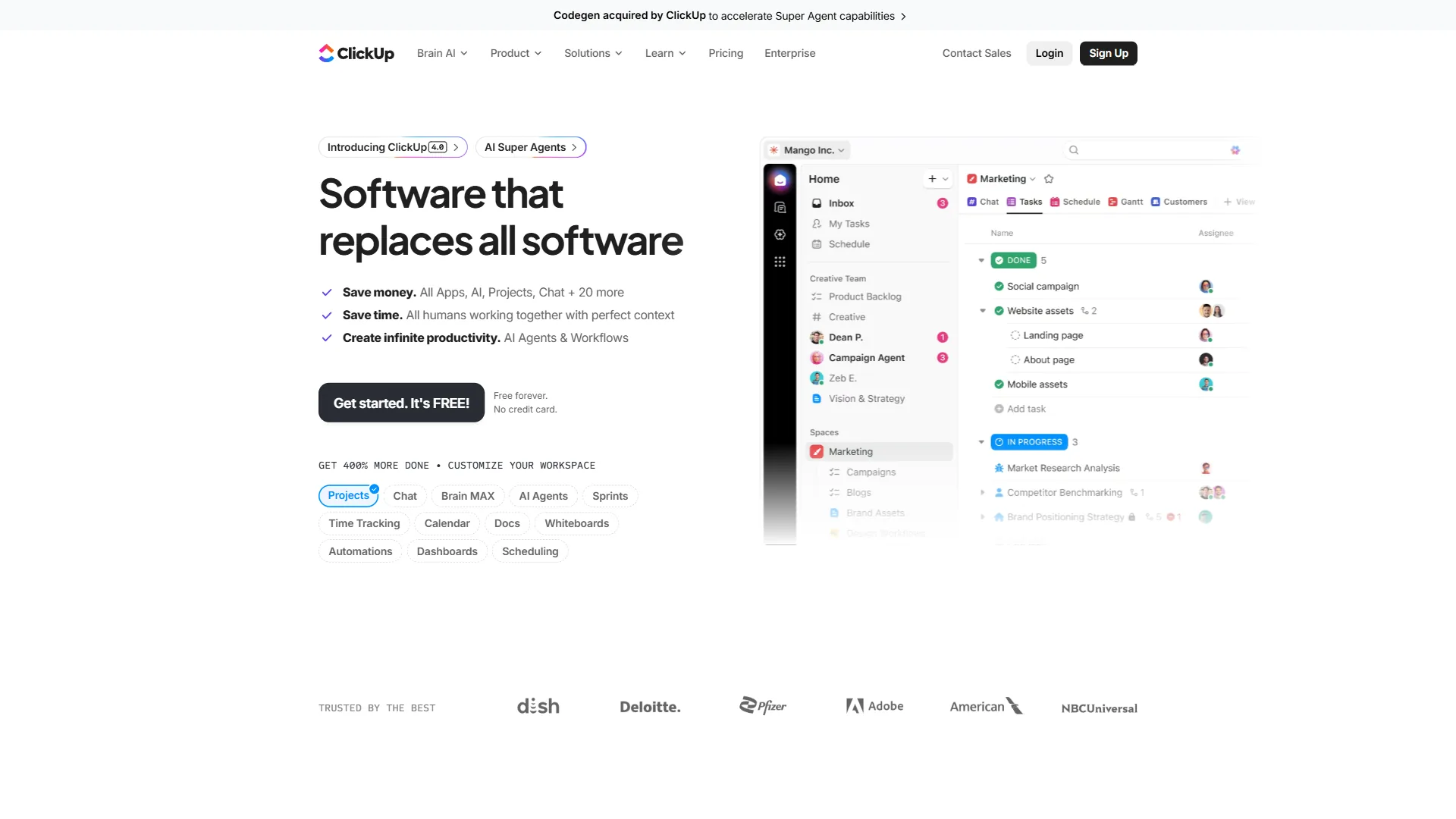
ClickUp offers 35+ views, unlimited customization, and ClickUp Brain AI at $7-12/user/month - the most feature-dense option for complex project management.
Pricing: Free (unlimited tasks) | Unlimited $7 per month (storage, integrations) | Business $12 per month (automation, time tracking) | Enterprise approximately $19 per month
ClickUp Brain summarizes tasks, suggests priorities based on workload analysis, generates status updates, and answers questions by querying your project data contextually.
35+ views: List, board, timeline, calendar, workload, table, mind maps, whiteboards - same data, different visualizations per team need.
Key strengths: 3.84x ROI (Forrester), replaces 5 tools average, saves 1 day/week per user. Powerful automation triggers (status→assign→notify), custom fields, dependencies, sprint planning.
Best for: Complex projects with dependencies, teams wanting one platform to replace multiple tools.
Limitations: Feature overload (teams use ~20%), setup time, performance lags at 50,000+ tasks.
Monday.com
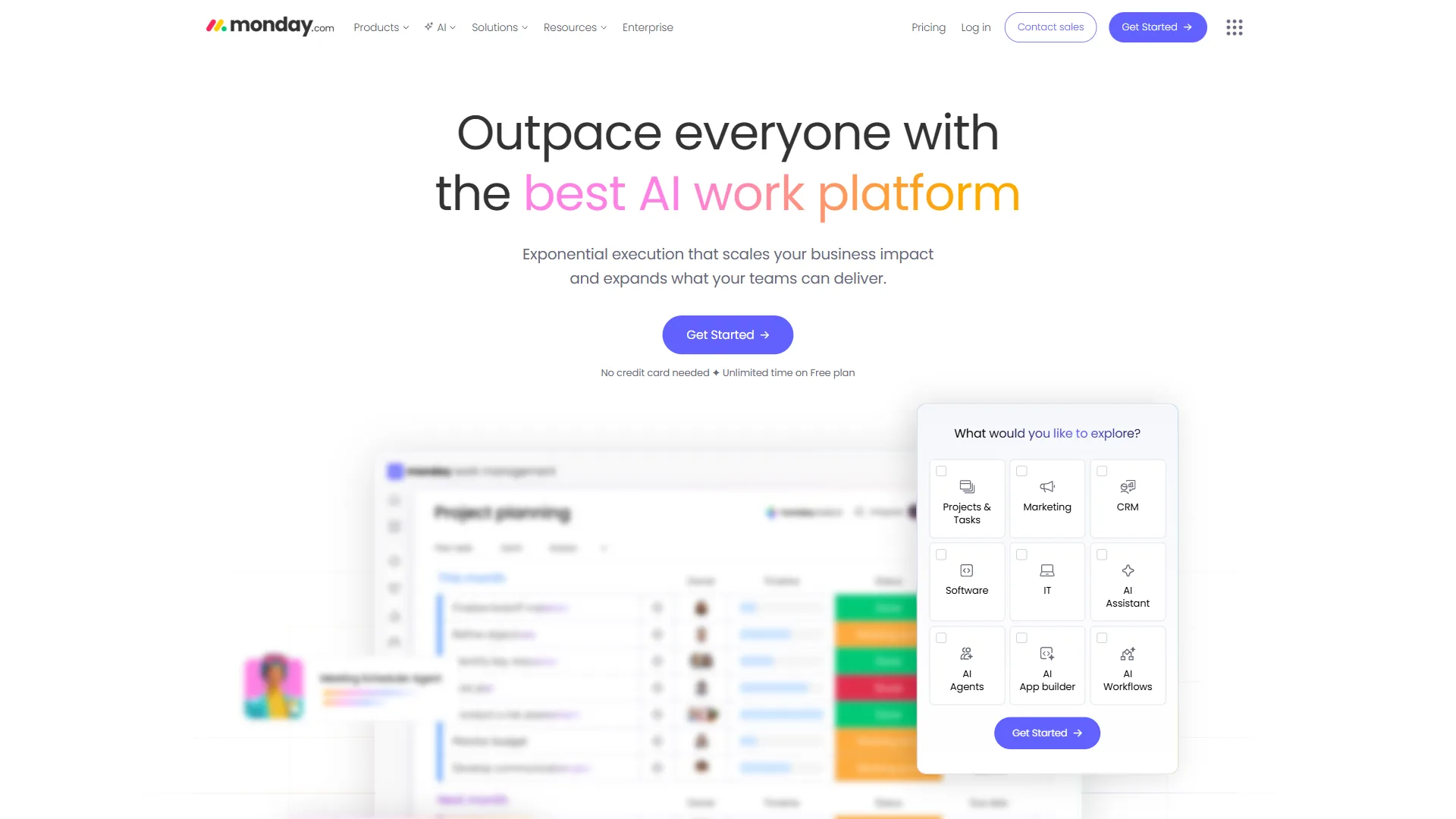
Monday.com is a “Work OS” for visual workflow building at $9-19/user/month - intuitive boards where non-technical teams create custom processes without code.
Pricing: Basic $9 per month (unlimited boards) | Standard $12 per month (timeline, automations) | Pro $19 per month (time tracking, formulas) | Enterprise custom
Monday agents build workflows from natural language (“notify design when marketing approves”), analyze boards to identify bottlenecks, and take actions - not just chat.
Visual boards: 30+ column types (status, people, date, files, formulas), color-coded for instant understanding. 250+ automation recipes with “when X happens, do Y” logic.
Key strengths: 288% ROI (Forrester), 7 hours saved per user weekly. 200+ integrations, Workdocs that pull live board data, custom dashboards for stakeholder visibility.
Best for: Non-technical teams, visual thinkers, multiple projects with different workflows.
Limitations: Pricier than ClickUp at scale, limited knowledge management, minimal offline functionality.
Asana
Asana is a project management platform that focuses on timeline-based planning and AI Studio workflow automation at $10.99-24.99/user/month, delivering the highest measured ROI in this comparison for marketing, product, and professional services teams.
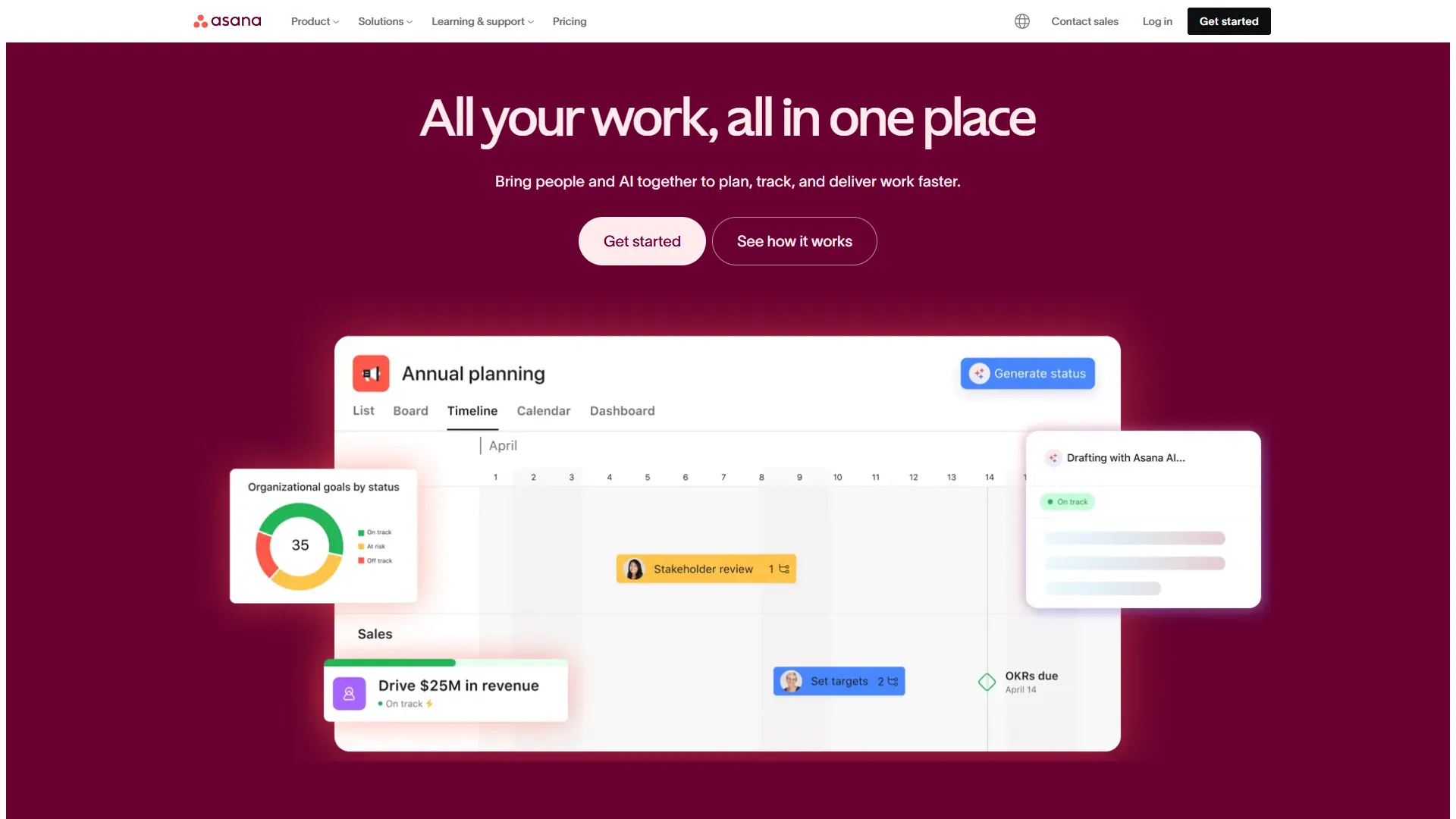
Pricing: Starter $10.99 per month (timeline, unlimited projects) | Advanced $24.99 per month (portfolios, goals, AI Studio) | Enterprise custom
AI Studio routes tasks based on skills/workload, generates project briefs from past projects, and creates status reports by summarizing completion, blockers, and risks automatically.
Timeline planning: Drag tasks to adjust dates, dependencies update in real-time. Portfolio view shows organizational workload across projects. Milestones auto-adjust when dependent tasks shift.
Key strengths: 437% ROI (Forrester) - highest in comparison. $3.5M saved over 3 years average. Goals connect tasks to strategy with automatic progress tracking.
Best for: Complex projects with dependencies, portfolio visibility, connecting daily work to strategic goals.
Limitations: Most expensive option, task-centric (no robust docs), time tracking requires integrations.
Methodology: How AI Features Compare Across Suites
AI features across these suites split into four distinct approaches - context-aware assistance (Google Gemini), autonomous agents (Notion, Monday), contextual analysis (ClickUp Brain), and workflow automation (Asana AI Studio). Our analysis is based on current vendor documentation, published pricing pages, and independent research from named firms rather than sponsored placement, and our research draws on the Microsoft Work Trend Index finding that 75% of knowledge workers now use AI tools in some capacity. “Productivity gains compound when AI sits inside the tools teams already use,” according to the Microsoft Work Trend Index team, framing the case for evaluating suite-native AI over standalone assistants. Forrester’s Total Economic Impact studies, reviewed for each vendor below, place workflow-automation ROI around 250% on average across enterprise deployments.
| Tool | AI Feature | Approach | Strength |
|---|---|---|---|
| Google Workspace | Gemini | Augments familiar apps | Context-aware assistance across emails, docs, calendar |
| Notion | AI Agents | Autonomous actions | Monitors databases, generates reports, unlimited on Business |
| ClickUp | Brain | Contextual recommendations | Knows workload, dependencies, completion rates |
| Monday.com | Agents | Workflow building | Natural language → board structure in minutes |
| Asana | AI Studio | Project intelligence | Routes tasks, generates briefs from past projects |
Summary: Google augments traditional tasks. Notion/Monday focus on autonomous agents. ClickUp emphasizes contextual analysis. Asana targets workflow automation.
Pricing by Team Size
Pricing for the best productivity suites scales with team size, starting free for solo users and reaching $1,250 per month for a 50-seat team on Asana Advanced - the table below maps the lowest sensible plan to each band.
| Team Size | Best Value | Monthly Cost (50 users) |
|---|---|---|
| Solo | Notion/ClickUp Free | $0 |
| 2-10 people | ClickUp Unlimited $7/user | $50-150 total |
| 10-50 people | ClickUp Business $12 | $600 |
| Google Standard $14 | $700 | |
| Monday Pro $19 | $950 | |
| Asana Advanced $25 | $1,250 | |
| 50+ (Enterprise) | Custom pricing | Negotiate volume discounts |
Which Tool Fits Each Use Case
The right productivity suite is the one that matches your dominant workflow - documents, knowledge bases, complex projects, visual boards, or portfolio planning - and the table below maps each suite to the use case it fits the best 2026 buyer is choosing for.
| Suite | Choose When |
|---|---|
| Google Workspace | Document-heavy work, professional email needed, external collaborators, minimal training budget |
| Notion | Building wikis/knowledge bases, flexible databases, interconnected information, team can invest in setup |
| ClickUp | Complex projects with dependencies, want one platform for everything, most features per dollar |
| Monday.com | Non-technical teams, visual thinkers, minimal learning curve, evolving workflows |
| Asana | Portfolio visibility, connecting tasks to goals, highest ROI priority, budget for premium |
Conclusion
Three decision factors: How document-centric is your work? How much customization do you need? What’s your training budget?
| Need | Recommendation |
|---|---|
| Formatted content + email | Google Workspace |
| Knowledge bases + flexibility | Notion |
| Complex projects + visual workflows | Monday.com or Asana |
| Most features per dollar | ClickUp |
All platforms offer AI capabilities and free trials in 2026. When evaluating the best productivity suites, the right choice is the one your team actually uses - match tool architecture to working style.
Which Tool Fits Your Team?
The productivity suite that fits your team is the one whose architecture matches your daily workflow - Google Workspace for document-heavy teams, Notion for knowledge bases, ClickUp for complex projects, Monday.com for visual builders, and Asana for portfolio planning. Choosing the best productivity suites starts with understanding how your team actually works day to day. Traditional suites like Google Workspace excel when document-heavy work, familiar spreadsheets, and separate apps for docs, sheets, and email match your existing habits. Modern all-in-one workspaces like Notion, ClickUp, Monday.com, and Asana reward teams willing to learn a new paradigm where databases, blocks, and views connect every piece of work into a single interconnected system.
Three questions clarify the decision:
- Do your workflows span projects, knowledge bases, and automations? A Notion or ClickUp build pays off quickly once teams learn the block-and-database model.
- Is your team already fluent in Docs and Sheets? Google Workspace at $7 to $22 per user delivers AI through Gemini without retraining anyone.
- Do you need visual workflow builders rather than lists and documents? Monday.com’s Work OS approach suits that pattern better than traditional office suites.
Many organizations split the difference, running external documents and email in Google Workspace while running internal operations in Notion or ClickUp. Budget matters too - pricing spans $7 to $25 per user across these productivity suites, so match the tool to the workflow it unlocks, not the feature count.
FAQ
The questions below are the most common buyer questions about the best productivity suites in 2026, answered with named-vendor pricing and Forrester-published ROI figures.
What is the most popular productivity suite?
Google Workspace and Microsoft 365 remain the dominant traditional office suites, while modern all-in-one platforms like Notion, ClickUp, Monday.com, and Asana have grown significantly. In 2026, teams choose between these two fundamentally different approaches - familiar document-focused tools or interconnected workspace platforms - depending on their workflow needs and team size.
What are the 5 most commonly used productivity tools?
The five most commonly reviewed productivity suites are Google Workspace, Notion, ClickUp, Monday.com, and Asana. Google Workspace handles documents and email, Notion excels at knowledge bases, ClickUp offers complex project management with 35+ views, Monday.com provides visual workflow building, and Asana focuses on timeline-based project planning with portfolio visibility.
What are the best productivity suites in 2026?
The top productivity suites in 2026 fall into two categories: traditional office suites like Google Workspace and Microsoft 365, and modern all-in-one workspaces like Notion, ClickUp, Monday.com, and Asana. Each takes a different approach - traditional suites excel at documents and spreadsheets, while modern platforms treat your entire workflow as an interconnected system.
Which productivity suite offers the best ROI?
Based on Forrester data reviewed for this comparison, Asana leads with 437% ROI and an average $3.5M saved over 3 years. ClickUp follows with 3.84x ROI and saves users roughly one day per week. Google Workspace delivers 336% ROI with 84 hours saved per user annually, while Monday.com shows 288% ROI with 7 hours saved per user weekly.
How much do productivity suites cost per user?
Pricing across these platforms spans a moderate range. Google Workspace runs $7-22/user/month, Notion $10-15/user/month, ClickUp $7-12/user/month, Monday.com $9-19/user/month, and Asana $10.99-24.99/user/month. Solo users and small teams can start free with Notion or ClickUp, while enterprise teams can negotiate volume discounts on custom plans.
Related Reading
Related reading covers the five tools compared above plus deeper guides to project management platforms that overlap with these productivity suites.
Tools covered in this article:
- Google Workspace - Cloud-based productivity suite
- Notion - All-in-one workspace with AI
- Asana - Work management platform
- ClickUp - All-in-one project management
- Monday.com - Visual work operating system
More productivity guides:
- Best AI Project Management Tools 2026 - PM tools compared
- Best Project Management Tools 2026 - Project management platforms
- Project Management for Small Teams - Small team productivity
External Resources
External resources for further reading on productivity suites include peer-reviewed business research and primary vendor reports - all from authoritative third-party sources outside our domain.
- Harvard Business Review - Productivity
- McKinsey Organizational Performance
- Asana Anatomy of Work Report
Editorial disclosure: AI Productivity may earn a commission from links on this page; our productivity-suite rankings are editorially independent and based on vendor documentation and published Forrester research, not sponsored placement.