






The best AI analytics platforms in 2026 are Pyramid Analytics, Looker, Tableau, Power BI, Qlik Sense, Domo, and Zoho Analytics - evaluated here on how effectively they turn data into actionable decisions rather than just dashboards.
The AI analytics conversation has shifted from automatic dashboards to decision intelligence - platforms that surface what to do next, not just what happened. The gap between marketing promises and actual decision support varies wildly across vendors.
According to Rita Sallam, distinguished VP analyst at Gartner, “By 2026, organizations that operationalize AI transparency, trust and security will see their AI models achieve a 50% improvement in adoption, business goals and user acceptance,” a finding documented in the firm’s data and analytics trends research. Our analysis here draws on each vendor’s current pricing pages, product documentation, and independent analyst research rather than sponsored placement. AI Productivity may earn a commission from links on this page; rankings remain editorially independent.
Comparison Table: AI Analytics Platforms 2026
Our comparison table ranks the seven AI analytics platforms by starting price, aggregated rating, and ideal use case so you can shortlist candidates at a glance. The right choice depends on budget, team size, and the workflows you need to optimize.
| Platform | Starting Price | Rating | Best For |
|---|---|---|---|
| Pyramid Analytics | $10K/year | Enterprise decision intelligence | |
| Looker | $36K/year | Enterprise governance + Google Cloud | |
| Tableau | $15/mo | Best-in-class visualizations | |
| Power BI | Free-$24/mo | Microsoft ecosystem + budget | |
| Qlik Sense | $30/mo | Associative data exploration | |
| Domo | $20K/year | 1,000+ connectors, all-in-one | |
| Zoho Analytics | Free-$60/mo | SMBs needing affordable AI |
Selection Criteria: What Separates Decision Intelligence from Traditional BI
Decision intelligence platforms are AI-driven BI tools that proactively surface insights, parse natural-language questions in business context, recommend remediation actions, and enforce governance without slowing self-service.
- Proactive insight delivery: decision intelligence platforms surface anomalies before you think to look - alerting stakeholders when Northeast sales drop 15% instead of waiting for the weekly review
- Natural language that actually works: “why did churn increase last quarter” should return analysis of customer behavior, not a generic churn chart
- Actionable recommendations: identifying which product categories, customer segments, and regions contributed - then suggesting remediation - is the bar
- Governance without friction: consistent metric definitions across hundreds of users while preserving self-service exploration
1. Pyramid Analytics: Purpose-Built Decision Intelligence
Pyramid Analytics is built ground-up as a decision intelligence platform rather than a visualization tool with AI bolted on.
Why Pyramid Stands Out for Decision Intelligence
Pyramid Analytics is a purpose-built decision intelligence platform that fuses data preparation, business intelligence, and data science into one product instead of leaving teams to stitch together Tableau, Alteryx, and DataRobot.
The 2026 Newton release introduced an embedded search bar with genuine natural language capabilities. Asking “why did patient wait times increase in Q3” triggers analysis of correlations across staffing levels, patient volume, and seasonal patterns. Healthcare organizations have achieved 80% accuracy in forecasting patient visits using Pyramid’s AI, according to Pyramid’s healthcare case studies.
The PYRANA direct query engine analyzes data in place without movement - critical for organizations with strict data residency requirements. For SAP-centric enterprises, the direct BW and HANA connectivity eliminates complex ETL processes that other platforms require.
Where Pyramid Falls Short
The learning curve is steep - 58% of users cite this as a challenge. Market share at 0.9% means a smaller community, fewer tutorials, and less third-party ecosystem than Power BI or Tableau.
Pyramid Analytics Pricing
- Free tier: Basic analytics for exploration
- Silver/Gold/Platinum: Custom pricing with increasing support levels
- Enterprise: $10,000-$20,000/year (no per-user fees)
Best For
Large enterprises consolidating multiple analytics tools, SAP-centric organizations, and teams prioritizing AI-powered decision support over simple visualization. Skip Pyramid if you need a fast-deploy SMB tool - the $10K floor and 6+ week implementation puts it out of reach for teams under 100 seats. Self-serve analyst features lag behind Tableau’s.
2. Looker: Enterprise Governance Done Right
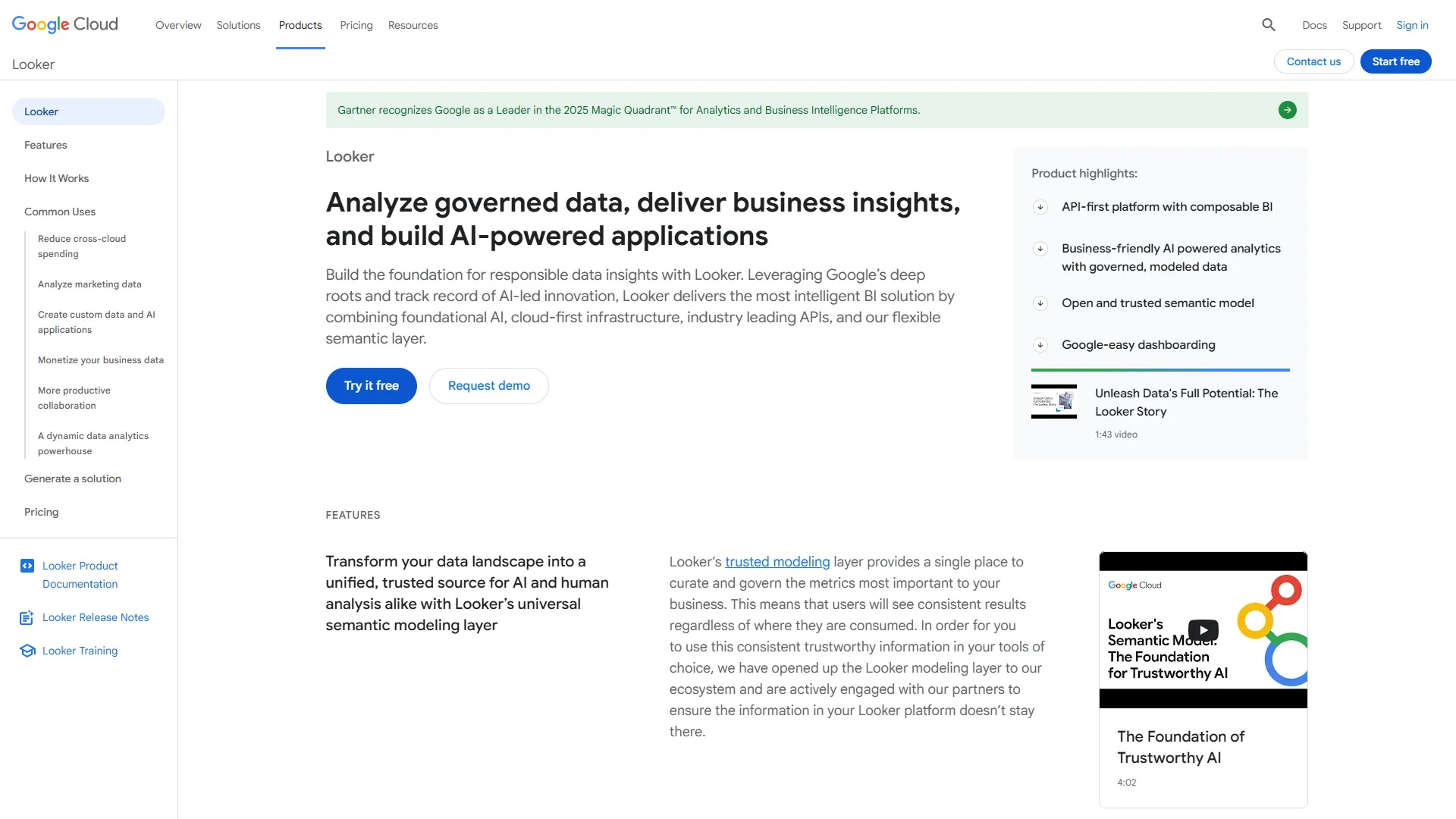
Looker is the Google Cloud enterprise BI platform that solves metric chaos through LookML, a proprietary modeling language that defines business logic once for every downstream dashboard. Looker on Google Cloud stands out for organizations needing centralized, governed metrics.
The LookML Advantage
Define “customer lifetime value” with all its edge cases, currency conversions, and segment filters once in LookML - every dashboard, report, and API call then uses the same calculation. This single source of truth eliminates the “which number is right?” meetings that plague other platforms.
For organizations building customer-facing analytics, Looker’s embedded capabilities are exceptional: white-label dashboards, API-first architecture, and multi-tenant data security make it the SaaS go-to.
Decision Intelligence Capabilities
Looker’s natural language querying understands business terminology because it is defined in LookML. Automated insights proactively surface unusual patterns and alert stakeholders before they open dashboards. Tight Google Cloud integration means BigQuery queries run natively without data extraction.
Where Looker Falls Short
Pricing starts at $36,000 per year, putting it out of reach for smaller organizations. The LookML learning curve requires dedicated analytics engineers.
Looker Pricing
Pricing verified April 2026 from Looker's pricing page:
- Standard Edition: Contact sales (Up to 10 users, around $36K/year starting point)
- One production instance
- 10 Standard Users plus 2 Developer Users
- LookML modeling and core BI capabilities
- Best for: Small teams or single-department deployments
- Enterprise Edition: Contact sales (Scales from $60K to $360K+/year with users and data volume)
- All Standard features
- Up to 100,000 query-based API calls per month
- Advanced governance and security controls
- Best for: Mid to large enterprises needing organization-wide BI
- Embed Platform: Contact sales (Custom pricing based on external user volume)
- All Enterprise features
- Up to 500,000 query-based API calls per month
- White-label dashboards and multi-tenant security
- Best for: SaaS companies building customer-facing analytics
Best For
Mid to large enterprises on Google Cloud with dedicated data teams who need centralized governance and consistent metrics, plus companies building embedded analytics products. Skip Looker if you are not on Google Cloud or your team lacks dedicated analytics engineers.
3. Tableau: Visualization Excellence with AI Catching Up
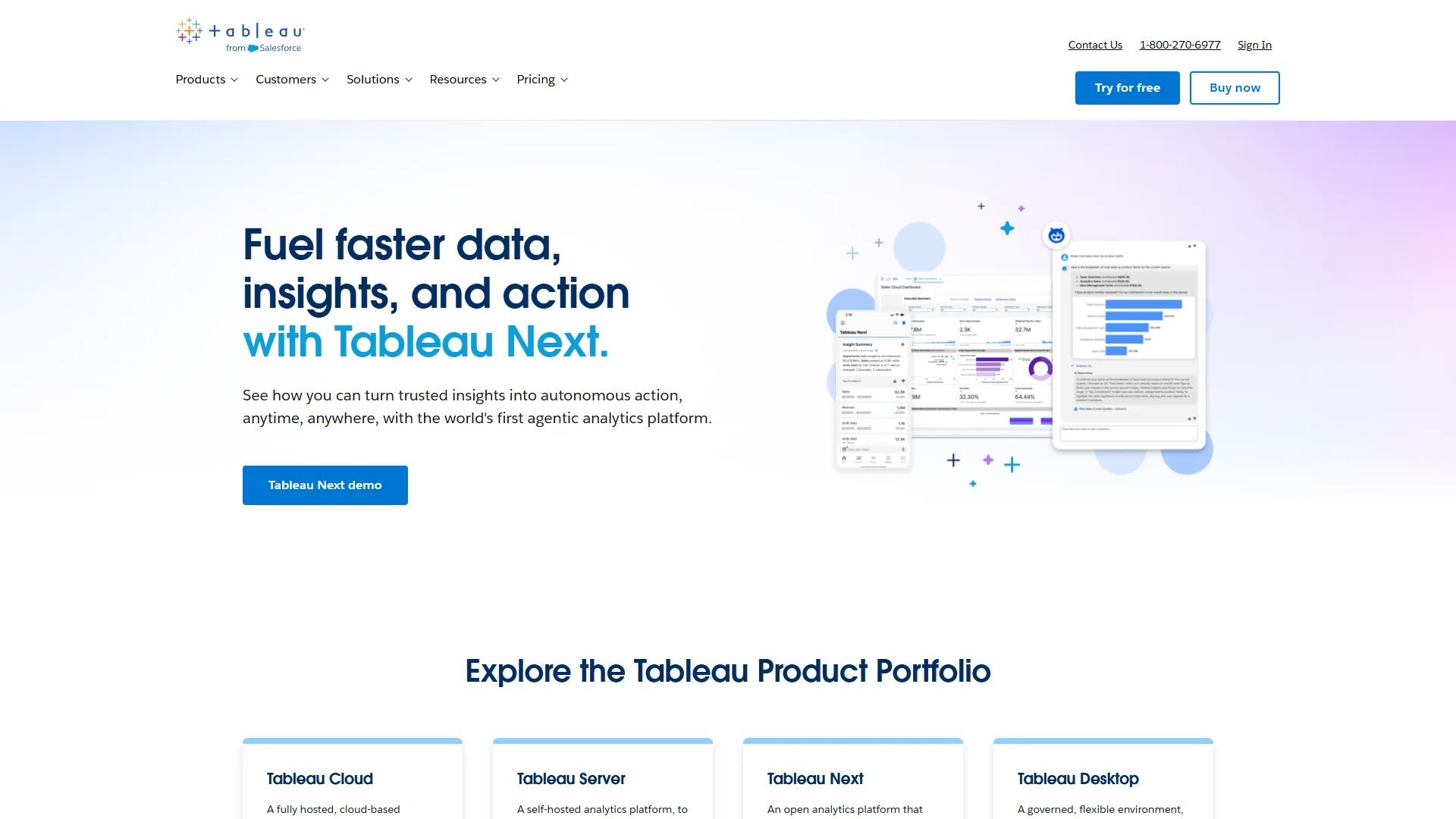
Tableau is the long-running visualization gold standard, now extending into agentic analytics with Tableau Next and Einstein Discovery.
Where Tableau Excels
The drag-and-drop interface handles complex visualizations - treemaps, dual-axis combination charts, interactive geographic maps - that require custom code elsewhere. Einstein Discovery (from Salesforce) provides genuine predictive analytics, reaching 87% accuracy in predicting deal close rates and lifting close rates by 12% through non-obvious correlations like “deal size correlates with demo count.” Ask Data, Tableau’s natural language interface, handles follow-up questions with context.
Decision Intelligence Gaps
Tableau is fundamentally visualization-first - it does not proactively surface insights or recommend actions the way Pyramid or Domo do. Data preparation happens in a separate tool (Tableau Prep), creating workflow friction.
Tableau Pricing
Pricing verified April 2026 from Tableau's pricing page:
- Viewer (Standard): $15/user/mo (View-only access, no editing)
- View and interact with published dashboards
- Download summary data
- Data-driven alerts and subscriptions
- Best for: Stakeholders who consume dashboards but do not edit them
- Explorer (Standard): $42/user/mo (Edit existing content, limited authoring)
- Explore and edit existing workbooks
- Download full data
- Manage users and content
- Best for: Analysts editing existing workbooks without authoring new data sources
- Creator (Standard): $75/user/mo (Full authoring capabilities, required for any deployment)
- Create new workbooks and data flows
- Full Tableau Desktop access
- Tableau Prep Builder for ETL
- Best for: Power users and analysts building dashboards and data flows from scratch
Best For
Organizations prioritizing best-in-class data storytelling and visualization, teams with analysts who know which questions to ask, and Salesforce-centric companies needing deep CRM integration. Skip Tableau if your team cannot dedicate analyst time or if Einstein Discovery’s CRM Analytics licensing pushes you over budget.
4. Power BI: The Budget-Conscious Choice
Power BI is the budget-conscious choice for AI analytics, with a free Desktop tier, Pro licensing at $10 per user per month, and Premium Per User at $24 per user per month - well below most competitors. The free tier is genuinely useful, and even Premium pricing undercuts most rivals.
AI Features That Work
Q&A lets users type “show me sales by region last quarter” and get instant visualizations, handling 80% of common questions accurately. Copilot in Power BI (Premium) generates DAX calculations and suggests visualizations from natural language. AI insights automatically scan data for anomalies, trends, and correlations.
The Microsoft Ecosystem Lock-In
For Azure, Office 365, or Dynamics 365 shops, Power BI integration is seamless: governance through Azure AD, reports embedded in Teams, Excel users connecting natively. The connector library (300+ sources) falls short of Domo’s 1,000+ and some SaaS integrations require custom Power Query work.
Where Decision Intelligence Falls Short
Governance gets messy at scale - unlike Looker’s centralized LookML, Power BI lets each user define metrics independently, leading to metric drift. Real-time refresh requires Premium capacity starting at $4,995 per month.
Power BI Pricing
- Free: Desktop app for local use
- Pro: $10 per user per month
- Premium Per User: $24 per user per month
- Premium Capacity: Starting at $4,995/month
Best For
Small to medium businesses with Microsoft investments. Teams needing affordable BI with solid AI features. Organizations that can tolerate some governance complexity.
5. Qlik Sense: Associative Exploration for Curious Analysts
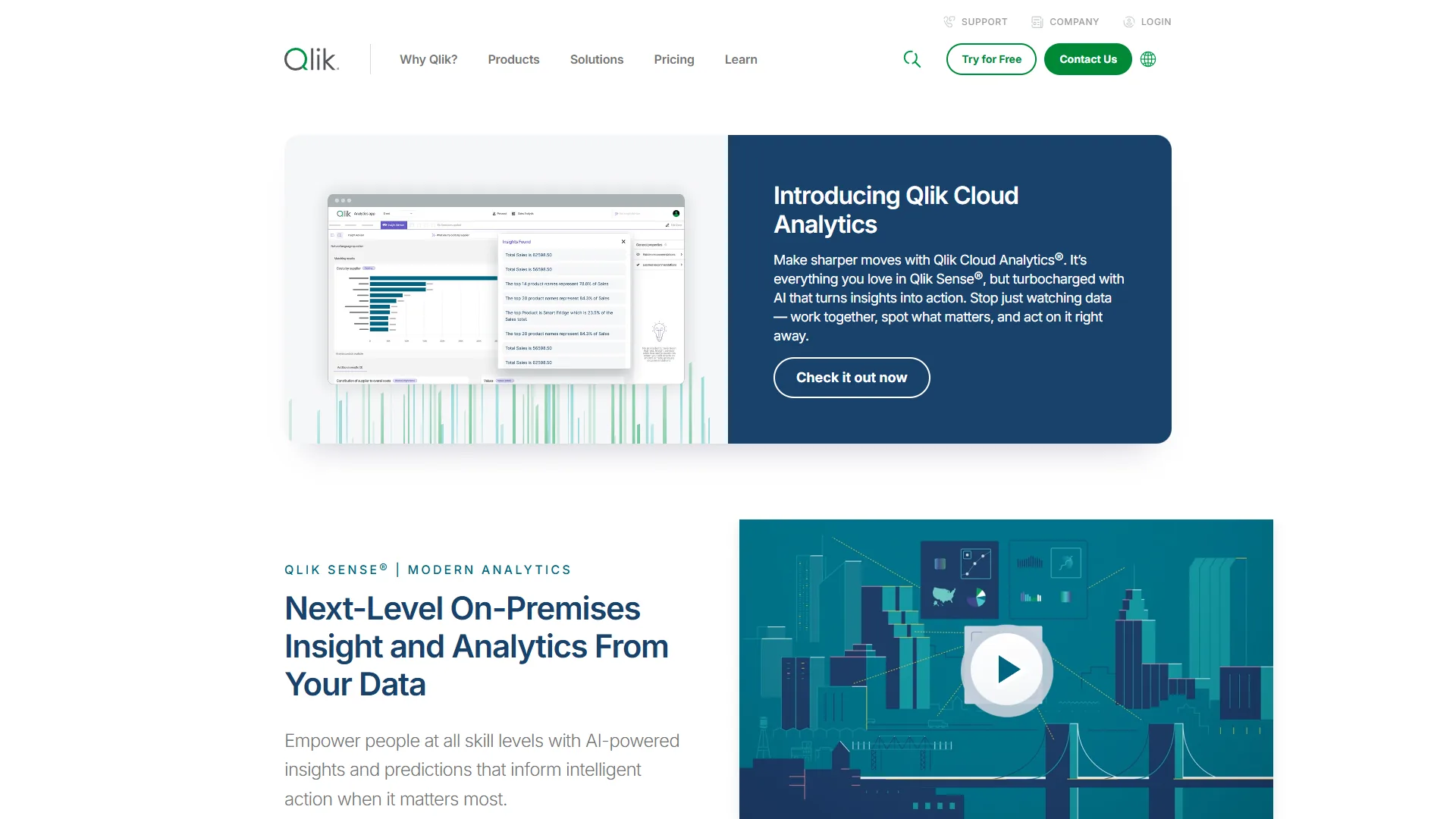
Qlik Sense is an associative analytics platform that lets analysts pivot freely across any dimension instead of following pre-defined drill-down paths, starting at $30 per user per month.
The Associative Difference
Instead of pre-defined drill-down paths, users explore in any direction: click a product category and Qlik highlights related customers, time periods, regions, and sales reps; click a region to see related products. This approach surfaces hidden relationships - patterns like a specific product+region+rep combination consistently underperforming, without IT-built custom reports.
AI Capabilities
Insight Advisor uses machine learning to suggest visualizations based on selected data. Augmented analytics detect anomalies and correlations across entire datasets, analyzing hundreds of potential contributing factors when revenue drops in one region.
The Learning Investment
The associative model requires different thinking about data exploration - some analysts embrace it, others find it confusing. Qlik Script, the proprietary data-loading language, is challenging to master without dedicated Qlik developers.
Qlik Sense Pricing
- Business: $30 per user per month
- Enterprise SaaS: Starting at $2,700/month (25 users included)
- Enterprise: Custom pricing for large deployments
Best For
Analyst-heavy teams who need to explore complex, interconnected data and organizations willing to invest in training for powerful but less intuitive capabilities. Skip Qlik Sense if you lack dedicated Qlik developers or if AI-driven proactive decision support is the priority.
6. Domo: The All-in-One Connector Champion
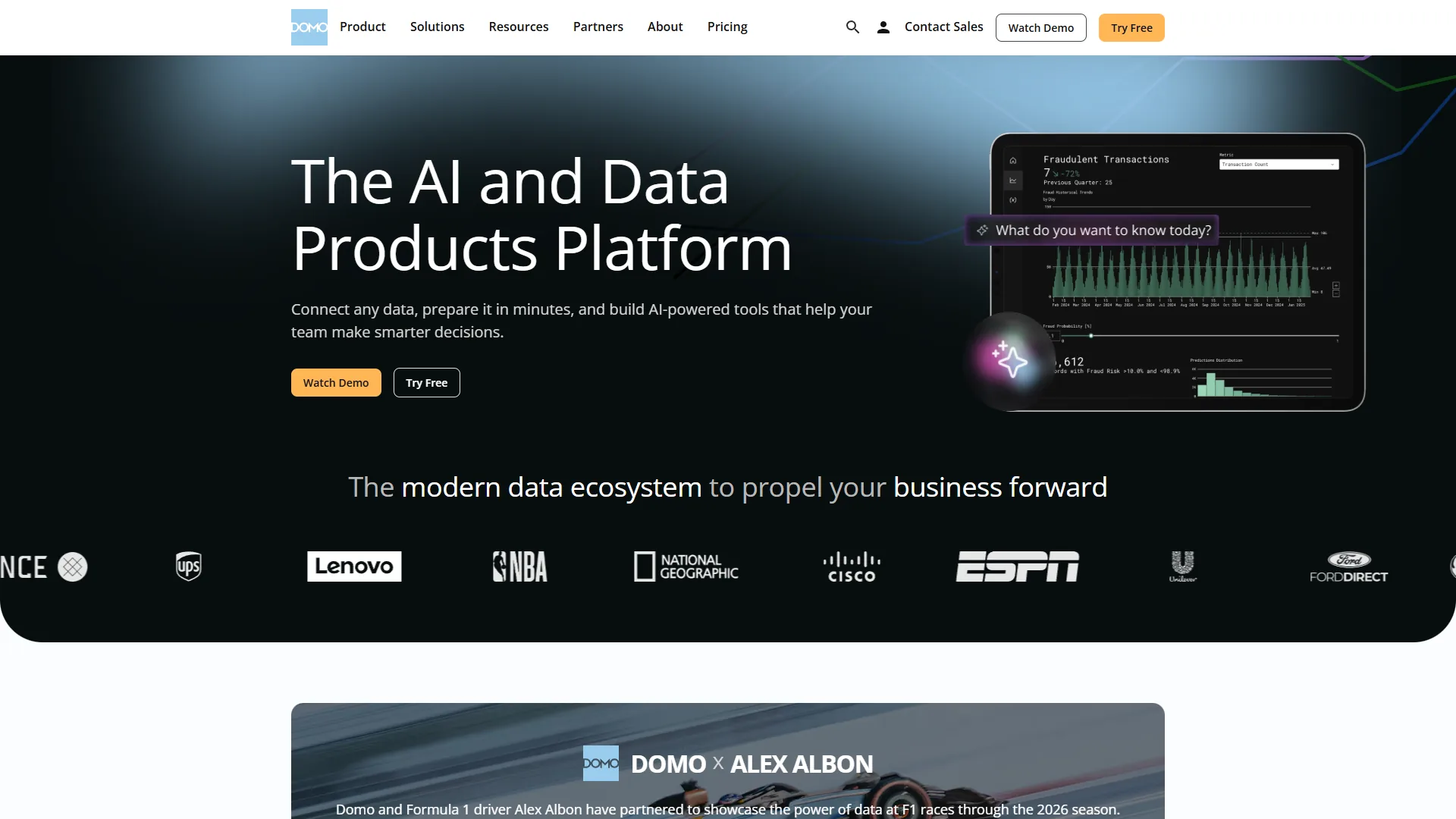
Domo is an all-in-one cloud BI platform with over 1,000 pre-built connectors, AutoML, and conversational analytics in a single environment, with pricing that typically starts at $20,000 per year.
Integration Depth That Matters
Over 1,000 pre-built connectors cover major databases to niche SaaS tools - Shopify, Google Ads, NetSuite, and PostgreSQL connect in under two hours without custom API work. Magic ETL uses a drag-and-drop visual canvas for data transformation, democratizing data prep beyond engineering.
Decision Intelligence Features
AutoML lets business users build predictive models by pointing and clicking - select data, choose “predict customer churn,” and AutoML builds, tests, and deploys the model. Conversational analytics proactively suggests follow-up analyses: ask “show revenue by product” and Domo might surface “revenue is down 12% for Product A - would you like to see which regions are affected?”
The Pricing Challenge
Domo’s pricing is opaque, requiring negotiation - most implementations start around $20,000 to $40,000 per year and scale higher for enterprise features. The “jack of all trades” approach (BI, ETL, project management, alerts) feels bloated when you only need analytics.
Domo Pricing
- Standard: $20,000-$40,000/year
- Enterprise: $50,000-$100,000+/year
- Individual licenses: $30-$200 per user per month depending on role
Best For
Growing companies wanting all-in-one platforms with minimal technical overhead and organizations with complex, heterogeneous data sources. Skip Domo if pricing transparency matters or if your team is under 100 users (Zoho or Power BI deliver similar capability at one-quarter the cost).
7. Zoho Analytics: AI-Powered BI for Budget-Conscious Teams
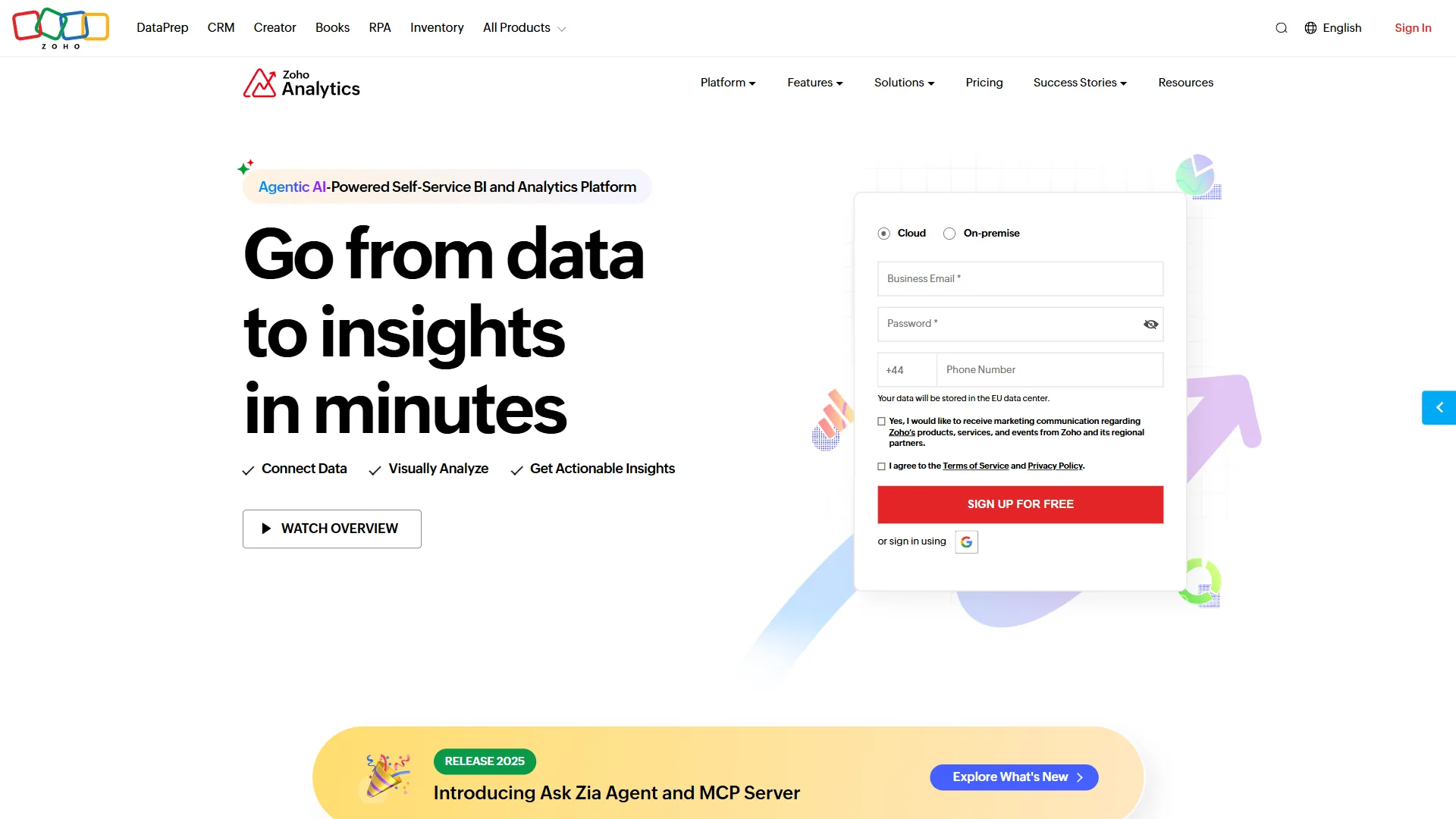
Zoho Analytics is an AI-powered self-service BI platform aimed at SMBs, with 500+ connectors, the Ask Zia conversational assistant, and pricing starting at $60 per month for five users.
Ask Zia: Conversational AI That Works
Ask Zia handles natural language queries in English, Spanish, and French - ask “show quarterly revenue trends by product category” and Zia generates the visualizations with diagnostic insights. The Enterprise tier adds LLM-powered automated anomaly detection, smart recommendations, and contextual explanations of data patterns.
Value Proposition
Nucleus Research case studies document 11.6x ROI with 1.2-month payback periods - one implementation saved 43 hours weekly in manual reporting across 190 users. At $60 per month for five users, the math works quickly. 500+ native connectors cover major databases, cloud services, and business apps without custom API coding.
Where It Falls Short
Row limits can be restrictive - Standard’s 1 million rows may be insufficient for data-intensive operations, and jumping to Enterprise ($575 per month) for 50 million rows is a significant cost step. Visualization sophistication does not match Tableau.
Zoho Analytics Pricing
Pricing verified April 2026 from Zoho Analytics's pricing page:
- FREE: $0/mo (2 users, 10,000 rows)
- Basic reports and dashboards
- Limited data capacity
- 15-day trial of paid plans
- Best for: Solo users testing the platform on small datasets
- BASIC: $24/user/mo annual ($30 monthly) (2 users, 0.5 Million rows)
- Unlimited reports and dashboards
- 2 business app connectors
- Best for: Very small teams running essential reporting
- STANDARD: $48/user/mo annual ($60 monthly) (5 users, 1 Million rows)
- Unlimited reports and dashboards
- 50+ business app connectors
- Best for: Small teams that need broader integrations and Ask Zia
- PREMIUM: $115/user/mo annual ($145 monthly) (15 users, 5 Million rows)
- Unlimited reports and dashboards
- 50+ business app connectors
- Advanced data preparation
- Best for: Mid-size teams with heavier data prep needs
- ENTERPRISE: $460/user/mo annual ($575 monthly) (50 users, 50 Million rows)
- Unlimited reports and dashboards
- 50+ business app connectors
- Advanced data preparation and governance
- Best for: Larger organizations needing enterprise-scale analytics with full Zia AI
Best For
SMBs needing comprehensive AI-powered analytics without enterprise pricing. Organizations already using Zoho ecosystem products. Teams prioritizing value-for-money over maximum capability.
Best Picks by Use Case: How to Choose the Best AI Analytics Platforms
Picking the best AI analytics platform requires matching three filters: annual budget, primary data stack, and team skill profile. That combination narrows seven options to one or two realistic picks.
Start with Budget Reality
Under $15,000 per year: Power BI or Zoho Analytics. $20,000 to $50,000: Domo or Qlik Sense. Over $50,000: Looker, Pyramid Analytics, or enterprise Tableau.
Match to Your Data Reality
- Microsoft-centric stack: Power BI saves setup time
- Google Cloud + BigQuery: Looker for native integration
- 10+ SaaS sources: Domo for connector breadth
- SAP enterprise: Pyramid Analytics for direct BW/HANA
Consider Your Team
- Dedicated data engineers: Looker or Pyramid Analytics reward the investment
- Business users alone: Zoho Analytics or Power BI ship results faster
- Curious analysts: Qlik Sense rewards exploratory thinking
Industry-Specific Considerations
- Healthcare: Pyramid Analytics for patient flow prediction
- SaaS: Looker for embedded analytics
- Retail: Domo for multi-channel integration
- Professional services: Tableau for client storytelling
Common Pitfalls: Implementation Reality Check
AI analytics deployments are projects that require 2-4 weeks for a basic setup, 3-6 months for a full organizational rollout, and 12-18 months to reach decision intelligence maturity, regardless of which platform you choose.
- Basic setup with a few data sources: 2-4 weeks
- Comprehensive organizational rollout: 3-6 months
- Full decision intelligence maturity: 12-18 months
Steeper-learning platforms (Looker, Pyramid Analytics, Qlik Sense) demand more upfront investment but save time long-term through governance. No-code platforms (Domo, Zoho Analytics) ship results faster but require refactoring as complexity grows.
Final Verdict: Which Platform Should You Choose?
Pyramid Analytics is the top pick for enterprise decision intelligence, with Looker leading on Google Cloud governance, Tableau on visualizations, Power BI on Microsoft-shop budgets, Qlik Sense on free-form exploration, Domo on connector breadth, and Zoho Analytics on SMB AI at $60 per month.
- Enterprise decision intelligence: Pyramid Analytics - all-in-one data prep, BI, and data science with 250+ connectors
- Enterprise governance on Google Cloud: Looker - LookML eliminates conflicting metric definitions at scale
- Best-in-class visualization: Tableau - when dashboard quality drives client presentations or board reviews
- Microsoft shops on a budget: Power BI - free tier, affordable Pro licensing, and seamless Microsoft integration
- Free-form data exploration: Qlik Sense - the associative engine surfaces relationships hierarchical navigation misses
- All-in-one integration depth: Domo - 1,000+ connectors eliminate custom API work
- SMB AI without enterprise pricing: Zoho Analytics - Ask Zia, 500+ connectors, $60 per month
The hardest part is not finding capable software - every option here delivers value. The challenge is the organizational change required to use data for decisions instead of to justify decisions already made.
FAQ
Q: Which AI platform is best for analysis?
Pyramid Analytics is the best AI platform for enterprise decision-intelligence analysis in 2026, while Power BI and Zoho Analytics lead the budget-conscious tier. The right pick depends on your data stack and team skills.
Q: Which AI tool is best for data analytics?
Tableau leads on best-in-class visualizations, Looker on Google Cloud governance, and Pyramid Analytics on integrated data prep plus AI for enterprise decision intelligence - the seven platforms compared here cover most realistic use cases.
Q: What are the 5 best AI platforms?
The top five AI analytics platforms for 2026 are Pyramid Analytics, Looker, Tableau, Power BI, and Qlik Sense - chosen on decision-intelligence depth, governance, visualization quality, ecosystem fit, and exploration model.
Q: Which AI platform is best for data analysis?
The best AI analytics platforms compared here include Pyramid Analytics, Looker, Tableau, Power BI, Qlik Sense, Domo, and Zoho Analytics. Pyramid Analytics leads for enterprise decision intelligence, Looker fits Google Cloud governance, Tableau wins on visualizations, and Power BI suits Microsoft-ecosystem teams on tighter budgets. The right pick depends on your budget, team size, and workflows.
Q: What are the top 5 AI analytics platforms in 2026?
The top picks are Pyramid Analytics for enterprise decision intelligence, Looker for Google Cloud governance, Tableau for best-in-class visualizations, Power BI for Microsoft ecosystem users on tighter budgets, and Qlik Sense for associative data exploration. Domo and Zoho Analytics round out the seven platforms compared, with Zoho offering an affordable option for SMBs needing AI features.
Related Reading
Related Reading includes every tool covered in this article plus deeper analytics guides on the site. Tools covered in this article:
- Pyramid Analytics - Decision intelligence platform
- Looker - Enterprise BI with semantic modeling
- Tableau - Visual analytics platform
- Power BI - Microsoft business intelligence
- Qlik Sense - Associative analytics engine
- Domo - Cloud BI with 1,000+ connectors
- Zoho Analytics - SMB analytics with AI
More analytics guides:
- Best BI Tools 2026 - Complete BI buyer’s guide
- Best Business Intelligence Tools 2026 - Enterprise BI platform comparison
- Best AI Project Management Tools - Data-driven project management
- Best Data Analytics Platforms 2026: Complete Comparison
External Resources
External Resources are primary documentation and analyst references that informed this comparison.