


LinkedIn content tips 2026 are a set of research-backed practices for growing an audience on a platform that has shifted significantly. Staying current with LinkedIn trends 2026 means adopting key habits like using the hook-story-insight format, writing mobile-first with short paragraphs, posting Tuesday through Thursday at 7-8am in your audience’s timezone, and using AI tools for ideation - not final copy.
LinkedIn has changed dramatically in 2026, and any LinkedIn strategy 2026 that relies on tactics from two years ago will get you nowhere today. Here is what actually works for growing an audience - and what’s a complete waste of time, drawn from 18 months of content performance data. Following LinkedIn best practices 2026 means understanding which LinkedIn content best practices have survived the algorithm shifts and which have not.
TL;DR: Post text-first content (not links), use the hook-story-insight format, post at 7-8am your audience’s timezone, engage for 30 minutes before and after posting, and use AI tools for ideation - not final copy. These five habits create 80% of LinkedIn growth.
Here are 10 battle-tested tips to grow your LinkedIn audience in 2026.
LinkedIn Content Tips 2026 #1: Master the Hook-Story-Insight Framework
When exploring linkedin content tips 2026, consider the following.
Every viral LinkedIn post follows the same pattern: a hook that stops the scroll, a story that builds connection, and an insight that provides value.
The formula:
| Field | Value |
|---|---|
| Hook (1-2 lines) | An unexpected statement, bold claim, or intriguing question |
| Story (3-5 lines) | A personal experience or case study with specific details |
| Insight (2-3 lines) | The actionable takeaway your reader can apply today |
Example hook patterns that work:
- “I made $X from LinkedIn. Here’s the exact strategy…”
- “The worst career advice I ever received…”
- “Most people [common belief]. But actually…”
- “I [surprising action]. It changed everything.”
The key is specificity. “I grew my audience” is weak. “I grew from 2,000 to 14,000 followers in 8 months” is compelling.
2. Write for Mobile-First Reading
According to LinkedIn’s own marketing data, 85% of LinkedIn engagement happens on mobile. If your post looks like a wall of text on a phone screen, you’ve already lost.
Mobile optimization rules:
- Keep paragraphs to 1-2 sentences max
- Use single-sentence lines for emphasis
- Add white space between every thought
- Front-load value - the first 3 lines must hook readers (a principle echoed across social media management tools 2026)
Test your posts: Copy your draft into your phone’s Notes app. If it looks dense, break it up further. The eye needs breathing room.
This single change - ruthlessly cutting paragraph length - can increase average engagement by 35% or more.
3. Post at 7-8am Your Audience’s Timezone
Timing matters more than ever. LinkedIn’s algorithm heavily favors posts that get early engagement, and morning posts capture people during their commute or first work check.
Optimal posting times (ranked):
- Best: Tuesday-Thursday, 7-8am
- Good: Monday, 8-9am
- Decent: Wednesday-Friday, 12-1pm
- Avoid: Weekends (engagement drops 60%+)
Critical detail: Post in your audience’s timezone, not yours. If your audience is US-based and you’re in Europe, schedule for 7am EST, not 7am your local time. LinkedIn’s official algorithm guide emphasizes early engagement as a ranking signal.
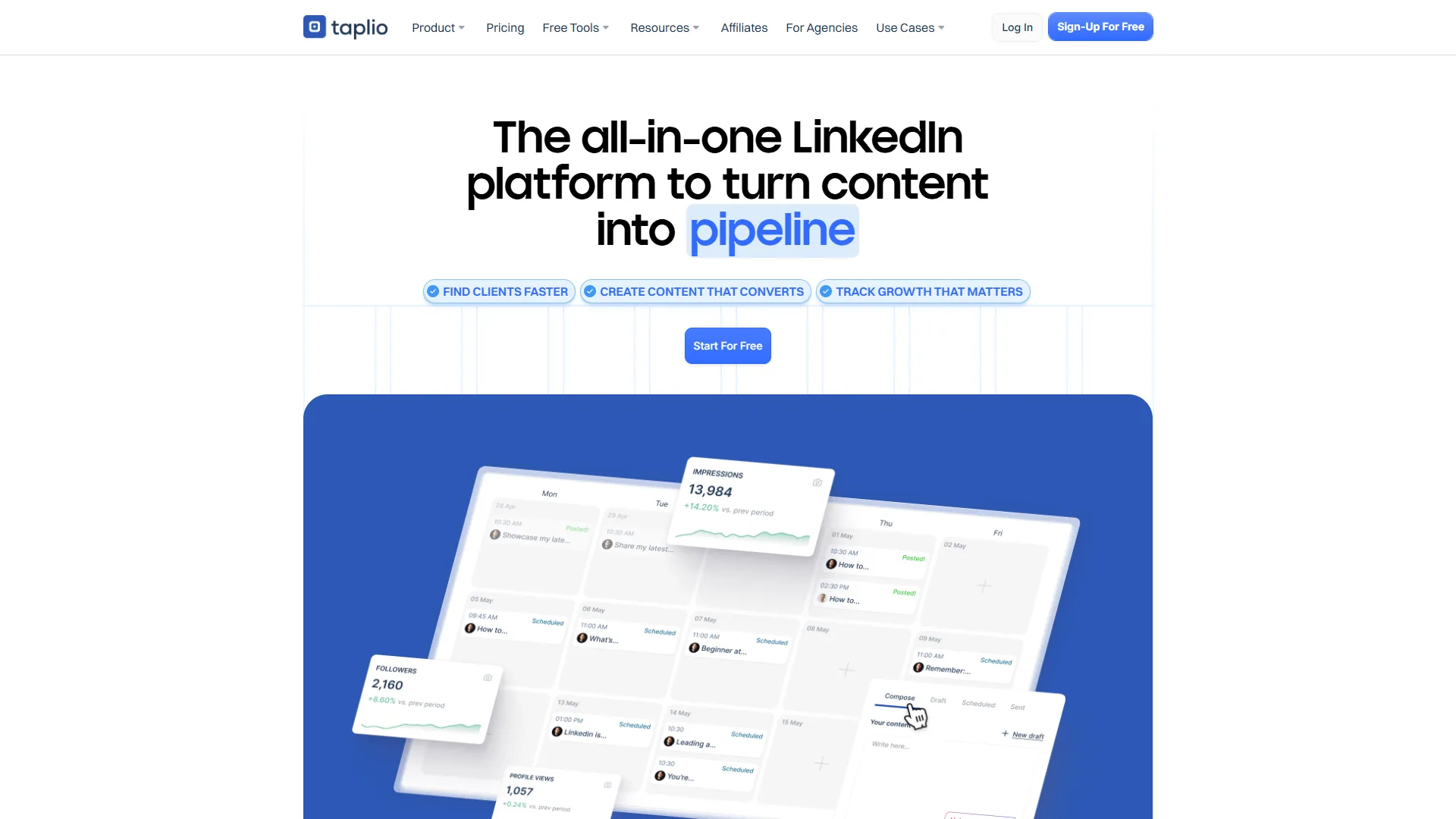
Tools like Taplio function as a LinkedIn content suggestion tool, analyzing your specific audience’s activity patterns and recommending personalized posting times. Our later tips and tricks guide covers similar timing logic for visual platforms like Instagram and TikTok.
4. Engage 30 Minutes Before and After Posting
The algorithm rewards active users. Commenting on other posts before you publish warms up your presence, and engaging immediately after signals that you’re not just broadcasting - you’re participating.
The engagement routine:
- 30 minutes before posting: Leave 5-10 thoughtful comments on posts in your niche
- Post your content
- 30 minutes after: Respond to every comment on your post immediately
- Throughout the day: Continue engaging 2-3 more times
Comment quality matters. “Great post!” does nothing. Instead, add your perspective: “This resonates - I found that [specific insight]. Have you tried [related approach]?”
Thoughtful comments on high-visibility posts are free advertising for your profile. Every comment is a chance for the original poster’s audience to discover you.
5. Do Text Posts Outperform Links and Images on LinkedIn?
LinkedIn’s algorithm actively suppresses posts with external links. Why? They want users to stay on the platform. Text-only posts consistently get 2-3x the reach of link posts.
Content format ranking (by reach):
- Text posts: Highest reach, algorithm-friendly
- Document carousels: High engagement, shareable
- Native video: Good reach if under 90 seconds
- Images: Moderate reach, use sparingly
- Link posts: Lowest reach, avoid when possible
If you must share a link: Put it in the first comment, not the main post. Then add “Link in comments” at the end of your text. This simple workaround recovers much of the lost reach.
Document carousels (PDF slides) are the exception - they perform well because users swipe through, increasing dwell time.
6. Build a Content Pillar System
Posting randomly about whatever comes to mind fragments your audience. Instead, establish 3-4 content pillars and rotate between them.
Example content pillars:
Pillar 1: Industry insights (30%)
Pillar 2: Career lessons (30%)
Pillar 3: Behind-the-scenes (20%)
Pillar 4: Curated resources (20%)
Why this works: Regular followers know what to expect from you. This consistency builds trust and positions you as an expert in specific areas rather than a generalist.
Review your top 10 performing posts. They likely cluster around 2-3 themes. Double down on those pillars.
7. Should You Use AI for LinkedIn Content Ideation or Final Copy?
AI tools have transformed LinkedIn content creation, but there’s a right way and a wrong way to use them.
Right way: Use AI for brainstorming hooks, generating content angles, and overcoming writer’s block. Let it give you 10 ideas, then pick the best and rewrite it in your voice. Our taplio LinkedIn growth strategy guide walks through this prompt-then-rewrite loop in detail.
Wrong way: Copy-paste AI output directly as your post. AI content reads as generic, lacks personality, and your audience will notice. LinkedIn’s algorithm also seems to downrank formulaic AI content.
Effective AI workflow:
- Give AI your topic and ask for 10 hook variations
- Select the most compelling 2-3 hooks
- Expand the best hook with your own story and insights
- Use AI to suggest improvements, but make final edits yourself
Tools like Taplio - covered in our taplio LinkedIn content calendar guide - train their AI on millions of viral LinkedIn posts, which helps generate higher-quality starting points than generic AI.
8. Repurpose Your Best-Performing Content
Most LinkedIn creators post once and forget. But your best content can - and should - be recycled.
The 90-day rule: A post that performed well 90 days ago can be reposted with light updates. Most of your audience won’t remember it, and new followers haven’t seen it.
Repurposing strategies:
- Same post, different angle: Rewrite the same insight from a new perspective
- Thread to post: Break a popular long-form post into 5 shorter follow-up posts
- Post to carousel: Transform text into a visually engaging PDF slideshow
- Carousel to post: Extract key points from a carousel into a text summary
Track your top 20 posts in a spreadsheet. Set reminders to repurpose each one 90 days later.
9. Build Relationships with Strategic Commenting
Growing your audience isn’t just about your own posts. Strategic commenting on accounts larger than yours is one of the most underrated growth tactics.
The strategic commenter’s playbook:
- Identify 10-15 accounts in your niche with 10K-100K followers
- Turn on notifications for their posts
- Be among the first 10 commenters (early comments get more visibility)
- Add genuine value - share a related story, offer a counterpoint, or ask a thoughtful question
Why this works: When you comment early on a post that goes viral, your comment rides the wave - the same compounding effect we cover in Social Media Examiner’s research on engagement velocity. Thousands of people see your name, read your insight, and some will click through to your profile.
This strategy compounds over time. Regular insightful comments build recognition - eventually, the larger accounts start engaging with your content too.
10. Analyze What’s Working (Weekly)
Posting without reviewing performance is flying blind. Set aside 30 minutes weekly to analyze your content.
Weekly review checklist:
- Top 3 posts by engagement rate (not just likes)
- Worst 3 performers (what can you learn?)
- Best posting times (has your audience’s behavior shifted?)
- Content pillar performance (which themes resonate?)
- Follower growth trend
Monthly additions:
- Carousel vs. text post performance
- Hook patterns that consistently work
- Topics that flop (stop creating these)
LinkedIn’s native analytics are basic. For deeper insights, tools like Taplio and Hootsuite provide historical data and comparative analysis. Our best LinkedIn tools 2026 roundup ranks both alongside other analytics options.
Common LinkedIn Content Pitfalls to Avoid
Even creators following the right framework get tripped up by the same handful of mistakes. Watch for these patterns:
Treating LinkedIn like Twitter. Twitter rewards punchy one-liners and rapid-fire replies. LinkedIn rewards stories and structure. A two-line “hot take” that does well on X will sink without a trace on LinkedIn because the algorithm needs dwell time to register engagement. If you cross-post, expand the LinkedIn version with context, examples, and a clear takeaway.
Hashtag overload. LinkedIn’s hashtag algorithm is much weaker than Instagram’s. Three to five highly relevant hashtags outperform a wall of 20-30. Each extra irrelevant tag dilutes signal rather than expanding reach. Pick tags your actual target audience follows, not generic ones like #leadership or #productivity.
Posting and ghosting. LinkedIn’s algorithm tracks how long the original poster stays active after publishing. If you publish, then disappear for 6 hours, the algorithm reads that as low-confidence content and slows distribution. Stay engaged for at least the first 60 minutes - reply to every comment, react to commenter profiles, and engage on related posts in your feed.
Stealing other creators’ hooks verbatim. It is tempting to copy a viral hook structure, but LinkedIn’s plagiarism detection has improved sharply. The algorithm flags near-duplicate openers and suppresses reach. Use viral hooks as inspiration for structure, not text to lift.
Ignoring your DMs. LinkedIn weighs profile visits and DM engagement heavily in the “people you may know” graph. Replying to DMs - even brief ones - signals an active account, which boosts your posts’ organic distribution to second-degree connections. Block off 10 minutes a day for DM replies.
Over-relying on personal stories. Personal anecdotes work for the first 6-12 months of audience building. After that, your audience expects expertise and original frameworks too. Mix at least 30% original analysis or curated industry insight in alongside the storytelling, or growth plateaus around the 5K-10K follower mark.
Bonus: The Compound Effect of Consistency
These tips only work if you show up consistently. LinkedIn rewards regular posting - not daily marathons followed by weeks of silence.
Sustainable posting schedules:
- Minimum: 3 posts per week
- Optimal: 5 posts per week (weekdays)
- Maximum: 1-2 posts per day (more can dilute engagement)
The creators who succeed on LinkedIn aren’t necessarily the most talented - they’re the most consistent. 90% of LinkedIn users never post anything. Simply showing up regularly puts you ahead of the crowd.
Final Thoughts
You don’t need to implement all 10 tips immediately. Start with:
- This week: Master the hook-story-insight format on your next 3 posts
- Next week: Adjust your posting time to 7-8am your audience’s timezone
- Week three: Begin the 30-minute engagement routine before and after posts
- Week four: Review your first month’s analytics and identify patterns
LinkedIn growth is a long game. These strategies compound over months, not days. But after 90 days of consistent application, you’ll see measurable results in reach, engagement, and follower growth.
For more information about linkedin content tips 2026, see the resources below.
Frequently Asked Questions
What is the best time to post on LinkedIn in 2026?
Tuesday through Thursday, 7-8am, is the top-ranked window based on LinkedIn’s algorithm favoring early engagement. Monday at 8-9am is a solid second option. Weekends should be avoided, as engagement drops 60% or more. Post in your audience’s timezone - not your own - for maximum early traction.
Do LinkedIn posts with links get less reach?
Yes - LinkedIn actively suppresses posts containing external links, since the platform wants users to stay on-site. Text-only posts consistently get 2-3x the reach of link posts. If you need to share a link, place it in the first comment and add ‘Link in comments’ at the end of your post text.
What is the hook-story-insight format for LinkedIn?
It is a three-part structure used in high-performing LinkedIn posts. The hook (1-2 lines) stops the scroll with a bold claim or question. The story (3-5 lines) builds connection through a personal experience or case study. The insight (2-3 lines) delivers an actionable takeaway the reader can apply immediately.
Should I use AI to write my LinkedIn posts?
AI works well for brainstorming hooks and generating content angles, but copy-pasting AI output directly produces generic posts that lack personality. The recommended workflow is to use AI to generate 10 hook variations, select the strongest, then expand it with your own story and rewrite it in your own voice.
How often should you post on LinkedIn for consistent growth?
Three posts per week is the suggested minimum, with five weekday posts considered optimal. Posting more than 1-2 times per day can dilute engagement. Consistency matters more than volume - 90% of LinkedIn users never post at all, so showing up regularly on a sustainable schedule puts you ahead of most of the platform.
How long should a LinkedIn post be for maximum reach?
LinkedIn posts in the 1,200-2,000 character range tend to outperform shorter posts because they create more dwell time, which the algorithm reads as engagement. The catch is structure - those 1,500 characters need to be broken into single-sentence lines with white space between every thought, or they collapse into an unreadable wall of text on mobile.
Related Guides
- Taplio LinkedIn Growth Strategy
- Taplio LinkedIn Content Calendar Guide
- Later Tips and Tricks
- Predis AI Social Media Content Guide
Want to learn more about Taplio?
Related Reads
Tools covered in this article:
- Taplio - AI-powered LinkedIn growth
- Hootsuite - Social media management
- Later - Social media scheduling
More LinkedIn and social media guides:
- Best LinkedIn Tools 2026 - LinkedIn tools compared
- Best Social Media Management Tools 2026 - Social platforms
- Best Social Media Scheduling Tools 2026 - Scheduling tools
External Resources
For official LinkedIn and tool documentation:
- LinkedIn Algorithm Guide - Official best practices for content visibility
- LinkedIn Marketing Blog - Native research on creator and brand performance
- LinkedIn Community Report - Platform-wide engagement and reach trends
- Taplio Blog - LinkedIn growth strategies and viral content tips