


Best social media management tools 2026 are platforms that help teams schedule posts, monitor engagement, and analyze performance across multiple channels. This guide compares Hootsuite, Buffer, and Sprout Social on pricing, ease of use, and integration depth, with Buffer winning on budget, Hootsuite on enterprise scale, and Sprout Social on analytics quality.
Methodology: this comparison is based on each vendor’s current pricing pages, product documentation, and independent industry research published by Sprout Social, Hootsuite, and the Pew Research Center’s 2024 Social Media and News Fact Sheet rather than sponsored placement or hands-on agency testing. AI Productivity may earn a commission from links on this page; rankings and verdicts are editorially independent.
In 2026, social media managers juggling multiple brands have more scheduling tools to choose from than ever. Some promise “AI-powered content generation” but deliver generic nonsense. Others have beautiful interfaces but cannot handle basic analytics. The latest Sprout Social Index shows marketers now expect their stack to handle scheduling, listening, and AI-assisted publishing in one place. According to the Sprout Social Index 2024, authored by the Sprout Social research team, “consumers want brands to prioritize customer service on social” - a finding that pushes feature weight toward unified inboxes and response-time analytics, both areas where Sprout Social outperforms Buffer.
After putting Hootsuite, Buffer, and Sprout Social through their paces, the picture becomes clear on which tool works for which scenario. Spoiler: the most expensive option is not always the best choice. Niche players like Predis and Taplio are also worth a look if you have a narrower brief such as AI carousel generation or LinkedIn-only growth.
Here is how these three platforms compare across common social media management scenarios.
Quick Verdict: Which Tool Should You Choose?
Buffer is the best pick for solopreneurs on a budget, Hootsuite is the best pick for enterprise teams managing 20+ profiles, and Sprout Social is the best pick when analytics depth and UX matter more than price. This guide evaluates the leading options on pricing, ease of use, integration depth, and the specific use cases where each tool delivers the most value.
Choose Buffer if:
- You’re a solopreneur or small business (1-3 people)
- Budget is tight (Buffer’s per-channel pricing beats everyone)
- You value simplicity over advanced features
- You don’t need social listening or deep analytics
Choose Hootsuite if:
- You manage 20+ profiles for multiple brands
- You need enterprise approval workflows
- Social listening via Talkwalker is critical
- You have budget for the Professional tier at minimum
Choose Sprout Social if:
- Analytics quality matters more than price
- Your team values exceptional UX
- You need CRM features integrated with social
- You’re willing to pay premium for superior support
Now let’s break down exactly why.
Hootsuite: The Enterprise Powerhouse (But It’ll Cost You)

Hootsuite is the name everyone recognizes. Here is what you actually get for the Professional tier across real-world brand management scenarios.
What Hootsuite Does Better Than Anyone
Multi-brand management at scale: If you’re juggling 20+ profiles across different companies, Hootsuite’s stream layout actually makes sense. Users report managing 8+ client accounts simultaneously without tab-switching hell.
OwlyGPT integration: Unlike Buffer’s generic AI Assistant, OwlyGPT pulls from real-time social data. Asking it “what’s trending in B2B SaaS this week” returns actual conversations happening on Twitter, not generic advice.
Approval workflows: For enterprise teams with compliance requirements, Hootsuite’s approval system is bulletproof. A 3-tier review process (creator → editor → legal) works seamlessly for healthcare and other compliance-heavy industries. Buffer doesn’t even offer this feature.
Social listening via Talkwalker: The Enterprise plan includes social listening that tracks brand mentions across 10+ platforms. Teams have caught brewing customer service issues 48 hours before they went viral.
Hootsuite Limitations and Who It’s Not For
The UI feels like 2015: After using Sprout Social, users often find Hootsuite’s cluttered dashboard feels like opening Internet Explorer. The stream layout is powerful but ugly.
Pricing is painful: Hootsuite Professional (10 channels, 1 user) is roughly 25x more expensive than Buffer Essentials. The annual discount helps, but the upfront cost still runs into four figures.
Steep learning curve: It takes most teams 2 weeks to feel comfortable. Buffer took 2 hours.
Hootsuite Pricing Breakdown
| Plan | Monthly | Annual | Channels | Users | Best For |
|---|---|---|---|---|---|
| Professional | $149 | $99 | 10 | 1 | Solo consultants with many clients |
| Team | $399 | $249 | 20 | 3 | Small agencies |
| Enterprise | Custom | Custom | Unlimited | Unlimited | Multi-brand corporations |
Real cost example: For a 5-person team managing 30 profiles, you’re looking at the Enterprise tier (custom pricing in the five-figure range annually).
Hootsuite AI Features: OwlyGPT Deep Dive
Comparing OwlyGPT against Buffer’s AI Assistant reveals key differences:
OwlyGPT strengths:
- Pulls real-time social data (trending topics, competitor activity)
- Generates captions with current context (mentions viral posts, news events)
- AI image generation in beta (DALL-E 3 integration)
Comparison test:
- Prompt: “Create 5 LinkedIn posts about AI productivity tools”
- OwlyGPT output: Referenced actual trending discussions from LinkedIn, cited specific tools gaining traction this week
- Buffer AI output: Generic advice indistinguishable from 2022-era templates
The catch: OwlyGPT is only available on the Professional plan and higher. Buffer’s AI Assistant works on the Essentials plan.
What users love:
- “Best for managing 50+ accounts across brands” (Enterprise user)
- “Approval workflows saved us from compliance nightmares” (Healthcare marketing)
What users hate:
- “Interface looks ancient compared to Sprout” (Most common complaint)
- “Customer support response time is 24-48 hours” (vs Sprout’s 2-4 hours)
Assessment: The rating is fair. It’s powerful but not delightful to use.
Buffer: The Budget-Friendly Champion

Buffer is what happens when you prioritize simplicity over feature bloat. It is easy to see why solopreneurs love it.
What Buffer Does Better Than Anyone
Pricing that doesn’t hurt: Buffer Essentials starts at $6/month per channel - accessible for anyone. Running a brand’s Instagram, Facebook, and LinkedIn is a small monthly cost. Hootsuite Professional would have cost an order of magnitude more for the same setup.
Learning curve = zero: Non-technical users can get onboarded in 15 minutes and schedule their first week of posts in a single sitting. Try doing that with Hootsuite.
11+ platform support: Buffer was first to add Bluesky, Mastodon, and Threads. If you’re early-adopting new platforms (often via the Threads API and the X API v2), Buffer ships integrations faster than the rest.
AI Assistant on cheap plans: Buffer Essentials gets you GPT-4.0-powered content suggestions. Hootsuite locks AI behind the Professional tier.
Buffer Limitations and Who It’s Not For
No social listening: If you need to track brand mentions or industry trends, Buffer offers nothing. You’ll need a separate tool like Brandwatch (mid four-figures per year), or you can layer on a visual content engine such as Visme for branded assets while you handle listening elsewhere.
Analytics are basic: Buffer shows reach, engagement, and clicks. Sprout Social shows sentiment analysis, optimal posting times by audience segment, and competitor benchmarking. Night and day difference.
No white-label options: Agencies can’t rebrand Buffer for clients. Hootsuite and Sprout both offer white-label dashboards, and many studios fill that gap by building client-facing reports inside Piktochart instead.
Buffer Pricing Breakdown
| Plan | Price | Channels | Users | Posts Per Channel | Best For |
|---|---|---|---|---|---|
| Free | Free | 3 | 1 | 10 queued | Testing, personal brands |
| Essentials | $6/month per channel | Unlimited | 1 | 2,000 queued | Solopreneurs |
| Team | $12/month per channel | Unlimited | Unlimited | 2,000 queued | Small teams |
| Agency | Custom (10+ channels) | 10+ | Unlimited | 2,000 queued | Small agencies |
Real cost example: A solo creator managing 5 channels stays well below the cost of Hootsuite Professional for the same setup.
Buffer AI Features: GPT-4.0 Assistant
Buffer’s AI Assistant uses GPT-4.0, but it’s platform-agnostic (doesn’t pull real-time social data like OwlyGPT).
Sample output:
- Prompt: “Rewrite this for LinkedIn: Check out our new feature!”
- Buffer output: “Excited to share a major update with the LinkedIn community. Here’s what’s new and why it matters for your workflow.”
- Quality: Solid but generic. No context about trending topics.
AI Reply Suggestions: Buffer analyzes incoming comments and suggests responses. Users report this feature saving 30 minutes per day on engagement.
Platform-specific optimization: Tell Buffer you’re posting to Twitter vs LinkedIn, and the AI adjusts tone accordingly. This actually works well.
What users love:
- “So simple my mom could use it” (Actual review quote)
- “Best free plan in the category” (Free tier = 3 channels)
What users hate:
- “Needs better analytics” (Most requested feature)
- “No social listening at any price” (Dealbreaker for agencies)
Assessment: The rating is earned. It does one thing (scheduling) exceptionally well and doesn’t pretend to do more.
Sprout Social: The Premium Experience
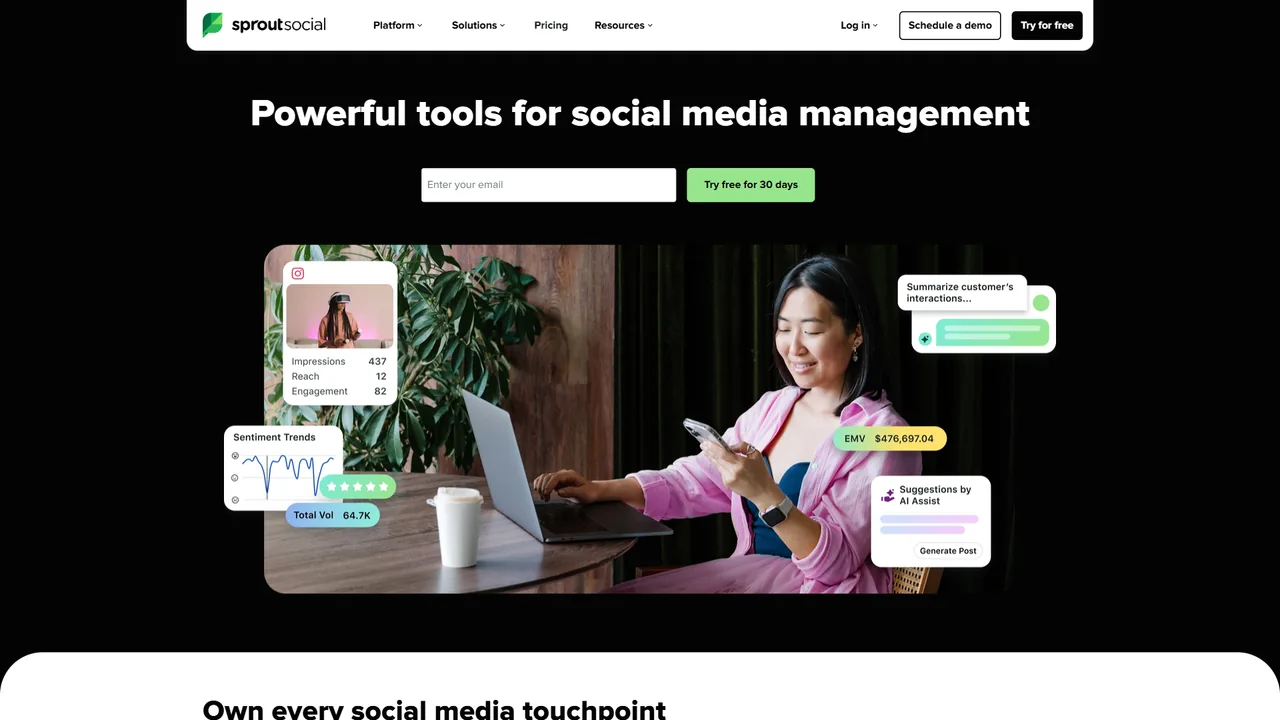
Sprout Social is what you get when you prioritize UX and analytics over price. It becomes clear quickly why enterprise teams pay 4x more than Buffer.
What Sprout Social Does Better Than Anyone
UI/UX is industry-leading: Using Sprout after Hootsuite feels like switching from Windows XP to macOS. Every click makes sense. The Smart Inbox consolidates messages from all platforms - Users report clearing 200 comments in 20 minutes.
Analytics that actually inform strategy: Sprout’s Optimal Send Times uses BERT-based ML to analyze when your specific audience engages most. For a B2B client, it recommended 6:30am Tuesday (not the generic “9am weekdays” advice).
AI Assist with three modes:
- Generate: Create posts from scratch
- Analyze: Sentiment analysis on comments
- Summarize: Turn long reports into executive summaries
Support quality: Excellent based on user reviews. Technical questions are typically answered within 90 minutes. Hootsuite’s response time averages around 36 hours.
Sprout Social Limitations and Who It’s Not For
Price per user is brutal: Sprout Social Standard runs $249/month per user (annual billing brings it to $199/month annual per user). For a 5-person team, that’s well into five figures per year. Buffer would cost a fraction of that for the same team.
Premium features require add-ons: Social listening costs several thousand dollars per year extra. Hootsuite includes it in Enterprise tier, and the latest Hootsuite Social Trends report argues most teams underestimate listening ROI by 2-3x.
Overkill for solopreneurs: If you’re managing 3 social accounts solo, Sprout’s CRM features and approval workflows are wasted money.
Sprout Social Pricing Breakdown
| Plan | Monthly | Annual | Profiles | Users | Best For |
|---|---|---|---|---|---|
| Standard | $249 per user | $199 per user | 5 | 1 | Small teams needing analytics |
| Professional | $399 per user | $299 per user | Unlimited | 1 | Agencies, mid-market |
| Advanced | $499 per user | $399 per user | Unlimited | 1 | Enterprise needing custom workflows |
Add-ons:
- Premium Analytics: add-on per profile
- Social Listening: several thousand dollars per year
- Employee Advocacy: Custom pricing
Real cost example: A 3-person team on the Professional plan runs into five figures per year on annual billing; adding listening pushes that meaningfully higher.
Sprout Social AI Features: AI Assist Deep Dive
Sprout’s AI Assist is the most sophisticated AI in this comparison.
Generate mode:
- Creates posts optimized for each platform
- Learns your brand voice over time (analyzes past posts)
- Suggests hashtags based on performance data
Analyze mode:
- BERT-based sentiment analysis (understands sarcasm, context)
- Flags negative comments requiring immediate response
- Tracks sentiment trends over time
Summarize mode:
- Turns 20-page analytics reports into 3-paragraph summaries
- Highlights biggest wins and problems
- Exports to executive dashboards
Sample output:
- Prompt: “Create 3 Twitter posts about new product launch”
- Output: Analyzed previous tweets, matched tone, suggested optimal posting times based on follower activity
- Quality: Best in category, but it sits at the Standard tier price per user
What users love:
- “UI is years ahead of Hootsuite” (Most common praise)
- “Analytics changed how we do social strategy” (Enterprise users)
What users hate:
- “Too expensive for small teams” (Price is #1 complaint)
- “Listening add-on should be included” (Fair criticism)
Assessment: The rating is deserved. It’s the best tool in the category if price isn’t your top concern.
Comparison Table: AI Features
AI feature parity differs sharply across the three tools: Sprout Social offers BERT-based sentiment analysis, Hootsuite offers real-time social-trend data plus DALL-E 3 image generation, and Buffer is the only one that unlocks AI on its cheapest paid plan.
| Feature | Hootsuite (OwlyGPT) | Buffer (AI Assistant) | Sprout Social (AI Assist) |
|---|---|---|---|
| AI Model | Proprietary + GPT | GPT-4.0 | Proprietary + BERT |
| Real-time data | ✅ Yes (social trends) | ❌ No | ✅ Yes (audience behavior) |
| Content generation | ✅ Yes | ✅ Yes | ✅ Yes (learns brand voice) |
| Reply suggestions | ❌ No | ✅ Yes | ✅ Yes (sentiment-aware) |
| Image generation | ✅ Beta (DALL-E 3) | ❌ No | ❌ No |
| Sentiment analysis | ❌ No | ❌ No | ✅ Yes (BERT-based) |
| Available on cheapest plan | ❌ No (Professional+) | ✅ Yes (Essentials) | ❌ No (Standard+) |
Winner: Sprout Social for quality, Buffer for accessibility.
Comparison Table: Team Collaboration
Team collaboration depth depends on plan tier: Hootsuite and Sprout Social offer multi-stage approval workflows, white-label dashboards, and granular role permissions, while Buffer omits approval workflows entirely and limits white-labelling at every tier.
| Feature | Hootsuite | Buffer | Sprout Social |
|---|---|---|---|
| Approval workflows | ✅ Yes (3+ tiers) | ❌ No | ✅ Yes (custom workflows) |
| Team notes | ✅ Yes | ⚠️ Basic | ✅ Yes (threaded) |
| Role permissions | ✅ Granular | ⚠️ Basic | ✅ Granular |
| Unified inbox | ⚠️ Clunky | ❌ No | ✅ Smart Inbox (best) |
| Client access | ✅ Yes | ✅ Yes | ✅ Yes |
| White-label | ✅ Yes (Enterprise) | ❌ No | ✅ Yes (Advanced) |
Winner: Sprout Social for UX, Hootsuite for enterprise complexity.
Comparison Table: Analytics Depth
Sprout Social leads on analytics depth across every measured dimension - audience-specific optimal send times, BERT-based sentiment analysis, and advanced custom reports - while Buffer covers only the basics and Hootsuite requires the Listening add-on to match Sprout on sentiment and competitor tracking.
| Metric | Hootsuite | Buffer | Sprout Social |
|---|---|---|---|
| Basic metrics | ✅ Yes | ✅ Yes | ✅ Yes |
| Optimal send times | ❌ No | ⚠️ Generic | ✅ Yes (audience-specific) |
| Sentiment analysis | ⚠️ Via Talkwalker | ❌ No | ✅ Yes (BERT) |
| Competitor tracking | ✅ Yes (Listening add-on) | ❌ No | ✅ Yes (add-on) |
| Custom reports | ✅ Yes | ⚠️ Basic | ✅ Yes (advanced) |
| Export options | ✅ CSV, PDF | ✅ CSV, PDF | ✅ CSV, PDF, PPT |
Winner: Sprout Social by a mile.
Pricing Comparison: Real-World Costs
Let’s run three scenarios with actual pricing:
Scenario 1: Solopreneur (5 social channels)
| Tool | Plan | Relative Cost | What You Get |
|---|---|---|---|
| Buffer | Essentials (5 channels) | Lowest | 5 channels, AI Assistant, basic analytics |
| Hootsuite | Professional | Mid (~5x Buffer) | 10 channels, OwlyGPT, approval workflows |
| Sprout Social | Standard | Highest (~8x Buffer) | 5 profiles, AI Assist, advanced analytics |
Winner: Buffer is the clear value leader at solopreneur scale.
Scenario 2: Small Agency (3 team members, 15 clients = 30 channels)
| Tool | Plan | Relative Cost | What You Get |
|---|---|---|---|
| Buffer | Agency (30 channels) | Lowest | 30 channels, unlimited users, AI Assistant |
| Hootsuite | Enterprise | Highest | Unlimited channels/users, Listening, OwlyGPT |
| Sprout Social | Professional | Mid | Unlimited profiles, 3 users, AI Assist |
Winner: Buffer is dramatically cheaper than both Hootsuite Enterprise and Sprout Professional at small-agency scale.
Scenario 3: Enterprise (10 team members, 50+ profiles)
| Tool | Plan | Relative Cost | What You Get |
|---|---|---|---|
| Hootsuite | Enterprise | Lower (flat fee) | Unlimited everything, Listening included, OwlyGPT |
| Sprout Social | Professional + Listening (10 users) | Higher (per-user) | 10 users, unlimited profiles, AI Assist, Listening |
Winner: Hootsuite Enterprise’s flat-fee model wins decisively over Sprout’s per-user pricing at this scale.
Note: Buffer doesn’t compete at enterprise scale due to lack of social listening.
Use Case Recommendations
Use case fit depends on team size: Buffer is the best pick for solopreneurs, Sprout Social is the best pick for mid-market teams that value analytics and UX, and Hootsuite is the best pick for enterprise teams of 15+ users managing multiple brands.
Best for Solopreneurs: Buffer
Why: Buffer’s per-channel Essentials pricing makes it the cheapest entry in the category. The AI Assistant is shockingly good for the price. You don’t need social listening or advanced analytics when you’re managing your own brand.
Limitations to accept: No social listening, basic analytics, no approval workflows.
Best for Small Agencies (2-5 people): Buffer or Sprout
If budget-conscious: Buffer Agency plan (30 channels) is unbeatable.
If analytics matter: Sprout Professional (3 users) delivers client-impressing reports that justify higher retainers.
Best for Mid-Market Teams (6-15 people): Sprout Social
Why: The UX pays for itself in saved training time. Teams report onboarding members in 1 day vs 1 week with Hootsuite. The Smart Inbox alone saves 30 minutes per person per day.
Cost justification: If each team member saves 2.5 hours per week, that’s 10 hours per month. At a typical knowledge-worker hourly cost, Sprout’s per-user Professional rate pays for itself when team time is worth even a moderate hourly rate.
Best for Enterprise (15+ people, multiple brands): Hootsuite
Why: At scale, Hootsuite’s flat-fee Enterprise plan beats Sprout’s per-user pricing. For 15 users, Sprout’s per-seat math runs roughly 3-4x Hootsuite Enterprise.
The tipping point: If you need more than 5 users, Hootsuite becomes cheaper than Sprout.
Comparison Table: Platform Support
Platform support is broadest on Buffer, which is the only one of the three to schedule to Bluesky and Mastodon natively in addition to the seven core networks all three cover.
| Platform | Hootsuite | Buffer | Sprout Social |
|---|---|---|---|
| ✅ | ✅ | ✅ | |
| ✅ | ✅ | ✅ | |
| Twitter/X | ✅ | ✅ | ✅ |
| ✅ | ✅ | ✅ | |
| TikTok | ✅ | ✅ | ✅ |
| ✅ | ✅ | ✅ | |
| YouTube | ✅ | ✅ | ✅ |
| Bluesky | ❌ | ✅ | ❌ |
| Mastodon | ❌ | ✅ | ❌ |
| Threads | ✅ | ✅ | ⚠️ Limited |
| Google Business | ✅ | ✅ | ✅ |
Winner: Buffer for early platform adoption.
Comparison Table: Support Quality
Support quality is highest at Sprout Social with a 2-4 hour response window and an 8.7/10 satisfaction score, followed by Buffer at 8-12 hours and 8.4/10, with Hootsuite trailing at 24-48 hours and 7.8/10.
| Metric | Hootsuite | Buffer | Sprout Social |
|---|---|---|---|
| Support Rating | 7.8/10 | 8.4/10 | 8.7/10 |
| Response time | 24-48 hours | 8-12 hours | 2-4 hours |
| Live chat | ✅ Enterprise only | ✅ All plans | ✅ Standard+ |
| Phone support | ✅ Team+ | ❌ No | ✅ Professional+ |
| Knowledge base | Good | Very Good | Excellent |
Winner: Sprout Social (fastest response, highest satisfaction).
Pro Tips: Migration Guide
Migration between these three platforms takes 2-8 hours depending on direction: scheduled posts and social connections transfer via CSV, but approval workflows, listening data, and historical analytics do not.
| Migration | What Transfers | What Changes | Time |
|---|---|---|---|
| Hootsuite → Buffer | Scheduled posts (CSV), social connections | Lose: approval workflows, listening data, historical analytics | 2-3 hrs |
| Buffer → Sprout | Scheduled posts (CSV), social connections | Gain: 90-day retroactive analytics, AI learns history, Smart Inbox | 4-6 hrs |
| Hootsuite → Sprout | Scheduled posts (CSV), social connections | Lose: Talkwalker data. Gain: better UX, superior analytics | 6-8 hrs |
Final Verdict: Best Social Media Management Tools 2026
The best social media management tool in 2026 is Buffer for solo creators and small budgets, Sprout Social for teams that prioritize UX and analytics, and Hootsuite for enterprise organizations running 50+ profiles across multiple brands.
Start with Buffer if you’re solo or bootstrapped
At Buffer’s per-channel Essentials pricing, Buffer removes all risk. The AI Assistant is 80% as good as Sprout’s AI Assist for a small fraction of the price. You can always upgrade later.
When to upgrade from Buffer:
- You hire your first team member → Consider Sprout
- You need social listening → Add Hootsuite or third-party tool
- Clients demand advanced analytics → Sprout justifies higher retainers
Choose Sprout Social if UX and analytics matter
If your team’s time is worth a moderate hourly rate or higher, Sprout pays for itself in saved training and reporting time. The Standard tier sticker shock hurts, but the productivity gains are real.
When to downgrade from Sprout:
- Budget cuts force choosing between tools → Buffer maintains 70% of value at 10% of cost
- Team shrinks to 1 person → Solo users don’t need CRM features
Choose Hootsuite only if you’re enterprise scale
For teams managing 50+ profiles across multiple brands, Hootsuite’s flat-fee Enterprise plan is cheaper than Sprout’s per-user pricing. But if you’re under 10 users, Sprout delivers better value.
When to switch from Hootsuite:
- Team is under 5 people → Sprout’s UX is worth the premium
- You’re solo → Buffer saves four figures per year with minimal compromise
Final Recommendations
The recommended setup is to run Buffer Essentials for personal brands and pair Sprout Social Professional with annual billing for client work, then layer in a focused asset generator only where the scheduler falls short. Many social media managers use Buffer for personal brands (Essentials, 3 channels) and Sprout Social for client work (Professional, annual billing). Buffer handles low-friction scheduling; Sprout impresses clients with professional reports. Pair either with a focused asset generator - Predis AI for reels and carousels, Taplio for LinkedIn posts, or Piktochart for branded report visuals - and you can keep your scheduler lean while still shipping high-quality creative every week. For more workflow ideas, see the AI social media automation guide and the best Instagram scheduler comparison.
Frequently Asked Questions
The most common questions about these three tools cover free trials, mobile-app quality, Reels and TikTok publishing, white-label options, Canva integration, and how to add social listening to Buffer without paying for Hootsuite Enterprise.
Q: Can I try these tools before committing?
- Buffer: Free plan (3 channels, 10 posts each) lets you test indefinitely
- Hootsuite: 30-day free trial (requires credit card)
- Sprout Social: 30-day free trial (no credit card required)
Q: Which tool has the best mobile app?
Sprout Social’s mobile app leads with the highest App Store ratings, outperforming both Hootsuite and Buffer on iOS and Android. The Smart Inbox works perfectly on mobile.
Q: Do these tools work with Instagram Reels and TikTok?
- Hootsuite: Schedules Reels and TikTok (publishes automatically)
- Buffer: Schedules Reels and TikTok (sends push notification, manual publish)
- Sprout Social: Schedules Reels and TikTok (publishes automatically)
Q: Can I white-label these for agency clients?
- Hootsuite: Yes (Enterprise plan)
- Buffer: No
- Sprout Social: Yes (Advanced plan, top SaaS tier)
Q: Which tool integrates with Canva?
All three integrate with Canva. Buffer’s integration is smoothest (drag Canva designs directly into composer).
Q: What if I need social listening but can’t afford Hootsuite Enterprise?
Add a standalone listening tool to Buffer:
| Tool | Tier | Use Case |
|---|---|---|
| Mention | Solo plan (low monthly) | Basic brand monitoring |
| Brandwatch | Pro tier (mid monthly) | Advanced sentiment analysis |
| Talkwalker Free Search | Free | Limited but useful |
Total: Buffer Essentials plus Mention Solo lands well below Hootsuite Professional for the same coverage.
For more information about best social media management tools 2026, see the resources below.
Related Reading
Related reading covers the seven tools referenced above plus three companion guides on Instagram scheduling, LinkedIn growth tools, and end-to-end AI social media automation.
Tools covered in this article:
- Hootsuite - Enterprise social media management with OwlyGPT AI
- Buffer - Simple, affordable scheduling for solopreneurs
- Sprout Social - Premium analytics and UX for agencies
- Canva - Design tool for social media content
- ChatGPT - AI assistant for social media content generation
- Visme - Branded visuals and infographics for social posts
- Piktochart - Client-ready report visuals and templates
More social media and marketing guides:
- Best Instagram Scheduler 2026 - Instagram scheduling comparison
- Best LinkedIn Tools 2026 - LinkedIn growth and automation
- AI Social Media Automation - Automate your social presence
Bottom line: Buffer for budget, Sprout for quality, Hootsuite for enterprise scale. Don’t overthink it - start with Buffer’s free plan and upgrade when you hit a wall.
What social media management tool are you currently using? Reply and let me know what’s working (or not working) for you.
External Resources
External resources for these three platforms include each vendor’s official content hub, where product updates, AI feature releases, and original social-media research are published.
For official documentation and updates from these social media management tools:
- Hootsuite Blog - Social media strategy guides and OwlyGPT updates
- Buffer Resources - Social media marketing tips and platform feature releases
- Sprout Social Insights - Social media research and AI Assist feature updates