



Top SEO tools are software platforms that help teams and individuals work more efficiently across the four stages of SEO work - Audit, Research, Optimize, and Monitor. Leading options include Ahrefs for backlink analysis, Surfer SEO for content optimization, Semrush for site audits, and Google Search Console for first-party performance data.
Most “top SEO tools” lists dump 20 platforms into a ranked list and call it a day. That approach wastes your time - particularly for digital marketers trying to build focused workflows - because no single tool handles every SEO workflow equally well. Ahrefs dominates backlink analysis but lacks a native content editor. Surfer SEO optimizes content beautifully but won’t crawl your site for technical issues. Semrush tries to do everything, and mostly succeeds, but the price reflects it.
The right SEO toolkit depends on two things: your workflow stage and your budget. This guide is an SEO tools list organized by the four stages of actual SEO work - Audit, Research, Optimize, and Monitor - including top SEO tools free of charge where they exist, so you can build a stack that fits your needs without paying for features you will never touch.
How This Guide Is Organized
This guide organizes the top SEO tools by workflow stage rather than by ranking, mapping each platform to the Audit, Research, Optimize, or Monitor stage where it delivers the most value for digital marketers. Our analysis draws on current vendor documentation, pricing pages, and independent research rather than sponsored placement, and AI Productivity may earn a commission from links on this page - our rankings are editorially independent.
Instead of ranking tools 1 through 10, this guide maps them to the SEO workflow stages where they deliver the most value:
| Workflow Stage | What You’re Doing | Top Tools |
|---|---|---|
| Audit | Finding technical issues, crawl errors, site health | Semrush, Ahrefs, Screaming Frog |
| Research | Keywords, competitors, content gaps, topic planning | Ahrefs, Semrush, MarketMuse |
| Optimize | Writing and optimizing content for search | Surfer SEO, Clearscope, MarketMuse |
| Monitor | Tracking rankings, traffic, AI visibility | Semrush, Ahrefs, Google Search Console |
Most teams need at least one tool per stage. Some platforms - like Semrush and Ahrefs - span multiple stages, which is why they show up more than once. For beginners and solo marketers, starting with a single platform that covers your main workflow stage is usually the right call. The key is knowing where each tool genuinely excels versus where it’s just checking a box.
The Top SEO Tools at a Glance
The top SEO tools at a glance are Semrush ($139.95/mo), Ahrefs ($29/mo), Surfer SEO ($99/mo), Clearscope ($189/mo), MarketMuse (free / $99/mo), Google Search Console (free), and Screaming Frog (free / $259/yr) - each compared below on starting price, rating, primary strength, and best-fit team.
| Tool | Starting Price | Rating | Primary Strength | Best For |
|---|---|---|---|---|
| Semrush | $139.95/mo | All-in-one marketing suite | Teams needing SEO + PPC + social | |
| Ahrefs | $29/mo (Starter) | Backlink index and competitive intel | Link builders and competitive research | |
| Surfer SEO | $99/mo | Content optimization scoring | Writers and content teams | |
| Clearscope | $189/mo | Enterprise content grading | Large editorial teams | |
| MarketMuse | Free / $99/mo | Topic authority modeling | Content strategists | |
| Google Search Console | Free | N/A | First-party performance data | Everyone (non-negotiable) |
| Screaming Frog | Free / $259/yr | N/A | Deep technical crawling | Technical SEOs |
Stage 1: Audit - Find What’s Broken Before You Build
Stage 1 audit tools find what is broken on your site before you build new content, surfacing crawl errors, broken links, missing meta tags, slow pages, and Core Web Vitals failures so you fix the foundation first. Technical SEO issues silently kill your rankings, and these platforms tested all tools in the audit category prioritize fixes by traffic impact rather than dumping raw error lists.
Semrush Site Audit
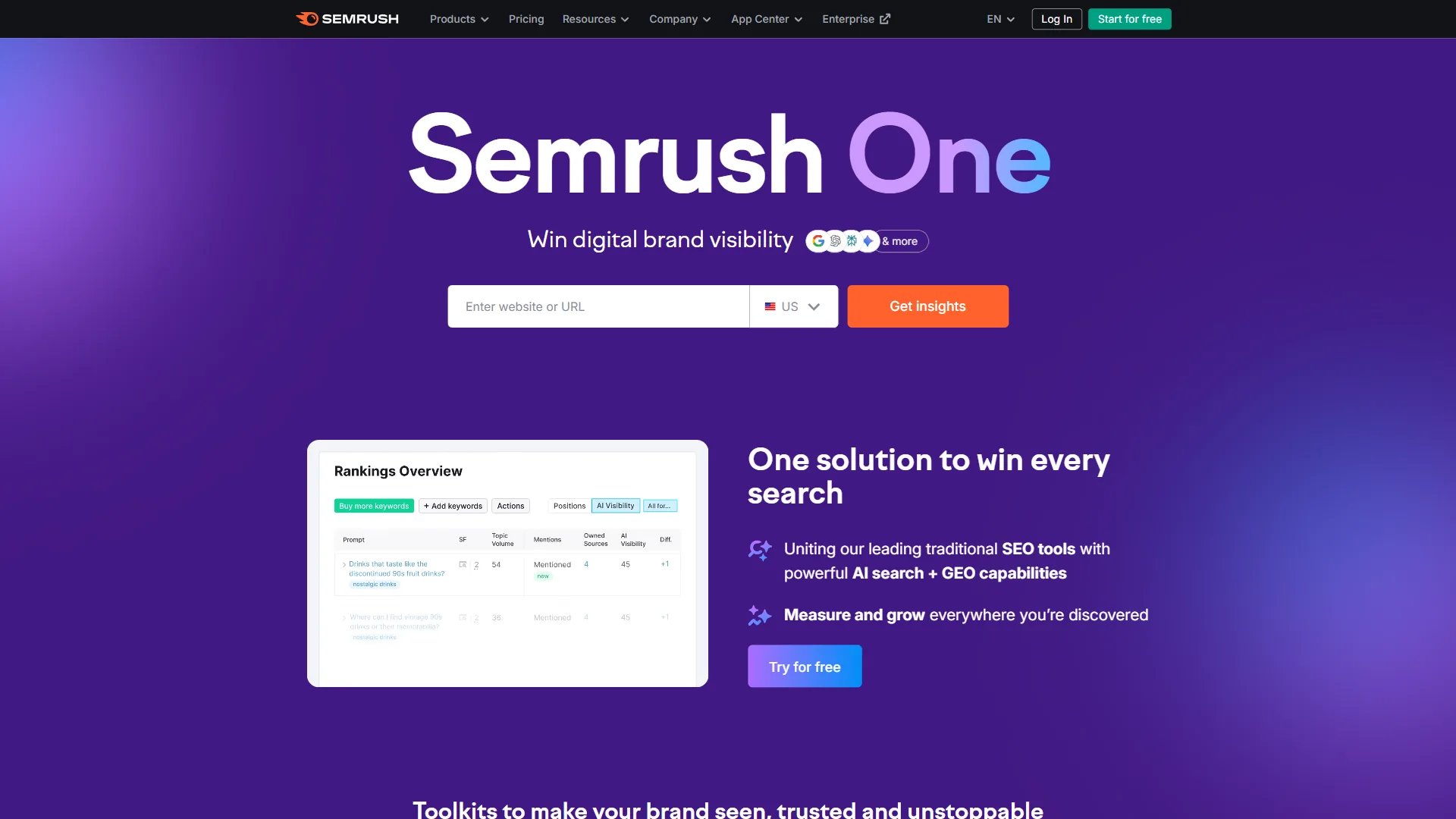
Semrush runs over 140 technical checks per crawl, covering everything from HTTP status codes and hreflang implementation to Core Web Vitals and structured data. What sets it apart from other audit tools is the prioritization engine. Instead of dumping 500 errors on you, it groups issues by severity and estimates the traffic impact of fixing each one.
The Site Audit also tracks historical health scores, so you can see whether your technical foundation is improving or degrading over time. For teams managing multiple sites, you can run scheduled crawls and get alerts when new critical issues appear.
Audit capabilities: 140+ checks, Core Web Vitals, JavaScript rendering, log file analysis (Business tier), scheduled crawls
Starting at: $139.95 per month (Pro) for 5 projects and 100,000 crawled pages per project
Ahrefs Site Audit
Ahrefs takes a different approach to auditing. Its crawler is fast - often completing a 10,000-page crawl in under 10 minutes - and the interface is cleaner than Semrush’s for quick issue identification. The free Ahrefs Webmaster Tools tier gives verified site owners access to Site Audit and limited Site Explorer data at no cost, making it one of the best entry points for technical SEO.
Where Ahrefs falls short on auditing compared to Semrush is depth. It covers fewer checks (around 100+), and the log file analysis and JavaScript rendering capabilities aren’t as mature. But for sites under 50,000 pages, Ahrefs handles technical auditing well enough that you probably don’t need a dedicated crawling tool.
Audit capabilities: 100+ checks, crawl scheduling, internal link analysis, Core Web Vitals, free tier for verified sites
Starting at: Free (Webmaster Tools) or $29 per month (Starter) for basic auditing
Screaming Frog SEO Spider
For pure technical depth, Screaming Frog remains the industry standard. It’s a desktop crawler that lets you inspect every URL on your site - HTTP headers, canonical tags, pagination, hreflang, structured data, and more. The free version crawls up to 500 URLs, which covers most small sites.
The paid version ($259 per year) removes the URL limit and adds features like JavaScript rendering, custom extraction, and Google Analytics/Search Console integration. Technical SEOs who need to diagnose complex crawl issues - redirect chains, orphan pages, or faceted navigation problems - usually keep Screaming Frog in their toolkit alongside a cloud-based platform.
Audit capabilities: Unlimited technical depth, custom extraction, JavaScript rendering, API integrations
Starting at: Free (500 URLs) or $259 per year (unlimited)
Which Audit Tool Should You Pick?
- Solo site owner on a budget: Ahrefs Webmaster Tools (free) + Screaming Frog free tier
- Small team or agency: Semrush Pro ($139.95 per month) covers auditing plus research and monitoring
- Technical SEO specialist: Screaming Frog paid ($259 per year) + either Semrush or Ahrefs for cloud-based scheduling
Stage 2: Research - Keywords, Competitors, and Content Gaps
Research is where you decide what to create and who you’re competing against. The top SEO tools in this stage help you find keywords worth targeting, analyze what competitors rank for, and identify content gaps you can exploit.
Ahrefs: Best Research Database
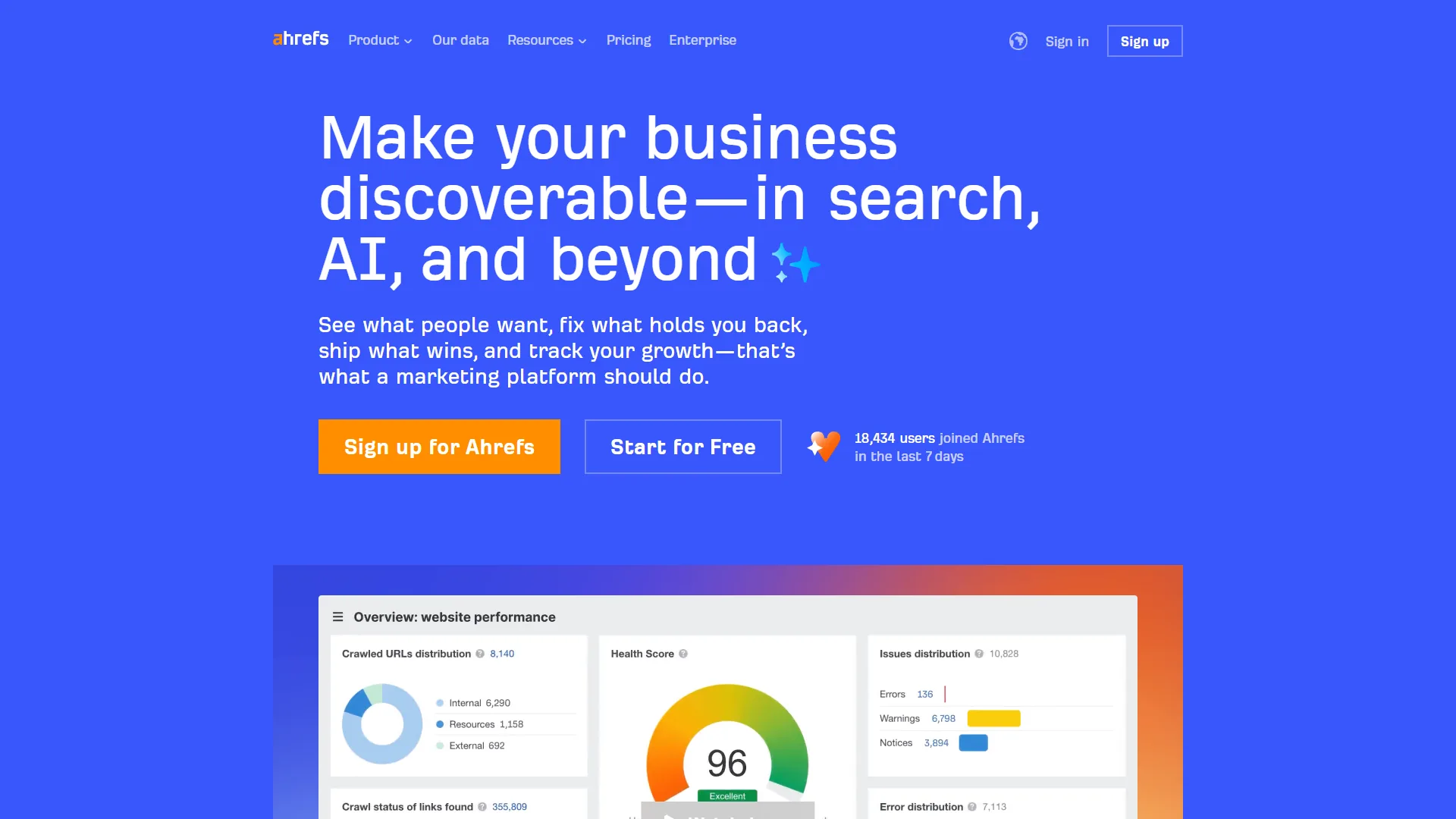
Ahrefs has the largest backlink index in the SEO industry - over 35 trillion external links crawled and updated every 15 to 30 minutes. This matters for research because accurate backlink data feeds into keyword difficulty scores, competitive analysis, and content gap identification.
Keywords Explorer covers 10 search engines (not just Google) and provides click data alongside search volume. A keyword with 10,000 monthly searches but 80% zero-click results is worth far less than one with 3,000 searches where users actually click through.
Content Gap analysis compares your domain against up to 10 competitors to find keywords they rank for that you don’t. In a documented SaaS case study, a single Content Gap analysis surfaced 47 mid-difficulty keywords. Prioritizing 12 of them produced content that reached page one within 90 days.
Content Explorer searches a database of over a billion pages to find content by topic, showing backlinks, traffic estimates, and social shares. It’s particularly useful for finding linkable content formats and identifying outreach targets.
Key research features: Keywords Explorer (10 search engines), Content Gap, Content Explorer, Site Explorer, SERP analysis with click data
Semrush: Best All-in-One Research
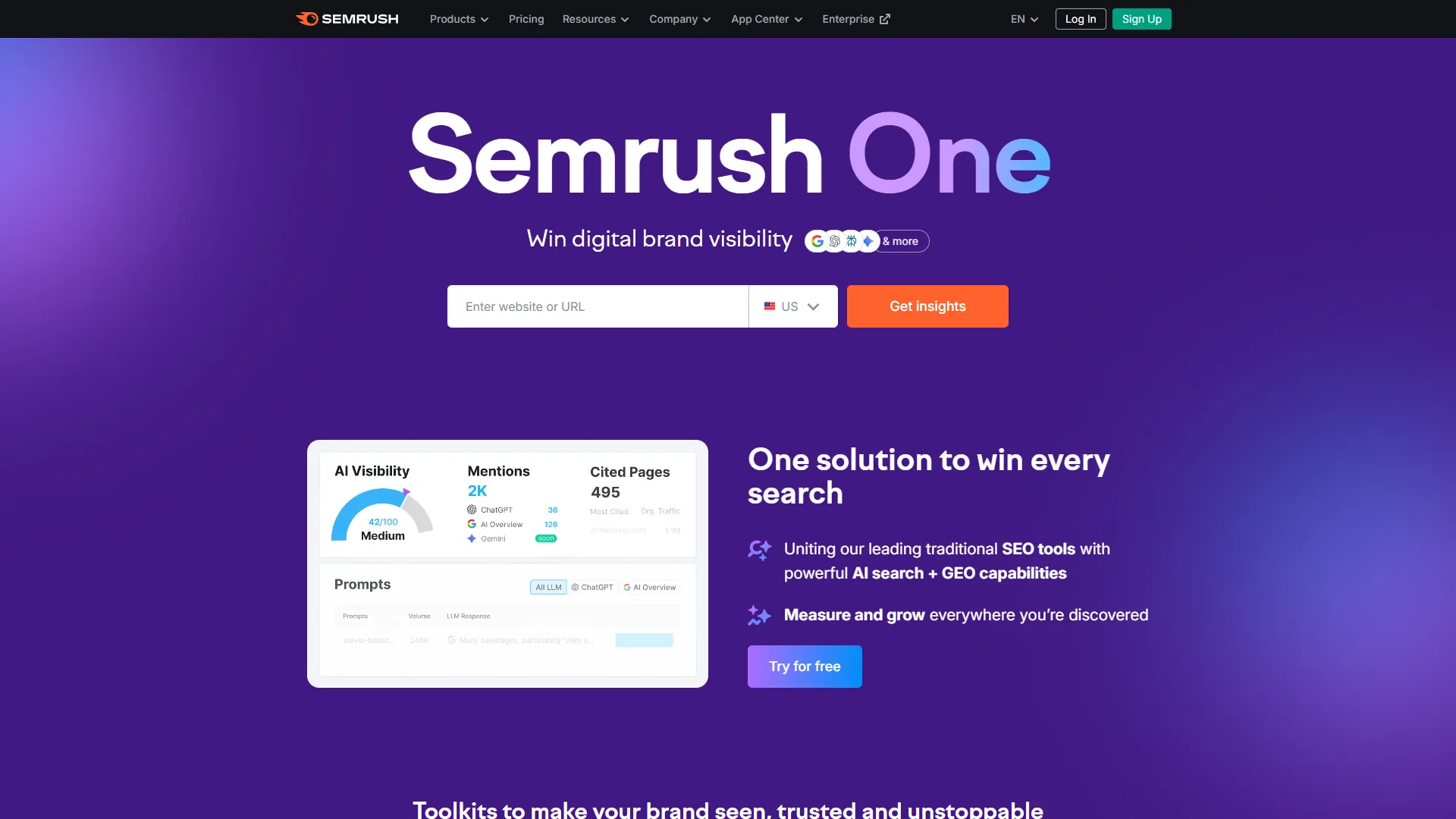
Semrush’s Keyword Magic Tool is the deepest keyword research database available, with over 26 billion keywords across 142 countries. What makes it stand out is the intent classification - every keyword is tagged as informational, navigational, commercial, or transactional. This saves hours of manual intent analysis when building content calendars.
The Semrush Copilot AI assistant (included free on all paid plans) now surfaces actionable insights from your data automatically. It monitors your projects and flags opportunities like declining pages, keyword cannibalization, and quick-win keywords where you rank positions 4 through 10. Instead of digging through dashboards, the Copilot brings the insights to you.
For competitive research, Semrush’s Traffic Analytics provides estimated traffic data for any domain, including traffic sources, top pages, and audience overlap. This goes beyond keyword-level competition into business-level intelligence. Combined with the EyeOn competitive monitoring tool, you can track when competitors publish new content, launch new ads, or change their site structure.
Semrush also introduced AI Visibility tracking in 2026, monitoring how your brand appears across ChatGPT, Google AI Overviews,Perplexityy, and Gemini. As AI-generated answers consume more search traffic, knowing whether AI engines cite your content is becoming as important as traditional rank tracking.
Key research features: Keyword Magic Tool (26B+ keywords), intent classification, Copilot AI, Traffic Analytics, EyeOn monitoring, AI Visibility tracking
MarketMuse: Best for Content Strategy
MarketMuse takes a fundamentally different approach to research. Instead of starting with individual keywords, it models your entire site’s topic authority using proprietary AI. The Topic Authority metric shows you which subjects your site is credible on and where the gaps are - not at the keyword level, but at the topic cluster level.
This matters for content strategy because Google’s algorithms increasingly reward topical depth over individual keyword targeting. MarketMuse’s SERP X-ray analyzes competitor content and identifies subtopics they cover that you don’t, giving you a research-backed content roadmap rather than a flat keyword list.
The free tier (10 queries/month) is enough to test the platform. The Optimize plan ($99 per month) adds content briefs and deeper analysis. For teams building authority in competitive niches, the strategic perspective MarketMuse provides is harder to replicate with traditional keyword tools.
Key research features: Topic Authority modeling, SERP X-ray, content gap analysis at topic level, AI-generated content briefs
Research Tool Comparison by Budget
| Budget | Recommended Stack | What You Get |
|---|---|---|
| $0/mo | Ahrefs Webmaster Tools + MarketMuse Free + Google Trends | Basic keyword data, limited competitive intel, trend analysis |
| $29-99/mo | Ahrefs Starter ($29) or MarketMuse Optimize ($99) | Solid keyword research or content strategy (pick one focus) |
| $130-250/mo | Semrush Pro ($139.95) or Ahrefs Lite ($129) | Full keyword research + competitive analysis + auditing |
| $250+/mo | Semrush Guru ($249.95) + MarketMuse Optimize ($99) | Complete research suite + content strategy + AI visibility |
Stage 3: Optimize - Turn Research Into Rankings
Stage 3 optimization tools turn keyword research into rankings by analyzing the top-ranking pages for your target keyword and scoring your draft against them in real time on structure, keyword usage, and topical coverage. Surfer SEO, Clearscope, and MarketMuse are the three platforms that cover every use case from solo-writer drafts to enterprise editorial workflows.
Surfer SEO: Best Content Optimization Platform
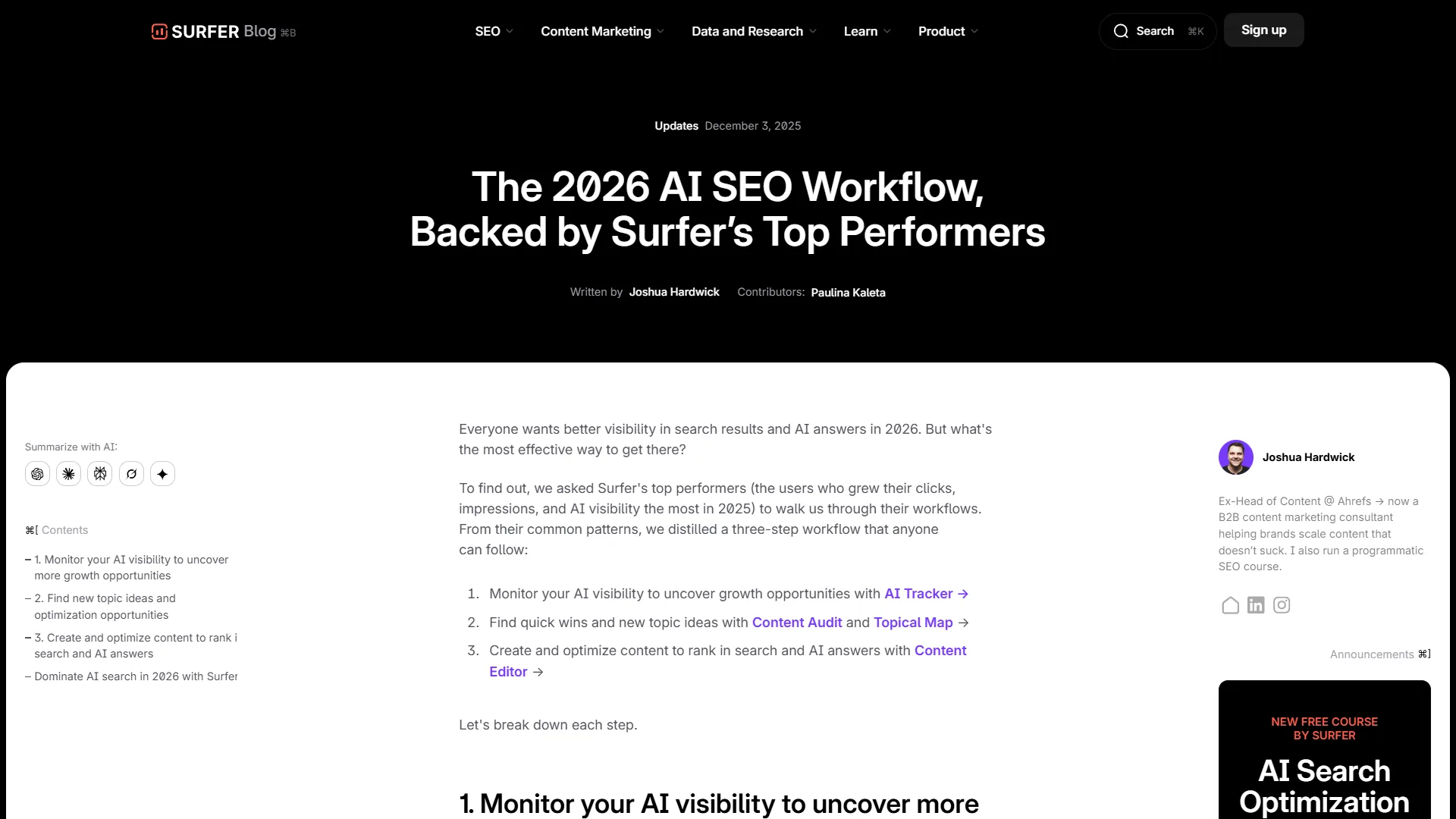
Surfer SEO is the most popular content optimization platform among SEO professionals, and for good reason. The Content Editor analyzes the top-ranking pages for your keyword and generates a real-time scoring system (0-100) that accounts for keyword density, semantic terms, heading structure, word count, and even image usage.
The 2026 version integrates GPT-4o for both AI writing and optimization suggestions. Surfer AI can generate a complete first draft in about three minutes, scoring 80+ in the Content Editor immediately. It’s not publish-ready, but it dramatically reduces the blank-page problem. The AI Humanizer then rewrites robotic-sounding passages to match a more natural tone.
Topical Map is Surfer’s answer to content strategy. It clusters related keywords and shows you how topics connect, helping you plan content that builds topical authority rather than targeting keywords in isolation. For a deeper dive into this approach, our topic authority SEO strategy guide walks through the framework step by step. For a content team producing 10+ articles per month, this feature alone justifies the subscription.
Surfer also offers Auto-Optimize - paste an existing URL and it suggests specific edits based on current SERP data (add this NLP term, expand this section, reduce keyword stuffing in paragraph 3).
Pricing: Essential at $99 per month (30 articles), Scale at $219 per month (100 articles), Enterprise at custom pricing
Key optimization features: Content Editor with NLP scoring, Surfer AI generation, Auto-Optimize for existing content, Topical Map, AI Humanizer
Clearscope: Best for Enterprise Teams
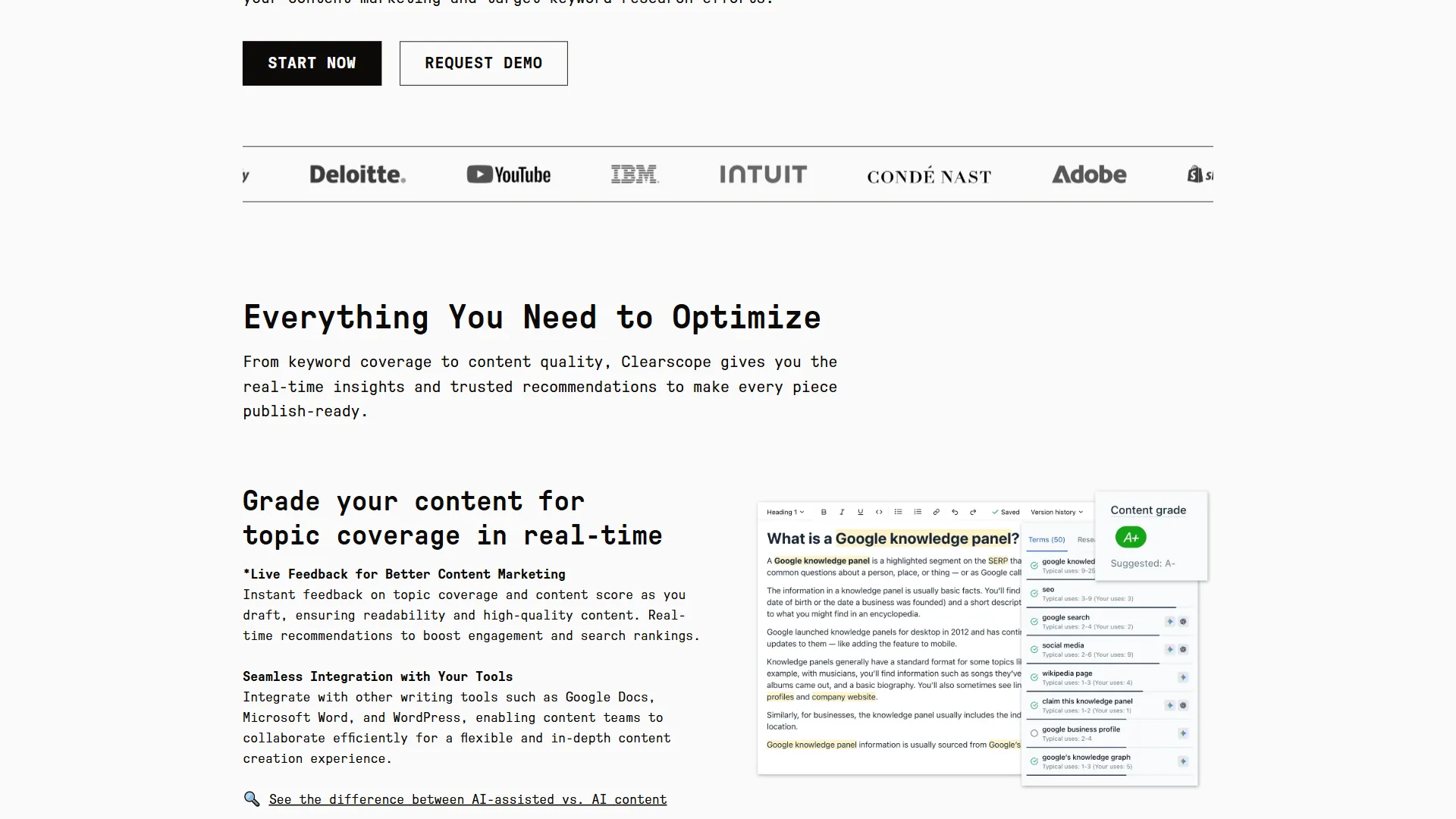
Clearscope takes a simpler approach than Surfer. Instead of a numerical score, it uses an A++ through F letter-grade system that editorial teams find more intuitive. The platform analyzes top-ranking content and surfaces the semantic keywords you should include, with clear indicators of which terms you’ve used, underused, or missed entirely.
Where Clearscope shines is in team workflows. The Google Docs and WordPress integrations let writers optimize without leaving their writing environment. The shared content reports make it easy for editors to review optimization before publishing. For large editorial operations where multiple writers need consistent optimization guidance, Clearscope’s simplicity is a feature, not a limitation.
The trade-off is price. At $189 per month for the Essentials plan (limited to 100 content reports), Clearscope costs nearly twice what Surfer charges for comparable output volume. The Business plan ($399 per month) removes limits and adds features like keyword discovery. There’s no free trial - you’ll need to book a demo.
Pricing: Essentials at $189 per month (100 reports), Business at $399 per month (unlimited reports)
Key optimization features: Letter-grade content scoring, Google Docs integration, WordPress plugin, team-friendly reporting, semantic keyword recommendations
Optimization Tool Comparison
| Factor | Surfer SEO | Clearscope | MarketMuse |
|---|---|---|---|
| Starting Price | $99/mo | $189/mo | $99/mo |
| Scoring System | 0-100 numeric | A++ to F letter grade | Content Score + Authority |
| AI Writing | Yes (GPT-4o) | Yes (included) | Yes (content briefs) |
| Best For | High-volume content teams | Enterprise editorial workflows | Strategic content planning |
| Free Option | No (7-day guarantee) | No (demo only) | Yes (10 queries/mo) |
| Integrations | Google Docs, WordPress, Jasper | Google Docs, WordPress | Google Docs, WordPress |
Stage 4: Monitor - Track What Matters
Publishing content is not the finish line. You need to track rankings, monitor traffic changes, and watch for technical regressions. The monitoring stage is also where AI visibility tracking has become critical in 2026.
Semrush Position Tracking + AI Visibility
Semrush’s position tracking updates daily and covers desktop, mobile, and local results across any location. The real differentiator in 2026 is the AI Visibility Toolkit - it tracks how your brand and content appear in AI-generated answers from ChatGPT, Google AI Overviews, Perplexity, and Gemini.
This matters because AI engines are increasingly answering queries that used to drive organic clicks. If Perplexity cites your article as a source for “best project management tools,” that’s both visibility and a trust signal. Semrush’s AI Visibility tracking lets you measure this exposure, identify which content AI engines prefer, and optimize for AI discoverability alongside traditional rankings.
Monitoring features: Daily rank tracking (500-5,000 keywords by tier), AI Visibility across 4 engines, Sensor (algorithm change detection), Copilot alerts
Ahrefs Rank Tracker + Brand Radar
Ahrefs Rank Tracker provides daily updates with SERP feature tracking - you can see whether you hold a featured snippet, appear in People Also Ask, or show up in AI Overviews. The Brand Radar feature (available on Standard and above) monitors brand mentions across ChatGPT, Perplexity, Google AI Overviews, Gemini, and Copilot, showing you exactly when and how AI engines reference your brand.
Ahrefs also tracks competitor rankings alongside yours, so you can spot when a competitor gains or loses a position for your target keywords. The alerts system notifies you of significant ranking changes, new or lost backlinks, and brand mentions - useful for staying proactive rather than discovering problems weeks after they start.
Monitoring features: Daily rank tracking, SERP feature monitoring, Brand Radar (AI mentions), backlink alerts, competitor tracking
Google Search Console (Non-Negotiable)
Regardless of which paid tools you use, Google Search Console is the only source of first-party performance data. It shows actual impressions, clicks, and average positions from Google’s own index - not estimated data from third-party crawlers.
Key data points you can’t get anywhere else:
- Actual click-through rates by query and page
- Index coverage reports showing which pages Google has indexed
- Core Web Vitals measured from real Chrome user data
- Manual actions or security issues affecting your site
- Crawl stats showing how Googlebot interacts with your site
Every SEO stack should include Search Console as the baseline truth layer. The paid tools provide richer analysis and competitive data, but Search Console is where you verify that reality matches the estimates. For a broader view of the SEO landscape including newer entrants, see our best SEO tools roundup.
Budget-Tier Stacks: Build Your Toolkit
Budget-tier SEO stacks fall into three brackets: the $0 bootstrapper stack (Ahrefs Webmaster Tools + Screaming Frog free + MarketMuse free + Google Search Console), the $239/mo professional stack (Semrush Pro + Surfer Essential), and the $500-800/mo agency stack (Semrush Guru + Ahrefs Standard + Surfer Scale or Clearscope Business + Screaming Frog paid). These three stacks together form my 2026 stack recommendations covering every budget below.
The $0 Stack (Bootstrapper)
| Stage | Tool | What You Get |
|---|---|---|
| Audit | Ahrefs Webmaster Tools + Screaming Frog Free | Site audit for verified domains + 500-URL crawls |
| Research | MarketMuse Free + Google Trends | 10 content queries/mo + trend data |
| Optimize | (Manual - no free optimization tool covers this well) | Use Search Console data to guide optimization |
| Monitor | Google Search Console | First-party ranking and indexing data |
Monthly cost: $0 Limitations: No competitive keyword research, no content optimization scoring, limited to your own site data. Works for a single site in early stages.
The $130-150/mo Stack (Professional)
| Stage | Tool | What You Get |
|---|---|---|
| Audit | Semrush Pro | 140+ checks, 5 projects, Core Web Vitals |
| Research | Semrush Pro | Keyword Magic Tool, competitive analysis, intent data |
| Optimize | Surfer SEO Essential | 30 articles/mo with NLP scoring + AI writing |
| Monitor | Semrush Pro + Google Search Console | Daily tracking (500 keywords) + first-party data |
Monthly cost: approximately $239 per month (Semrush Pro $139.95 + Surfer Essential $99) Why this works: Semrush covers three of the four stages, and Surfer fills the content optimization gap. You get full research capabilities, solid auditing, and real-time content optimization.
The $300+/mo Stack (Agency/Enterprise)
| Stage | Tool | What You Get |
|---|---|---|
| Audit | Semrush Guru + Screaming Frog Paid | Deep technical auditing + historical data |
| Research | Ahrefs Standard + MarketMuse Optimize | Largest backlink index + topic authority planning |
| Optimize | Surfer SEO Scale or Clearscope Business | 100 articles/mo or unlimited content reports |
| Monitor | Semrush Guru (AI Visibility) + Ahrefs Brand Radar | AI engine tracking across all major platforms |
Monthly cost: $500-800+/mo depending on specific tiers Why this works: At this level, you’re getting the best tool for each stage rather than compromising. Ahrefs for research depth, Semrush for monitoring and AI visibility, Surfer or Clearscope for optimization, and Screaming Frog for technical crawling. This is the stack for teams managing multiple client sites or large content operations.
What About AI Engine Optimization (AEO)?
AI Engine Optimization (AEO) is the practice of optimizing content so that ChatGPT, Perplexity, Google AI Overviews, and Gemini cite your page as a source - and Semrush, Ahrefs, and MarketMuse are the three top SEO tools that have added native AEO tracking in 2026. Google’s AI Overviews now appear in a significant portion of searches, and ChatGPT and Perplexity have become genuine traffic sources:
- Semrush added the AI Visibility Toolkit, tracking mentions across ChatGPT, AI Overviews, Perplexity, and Gemini
- Ahrefs launched Brand Radar to monitor AI engine citations and AI References tracking
- MarketMuse focuses on topical authority, which correlates strongly with AI engine citations
If AI visibility is a priority for your brand, Semrush currently offers the most comprehensive tracking. Ahrefs is catching up with Brand Radar but requires the Standard tier ($249 per month) for full access. Neither Surfer SEO nor Clearscope has introduced dedicated AEO features yet - they remain focused on optimizing content for traditional search.
How to Choose: Decision Framework
The decision framework for choosing an SEO tool comes down to three questions: what your primary workflow is, how many sites you manage, and what your monthly budget allows. Answer these three questions to match your situation to one of the budget-tier stacks above:
1. What’s your primary workflow?
- Mostly writing and optimizing content -> Surfer SEO
- Mostly researching keywords and competitors -> Ahrefs
- Need to cover multiple marketing channels -> Semrush
- Building long-term topic authority -> MarketMuse
2. How many sites do you manage?
- 1 site -> Ahrefs Starter or Lite is plenty
- 2-5 sites -> Semrush Pro or Ahrefs Lite
- 5+ sites or agency -> Semrush Guru/Business or Ahrefs Standard/Advanced
3. What’s your monthly budget?
- Under $50 per month -> Ahrefs Starter ($29) + free tools
- $100-150/mo -> One major platform (Semrush Pro or Ahrefs Lite)
- $200-300/mo -> Major platform + optimization tool (Surfer or Clearscope)
- $300+/mo -> Best-in-class at each workflow stage
The most common mistake is buying two all-in-one platforms. If you’re running both Semrush and Ahrefs at full price, you’re paying for massive feature overlap. Pick one for research and monitoring, then complement it with a specialized tool where it falls short. If Surfer SEO is on your shortlist, our Surfer SEO alternatives guide compares it against other content optimization platforms.
The Bottom Line
The top SEO tools in 2026 have matured to the point where the differences between them are less about quality and more about specialization. Semrush is the strongest all-in-one platform, particularly with its AI Visibility tracking. Ahrefs has the deepest backlink data and the most accessible entry pricing. Surfer SEO leads content optimization. MarketMuse provides strategic perspective that keyword-level tools miss. And Clearscope offers the cleanest experience for large editorial teams.
Build your stack around your workflow, not around tool rankings. Start with one platform that covers your most critical stage, add Google Search Console (it’s free - there’s no excuse), and expand as your needs grow. The best SEO toolkit is the one you actually use consistently, not the most expensive collection you can assemble.
FAQ
The FAQ below answers the four most common Google People Also Ask questions about the top SEO tools, covering strategy stages, most-used platforms, and whether a free-only stack is viable.
Q: What are the top 5 SEO strategies?
The top 5 SEO strategies in 2026 are technical audits, keyword and competitor research, on-page content optimization, link building, and rank and AI-visibility monitoring. These five strategies map onto the four workflow stages this guide organizes around - Audit, Research, Optimize, and Monitor - so the right SEO toolkit depends on which stage you are working on and what your budget allows.
Q: What is the most used SEO tool?
The most used SEO tool overall is Google Search Console because it is free and provides first-party impression, click, and indexing data straight from Google. Among paid platforms, Semrush and Ahrefs are the two most widely used all-in-one suites, with Semrush leading on integrated marketing-suite breadth and Ahrefs leading on backlink-index depth.
Q: Can you do SEO with free tools only?
Yes, a $0 SEO stack is possible but limited. The free tier covers Ahrefs Webmaster Tools for site auditing, MarketMuse Free for 10 content queries per month, and Google Search Console for first-party ranking data. The main limitations are no competitive keyword research, no content optimization scoring, and data restricted to your own site. Works for a single site in early stages.
Related Reading
Related reading on this site covers the full tool reviews for the five platforms ranked above, plus head-to-head comparisons and budget-specific roundups for readers ready to dig deeper into a single category.
- Ahrefs Review, Semrush Review, Surfer SEO Review, Clearscope Review, and MarketMuse Review - Full tool reviews with pricing and ratings
- Semrush vs Ahrefs: Which SEO Tool Is Worth Your Money?
- Best AI SEO Tools 2026: MarketMuse vs Clearscope vs Surfer
- Best Free SEO Tools 2026: Build a $0 Toolkit That Actually Works
- Surfer SEO Tips: Maximize Your Content Editor Scores
- Best SEO Content Tools 2026: Surfer vs Clearscope vs Frase
External Resources
External resources below are the three primary-source references this guide draws on for search documentation, industry benchmark data, and annual search-trend reporting.
- Google Search Central Documentation - Official search documentation and best practices
- Ahrefs SEO Statistics - Updated industry benchmarks and data
- Semrush State of Search - Annual report on search trends and algorithm changes