





Semrush competitors are SEO platforms that operate in the same market as Semrush - tools like Ahrefs, Surfer SEO, MarketMuse, Clearscope, and Moz Pro - each outperforming it in specific areas like backlink accuracy, content optimization, or pricing. While Semrush remains the all-in-one benchmark at $139.95 per month, competitors offer entry points as low as $29 per month.
Semrush competitors have multiplied in 2026, and a close competitor analysis shows several now outperform the industry standard in backlink depth, content optimization, ease of use, pricing, and topic intelligence. Semrush’s all-in-one breadth is still unmatched, but individual competitors have carved out clear leads. A Semrush demo can show where the platform’s strengths hold and where gaps exist.
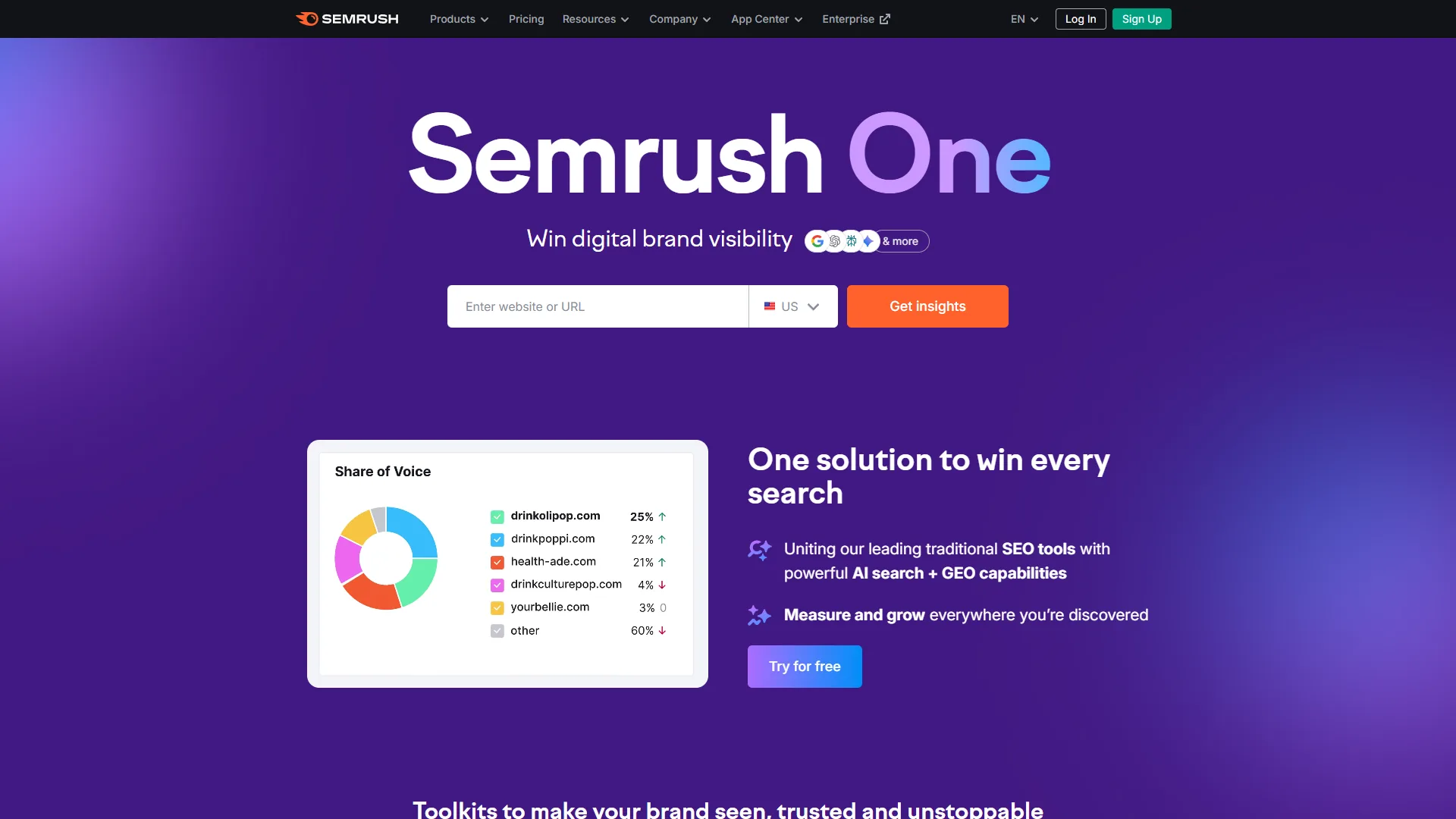
This is a direct look at five Semrush competitors and the specific areas where each wins - if you already use Semrush and want to know where your toolset has gaps, or are evaluating which platform to invest in first, this comparison gives you the concrete data to decide.
Comparison Table: Semrush Competitors at a Glance
The six leading Semrush competitors in 2026 are Ahrefs ($29/mo), Surfer SEO ($99/mo), MarketMuse (free tier), Clearscope ($189/mo), Moz Pro ($49/mo), and Semrush itself ($139.95/mo), each leading on a single dimension - backlinks, content, topic intelligence, grading accuracy, or price. This roundup of Semrush alternatives for 2026 worth trying covers free & paid tiers from $29 entry to $499 enterprise plans, so it works for every budget.
| Feature | Semrush | Ahrefs | Surfer SEO | MarketMuse | Clearscope | Moz Pro |
|---|---|---|---|---|---|---|
| Starting Price | $139.95/mo | $29/mo | $99/mo | Free (limited) | $189/mo | $49/mo |
| Pro-Level Price | $139.95/mo | $129/mo | $99/mo | $99/mo | $189/mo | $99/mo |
| Keyword Database | 20B+ | Largest | Limited | Limited | 50/mo discoveries | Full Explorer |
| Backlink Index | 43T | 35T+ (most accurate) | None | None | None | Link Explorer |
| Content Optimization | Good (Guru+) | AI Content Helper | Best-in-class | AI topic modeling | A-F grading | Basic |
| Technical SEO | 140+ audit checks | Full audit | None | None | None | Site crawl |
| AI Features | Copilot, AI Visibility | Brand Radar | Surfer AI, GPT-4o | Proprietary NLP | Semantic NLP | MozBar |
| Rating | ||||||
| Best For | All-in-one marketing | Backlink analysis | Content creation | Topic strategy | Content accuracy | Beginners |
Now let’s break down exactly where each competitor outperforms Semrush - and where they fall short.
1. Ahrefs - Beats Semrush on Backlink Data and Entry Pricing
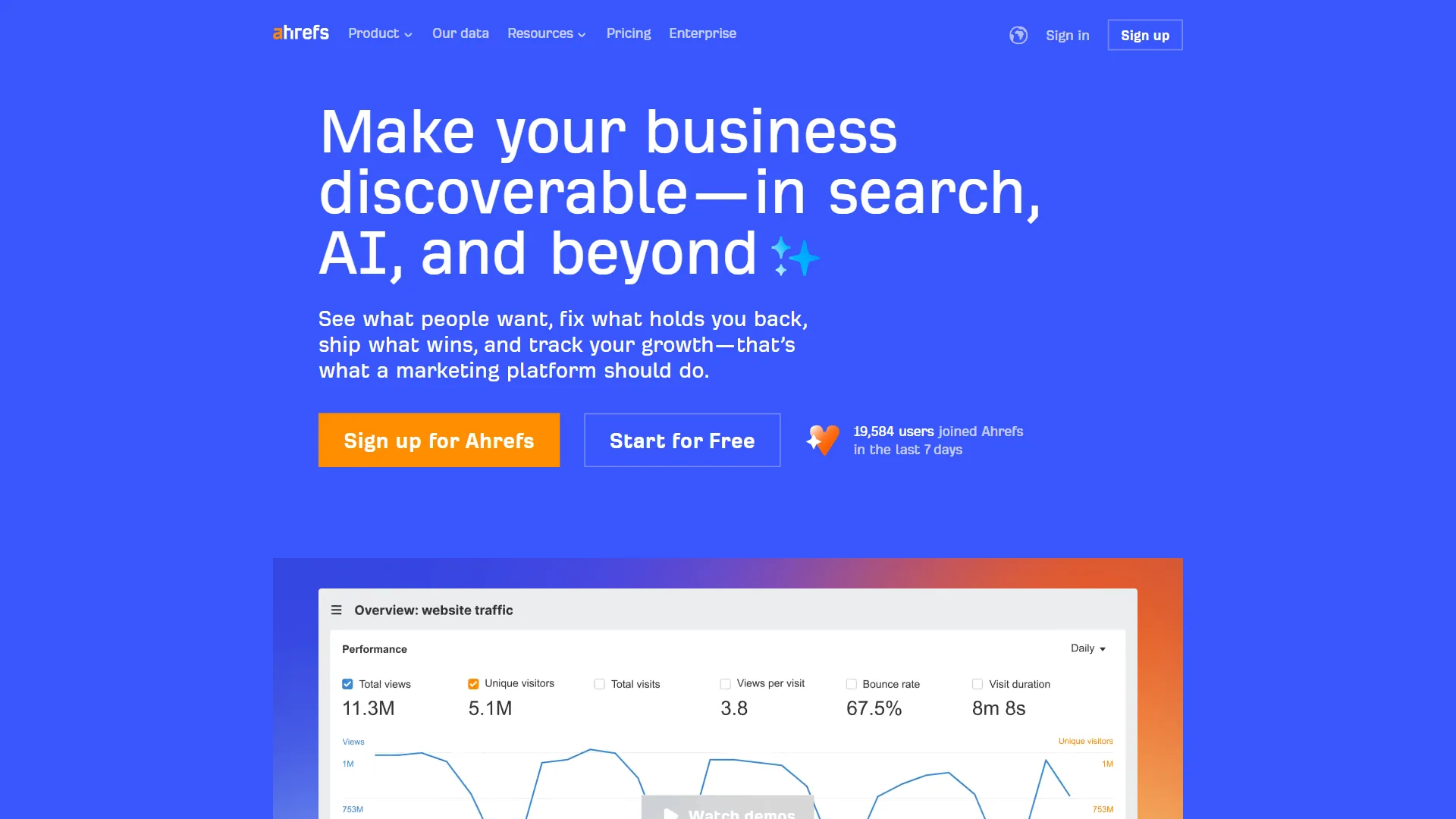
Ahrefs is the closest direct Semrush competitor - both cover keyword research, backlink analysis, rank tracking, and site auditing - but Ahrefs wins in two critical areas: backlink accuracy and flexible pricing.
Where Ahrefs beats Semrush:
- Backlink database quality - Ahrefs maintains 35T+ external backlinks with a crawler that updates every 15 minutes; the SEO community generally considers its data more accurate and fresher than Semrush’s larger 43T raw index.
- Entry-level pricing - Ahrefs’ Starter plan at $29 per month gives small sites basic Site Explorer, keyword research, and backlink checks. Semrush’s first paid plan is $139.95/mo.
- Brand Radar for AI search - Ahrefs tracks brand mentions across ChatGPT, Perplexity, Google AI Overviews, Gemini, and Microsoft Copilot using 100M+ prompts. Semrush’s similar AI Visibility tracking is a $99/mo add-on.
- 40+ free AI writing tools - Ahrefs provides content generators and paraphrasing tools free; Semrush’s content tools require Guru ($249.95/mo).
Where Semrush still wins over Ahrefs: Semrush includes comprehensive PPC and advertising intelligence (ad research, competitor ad copy, PLA tracking), social media scheduling and analytics, and a broader marketing suite. Ahrefs has none of these - if your team handles paid search and social alongside SEO, Semrush eliminates three or four separate tools.
Limitations and who Ahrefs is not for: Ahrefs has no PPC tools, no social media management, and no advertising intelligence. The Starter tier ($29/mo) is capped at 100 credits per month, so most professional work requires Lite at $129/mo, plus $50-80/mo per additional seat. Skip Ahrefs if you need unified SEO + PPC + social or your team has more than two seats.
The verdict on Ahrefs: Choose Ahrefs over Semrush if backlink analysis drives your strategy, you want a lower entry price, or you need AI search visibility tracking without an add-on. See our Semrush vs Ahrefs comparison for a deeper head-to-head.
2. Surfer SEO - Beats Semrush on Content Optimization

Surfer SEO is not trying to compete with Semrush across the board - it focuses on content optimization and does it better than Semrush’s built-in content tools by a significant margin.
Where Surfer SEO beats Semrush:
- Content Editor - Surfer’s GPT-4o-powered NLP editor gives real-time scoring, keyword suggestions, and structure guidance. Semrush’s SEO Writing Assistant is locked behind Guru ($249.95/mo) and less granular.
- AI article generation - Surfer AI generates full articles in roughly 3 minutes using a 128k token context at $9-29 per article.
- Content-specific pricing - Surfer’s Essential plan at $99/mo includes 30 Content Editor articles, 5 AI articles, and SERP analysis. Equivalent Semrush content tools require Guru at $249.95/mo.
- Topical Map - Surfer’s AI-generated content strategy tool with Google Search Console integration visualizes topic clusters, content gaps, and keyword opportunities.
Where Semrush still wins over Surfer SEO: Semrush has a 20B+ keyword database (Surfer caps at 100 credits/day on Essential), a 43T backlink index (Surfer has none), a 140+ check site audit, and rank tracking included in every paid plan (Surfer charges a $17/mo add-on).
Limitations and who Surfer SEO is not for: Surfer is content-only - no backlink index, no site audit, no PPC tools, no rank tracking on the base plan. Keyword research is capped at 100 credits/day on Essential, and AI articles cost $9-29 each beyond the included 5/month. Skip Surfer if you want a single tool to cover your full SEO workflow or your team needs technical audits.
The verdict on Surfer SEO: If content optimization is your primary workflow, Surfer delivers better tools at a lower price. Many serious SEO teams pair Surfer (content) with Semrush or Ahrefs (research and backlinks). See our best SEO content tools roundup for Surfer vs Clearscope vs Frase.
3. MarketMuse - Beats Semrush on Topic Intelligence
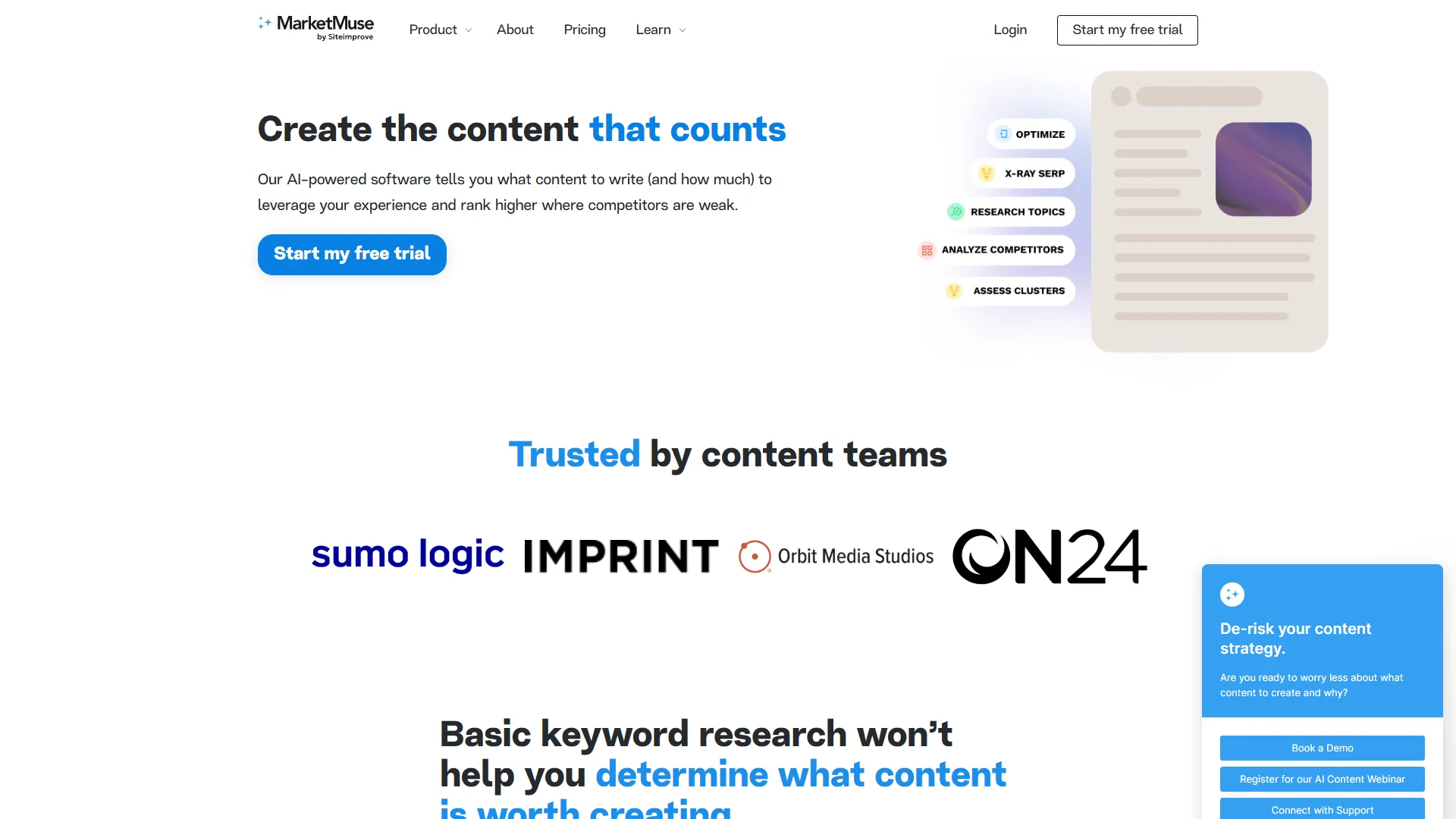
MarketMuse beats Semrush on topic intelligence by quantifying a site’s authority on specific subjects with proprietary AI built over 10+ years, rather than reporting keyword positions. Instead of starting with keywords, it starts with topics - measuring your authority on specific subjects and identifying strategic gaps.
Where MarketMuse beats Semrush:
- Topic Authority scoring - Proprietary metrics (Topic Authority, Page Authority, Competitive Advantage) quantify how well your site covers specific topics versus competitors. Semrush measures keyword rankings only.
- Content briefs - MarketMuse generates comprehensive briefs with topic recommendations, keyword targets, and structure suggestions. Up to 9 brief types on the Strategy plan.
- Content decay detection - The Research plan ($249/mo) and above automatically surface content losing rankings or becoming outdated.
- SERP X-ray and Heatmap - Granular competitive analysis with visual heatmaps highlights topic gaps far beyond Semrush’s competitor analysis.
Where Semrush still wins over MarketMuse: Semrush has broader scope (keyword research, backlinks, PPC, social, technical SEO - MarketMuse has none of these), a 20B+ keyword database (orders of magnitude larger), more stable infrastructure, and a less steep learning curve.
Limitations and who MarketMuse is not for: The interface has a steep learning curve, and user reviews flag occasional downtime. Pricing is steep relative to scope - $249/mo for Research, $499/mo for Strategy - with no backlink data, no rank tracking, and no site auditing. The free tier is capped at 10 queries per month. Skip MarketMuse if your team is small, you need an all-in-one tool, or you are not focused on building topic authority at scale.
The verdict on MarketMuse: Choose MarketMuse over Semrush for content strategy at scale - building topic authority, planning clusters, and prioritizing topics. For enterprise content teams that already have keyword research and backlink tools, it adds a strategic layer Semrush does not match.
4. Clearscope - Beats Semrush on Content Accuracy and Ease of Use
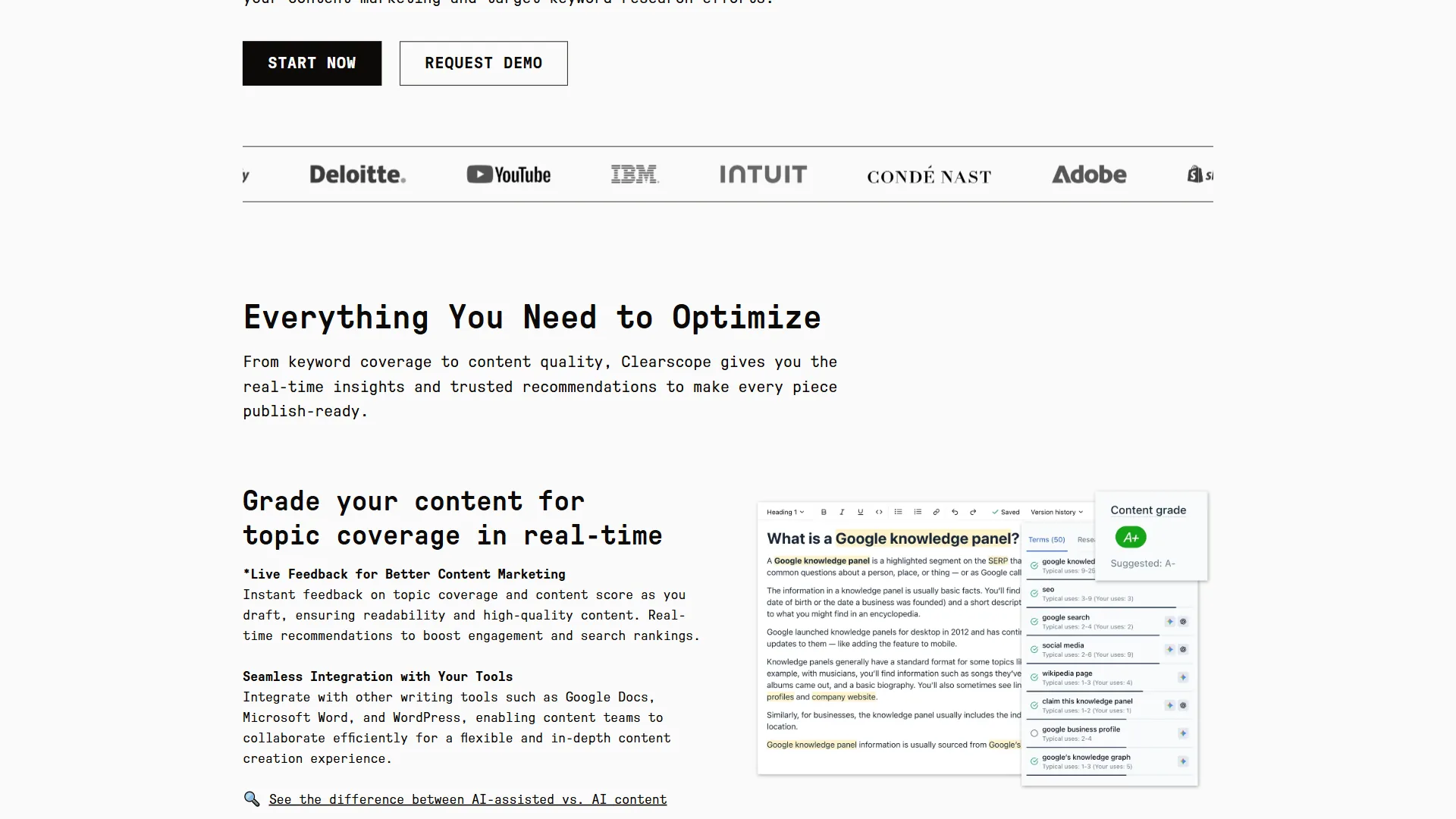
Clearscope has earned a strong reputation in the SEO tools category - and that reputation is built on doing one thing exceptionally well: content grading.
Where Clearscope beats Semrush:
- A-F content grading - The most accurate content scoring available, using NLP analysis of top-ranking pages to produce a letter grade that correlates strongly with ranking performance.
- Ease of use - A clean, focused interface lets writers start optimizing within minutes versus Semrush’s dozens of competing menus and dashboards.
- Google Docs integration - Writers optimize directly in Google Docs with real-time grades and keyword suggestions alongside the document.
- Unlimited user accounts - Every Clearscope plan includes unlimited users; Semrush charges $45-100/mo per additional seat.
Where Semrush still wins over Clearscope: Semrush has far broader scope (keyword research, backlinks, technical SEO, rank tracking, PPC - Clearscope has none), better value (Pro at $139.95/mo vs Clearscope at $189/mo), a 20B+ keyword database vs Clearscope’s 50 discoveries/mo on Essentials, and a 14-day free trial vs Clearscope’s demo-only sales process.
Limitations and who Clearscope is not for: $189/mo buys content grading and very little else - no backlink data, no rank tracking, no site audit, only 50 keyword discoveries per month on Essentials, and no free trial (demo only). Skip Clearscope if your budget is tight or you do not already have separate SEO tooling for keywords and links.
The verdict on Clearscope: Clearscope is the premium choice for content teams that value accuracy and have the budget to run it alongside Semrush or Ahrefs. If you can only afford one tool, Semrush provides far more functionality per dollar.
5. Moz Pro - Beats Semrush on Affordability and Domain Authority
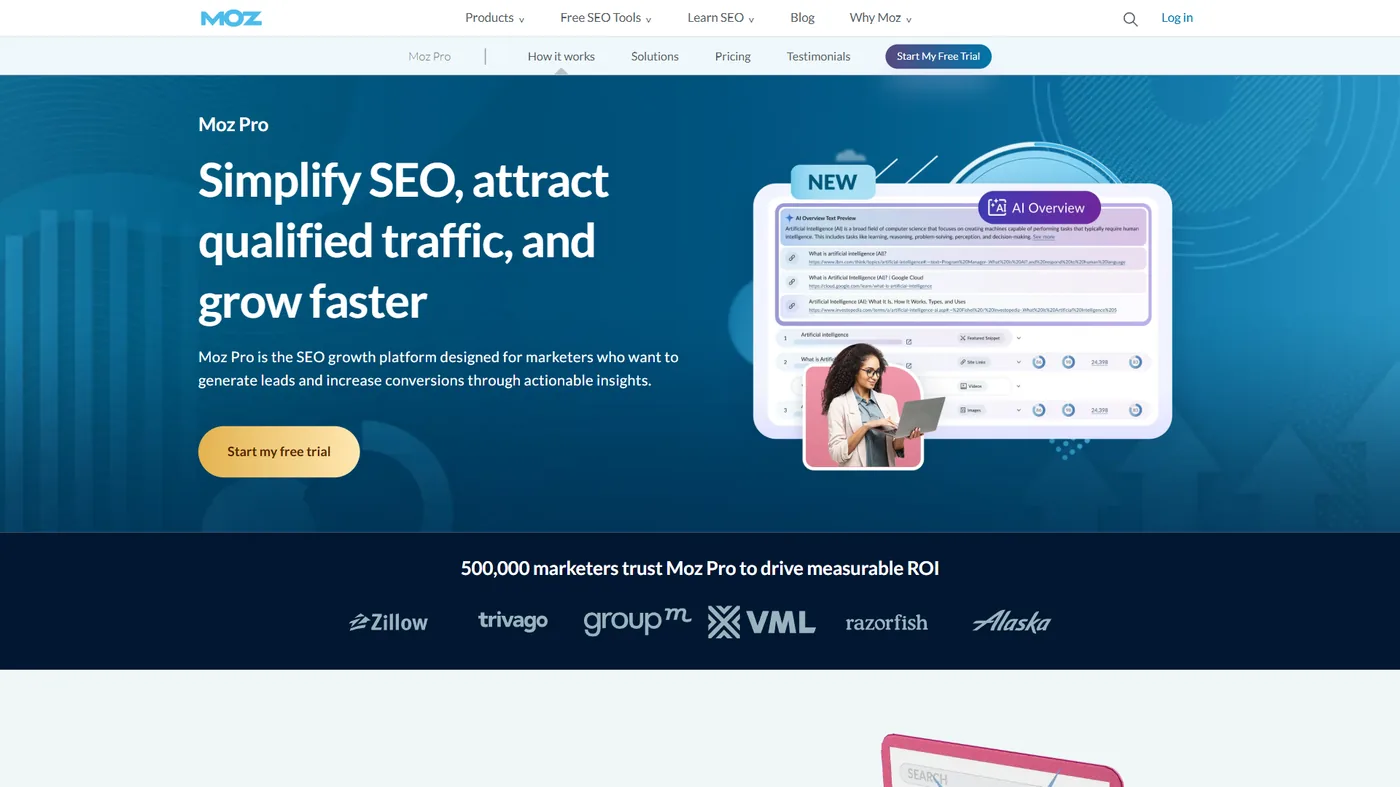
Moz Pro is the original SEO platform - founded in 2004, predating Semrush and Ahrefs - and while it has lost ground in raw data volume, it retains advantages in affordability and Domain Authority reporting.
Where Moz Pro beats Semrush:
- Entry-level pricing - The Starter plan at $49/mo ($39 annual) is the most affordable full-featured SEO platform on this list - roughly one-third of Semrush’s $139.95/mo entry.
- Domain Authority - Moz invented the Domain Authority metric, the most widely recognized domain strength indicator in the SEO industry. DA is the metric clients and stakeholders most commonly reference.
- 30-day free trial - Moz offers twice the evaluation time of Semrush’s 14 days.
- Educational resources - Whiteboard Friday, Moz Academy, and the Beginner’s Guide to SEO make Moz the most accessible platform for newcomers.
- MozBar browser extension - The free MozBar extension (700K+ users) shows DA, PA, and Spam Score on every SERP.
Where Semrush still wins over Moz Pro: Semrush has dramatically more data scale (20B+ keywords, 43T backlinks vs Moz’s smaller indexes), AI Visibility and Content Toolkit features Moz lacks entirely, PPC and social media management, more keywords per dollar in rank tracking, and a 140+ check site audit versus Moz’s lighter crawl.
Limitations and who Moz Pro is not for: Data depth is the main weakness - the link index and keyword database are meaningfully smaller than Semrush and Ahrefs, and crawl frequency is slower so backlink and ranking data may be days old. No AI Visibility tools, no AI content tools, no PPC or social features. Skip Moz Pro if you need real-time data depth or AI-driven SEO workflows.
The verdict on Moz Pro: Moz Pro is the best Semrush competitor for teams on a budget, beginners, and anyone who needs Domain Authority for reporting. At roughly one-third the entry price, it covers the core SEO fundamentals most small-to-mid-sized businesses need. See our best free SEO tools roundup for no-cost options.
Which Tool Fits Your SEO Workflow
The right Semrush competitor for your SEO workflow depends on which single capability matters most - backlinks (Ahrefs), content optimization (Surfer or Clearscope), topic strategy (MarketMuse), price (Moz Pro), or all-in-one breadth (Semrush). Use this decision framework to match a tool to your primary need:
- Everything in one platform - Semrush. No competitor matches its breadth across SEO, PPC, content, and social.
- Backlinks are your primary focus - Ahrefs. The 35T+ backlink database with 15-minute crawler updates leads the industry.
- Content optimization drives revenue - Surfer SEO for the best editor, or Clearscope for the highest grading accuracy.
- Topic-level strategic planning - MarketMuse. Topic Authority metrics and content briefs go deeper than any competitor.
- Budget is the top constraint - Moz Pro at $49/mo covers core SEO at a fraction of Semrush’s cost.
- Simplest writing workflow - Clearscope. Google Docs integration and A-F grading need almost no learning curve.
Many SEO teams pair tools rather than picking one - typically Semrush or Ahrefs for research and technical SEO, plus Surfer or Clearscope for content. See Semrush’s official features page and Ahrefs’ comparison with Semrush for vendor-side detail.
The Bottom Line
Semrush remains the most comprehensive SEO platform in 2026, but Ahrefs wins on backlink accuracy and entry price, Surfer SEO wins on content optimization, MarketMuse wins on topic strategy, Clearscope wins on grading accuracy, and Moz Pro wins on affordability - so the best Semrush competitor is the one that targets your single most important workflow. Its combination of 20B+ keywords, 43T backlinks, 140+ audit checks, AI Visibility tracking, and PPC tools is unmatched by any single competitor. But “most comprehensive” does not mean “best at everything.”
As Semrush itself notes in its competitor-analysis writeup, “competitor analysis tools help you better understand your top competition and discover ways to outperform them” - underscoring that no single SEO platform owns every workflow, which is exactly why specialized alternatives have carved out leads in backlinks, content, and topic strategy.
Methodology: This comparison is based on each vendor’s current public pricing, feature documentation, and independent SEO-community research rather than sponsored placement or paid placement claims.
Disclosure: AI Productivity may earn a commission from links on this page; rankings and recommendations are editorially independent.
Ahrefs beats Semrush on backlink accuracy at $29/mo. Surfer outperforms Semrush’s content tools at less than half the price. MarketMuse delivers deeper topic intelligence. Clearscope offers higher grading accuracy. Moz Pro covers core SEO affordably for small businesses.
The strongest 2026 SEO strategy often combines tools rather than choosing one - evaluate workflow gaps, test the competitor that fills them, and build a toolkit that matches your needs.
Explore our detailed tool pages for deeper reviews: Semrush, Ahrefs, Surfer SEO, MarketMuse, Clearscope, and Moz Pro.
FAQ
These FAQs answer the most common questions buyers ask when evaluating Semrush alternatives & competitors, covering pricing, AI features, and content workflows across free & paid tiers.
Q: What is the best alternative to Semrush?
The best alternative depends on your primary workflow - Ahrefs for backlink analysis (35T+ index, $29/mo entry), Surfer SEO for content optimization at roughly half the cost, and Moz Pro for beginners at $49/mo. No single competitor matches Semrush’s breadth, but each excels in a specific area.
Q: Which SEO tool is best?
No single SEO tool is best for every team. Semrush wins all-in-one marketing coverage, Ahrefs wins backlinks and AI search tracking, Surfer wins content optimization, MarketMuse leads topic strategy, and Moz Pro is most accessible for beginners.
Q: Does Ahrefs include AI search tracking in its base plan?
Yes - Ahrefs’ Brand Radar tracks brand mentions across ChatGPT, Perplexity, Google AI Overviews, Gemini, and Microsoft Copilot using 100M+ prompts, included in the Standard plan and above. Semrush charges a $99/mo add-on for comparable AI Visibility tracking.
Q: Which Semrush competitor is best for content optimization?
Surfer SEO and Clearscope both outperform Semrush’s content tools. Surfer’s GPT-4o NLP editor provides real-time scoring and AI article generation from $99/mo - less than half the cost of Semrush Guru. Clearscope offers the highest grading accuracy with an A-F system and unlimited seats.
Q: What is the cheapest full-featured SEO alternative to Semrush?
Moz Pro starts at $49/mo - roughly one-third of Semrush’s $139.95/mo entry price - and covers keyword research, rank tracking, site auditing, and backlinks. It also offers a 30-day free trial versus Semrush’s 14 days.
Related Reading
The Semrush competitors covered in this article each have a dedicated review page with pricing, ratings, and feature breakdowns, listed below for deeper research.
Tools covered in this article:
- Semrush - All-in-one SEO and marketing platform
- Ahrefs - Backlink analysis and SEO research
- Surfer SEO - Content optimization and AI writing
- MarketMuse - Topic authority and content strategy
- Clearscope - Content grading and optimization
- Moz Pro - SEO tools with Domain Authority
More SEO guides:
- Semrush vs Ahrefs: Which SEO Tool Is Worth Your Money in 2026?
- Best AI SEO Tools for Content Optimization
- Best SEO Tools for Content Optimization in 2026
- Best SEO Content Tools 2026: Surfer vs Clearscope vs Frase
External Resources
The official vendor websites below provide current pricing, product documentation, and trial sign-ups for each Semrush competitor.