

Mailchimp is the better all-in-one marketing platform for general businesses, while Klaviyo is the better revenue engine for ecommerce stores - the right choice depends on whether email is one channel among many or your primary revenue driver. Both platforms expanded in 2026: Mailchimp added advanced automation and Intuit Assist AI; Klaviyo doubled down on SMS, predictive analytics, and per-campaign revenue attribution.
This guide compares both platforms feature-by-feature - pricing, automation, analytics, SMS, AI, and ecommerce depth - and explains which beats the other for your business model. Our analysis draws on current vendor documentation, pricing pages, and independent research rather than sponsored placement; AI Productivity may earn a commission from links on this page, and rankings are editorially independent. For a wider lens, our best email marketing tools 2026 shortlist groups every major contender by use case, and the Litmus State of Email report provides channel-wide benchmarks.
Comparison Table: Mailchimp vs Klaviyo
Mailchimp and Klaviyo differ most on starting price, SMS architecture, and revenue attribution depth - the table below summarizes the seven dimensions that actually drive the decision.
| Aspect | Mailchimp | Klaviyo |
|---|---|---|
| Rating | ||
| Starting Price | Free / $13/mo | Free / $20/mo |
| Best For | General marketing, beginners | Ecommerce, revenue-focused teams |
| Free Tier | 500 contacts, 1,000 emails/mo | 250 contacts, 500 emails/mo |
| SMS Marketing | Add-on | Native (Email+SMS plans) |
| Integrations | 800+ | 350+ |
| Revenue Attribution | Basic | Advanced (per-campaign ROI) |
| AI Features | Intuit Assist AI | Predictive analytics, AI segments |
| Ecommerce Depth | Good | Excellent |
Methodology: The Core Difference Between Mailchimp and Klaviyo
The core difference is that Mailchimp is an all-in-one marketing platform that happens to be great at email, while Klaviyo is a revenue engine built around email and SMS for ecommerce. Our methodology for this comparison is based on each vendor’s current pricing and feature documentation, independent reviewer data, and the channel-level benchmarks from the Litmus and Klaviyo reports cited above - not on hands-on benchmarking.
That distinction matters more than any feature comparison. If you sell physical products through Shopify, BigCommerce, or WooCommerce, Klaviyo speaks your language natively - it thinks in terms of average order value, customer lifetime value, and revenue per recipient. Mailchimp thinks in terms of open rates, click rates, and audience growth. Choosing the wrong one for your business model means fighting the platform instead of using it. Teams weighing other contenders should also see our mailchimp alternatives breakdown before committing.
Mailchimp: The All-in-One Marketing Platform
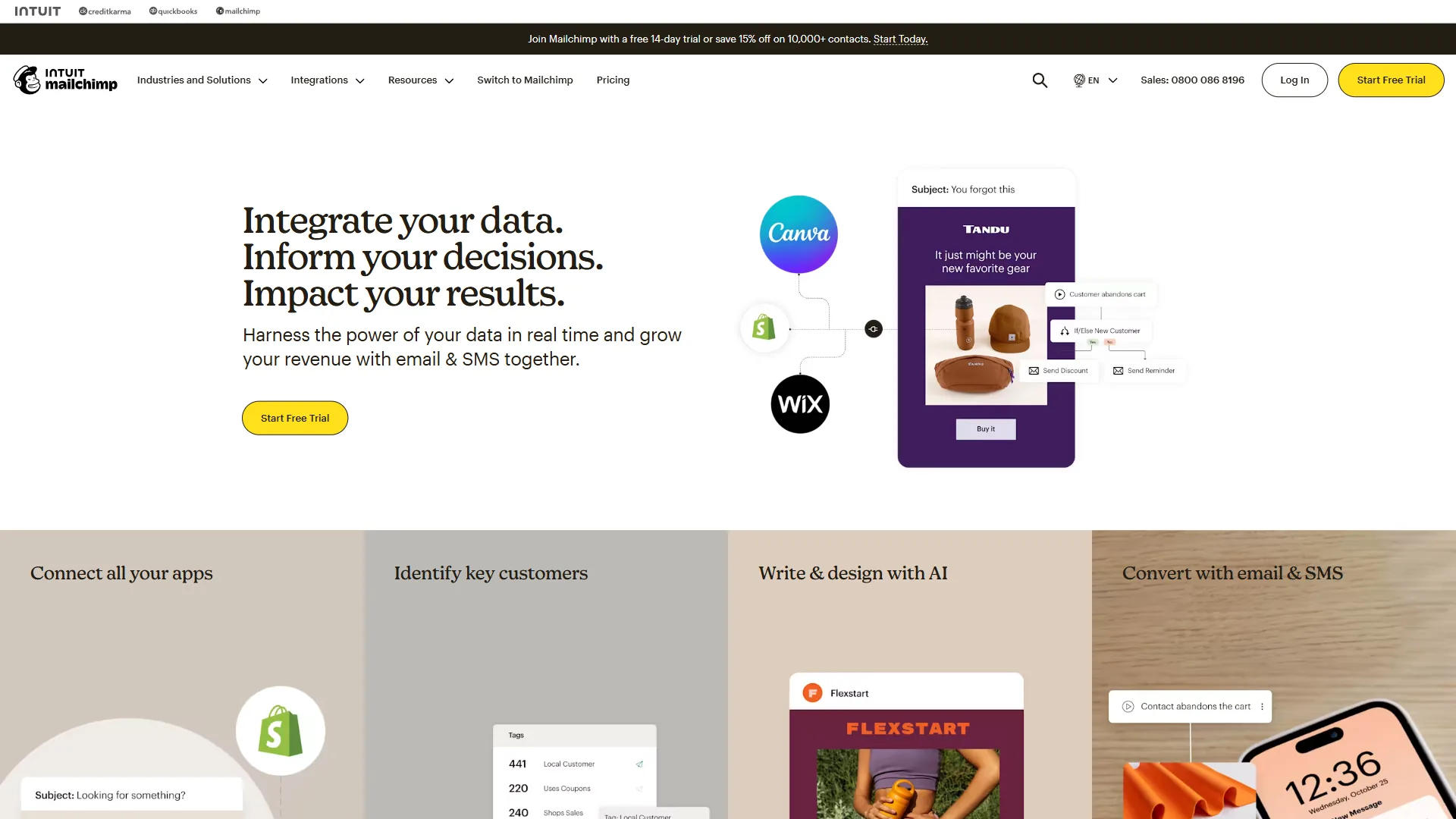
Mailchimp is an all-in-one marketing platform that bundles email, website building, social posting, landing pages, postcards, and Intuit Assist AI into one dashboard, with paid plans starting at $13 per month. Under Intuit’s ownership since 2021, it has evolved far beyond its email roots - and for small businesses that want one dashboard to run their entire marketing stack, that breadth is genuinely valuable.
Key Strengths:
- Drag-and-drop email builder with 100+ templates that actually look good
- Customer Journey Builder for multi-step automated workflows
- Intuit Assist AI for subject line optimization, content generation, and send-time prediction
- 800+ integrations covering virtually every tool in your stack
- Website builder, landing pages, and social posting built in
- Generous free tier for testing and small lists
Pricing Breakdown:
| Tier | Monthly Price | Contacts | Key Features |
|---|---|---|---|
| Free | $0 | 500 | 1,000 emails/mo, basic templates, 1 audience |
| Essentials | $13/mo | 500 | 5,000 emails/mo, A/B testing, email scheduling |
| Standard | $20/mo | 500 | 6,000 emails/mo, Customer Journey Builder, AI |
| Premium | $350/mo | 10,000 | 150,000 emails/mo, advanced segmentation, phone support |
Prices scale with contact count. At 10,000 contacts, Standard jumps to roughly $100 per month. At 50,000 contacts, expect $350+ on Standard.
Best For: Small businesses, content creators, and marketing teams that need email alongside other channels without juggling five different subscriptions. If your business is not primarily ecommerce, Mailchimp’s breadth is hard to beat - though it is worth exploring other options before committing.
Limitations: Revenue attribution is shallow versus Klaviyo, predictive analytics are minimal, SMS feels bolted on, and pricing scales aggressively ($350+/month at 50,000 contacts). Skip Mailchimp if revenue per email is your primary metric or if you run a Shopify/BigCommerce store at any meaningful volume.
Klaviyo: The Ecommerce Revenue Engine
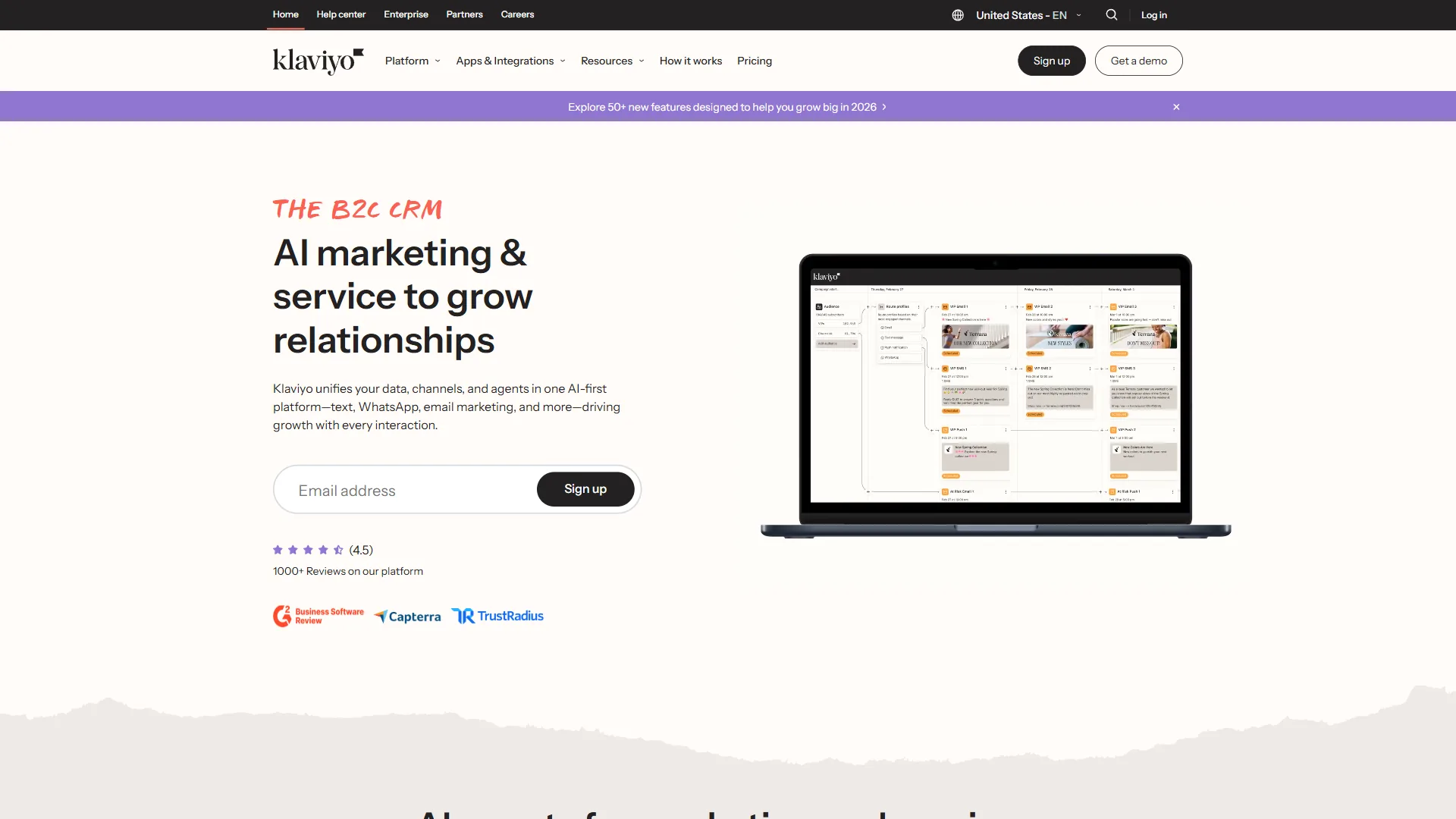
Klaviyo is an ecommerce-first email and SMS platform that powers more than 100,000 Shopify stores and prices Email plans from $20 per month for the first 500 contacts. Every feature - from the flow builder to the analytics dashboard - is designed around the question that matters most to online sellers: how much revenue did this email generate? According to the Klaviyo company overview, the platform counts brands like Glossier, Chubbies, and Living Proof among its users.
Key Strengths:
- Revenue attribution down to the individual campaign and flow level
- Predictive analytics for customer lifetime value, next order date, and churn risk
- Native SMS marketing with combined email+SMS flows
- Deep Shopify integration that syncs product catalogs, order data, and customer behavior in real time
- Pre-built automation flows for abandoned carts, post-purchase, win-back, and browse abandonment
- AI-powered segmentation and personalized product recommendations
Pricing Breakdown:
| Tier | Monthly Price | Contacts | Key Features |
|---|---|---|---|
| Free | $0 | 250 | 500 emails/mo, 150 SMS credits, basic flows |
| $20/mo | 251-500 | Unlimited emails, all flows, A/B testing | |
| Email + SMS | $35/mo | 251-500 | Email + 1,250 SMS credits, SMS flows |
Pricing scales with contact count. At 10,000 contacts, Email plans run roughly $150 per month. At 50,000 contacts, expect $700+. SMS credits are purchased separately on the Email+SMS plan.
Best For: Ecommerce businesses on Shopify, BigCommerce, or WooCommerce that want to maximize revenue from their existing customer list. If your primary metric is revenue per email sent rather than open rates, Klaviyo is purpose-built for that.
Limitations: Pricing escalates faster than Mailchimp ($700/month at 50,000 contacts before SMS credits), the learning curve is steep, and the platform assumes ecommerce literacy (RFM, CLV, cohort analysis). The free tier is tighter (250 vs 500 contacts). Skip Klaviyo if you run a content or service business or if email is one channel among many rather than a revenue engine.
Feature-by-Feature: Mailchimp vs Klaviyo
Klaviyo wins on automation depth, analytics, ecommerce integration, SMS, and AI strategy, while Mailchimp wins on starting price, ease of use, and integration breadth - the seven feature scorecards below explain why one beats the other in each lane.
Pricing and Value
Mailchimp wins on sticker price at lower tiers - 500 free contacts versus Klaviyo’s 250, and paid plans start $7/mo cheaper. The all-in-one bundle (website, social, landing pages) may eliminate extra tool spend.
Klaviyo costs more per contact but delivers clearer ROI tracking - when an abandoned cart flow shows $12,000 generated last month, a $150/month bill feels like a bargain. Native SMS is included without add-ons. At 50,000 contacts, Mailchimp Standard runs roughly $350/month while Klaviyo Email sits around $700/month.
Winner: Mailchimp for budget-conscious general marketing - the most common reason teams choose Mailchimp over Klaviyo at the entry tier; Klaviyo for ecommerce where revenue attribution justifies the cost.
Automation and Flows
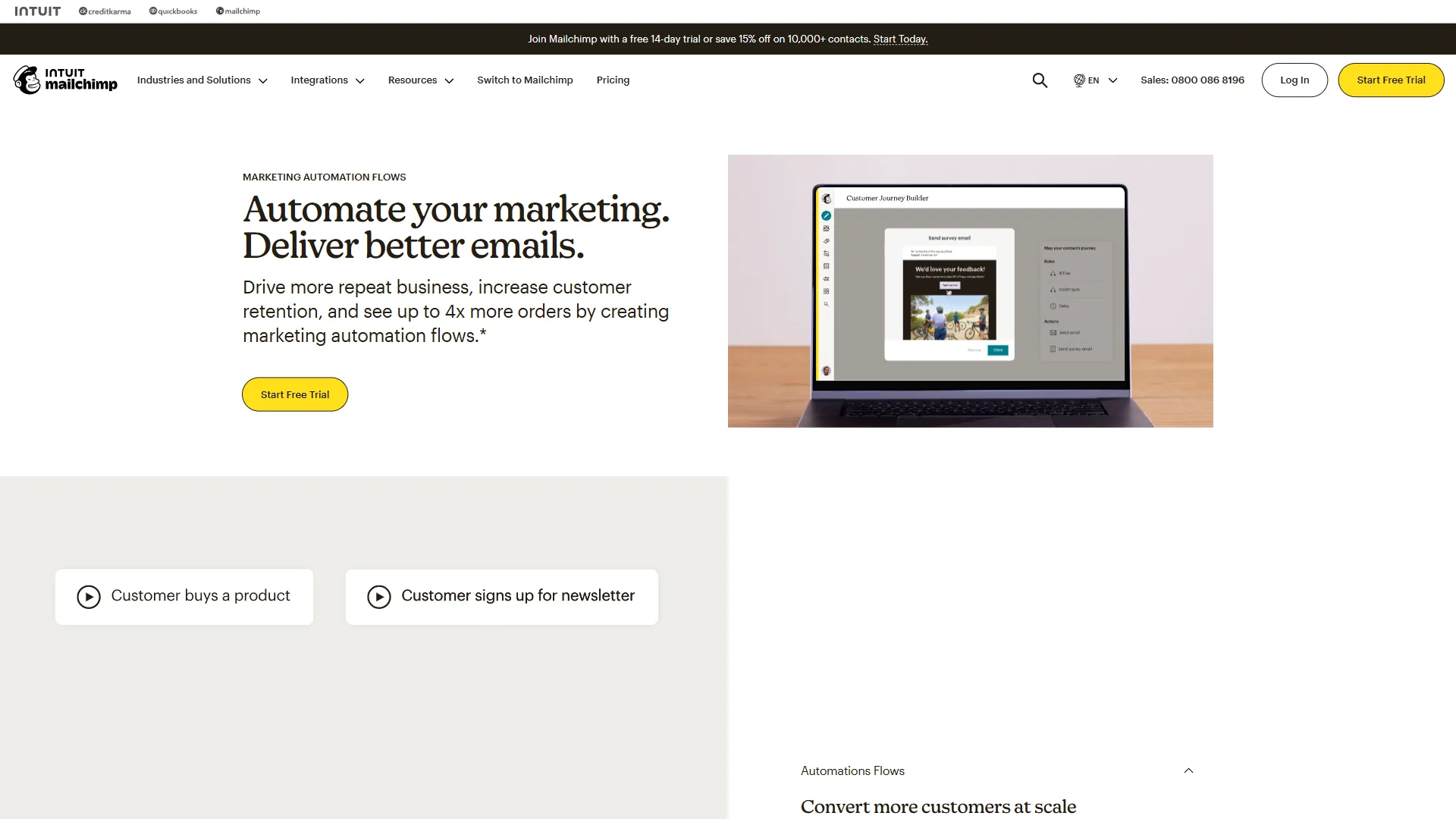
Mailchimp’s Customer Journey Builder handles multi-step automations with branching logic, delays, and conditional splits. It is visual and covers the fundamentals - welcome series, abandoned carts, re-engagement. The Standard plan unlocks the full builder.
Klaviyo’s flow builder branches based on predicted customer lifetime value, next-order date, and browsing behavior - a post-purchase flow can show different products to first-time buyers versus VIP customers automatically. The pre-built library includes 50+ ecommerce-specific templates. Mailchimp’s automations ask “what did this person do?” Klaviyo’s ask “what is this person likely to do next?”
Winner: Klaviyo, especially for ecommerce.
Analytics and Revenue Attribution
This is the category where the gap is widest.
Mailchimp reports standard email metrics - opens, clicks, revenue (if you connect your store). The dashboard is clean and sufficient for general marketing; campaigns can be benchmarked against the Mailchimp email benchmarks by industry.
Klaviyo treats every email as a revenue event. The dashboard shows revenue per recipient, channel comparisons (email vs SMS), and CLV trends. The Klaviyo benchmark report provides industry baselines for revenue-per-recipient. The predictive layer estimates future revenue and flags at-risk customers before they churn - our marketing automation tools 2026 shortlist groups other platforms with similar attribution depth.
Winner: Klaviyo by a significant margin.
Ecommerce Integration
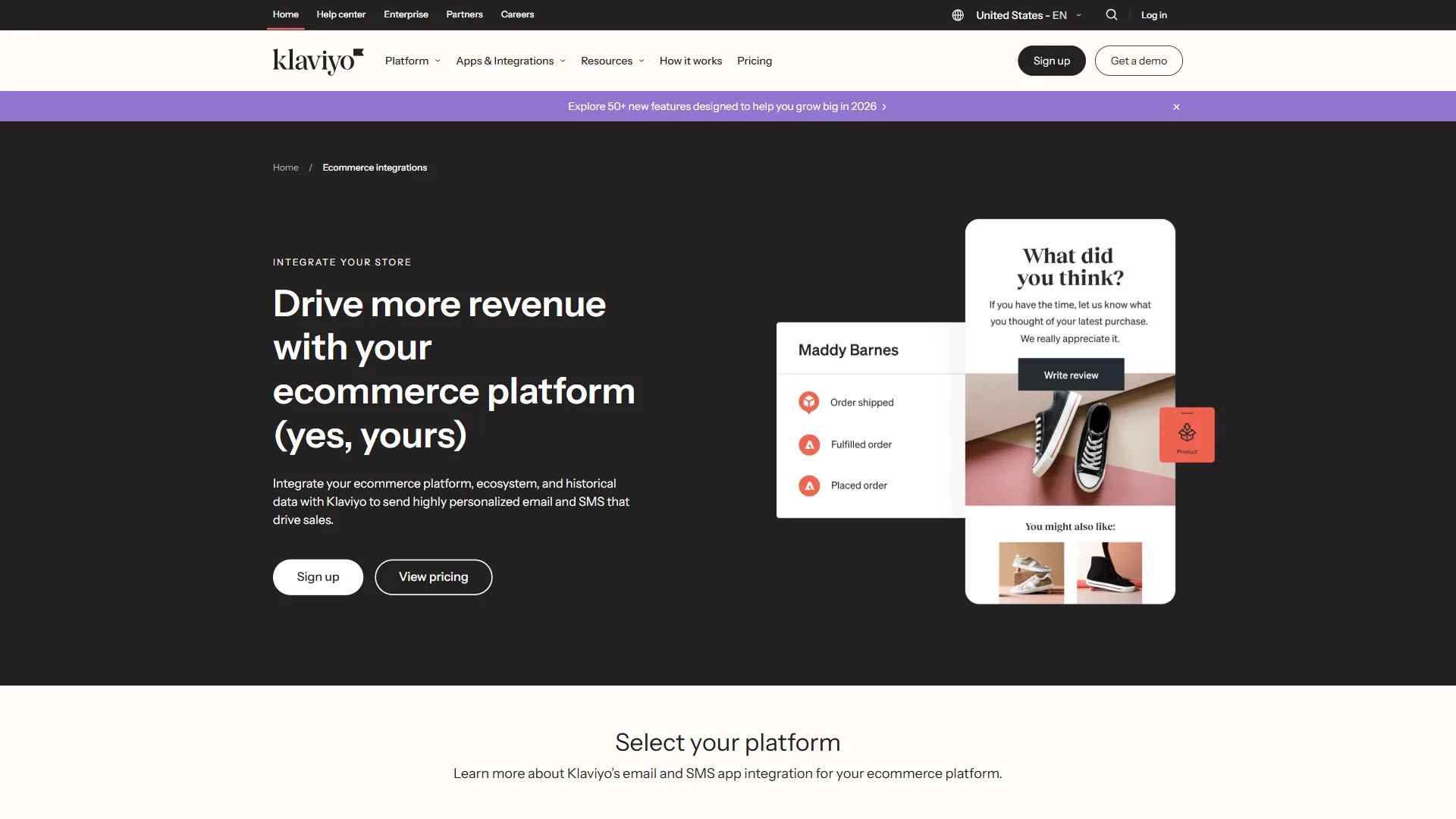
Mailchimp integrates with Shopify, WooCommerce, and BigCommerce - product data syncs, purchase tracking works, and you can segment by purchase behavior.
Klaviyo goes several layers deeper. The Shopify integration syncs in real time, product catalog sync enables dynamic recommendations inside emails, and customer profiles show complete purchase histories and predicted future behavior in one view. A Klaviyo abandoned cart email dynamically shows the abandoned products, cross-sells related items, and adjusts the discount based on predicted CLV - all automatically.
Winner: Klaviyo. The depth of ecommerce data integration is not close.
Ease of Use
Mailchimp has invested years in accessibility - the drag-and-drop builder is intuitive, templates look professional out of the box, and first-time marketers can launch a campaign within an hour. See our how to automate email with AI guide for the workflows worth setting up first.
Klaviyo has a steeper learning curve. The flow builder is powerful but takes time, segmentation can overwhelm newcomers, and the platform assumes ecommerce literacy (CLV, RFM, cohort behavior). Once mastered, it builds campaigns that would need multiple tools in Mailchimp.
Winner: Mailchimp for beginners; Klaviyo for ecommerce teams willing to invest.
SMS Marketing
Mailchimp offers SMS as an add-on; campaigns work, but the integration with email automations feels bolted on, and compliance/reporting lag dedicated SMS platforms.
Klaviyo built SMS into its core. Email and SMS flows run side by side - a customer who skips an abandoned cart email can receive an SMS follow-up automatically. Reporting unifies email and SMS revenue. For ecommerce businesses where SMS drives 15-25% of marketing revenue, this integration matters enormously.
Winner: Klaviyo.
AI Features
Mailchimp uses Intuit Assist AI for subject line generation, content suggestions, send-time optimization, and audience insights - helpful for individual campaigns but not strategy-changing.
Klaviyo applies AI to predictive analytics - forecasting CLV, next purchase dates, churn probability, and per-recipient send times. AI segments group customers by predicted behavior, not just past actions. Mailchimp’s AI helps you write better emails; Klaviyo’s AI helps you send the right email to the right person at the right time.
Winner: Klaviyo for strategic AI that impacts revenue; Mailchimp for AI that improves day-to-day execution.
How Complex Is Migrating Between Mailchimp and Klaviyo?
Migrating between Mailchimp and Klaviyo takes one to two weeks of focused work, mostly to rebuild automation flows since contact data exports cleanly but flows and revenue-attribution history do not transfer. Here is what to expect when choosing the right email platform for your stack:
Mailchimp to Klaviyo: Contact lists export cleanly; automation flows must be rebuilt; historical email data transfers partially; ecommerce reconnection takes 1-2 hours; expect 1-2 weeks for core automations; Klaviyo offers free migration support on paid plans.
Klaviyo to Mailchimp: Contact data exports easily; revenue attribution history and predictive analytics data are lost; complex flows need simplification since Mailchimp’s automation is less granular.
Bottom line: Moving from Mailchimp to Klaviyo is the more common path. Teams wanting a middle ground often evaluate for stronger automation without Klaviyo’s ecommerce-only lens, or when email needs to live alongside CRM and sales.
Choose Mailchimp If
Mailchimp is the right email platform for you when budget, breadth, and ease of use matter more than ecommerce revenue attribution:
- You are not primarily ecommerce - Content businesses, service companies, nonprofits, and small businesses get more value from the all-in-one approach
- Budget matters more than analytics depth - More generous free tier and lower-priced paid plans
- You need more than email - Website builder, landing pages, social posting, and postcards in one platform
- You are getting started with email marketing - Gentler learning curve and faster results
- Integration breadth matters - 800+ integrations versus Klaviyo’s 350+
Real-world fit: A fitness studio running monthly newsletters, a consultant sending weekly thought leadership, or a nonprofit coordinating donor communications.
Choose Klaviyo If
Klaviyo is the right choice when ecommerce revenue, SMS, and predictive analytics are central to your strategy:
- Ecommerce is your business - Shopify, BigCommerce, or WooCommerce store where revenue attribution and personalization matter
- Revenue per email is your primary metric - You want to know exactly how much money each campaign generates
- SMS is part of your strategy - Native email+SMS flows with unified analytics
- You need predictive analytics - Customer lifetime value, churn prediction, and next-purchase forecasting
- Lifecycle marketing is your focus - Abandoned carts, post-purchase, win-back, and browse abandonment flows
Real-world fit: A DTC skincare brand generating 30% of revenue from email, a multi-brand operation needing revenue attribution, or a subscription box relying on lifecycle emails to reduce churn.
The Bottom Line
Klaviyo wins for ecommerce stores that need revenue attribution and native SMS, while Mailchimp wins for non-ecommerce teams that need an affordable all-in-one platform - the mailchimp vs klaviyo decision ultimately comes down to one question: is your business built on ecommerce revenue?
If yes, Klaviyo is the clear winner. Revenue attribution, predictive analytics, native SMS, and ecommerce-depth integration justify the higher price.
If no, Mailchimp is the smarter choice. The all-in-one platform eliminates tool sprawl, the learning curve is gentler, and the breadth covers marketing needs Klaviyo does not address.
Choose based on what your business is today, not what you think it might become. Both platforms make migration possible if your needs evolve.
FAQ
The four questions below answer the most-asked Mailchimp vs Klaviyo searches with honest opinions drawn from each vendor’s own documentation.
Why is Klaviyo better than Mailchimp?
Klaviyo is better than Mailchimp for ecommerce because Klaviyo treats every email as a revenue event. According to Andrew Bialecki, Klaviyo’s CEO and co-founder, the platform “lets you tie every email and SMS send to the revenue it drove” - positioning Klaviyo as a revenue layer rather than an email tool. Its analytics dashboard shows exactly how much money each campaign, flow, and segment generated - including revenue per recipient and customer lifetime value trends. The predictive analytics layer estimates future revenue from your current list and flags at-risk customers before they churn, enabling data-driven marketing decisions general-purpose platforms cannot match.
Why are people leaving Mailchimp?
People leave Mailchimp because both platforms get expensive at scale - $350/month at 50,000 contacts on Standard - and Klaviyo users consistently report higher revenue per email, more than offsetting the price difference. Klaviyo’s per-campaign ROI tracking delivers ecommerce depth Mailchimp does not.
Who is Mailchimp’s biggest competitor?
Klaviyo is Mailchimp’s primary competitor. Mailchimp is an all-in-one marketing platform built around email, while Klaviyo is a revenue engine built around email and SMS for ecommerce - Mailchimp targets general marketers and beginners, Klaviyo targets ecommerce teams focused on revenue attribution.
Is Klaviyo the best email marketing platform?
Klaviyo is the leading email platform for ecommerce, powering over 100,000 Shopify merchants. For non-ecommerce businesses - content companies, service providers, or nonprofits - Mailchimp typically delivers more value per dollar.
Related Reads
Related guides cover adjacent angles - alternative platforms, marketing automation depth, and ecommerce personalization - and help readers pick the right email platform once the Mailchimp vs Klaviyo question is answered.
Tools covered in this article:
More email marketing and ecommerce guides:
- Best Email Marketing Tools 2026 - Top email platforms compared
- Best Marketing Automation Tools 2026 - Marketing automation platforms
- Bloomreach vs Klaviyo - Enterprise personalization comparison
External Resources
External resources below come from the two vendors and from Shopify, the platform whose ecommerce stack defines most Klaviyo deployments.
- Mailchimp Marketing Library - Official guides and best practices
- Klaviyo Blog - Ecommerce email marketing strategies
- Shopify Email Marketing Guide - Ecommerce email fundamentals