


The four strongest Mailchimp alternatives in 2026 are HubSpot, Klaviyo, and ActiveCampaign, with Mailchimp itself remaining the budget pick for sub-500-contact newsletters. This guide compares each platform on pricing, automation depth, deliverability, and AI features so small-business marketers can pick the right fit fast.
Mailchimp earned its reputation as the default email tool through a simple drag-and-drop editor and a generous free tier. The 2026 version is different - pricing has climbed sharply, the free tier has been gutted, and Intuit has bolted on website builders and CRM-lite features users pay for whether or not they use them.
Our analysis draws on each vendor’s current pricing pages, product documentation, independent deliverability testing from EmailToolTester and Litmus, and customer-reported pain points - not sponsored placement. AI Productivity may earn a commission from affiliate links on this page; rankings and recommendations are editorially independent. For a wider lens on the category, see our best email marketing tools 2026 shortlist.
Why People Leave Mailchimp
Users leave Mailchimp in 2026 because pricing has climbed sharply, the free tier has been gutted to 500 contacts, contact-based billing charges for inactive subscribers, and AI features stay locked behind the $20 per month Standard plan.
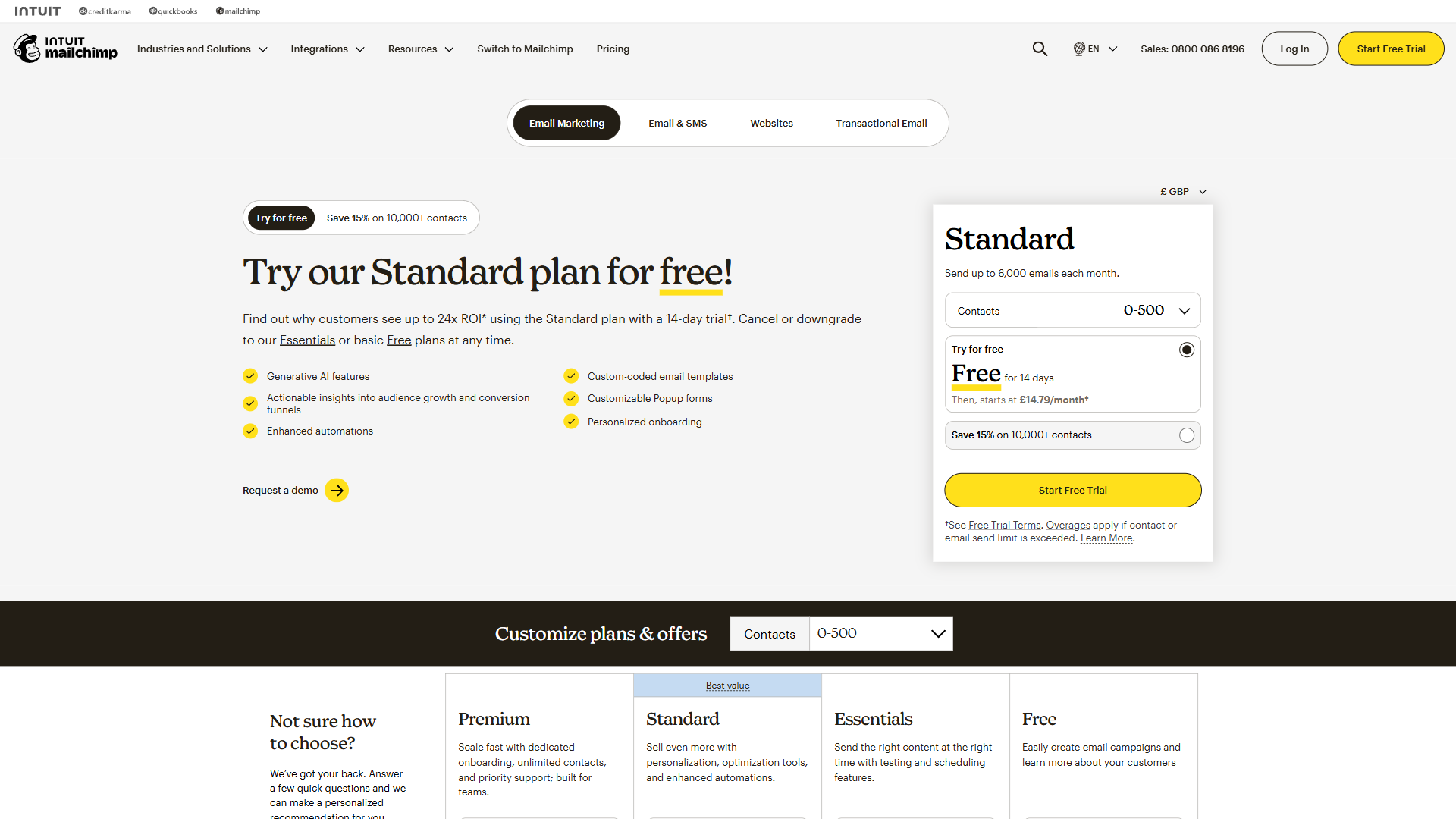
Mailchimp still works for simple newsletters to small lists, but several pain points are pushing users toward alternatives in 2026:
- Rising costs at scale - Standard runs $20 per month at 500 contacts, $100 at 5,000, and $350 at 50,000, where competitors charge $30 to $50 with more features included (see Mailchimp’s official rate card)
- Free tier is barely usable - 500 contacts, 1,000 monthly sends, no automation, no A/B testing, and Mailchimp branding on every email (the 2020 free tier supported 2,000 contacts with basic automation)
- Overpaying for unused features - Intuit’s acquisition added website builders, social posting, and CRM-lite features; pure-email users subsidize tools they never open
- Contact-based pricing penalizes growth - unsubscribed and inactive contacts still count unless manually archived; ActiveCampaign only charges for active contacts
- Deliverability questions - independent tests from EmailToolTester show Mailchimp delivery around 81% versus top performers above 90%
- AI features locked behind Standard - subject-line generation, send-time optimization, and content suggestions all require the $20 per month Standard plan
If any of those resonate, one of these mailchimp alternatives is likely a better fit for your budget and workflow.
Comparison Table: Mailchimp Alternatives
The four leading Mailchimp alternatives are HubSpot (free CRM with email at $20 per month), Klaviyo ($20 per month for ecommerce), and ActiveCampaign ($15 per month for B2B automation), each priced and positioned for a different workflow.
| Tool | Starting Price | Best For | AI Features | Free Tier | Contact Pricing |
|---|---|---|---|---|---|
| Mailchimp | $13/mo (Essentials) | Simple newsletters | Intuit Assist (Standard+) | 500 contacts | All contacts |
| HubSpot | Free CRM / $20/mo | Growth teams needing CRM + email | AI content assistant, predictive send | Yes (generous) | Marketing contacts only |
| Klaviyo | Free / $20/mo | Ecommerce and Shopify stores | AI segmentation, predictive analytics | 250 contacts | Active profiles |
| ActiveCampaign | $15/mo | B2B with complex automations | AI-powered automation builder | 14-day trial | Active contacts only |
Feature-by-Feature: AI Email Capabilities
AI email features differ sharply across Mailchimp alternatives in 2026 - Klaviyo includes predictive analytics on its free tier, HubSpot ships AI content tools across all paid plans, ActiveCampaign requires the Plus tier for predictive sending, and Mailchimp gates everything behind the $20 per month Standard plan.
“For every $1 spent on email marketing, marketers make $36 back,” according to Litmus, whose State of Email research tracks how AI-driven personalization and send-time optimization are widening the ROI gap between platforms that bundle AI features and those that gate them behind premium tiers.
| Feature | Mailchimp | HubSpot | Klaviyo | ActiveCampaign |
|---|---|---|---|---|
| Subject line generation | Standard+ only | All paid plans | Free tier | Starter+ |
| Send time optimization | Standard+ only | Pro+ | All paid | Plus+ |
| Predictive analytics | Premium only | Enterprise | All paid | Pro+ |
| Content suggestions | Standard+ only | All paid plans | All paid | Plus+ |
| Customer scoring | Premium only | Free CRM | All paid (RFM) | Plus+ |
| Automation AI | Limited | Workflows | Flow AI | Advanced builder |
The key takeaway: Mailchimp gates most AI features behind Standard, while Klaviyo includes predictive analytics on lower tiers and HubSpot opens AI content tools to every paid plan.
1. HubSpot - Best for Growth Teams Wanting CRM + Email
HubSpot is the best Mailchimp alternative for teams that want CRM and email in one platform - rather than importing contacts into an email tool, you manage relationships in the CRM and use email as one channel.
The free tier is genuinely useful: a full CRM, contact management, email marketing (2,000 sends per month), forms, landing pages, and live chat at no cost - far more generous than Mailchimp’s free plan, which strips automation and caps contacts at 500.
Where HubSpot beats Mailchimp:
- Full CRM ecosystem - Contact records show every email opened, page visited, form submitted, and deal stage. Mailchimp’s CRM-lite features don’t come close to this depth
- Marketing contacts billing - You only pay for contacts you actively market to. Non-marketing contacts (leads you’re nurturing in CRM but not emailing) are free. Mailchimp charges for every contact on your list
- Content AI that works - HubSpot’s AI content assistant generates email copy, subject lines, and blog posts directly in the editor. It pulls from your brand voice settings and past performance data
- Reporting depth - Revenue attribution, lifecycle stage tracking, and custom dashboards that connect email performance to actual sales. Mailchimp shows opens and clicks; HubSpot’s custom report builder connects email performance to pipeline impact
Where HubSpot falls short:
- Price escalates fast - The free tier is great, but Starter is $20 per month, Professional jumps to $890 per month, and Enterprise hits $3,600/month. The jump from Starter to Professional is a cliff, not a step
- Template design - Mailchimp’s drag-and-drop editor and template library are still more intuitive and visually polished
- Complexity - The platform can overwhelm teams that genuinely just need email. If you are not using CRM, deals, or marketing automation, HubSpot is overkill
- Email deliverability - HubSpot uses shared IP pools on lower tiers, which can affect deliverability if other users on the same IP misbehave
Pricing: Free CRM (2,000 emails/month) / Starter at $20 per month (1,000 marketing contacts) / Professional at $890 per month (2,000 marketing contacts, full automation). Annual contracts required on Professional and Enterprise.
Best for: Teams that want email marketing as part of a broader growth stack. If you already use HubSpot for CRM, switching email here eliminates data silos. Skip HubSpot if your workflow is purely newsletter sends, your budget caps below $200 per month, or you do not need CRM.
2. Klaviyo - Best for Ecommerce and Shopify Store Owners
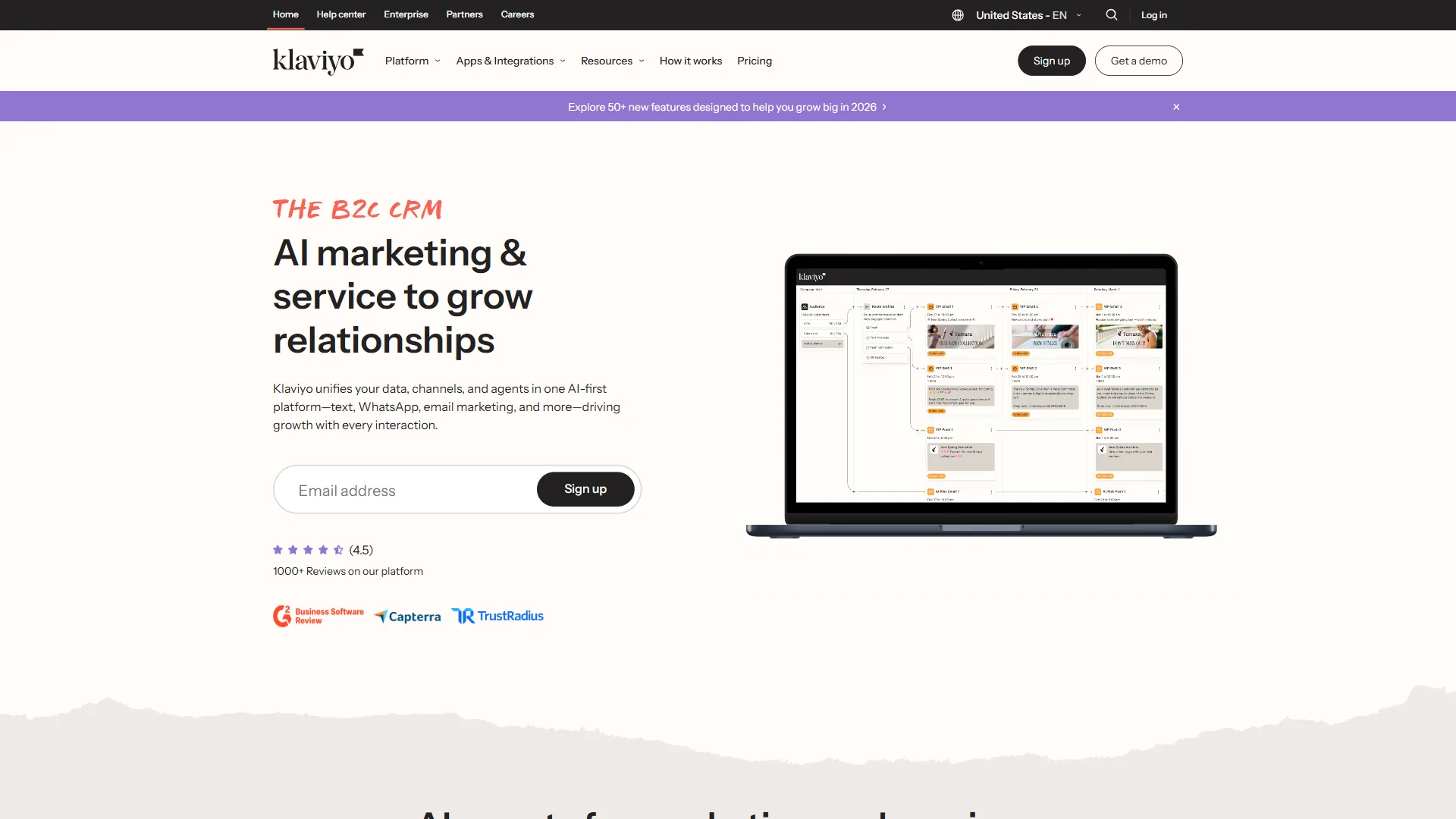
Klaviyo is the best Mailchimp alternative for ecommerce and Shopify stores because its platform was built specifically around customer behavior data - purchase history, browsing patterns, cart activity, and lifetime value - rather than generic newsletter sends.
If you run a Shopify store, Klaviyo’s native integrations sync purchase and behavior data to power automations Mailchimp cannot match. Mailchimp sends a “you left items in your cart” email; Klaviyo runs a cart-abandonment sequence that adjusts messaging based on order history, predicted next purchase date, churn likelihood, and average order value.
Where Klaviyo beats Mailchimp:
- Revenue attribution - Every email and flow shows exactly how much revenue it generated. Mailchimp shows clicks; Klaviyo shows dollars
- Predictive analytics on all paid plans - Predicted customer lifetime value, expected next order date, and churn risk scoring. Mailchimp reserves predictive features for Premium ($350+/month)
- Deep ecommerce integrations - Native Shopify, WooCommerce, BigCommerce, and Magento integrations sync in real-time. Product feeds update automatically in email templates
- RFM segmentation - Recency, Frequency, Monetary analysis built in. Automatically groups customers into segments like “loyal customers,” “at risk,” and “needs attention”
- SMS + email in one platform - Unified flows that coordinate email and SMS based on customer behavior, not separate tools bolted together
Where Klaviyo falls short:
- Learning curve - The segmentation and flow builders are powerful but dense. Mailchimp’s simpler interface gets campaigns out the door faster for beginners
- Pricing at scale - Competitive up to about 50,000 contacts, but costs can exceed Mailchimp at very large list sizes (100k+ contacts)
- Non-ecommerce limitations - If you are a SaaS company, consultant, or media publisher, Klaviyo’s ecommerce-centric features feel over-engineered for your use case
- Template variety - Fewer pre-built email templates than Mailchimp. The editor is functional but less polished
Pricing: Free up to 250 contacts (500 email sends/month). Email plan starts at $20 per month for 251-500 contacts, $45 per month for 1,001-1,500 contacts, and $100 per month for 5,001-6,000 contacts. Email + SMS plan starts at $35 per month for 251-500 contacts. Cost increases with active profile count.
Best for: Ecommerce businesses, especially Shopify stores. If revenue-per-email is your primary metric, Klaviyo’s data-driven approach beats Mailchimp for online stores. Pass on Klaviyo if you do not run an online store, your list is heading past 100,000 contacts, or you need a simple drag-and-drop newsletter editor.
3. ActiveCampaign - Best for B2B Teams with Complex Automation Needs
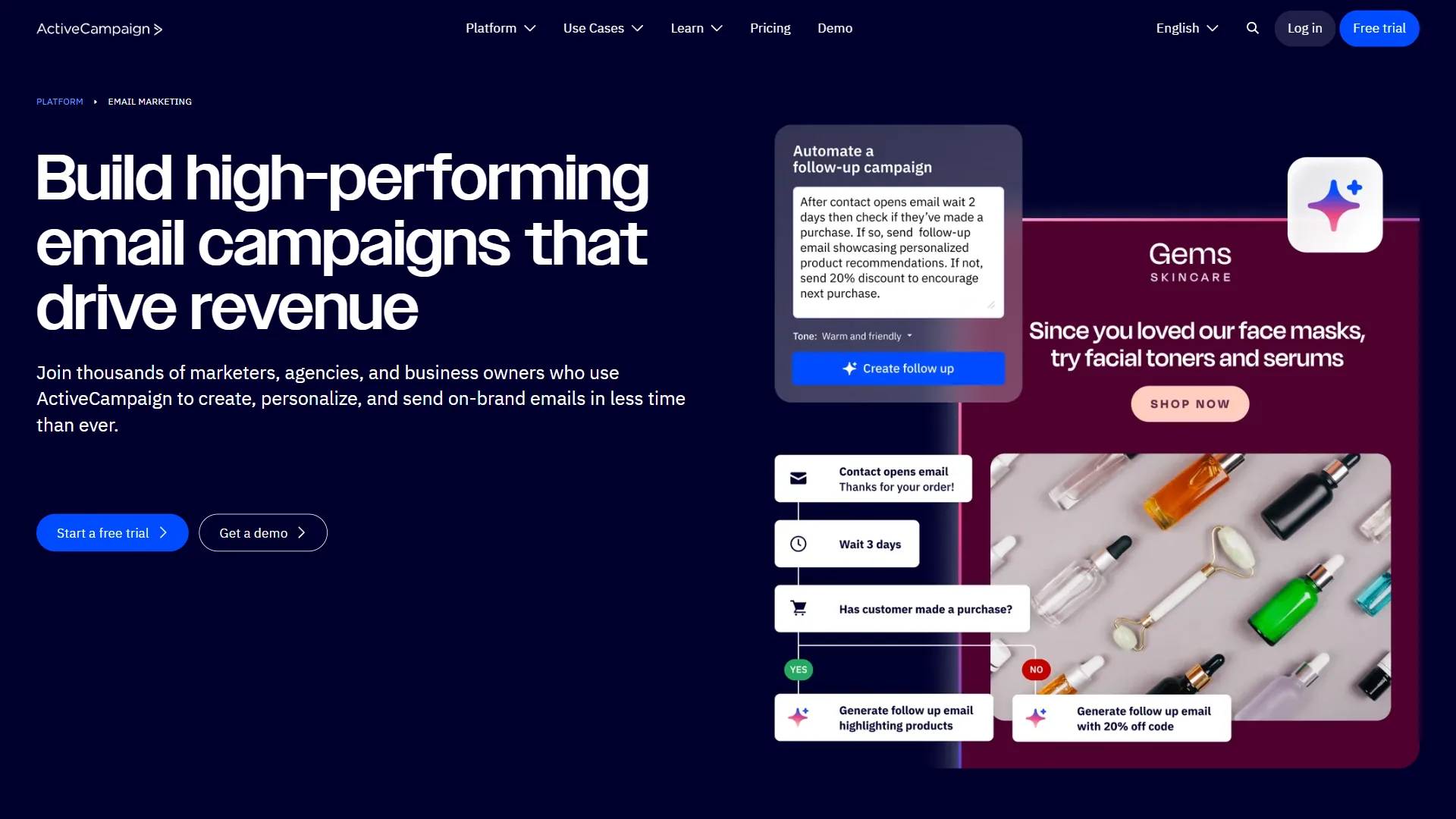
ActiveCampaign is the best Mailchimp alternative for B2B teams running complex automation, because its visual builder supports branching logic, conditional waits, goal tracking, split actions, and cross-channel triggers that Mailchimp’s basic if/then sequences cannot handle.
The ActiveCampaign automation builder goes far beyond Mailchimp’s, and the Plus plan adds a built-in CRM that ties email nurture sequences directly into deal stages - a compelling all-in-one option for B2B teams managing longer sales cycles.
Where ActiveCampaign beats Mailchimp:
- Automation depth - Conditional content, site tracking triggers, event-based automations, lead scoring, and deal-based workflows. The visual builder handles multi-step sequences that would require workarounds in Mailchimp
- Active contacts only billing - You only pay for contacts who are actively receiving emails. Unsubscribed, bounced, and non-opted-in contacts do not count. Mailchimp charges for everyone on your list
- Deliverability track record - ActiveCampaign consistently ranks at or near the top in independent Litmus deliverability benchmarks, with rates above 90% in most rounds
- CRM included - The Plus plan ($49 per month) includes a full sales CRM with pipelines, deal tracking, and win probability scoring. Mailchimp’s CRM features are surface-level by comparison
- Machine learning automation - Predictive sending, win probability on deals, and automated content recommendations improve over time based on your data
Where ActiveCampaign falls short:
- No free tier - Only a 14-day free trial. If you need a permanently free option, look at HubSpot or Klaviyo
- Interface density - The power comes at the cost of simplicity. New users can feel overwhelmed by the number of options in the automation builder
- Email template design - The template library and drag-and-drop editor are functional but not as polished or visually appealing as Mailchimp’s
- Reporting - While improving, the analytics dashboard is less intuitive than Mailchimp’s for quick campaign performance checks
Pricing: Starter at $15 per month (1,000 contacts) / Plus at $49 per month (adds CRM, landing pages) / Pro at $79 per month (adds predictive sending, split automations) / Enterprise at $145 per month. All prices based on 1,000 contacts and scale with list size.
Best for: B2B companies with multi-step sales processes, agencies managing multiple client automations, and teams where email automation complexity has outgrown Mailchimp. Skip ActiveCampaign if you need a permanent free tier, you only send simple newsletters, or you want a lightweight UI rather than a deep automation toolkit.
Total Cost: Pricing by List Size
Mailchimp’s Standard plan costs $20 per month at 500 contacts, $100 at 5,000, and $350 at 50,000 - compared to ActiveCampaign Plus at $49, $99, and $339 for the same tiers and HubSpot Starter at $20, $45, and $450. Real per-list-size costs are below, based on each vendor’s published rate card:
| List Size | Mailchimp (Standard) | HubSpot (Starter) | Klaviyo (Email) | ActiveCampaign (Plus) |
|---|---|---|---|---|
| 500 | $20/mo | $20/mo | $20/mo | $49/mo |
| 2,500 | $60/mo | $20/mo | $60/mo | $49/mo |
| 5,000 | $100/mo | $45/mo | $100/mo | $99/mo |
| 10,000 | $135/mo | $90/mo | $150/mo | $139/mo |
| 25,000 | $259/mo | $225/mo | $375/mo | $259/mo |
| 50,000 | $350/mo | $450/mo | $720/mo | $339/mo |
Key takeaways: under 5,000 contacts HubSpot Starter is the best value if you want CRM features, with Mailchimp and Klaviyo comparable for pure email; from 5,000 to 25,000 contacts ActiveCampaign’s active-contact-only billing and included CRM win; above 25,000 contacts ActiveCampaign is the cost leader and Klaviyo’s per-profile pricing gets expensive. Mailchimp charges for all contacts including inactive ones, so real costs run 10-20% higher than listed if you have unengaged subscribers.
Pro Tips: Migration Considerations
Switching email platforms requires planning - here is what to expect.
What transfers cleanly: contact lists and custom fields (CSV export/import works everywhere), template designs (most platforms support HTML import), and basic segments based on list membership or tags.
What you will need to rebuild: automation workflows (no platform-to-platform transfer exists), custom segments using behavioral data, integrations with other stack tools, and sending reputation on the new IP infrastructure.
Deliverability tip: Start by sending to your most engaged segment first to warm up your new sending reputation. Most platforms recommend a 2-4 week warm-up period of gradually increasing send volume - Mailchimp’s industry benchmarks are a useful baseline for tracking engagement recovery after the move.
Which Alternative Fits Your Workflow?
The best Mailchimp alternative depends on your business model: Klaviyo for ecommerce, HubSpot for CRM-plus-email teams, ActiveCampaign for B2B automation, and Mailchimp itself for simple newsletters under 500 contacts.
Ecommerce store: Pick Klaviyo ($20 per month). Revenue attribution, predictive analytics, and native Shopify integration make it the obvious choice - our Mailchimp vs Klaviyo head-to-head digs deeper.
CRM plus email in one place: Choose HubSpot (free to $20 per month). The free CRM tier alone beats Mailchimp’s paid plans for contact management.
Complex automation sequences: Pick ActiveCampaign ($15 per month). The automation builder handles branching paths and multi-channel workflows Mailchimp cannot - see our how to automate email with AI guide for patterns.
Simple newsletters on a budget: Mailchimp is still fine. If you send a weekly newsletter to under 500 people without automation, the free tier works - but once you outgrow that, any of the three alternatives gives more value per dollar.
The Bottom Line
Mailchimp is no longer the default email platform for most growing teams in 2026 - HubSpot’s free CRM, Klaviyo’s ecommerce attribution, and ActiveCampaign’s automation depth each beat Mailchimp on the metric their target audience cares most about.
HubSpot’s free CRM offers more functionality at no cost, Klaviyo delivers measurably better results for ecommerce, and ActiveCampaign provides deeper automation at competitive prices. The switching cost is real - rebuilding automations and warming a new sending reputation takes effort - but for most businesses past the newsletter stage, the right Mailchimp alternative pays for itself through better deliverability, smarter automation, and pricing that does not penalize list growth.
FAQ
Q: Why are people leaving Mailchimp?
People leave Mailchimp because pricing has climbed sharply since the Intuit acquisition, the free tier has been gutted to 500 contacts with no automation, contact-based billing charges for unsubscribed users, and AI features stay locked behind the $20 per month Standard plan.
Q: Is free Mailchimp going away?
The free Mailchimp plan still exists but has been significantly reduced - it now caps at 500 contacts and 1,000 monthly sends, with no automation, no A/B testing, and Mailchimp branding on every email.
Q: What is the best Mailchimp alternative for ecommerce?
Klaviyo is the strongest choice for ecommerce, especially Shopify stores. It pulls in purchase history, browsing behavior, cart activity, and lifetime value data to power automations Mailchimp cannot match. Plans start at $20 per month for up to 500 contacts, with a free tier available for up to 250 contacts.
Q: Is HubSpot really free compared to Mailchimp?
HubSpot’s free tier includes a full CRM, contact management, email marketing up to 2,000 sends per month, forms, landing pages, and live chat - significantly more generous than Mailchimp’s free plan, which limits you to 500 contacts and strips out automation entirely.
Q: Which Mailchimp alternative has the best automation features?
ActiveCampaign is built for teams that need complex automation. Its builder supports branching logic, conditional waits, goal tracking, split actions, and cross-channel triggers - capabilities that go well beyond Mailchimp’s basic if/then sequences. Plans start at $15 per month for 1,000 contacts.
Related Reading
These related guides extend the analysis above with broader category coverage, head-to-head matchups, and platform-specific deep dives:
- Best Email Marketing Tools 2026 - Broader comparison covering more platforms
- Mailchimp vs Klaviyo - Direct ecommerce-focused comparison
- Best Email Marketing Platforms 2026 - Comprehensive platform roundup
- How to Automate Email with AI - Practical email automation guide
- Mailchimp Review | HubSpot Review | Klaviyo Review | ActiveCampaign Review
External Resources
These third-party sources back the pricing, deliverability, and feature claims above: