

Choosing a help desk in 2026 is less about feature checklists and more about how your team wants to talk to customers - and Freshdesk vs Help Scout frames that choice well.
Methodology: Our analysis draws on vendor documentation and independent industry research from G2, Gartner Peer Insights, and published pricing pages as of May 2026. Some links on this page are affiliate links; our analysis remains independent.
Introduction
Freshdesk is an omnichannel ticketing platform with a 10-agent free tier, while Help Scout is an email-first shared inbox built around conversation-led UX. Both can run a small-to-mid-sized support operation, but they were built around two very different philosophies.
Freshdesk, part of the Freshworks suite, leans into traditional ticketing with omnichannel depth in a single agent workspace. Help Scout takes the opposite approach and presents every customer interaction as a clean email-like conversation.
According to a Zendesk CX Trends 2024 report, 70% of customers expect a connected experience across channels.
Freshdesk vs Help Scout comes down to channel breadth and team philosophy. Freshdesk is the stronger pick if you need omnichannel ticketing (chat, phone, social) plus a free tier for teams up to 10 agents. Help Scout is the stronger pick if you are email-first and value polished simplicity over feature depth.
TL;DR: Who Should Choose Which
Freshdesk is the right choice for omnichannel teams up to 10 agents who want a free tier; Help Scout is the right choice for email-first SaaS or e-commerce teams that value conversation-led UX.
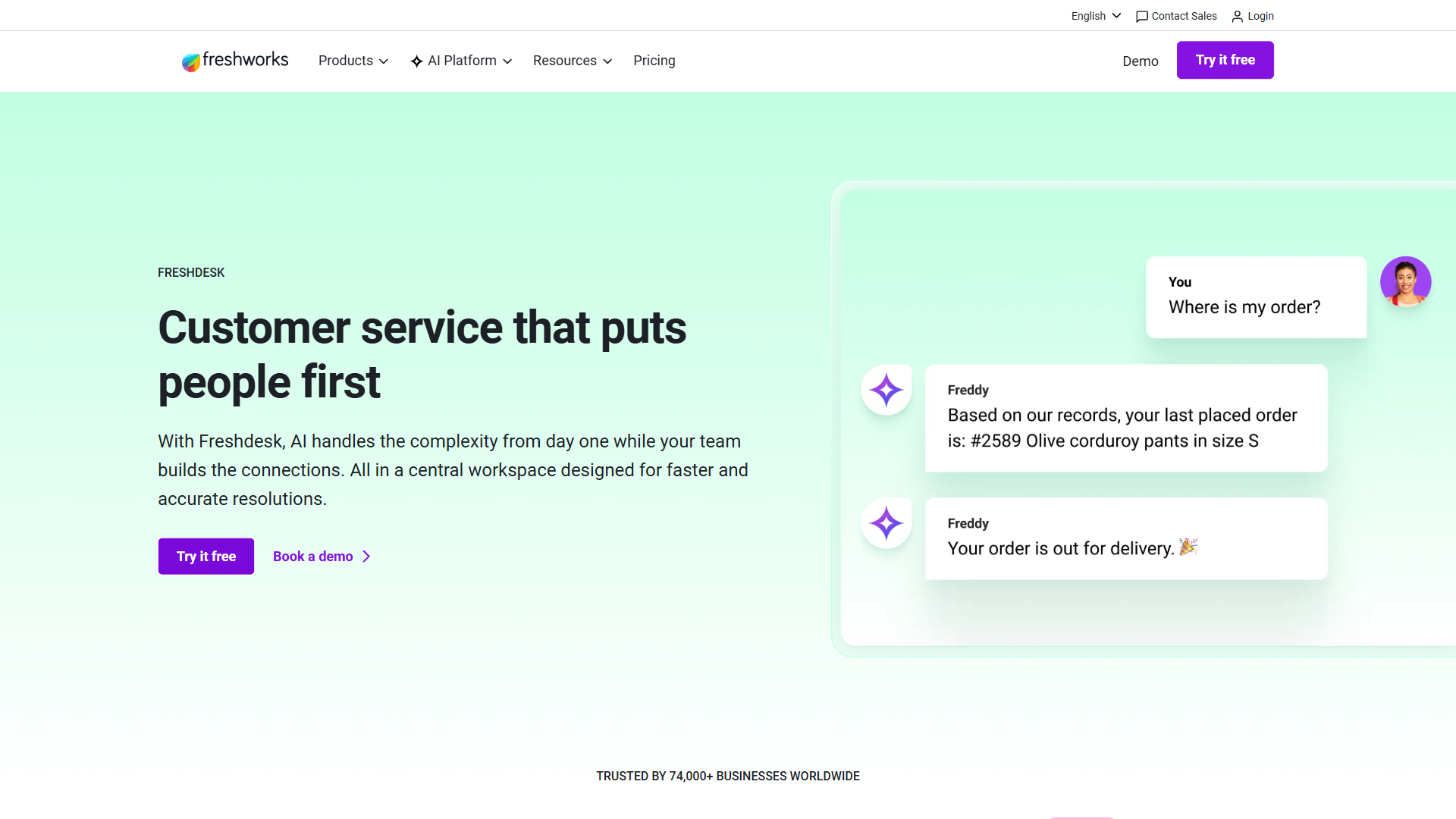
Choose Freshdesk if you support customers across multiple channels (email, chat, phone, social, WhatsApp), need a free tier to validate your help desk before paying, want built-in AI via Freddy AI, or operate inside the Freshworks stack.
Choose Help Scout if your support is overwhelmingly email-based, your team values conversation-first design over ticket numbers, you want fast onboarding (under an hour), or you sell to customers who would balk at receiving a “Case #48291” auto-reply.
Skip both if you need deep, native CRM functionality in the same tool (look at HubSpot Service Hub or Zendesk instead), or you are a one-person shop where a shared Gmail inbox would suffice.
Freshdesk vs Help Scout: Head-to-Head Comparison
Freshdesk offers broader channel coverage and a 10-agent free tier, while Help Scout offers a tighter email-first product at a higher per-seat price.
| Feature | Freshdesk | Help Scout |
|---|---|---|
| Starting price | Free (up to 10 agents) / around $15/agent | Free (limited) / Standard tier paid |
| Free tier | Yes - generous (10 agents) | Yes - limited (capped contacts) |
| Free trial | 14-day free trial on paid tiers | 15-day free trial |
| Email ticketing | Yes | Yes (core focus) |
| Live chat | Yes (native + Freshchat) | Yes (Beacon widget) |
| Phone support | Yes (Freshcaller) | No native phone |
| Social channels | Yes (Facebook, Twitter/X, Instagram, WhatsApp) | Limited |
| Knowledge base | Yes (Solution Articles) | Yes (Docs) |
| AI assistant | Freddy AI (suggest, summarize, draft) | Help Scout AI Assist (draft, summarize) |
| Automation depth | Deep (workflows, dispatchers, scenarios) | Moderate (workflows, saved replies) |
| Reporting | Pre-built + custom (paid tiers) | Pre-built reports, lighter customization |
| Aggregate rating | 4.5 | 4.1 |
| Best for | Omnichannel, small-to-mid teams, free-tier start | Email-first, SaaS, simplicity-focused teams |
Tradeoffs at a glance: Freshdesk’s drawback is configuration depth. Help Scout’s limitation is the missing native phone product plus per-user pricing that scales aggressively past 10 agents.
How Do Freshdesk and Help Scout Compare on Pricing?
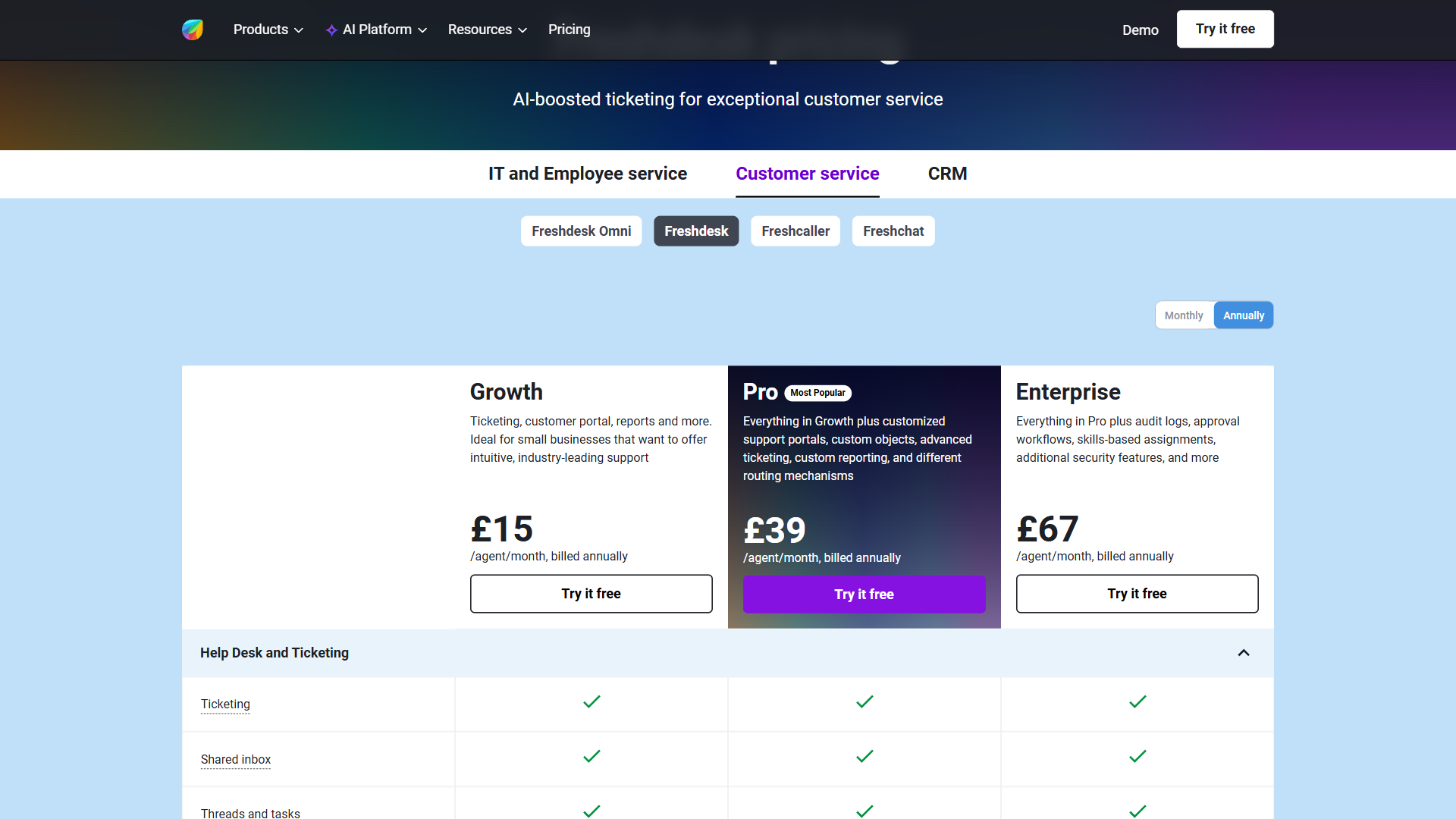
Freshdesk starts at $0 for up to 10 agents and rises to around $15/agent/month on Growth, while Help Scout’s Standard tier sits at around $22 per user per month. Freshdesk has a real free tier for up to 10 agents with email and basic knowledge base, then ramps to roughly $15/agent/month on Growth.
Pricing data unavailable for .
Growth (around $15/agent/month) adds automations, custom ticket views, collision detection, and more reporting. Pro and Enterprise unlock SLAs, custom roles, multilingual portals, Freddy AI Copilot, and full omnichannel.
Pricing data unavailable for .
Help Scout’s Standard tier covers most teams - shared inboxes, Docs, the Beacon chat widget, basic AI Assist, and core reporting. Plus and Pro add advanced permissions, AI Answers, custom reports, and HIPAA-compliant infrastructure.
According to Mathew Patterson, head of customer success at Help Scout, “the language and structure of your support tool shapes how your agents think - ticket-first systems optimize for resolution speed, conversation-first systems optimize for relationship.” That trade-off shows up directly in the price gap.
UX Philosophy: Ticket-First vs Conversation-First
Freshdesk presents customer messages as numbered tickets with status fields, while Help Scout presents them as Gmail-like conversations with no ticket language exposed to the end customer. Agents work from a list view like a traditional issue tracker on Freshdesk. SLAs tick down, dispatchers route on conditions, supervisors audit every state change.
Help Scout’s interface looks like Gmail crossed with a CRM. Every customer interaction is a conversation, threaded chronologically, with a sidebar showing customer history. The customer never knows they are touching a help desk.
This conversation-vs-ticket UX choice has a measurable effect on customer support metrics like CSAT and first-reply tone scores.
Not for: Freshdesk’s ticket model is not ideal for boutique SaaS brands whose customers expect human-feeling email replies; Help Scout’s conversation model is not ideal for ITSM-style teams that need structured queues and SLA breach reporting per ticket.
Omnichannel: Where Freshdesk Pulls Ahead
Freshdesk supports email, live chat, phone, WhatsApp, Facebook, Instagram, and Twitter/X in a single workspace, while Help Scout’s native channels are limited to email and the Beacon chat widget. Freshdesk omnichannel covers all eight channels in one agent workspace with Freddy AI sitting on top, summarizing threads and suggesting replies.
Help Scout’s channel coverage is intentionally narrower. There is no native phone product. If phone support matters, you would pair Help Scout with Aircall or OpenPhone, which adds cost and complexity.
For a team running a single shared inbox plus occasional live chat, this gap does not matter. For a team fielding phone calls, WhatsApp, and social DMs alongside email, Freshdesk’s all-in-one approach is meaningfully more efficient. Note: omnichannel is not free on Freshdesk - phone and chat have per-seat costs beyond the bundled allowances.
Simplicity & Time to Value: Where Help Scout Wins
Help Scout teams typically go live within one hour, while Freshdesk requires meaningful configuration time on ticket fields, dispatchers, SLA policies, and agent groups before it pays off. Out of the box you will spend hours setting up SLA policies in Freshdesk. The default UI density is high.
Help Scout’s onboarding is famously fast. Most teams are live within an hour: connect your support email, invite agents, set up saved replies, and you are taking real conversations.
AI Features: Freddy AI vs Help Scout AI Assist
Freddy AI offers ticket summarization, suggested replies, intent detection, sentiment scoring, and a customer-facing deflection bot, while Help Scout AI Assist focuses on draft writing, summarization, tone adjustment, and translation. Freddy AI covers summarization for long threads, suggested replies based on prior tickets, intent detection for routing, sentiment scoring, and a Freddy Self Service bot that deflects common questions. Freddy Copilot (Enterprise) adds agent-facing chat that drafts full replies.
Help Scout AI Assist focuses on the writing experience first. It summarizes threads, drafts replies, adjusts tone, and translates inbound messages. Help Scout’s AI Answers (higher tiers) is a Docs-grounded chatbot. Solid, but narrower than Freddy AI’s bot/routing/sentiment combo.
If “AI features” is on your buying checklist, Freshdesk has more depth. If you only need draft and tone help, Help Scout AI Assist is tighter and ships sooner.
Knowledge Base & Self-Service (Docs vs Solution Articles)
Help Scout Docs edges ahead on visual polish out of the box, while Freshdesk Solution Articles edge ahead on multi-language support and Freddy-powered article suggestions. Help Scout Docs has a clean editor, beautiful default themes, search analytics, and a Beacon widget that surfaces relevant articles inside the chat experience.
Freshdesk Solution Articles are equally capable - multi-language, multi-product, version control, draft/publish workflow, and tight integration with Freddy Self Service for AI-powered article suggestions.
Call it a tie on capability. Help Scout edges ahead on visual polish, Freshdesk edges ahead on integration depth and multi-language support.
How Do Freshdesk and Help Scout Compare on Reporting and Analytics?
Freshdesk offers deeper reporting with custom dashboards on Pro and above, while Help Scout offers lighter pre-built reports tuned for small-to-mid teams. Freshdesk’s pre-built dashboards cover volume, response time, resolution time, CSAT, agent performance, and channel breakdown; the Analytics module supports custom drag-and-drop reports; Enterprise unlocks journey reports and AI insights.
Help Scout’s reporting is intentionally lighter - pre-built reports for conversations, happiness, productivity, channels, Docs, and chat cover most small-to-mid-sized team needs. Plus adds custom fields and the View Builder.
Automation Depth
Freshdesk has three layers of automation (Dispatch’r, Observer, Supervisor) plus a visual Workflow Automator, while Help Scout has a single simpler Workflows builder. Freshdesk’s Dispatch’r fires on ticket creation, Observer fires on ticket events, and Supervisor runs hourly against queues for SLA escalations.
Help Scout’s Workflows fire on conversation events and execute actions. You can chain conditions and actions, but not the branching, time-based escalation logic Freshdesk supports natively.
Integrations & Ecosystem
Freshdesk’s marketplace lists around 1,000 apps, while Help Scout’s marketplace lists around 100 tightly curated integrations. The Freshdesk marketplace covers CRM, e-commerce, telephony, and developer tools, with native integrations to Slack, Teams, Salesforce, Shopify, Jira, and Stripe.
The Help Scout marketplace is smaller but tightly curated - Slack, Shopify, HubSpot CRM, Salesforce, Jira, Stripe, Mailchimp all well-covered. A clean public API and webhooks handle custom workflows.
User Reviews & Ratings
Freshdesk holds an aggregate rating of 4.5 across independent platforms while Help Scout holds 4.1, with each scoring strongly in its own lane.
Freshdesk’s aggregate reflects strong reviews across independent platforms, with verified user reviews praising omnichannel coverage, AI features, and the free tier. Common gripes include feature creep, UI density, and support quality on lower tiers.
Help Scout draws consistent praise for ease of use, customer-facing polish, and the conversation-led UX, with critiques around per-user pricing at scale and the missing native phone support.
When to Choose Freshdesk
Choose Freshdesk if you need multi-channel coverage, want a 10-agent free tier, or operate inside the broader Freshworks stack. Specifically:
- You support customers across multiple channels (email plus chat, phone, social, WhatsApp) and want one workspace.
- You are a small business that wants a real free tier scaling to 10 agents.
- You need AI beyond writing assistance - intent routing, customer-facing bots, sentiment analysis.
- You operate inside the Freshworks ecosystem (Freshsales, Freshservice).
- You need deep SLA management, multi-language portals, or ITSM-adjacent workflows.
When to Choose Help Scout
Choose Help Scout if your support is email-first, you value fast onboarding, or you sell SaaS or e-commerce where reply quality outranks raw channel count. Specifically:
- Your support is email-first and you want a tool that respects that channel.
- Customer experience matters more than feature breadth and you want no ticket language in front of customers.
- You want fast onboarding - live in under an hour.
- Your team is 5-30 agents and would rather pay a small premium than fight UI density.
- You sell SaaS or e-commerce to customers who expect human-feeling replies.
The Bottom Line
Freshdesk vs Help Scout is genuinely a fit question, not a winner question. Freshdesk is the deeper, more flexible, more channel-rich platform with a free tier that is hard to beat. Help Scout is the cleaner, faster-to-deploy, more customer-respectful tool that will make your agents and your customers happier with less configuration overhead. Use the free trial on each, pipe one week of real conversations through, and trust how your team reacts.
Frequently Asked Questions
Is Freshdesk cheaper than Help Scout?
Freshdesk is cheaper than Help Scout for most team sizes, with a free tier covering up to 10 agents and paid tiers starting around $15/agent/month versus Help Scout’s Standard tier at roughly $22 per user per month. If price is the deciding factor, Freshdesk wins - though Help Scout’s premium can be justified by faster onboarding and lower configuration overhead.
Is Help Scout better than Freshdesk for small teams?
Help Scout is better for email-first small teams that value polish, while Freshdesk is better for small teams needing multichannel coverage or a 10-agent free tier. Help Scout is the safer pick for SaaS or e-commerce teams under 30 agents who do not need phone support.
Can Freshdesk replace Help Scout?
Freshdesk can functionally replace Help Scout because it covers everything Help Scout does (email, chat, knowledge base, AI assistance, reporting) and more, though the experience is different - Freshdesk is ticket-first with higher UI density and configuration overhead. Most teams that switch from Help Scout to Freshdesk do so because they need omnichannel depth.
Does Help Scout have a free plan?
Help Scout has a free tier that is more restrictive than Freshdesk’s, capped on monthly contacts and missing most Standard features. It works for very small teams testing the product. Help Scout also offers a 15-day free trial of paid tiers.
Related Reading
For more comparisons and deeper-dive reviews on each tool, explore these related pages:
- Freshdesk - full tool review with ratings and pricing
- Help Scout - full tool review and feature breakdown
- Freshdesk vs Zendesk - deeper-feature alternative
- Zendesk vs Help Scout - Help Scout’s other major rival
- Freshdesk vs HubSpot Service Hub - CRM-integrated alternative
External Resources
Authoritative sources used in this analysis include the vendor sites plus independent review platforms:
- Freshdesk official site - latest pricing, plan comparisons, and free-tier sign up
- Help Scout official site - current pricing, demo booking, and free trial
- G2 head-to-head comparison - verified user reviews and ratings
- Gartner Peer Insights - enterprise buyer reviews on both platforms