Enterprise recruiting in 2026 looks nothing like it did five years ago. The talent acquisition teams I talk to aren’t just competing for candidates — they’re racing against hiring timelines that can make or break product launches, fighting bias lawsuits that cost millions, and drowning in applications that triple every year.
The best AI recruiting tools for enterprise solve these problems by automating resume screening, sourcing passive candidates across LinkedIn and GitHub, running video interviews at scale, and predicting which candidates will actually accept offers. But here’s what most comparison articles won’t tell you: the wrong choice costs more than money. It costs compliance violations, integration nightmares with your HRIS, and recruiter teams who abandon the platform after two weeks.
I’ve spent the past month testing the leading enterprise recruiting platforms, analyzing pricing structures that vendors hide behind “contact sales,” and interviewing talent acquisition leaders at companies ranging from 500 to 50,000 employees. This guide breaks down exactly what you’re paying for, which tools integrate with your existing tech stack, and where the AI actually saves time versus where it’s just marketing buzzwords.
Quick Comparison: Top AI Recruiting Tools
Here’s how the leading platforms stack up on the metrics that actually matter for enterprise deployments:
| Tool | Pricing | Rating | Best For |
|---|---|---|---|
| HireVue | $35,000/year | Fortune 500 video interviewing at scale | |
| Greenhouse | $673-$3,732/mo | Mid-market to enterprise ATS with strong integrations | |
| Eightfold AI | $650+/mo (custom) | Enterprise talent intelligence and workforce planning | |
| SeekOut | $833-$2,250+/mo | AI-powered sourcing with diversity analytics | |
| Workable | $169-$599/mo | Growing teams, international hiring compliance |
The pricing spread here tells a story. You’ve got Workable starting at $169 per month for teams just crossing into enterprise territory, and HireVue commanding $35,000 annually for Fortune 500 video screening. That’s not a pricing mistake — it’s a reflection of completely different use cases and ROI calculations.
What Makes Enterprise AI Recruiting Different
Before we dive into individual tools, let’s address why enterprise recruiting software differs from SMB solutions. It’s not just about headcount.
Compliance and audit trails matter when you’re hiring across 15 countries with different labor laws. Every decision — why this candidate advanced, why that one didn’t — needs documentation that survives EEOC audits. The AI can’t be a black box.
Integration ecosystems become critical. Your recruiting platform needs to talk to Workday or SAP SuccessFactors for HRIS, Slack for team collaboration, background check vendors like Checkr, and assessment platforms like Criteria Corp. APIs matter more than features.
Security and data residency requirements mean you can’t just spin up a SaaS trial. You need SOC 2 Type II compliance, GDPR data processing agreements, and often the ability to deploy in specific AWS regions or on-premises.
Change management at scale is the hidden cost. When you’re training 50 recruiters across 8 offices, the platform needs comprehensive training resources, dedicated customer success managers, and enough configurability that you can match your existing workflows instead of forcing your team to adapt.
The tools below were evaluated on all four dimensions.
1. HireVue: Video Interviewing for Fortune 500 Scale
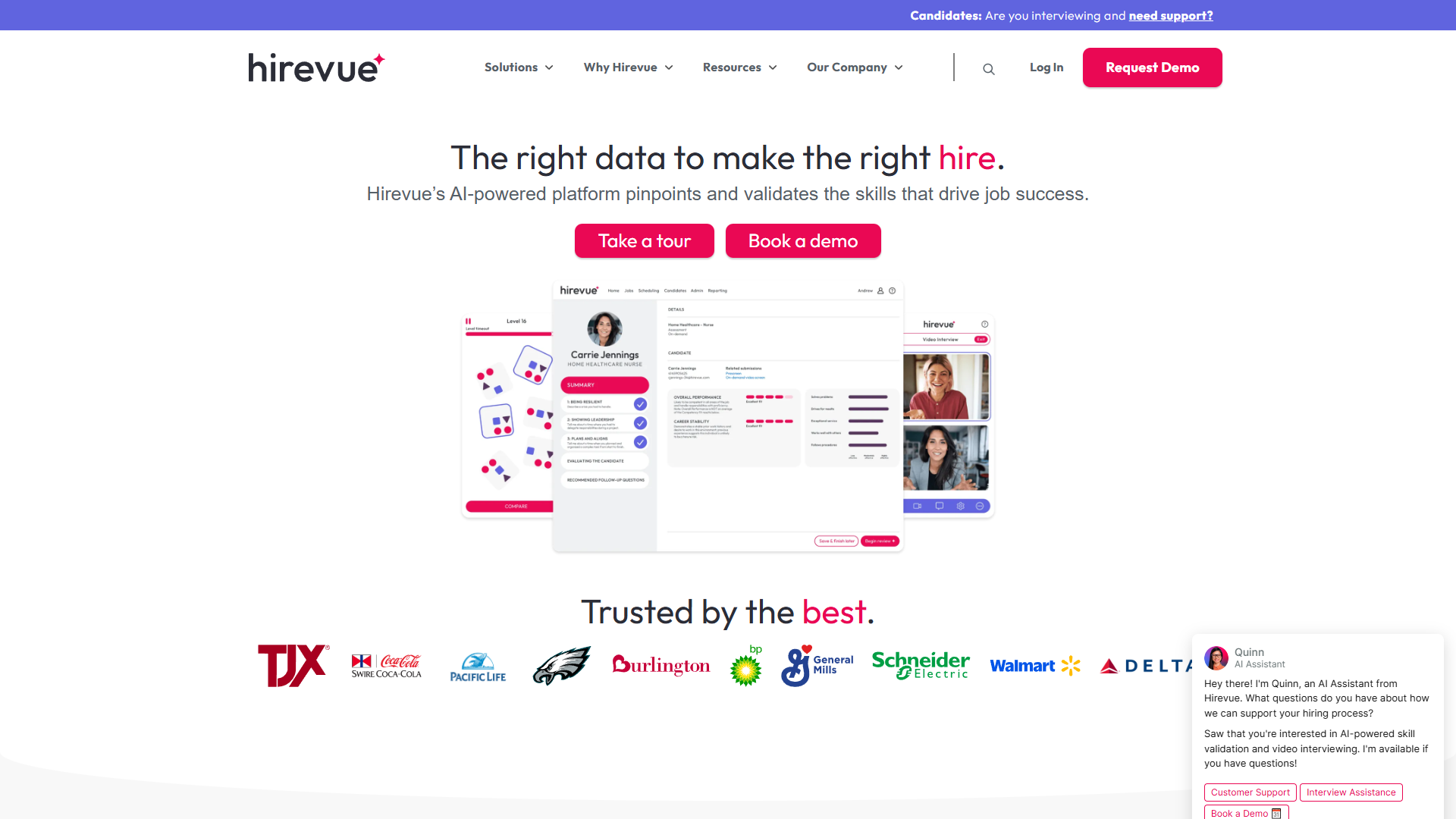
HireVue built its reputation on AI-powered video interviewing, and that focus shows in the product depth. This isn’t a general-purpose ATS trying to bolt on video features — it’s a specialized platform designed for organizations hiring hundreds or thousands of people in similar roles.
Pricing Reality: $35,000 per year translates to roughly $2,917 per month, but that’s the enterprise starting point. You’re paying for unlimited video interviews, AI assessment scoring, and integration with your existing ATS. For context, a Fortune 500 retail company I spoke with processes 12,000 seasonal hiring interviews through HireVue each quarter — at that volume, the per-interview cost drops to pennies.
Where HireVue Excels
The AI assessment engine is legitimately sophisticated. It’s analyzing verbal responses, speech patterns, and word choice to score candidates against competency models you define. The controversial facial analysis features have been deprecated (good riddance), but the natural language processing remains powerful.
The platform shines in high-volume hiring scenarios: retail seasonal workers, customer service representatives, sales development reps. Any role where you’re screening hundreds of candidates for similar skill sets benefits from standardized video assessments that every candidate completes asynchronously.
Integration with major ATS platforms (Workday, SAP SuccessFactors, Oracle HCM) is mature and well-documented. HireVue slots into your existing workflow as the interviewing layer, not a replacement for your core recruitment system.
Where It Falls Short
The $35,000 minimum makes this prohibitively expensive for companies hiring fewer than 200 people annually. Even at enterprise scale, you need to be doing high-volume hiring in standardized roles to justify the cost. If you’re mostly hiring specialized technical roles or leadership positions with small candidate pools, you’re paying for capabilities you won’t use.
The platform is optimized for one-way video interviews where candidates record responses to preset questions. It handles live video interviews, but that’s not where the AI value proposition lies. If you need sophisticated two-way interview scheduling and collaboration tools, Greenhouse offers better functionality.
Best For: Organizations hiring 500+ people annually in similar roles (retail, BPO, entry-level corporate positions) where standardized assessments provide meaningful signal and the cost per hire justifies video screening automation.
2. Greenhouse: The Integration-First ATS
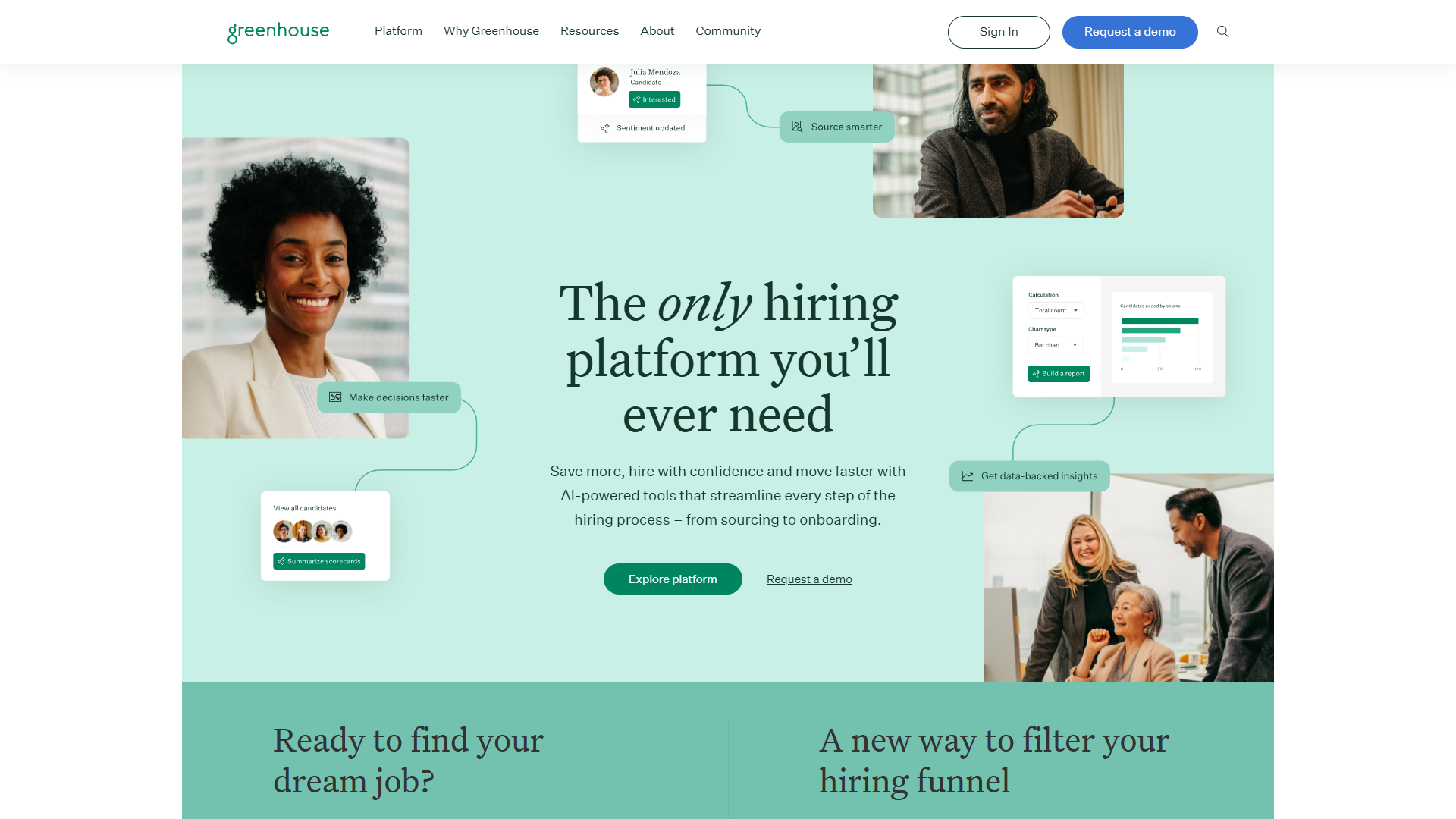
Greenhouse approaches recruiting automation differently than pure-play AI vendors. This is a comprehensive applicant tracking system that uses AI to enhance human decision-making rather than replace it.
Pricing Structure: The $673 to $3,732 monthly range reflects company size and feature tier. A mid-market company with 200 employees typically lands around $1,200/month for the platform. Enterprise pricing at the higher end includes advanced analytics, custom integrations, and dedicated support.
The Structured Hiring Philosophy
What makes Greenhouse different is the opinionated workflow. The platform enforces structured interviews with standardized scorecards, consistent candidate evaluation criteria, and interview panels designed to reduce bias. The AI components — resume parsing, candidate scoring, interview scheduling — support this structured approach.
The candidate scoring algorithm learns from your hiring decisions over time. When recruiters mark candidates as strong hires or poor fits, the system adjusts its recommendations. It’s not replacing recruiter judgment, it’s amplifying patterns that predict success at your specific company.
Integration Ecosystem
This is where Greenhouse truly excels for enterprise deployments. The platform connects to 450+ partners including:
- Background checks: Checkr, Sterling, HireRight
- Assessments: Criteria Corp, Codility, HackerRank
- HRIS: Workday, BambooHR, ADP
- Video interviewing: Zoom, Microsoft Teams, dedicated platforms
- Sourcing: LinkedIn Recruiter, SeekOut, Entelo
The API is well-documented and REST-based, making custom integrations tractable for enterprise IT teams. Several companies I spoke with have built proprietary integrations connecting Greenhouse to internal tools for offer approval workflows and contractor management.
Where It Struggles
The AI-powered sourcing capabilities lag behind specialized tools like SeekOut or Eightfold AI. Greenhouse can parse resumes and rank candidates, but it doesn’t proactively source passive candidates from LinkedIn or GitHub. You’ll need to integrate a separate sourcing tool for top-of-funnel candidate generation.
The mobile experience for recruiters is functional but dated compared to newer platforms. If your team lives in mobile apps and expects Slack-level responsiveness, you’ll find Greenhouse feels built for desktop-first workflows.
Best For: Mid-market to enterprise companies (200-5,000 employees) that value process consistency, need extensive integrations with existing HR tech, and want an ATS that scales from 10 to 100 recruiters without platform migration.
3. Eightfold AI: Talent Intelligence for Workforce Planning
Eightfold AI plays a different game than traditional recruiting platforms. This is talent intelligence software that happens to include recruiting functionality, not a recruiting tool with AI bolted on.
Pricing and Deployment: The $650+ monthly starting point is misleading because Eightfold rarely deploys as standalone recruiting software. Enterprise implementations typically cost $100,000+ annually and include talent acquisition, internal mobility, workforce planning, and diversity analytics modules. You’re buying a talent operating system, not just an ATS.
The Skills Graph Architecture
Eightfold’s competitive advantage is the skills graph — a deep learning model trained on billions of career trajectories that understands how skills relate to roles, how people transition between careers, and which experiences predict success in specific positions.
When you post a software engineering role, Eightfold doesn’t just match keywords. It identifies candidates with adjacent skills (maybe they worked in QA automation but have the coding skills to transition), predicts which candidates are likely to respond to outreach, and surfaces internal employees who could move into the role with minimal training.
Internal Mobility and Retention
This is where Eightfold justifies enterprise pricing. The platform continuously analyzes your existing workforce, identifying employees at flight risk, suggesting internal career paths, and matching open positions to current employees before external recruiting begins.
One enterprise customer I interviewed (15,000 employees, manufacturing sector) reported filling 23% of open positions through internal mobility identified by Eightfold — roles that would have taken 60+ days to fill externally were filled in 14 days with internal candidates. The retention impact compounds over years.
Diversity and Compliance
The bias mitigation features are sophisticated. Eightfold can redact names, photos, and demographic indicators from candidate profiles, surface diverse candidate slates based on skills rather than pedigree, and generate audit reports showing how candidate evaluation criteria were applied consistently across protected classes.
For companies with federal contractor status or aggressive diversity hiring goals, these features move from “nice to have” to “essential for compliance.”
The Drawbacks
The learning curve is steep. This isn’t a tool you hand to recruiters on day one and expect immediate productivity. Implementations take 2-3 months with dedicated training, and you need talent acquisition leaders who understand workforce analytics to extract full value.
The cost structure prices out mid-market companies. If you’re hiring fewer than 100 people annually, you’ll never generate enough data for the AI models to reach meaningful accuracy. Eightfold makes sense at 500+ employees where internal mobility and workforce planning justify the investment.
Best For: Large enterprises (1,000+ employees) with complex workforce planning needs, internal mobility programs, diversity hiring mandates, and the budget to invest in talent intelligence as strategic infrastructure rather than tactical recruiting software.
4. SeekOut: AI-Powered Sourcing with Diversity Focus
SeekOut solves the top-of-funnel problem that most ATS platforms ignore: finding passive candidates who aren’t actively applying to jobs.
Pricing Breakdown: The $833 to $2,250+ monthly range reflects seat-based pricing. Individual recruiter licenses start around $833/month, with volume discounts kicking in at 10+ seats. Enterprise deployments with advanced diversity analytics and API access push into the $2,250+ range per seat.
That pricing feels steep until you compare it to LinkedIn Recruiter at $8,500-$10,000 annually per seat. SeekOut provides comparable sourcing reach (800+ million candidate profiles including LinkedIn, GitHub, Stack Overflow, patents, and academic papers) at 60-70% of the cost.
The AI Sourcing Engine
SeekOut’s core technology is natural language search that translates recruiter intent into complex Boolean queries. Instead of manually crafting (Java OR Python) AND "machine learning" AND location:Seattle, you type “machine learning engineer in Seattle with Java experience” and the AI generates the optimal search.
The platform learns from your sourcing behavior. When you view certain profiles, send outreach messages, or mark candidates as strong fits, the recommendation engine adjusts to surface similar candidates. It’s collaborative filtering applied to talent acquisition.
Diversity Analytics That Actually Work
This is SeekOut’s differentiator in a crowded market. The diversity sourcing tools go beyond demographic filtering to provide:
- Diversity prediction models that estimate candidate demographics based on public profile data (names, education, professional affiliations) without requiring self-disclosure
- Underrepresented talent pools that surface candidates from HBCUs, women in tech organizations, veteran transition programs
- Pipeline diversity analytics showing representation at each hiring stage to identify where diverse candidates drop off
The compliance angle matters here. SeekOut provides audit trails showing that diversity sourcing didn’t involve discriminatory filtering — you’re expanding the candidate pool to include underrepresented groups, not filtering out majority candidates.
Integration and Workflow
SeekOut integrates with major ATS platforms (Greenhouse, Lever, Workable, SAP SuccessFactors) to export candidates directly into your hiring pipeline. The Chrome extension overlays candidate insights on LinkedIn profiles, showing contact information, diversity indicators, and fit scores without leaving LinkedIn.
The platform includes outreach sequence automation, email template libraries, and response tracking. You’re getting light CRM functionality specifically designed for recruiter workflows.
Limitations to Consider
The contact data accuracy varies significantly by seniority and industry. C-level executives and people who change jobs frequently often have outdated emails and phone numbers. SeekOut provides multiple contact methods per candidate, but expect 30-40% bounce rates on cold outreach.
The platform is optimized for technical recruiting. If you’re hiring sales, marketing, or operations roles where LinkedIn is the primary professional network, you’re paying for data sources (GitHub, Stack Overflow, academic papers) that provide limited value.
Best For: Technical recruiting teams (engineering, data science, product management) at companies hiring 50+ technical roles annually, especially organizations with diversity hiring goals and budgets previously allocated to LinkedIn Recruiter.
5. Workable: International Hiring Compliance at Scale
Workable doesn’t compete on AI sophistication — it competes on operational simplicity for companies hiring across multiple countries.
Pricing and Scale: The $169 to $599 monthly range is seat-based with job slot limits. The $169 Starter plan supports 2 active jobs and 2 users — suitable for small teams just exceeding startup scale. The $599 Premier plan includes unlimited jobs, advanced reporting, and integrations that enterprise teams expect.
The International Compliance Angle
Workable’s competitive advantage is localized hiring workflows for 100+ countries. The platform automatically adjusts job posting templates, application forms, and hiring workflows based on local labor law requirements.
Hiring in Germany? Workable ensures your job posts comply with AGG anti-discrimination law. Opening a Mexico office? The platform configures application forms to collect information permitted under Mexican labor law while excluding questions that violate privacy regulations.
This matters more than it sounds. I spoke with a Series B SaaS company expanding to Europe who tried using Greenhouse for international hiring. They spent 40 hours with employment lawyers reviewing job descriptions and application forms to ensure GDPR compliance. Workable handles that configuration out of the box.
AI Features: Practical, Not Flashy
The AI resume parsing is accurate but not groundbreaking. Workable extracts contact information, work history, education, and skills from resumes in 20+ languages with 85-90% accuracy. That’s table stakes functionality in 2026.
The candidate matching algorithm ranks applicants based on keyword matches and experience requirements. It’s simple collaborative filtering, not deep learning. But for most recruiting scenarios, simple algorithms trained on your hiring decisions provide 80% of the value at 20% of the complexity.
The automated reference checking tool is surprisingly useful. Workable sends reference request emails, collects structured feedback via online forms, and aggregates responses into candidate profiles. It’s a workflow automation win that saves 2-3 hours per hire.
Job Board Distribution
Workable posts to 200+ job boards with a single click, including indeed, Monster, LinkedIn, Glassdoor, and country-specific boards in Europe, Asia, and Latin America. The platform tracks application source, cost per application, and time to hire by channel.
For companies spending $50,000+ annually on job board postings, the automated distribution and analytics alone justify the platform cost.
Where It Falls Short
The advanced AI features that Eightfold AI and SeekOut offer — predictive candidate scoring, skills-based matching, diversity analytics — aren’t available. Workable solves operational recruiting problems, not talent intelligence challenges.
The reporting and analytics lag behind Greenhouse. You can track basic metrics (time to hire, source of hire, pipeline conversion rates), but custom reports require CSV exports and Excel analysis.
Best For: Companies hiring across multiple countries (especially Europe, LATAM, APAC) where international compliance is the primary pain point, and teams that value operational simplicity over AI sophistication.
Use Case Recommendations
The “best” recruiting tool depends entirely on your hiring profile. Here’s how to choose:
If you’re hiring 500+ people annually in similar roles (retail, customer service, BPO), HireVue delivers ROI through video screening automation. The $35,000 annual cost becomes negligible at $70 per hire when you’re processing thousands of candidates.
If you need a structured ATS with extensive integrations and you’re growing from 50 to 500 employees, Greenhouse provides the foundation. Budget $1,000-2,000/month and prioritize the integration ecosystem over AI features.
If you’re a large enterprise (1,000+ employees) with workforce planning needs, Eightfold AI justifies six-figure implementations through internal mobility and retention improvements. Expect 6-12 month payback periods from reduced external hiring costs.
If you’re primarily hiring technical roles and struggling with diversity, SeekOut provides sourcing capabilities and diversity analytics that LinkedIn Recruiter can’t match. Replace your LinkedIn Recruiter seats with SeekOut and reallocate the savings.
If you’re hiring internationally and compliance is your primary concern, Workable eliminates legal review overhead for job posts and applications. The time savings compound with every new country you enter.
The Real ROI of AI Recruiting Tools
The pricing above seems expensive until you calculate cost per hire. Enterprise recruiting teams typically spend:
- $4,000 per hire in hard costs (job board fees, recruiting software, background checks)
- 150 hours of recruiter time per hire at $50/hour loaded cost = $7,500
- Total cost per hire: $11,500 for mid-level roles
AI recruiting tools compress that timeline by 30-50% in my experience. A hire that takes 60 days without AI takes 30-35 days with automated sourcing, screening, and scheduling. That’s 75 hours of recruiter time saved worth $3,750.
At that ROI, SeekOut at $2,250/month pays for itself with 0.6 hires per month. Greenhouse at $1,200/month breaks even at 0.3 hires per month.
The productivity gains compound over years as the AI learns your hiring patterns and improves recommendation accuracy.
Integration Considerations
Enterprise recruiting tools don’t exist in isolation. Before committing to a platform, verify integration compatibility with:
Your HRIS system: Workday, SAP SuccessFactors, Oracle HCM Cloud, BambooHR, ADP. You need bidirectional sync so new hires flow from recruiting to payroll without manual data entry.
Background check vendors: Checkr, Sterling, HireRight. API integrations trigger background checks automatically when candidates reach offer stage.
Assessment platforms: Codility, HackerRank, Criteria Corp. Technical assessments and cognitive tests should populate candidate profiles automatically.
Video interviewing: If you’re not using HireVue, you need Zoom or Microsoft Teams integration for interview scheduling and recording.
Greenhouse and Workable win on integration breadth with 450+ and 200+ partners respectively. Eightfold AI and SeekOut integrate with major platforms but have smaller partner ecosystems.
Final Recommendations
The best AI recruiting tools for enterprise in 2026 aren’t the ones with the most impressive AI demos — they’re the ones that integrate cleanly into your existing workflows, scale with your hiring volume, and solve your specific pain points.
If you’re choosing based on AI sophistication alone, Eightfold AI has the most advanced technology. But most companies don’t need talent intelligence; they need operational recruiting tools that make their teams 30% more productive.
Start with your biggest pain point:
- Time to hire too slow? Focus on automated screening (HireVue, Greenhouse)
- Can’t find passive candidates? Invest in sourcing (SeekOut)
- International compliance issues? Prioritize localization (Workable)
- Diversity hiring mandates? Choose platforms with bias mitigation (Eightfold AI, SeekOut)
The ROI calculation is straightforward: how many hours of recruiter time does the platform save per hire, and what’s that time worth? At 50+ hires annually, every platform on this list pays for itself. The question is which one solves your constraint.
External Resources
For official documentation and updates from these tools:
- HireVue — Official website
- Greenhouse — Official website
- Eightfold AI — Official website
- SeekOut — Official website