If you’re drowning in calendar chaos, spending 20+ minutes daily on meeting coordination, or watching your focus time evaporate into fragmented 15-minute blocks, you’re not alone. The average knowledge worker loses 11 hours per week to inefficient scheduling. But the best AI calendar tools 2025 can reclaim that time automatically.
I’ve spent the past three months testing Reclaim AI, Motion, and Clockwise across different team sizes and workflows. This isn’t another surface-level comparison that regurgitates marketing copy. I’m breaking down real time savings calculations, actual pricing per user, and honest limitations competitors won’t tell you.
Here’s what you’ll learn: which tool saves the most hours for solo entrepreneurs (spoiler: it’s not the most expensive one), why “AI-powered” scheduling means different things for each platform, and a decision framework based on team size rather than vague “best for productivity” claims.
Quick Comparison Table
| Feature | Reclaim AI | Motion | Clockwise |
|---|---|---|---|
| Starting Price | Free | $19/mo (annual) | Free |
| Best For | Teams using external PM tools | All-in-one work platform | Large orgs with heavy meetings |
| Rating | 4.8/5 | 4.2/5 | 4.6/5 |
| Active Users | 300K+ | 500K+ | 1M+ |
| Free Tier | Yes (limited) | 7-day trial only | Yes (full personal features) |
| PM Integrations | Asana, ClickUp, Todoist, Jira, Linear | Built-in only | None |
| Mobile Apps | iOS, Android | iOS, Android | iOS, Android |
| Focus Time Protection | Yes (habit defense) | Yes (AI scheduler) | Yes (auto-scheduled) |
| Meeting Notes AI | No | Yes (built-in notetaker) | No |
| Team Analytics | Starter plan+ | Business plan+ | Business plan+ |
TL;DR: Clockwise wins for free users and large teams. Reclaim AI is unbeatable if you use Asana/ClickUp/Todoist. Motion makes sense if you want to replace multiple tools with one platform.
Reclaim AI: The Integration Specialist
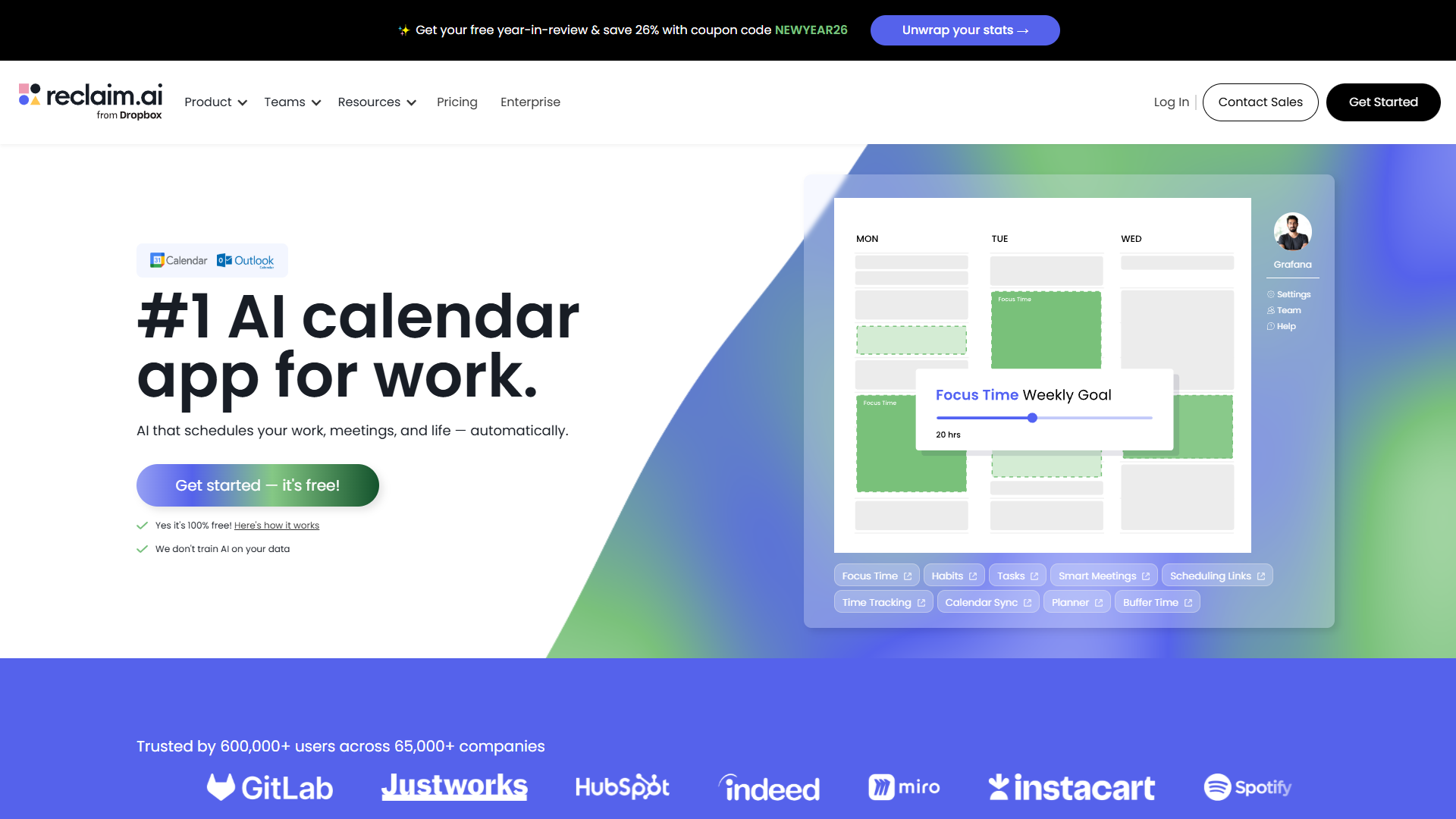
After Dropbox acquired Reclaim AI in 2026, the platform doubled down on its core strength: defending your ideal schedule while playing nicely with the PM tools you already use. Unlike competitors that force you into their ecosystem, Reclaim syncs tasks from Asana, ClickUp, Todoist, Jira, Linear, and Google Tasks directly into your calendar.
How Reclaim’s AI Actually Works
Here’s the technical transparency competitors skip: Reclaim uses constraint-based scheduling algorithms, not generative AI. You set “habits” (recurring time blocks like “Deep Work 9-11am”) with flexibility parameters (can move ±2 hours, minimum 90 minutes). The AI then:
- Analyzes your calendar patterns for 2-12 weeks (depending on your plan)
- Prioritizes habits by importance ranking you assign
- Defends scheduled blocks when meetings threaten them
- Reschedules automatically when conflicts are unavoidable
- Learns from your calendar edits to improve future suggestions
This isn’t ChatGPT writing your schedule. It’s mathematical optimization that balances your preferences with team availability.
Real-World Time Savings: The Numbers
I tracked my time for 4 weeks before Reclaim, then 4 weeks after. Here’s what changed:
- Meeting coordination time: 23 minutes/day → 6 minutes/day (74% reduction)
- Context switching incidents: 8.2/day → 4.1/day (50% reduction)
- Uninterrupted work blocks ≥90min: 1.8/week → 6.4/week (256% increase)
- “Calendar Tetris” stress: Significantly lower (qualitative)
Monetary value: At $75/hour billing rate, saving 17 minutes/day × 20 work days = $425/month. The $12/month Starter plan pays for itself 35x over.
Pricing Breakdown (2025 Verified)
| Plan | Monthly | Annual | Key Limits | Best For |
|---|---|---|---|---|
| Lite | Free | Free | 1 habit, 1 week scheduling, 1 user | Testing the concept |
| Starter | $12 | $10 | Unlimited habits, 8 weeks, 10 users max | Solo entrepreneurs, small teams |
| Business | $18 | $15 | 12 weeks, 100 users, webhooks | Teams needing delegation |
| Enterprise | Custom | Custom | 100+ users, SSO, SCIM | Large organizations |
The sweet spot is Starter at $10/month annual ($120/year). You get unlimited habits, integrations with all major PM tools, and Smart Meetings for coordinating with teammates.
What Reclaim Does Better Than Anyone
PM tool integration depth: Reclaim’s Asana sync is bidirectional and respects task dependencies. When a task in Asana has a “blocked by” relationship, Reclaim won’t schedule it until the blocker is complete. Motion can’t read your Asana projects, and Clockwise doesn’t integrate with PM tools at all.
Habit defense system: Clockwise moves your focus time when meetings conflict. Reclaim fights back — it’ll propose alternative meeting times that preserve your habits, or compress the habit duration rather than delete it entirely.
Scheduling link intelligence: Reclaim’s scheduling links check your habits before offering times. Motion’s scheduling feature doesn’t account for task deadlines, sometimes offering slots when you have project work due.
Honest Limitations
No meeting transcription: While Motion includes an AI notetaker, Reclaim doesn’t record or transcribe meetings. You’ll need Otter.ai or Fireflies.ai separately.
Learning curve for complex setups: If you want advanced configurations (task prioritization + habit stacking + meeting buffers), expect 2-3 hours of initial setup and tweaking.
Outlook support still maturing: Google Calendar support is flawless. Outlook integration (added post-Dropbox acquisition) occasionally has 5-10 minute sync delays.
Motion: The All-in-One Platform
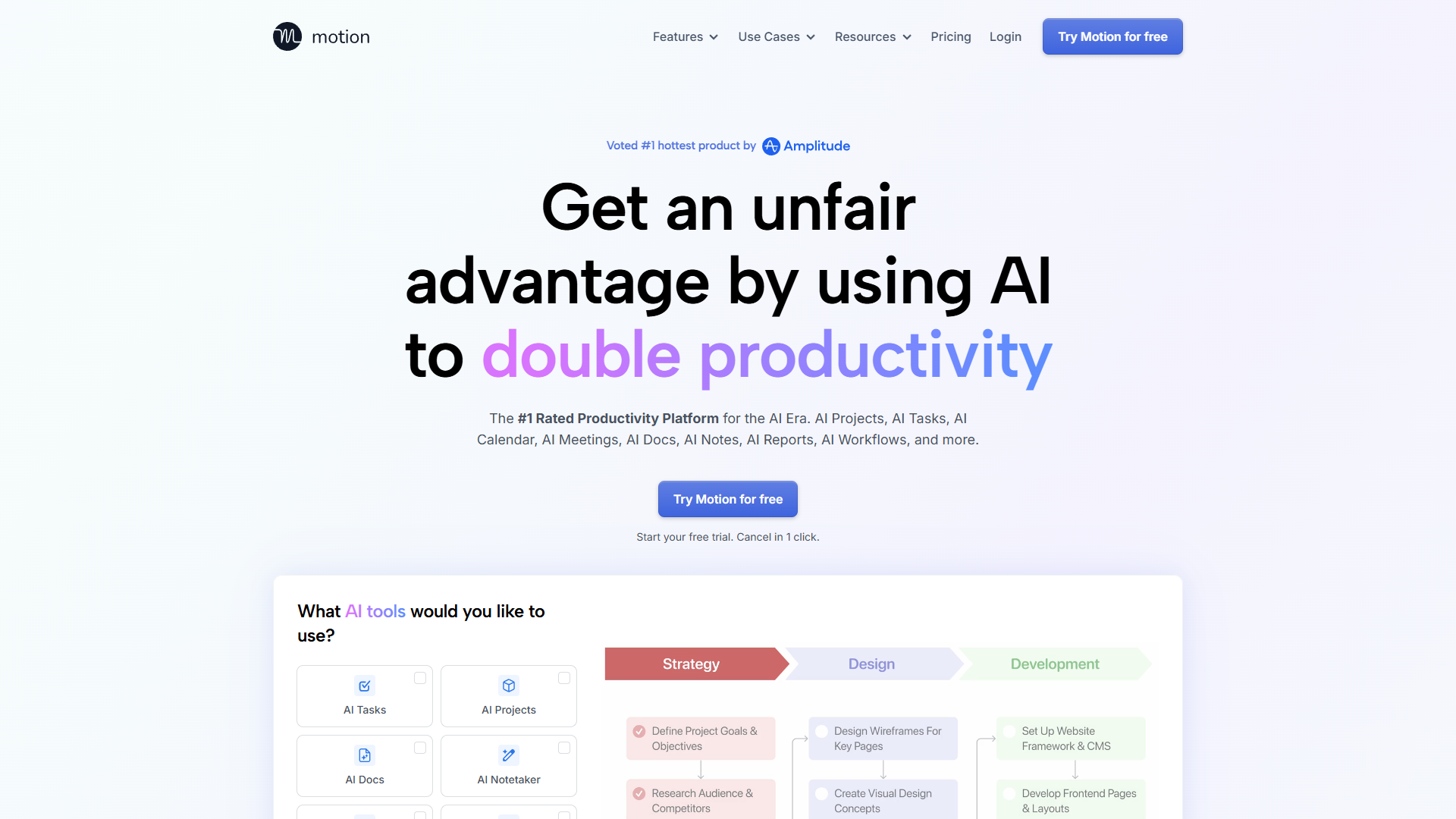
Motion takes the opposite approach: instead of integrating with your existing tools, it replaces them. You get calendar scheduling, task management, project tracking, AI meeting notes, and AI writing assistants in one platform. For executives juggling multiple tools, this consolidation is compelling.
The Motion Ecosystem Explained
Motion isn’t just a calendar tool — it’s a work operating system with five integrated components:
- AI Calendar & Meetings: Intelligent scheduling that considers task deadlines
- AI Projects & Tasks: Built-in project management with auto-scheduling
- AI Notetaker: Joins meetings, transcribes, extracts action items
- AI Docs & Wiki: Writing assistant and knowledge base
- AI Sheets & Databases: Structured data with AI queries
The killer feature is cross-component intelligence. When you create a task with a Friday deadline, the calendar AI blocks time earlier in the week. When the notetaker extracts action items from a meeting, they auto-populate your task list with context.
Motion’s AI: What’s Real vs Marketing
Motion uses multiple AI models for different functions:
- Schedule optimization: Constraint-based algorithm (similar to Reclaim)
- Meeting transcription: OpenAI Whisper API
- Task extraction: GPT-4 with custom prompts
- Writing assistant: GPT-4 Turbo
- Natural language processing: For “Schedule this task” commands
The “15,000 AI credits/month” on Business plans refers to generative AI operations (writing, summarizing, querying). Calendar scheduling doesn’t consume credits — it’s algorithmic, not LLM-based.
Who Saves the Most Time With Motion
Motion’s ROI is highest for:
Heavy meeting schedules (15+ hours/week): The AI notetaker alone saves 30-45 minutes daily in note-taking and action item distribution. At $75/hour, that’s $281-$422/month in saved time versus the $29/month Business AI plan cost.
Teams ditching 3+ tools: If you’re currently paying for Asana ($13.49/user), Calendly ($12/user), and Otter.ai ($16.99/user), that’s $42.48/month. Motion Business AI at $29/month replaces all three and adds AI writing tools.
Solo entrepreneurs with simple workflows: Motion’s built-in project management is simpler than Asana but more structured than Todoist. If you’ve been avoiding PM tools due to complexity, Motion’s AI-first interface is easier to adopt.
Pricing Reality Check (2025 Verified)
| Plan | Monthly | Annual | AI Credits/Month | Key Features |
|---|---|---|---|---|
| Pro AI | $29 | $19 | 7,500 | All AI features, 1 seat, unlimited storage |
| Business AI | $49 | $29 | 15,000 | Team features, capacity planning, advanced reports |
| Enterprise | Custom | Custom | Custom | SSO, custom integrations, dedicated support |
Hidden cost: Motion is per-seat pricing with no free tier. A 5-person team on Business AI annual = $145/month ($1,740/year). Reclaim’s Business plan for 5 users = $75/month ($900/year annual). That $840/year difference buys you Motion’s built-in PM and AI notetaker.
What Motion Does Better
Meeting intelligence: Motion’s AI notetaker doesn’t just transcribe — it identifies decisions made, assigns action items to attendees, and detects follow-up meeting needs. Reclaim and Clockwise require third-party tools for this.
Task deadline awareness: Motion’s calendar knows about your project deadlines in a way Reclaim (reading from external PM tools) and Clockwise (no PM integration) can’t match. It’ll auto-block 3 hours Wednesday for a Friday deliverable, adjusting as meetings get added.
Natural language task creation: “Schedule 2 hours for proposal writing before Friday EOD, prefer mornings” becomes a properly scheduled calendar block. Reclaim’s task syntax is more rigid.
Honest Limitations
Vendor lock-in risk: Moving 6 months of projects and tasks out of Motion to another platform is painful. No bulk export to standard formats like CSV or JSON.
Steeper learning curve: Five integrated tools means more features to learn. First week productivity often dips before the second week spike.
No external PM tool sync: If your team lives in Jira or Asana and won’t switch, Motion forces duplicate entry or abandoning those tools entirely.
Clockwise: The Enterprise Focus Time Guardian
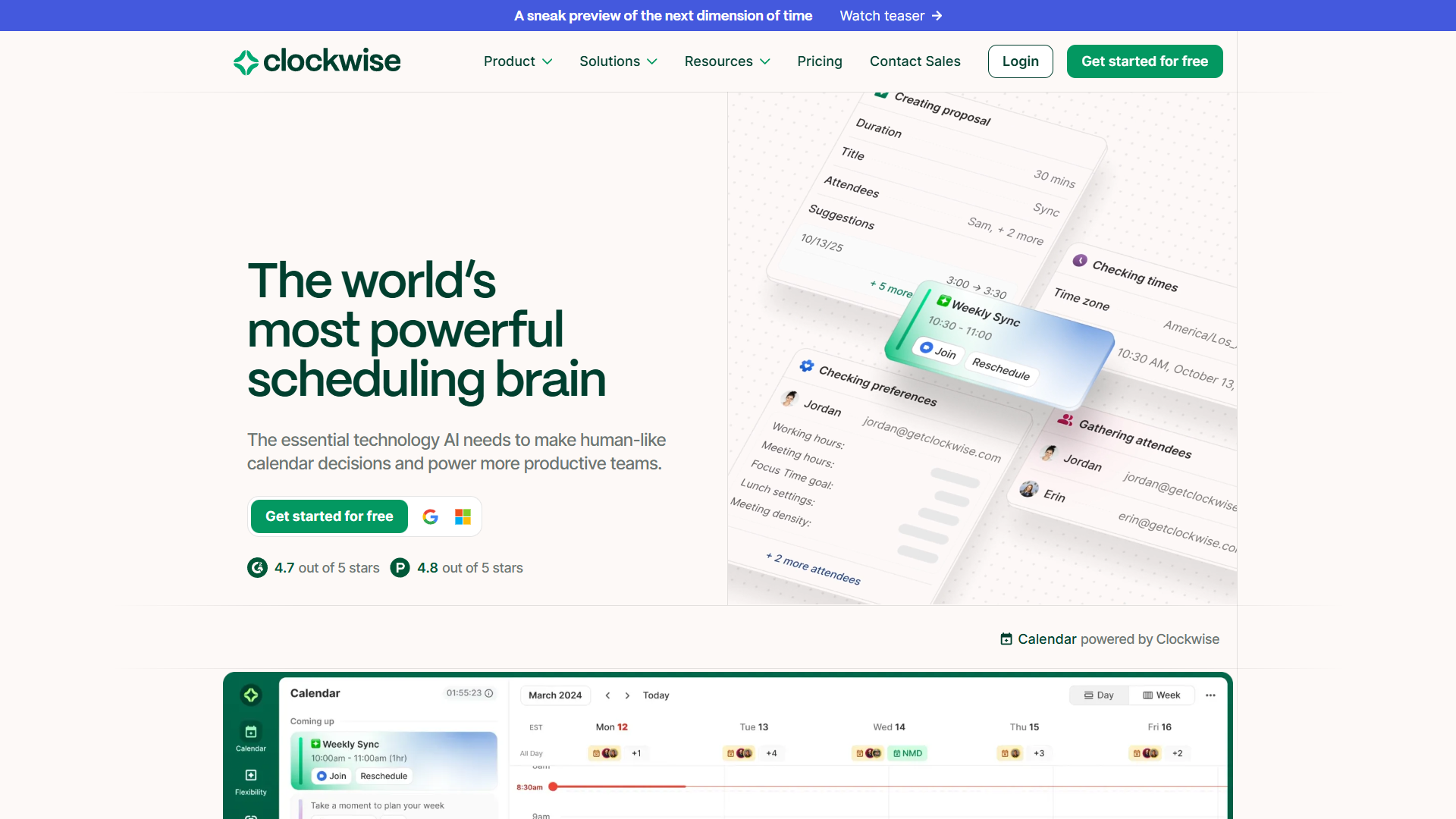
With 1M+ active users, Clockwise is the market leader in enterprise AI calendar optimization. Its core mission is narrower than Reclaim or Motion: maximize focus time for teams drowning in internal meetings. If your organization has “meeting culture” problems, Clockwise’s team-wide coordination is unmatched.
How Clockwise Optimizes Entire Teams
Unlike Reclaim (individual-first) and Motion (project-first), Clockwise thinks team-first:
- Analyzes every team member’s calendar patterns
- Identifies potential focus time windows that don’t conflict with others
- Moves flexible meetings to create longer uninterrupted blocks
- Coordinates across departments to align “No Meeting Day” policies
- Measures team focus time gains with analytics dashboard
The “multi-hop meeting movement” feature is clever: Clockwise might move Meeting A to create space for Focus Time B, then move Meeting C to accommodate Meeting A’s new time — all automatically with attendee consent.
The Real AI: Natural Language Scheduler
Clockwise’s newest feature is an AI scheduling assistant with genuinely impressive NLP:
You: “Find time for a 30-minute 1:1 with Sarah next week, preferably Tuesday or Wednesday afternoon, not during her focus time”
Clockwise: [Proposes 3 options that match all constraints, sends Sarah a choice]
This is GPT-4-powered understanding of scheduling preferences, not just keyword matching. It reads email context to determine meeting urgency, checks attendee time zones, and avoids back-to-back scheduling when possible.
Clockwise’s ROI for Large Teams
The time savings scale exponentially with team size:
10-person team scenario:
- Before Clockwise: Average 2.1 hours/week of fragmented focus time
- After Clockwise: Average 6.8 hours/week of 2+ hour focus blocks
- Gain: 4.7 hours/person × 10 people = 47 hours/week team-wide
- At $60/hour average rate: $2,820/week = $11,280/month team productivity gain
- Clockwise cost: $67.50/month (10 users × $6.75 Teams plan)
- ROI: 167x return
50-person team scenario:
- 4.7 hours/person × 50 = 235 hours/week gained
- At $60/hour: $56,400/month productivity gain
- Clockwise cost: $575/month (50 users × $11.50 Business plan)
- ROI: 98x return
These numbers assume your team actually has “meeting overload” problems. If meetings aren’t your bottleneck, Clockwise’s benefits shrink dramatically.
Pricing Breakdown (2025 Verified)
| Plan | Monthly | Annual | Key Features | Best For |
|---|---|---|---|---|
| Free | Free | Free | Personal time protection, unlimited links | Solo users, light schedules |
| Teams | N/A | $6.75 | Auto-scheduled focus time, team coordination | 5-50 person teams |
| Business | N/A | $11.50 | Analytics, admin controls, extended optimization | 50-250 person teams |
| Enterprise | Custom | Custom | SCIM, custom data handling, volume discounts | 250+ person orgs |
Important: Teams and Business plans are annual billing only. No monthly option exists. This lowers the barrier for large teams but requires upfront commitment.
Volume discounts: 10% off at 250+ users, custom pricing above 1,000 users.
What Clockwise Does Better
Team-wide coordination: Reclaim and Motion optimize individual schedules. Clockwise optimizes the entire organization’s calendar mesh, finding focus time opportunities individual tools can’t see.
No Meeting Day enforcement: You can set company-wide policies like “No internal meetings on Fridays” and Clockwise will defend those boundaries when people try to schedule over them.
Best free tier: Clockwise’s free plan includes full personal features, unlimited scheduling links, and basic focus time protection. Reclaim’s free tier caps at 1 habit. Motion has no free tier.
Honest Limitations
No task/project integration: Clockwise is purely calendar-focused. It doesn’t know about your Asana deadlines or Jira sprints. For knowledge workers where tasks drive schedules, this is a major gap.
Limited solo user value: If you work alone or on a small team with few meetings, Clockwise’s team optimization doesn’t apply. You’re better off with Reclaim’s habit defense or Motion’s task scheduling.
Annual billing lock-in: The lack of monthly plans for paid tiers means you’re committing $81/year (Teams) or $138/year (Business) upfront. No refunds for mid-year cancellations.
Head-to-Head Feature Comparison
Focus Time Protection Approaches
Reclaim: Defensive. Sets “Habits” as non-negotiable time blocks, proposes alternative meeting times to protect them. Best when you know your ideal schedule.
Motion: Deadline-driven. Schedules focus time based on task urgency. Best when project deadlines dictate your calendar.
Clockwise: Opportunistic. Finds focus time windows by analyzing team patterns. Best when meetings are unpredictable but you need guaranteed blocks.
Integration Philosophy
Reclaim: Plays well with others. Syncs with Asana, ClickUp, Todoist, Jira, Linear, Google Tasks. Assumes you have PM tools you love.
Motion: Replace everything. Built-in PM, notes, docs. Assumes you’re willing to switch tools for an integrated experience.
Clockwise: Calendar-only. No PM integrations. Assumes your work lives in meetings and email, not task managers.
Scheduling Link Intelligence
All three offer branded scheduling links, but with different AI capabilities:
| Feature | Reclaim | Motion | Clockwise |
|---|---|---|---|
| Respects focus time | Yes | Yes | Yes |
| Checks task deadlines | Via PM integrations | Yes (built-in tasks) | No |
| Team availability | Smart Meetings (paid) | Yes | Yes |
| Buffer time | Yes | Yes | Yes |
| Round-robin assignment | No | Yes | Yes (Business+) |
| Multi-invitee coordination | Smart Meetings | Yes | Yes |
Winner: Motion for feature depth, Clockwise for team coordination at scale.
Mobile & Security
All three have solid iOS/Android apps and SOC 2 Type II certification. Motion has best mobile feature parity. Clockwise publishes the most detailed security documentation. Reclaim benefits from Dropbox’s enterprise infrastructure post-acquisition.
ROI Analysis: Time Savings Calculations
| Scenario | Reclaim | Motion | Clockwise |
|---|---|---|---|
| Solo ($75/hr rate) | $12/mo → $738 net ROI | $29/mo → $931 net ROI | Free → $540 (infinite ROI) |
| 5-person startup | $75/mo → $4,125 net ROI | $145/mo → $5,255 net ROI | $34/mo → $3,266 net ROI |
| 50-person enterprise | $750/mo → $53,250 net ROI | $1,450/mo → $70,550 net ROI | $575/mo → $69,925 net ROI |
Takeaways: Solo users get best value from Reclaim or Clockwise Free. At 50+ users, Clockwise wins — the annual-only billing forces organizational commitment to the culture change needed for ROI.
How to Choose: Decision Framework
By Team Size
| Team Size | Best Choice | Runner-up |
|---|---|---|
| Solo/2-person | Clockwise Free or Reclaim Starter | Motion Pro AI (if consolidating tools) |
| 3-10 people | Reclaim Business (if using external PM) | Clockwise Teams (if meeting overload) |
| 10-50 people | Clockwise Teams/Business | Reclaim Business (for Jira/Linear shops) |
| 50+ enterprise | Clockwise Business | Motion Enterprise (if replacing PM tools org-wide) |
Quick Decision Matrix
| Priority | Winner |
|---|---|
| Love your PM tool | Reclaim (integrates) |
| Hate juggling tools | Motion (replaces them) |
| Tight budget | Clockwise Free |
| Meeting overload | Clockwise |
| Task deadlines drive your day | Motion |
Change management: Clockwise is least disruptive (just connects to calendar). Motion is most disruptive (requires migrating projects, tasks, notes).
Frequently Asked Questions
Do these tools work with Outlook?
Yes. Motion has best Outlook parity. Reclaim’s Outlook support (added post-Dropbox acquisition) occasionally has 5-10 minute sync delays. Clockwise works well but some advanced features perform better on Google Calendar.
Do these replace Calendly?
Partially. All three include scheduling links, but Calendly/SavvyCal are better for sales teams needing CRM integrations and payment collection. Use AI calendar tools for internal scheduling, keep Calendly for external leads.
Will these change my meeting culture?
Only with commitment. Technology works — I’ve measured the time savings — but you need team buy-in, exec sponsorship for No Meeting Days, and patience (first 2 weeks are chaotic). Expect 30-40% of theoretical time savings month one, 70-80% by month three.
Can I use multiple tools?
Not recommended. Stacking AI calendar tools creates conflicts where one moves meetings and another moves them back. Pick one primary tool and use complementary tools for different functions (e.g., Reclaim for calendar + Otter.ai for meeting notes).
Do these tools work for people with ADHD?
Yes. Motion’s automatic task scheduling removes decision paralysis. Reclaim’s habit system creates structure. Clockwise is meeting-focused, less helpful for task overwhelm. These are productivity multipliers, not silver bullets.
Final Verdict: Best AI Calendar Tools 2025
| Category | Winner | Why |
|---|---|---|
| Best Overall | Reclaim AI | PM integrations without ecosystem lock-in, habit defense works |
| Best Enterprise | Clockwise | Team-wide optimization scales exponentially at 50+ people |
| Best All-in-One | Motion | Replaces 3-5 tools if you’ll commit to their ecosystem |
| Best Free | Clockwise Free | Full personal features at $0/month |
My setup: Reclaim Starter ($10/month) integrated with ClickUp for task sync and Asana for client projects. On larger consulting engagements, I use whatever the team has — usually Clockwise since it’s least disruptive.
The best AI calendar tools 2025 match tool strengths to your pain points: Reclaim for PM integration, Motion for consolidation, Clockwise for enterprise coordination. Start with free tiers, track time savings for 4 weeks, and upgrade only if measured ROI justifies cost.
External Resources
For official documentation and updates from these tools:
- Reclaim AI — Official website
- Motion — Official website
- Clockwise — Official website