


The best AI writing tools for novelists are Sudowrite for fiction-specific prose generation, Claude for developmental editing, ChatGPT for outlining and brainstorming, and Novelcrafter for novel organization - and pairing them in a structured workflow lets authors draft roughly four times faster without sacrificing creative control. This guide ranks each tool for fiction drafting, with current pricing and a stage-by-stage workflow.
An 80,000-word novel at 500 words per day takes 160 days; the same novel at 2,000 words per day with AI assistance takes 40 days. The AI writing assistant market is projected to reach $6.5 billion by 2030, according to Market Research Future, and over 50% of content marketers now use AI writing tools in their workflow, the Content Marketing Institute reports.
Our analysis draws on current vendor documentation, pricing pages, and independent research rather than sponsored placement or hands-on benchmarking. AI Productivity may earn a commission from links on this page; our rankings and recommendations remain editorially independent.
This guide shows which AI tools work for novelists, how to integrate them without losing your voice, and the techniques that separate amateur users from pros shipping novels at 4x their previous pace.
Understanding AI Writing Tools for Novelists
Not all AI writing tools are created equal. ChatGPT and Claude are brilliant for business writing - see our Claude vs ChatGPT comparison for how they differ - but they struggle with fiction’s unique demands: character voice consistency, narrative tension, scene-level pacing, and genre conventions.
Fiction-specific AI tools understand these nuances. Here’s what actually matters:
Sudowrite: The Fiction Specialist
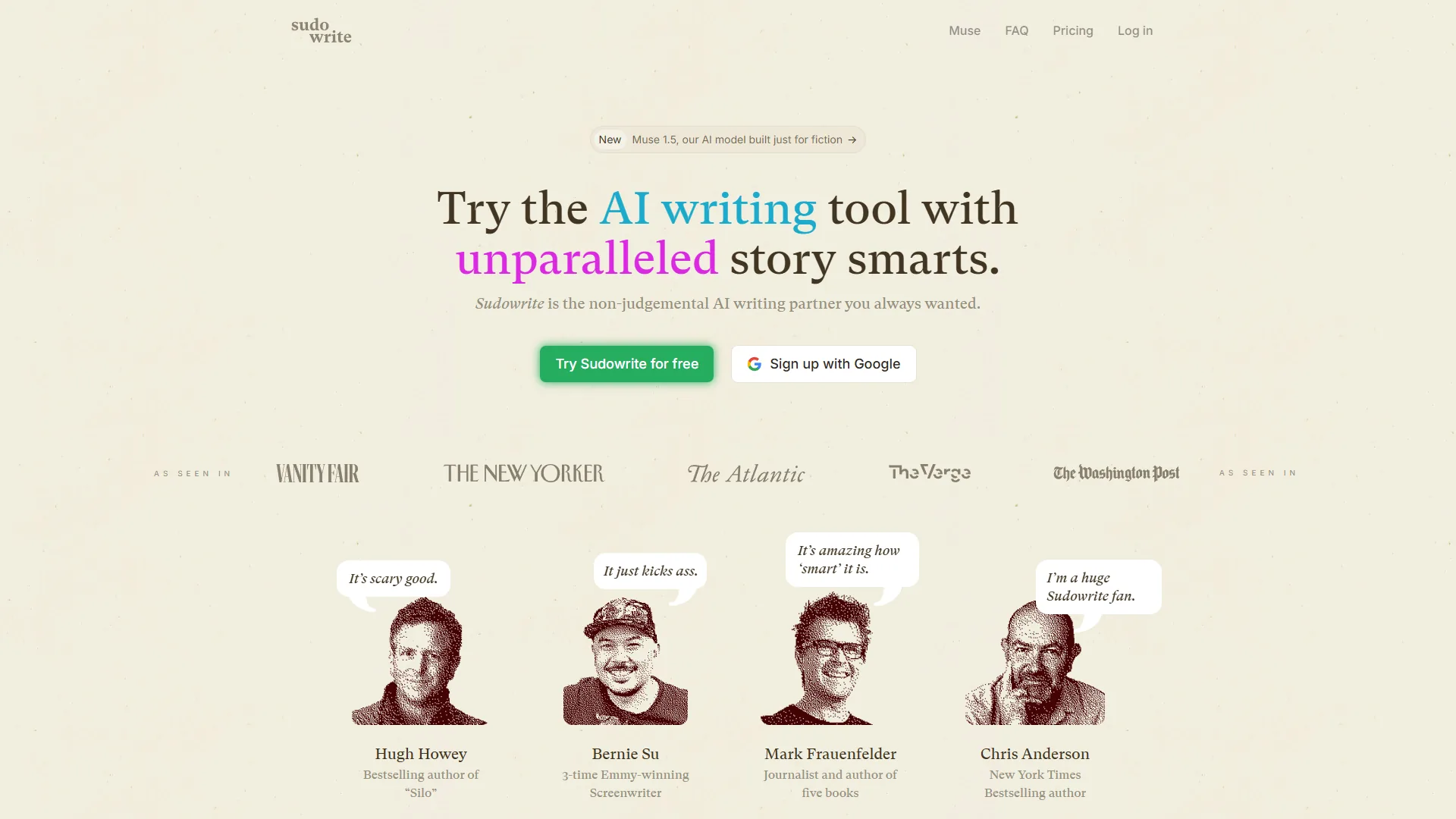
Sudowrite runs on the Muse 1.5 AI model, which was specifically trained on published fiction - which is why it handles romance meet-cutes and thriller chase scenes more naturally than general-purpose models.
Key features that matter for novelists:
My Voice: Train the AI on 10,000 words of your prose so Sudowrite matches your sentence rhythm, vocabulary, and dialogue patterns - the fix for generic “AI voice.”
Story Bible: Context management for novels. Track character details, world-building notes, and plot threads so the AI does not flip your protagonist’s eye color between chapters.
Write/Describe/Expand: “Describe” generates sensory details. “Expand” turns a 200-word scene outline into 1,000 words of prose. “Write” continues from where you stopped, maintaining momentum.
Pricing reality:
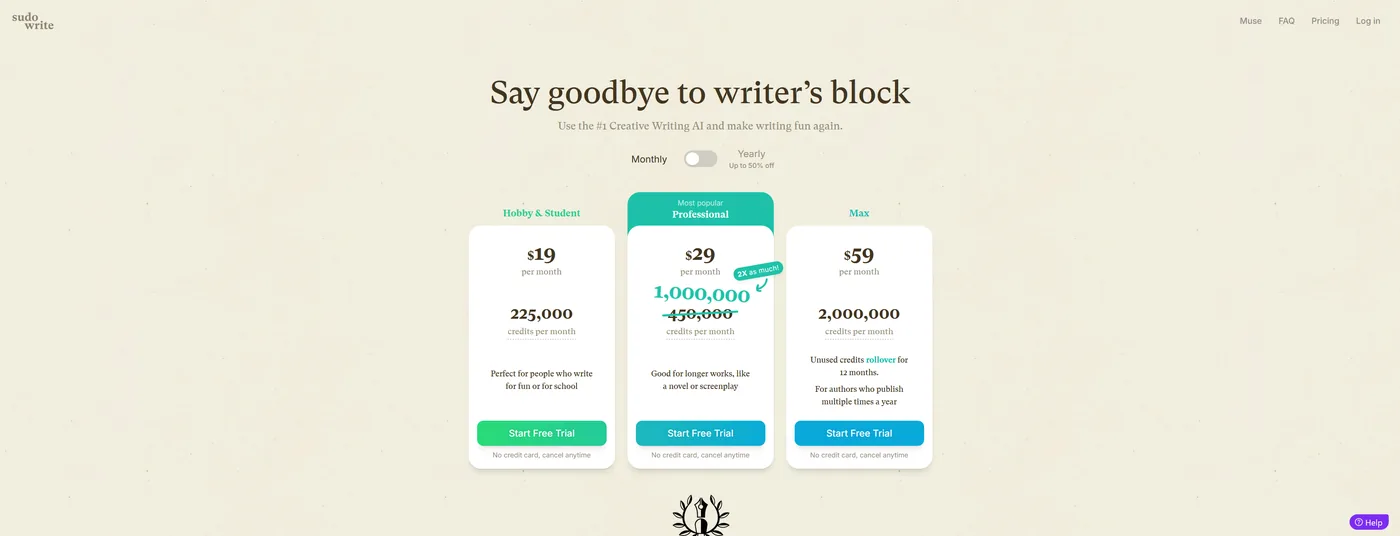
- Hobby tier ($19 per month, 225K credits): Good for 30,000-40,000 words/month
- Professional ($29 per month, 1M credits): Comfortable for 100,000+ words/month
- Max ($59 per month, 2M credits): For authors drafting multiple novels simultaneously
The Free Alternatives
ChatGPT (GPT-4): Best for outlining, plot brainstorming, and “what if” exploration; weak at long-project voice consistency.
Claude: Superior for developmental editing - feed a 5,000-word chapter and Claude flags pacing, motivation, and consistency gaps better than most human beta readers. The free tier handles serious novel work.
Novelcrafter: A novel-management platform with AI features. Where Sudowrite leads on prose, Novelcrafter leads on organization - multi-POV, timelines, and subplot tracking.
NovelAI: Built for genre fiction (fantasy, sci-fi, romance). Image generation for character references is a bonus. Genre writers appreciate its understanding of tropes and conventions.
What Makes Fiction AI Different
General writing AI trains on business prose; fiction AI must handle voice consistency, show-vs-tell sensory detail, genre conventions, and scene-level tension. That is why Sudowrite’s Muse 1.5 model performs differently than ChatGPT’s GPT-4 - they are trained on fundamentally different text corpora.
The 4-Stage AI-Assisted Novel Writing Workflow
The AI-assisted novel writing workflow has four stages - AI-assisted outlining, AI-powered drafting, AI-assisted revision, and AI-powered polish - and following them in order is what gets a novelist to 2,000 words per day without sacrificing quality. Here is how each stage works:
Stage 1: AI-Assisted Outlining (2-3 hours)
Use ChatGPT or Claude for rapid three-act outlining. Prompt with your genre, one-sentence premise, and theme; ask for 8-10 major plot points covering what happens, the character-growth moment, the emotional beat, and how each raises stakes. Outlining drops from 6-8 hours of index-card staring to 2-3 hours of iterative AI conversation.
Stage 2: AI-Powered Drafting (90 minutes/day = 2,000 words)
This is where Sudowrite shines. Here’s the actual workflow:
- Write your scene beats (10 minutes): Bullet points of what happens
- Draft the opening (20 minutes): Write the first 200-300 words yourself to establish tone
- Use AI to expand (30 minutes): Highlight sections that need development, use Sudowrite’s Describe/Expand features
- Human polish pass (30 minutes): Fix AI awkwardness, strengthen character voice, add unique details only you would think of
The 4x speed multiplier: You write 600-800 seed words and direct AI to expand them into 2,000 polished words, spending the second half editing. AI never gets writer’s block on description or dialogue - the two biggest time sinks for most novelists.
Stage 3: AI-Assisted Revision (1 week per 80K words)
AI revision feeds chapters to Claude with targeted prompts:
Plot consistency check: paste the chapter plus story bible; ask Claude to flag inconsistencies in character descriptions, world-building rules, timeline, and earlier plot threads.
Pacing analysis: ask where the scene drags or rushes, and request specific cuts and expansions.
Character voice audit: paste three scenes featuring the protagonist; ask whether dialogue voice stays consistent and where it slips.
This catches ~80% of structural issues in one pass. You then do a human read-through for prose quality and emotional resonance. Revision drops from 4-6 weeks to 1-2 weeks.
Stage 4: AI-Powered Polish (3-4 days)
Final polish fixes prose-level issues: word repetition, awkward sentences, filter words (“she felt,” “he thought”), and rhythm. Sudowrite’s Rewrite feature strips filter words and varies sentence structure on demand. Claude for proofreading catches roughly 90% of typos, grammar errors, and formatting inconsistencies before manuscripts reach human beta readers.
Tool Recommendations by Budget
Budget recommendations split into four tiers: free, entry ($19), professional ($29), and premium ($59+) - matching each novelist’s word-count target and revenue model. The free stack of ChatGPT and Claude covers outlining and revision, while paid Sudowrite tiers unlock prose generation for serious novel writing software workflows. The table below summarizes the tiers:
| Budget tier | Monthly cost | Core tool stack | Speed multiplier |
|---|---|---|---|
| Free | $0 | ChatGPT (free) + Claude (free) + Google Docs | 1.5-2x |
| Entry | $19-29 | Sudowrite Hobby ($19) + Claude (free) | 3-4x |
| Professional | $29-59 | Sudowrite Professional ($29) + Novelcrafter ($15) + Claude (free) | 4-5x |
| Premium | $59+ | Sudowrite Max ($59) + Novelcrafter ($15) + Claude Pro ($20) | 4-5x |
Free Tier ($0 per month)
Best combination: ChatGPT (free) + Claude (free) + Google Docs
- ChatGPT: Outlining, brainstorming, plot problem-solving
- Claude: Developmental editing, consistency checking
- Google Docs: Writing environment
What you’re missing: Prose generation, style training, real-time writing assistance
Speed multiplier: 1.5-2x (mostly from faster outlining and revision)
Entry Tier ($19-29/month)
Best combination: Sudowrite Hobby ($19 per month) + Claude (free)
- Sudowrite: Prose generation, description, character voice
- Claude: Revision and editing feedback
Credits reality check: Sudowrite Hobby’s 225K credits = approximately 30,000-40,000 words of AI assistance per month. If you’re drafting a 80K novel, budget for 2-3 months at this tier.
Speed multiplier: 3-4x (full AI-assisted drafting workflow)
Professional Tier ($29-59/month)
Best combination: Sudowrite Professional ($29 per month) + Novelcrafter ($15 per month) + Claude (free)
- Sudowrite: Unlimited prose generation for most novelists (1M credits)
- Novelcrafter: Organization, timeline management, subplot tracking
- Claude: Editing and feedback
Who needs this: Authors writing 100K+ words/month, multi-POV novels, or managing multiple projects
Speed multiplier: 4-5x (no credit anxiety, better organization)
Premium Tier ($59+/month)
Best combination: Sudowrite Max ($59 per month) + Novelcrafter ($15 per month) + Claude Pro ($20 per month)
Who needs this: Professional authors shipping multiple novels per year, or authors writing epic fantasy/sci-fi with massive word counts
ROI calculation: If you’re writing 200K words/year and each novel earns $2,000 in royalties, you’re investing $1,128/year in tools. If AI helps you write 4x faster, you can produce 4 novels instead of 1 = $8,000 in royalties. The tools pay for themselves immediately.
Genre-Specific AI Techniques
Sudowrite is the top AI writing partner for romance prose, followed by Claude for thriller pacing analysis and Novelcrafter for fantasy world-building. Each fiction category pairs with the tool that suits its conventions best, and the techniques below show what actually works for fiction writers across genre lines.
Romance
Sudowrite excels at emotional interiority and sensory details; Claude polices character-arc emotional beats. Write the dialogue and plot turns yourself, then let AI develop the internal monologue between lines - romance readers expect rich interiority and AI generates it faster than human drafting allows.
Science Fiction
ChatGPT and Claude handle world-building logic checks and technology consistency; Sudowrite handles descriptions of alien environments and future tech; NovelAI suits space opera or military SF tropes. Use AI as a science consultant for FTL plausibility, not as the exposition writer - a craft principle reinforced in the AI content writing workflow guide.
Thriller
Claude analyzes thriller pacing (where thrillers live or die); Sudowrite drafts high-tension action and sensory beats; ChatGPT plots twists and red herrings. Write the reveals yourself, then let AI fill the connective tissue - stakeouts, research montages, travel sequences - that maintain reader tension between plot points.
Fantasy
Novelcrafter plus Sudowrite manage complex magic systems and world geography; Claude audits chapters against your world-building bible. Build the Story Bible with explicit magic rules, reference it in every Sudowrite session, then run Claude consistency passes between drafts.
Common Mistakes to Avoid
Novelists make six recurring mistakes with AI writing tools: skipping voice training, accepting first-draft AI output, using generic prompts, skipping the editing phase, letting AI make creative decisions, and rationing credits out of anxiety. Each one erodes either prose quality or the speed advantage. The underlying error is treating AI as a replacement for the author rather than an assistant. According to Mary Rasenberger, CEO at the Authors Guild, “Generative AI cannot create great literature on its own and still requires a human author’s vision, voice, and craft,” as stated in the guild’s best-practices guidance on the responsible use of AI. The failure patterns below all trace back to ignoring that line.
Mistake #1: Using AI Without Voice Training
Generic AI output flattens your protagonist’s voice into bland prose - a problem explored further in the best AI writing tools 2026 overview. The fix is a 30-minute setup: feed Sudowrite 10,000 words of your best prose through the My Voice feature. Test by generating paragraphs with and without voice training - if you cannot tell which is yours, add more samples.
Mistake #2: Accepting First-Draft AI Output
The workflow is human → AI → human: you establish tone, AI expands, you polish for voice and emotional resonance. Spend 20-30 minutes of human polish per 1,000 AI-generated words (30-50% of total time) - skip this and the manuscript reads technically correct but emotionally flat.
Mistake #3: Using Generic Prompts
Vague prompts produce vague prose. Replace “write a scene where Marcus confronts his ex” with a directive that names the setting, the tone (noir, cynical), the character’s voice signature (short sentences, dry humor), the sensory focus, and the target word count. Specificity is what turns AI output into usable material.
Mistake #4: Skipping the Editing Phase
Drafting at 3,000 words per day without revising grows the manuscript without improving it. AI speed should free time for deeper revision, not eliminate it. The pattern that works: draft Act 1 with AI for two weeks → revise Act 1 with AI assistance for three days → repeat for each act.
Mistake #5: Letting AI Make Creative Decisions
Asking AI “what should happen next?” and following its suggestions blindly is a creative-direction failure. AI executes; the author decides themes, plot, and emotional beats. Use it to generate three options, then pick the one that serves your story.
Mistake #6: Credit Anxiety
Rationing Sudowrite credits and writing worse prose to save them means you are on the wrong tier. Professional ($29 per month, 1M credits) is effectively unlimited for most novelists; Max ($59 per month, 2M credits) covers high-volume authors. Spending $30 more to finish six weeks faster beats saving $30 and finishing six months later - opportunity cost of your time exceeds the tool cost.
Getting Started Today: Your 7-Day Roadmap
The fastest 7-day start is a free trial sequence: Claude and ChatGPT revision on days 1-2, Sudowrite prose generation and voice training on days 3-5, the full 4-stage workflow on day 6, and a tier decision on day 7. The plan answers the “best ai for novel writing free” path before any paid commitment. Here is the day-by-day plan:
Day 1-2: Free Tier Testing
Paste an existing chapter into Claude and ask it to identify pacing issues, character-voice inconsistencies, plot logic gaps, and show-vs-tell opportunities. Then use ChatGPT to brainstorm solutions for whatever Claude flags - feedback comparable to a professional editor at $0.
Day 3-4: Prose Generation Testing (Sudowrite Free Trial)
Use Sudowrite’s free trial to write 200 seed words, run “Expand” to 600 words, use “Describe” on three moments, and polish for 30 minutes. The output benchmark is 600 polished words inside an hour - compare against your normal pace.
Day 5: Voice Training
If Sudowrite output feels useful but generic, export 10,000 of your best words from a completed manuscript and upload to the My Voice feature. Repeat the Day 3-4 test - output should now read noticeably more like your writing.
Day 6: Workflow Integration
Draft a 1,000-word scene using the full 4-stage workflow: 5 minutes outlining beats, 15 minutes writing the opening 200 words, 20 minutes of AI-assisted expansion, 20 minutes of human polish. Track time and output quality against your baseline.
Day 7: Decision Day
Evaluate whether AI saved time without sacrificing quality, which features carried the most value, and your estimated speed multiplier. Then choose a tier:
- Speed improvement under 2x → stick with free tools
- 2-3x → Sudowrite Hobby ($19 per month)
- 3-4x → Sudowrite Professional ($29 per month)
- 100K+ words per month → Sudowrite Max ($59 per month)
The Future of AI-Assisted Fiction Writing
The next 12-18 months of fiction AI depends on five shifts: longer context windows that hold an entire 100K-word manuscript, faster voice cloning from 3,000-5,000 word samples, genre-specific models for writing novels (romance, thriller, fantasy, literary), multi-modal research from mood boards, and real-time AI assistance integrated into Scrivener and Google Docs. Authors who learn AI writing tools now will have a structural advantage when those improvements ship.
Start Writing Faster Today
Novelists write faster with AI by delegating the mechanical work - outlining, description, expansion, and consistency checking - while keeping full control of character arcs, plot decisions, and emotional beats. The 4x speed promise is not hype. It is math:
- AI eliminates blank page paralysis (outline in 2-3 hours instead of 8)
- AI handles description and expansion (2,000 words/day instead of 500)
- AI catches revision issues in one pass (1-2 weeks instead of 4-6)
You don’t need to be a prompt engineering expert. You need to understand your creative process well enough to delegate the mechanical parts - description, expansion, consistency checking - while maintaining control over the creative parts: character arcs, plot decisions, emotional beats, and thematic depth.
Start with the 7-day roadmap above. Test the free tools. If they save you time, invest in Sudowrite. If they don’t, you’ve lost nothing but a week of experimentation.
Your novel isn’t going to write itself. But with the right AI writing tools for novelists and a solid workflow, it’s going to write a hell of a lot faster.
The Bottom Line
The best AI writing tools for novelists are Sudowrite for fiction prose, Claude for editing, ChatGPT for outlining, and Novelcrafter for organization - tools that combine drafting speed with creative control. Start with the free tiers, find your preferred workflow, and let AI handle the mechanical work while you focus on storytelling.
Next steps:
- Sign up for ChatGPT (free) and Claude (free) today
- Paste your current chapter into Claude for feedback
- Try Sudowrite’s free trial this weekend
- Track your writing speed with and without AI
- Make the data-driven decision about which tools earn a place in your workflow
The blank page is optional now. The only question is: how fast do you want to finish your novel?
Related Reads
This article covers three AI writing tools in depth: Sudowrite, Claude, and ChatGPT, plus supporting picks across novel writing software and Scrivener integrations.
- Sudowrite - AI writing assistant designed specifically for fiction authors
- Claude - AI assistant for feedback and story analysis
- ChatGPT - Versatile AI for brainstorming and outlining
More writing and content guides:
- Best AI Writing Tools 2026 - Comprehensive writing tools comparison
- AI Tools for Freelance Writers - Tools for professional writers
- AI Content Writing Workflow - Streamlined content production
- Best AI Tools for Data Analysts in 2026
- Best AI Tools for Teachers 2026: Save Hours on Lesson Planning and Grading
- Apps Like ChatGPT: 7 Alternatives Worth Trying in 2026
External Resources
External resources below offer additional research and reporting on AI writing tools, novel writing AI free options, and content marketing fundamentals: