





Enterprise marketing automation ROI is the measure of revenue growth and business value derived from platforms like HubSpot and Marketo, where annual investments often exceed $100,000. Evaluating ROI requires examining implementation costs, scalability, multi-channel orchestration, AI-powered lead scoring, attribution modeling, and deep CRM integration across complex enterprise buyer journeys.
In 2026, choosing the right marketing automation platform at enterprise scale is about enterprise marketing automation ROI, scalability, and whether your $100,000+ annual investment will actually drive revenue growth. This guide compares HubSpot and Marketo with real ROI data, implementation costs, and decision frameworks for enterprise marketing teams.
AI Productivity may earn a commission from links on this page; our rankings are editorially independent and based on vendor documentation, pricing pages, and independent research.
Methodology: What is Enterprise Marketing Automation?
Enterprise marketing automation is the orchestration of multi-channel campaigns, account-based marketing, AI lead scoring, and CRM integration on platforms like HubSpot and Marketo at $40,000 to $150,000+ annual spend. This guide evaluates each on pricing, features, and real performance to help you pick the right fit for your team and budget.
Enterprise marketing automation goes beyond basic email campaigns. At scale, you need:
- Multi-channel orchestration across email, social, web, SMS, and events
- Account-based marketing (ABM) for targeting high-value accounts
- Advanced lead scoring with AI-powered predictive analytics
- Deep CRM integration with bi-directional data sync
- Attribution modeling to prove marketing ROI across complex buyer journeys
- Compliance management for GDPR, CCPA, and industry regulations
The platforms that dominate this space are HubSpot and Marketo. Both serve enterprises, but their approaches, pricing models, and ROI profiles differ significantly.
HubSpot: The All-in-One Growth Platform
HubSpot is an all-in-one marketing, sales, and service platform with 248,000+ customers, Enterprise pricing at $3,600 per month, and a documented 505% three-year ROI in an IDC study.
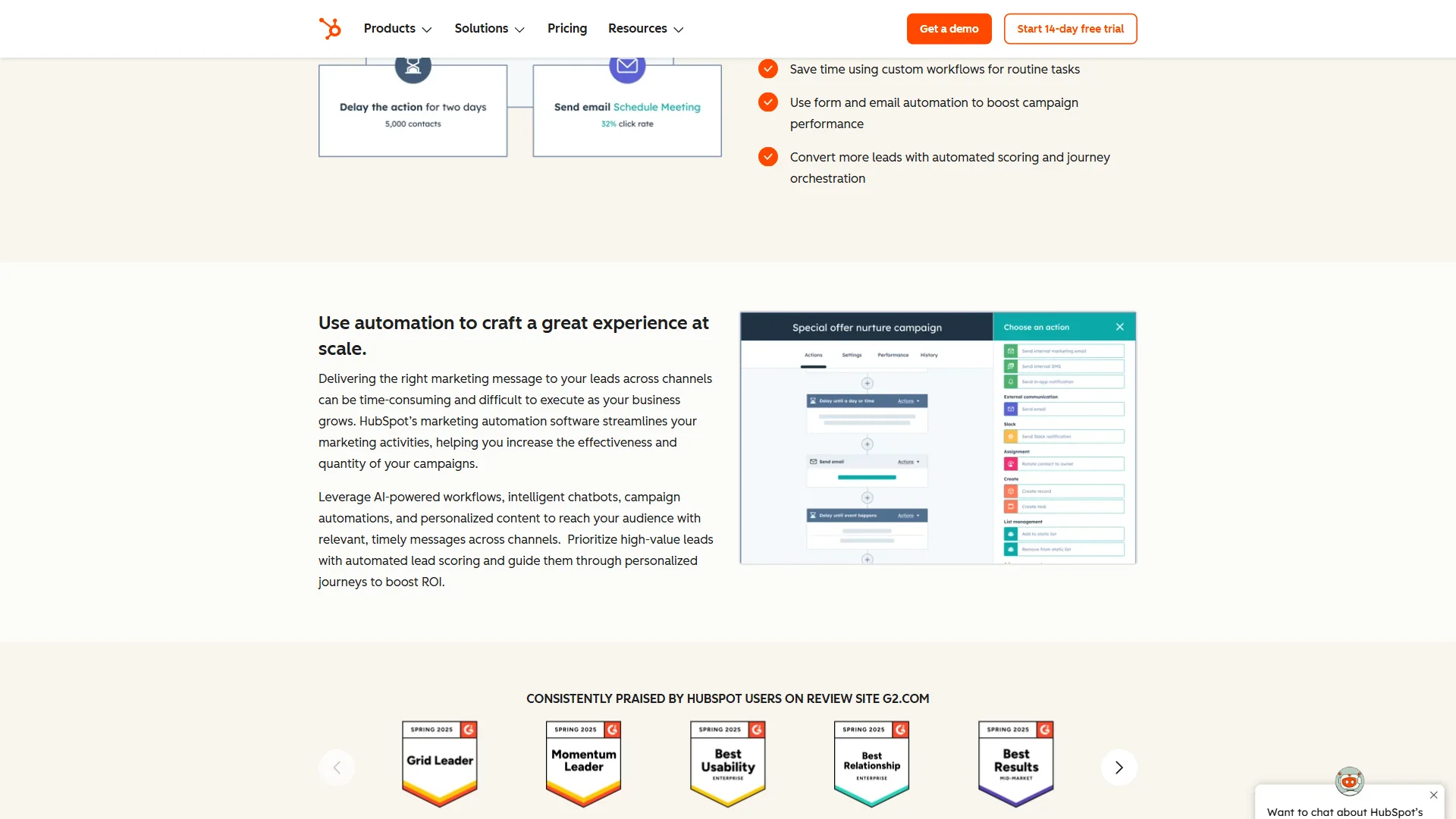
HubSpot has evolved from a mid-market solution to a serious enterprise contender. With 248,000+ customers globally, it’s built a reputation for usability without sacrificing power.
User ratings:
HubSpot’s AI Advantage: Breeze AI Suite
In 2024, HubSpot launched Breeze, its unified AI layer that transforms how enterprises operate:
- Breeze Copilot sits across all Hubs (Marketing, Sales, Service, Content, Operations), providing contextual AI assistance
- Breeze Agents are autonomous AI workers that handle repetitive tasks (social media scheduling, lead prospecting, customer support)
- Breeze Intelligence enriches CRM data automatically, adds buyer intent signals, and scores leads with AI
This integrated approach means your marketing automation isn’t siloed. A lead captured through a Breeze-powered chatbot automatically flows into your CRM, triggers nurture sequences, and notifies sales when intent signals spike.
HubSpot Pricing at Enterprise Scale
HubSpot’s tiered pricing accommodates growth:
- Free tier: Basic CRM and marketing tools (ideal for testing)
- Starter: $15 per month for small teams
- Professional: $890 per month for growing businesses
- Enterprise: $3,600/month for large organizations with advanced needs
Most enterprises operate at the Professional or Enterprise tier. At $3,600/month (approximately $43,200/year), HubSpot is significantly cheaper than Marketo’s typical implementation costs, which often exceed $100,000 annually.
Key cost considerations:
- Contact-based pricing: Higher volumes increase costs
- Additional Hubs: Each Hub (Sales, Service, CMS, Operations) adds to total cost
- Add-ons: Advanced reporting, dedicated IP addresses, and custom SSL certificates cost extra
- Onboarding: Professional Services packages range from $3,000 to $25,000+
HubSpot ROI at Scale
An IDC study found HubSpot delivers 505% ROI over three years for enterprise customers. According to Scott Brinker, VP of platform ecosystem at HubSpot, “Marketing technology has fundamentally reshaped how enterprises plan and measure every revenue-generating campaign.” Here’s how that breaks down:
Revenue Impact:
- 1.57x annual revenue increase on average
- 40% more qualified leads generated
- 35% improvement in lead-to-customer conversion rates
Cost Savings:
- 75% reduction in manual marketing tasks through automation
- 60% faster campaign deployment compared to legacy systems
- Consolidated tool stack savings (email, CRM, analytics, CMS all integrated)
Productivity Gains:
- Marketing teams report 30% more time for strategic work
- Sales reps spend 25% less time on data entry
- Customer service teams resolve tickets 40% faster with unified data
Real-world example: a 500-employee SaaS company moved from Marketo and Salesforce to HubSpot and cut platform costs from $150,000 to $65,000 annually, lifted marketing productivity 45%, improved pipeline velocity 28%, and hit 320% net ROI in year one.
Best Use Cases for HubSpot
HubSpot excels for teams scaling from mid-market to enterprise that value ease of use, want to consolidate vendors into one platform, need shared sales-and-marketing visibility, and run inbound lead generation.
HubSpot Limitations and Who It’s Not For
Skip HubSpot if: You need advanced revenue cycle modeling with deeply customized Salesforce objects, your marketing operations team has 5+ specialists who want raw API access, or you operate in a heavily regulated industry where Marketo’s audit trails and Adobe Sensei integration are required. Contact-based pricing also punishes large databases above 100,000 contacts, and reporting lags Marketo on attribution beyond 7 touchpoints.
Marketo: The Enterprise ABM Powerhouse
Marketo is Adobe’s enterprise marketing automation platform built for account-based marketing at scale, averaging $112,544 in annual platform spend and delivering an average 5.44x ROI across enterprise customers.
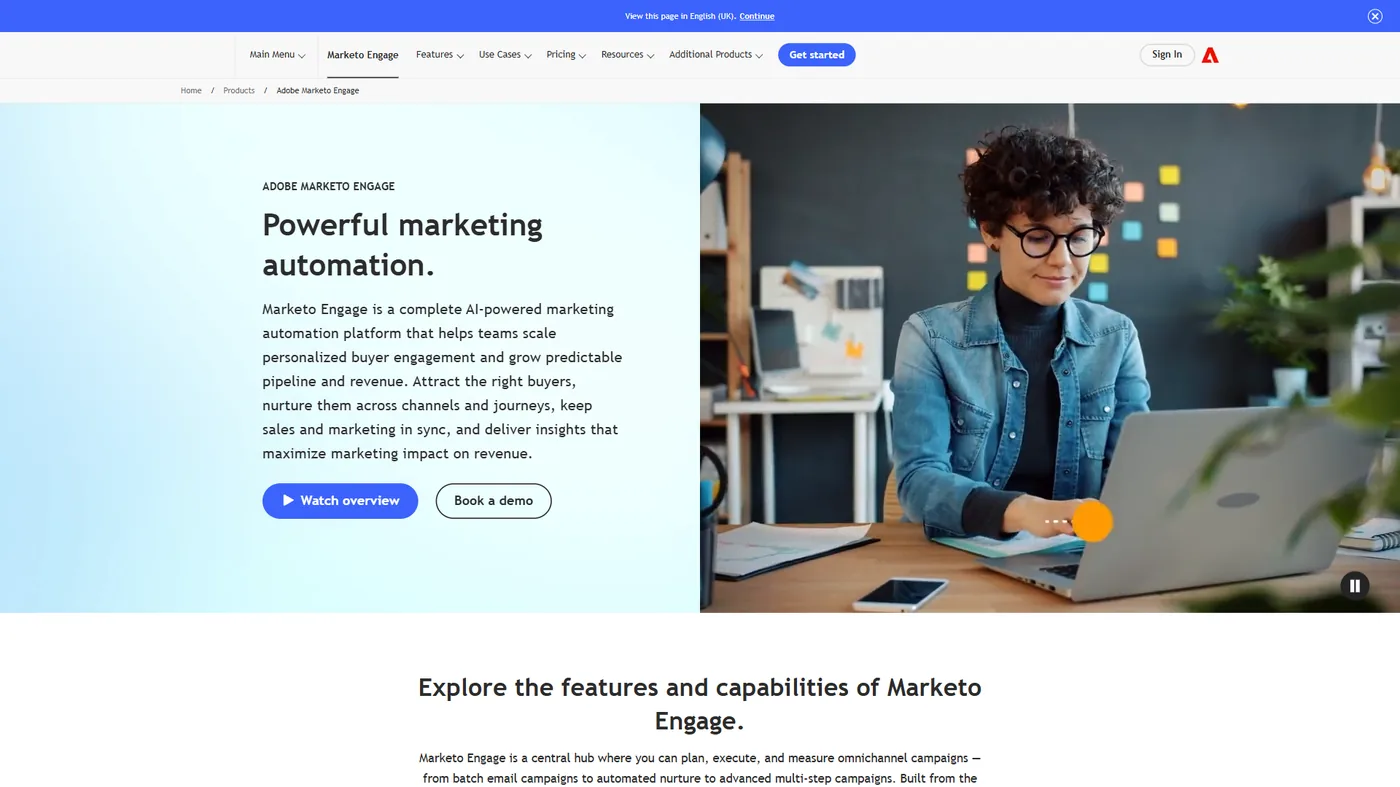
Marketo, now part of Adobe Experience Cloud, is purpose-built for complex B2B marketing at scale. It’s the go-to choice for enterprises with sophisticated buyer journeys, large marketing operations teams, and deep Salesforce investments.
User ratings:
Marketo’s AI Capabilities: Adobe Sensei
Marketo applies Adobe Sensei AI across its platform:
- Predictive Audiences: AI identifies lookalike segments based on your best customers
- Content AI: Suggests optimal content for each buyer journey stage
- Engagement Scoring: Machine learning predicts which leads will convert
- Send Time Optimization: AI determines the best time to reach each contact
- A/B Test Forecasting: Predicts test outcomes to accelerate decision-making
These AI features integrate with Adobe’s broader Experience Cloud, giving marketing teams access to enterprise-grade personalization engines, real-time CDP, and journey orchestration tools.
Marketo Pricing Reality
Marketo doesn’t publish pricing, but industry data reveals typical costs:
- Growth tier: Approximately $40,000 to $60,000 annually
- Select tier: $60,000 to $100,000 annually
- Prime tier: $100,000 to $150,000+ annually
- Ultimate tier: $150,000+ with custom pricing
Average annual spend across all tiers: $112,544
Additional costs to factor in:
- Implementation: $20,000 to $100,000+ depending on complexity
- Salesforce integration: Often requires dedicated admin or consultant ($80,000 to $120,000 annually)
- Training: $5,000 to $15,000 for team enablement
- Partner support: Many enterprises retain agencies for ongoing optimization ($3,000 to $10,000 monthly)
Total first-year cost for a mid-sized enterprise: $150,000 to $250,000.
Marketo ROI at Enterprise Scale
Despite higher costs, Marketo delivers strong returns:
Average ROI: 5.44x across enterprise customers
Cost Efficiency:
- 15% to 20% reduction in marketing program costs through automation
- 10% to 15% faster campaign execution
- 25% reduction in manual lead routing and scoring efforts
Revenue Impact:
- 20% increase in pipeline from improved lead quality
- 30% improvement in sales and marketing alignment
- 18% higher win rates on qualified opportunities
Enterprise-Specific Benefits:
- Multi-touch attribution proves marketing’s revenue contribution (critical for justifying budgets)
- ABM capabilities drive 2x to 3x higher deal sizes for target accounts
- Revenue Cycle Analytics provides executive-level reporting
Real-world example: a Fortune 500 tech company with 5,000 employees implemented Marketo on a $180,000 year-one investment, drove $45 million in marketing-influenced revenue with $8.2 million attributed, and reported 4,455% first-year ROI.
Best Use Cases for Marketo
Marketo shines for large enterprises (1,000+ employees) with complex buyer committees, deep Salesforce investment, ABM-led pipeline, dedicated marketing-ops, and regulated-industry compliance needs.
Marketo Limitations and Who It’s Not For
Skip Marketo if: Your team is fewer than 10 marketers, you have no dedicated marketing ops role, or your sales process is transactional with deal sizes under $10,000. The $112,544 average platform cost plus heavy Salesforce admin support and 3 to 6 months of implementation lag make it a poor fit for fast-moving mid-market teams. Reporting and segmentation remain notoriously complex - time to proficiency runs 8 to 16 weeks versus HubSpot’s 1 to 2 weeks.
Comparison Table: HubSpot vs Marketo
HubSpot costs $890 to $3,600 per month with an easy interface and built-in CRM, while Marketo averages $112,544 per year with deeper Salesforce integration, Adobe Sensei AI, and stronger account-based marketing capabilities.
| Feature | HubSpot | Marketo |
|---|---|---|
| User Rating | ||
| Starting Price | $890/mo (Professional) | approximately $40,000/year (Growth tier) |
| Typical Enterprise Cost | $43,200 to $65,000/year | $112,544/year average |
| Ease of Use | Excellent - intuitive interface | Moderate - requires training |
| CRM Integration | Native HubSpot CRM included | Deep Salesforce integration |
| AI Features | Breeze AI Suite (Copilot, Agents, Intelligence) | Adobe Sensei AI (predictive, content, engagement) |
| ABM Capabilities | Good - growing rapidly | Excellent - industry-leading |
| Lead Scoring | AI-powered with predictive scoring | Advanced ML models with custom algorithms |
| Attribution Modeling | Multi-touch, built-in | Revenue Cycle Analytics, highly sophisticated |
| Email Deliverability | Very good | Excellent with dedicated IPs |
| Reporting | User-friendly dashboards | Powerful but complex |
| Learning Curve | Low - most users productive in days | High - weeks to months for full proficiency |
| Best For | SMBs scaling to enterprise, all-in-one seekers | Large enterprises, Salesforce-centric orgs |
Total Cost: Enterprise Marketing Automation ROI Analysis at Scale
Total three-year cost runs $239,600 for HubSpot Enterprise and $849,632 for Marketo, with expected returns of $1,209,980 (505% IDC ROI) and $4,621,998 (5.44x industry average) respectively.
Total Cost of Ownership (3-Year Projection)
HubSpot Enterprise Implementation:
- Platform cost: $43,200/year × 3 = $129,600
- Implementation and onboarding: $15,000
- Training: $5,000
- Additional Hubs (Sales, Service): $30,000/year × 3 = $90,000
- Ongoing optimization: $0 (managed internally)
- Total 3-year cost: $239,600
Expected return (IDC data): 505% ROI = $1,209,980 in value generated
Marketo Enterprise Implementation:
- Platform cost: $112,544/year × 3 = $337,632
- Implementation: $50,000
- Training: $12,000
- Salesforce integration support: $90,000/year × 3 = $270,000
- Agency support: $5,000/month × 36 = $180,000
- Total 3-year cost: $849,632
Expected return (industry data): 5.44x ROI = $4,621,998 in value generated
Break-Even Analysis
HubSpot typically breaks even within 6 to 9 months for enterprises that:
- Consolidate 3+ marketing tools into HubSpot
- Improve lead conversion rates by 20%+
- Reduce agency dependencies
Marketo typically breaks even within 12 to 18 months for enterprises that:
- Have complex, high-value B2B sales cycles
- Implement robust attribution modeling
- Apply ABM for enterprise accounts
Hidden Costs to Consider
Both platforms carry costs beyond the sticker price: data migration ($10,000 to $50,000), custom integrations ($5,000 to $25,000 each), agency support ($3,000 to $10,000 per month), and 3 to 6 months of ramp-up productivity loss.
Choose HubSpot if Budget and Speed Matter
Choose HubSpot when enterprise platform budget is capped near $43,200 per year, marketing teams need to be productive in 1 to 2 weeks rather than months, and consolidating CRM, marketing, sales, and service into one vendor matters more than maximum customization depth.
Select HubSpot if:
- Budget constraints matter: You need enterprise capabilities without six-figure platform costs
- Speed to value is critical: Your team needs to be productive quickly without heavy training
- You’re consolidating tools: CRM, marketing, sales enablement, and service in one platform
- You prioritize inbound methodology: Content marketing and lead nurturing are core strategies
- You want AI without complexity: Breeze AI works out-of-the-box without extensive setup
- Your sales cycle is relatively short: Less than 6 months from awareness to close
Warning signs HubSpot might not fit: advanced revenue-cycle modeling, a highly customized Salesforce instance, or a 5+ specialist marketing-ops team that needs deeper complexity.
Choose Marketo if You Run a Large Enterprise
Choose Marketo when the organization has 1,000+ employees, runs B2B sales cycles of 6 to 24 months on Salesforce, fields a dedicated marketing operations team, and treats account-based marketing as the primary pipeline strategy.
Select Marketo if:
- You’re a large enterprise: 1,000+ employees with substantial marketing budgets
- Salesforce is your system of record: Deep native integration is non-negotiable
- ABM is strategic: Named account targeting drives your pipeline
- Complex attribution is required: Prove marketing revenue impact across 10+ touchpoints
- You have marketing ops resources: Dedicated team to optimize the platform
- Sales cycles are long and complex: 6 to 24+ months with multiple stakeholders
Warning signs Marketo might be overkill: marketing team under 10 people, no dedicated marketing-ops role, transactional sales with deals under $10,000, or a quick-win mandate without change-management capacity.
Pro Tips: Implementation Best Practices
Successful enterprise rollouts map the buyer journey end-to-end, clean CRM data before migration, define revenue-attribution metrics up front, and stage training in waves so power users go live first.
Before You Buy
- Map your buyer journey end-to-end: Document every touchpoint and handoff
- Audit your data quality: Clean CRM data before migration
- Define success metrics: Revenue attribution, pipeline velocity, lead quality
- Calculate true ROI: Include platform, implementation, headcount, opportunity cost
During Implementation
- Start with core use cases: Avoid trying to implement everything at once
- Integrate with your CRM first: This is the foundation for everything else
- Establish governance: Who owns lead scoring, campaign approval, data hygiene
- Train in waves: Power users first, then broader team rollout
Post-Launch Optimization
- Monitor deliverability: Watch bounce rates, spam complaints, engagement
- Refine lead scoring: Adjust based on actual conversion data
- A/B test continuously: Subject lines, CTAs, landing pages, nurture cadences
- Scale gradually: Add ABM and predictive scoring once basics work
Conclusion
Both HubSpot and Marketo deliver strong enterprise marketing automation ROI at scale, but they serve different organizational profiles.
Choose HubSpot if you value ease of use, all-in-one consolidation, and faster time to value. With 505% ROI over three years and approximately $43,200 annual cost at the Enterprise tier, it’s the cost-effective choice for organizations scaling from mid-market or consolidating fragmented tool stacks.
Choose Marketo if you’re a large enterprise with complex B2B sales cycles, deep Salesforce investment, and dedicated marketing operations resources. Despite higher costs averaging $112,544 annually, its 5.44x average ROI and enterprise-grade ABM capabilities justify the investment when deal sizes and sales cycles demand sophisticated automation.
Consider also evaluating Mailchimp for simpler email marketing needs or Customer.io for product-led growth companies with event-driven messaging requirements. For most mid-market and growing enterprise teams, HubSpot is the safer starting pick thanks to faster time to value and a more accessible interface.
Related Reads
Related reads cover lighter HubSpot and Marketo alternatives, complementary email and CRM tools, and broader marketing-automation roundups for cases where neither enterprise platform is the right fit.
Tools covered in this article:
- HubSpot - CRM and marketing platform
- Marketo - Marketing automation
- Mailchimp - Email marketing platform
- Customer.io - Customer engagement
- Salesforce - CRM and sales platform
More marketing guides:
- Best Email Marketing Tools 2026 - Email platforms compared
- Best CRM Software 2026 - CRM solutions compared
- Best Marketing Automation Tools 2026 - Marketing automation platforms
- How to Automate Email with AI: Save Hours Every Week
FAQ
Q: How much does HubSpot cost at the enterprise level?
HubSpot’s Enterprise tier is priced at $3,600 per month, which comes to approximately $43,200 per year. This is notably lower than Marketo’s typical implementation costs, which often exceed $100,000 annually. Most large organizations operate at either the Professional ($890 per month) or Enterprise tier.
Q: What features do enterprise marketing automation platforms need?
At enterprise scale, marketing automation platforms need multi-channel orchestration across email, social, web, SMS, and events - plus account-based marketing, AI-powered lead scoring, deep CRM integration with bi-directional data sync, attribution modeling for complex buyer journeys, and compliance management for regulations like GDPR and CCPA.
Q: What is HubSpot Breeze AI and how does it help marketers?
Breeze is HubSpot’s unified AI layer launched in 2024. It includes Breeze Copilot for contextual AI assistance across all Hubs, Breeze Agents that handle repetitive tasks like social media scheduling and lead prospecting, and Breeze Intelligence which enriches CRM data and adds buyer intent signals. Together, these tools connect lead capture, nurture sequences, and sales alerts automatically.
Q: What is enterprise marketing automation ROI?
Enterprise marketing automation ROI measures the revenue growth and business value derived from platforms like HubSpot and Marketo, where annual investments often exceed $100,000. Evaluating it requires examining implementation costs, scalability, multi-channel orchestration, AI-powered lead scoring, attribution modeling, and CRM integration across complex enterprise buyer journeys.
External Resources
External resources below come from McKinsey, Gartner, and Adobe primary documentation that supply the benchmarks, ROI figures, and AI-trend context cited throughout this guide.