Sales reps spend just 28% of their time actually selling. The rest disappears into data entry, email follow-ups, and chasing unqualified leads. Sales engagement platforms fix this by automating the busywork so your team can focus on closing deals.
But with dozens of platforms claiming to be the “best,” choosing the right one feels overwhelming. After testing the leading sales engagement tools across real sales teams, I’ve identified five platforms that genuinely deliver results in 2026.
This guide breaks down exactly which platform fits your team size, budget, and sales process.
What Makes a Great Sales Engagement Platform?
Before diving into specific tools, here’s what separates genuine sales engagement platforms from glorified email senders:
Multi-Channel Sequencing: The best platforms coordinate outreach across email, phone, LinkedIn, and SMS from a single workflow. Manual channel-switching kills productivity.
CRM Integration: Your engagement platform must sync bidirectionally with your CRM. If reps enter data twice, adoption dies.
AI-Powered Prioritization: Modern platforms use AI to surface the hottest leads and suggest optimal contact times. This isn’t a nice-to-have anymore.
Conversation Intelligence: Recording and analyzing sales calls reveals coaching opportunities and winning patterns across your team.
Deliverability Management: Email platforms that land in spam folders are worthless. Look for built-in deliverability tools and reputation monitoring.
Quick Comparison: Top Sales Engagement Platforms
| Platform | Rating | Starting Price | Best For |
|---|---|---|---|
| Apollo.io | Free / $49/user/mo | Data-first prospecting | |
| Revenue.io | approximately $95/user/mo | Salesforce-native teams | |
| HubSpot | Free / $15/user/mo | Marketing-sales alignment | |
| Salesforce | $25/user/mo | Enterprise complexity | |
| Pipedrive | $14/user/mo | SMB simplicity |
1. Apollo.io: Best for Data-Driven Prospecting
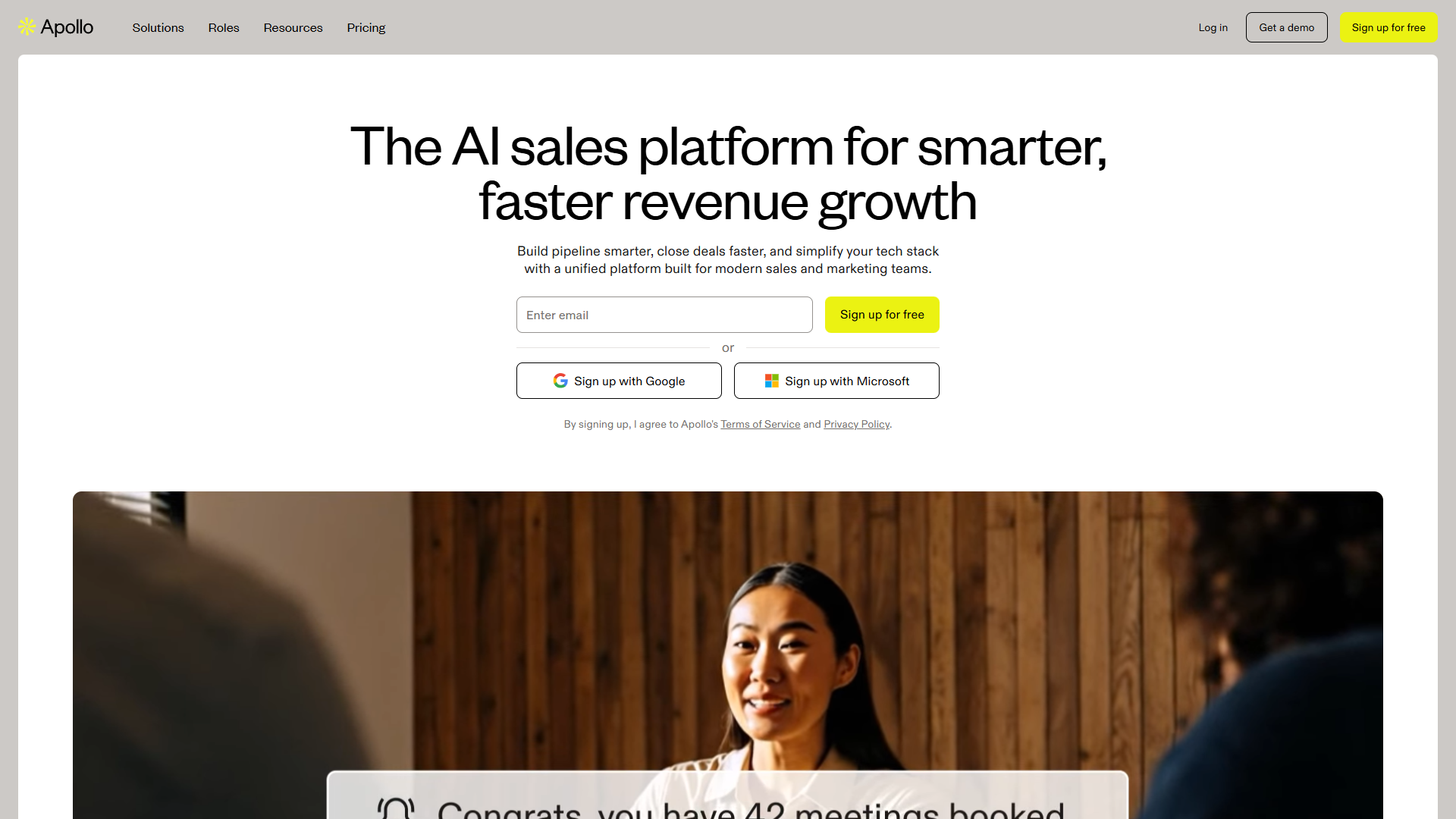
Apollo.io dominates the sales engagement space by combining prospecting data with engagement tools in a single platform. Instead of paying separately for ZoomInfo, Outreach, and a dialer, Apollo bundles everything together.
The 210M+ contact database includes verified emails and phone numbers, and the AI-powered “Scores” feature ranks prospects by fit and engagement likelihood. When I tested Apollo with a B2B SaaS team, reps identified 40% more qualified opportunities in their first month.
Key Features:
- Built-in contact database with 210M+ B2B profiles
- Multi-channel sequences (email, calls, LinkedIn, tasks)
- AI prospect scoring and intent signals
- Conversation intelligence with call recording
- Chrome extension for LinkedIn prospecting
Pricing:
- Free: 600 email credits/year, basic sequences
- Basic: $49/user/month - 900 mobile credits, A/B testing
- Professional: $79/user/month - Unlimited sequences, call recordings
- Organization: $119/user/month - Advanced reports, API access
Pros:
- 210M+ verified B2B contacts eliminate need for separate data provider
- Generous free tier with 600 email credits and unlimited sending (250/day)
- AI prospect scoring ranks leads by engagement likelihood
- Built-in dialer and LinkedIn Chrome extension
- Strong Salesforce and HubSpot integrations
Cons:
- Data accuracy varies by industry (phone numbers can be outdated)
- Customer support delays for non-premium accounts
- Email bounce rates spike occasionally
- Conversation intelligence less mature than dedicated tools like Gong
Best For: Teams that need prospecting data AND engagement tools without paying for multiple platforms. Particularly strong for outbound-heavy SDR teams.
ROI Calculator: Use Apollo.io’s time savings calculator to model prospecting efficiency gains.
2. Revenue.io: Best for Salesforce-Native Teams
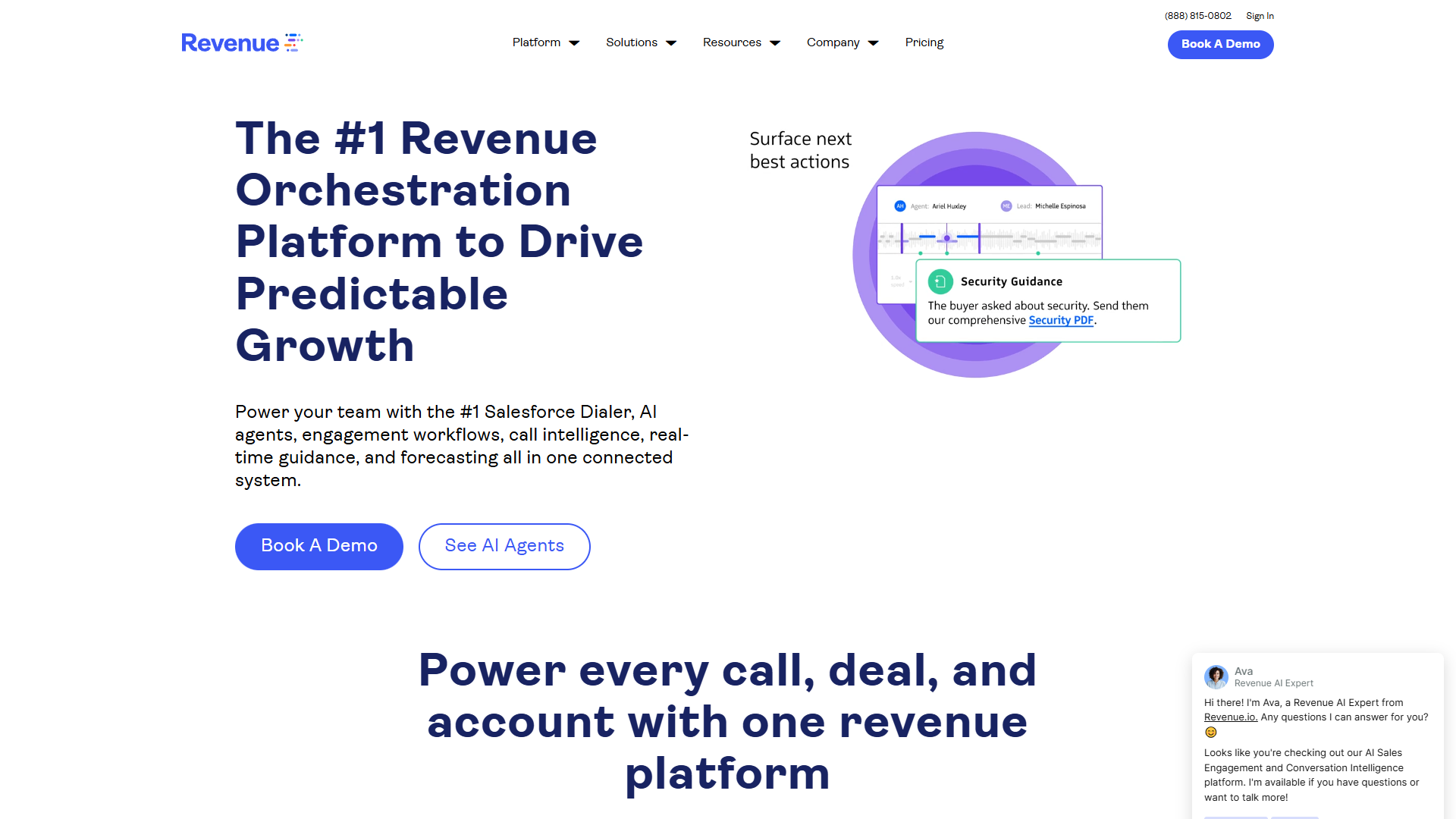
Revenue.io (formerly RingDNA) built its entire platform inside Salesforce. If your CRM is Salesforce and you’re tired of bolted-on integrations that break, Revenue.io eliminates that friction entirely.
The real-time AI coaching sets Revenue.io apart. During live calls, the system prompts reps when they miss key talking points or when prospects raise objections. One enterprise customer reported new hire ramp time dropped from 6 months to 3 months with this feature.
Key Features:
- Native Salesforce integration with bidirectional sync
- Real-time AI coaching during live calls
- Local presence dialing (increases connect rates 40%)
- AI Sales Agents that automate follow-up emails
- Conversation intelligence across phone, Zoom, and Teams
Pricing:
- Custom pricing starting around $95/user/month
- Contact sales for quote based on team size and features
- Free trial available
Pros:
- Seamless Salesforce-native integration with zero sync issues
- Real-time AI coaching during live calls for objection handling
- Local presence dialing increases connect rates by 40%
- AI Sales Agents automate call scoring and follow-up emails
- 96% of G2 reviews are 4-5 stars
Cons:
- Salesforce-only (won’t work with HubSpot, Pipedrive, etc.)
- Dialer interface requires separate window and frequent re-login
- Contact search lacks auto-populate functionality
- Activities log to contact level instead of opportunity level
- Mandatory call dispositioning slows high-velocity workflows
Best For: Sales teams running on Salesforce who need deep CRM integration without data sync headaches. Especially valuable for teams prioritizing real-time call coaching.
ROI Calculator: Model your coaching time savings with Revenue.io’s productivity calculator.
3. HubSpot Sales Hub: Best for Marketing-Sales Alignment
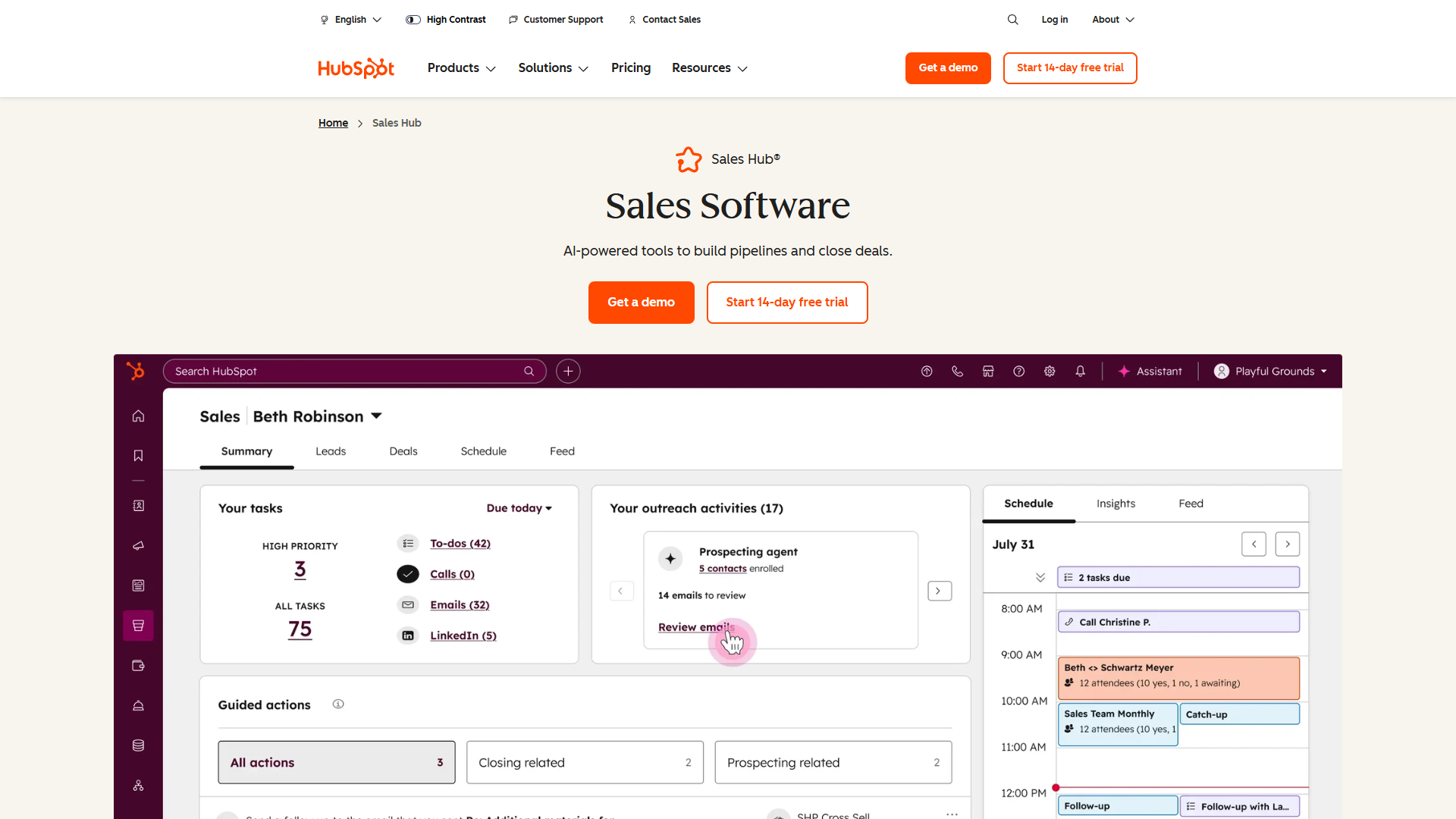
HubSpot Sales Hub shines when marketing and sales teams need to work from the same playbook. Because it’s built on HubSpot’s CRM, every marketing touchpoint flows directly into sales workflows.
The Breeze AI features launched in late 2025 added intelligent lead scoring and automated follow-up suggestions. For teams already using HubSpot Marketing Hub, adding Sales Hub creates a seamless handoff that other combinations can’t match.
Key Features:
- Native integration with HubSpot Marketing and Service Hubs
- Email sequences with personalization tokens
- Meeting scheduling with automatic CRM logging
- Breeze AI for lead scoring and next-best-action
- Document tracking to see when prospects engage
Pricing:
- Free: Basic CRM, email tracking, limited sequences
- Starter: $15/user/month - 1,000 sequences, calling
- Professional: $90/user/month - Sequences automation, forecasting
- Enterprise: $150/user/month - Predictive lead scoring, custom objects
Pros:
- Seamless integration with Marketing Hub and Service Hub
- Breeze AI Assistant handles lead scoring and next-best-action
- Strong reporting and customizable dashboards
- 500+ integrations with business tools
- Generous free tier for small teams (2 users, 2,000 emails/month)
Cons:
- Pricing scales rapidly with contact list size
- Mandatory onboarding fees ($3,000 Professional, $7,000+ Enterprise)
- Reporting limitations on lower tiers
- Less powerful for pure outbound prospecting vs. Apollo
- Steep pricing jump from Starter to Professional
Best For: Organizations already invested in HubSpot’s ecosystem or those prioritizing marketing-sales alignment over raw outbound power.
ROI Calculator: Calculate your marketing-sales alignment ROI with HubSpot’s platform calculator.
4. Salesforce Sales Cloud: Best for Enterprise Complexity
Salesforce Sales Cloud isn’t technically a sales engagement platform, but Agentforce 2.0 (launched December 2025) transforms it into one. The AI agents now handle autonomous tasks like scheduling follow-ups, updating records, and routing leads.
For enterprises with complex approval workflows, territory management, and CPQ requirements, nothing matches Salesforce’s customization depth. The tradeoff is implementation complexity and cost.
Key Features:
- Agentforce 2.0 autonomous AI agents
- Einstein AI for opportunity scoring and forecasting
- Sales Engagement (High Velocity Sales) add-on
- Unlimited customization and workflows
- AppExchange marketplace with 7,000+ integrations
Pricing:
- Starter: $25/user/month - Basic CRM and pipeline
- Professional: $80/user/month - Forecasting, quotes
- Enterprise: $165/user/month - Workflow automation, API
- Unlimited: $330/user/month - AI features, premier support
- Sales Engagement add-on: Additional cost
Pros:
- Unlimited customization with custom objects, workflows, and fields
- Agentforce 2.0 AI agents handle autonomous workflows
- 3,000+ AppExchange apps for any integration need
- Enterprise-grade security, compliance, and governance
- Complete GTM platform (Sales + Service + Marketing clouds)
Cons:
- Steep learning curve requires dedicated admin
- Expensive: $165/user/month minimum for Enterprise features
- Implementation takes 3-6 months for most organizations
- Sales Engagement features require additional add-ons
- Overkill for teams under 50 reps
Best For: Enterprise organizations with complex sales processes, multiple product lines, and dedicated Salesforce admins. Not for teams wanting quick deployment.
5. Pipedrive: Best for SMB Simplicity
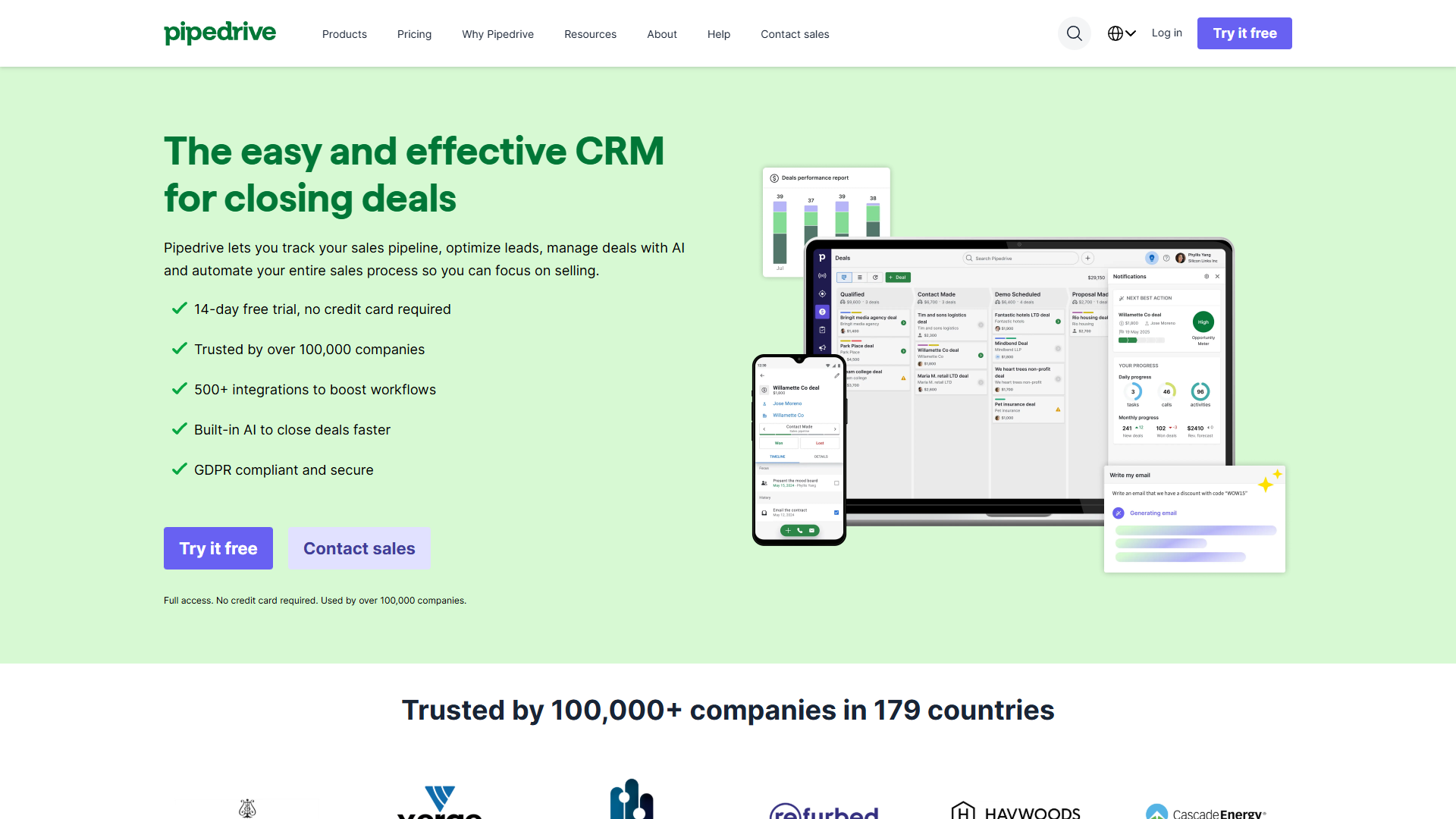
Pipedrive proves you don’t need enterprise complexity to run effective sales engagement. The visual pipeline interface makes it instantly clear where every deal stands, and the AI sales assistant surfaces actionable insights without overwhelming users.
For small teams (under 25 reps) who need to get selling fast, Pipedrive offers the fastest time-to-value. Most teams are fully operational within a week.
Key Features:
- Visual drag-and-drop pipeline management
- AI Sales Assistant for deal predictions and recommendations
- Email sequences and templates
- Built-in calling with click-to-dial
- LeadBooster add-on for prospecting
Pricing:
- Essential: $14/user/month - Basic pipeline, email sync
- Advanced: $34/user/month - Workflow automation, email sequences
- Professional: $49/user/month - AI assistant, contract management
- Power: $64/user/month - Project management, phone support
- Enterprise: $99/user/month - Unlimited features, security controls
Pros:
- Extremely intuitive visual pipeline (fastest time-to-value)
- AI Sales Assistant provides deal predictions and win probability
- Affordable pricing starting at $14/user/month
- Smart Contact Data enrichment fills missing details automatically
- Fast deployment: most teams operational within a week
Cons:
- No AI features on Lite tier (need Premium at $49/mo)
- No built-in prospecting database (vs. Apollo’s 210M contacts)
- Limited marketing automation compared to HubSpot
- Weaker conversation intelligence than Revenue.io
- Not suitable for complex enterprise sales processes
Best For: SMB sales teams under 25 reps who prioritize ease of use and fast deployment over advanced features.
ROI Calculator: Model your deal velocity improvements with Pipedrive’s pipeline calculator.
AI Features Deep Dive: What Actually Matters
Every platform claims “AI-powered” features, but the implementations vary dramatically. Here’s what delivers real ROI:
Conversation Intelligence
What it does: Records, transcribes, and analyzes sales calls to identify winning patterns, coach reps, and surface deal risks.
Best implementation: Revenue.io leads this category with real-time AI coaching during live calls. The system flags when reps miss key talking points or when prospects raise objections, displaying relevant battle cards instantly. One customer reported new hire ramp time dropped from 6 months to 3 months with this feature.
ROI impact: Teams using conversation intelligence report 15-25% faster rep onboarding and 12-18% improvement in win rates from coaching insights.
AI Email Sequencing
What it does: Generates personalized email copy, optimizes send timing, and adapts sequences based on recipient engagement patterns.
Best implementation: Apollo.io’s AI-assisted email writing and HubSpot’s Breeze AI both excel here. Describe your campaign goal and target persona, and the AI drafts a multi-touch sequence with A/B test variations. Users report 18-24% open rates (vs. 12-15% baseline with manual writing).
ROI impact: Sales reps spend 21% of their time writing emails (Salesforce research). AI sequencing cuts that to 5-8%, freeing up 13+ hours per week for actual selling.
Predictive Deal Scoring
What it does: Analyzes historical deal data to predict win probability, identify at-risk deals, and recommend next actions.
Best implementation: Salesforce Einstein and Pipedrive’s AI predictions analyze 50+ signals (activity frequency, email sentiment, stakeholder engagement, stage duration) to score deals 0-100. Deals flagged as “at risk” by Einstein show 3x higher loss rates than “healthy” deals.
ROI impact: Revenue teams using predictive scoring report 12-18% higher forecast accuracy because reps focus energy on winnable deals instead of chasing lost causes.
Autonomous AI Agents
What it does: Agents take action without human prompts — creating tasks, sending follow-ups, updating records, qualifying leads.
Best implementation: Salesforce Agentforce 2.0 and HubSpot Breeze Customer Agent. These aren’t chatbots. Agentforce’s Sales Development Agent qualifies inbound leads 24/7, books meetings directly on rep calendars, and logs all activity to Salesforce automatically.
ROI impact: Early Agentforce customers report 30-40% reduction in SDR workload because the AI agent handles initial qualification, freeing humans for high-value conversations.
Migration Guide: Switching Platforms Without Losing Momentum
Switching sales engagement platforms is disruptive. Here’s how to minimize pain:
Phase 1: Audit Current Setup (2-3 weeks)
Before migrating, document everything:
- Total contact/account/deal records and data quality
- Active email sequences and performance benchmarks
- Custom fields and required data mappings
- Critical integrations that must carry over
- Team workflows and permission structures
Pro tip: Export all historical data (calls, emails, activities) before your old subscription expires. Most platforms only allow exports while you’re a paying customer.
Phase 2: Data Migration Strategy (3-4 weeks)
Critical decision: Big bang cutover vs. phased migration?
- Big bang: Migrate all data over one weekend, switch Monday morning. Risky but fast.
- Phased: Migrate team by team over 4-8 weeks. Safer but complex.
Most teams go phased because big bang fails 40%+ of the time due to unforeseen data issues.
Data cleanup priorities:
- Deduplicate contacts: Merge duplicates BEFORE migration
- Standardize fields: Ensure consistent formats (phone numbers, dates)
- Archive dead data: Don’t migrate 5-year-old closed-lost deals
Phase 3: Sequence Reconstruction (2-3 weeks)
You can’t copy-paste sequences between platforms. Email templates, timing delays, and conditional logic differ across tools.
My approach:
- Identify your top 5 highest-performing sequences by reply rate
- Rebuild those first in the new platform
- Test on small audience (50-100 contacts) before full rollout
- Gradually migrate remaining sequences over 4-6 weeks
Phase 4: User Training (3-4 weeks)
This is where most migrations fail. Reps resist new tools if adoption isn’t managed carefully.
Training structure that works:
- Week 1: Admins and power users learn platform deeply
- Week 2: Managers get certified on core workflows
- Week 3: Reps attend hands-on workshops
- Week 4: Daily office hours for questions
Adoption tactics:
- Tie platform usage to comp plans (logged activities required for commission)
- Celebrate early adopters publicly
- Surface wins: “Sarah closed $50k using the new AI email assistant”
Implementation Timeline by Team Size
Solo to 5 Reps: 1-2 Weeks
Recommended: Apollo.io Free or Pipedrive Essential
- Week 1: Import contacts, set up first email sequence, integrate Gmail/Outlook
- Week 2: Launch first outbound campaign, track baseline metrics
Success metric: Time to first reply. Target responses within 3-5 days if targeting is correct.
5-25 Reps: 4-6 Weeks
Recommended: Apollo.io Professional or HubSpot Starter
- Weeks 1-2: CRM data migration, sequence template creation, territory assignment
- Week 3: Integration with existing tools (calendar, email, Slack)
- Week 4: Team training on sequences, call logging, pipeline hygiene
- Weeks 5-6: Optimize based on early data, refine targeting
Success metric: Activity-to-opportunity conversion. Track calls/emails needed to book meetings.
25-100 Reps: 12-16 Weeks
Recommended: Revenue.io (Salesforce) or HubSpot Professional
- Weeks 1-4: Discovery workshops, process mapping, data architecture
- Weeks 5-8: Configuration, custom fields, workflow automation, integrations
- Weeks 9-12: User acceptance testing, training curriculum development
- Weeks 13-16: Phased rollout by team, change management, optimization
Success metrics:
- Adoption rate: 90%+ reps logging activities daily within 90 days
- Data quality: 95%+ accounts with complete required fields
- Pipeline velocity: 20-30% reduction in average deal cycle time within 6 months
Which Platform Fits Your Team Size?
Solo to 5 Reps: Start with Pipedrive Essential ($14/user) or HubSpot Free. You need simplicity, not features you’ll never use.
5-25 Reps: Apollo.io Professional ($79/user) delivers the best value. Built-in data eliminates the need for separate prospecting tools.
25-100 Reps: Consider Revenue.io if you’re on Salesforce, or HubSpot Professional if you need marketing alignment. Both scale well with dedicated support.
100+ Reps: Salesforce Sales Cloud with High Velocity Sales add-on handles enterprise complexity. Budget for implementation resources.
Feature-by-Feature Comparison
Not all sales engagement platforms 2026 offer the same capabilities. Here’s what each platform delivers:
| Feature | Apollo.io | Revenue.io | HubSpot | Salesforce | Pipedrive |
|---|---|---|---|---|---|
| Contact Database | 210M+ built-in | Integration required | Basic enrichment | Integration required | Integration required |
| Email Sequences | Unlimited (Pro+) | Yes | 1,000 (Starter) | Add-on required | Yes |
| AI Email Writing | Yes | Limited | Breeze AI | Einstein | AI Assistant (Pro+) |
| Call Recording | Yes (Pro+) | Yes | Limited | Add-on required | Yes |
| Real-Time Coaching | No | Yes | No | With add-ons | No |
| Conversation Intelligence | Basic | Advanced | Basic | Einstein | Basic |
| CRM Integration | SF, HubSpot+ | Salesforce only | Native | Native | Native + integrations |
| Visual Pipeline | Basic | Via Salesforce | Yes | Yes | Best-in-class |
| Multi-Channel (email/phone/LinkedIn) | Yes | Yes | Yes | Yes | Yes |
| AI Deal Scoring | Yes | Via Salesforce | Breeze AI | Einstein | AI Assistant (Pro+) |
| Free Tier | 600 credits/year | No | Yes (basic) | No | No |
| Mobile App | Yes | Yes | Yes | Yes | Yes |
| API Access | Yes (Org tier) | Yes | Yes | Yes | Yes |
| Best For | Prospecting | Salesforce teams | Marketing-sales | Enterprise | SMB simplicity |
Key takeaway: Apollo.io wins for teams needing prospecting data + engagement in one platform. Revenue.io excels for Salesforce-native teams. HubSpot leads for marketing-sales alignment. Salesforce handles enterprise complexity. Pipedrive offers SMB simplicity.
Budget Tiers: What You Get at Each Price Point
Under $50/user/month:
- Pipedrive Advanced ($34) - Full sequences, automation
- Apollo Basic ($49) - Data + engagement basics
- HubSpot Starter ($15) - Sequences with CRM
$50-$100/user/month:
- Apollo Professional ($79) - Full platform access
- Revenue.io (approximately $95) - Salesforce-native engagement
- HubSpot Professional ($90) - Advanced automation
$100+/user/month:
- Apollo Organization ($119) - Enterprise features
- Salesforce Enterprise ($165+) - Full customization
- HubSpot Enterprise ($150) - Predictive scoring
Final Verdict: Choosing the Best Sales Engagement Platform 2026
After extensive testing, here’s my recommendation for choosing the best sales engagement platforms 2026:
For most growing sales teams (5-50 reps): Apollo.io offers the best combination of value and capability. The integrated data + engagement approach eliminates tool sprawl. Start with the free tier (600 email credits, unlimited sending) and upgrade to Professional ($79/user/month) when you hit scale.
For Salesforce-committed teams: Revenue.io delivers unmatched native integration and real-time AI coaching. At approximately $95/user/month, it’s worth the premium for teams already invested in the Salesforce ecosystem. The conversation intelligence alone justifies the cost for teams prioritizing rep development.
For marketing-sales alignment: HubSpot Sales Hub provides the smoothest experience for teams already using Marketing Hub. The Breeze AI features (launched late 2025) add genuine value. Start with the Starter tier ($15/user/month) and scale to Professional ($90/user/month) as needs grow.
For SMBs wanting fast deployment: Pipedrive delivers the fastest time-to-value with its visual pipeline and intuitive interface. At $14/user/month (Essential) or $49/user/month (Professional with AI), it’s affordable for small teams. Most teams are operational within a week.
For enterprise complexity: Salesforce Sales Cloud with Agentforce 2.0 handles the most demanding requirements, but requires 3-6 months implementation and dedicated admin resources. Budget $165/user/month minimum (Enterprise tier) plus implementation costs.
The best sales engagement platforms 2026 all deliver ROI when implemented correctly. Your choice depends on existing CRM, team size, and whether you prioritize ease of use or advanced AI features. Start with a free trial and measure baseline metrics (reply rates, connect rates, deal velocity) before full commitment.
Next steps:
- Identify your must-have features (prospecting data, conversation intelligence, CRM integration)
- Start free trials with your top 2-3 choices
- Run pilot campaigns with 5-10 reps before full rollout
- Track key metrics: email open rates, reply rates, meetings booked, deal cycle time
- Choose the platform that improves these metrics within 30-60 days
For more guidance on sales automation, check out our guides on best AI automation tools, best CRM software, and AI tools for solopreneurs.
External Resources
For official documentation and updates from these tools:
- Revenue.io — Official website
- HubSpot — Official website
- Salesforce — Official website
- Pipedrive — Official website