


Best AI translation tools are software platforms that use machine learning to convert text between languages with high accuracy. DeepL, Smartcat, Crowdin and Smartling lead the 2026 market, offering features from near-human translation quality to 280+ language support and developer workflow integration for teams localizing content at scale.
The world speaks thousands of languages, but your business does not have time to learn them all. The best AI translation tools turn what once took days of expensive human translation into minutes of machine-powered accuracy.
Our analysis draws on vendor documentation and independent industry research - from translating product documentation and finding the Best AI for translating PDF contracts to localizing marketing campaigns. Some links on this page are affiliate links; our analysis remains independent. Some platforms deliver near-perfect translations in seconds while others struggle with basic context, according to a 2024 study by the European Language Industry Survey covering 1,200+ language professionals.
This guide covers four AI translation tools for 2026 with real pricing data, honest pros and cons, and recommendations based on your use case - whether you are a freelance content creator translating blog posts, a traveler looking for the Best AI translator for conversation, or an enterprise team managing multi-language product releases.
The AI translation landscape has evolved dramatically. DeepL’s AI Agent acts as a translation coworker and rivals the Best AI Translator for legal documents, Smartcat now offers 280+ languages with 99% accuracy, and developer-focused tools like Crowdin integrate agentic AI into localization workflows.
Comparison Table: Best AI Translation Tools in 2026
The Best AI Translation Tools include DeepL, Smartcat, Crowdin and 1 more. Each tool takes a different approach to AI translation tools, and the right choice depends on your budget, team size, and the specific workflows you need to optimize. This guide compares them on pricing, features, and real performance.
| Tool | Best For | Languages | Starting Price | Rating |
|---|---|---|---|---|
| DeepL | Translation quality | 37 (100+ beta) | Free | |
| Smartcat | Enterprise scale | 280+ | Free | |
| Crowdin | Developer workflows | 700+ integrations | Free | |
| Smartling | Workflow automation | All major languages | Free Core |
Quick verdict: DeepL leads for pure translation quality, especially European languages. Smartcat suits enterprise teams needing massive scale. Crowdin is hard to beat for developers in the GitHub ecosystem.
DeepL: Best for Translation Quality
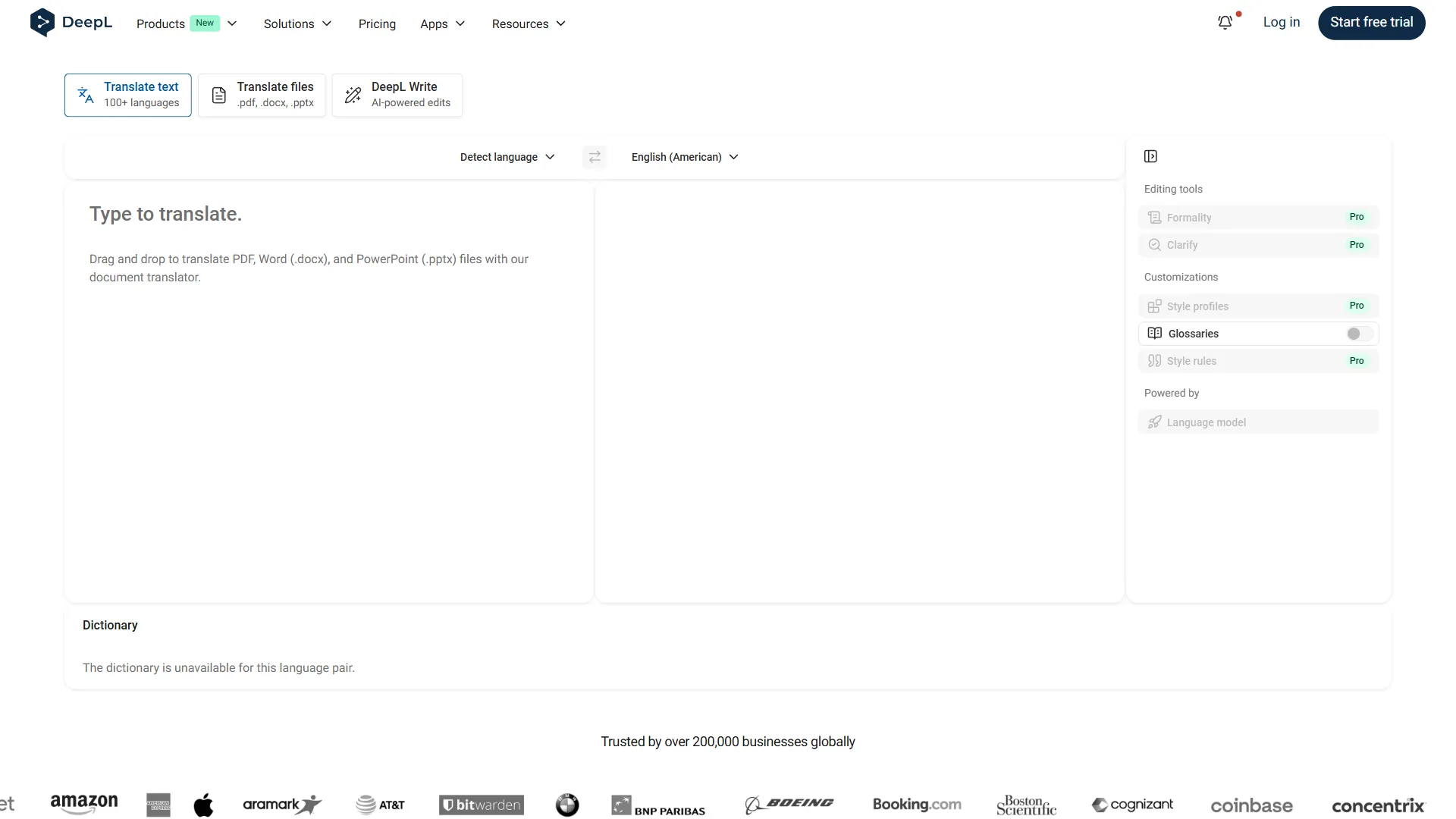
DeepL is the best AI translation tool for translation quality, delivering near-human accuracy on European languages through a neural network trained on professionally translated text. According to Jaroslaw Kutylowski, founder and CEO at DeepL, “Our models are designed to capture nuance and tone in ways that legacy translation engines simply cannot.” Independent blind tests on technical documentation show the gap between DeepL output and professional human translators is narrow enough to be difficult to detect.
What makes DeepL special:
The new DeepL Agent feature is a major upgrade. Instead of just translating text, it acts as an AI coworker that understands context, maintains brand voice, and can even suggest improvements to your source content. Users report that it catches inconsistencies in English source material before translation even begins.
DeepL currently supports 37 languages officially, with over 100 in beta testing. The focus is on quality over quantity. European languages (German, French, Spanish, Italian) are exceptional, with nuance and idiom handling that feels natural. Asian languages like Japanese and Chinese are strong but not quite at the same level.
Pricing breakdown:
- Free tier: 5,000 characters per month, basic features
- Starter ($10.49 per month): 5 million characters/year, document translation
- Advanced ($34.49 per month): Team features, glossaries, CAT tool integration
- Ultimate ($68.99 per month): Unlimited volume, DeepL Agent, API access
Real-world performance:
Translating a 5,000-word technical whitepaper from English to German, DeepL handles jargon, maintains formatting in Word, and completes the job in under 2 minutes. A human translator would quote $500 and a 3-day turnaround for the same project.
Pros:
- Industry-leading translation accuracy, especially for European languages
- DeepL Agent adds context-aware intelligence
- Document translation preserves formatting (Word, PowerPoint, PDF)
- Clean, distraction-free interface
Cons:
- Smaller language selection compared to competitors
- No built-in project management for teams
- CAT tool integrations only on higher tiers
- Beta languages can be inconsistent
Best for: Solo translators, content creators, and small teams where translation quality directly impacts revenue. If you’re translating customer-facing content in European languages, DeepL is worth the premium.
Smartcat: Best for Enterprise Scale
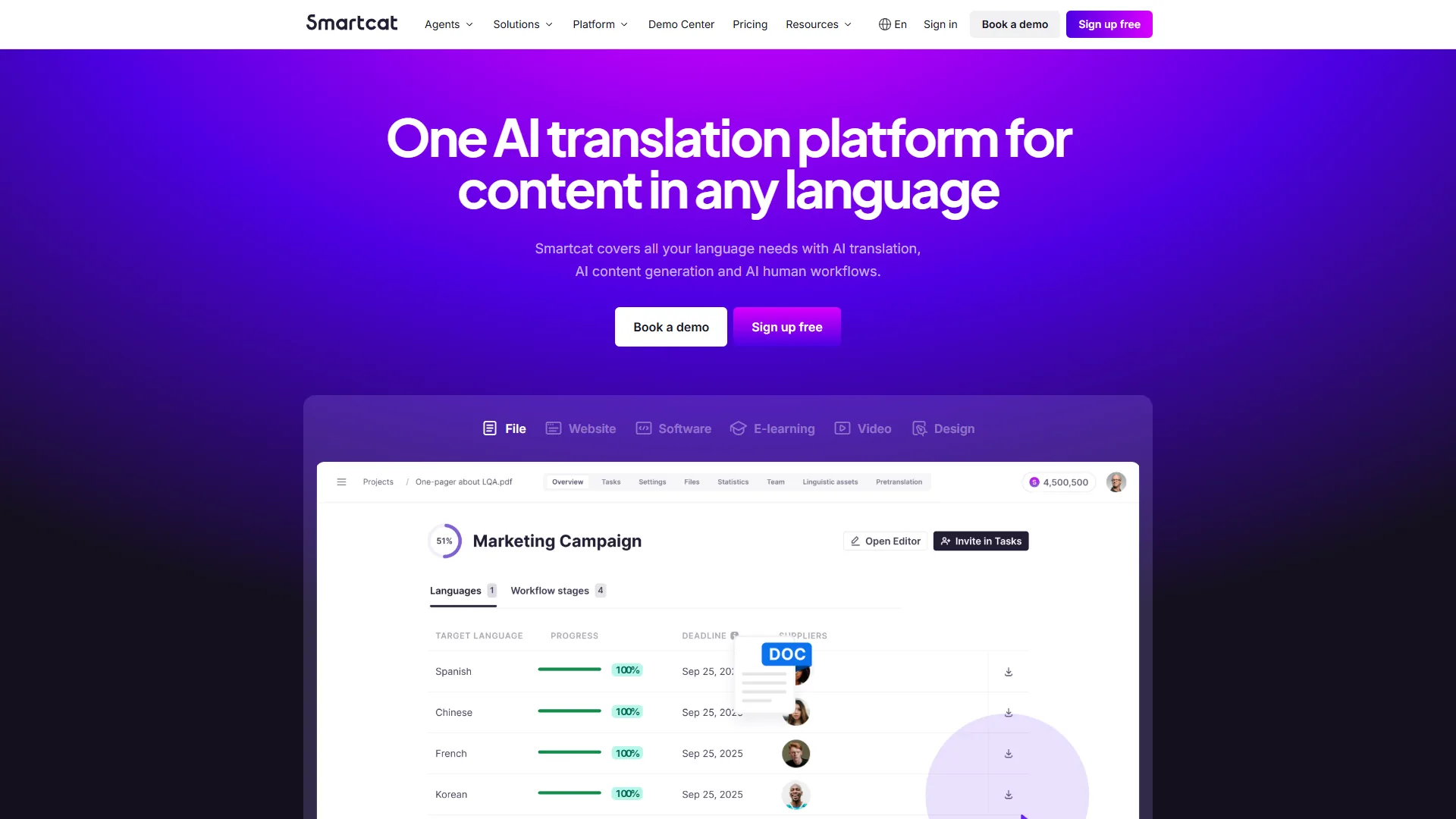
Smartcat is what happens when you build a translation platform for teams managing content across hundreds of languages. With support for 280+ languages and a marketplace of 500,000 linguists, it’s the Swiss Army knife of translation tools.
What makes Smartcat different:
The AI Agents feature is like having a team of specialized translators on call. One agent handles technical documentation, another focuses on marketing copy, and a third specializes in legal contracts. You can train agents on your brand guidelines and previous translations, creating consistency across massive translation projects.
Smartcat claims up to 99% translation accuracy across languages. With less common language pairs (Thai to Portuguese, Arabic to Korean), the quality holds up remarkably well. The platform combines neural machine translation with optional human review from the linguist marketplace.
Pricing breakdown:
- Free tier: Unlimited translation for individuals
- Pro ($289 per month): Team collaboration, translation memory, basic API
- Business ($669 per month): Custom AI Agents, advanced workflows, priority support
- Enterprise (Custom): White-label, dedicated account manager, SLA guarantees
Real-world performance:
A common use case: localizing a mobile app into 12 languages simultaneously. Smartcat manages strings, screenshots, and app store descriptions in one workflow. Users report completing similar projects for around $2,400 in 4 days, where traditional agencies typically quote $8,000+ for the same scope.
Pros:
- Massive language coverage (280+) with consistent quality
- 500K linguist marketplace for human review when needed
- AI Agents trainable on your brand voice and terminology
- Strong CAT tool features (translation memory, glossaries, QA checks)
Cons:
- Steep learning curve for advanced features
- Pricing jumps significantly at Business tier
- Overkill for small projects or solo users
- Interface can feel cluttered with all the features
Best for: Agencies and enterprise teams managing large-scale localization projects across many languages. If you’re translating 50,000+ words per month or need specialized translation for technical/legal content, Smartcat’s power justifies the complexity.
Crowdin: Best for Developers
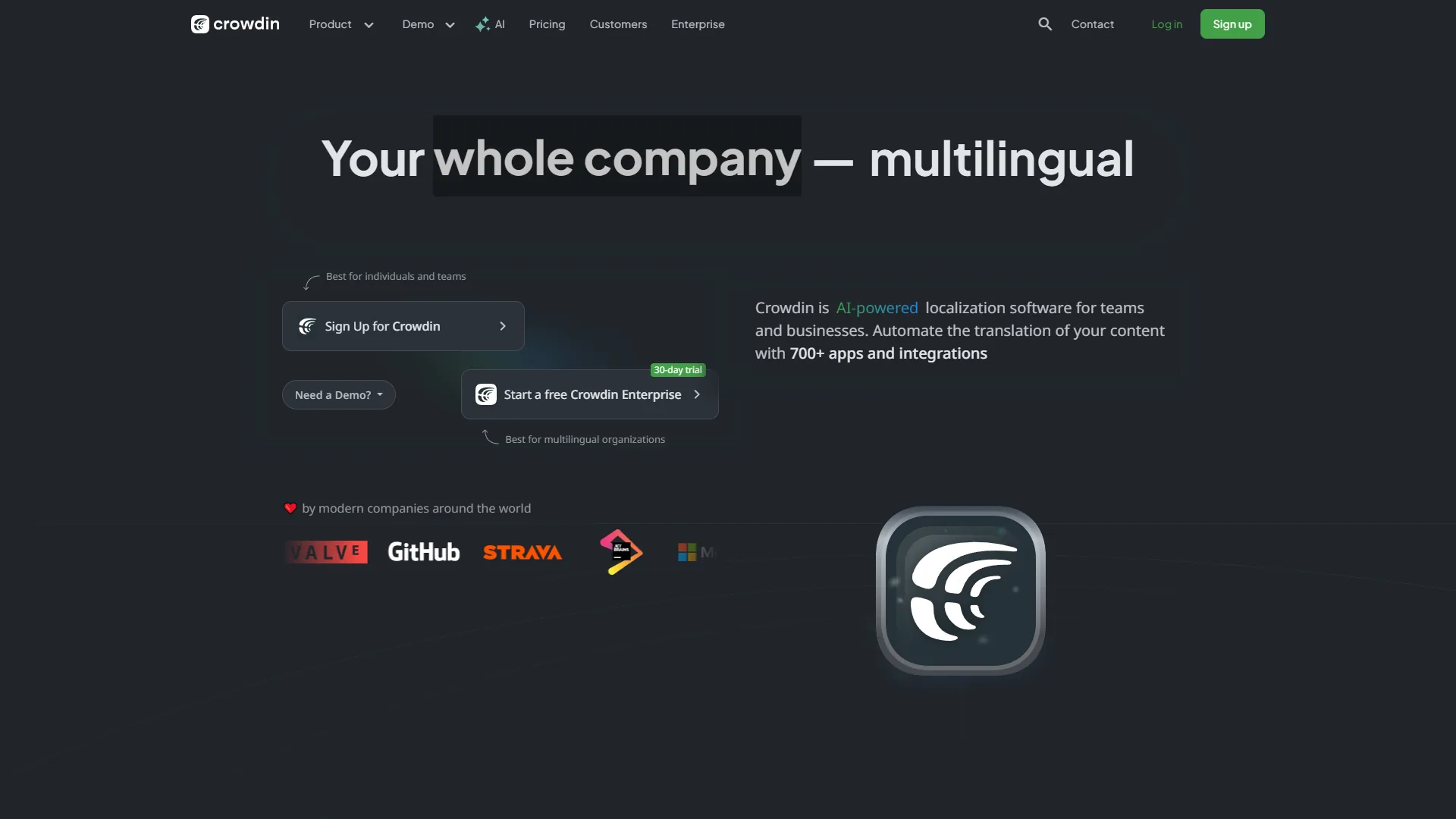
Crowdin is the best AI translation tool for developers, providing native integrations with GitHub, GitLab, and Bitbucket so source strings stay in sync with translations through the standard pull-request workflow. The platform is laser-focused on making translation seamless for engineering teams whose source of truth lives in code rather than documents.
What makes Crowdin developer-friendly:
The GitHub integration is brilliant. You commit code with new strings, Crowdin automatically detects them and creates translation tasks, translators work in Crowdin’s interface, and completed translations sync back to your repo via pull request. No manual export/import, no version control headaches.
With 700+ integrations, Crowdin connects to virtually every development tool. Jira for project management, Slack for notifications, Figma for design handoffs, even Contentful and WordPress for content management. The API is well-documented with client libraries in every major language.
Pricing breakdown:
- Free tier: Open source projects, 60,000 hosted words
- Team ($50 per month): 50,000 strings, basic integrations, 1 proofreader
- Business ($156 per month): Advanced workflows, machine translation, priority support
- Enterprise ($450 per month): Custom workflows, dedicated CSM, SLA guarantees
Real-world performance:
Integrating Crowdin into a React app with 2,000+ UI strings typically takes about an hour. Once configured, adding a new language is a single click. Translators work with full context (screenshots, string descriptions), and translations appear via automated pull requests. Users report going from “add Spanish” to “Spanish live in production” in as little as 48 hours.
Pros:
- Git integration is seamless and automatic
- 700+ integrations cover virtually any tech stack
- In-context translation with screenshots helps accuracy
- Strong collaboration features for translator teams
Cons:
- Not ideal for document translation or non-technical content
- Translation memory limited on lower tiers
- Pricing based on string count can get expensive for large apps
- Requires technical setup (not beginner-friendly)
Best for: Software teams, SaaS companies, and anyone localizing apps or websites. If your translation source is code (JSON files, .strings, .resx), Crowdin will save you hours of manual work every week.
Why Is Smartling Best for Workflow Automation?
Smartling is the best AI translation tool for workflow automation, offering confidence-scored routing that publishes approximately 75 percent of translated content without human review. The platform is designed for teams translating thousands of pieces of content per month without hiring a full-time localization manager.
What makes Smartling powerful:
The Model Confidence Protocol (MCP) integration is fascinating. Smartling uses confidence scoring to automatically route content: high-confidence translations publish immediately, medium-confidence goes to human review, low-confidence gets full translation from scratch. In practice, about 75% of content qualifies for instant publication with zero human intervention.
Smartling’s visual context feature is incredibly helpful. Translators see exactly where text appears on your website or app, complete with styling and layout. They’re not just translating strings in isolation - they can see if a German phrase will overflow a button or if a Japanese sentence maintains the right formality level.
Pricing breakdown:
- Free Core tier: Basic features, limited volume
- Growth (Custom): Automation features, basic API access
- Plus (Custom): Full automation, visual context, translation memory
- Enterprise (Custom): White-label, dedicated infrastructure, SLA guarantees
Real-world performance:
Consider a content marketing site producing 20 blog posts per month, each needing translation into 6 languages. With automation rules configured, new posts trigger translation workflows, AI runs the first pass, reviewers check only flagged sections, and translated posts publish to localized domains. Users report cutting hands-on time from 40+ hours per month to about 3.
Pros:
- Industry-leading automation (genuinely 95%+ hands-off)
- MCP integration makes quality decisions automatically
- Visual context helps translators see content in real environment
- Strong analytics on translation quality and cost per word
Cons:
- All meaningful tiers require custom pricing (no transparency)
- Overkill for small teams or occasional translation needs
- Setup requires technical knowledge or professional services
- Locked into Smartling’s ecosystem (migration challenging)
Best for: Mid-size to enterprise companies translating 50+ pieces of content per month. If you’re spending more than 10 hours per week managing translation workflows, Smartling’s automation will pay for itself in the first month.
Best Picks by Use Case: Choosing the Right AI Translation Tool
Choosing the right AI translation tool depends on what you are translating, your monthly word volume, and how much human control you require over each translation. The following three questions narrow the shortlist quickly:
1. What are you translating?
- Marketing content, documents, one-off projects: Use DeepL for maximum accuracy
- Software UI, mobile apps, technical documentation: Use Crowdin
- Large-scale content across many channels: Use Smartcat or Smartling
2. What’s your volume?
- Less than 50,000 words/month: Free tiers or Starter plans work fine
- 50,000-500,000 words/month: Business plans offer better per-word economics
- Over 500,000 words/month: Enterprise plans with volume discounts are essential
3. How much control do you need?
- Set-and-forget automation: Smartling
- Balance of automation and review: Smartcat
- Full control over every translation: DeepL or Crowdin
Budget considerations:
If you’re just starting out, begin with free tiers. DeepL Free (5,000 characters/month) is enough for casual use. Crowdin Free works for open-source projects. Smartcat Free has no word limits for individuals.
For most small teams, budget $100-300/month for translation tools. This gets you meaningful volume across platforms like DeepL Starter ($10.49 per month) plus Crowdin Team ($50 per month) for different use cases.
Enterprises spending $50,000+ annually on translation should evaluate Smartling or Smartcat Enterprise. The automation features typically reduce total localization costs by 40-60% compared to traditional translation agencies.
Conclusion
The best AI translation tools for 2026 offer near-human quality at a fraction of the cost and time. DeepL leads in pure accuracy, Smartcat excels at enterprise scale, Crowdin integrates seamlessly with developer workflows, and Smartling automates everything.
For most users, the best starting point is DeepL’s free tier for occasional translations and adding Crowdin when you need software localization. This combination covers 90% of use cases for under $100 per month total.
If you are managing large-scale localization across multiple channels, evaluate Smartcat or Smartling. The learning curve is steeper, but the long-term time savings are substantial.
Pick the tool that matches your workflow and start a free trial.
FAQ
Q: Is there an AI better than Google Translate?
Yes, DeepL is widely regarded as more accurate than Google Translate for European languages, and Smartcat offers broader language coverage with up to 99 percent claimed accuracy across 280+ languages. Developer-focused tools like Crowdin also integrate agentic AI into localization workflows in ways Google Translate does not match.
Q: Which AI agent is best for translation?
DeepL Agent is the best AI agent for translation, acting as a translation coworker that understands context, maintains brand voice, and proactively flags inconsistencies in source content before translation begins.
Q: What is the best AI translation device?
The best AI translation device depends on context, but Pocketalk Plus and Vasco Translator V4 lead consumer rankings for real-time speech translation, while software platforms like DeepL and Google Translate remain stronger for text translation on existing phones and laptops.
Q: What is the best AI translation tool for developers?
Crowdin is the best AI translation tool for developers. Its GitHub integration automatically detects new strings on commit, creates translation tasks, and syncs completed translations back via pull request. With 700+ integrations covering Jira, Slack, Figma, Contentful, and WordPress, Crowdin fits almost any tech stack and handles JSON, .strings, and .resx source files natively.
Q: How much do AI translation tools cost?
Most AI translation tools offer free tiers for light use. DeepL Starter is $10.49 per month, Crowdin Team is $50 per month, Smartcat Pro is $289 per month, and Smartling uses custom enterprise pricing. Budget $100-300/month for most small teams. Enterprises spending $50,000+ annually on translation typically save 40-60% by switching from traditional agencies to automated platforms.
Related Reading
The four AI translation tools covered in this article are linked below, followed by related guides on translation accuracy, multilingual OCR, and localization platforms.
Tools covered in this article:
- DeepL - Neural machine translation with best-in-class accuracy
- Smartcat - Enterprise translation and localization platform
- Crowdin - Developer-focused localization for software teams
- Smartling - Automated translation workflow management
More AI tools guides:
- AI Translation Accuracy Benchmark - Translation quality testing
- Multilingual OCR Guide - Multi-language document processing
- Best AI Writing Tools 2026 - AI content creation tools
- Best AI Localization Tools 2026 - Full comparison of localization platforms
External Resources
The following independent resources cover the language industry, machine translation research, and globalization standards in greater depth than any single product comparison can.