This guide covers project management software small teams with hands-on analysis.
In 2026, managing a small team shouldn’t feel like managing chaos. Yet here we are — spreadsheets scattered across Google Drive, Slack threads where critical decisions disappear into the void, and that one person who still emails task updates because “it’s easier for me.”
The irony? Small teams under 20 people face the same coordination challenges as larger organizations, but with fewer resources and tighter budgets. You need project management software that actually fits your scale — not enterprise platforms that charge per seat for features you’ll never touch, and not basic to-do apps that crumble the moment you have dependencies to track.
After testing project management software for small teams across budget-conscious startups, remote agencies, and growing SaaS companies, I’ve identified three platforms that genuinely work for teams under 20: Zoho Projects (best value), ClickUp (most customizable), and Asana (strongest for timeline-heavy work).
This guide breaks down pricing, real-world ROI data, AI capabilities, and the specific features that matter when you’re small but scaling. No marketing fluff — just what works when every team member counts.
TL;DR - Quick Comparison
| Tool | Starting Price | Free Tier | Best For | Key Advantage |
|---|---|---|---|---|
| Zoho Projects | $5/user/month | Yes (3 users, 2 projects) | Budget-conscious teams | Most affordable premium tier |
| ClickUp | $7/user/month | Yes (100MB storage) | Customizable workflows | All-in-one platform (50% cost reduction) |
| Asana | $10.99/user/month | Yes (10 users) | Timeline management | Best free tier (10 users unlimited projects) |
Quick Verdict:
- Tightest budget? Zoho Projects at $5/user/month saves $2,000/year vs. alternatives
- Consolidating tools? ClickUp replaces 3-5 apps with 3.84x ROI multiplier
- Timeline-driven projects? Asana delivers 437% 3-year ROI (Forrester)
How We Evaluated Project Management Software for Small Teams
I tested each platform through the lens of small team constraints: limited budgets, lean operational capacity, and the need for fast adoption without dedicated training time.
Evaluation Criteria:
- Pricing Transparency: Real monthly costs for 10-15 users, not misleading “per user” rates that explode at scale
- Free Tier Viability: Can you actually run a small team on the free plan, or is it a demo?
- Setup Speed: Time from signup to first productive sprint (target: under 1 week)
- AI Features: Whether AI-powered automation actually saves time vs. marketing theater
- ROI Data: Hard numbers on cost savings and productivity gains (sourced from Forrester, G2, vendor case studies)
All pricing verified as of December 2025. G2 ratings based on 1,400+ to 10,600+ verified reviews. ROI calculations based on 10-person team benchmarks.
The Best Project Management Software for Small Teams
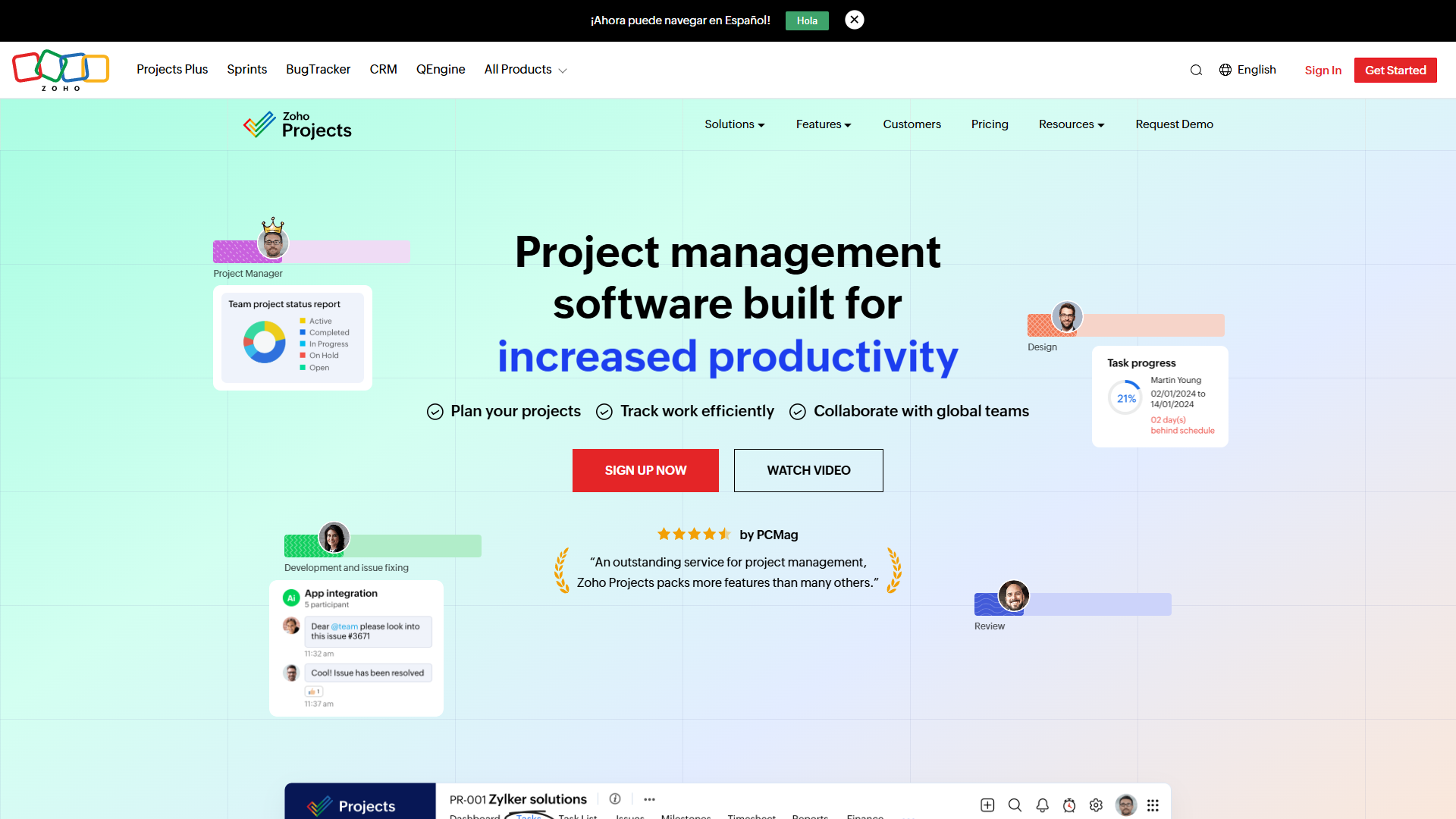
1. Zoho Projects - Best Value for Budget-Conscious Teams
Rating:
Zoho Projects is the strongest value play for small teams prioritizing budget without sacrificing core functionality. At $5/user/month (annual billing), it undercuts ClickUp by 29% and Asana by 54% — savings that compound to $2,000/year for a 15-person team.
What surprised me: the free tier isn’t a gimmick. Three users with two projects and 5GB storage is legitimately usable for micro-teams testing whether structured project management fits their workflow. The Premium tier ($5/user/month) scales to 50 users with 100GB storage, Gantt charts, time tracking, and Zia AI assistant — all features competitors lock behind $10+ tiers.
Key Features:
- Gantt Charts & Dependencies: Visualize project timelines and critical paths without upgrading to enterprise plans
- Time Tracking: Native time logging across tasks (no third-party integrations required)
- Zia AI Assistant: ChatGPT-powered task generation, search, insights, and translation (included in Premium tier)
- Resource Utilization Charts: See who’s overloaded before burnout happens (critical for small teams with no bench depth)
- Zoho Ecosystem Integration: Seamless connection to Zoho CRM, Zoho Invoice, Zoho Mail (advantage if you’re already in the Zoho suite)
Pricing Breakdown:
- Free: 3 users, 2 projects, 5GB storage, basic Gantt charts
- Premium ($5/user/month annual): 50 users, unlimited projects, 100GB storage, time tracking, Zia AI, custom fields
- Enterprise ($10/user/month annual): Unlimited users, 120GB storage, SSO, advanced roles
Pros:
- Lowest premium pricing among major platforms
- Strong free tier for testing/micro-teams
- Time tracking included (saves $3-5/user/month on separate tools)
- Zia AI at mid-tier pricing (competitors charge $9+/user for AI)
- 4-week implementation timeline (faster than Asana’s custom workflow setup)
Cons:
- Zoho UI feels dated compared to ClickUp/Asana’s modern interfaces
- Zia AI less powerful than ClickUp Brain’s multi-model architecture
- Smaller integration marketplace (100+ vs. ClickUp’s 1,000+ or Asana’s 300+)
- Less flexibility for non-standard workflows (more opinionated structure)
Best For:
- Budget-conscious SMBs where cost per seat is a primary constraint
- Remote teams needing time tracking without separate tools
- Organizations already using Zoho CRM, Mail, or other Zoho apps
- Teams prioritizing Gantt charts and traditional project management over workflow customization
ROI Snapshot: $2,000/year savings vs. Asana for 15-person team. 4-week implementation means productivity gains start faster than platforms requiring extensive customization.
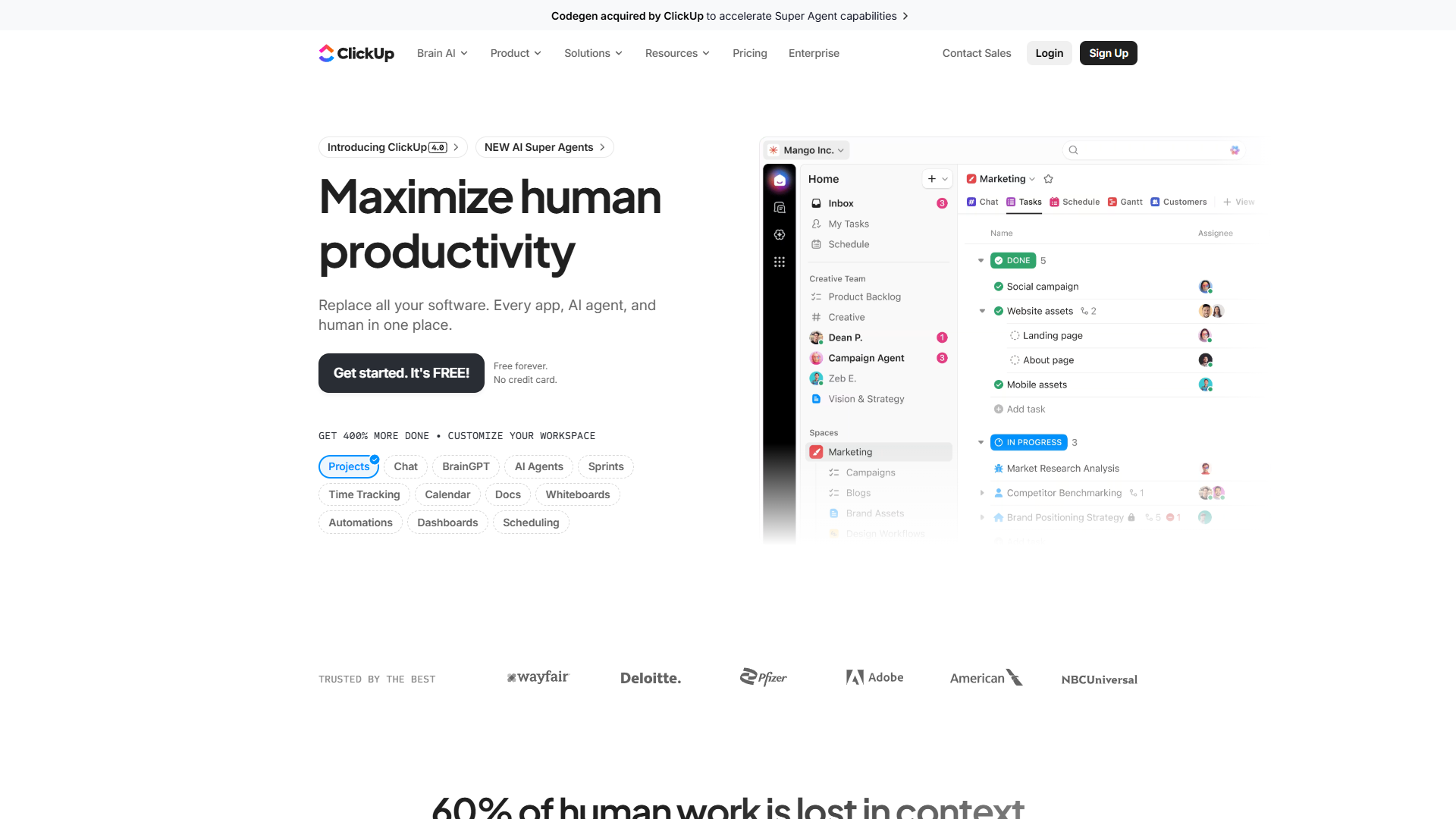
2. ClickUp - Most Customizable All-in-One Platform
Rating:
ClickUp positions itself as the platform that replaces your entire tool stack — and for small teams drowning in SaaS subscriptions, that promise delivers. I’ve seen marketing agencies consolidate project management, docs, wikis, time tracking, and goal tracking into ClickUp, cutting monthly tool spend by 50% while improving visibility.
The platform’s strength is radical customization: 35+ view types (List, Board, Gantt, Calendar, Timeline, Workload, Map), unlimited custom fields, and workflow automation that adapts to how you actually work instead of forcing you into templates. For small teams with unique processes (agencies, consulting firms, R&D groups), ClickUp molds to your workflow.
ClickUp Brain (AI add-on) is where things get interesting. Unlike basic AI autocomplete, Brain includes multi-model access (GPT-4, Claude), autonomous Autopilot Agents that execute tasks, and AI Knowledge Manager that surfaces insights from your entire workspace. At $9/user/month for AI Standard, it’s aggressive pricing for this capability depth.
Key Features:
- 35+ View Types: Adapt the interface to different teams (developers want Board, executives want Gantt, marketers want Calendar)
- ClickUp Brain AI: GPT-4/Claude access, Autopilot Agents for task automation, AI Knowledge Manager, unlimited AI essentials (AI Standard $9/user/month)
- Unlimited Storage (Unlimited plan): No file size gymnastics for small teams managing client assets
- Native Time Tracking: Built-in timesheets with billable rates (critical for agencies/consultancies)
- Advanced Automations (Business plan): 250+ automations per month to eliminate repetitive work
- 1,000+ Integrations: Connect to Slack, Google Workspace, Zoom, Salesforce, GitHub, and long-tail tools
Pricing Breakdown:
- Free Forever: Unlimited tasks/users, 100MB storage, collaborative docs, Kanban boards, sprint management
- Unlimited ($7/user/month annual): Unlimited storage, unlimited integrations, unlimited dashboards, Gantt charts, native time tracking, Goals
- Business ($12/user/month annual): Advanced automations (250+/month), Timeline view, Mind maps, Workload view, Google SSO
- Enterprise (Custom): White labeling, unlimited custom roles, SSO (SAML/Okta), API access, dedicated success manager
- AI Add-On Pricing: AI Standard ($9/user/month) for unlimited AI essentials; AI Autopilot ($28/user/month) for unlimited automations and agents
Pros:
- True all-in-one replacement for 3-5 separate tools (docs, project management, goals, time tracking)
- 3.84x ROI multiplier with 50% cost reduction common among users consolidating tools
- 35+ views accommodate different team preferences without separate tools
- ClickUp Brain AI at $9/user/month competitive vs. standalone AI tools
- Business plan automations (250+/month) eliminate significant manual work for small teams
Cons:
- Overwhelming feature depth creates steep learning curve (1-2 weeks for full adoption)
- Free plan’s 100MB storage restrictive for teams managing media/design files
- Aggressive upselling to Business tier for features like Timeline view and advanced automations
- AI capabilities require paid add-on (not included in base plans)
- Some users report performance lag with large workspaces (1,000+ tasks)
Best For:
- Teams consolidating multiple tools to reduce SaaS sprawl
- Remote-first teams needing centralized docs + project management + communication
- Agencies and consultancies requiring time tracking, client workspaces, and custom branding (Enterprise)
- Highly customizable workflows where standardized templates don’t fit
ROI Snapshot: 3.84x ROI multiplier with 50% cost reduction reported in G2 reviews. For a 10-person team spending $500/month on scattered tools, consolidating to ClickUp Unlimited ($70/month) yields $430/month savings ($5,160/year).
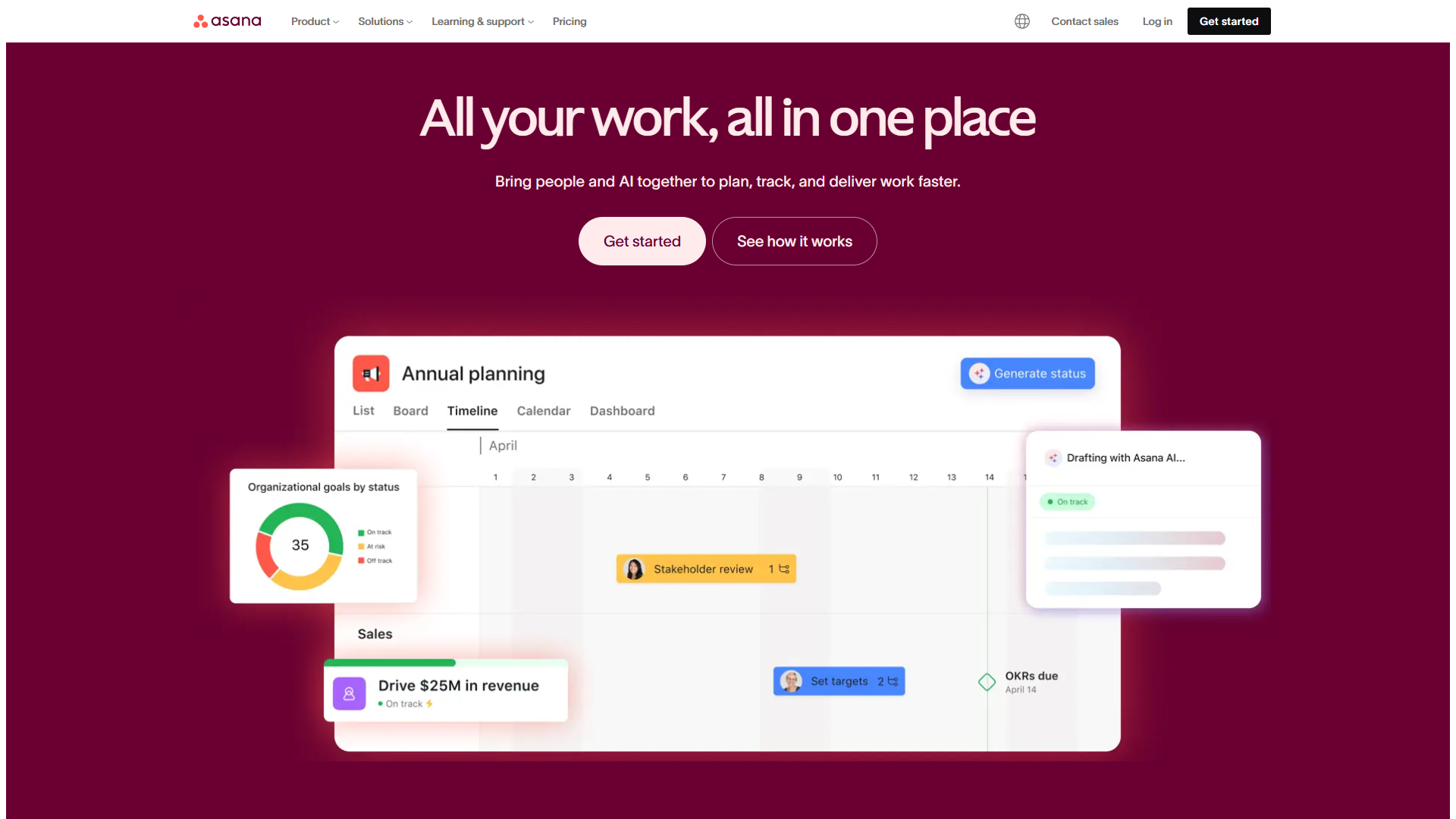
3. Asana - Strongest Timeline Management for Cross-Functional Work
Rating:
Asana earns its reputation as the timeline management leader, particularly for marketing teams and cross-functional projects where dependencies between teams create bottlenecks. A Forrester Total Economic Impact study found 437% three-year ROI — driven primarily by 81% improvement in team collaboration and 2-week setup time.
What sets Asana apart: Timeline view (Gantt-style) is available on the Starter plan ($10.99/user/month), whereas competitors lock it behind higher tiers. For small teams running campaigns with hard deadlines (product launches, events, content calendars), visualizing dependencies is non-negotiable — and Asana makes it accessible.
The free Personal plan is genuinely generous: 10 users with unlimited tasks and projects. For small teams under 10 people who don’t need advanced reporting or AI, you can run productively without paying. This makes Asana the lowest-friction entry point for teams skeptical about adopting project management software.
Key Features:
- Timeline View (Gantt): Visual dependencies and critical path on Starter plan ($10.99/user/month vs. competitors at $12-15)
- AI Studio (Starter+): Smart Goals, automated status updates, intelligent task suggestions
- Workflow Builder: No-code automation for approvals, task assignments, status changes (250 automations/month on Starter)
- 300+ Integrations: Salesforce, Adobe Creative Cloud, Microsoft Teams, Slack, Zoom, Google Workspace
- Portfolio Views (Advanced plan): Multi-project oversight for teams managing 5+ simultaneous projects
- Forms with Branching Logic: Intake requests with conditional fields (reduces back-and-forth for client/stakeholder requests)
Pricing Breakdown:
- Personal (Free): 10 users, unlimited tasks/projects, List/Board/Calendar views, basic forms
- Starter ($10.99/user/month annual): Timeline/Gantt view, Workflow Builder, 250 automations/month, AI Studio Basic, custom fields, task dependencies
- Advanced ($24.99/user/month annual): Portfolio views, Workload/Time tracking, Goals across departments, 25,000 automations/month, advanced reporting
- Enterprise (Custom): SAML/SSO, SCIM provisioning, unlimited automations, 24/7 priority support, 99.9% SLA
- Enterprise+ ($538/user/month annual): HIPAA compliance, data residency, DLP, eDiscovery, 99.99% SLA
Pros:
- Best free tier (10 users unlimited projects vs. ClickUp’s storage limits or Zoho’s 2-project cap)
- Timeline view available at Starter tier (lowest price point for Gantt charts)
- 437% three-year ROI (Forrester study) driven by collaboration improvements
- 2-week implementation faster than custom-heavy platforms
- 300+ integrations cover most small team tech stacks (Salesforce, Adobe, Microsoft)
- Strong mobile apps for remote/field teams
Cons:
- Highest per-seat pricing ($10.99/user/month vs. Zoho $5, ClickUp $7)
- AI features limited to Starter+ plans (free tier has no AI)
- Less customizable than ClickUp (more opinionated workflows)
- Advanced features (Portfolio, Workload) locked behind $24.99/user/month tier
- Requires investment in setup/customization to unlock full value
Best For:
- Marketing teams managing campaigns with dependencies (content → design → approval → publish)
- Cross-functional projects where timeline visualization prevents bottlenecks
- Teams under 10 people who can leverage the generous free tier
- Organizations needing Timeline/Gantt views without paying $15+/user/month
- Enterprise teams requiring HIPAA compliance or strict data residency (Enterprise+)
ROI Snapshot: 437% three-year ROI per Forrester. For a 15-person marketing team, Asana Starter ($164/month annual) delivers collaboration improvements worth $717/month in saved time and reduced miscommunication.
Decision Framework: Choosing the Right PM Software for Your Small Team
Start here: What’s your primary constraint?
Budget is the Primary Constraint
Choose: Zoho Projects
- Premium tier at $5/user/month undercuts competitors by 29-54%
- $2,000/year savings vs. Asana for 15-person team
- Time tracking included (saves $3-5/user/month on separate tools)
- Trade-off: Older UI, less workflow flexibility
You’re Consolidating Multiple Tools
Choose: ClickUp
- Replaces project management + docs + wikis + time tracking + goals
- 3.84x ROI multiplier, 50% cost reduction common
- Unlimited storage on Unlimited plan ($7/user/month)
- Trade-off: Steeper learning curve (1-2 weeks)
Timeline/Dependencies are Critical
Choose: Asana
- Timeline view (Gantt) available at Starter tier ($10.99/user/month)
- 437% three-year ROI from improved collaboration
- Best for marketing campaigns, product launches, event planning
- Trade-off: Highest per-seat pricing
Team is Under 10 People
Choose: Asana Personal (Free)
- 10 users, unlimited tasks/projects
- List, Board, Calendar views included
- Zero cost to test project management software adoption
- Trade-off: No Timeline view or AI (upgrade to Starter when needed)
You’re in the Zoho Ecosystem
Choose: Zoho Projects
- Seamless integration with Zoho CRM, Mail, Invoice
- Unified billing and user management
- Zia AI leverages data across Zoho apps
- Trade-off: Less value if not using other Zoho products
Heavy Customization Required
Choose: ClickUp
- 35+ view types (List, Board, Gantt, Timeline, Map, Workload, etc.)
- Unlimited custom fields
- 250+ automations/month on Business plan
- Trade-off: Complexity can overwhelm teams wanting simplicity
Feature Comparison: What You Get at Each Price Point
Free Tier Comparison
| Feature | Zoho Projects | ClickUp | Asana |
|---|---|---|---|
| User Limit | 3 users | Unlimited | 10 users |
| Project Limit | 2 projects | Unlimited | Unlimited |
| Storage | 5GB | 100MB | 100MB/file |
| Gantt Charts | Yes (basic) | No | No |
| Time Tracking | No | No | No |
| Mobile Apps | Yes | Yes | Yes |
| Best For | Micro-teams testing PM | Teams prioritizing task flexibility | Small teams under 10 |
Free Tier Winner: Asana (10 users unlimited projects beats Zoho’s 2-project cap and ClickUp’s 100MB storage)
Premium Tier Comparison ($5-11/user/month)
| Feature | Zoho Premium ($5) | ClickUp Unlimited ($7) | Asana Starter ($10.99) |
|---|---|---|---|
| Gantt/Timeline | Yes | Yes | Yes |
| Time Tracking | Yes | Yes | No (Advanced tier) |
| Storage | 100GB | Unlimited | 100MB/file |
| AI Features | Zia AI included | Paid add-on ($9+) | AI Studio Basic included |
| Automations/Month | Basic | Unlimited | 250 |
| Custom Fields | Yes | Yes | Yes |
| Integrations | 100+ | 1,000+ | 300+ |
Premium Tier Winner: Context-dependent
- Budget: Zoho ($5 vs. $7-11)
- Storage: ClickUp (Unlimited vs. 100GB/100MB)
- AI: Zoho (included vs. ClickUp paid add-on)
- Automation: ClickUp (unlimited vs. 250/month)
AI Capabilities: Which Platform’s AI Actually Saves Time?
Zoho Zia AI (Included in Premium $5/user/month):
- ChatGPT-powered task generation from natural language
- Smart search across projects, tasks, comments
- Automated insights (schedule risk, resource overload alerts)
- Translation for global remote teams
- Verdict: Best value AI for budget-conscious teams. Not cutting-edge but practical.
ClickUp Brain (AI Standard $9/user/month add-on):
- Multi-model access (GPT-4, Claude Sonnet)
- Autopilot Agents that execute tasks autonomously
- AI Knowledge Manager surfaces insights from workspace data
- Unlimited AI essentials (summarization, drafting, Q&A)
- Verdict: Most powerful AI for teams consolidating tools. $9/user/month justified if replacing separate AI subscriptions.
Asana AI Studio (Included in Starter+ $10.99/user/month):
- Smart Goals with auto-generated milestones
- Automated status updates from task completion patterns
- Intelligent task suggestions and assignment
- Verdict: Solid productivity AI for timeline-heavy work. Not as deep as ClickUp Brain but included in base pricing.
Common Small Team Concerns Addressed
| Concern | Answer |
|---|---|
| ”Only 8 people — do we need PM software?” | Yes, especially if remote or scaling. One blocked person = 12.5% of team idle. Start with Asana Personal (free, 10 users) for 30 days. |
| ”Budget is $500/month for all software” | All fit easily: Zoho Premium $50/mo, ClickUp Unlimited $70/mo, Asana Starter $110/mo (10 users). Forrester’s 437% ROI means $1 spent returns $4.37. |
| ”We tried PM software before and stopped using it” | Usual causes: tool too complex, no exec buy-in, or forcing old workflows. Fix: free tier first, leadership uses it first, focus on one workflow, set 30-day success metrics. |
| ”What if we outgrow it in 2 years?” | All three scale to 100+ users (Enterprise tiers). Export exists everywhere. Growth outpacing your PM is a problem you want to have. |
Implementation Timeline: Getting Your Team Productive Fast
| Week | Focus | Activities |
|---|---|---|
| 1 | Setup | Configure workspace, import projects from spreadsheets, invite team, assign permissions |
| 2 | Pilot | Start with one team/project type, 1-hour training, run standups in Board/List view |
| 3 | Expand | Roll out to additional teams, configure automations, integrate Slack/email/calendar |
| 4 | Optimize | Review analytics, adjust workflows, train advanced features (Gantt, AI tools) |
Speed: Asana (2 weeks) | Most customization: ClickUp (3-4 weeks) | Balance: Zoho (4 weeks)
FAQ
| Question | Answer |
|---|---|
| Best for remote teams? | ClickUp or Zoho Projects — both centralize communication + PM. ClickUp consolidates docs/tasks/chat; Zoho includes time tracking. |
| Can 10 people use free tier? | Yes, with Asana Personal (10 users, unlimited projects). ClickUp Free has 100MB storage limit. Zoho Free caps at 3 users. |
| Migration time from spreadsheets? | 1-2 weeks for data import, 4 weeks for full adoption. Start net-new projects in PM software; legacy winds down naturally. |
| Non-technical teams (marketing, ops)? | Asana’s Timeline excels for campaigns. ClickUp’s 35+ views adapt to different stakeholders. Zoho feels more engineer-y. |
| Top integrations? | Slack/Teams (status updates), Google/M365 (files, calendars), Zoom (meeting links), Time tracking (unless native), CRM (Salesforce/HubSpot). |
| Can I switch platforms later? | Yes — all export CSV/JSON. Budget 2-4 weeks for migration. Start with free tiers to test before committing. |
| Does AI actually help? | Yes for: summarizing threads, drafting status updates, smart assignment, risk detection. Overhyped for: priority decisions, full project plans. Best value: Zoho Zia at $5/user/month. |
Final Verdict: Which Project Management Software Should Small Teams Choose?
For project management software small teams, If budget is your #1 constraint: Zoho Projects
$5/user/month for Premium tier with Gantt charts, time tracking, and Zia AI undercuts ClickUp by 29% and Asana by 54%. For a 15-person team, that’s $2,000/year in savings — real money for small teams watching every dollar.
If you’re consolidating multiple tools: ClickUp
Replace project management, docs, wikis, time tracking, and goals in one platform. G2 reviews report 3.84x ROI with 50% cost reduction. The learning curve is real (1-2 weeks), but the payoff is eliminating 3-5 separate SaaS subscriptions.
If timeline management is critical: Asana
Forrester’s 437% three-year ROI is driven by Timeline view improving cross-functional collaboration. Best for marketing campaigns, product launches, and any work with hard dependencies between teams. The free 10-user tier makes it the lowest-friction entry point.
If you’re under 10 people and testing PM software: Asana Personal (Free)
Ten users with unlimited tasks and projects, zero credit card required. Prove project management software works for your team before committing budget. Upgrade to Starter ($10.99/user/month) when you need Timeline view or AI.
Ready to Get Your Small Team Organized?
The difference between coordinated small teams and chaotic ones isn’t talent — it’s systems. Project management software for small teams creates visibility that prevents bottlenecks, tracks commitments so nothing falls through cracks, and gives everyone clarity on priorities.
Start with the free tier that fits your team size:
- Under 3 people: Zoho Projects Free (2 projects, Gantt charts)
- 4-10 people: Asana Personal Free (unlimited projects, best free tier)
- 10+ people: ClickUp Free Forever (unlimited users/tasks, watch for 100MB storage limit)
Test for 30 days. Track whether you’re finishing tasks faster and missing fewer deadlines. If the answer is yes, upgrade to the paid tier. If not, try a different platform or accept that your team might not need PM software yet (some small teams genuinely don’t — especially if you’re co-located and working on independent projects).
The best project management software small teams choose is the one they actually use. Start small, prove value, scale when ready.