The best AI CRM tools 2025 have evolved from simple contact databases into intelligent business partners. If your sales team is still drowning in manual data entry while your CRM sits underutilized, you’re not alone. The difference between a CRM that becomes your competitive advantage and one that collects digital dust comes down to AI sophistication.
After years of watching businesses struggle with CRM adoption, I’ve seen a clear pattern: the right AI features can transform your CRM from a burden into your best sales rep. But with Salesforce charging up to $500 per user monthly, HubSpot’s complex pricing tiers, and Zoho’s budget-friendly promise, how do you choose?
This guide cuts through the marketing fluff. We’ll compare the three market leaders — Salesforce, HubSpot, and Zoho CRM — with real pricing data, actual AI capabilities, and honest assessments of who each platform truly serves best.
TL;DR: Quick Takeaways
The three market leaders each dominate different segments:
-
Salesforce: Best for enterprise (200+ employees). Pricing: $25-500/user/mo. Agentforce 2.0 delivers autonomous AI agents that can handle tier-1 support and qualify leads without human intervention. 9,000+ AppExchange integrations offer unmatched customization. Downside: steepest learning curve and highest cost.
-
HubSpot: Best for marketing-led organizations. Pricing: Free-$3,600/mo. Breeze AI Suite (Assistant, Customer Agent, Prospecting Agent, Studio) provides the most accessible AI, with features available even on the free tier. All-in-one platform unifies marketing, sales, and service. Downside: mandatory onboarding fees ($3,000-7,000) and contact-based pricing can escalate quickly.
-
Zoho CRM: Best for budget-conscious SMBs. Pricing: Free-$65/user/mo. Zia AI offers enterprise-grade predictions, churn detection, and sentiment analysis at a fraction of Salesforce’s cost. Enterprise AI features start at just $40/user/mo vs Salesforce’s $500. Downside: smaller integration ecosystem and less modern interface.
Bottom line: All three offer powerful AI. Your choice hinges on company size, budget, and whether you value customization (Salesforce), ease of use (HubSpot), or value (Zoho).
Quick Comparison: At a Glance
| Feature | Salesforce | HubSpot | Zoho CRM |
|---|---|---|---|
| Pricing Range | $25-500/user/mo | Free-$3,600/mo | Free-$65/user/mo |
| AI Platform | Einstein AI + Agentforce 2.0 | Breeze AI Suite | Zia AI |
| Best For | Enterprise (200+ employees) | Marketing-led orgs | Budget-conscious SMBs |
| Rating | |||
| Key Strength | Deepest customization, 9,000+ apps | All-in-one platform, ease of use | Enterprise features at SMB pricing |
| AI Features | Autonomous agents, Atlas Reasoning | Assistant, Customer Agent, Prospecting | Predictions, churn detection, QuickML |
| Free Tier | 30-day trial only | Yes (2 users) | Yes (3 users) |
| Integration Count | 9,000+ | 500+ | 300+ third-party |
| Setup Time | 1-3 months | 1-2 days | 1-2 weeks |
Salesforce: Enterprise AI CRM Leader
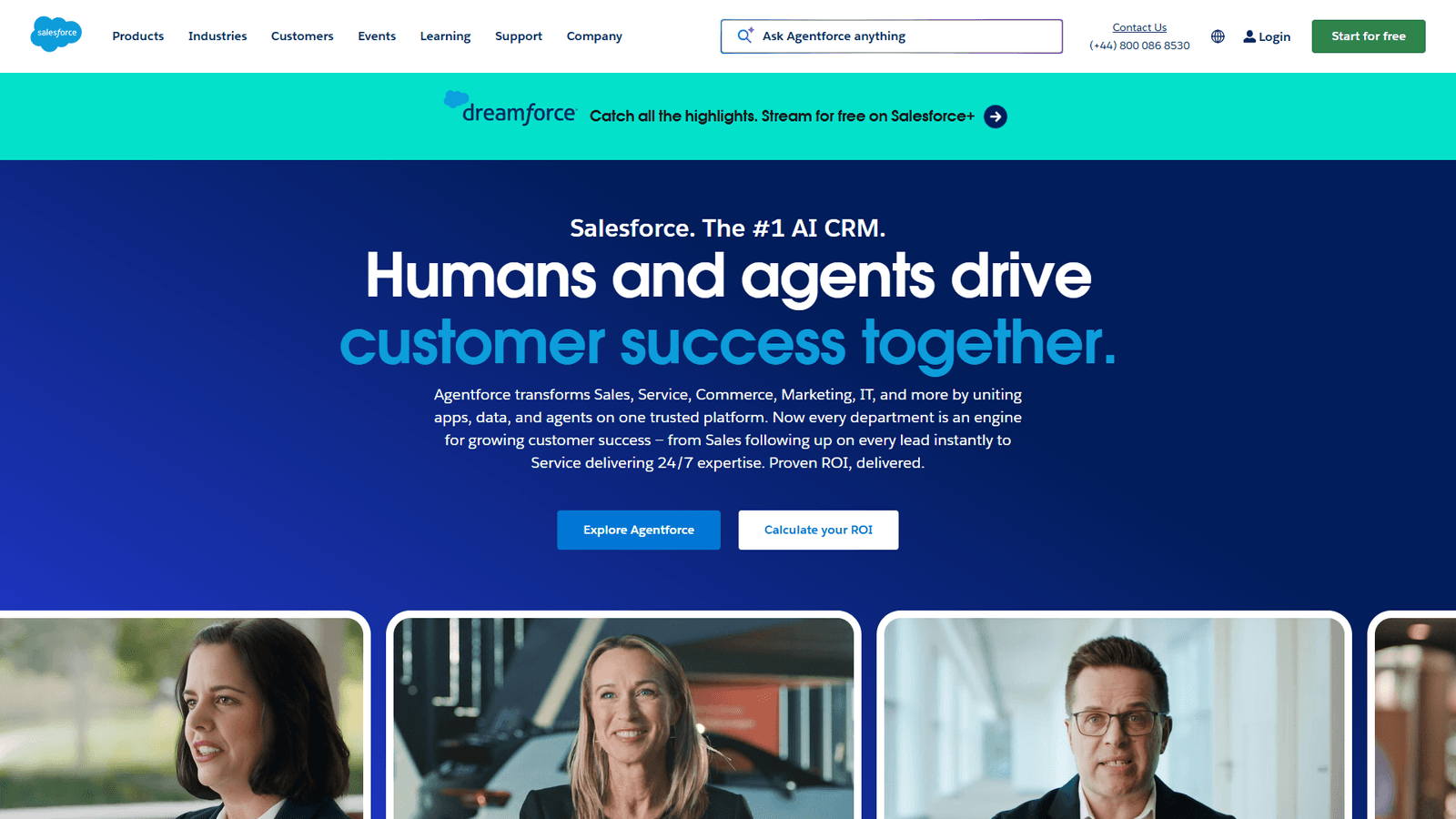
Salesforce has dominated the enterprise CRM market since 1999, and with 22,203 G2 reviews averaging , the platform’s reputation speaks for itself. But reputation doesn’t justify $500/user/month unless the AI delivers real ROI.
Einstein AI & Agentforce 2.0: Autonomous Intelligence
Salesforce’s AI strategy centers on Agentforce 2.0, launched in late 2024. Unlike traditional AI assistants that suggest actions, Agentforce agents take actions autonomously:
What Agentforce 2.0 Actually Does:
-
Autonomous SDR Agent: Qualifies inbound leads, schedules meetings, and sends personalized follow-ups without human intervention. The agent analyzes lead behavior, scores fit, and routes only qualified opportunities to sales reps.
-
Service Agent: Handles tier-1 support tickets via chat, email, and voice. The agent can resolve password resets, answer product questions, and escalate complex issues to humans — all while maintaining your brand voice through Agent Script behavioral controls.
-
Atlas Reasoning Engine: The AI brain powering Agentforce. Atlas processes unstructured data (emails, call transcripts, support tickets) to make complex decisions. For example, Atlas can analyze a support ticket, cross-reference past interactions, check product documentation, and determine the optimal resolution path.
-
Einstein Copilot: Your Slack-like AI assistant within Salesforce. Ask “Which deals are at risk this quarter?” and Copilot analyzes pipeline data, communication sentiment, and engagement patterns to surface concerning opportunities.
Real-world example: A Series B SaaS company using Agentforce reports their SDR agent now handles 40% of inbound lead qualification, freeing human SDRs to focus on outbound and complex opportunities. ROI: 2.5 additional qualified meetings per rep per week.
Salesforce Pricing: Breaking Down the Tiers
Pricing verified January 2026 from Salesforce.com:
-
Starter Suite: $25/user/mo (up to 325 users)
- Basic CRM: contacts, leads, accounts, opportunities
- Mobile app and email integration
- Limited to basic features — no Einstein AI
- Best for: Very small teams testing Salesforce
-
Pro Suite: $80/user/mo (unlimited users)
- Everything in Starter
- Lead scoring and forecasting
- Workflow automation and API access
- Still no advanced AI features
- Best for: Growing teams needing automation
-
Enterprise: $165/user/mo (unlimited users)
- Everything in Pro
- Advanced customizations and territory management
- Sandbox environments for testing
- Complex workflow capabilities
- Best for: Mid-market companies (100-500 employees)
-
Unlimited: $330/user/mo (unlimited users)
- Everything in Enterprise
- 24/7 premium support
- Unlimited Einstein AI features (predictions, forecasting)
- Einstein Copilot included
- Best for: Large enterprises needing full AI + premium support
-
Einstein 1 Sales: $500/user/mo (unlimited users)
- Everything in Unlimited
- Agentforce 2.0 autonomous AI agents
- Atlas Reasoning Engine for complex decisions
- MuleSoft Agent Fabric for orchestration
- Best for: Enterprises betting on AI-first sales (500+ employees)
Pricing reality check: For a 100-person sales team, Einstein 1 Sales costs $50,000/month ($600K annually). That’s enterprise-only pricing. Most SMBs should look at Enterprise ($16,500/mo) or consider HubSpot/Zoho.
Pros & Cons
Pros: 9,000+ integrations, unlimited customization (Apex code), HIPAA/SOC2/ISO compliant, most advanced AI (autonomous agents)
Cons: 1-3 month onboarding, requires dedicated admin (50+ users), 7.7x more expensive than Zoho, overkill for small teams
Best For: Enterprise Sales Teams
Choose Salesforce if you’re:
- 200+ employees with complex sales processes
- Enterprise budget ($165-500/user/mo is acceptable)
- Need deep customization and integrations
- Have technical resources (dedicated admin or Salesforce partner)
- Betting on AI-first sales (autonomous agents justify premium)
HubSpot: All-in-One CRM with Breeze AI
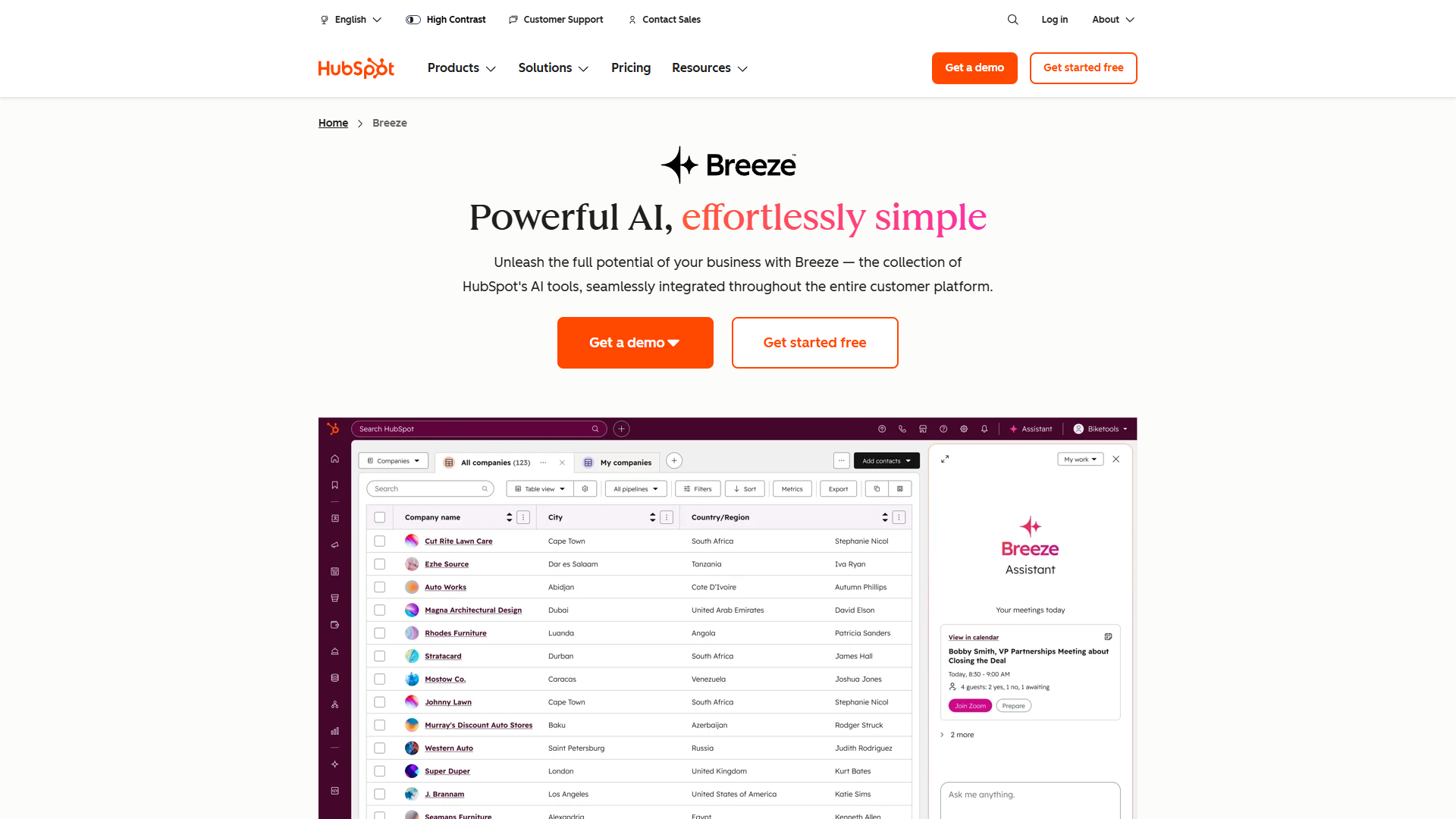
HubSpot entered the CRM market in 2006 with a radical idea: CRM should be easy. With 34,038 G2 reviews (the most of any CRM) averaging , HubSpot proved that user-friendly doesn’t mean feature-light.
Breeze AI Suite: Accessible Intelligence
HubSpot launched Breeze AI in late 2024, taking a different approach than Salesforce. Instead of autonomous agents working independently, Breeze acts as your copilot — augmenting human work rather than replacing it.
Breeze AI Suite Components:
-
Breeze Assistant: Your AI copilot in every HubSpot screen. Drafts personalized emails based on contact history, summarizes call recordings into action items, suggests next steps for deals, and answers questions about your data (“Which contacts opened our last email but didn’t click?”).
-
Breeze Customer Agent: Handles support tickets via chat and email. Unlike Salesforce’s autonomous agents, Breeze Customer Agent works more like a smart chatbot — it can resolve 50%+ of tier-1 tickets (password resets, shipping status, basic questions) and escalates complexity to humans with full context.
-
Breeze Prospecting Agent: The lead generation powerhouse. Identifies website visitors, enriches their profiles with company data (size, industry, revenue), scores them based on fit, and automatically adds high-intent prospects to targeted email sequences. This is where HubSpot shines — the agent can find prospects you didn’t know were interested.
-
Breeze Studio: Build custom AI agents without code. Use the visual builder to create agents for specific use cases (e.g., “Event registration agent” that handles webinar signups and sends calendar invites). Available on Enterprise tier only.
Real-world example: A B2B marketing agency using Breeze Prospecting Agent reports 3x more MQLs from website traffic. The agent identified visitors from target accounts (Fortune 500 companies), enriched their data, and triggered personalized outreach — all automated.
HubSpot Pricing: Understanding the Complexity
HubSpot’s pricing is famously complex because it combines per-seat pricing + contact-based pricing + hub-based pricing. Here’s the breakdown verified January 2026:
Free Forever Tier:
- $0/mo for up to 2 users
- Unlimited contacts
- Basic CRM, email tracking, meeting scheduling
- 2,000 emails/month
- Limited Breeze AI features
- Best for: Startups and solopreneurs testing CRM
Starter Customer Platform:
- $15/user/mo (monthly billing) or $9/user/mo (annual)
- Includes all five hubs (Marketing, Sales, Service, CMS, Operations)
- 1,000 marketing contacts included
- Basic marketing automation
- Breeze AI Assistant access
- No onboarding fee (unlike Professional/Enterprise)
- Best for: Small businesses (5-20 employees) needing all-in-one platform
Professional (Marketing Hub):
- $890/mo (monthly) or $801/mo (annual)
- 2,000 marketing contacts included
- 3 core seats included (additional seats $45/mo each)
- Full marketing automation (A/B testing, dynamic personalization)
- Breeze AI Assistant with memory + Breeze Prospecting Agent
- $3,000 one-time onboarding fee
- Best for: Mid-market companies (50-200 employees) doing serious marketing
Enterprise (Marketing Hub):
- $3,600/mo (monthly) or $3,240/mo (annual)
- 10,000 marketing contacts included
- 5 core seats included (additional seats $75/mo each)
- Full Breeze AI Suite (Assistant, Customer Agent, Prospecting Agent, Studio)
- Custom AI assistants via Breeze Studio
- $7,000 one-time onboarding fee
- Best for: Large enterprises (500+ employees) requiring advanced customization
Sales & Service Hub Pricing:
- Professional: $500/mo (3 seats, sales sequences, playbooks)
- Enterprise: $1,500/mo (5 seats, advanced automation, AI agents)
- Onboarding fees: $1,500 (Pro) to $3,500 (Enterprise)
Pricing reality check: HubSpot looks affordable until you scale. A mid-market company with 50,000 contacts needs Professional tier ($890/mo base) + additional contact tiers (roughly $1,500/mo) + extra seats (10 users = $450/mo) = $2,840/mo before onboarding fees. That’s $37,080 year one vs Zoho Enterprise at $24,000 annually for 50 users.
Pros: Why Marketing Teams Love HubSpot
-
Easiest to learn: Sales reps can be productive in 1-2 days, not weeks. The interface is intuitive, and HubSpot Academy offers free certification courses.
-
True all-in-one platform: Marketing Hub + Sales Hub + Service Hub share one database. No integration headaches. Build a landing page, capture a lead, nurture via email, close in CRM, support via ticketing — all in one platform.
-
Generous free tier: Unlike Salesforce’s trial-only approach, HubSpot offers a permanent free tier with real utility. Many startups run on HubSpot Free for their first year.
-
AI on every tier: Even free users get basic Breeze AI features. Salesforce locks AI behind $330-500/user/mo tiers.
-
Best for marketing-led growth: If your company prioritizes content marketing, SEO, and inbound lead generation, HubSpot’s Marketing Hub is unmatched. Breeze Prospecting Agent turns your blog into a lead generation machine.
Cons: Why CFOs Push Back on HubSpot
-
Pricing complexity: Explaining HubSpot pricing to your CFO requires a spreadsheet. Seat fees + contact fees + hub fees + onboarding fees create confusion.
-
Mandatory onboarding fees: $3,000 (Professional) to $7,000 (Enterprise) is non-negotiable. That’s $7,000 you pay before sending a single email.
-
Contact list pricing escalates: If you’re doing marketing right, your contact list grows. HubSpot charges more as you grow. A company with 100,000 contacts on Enterprise pays $4,800/mo vs the base $3,600/mo.
-
Less customizable than Salesforce: No custom code. You’re limited to HubSpot’s workflows and properties. For most companies this is fine, but enterprises with unique processes may hit walls.
Best For: Marketing-Led Organizations
Choose HubSpot if you’re:
- Marketing-led organization (inbound, content marketing, SEO focused)
- 10-200 employees wanting all-in-one simplicity
- Prioritize ease of use over deep customization
- Want AI on a free or affordable tier
- Need marketing + sales + service unified
- Comfortable with contact-based pricing model
Zoho CRM: Enterprise AI on an SMB Budget
Zoho CRM is the value play that punches above its weight. With 2,818 G2 reviews averaging , Zoho doesn’t have Salesforce’s volume or HubSpot’s buzz — but it delivers enterprise AI features at SMB pricing.
Zia AI: Predictive Intelligence That Works
Zoho’s AI strategy focuses on predictions and insights rather than autonomous agents. Zia AI won’t replace your SDR, but it will make your SDR smarter.
Zia AI Capabilities:
-
Deal Predictions: Zia analyzes your historical won/lost deals to predict closure probability for open opportunities. The AI considers factors like deal size, contact engagement, communication frequency, and sales cycle length. You get a 0-100% confidence score for every deal.
-
Churn Detection: For existing customers, Zia monitors support ticket volume, sentiment trends, product usage patterns, and payment history to flag at-risk accounts. Get alerts 30-60 days before a customer is likely to churn, giving you time to intervene.
-
Sentiment Analysis: Zia reads your email conversations (with customer permission) and scores sentiment on a -10 to +10 scale. If a customer’s emails shift from positive (+7) to negative (-3), Zia alerts you that the relationship needs attention.
-
Optimal Contact Time: Machine learning determines when each contact is most likely to engage. Zia might tell you “Contact Sarah on Tuesdays between 10-11am for highest response rate” based on historical email open patterns.
-
QuickML (Ultimate tier): No-code machine learning lets you build custom predictions. Example: Train a model to predict “Which leads from webinars are most likely to book demos?” Zia learns from your data and scores new webinar leads automatically.
-
Zia Vision: Image recognition for business card scanning and document processing. Snap a photo of a business card at a conference, and Zia extracts name, title, company, and contact info into a new lead record.
Real-world example: A 30-person software company using Zia Churn Detection identified 8 at-risk customers in Q4 2024. Proactive outreach saved 6 of them, preserving $180K in annual recurring revenue. ROI on Zoho Ultimate ($52/user/mo for 30 users = $18,720/year) was 9.6x in year one.
Zoho CRM Pricing: The Value Proposition
Pricing verified January 2026 from Zoho.com/crm:
-
Free: $0/mo for up to 3 users
- Unlimited contacts
- Basic CRM (leads, contacts, deals, tasks)
- 250 emails/day
- Mobile app
- No AI features
- Best for: Micro-businesses (1-3 people) testing CRM
-
Standard: $14/user/mo annual ($20 monthly)
- Everything in Free
- Unlimited users
- Sales forecasting and scoring rules
- 500 emails/day
- Still no Zia AI
- Best for: Small teams (5-15 people) needing basic automation
-
Professional: $23/user/mo annual ($35 monthly)
- Everything in Standard
- Blueprint process management (visual sales processes)
- Advanced workflow automation
- 1,000 emails/day
- Inventory management
- Still no Zia AI (frustrating!)
- Best for: Growing teams (15-50 people) needing workflows
-
Enterprise: $40/user/mo annual ($50 monthly)
- Everything in Professional
- Zia AI included (predictions, sentiment, churn detection)
- Zia Vision image recognition
- 2,000 emails/day
- Territory management
- Advanced analytics
- Best for: SMBs (50-200 people) wanting AI at reasonable cost
-
Ultimate: $52/user/mo annual ($65 monthly)
- Everything in Enterprise
- Zia Agent Studio (build custom AI agents without code)
- QuickML (no-code machine learning)
- Enhanced AI with OpenAI integration
- Unlimited storage
- 5,000 emails/day
- Premium support
- Best for: Data-driven teams wanting custom ML models
Pricing reality check: For 50 users, Zoho Ultimate costs $31,200/year. Salesforce Enterprise (comparable features) costs $99,000/year. HubSpot Professional (Marketing Hub) costs $28,000/year but limits contacts. Zoho delivers enterprise AI at 31% of Salesforce’s cost.
Pros: Why SMBs Choose Zoho
-
Best pricing: Full AI starts at $40/user/mo (Enterprise) vs Salesforce’s $500/user/mo. That’s 92% cheaper for similar AI capabilities.
-
Zoho ecosystem value: If you use Zoho Mail ($1/user/mo), Zoho Projects, Zoho Books (accounting), or Zoho Analytics, everything integrates seamlessly. A complete business suite for under $75/user/mo total.
-
No onboarding fees: Unlike HubSpot’s mandatory $3,000-7,000 fees, Zoho charges nothing to get started. Implementation partners available if you need help, but not required.
-
Zia AI is genuinely useful: Churn detection and deal predictions deliver ROI on day one. You don’t need three months to see value like with Salesforce’s complexity.
-
Generous free tier: 3 users (vs HubSpot’s 2) with unlimited contacts. Perfect for side projects and micro-businesses.
Cons: Why Enterprises Hesitate
-
Smaller integration ecosystem: 300+ third-party apps vs Salesforce’s 9,000. If you need niche integrations (specialized industry tools), Salesforce wins.
-
Interface feels dated: Zoho’s UI has improved but still lags HubSpot’s modern design. It’s functional, not beautiful.
-
Zia requires Enterprise tier: Frustratingly, you can’t get Zia AI on Free, Standard, or Professional tiers. You must jump to Enterprise ($40/user/mo) while HubSpot offers AI on the free tier.
-
Fewer reviews = less community: With 2,818 G2 reviews vs Salesforce’s 22,203, you’ll find fewer community solutions on Stack Overflow and YouTube.
-
Customization requires Deluge scripting: Zoho’s custom code language (Deluge) is less popular than Salesforce’s Apex. Harder to find developers.
Best For: Budget-Conscious SMBs
Choose Zoho CRM if you’re:
- 10-100 employees with limited budget
- Value-focused (want enterprise features without enterprise pricing)
- Already using Zoho ecosystem (Mail, Projects, Books)
- Need AI but can’t justify Salesforce’s $500/user/mo
- Comfortable with moderate learning curve (easier than Salesforce, harder than HubSpot)
- Don’t need cutting-edge integrations (300+ apps sufficient)
Feature Comparison Summary
| Dimension | Salesforce | HubSpot | Zoho CRM |
|---|---|---|---|
| AI | Most advanced (autonomous agents) | Most accessible (free tier) | Best value ($40/user/mo) |
| Customization | Unlimited (Apex code) | Moderate (no-code) | High (Deluge scripting) |
| Integrations | 9,000+ apps | 500+ quality apps | 300+ third-party |
| Learning Curve | 1-3 months | 1-2 days | 1-2 weeks |
| Pricing | Premium ($165-500/user) | Complex (seat + contact) | Value ($40-52/user) |
Decision Framework
By Company Size
| Size | Best Choice | Why |
|---|---|---|
| 1-10 | HubSpot/Zoho Free | Real utility at $0 |
| 10-50 | Zoho Professional ($23/user) | Automation at affordable price |
| 50-200 | Zoho Enterprise ($40/user) | Full AI at SMB pricing |
| 200+ | Salesforce Enterprise ($165/user) | Customization matters more than cost at scale |
By Priority
| Priority | Winner |
|---|---|
| AI sophistication | Salesforce (autonomous agents) |
| Ease of use | HubSpot (1-2 day setup) |
| Value for money | Zoho (92% cheaper than Salesforce) |
| Marketing automation | HubSpot (unified platform) |
| Sales customization | Salesforce (9,000+ integrations) |
Frequently Asked Questions
Which CRM has the best AI?
Salesforce Agentforce 2.0 is most sophisticated (autonomous agents). HubSpot Breeze AI is most accessible (free tier). Zoho Zia AI offers best value ($40/user/mo vs $500/user/mo).
Is Salesforce worth the cost?
Yes for enterprises (200+ employees) with complex processes. No for SMBs — Zoho Enterprise delivers similar AI at 92% lower cost.
Which CRM is easiest to set up?
HubSpot (1-2 days). Zoho takes 1-2 weeks. Salesforce needs 1-3 months and often requires a dedicated admin.
Final Recommendations
| CRM | Best For | Bottom Line |
|---|---|---|
| Salesforce | Enterprise (200+ employees) with complex processes | Power + customization for those who can afford it |
| HubSpot | Marketing-led orgs (10-200 employees) | Best UX and fastest time-to-value |
| Zoho CRM | SMBs (10-100 employees) with limited budget | Value champion — 92% cheaper than Salesforce |
Getting started: Try free tiers first (HubSpot or Zoho CRM) to understand CRM basics. Enterprise teams should request Salesforce demos — list prices are often negotiable.
The best AI CRM tools 2025 aren’t about features — they’re about fit. Choose the platform matching your size, budget, and priorities.
External Resources
For official documentation and updates from these tools:
- Salesforce — Official website
- HubSpot — Official website
- Zoho CRM — Official website