This guide covers ats roi calculator with hands-on analysis.
In 2026, investing in an applicant tracking system (ATS) can cost anywhere from $900 to $140,000+ per year. That’s a wide range, and it raises an obvious question: when does the premium pricing actually pay off?
If you’re hiring fewer than five people per year, a $50,000 enterprise ATS is financial malpractice. But if you’re bringing on 50+ employees annually, that same system could save you six figures in agency fees and productivity losses. The difference between making a smart investment and wasting money comes down to calculating your actual ROI.
This guide walks you through the real math behind ATS ROI, including the metrics that matter most, company-size-specific breakeven points, and platform comparisons with actual pricing. You’ll also see real examples showing how companies calculate their returns, and crucially, when an ATS investment doesn’t make sense.
The ATS ROI Formula
The basic ROI formula for any software investment is straightforward:
ROI = (Value Gained - Cost) / Cost × 100
For an ATS, “value gained” breaks down into three measurable categories:
Time savings: How many hours does automation recover? If your recruiters spend 20 hours per week on manual tasks (posting jobs, screening resumes, scheduling interviews), and an ATS cuts that to 7 hours, you’ve saved 13 hours weekly. At $50/hour, that’s $650/week or $33,800/year in recovered productivity.
Cost reduction: What expenses does the ATS eliminate? Agency fees typically run 15-25% of first-year salary. If you’re hiring 20 people at $60,000 average salary, avoiding just five agency placements saves $45,000-$75,000 annually.
Quality improvement: Better hires generate more revenue and stay longer. This is harder to quantify but extremely valuable. If an ATS helps you avoid one bad hire per year, you’ve prevented a cost equal to 30% of that position’s first-year salary in wasted training, productivity losses, and replacement hiring.
What NOT to include in your calculation: sunk costs from previous systems, inflated projections based on best-case scenarios, or value from features you won’t actually use. Your ROI calculation should reflect realistic usage patterns and conservative estimates.
The average ATS ROI across industries ranges from 120-300% according to SHRM’s 2024 research. Greenhouse’s commissioned IDC study reports ROI up to 589% for their platform specifically. The typical payback period is around four months, meaning most companies recover their initial investment within the first year.
Key Metrics That Drive ATS ROI
Five core metrics determine whether your ATS investment pays off:
Time to Fill
Every day a position stays vacant costs money. For a $60,000 role, each unfilled day costs roughly $164 in lost productivity (salary divided by working days). If your average time to fill is 45 days and an ATS reduces that to 30 days, you’re saving $2,460 per hire in vacancy costs.
SHRM data shows 86% of recruiters report decreased time-to-hire after implementing an ATS. Greenhouse reports an average 27% reduction in time-to-hire for their customers.
Cost Per Hire
The average cost per hire in the U.S. is $4,700 (SHRM 2024). This includes recruiter time, job board fees, background checks, and agency fees. An effective ATS reduces this through:
- Automated job distribution (eliminating multi-posting time)
- Resume screening AI (cutting manual review time by 75%)
- Interview scheduling automation (saving 3-5 hours per hire)
- Agency fee reduction (bringing more hires in-house)
Greenhouse customers report an average 31% reduction in cost-per-hire. For a company making 30 hires annually, that 31% reduction saves $43,710 per year.
Quality of Hire
This is the most impactful metric but also the hardest to measure. Quality of hire tracks new employee performance, retention, and cultural fit. Better quality means:
- Higher first-year performance ratings
- Longer tenure (reducing replacement costs)
- Better team productivity
- Stronger cultural alignment
An ATS improves quality through structured interview scorecards, collaborative hiring workflows, and data-driven candidate comparisons. While hard to quantify precisely, preventing even one bad hire saves 30% of that position’s first-year salary.
Recruiter Productivity
How many hours does your recruiting team spend on administrative tasks versus strategic candidate engagement? Pre-ATS, the split is often 60% admin, 40% strategic. Post-ATS, that can flip to 20% admin, 80% strategic.
Greenhouse reports their customers gain 15 hours per week in recruiter time savings. For a three-person recruiting team at $50/hour, that’s $117,000 in annual recovered productivity. That productivity can be redirected toward sourcing passive candidates, building talent pipelines, or expanding hiring capacity without adding headcount.
Bad Hire Prevention
The U.S. Department of Labor estimates a bad hire costs 30% of the employee’s first-year salary. For a $60,000 position, that’s $18,000 in wasted recruiting costs, training investment, and productivity losses.
An ATS reduces bad hires through:
- Structured interviewing (reducing bias and inconsistency)
- Collaborative feedback (catching red flags earlier)
- Data-driven decisions (comparing candidates objectively)
- Reference check tracking (ensuring due diligence)
If an ATS helps you avoid just two bad hires per year at $60,000 average salary, you’ve prevented $36,000 in losses.
ROI by Company Size
The math changes dramatically based on hiring volume and company maturity:
Startups (5-50 Employees)
Hiring volume: 1-10 hires per year Breakeven point: Around 5 hires per year
For early-stage startups, a full-featured ATS often doesn’t make financial sense. If you’re hiring 3-4 people annually, the time savings and cost reductions won’t justify a $6,000+ annual investment.
When it makes sense:
- You’re scaling from 10 to 50 employees within 12 months
- You’re hiring for multiple specialized roles simultaneously
- You need structured hiring to establish culture early
- You have compliance requirements (federal contracts, specific industries)
Recommended platforms: JazzHR ($900-$5,040/year) or Workable ($3,588/year starter tier) offer strong functionality at startup-friendly pricing. At this scale, avoid enterprise platforms like Greenhouse or Lever unless you’re backed by significant funding and planning aggressive growth.
ROI example: A 20-person startup hiring 8 people in year one invests $1,500 in JazzHR. They save 5 hours per hire in administrative tasks (40 hours total at $40/hour = $1,600) and avoid one agency placement ($9,000). First-year ROI: 607%.
SMBs (50-500 Employees)
Hiring volume: 10-50 hires per year Breakeven point: Around 15 hires per year
This is the sweet spot for ATS ROI. You’re hiring frequently enough to benefit from automation, but small enough that setup and training don’t become major obstacles.
When it makes sense:
- You’re making 15+ hires annually
- Your recruiting team spends more than 20 hours weekly on administrative tasks
- You’re paying agency fees for more than 20% of hires
- You need better candidate experience to compete for talent
Recommended platforms: Greenhouse Essential ($6,000-$18,000/year) or Lever Standard offer the right balance of features and cost. At this scale, the premium features (advanced analytics, DEI tools, integration ecosystem) start delivering measurable value.
ROI example: A 200-person company making 25 hires annually invests $12,000 in Greenhouse Essential. They achieve:
- 36% recruiter efficiency increase: 15 hours/week × $50/hour × 52 weeks = $39,000
- 31% cost-per-hire reduction: $4,700 × 25 hires × 0.31 = $36,425
- Avoided agency fees: 5 fewer agency hires at $12,000 average = $60,000
Total value: $135,425. First-year ROI: 1,029%.
Enterprise (500+ Employees)
Hiring volume: 50-500+ hires per year Breakeven point: Immediate (at scale, almost any ATS pays for itself)
At enterprise scale, the ROI question shifts from “Should we have an ATS?” to “Which platform maximizes our ROI?”
When premium pricing makes sense:
- You’re making 100+ hires annually
- You operate in regulated industries (healthcare, finance, government)
- You hire globally across multiple regions
- You need advanced analytics and reporting for board-level visibility
- Integration with HRIS, payroll, and onboarding systems is critical
Recommended platforms: Greenhouse Expert ($50,000+/year) or Lever Enterprise provide white-glove support, unlimited users, advanced DEI features, and enterprise-grade security.
ROI example: A 2,000-person company making 200 hires annually invests $60,000 in Greenhouse Expert. They achieve:
- Recruiter productivity: 100 hours/week saved × $60/hour × 52 weeks = $312,000
- Cost-per-hire reduction: $5,200 × 200 hires × 0.31 = $322,400
- Bad hire prevention: 3 avoided bad hires × $20,000 cost = $60,000
- Compliance risk reduction: Value difficult to quantify but significant
Total value: $694,400+. First-year ROI: 1,057%.
Platform Comparison
Here’s how major ATS platforms compare on price-to-value:
| Platform | Annual Cost | Best For | Key Strength | ROI Timeline |
|---|---|---|---|---|
| Greenhouse | $6,000-$50,000+ | SMB to Enterprise | Structured hiring & analytics | 4-6 months |
| Lever | $3,500-$140,000+ | Mid-market to Enterprise | CRM + ATS combined | 6-8 months |
| JazzHR | $900-$5,040 | Startups & Small Business | Transparent pricing & simplicity | 2-4 months |
| Workable | $3,588-$6,444+ | Startups to Mid-market | AI sourcing & speed | 3-5 months |
| BambooHR | $3,000-$12,000+ | SMBs with existing HRIS | All-in-one HR + ATS | 4-6 months |
Greenhouse: The Premium Choice
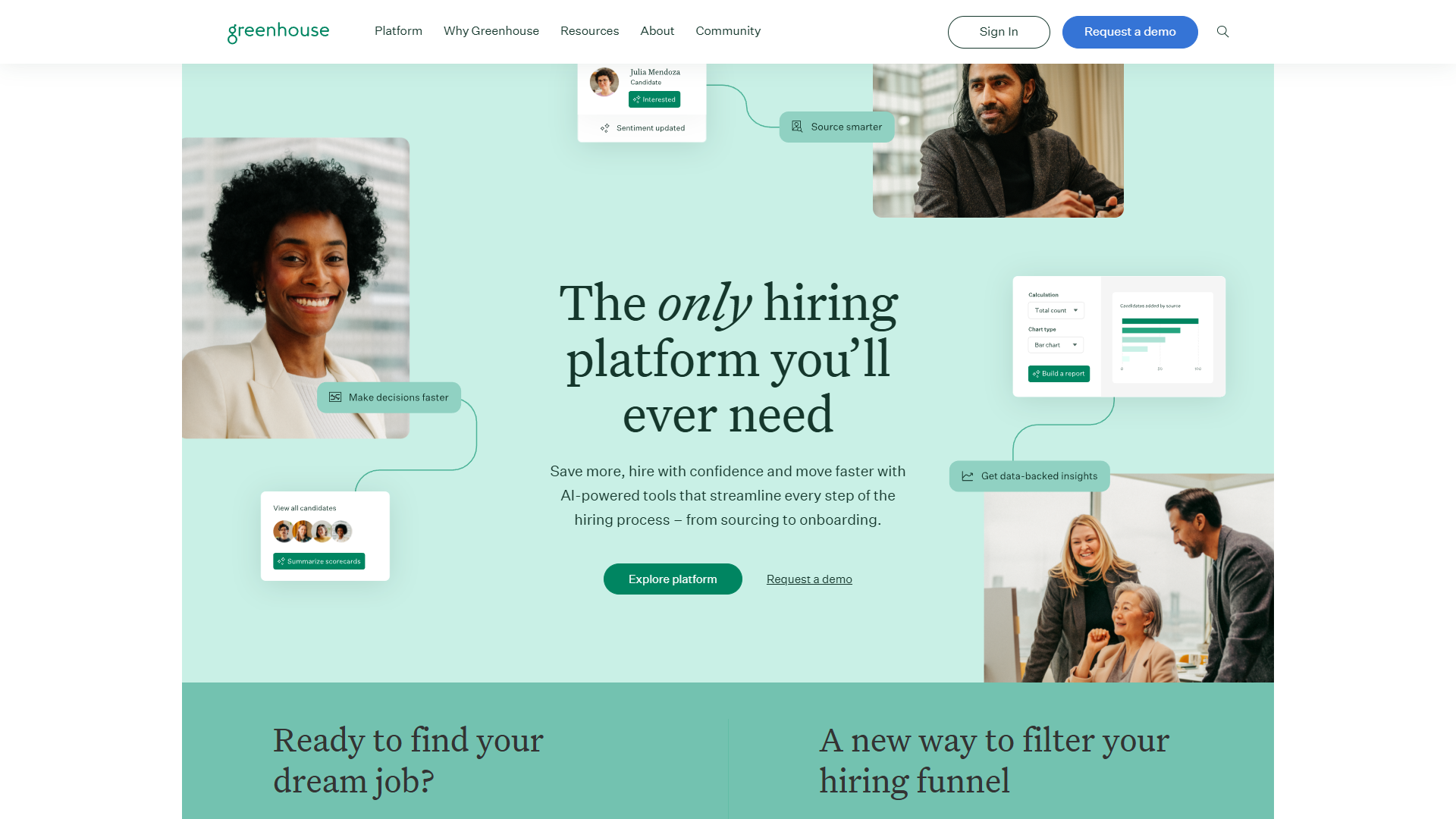
Greenhouse is the gold standard for structured hiring. Their platform focuses on reducing bias, improving candidate experience, and providing deep analytics.
Pricing tiers:
- Essential: $6,000-$18,000/year (unlimited users, core features)
- Advanced: $18,000-$35,000/year (adds interview kits, advanced scheduling)
- Expert: $50,000+/year (white-glove support, custom integrations)
Value proposition: Greenhouse reports 589% ROI based on IDC research, driven by 36% recruiter efficiency gains and 31% cost-per-hire reduction. Their structured interview methodology reduces bad hires and improves diversity metrics.
Worth the premium when: You’re making 20+ hires annually, value data-driven decision-making, and need robust DEI features.
JazzHR: The Budget-Friendly Option
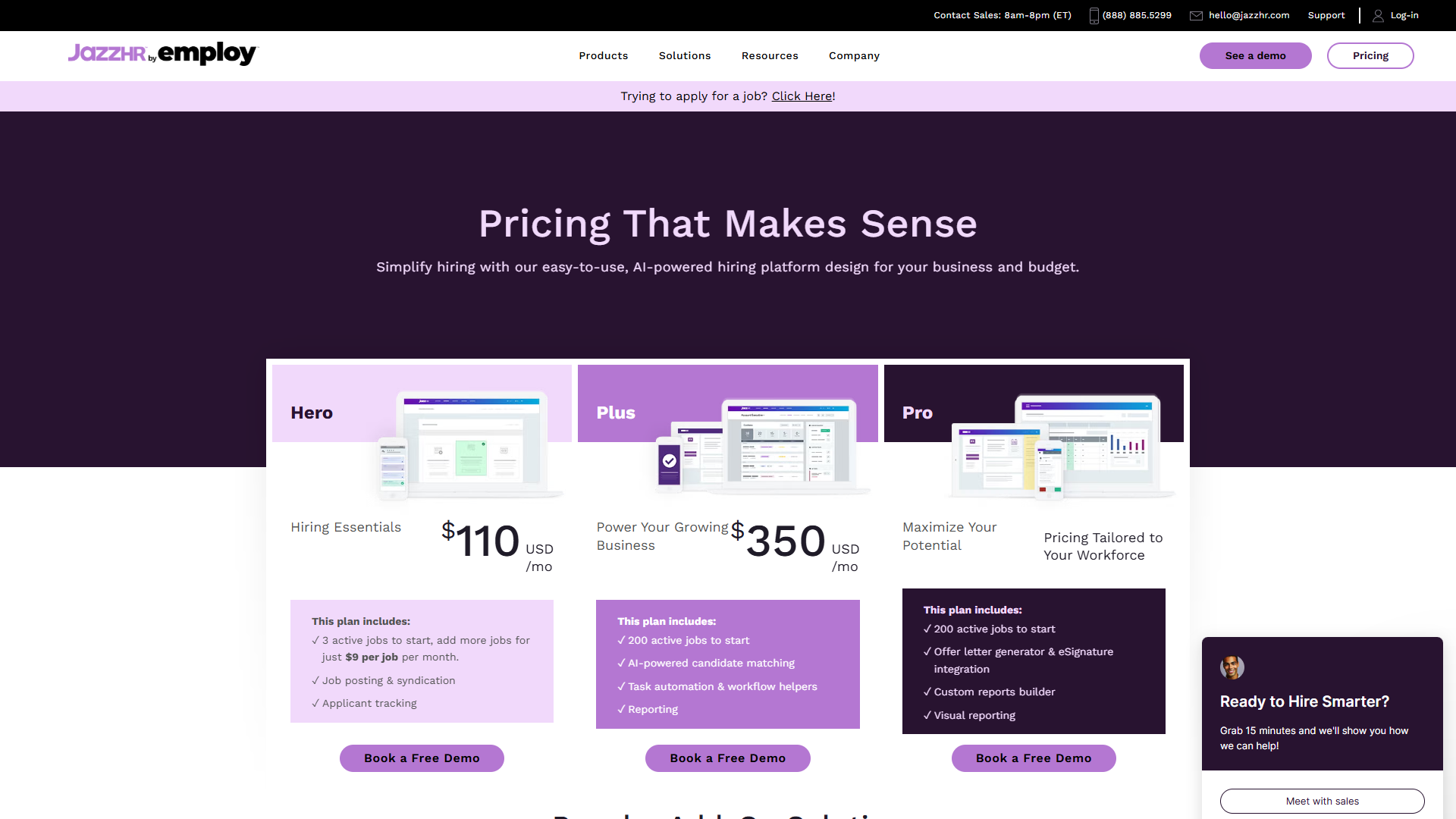
JazzHR provides exceptional value for startups and small businesses. At $75-$420/month ($900-$5,040/year), it’s the most affordable full-featured ATS.
Value proposition: Fast ROI through simplicity. Setup takes days instead of weeks, and the learning curve is minimal. You get automated job posting, resume parsing, interview scheduling, and reporting without enterprise complexity.
Worth it when: You’re hiring 5-20 people annually, have a small recruiting team, and need quick wins without extensive training.
Real ROI Examples
Example 1: 150-Person Marketing Agency
Scenario: Growing agency making 30 hires annually, previously using spreadsheets and email.
Investment: Greenhouse Essential at $12,000/year
Value gained:
- Time savings: Two recruiters gained 10 hours/week each (20 hours total × $45/hour × 52 weeks = $46,800)
- Agency fee reduction: Brought 8 hires in-house that would have gone to agencies (8 × $11,000 average fee = $88,000)
- Bad hire prevention: Structured interviews helped avoid 1 bad hire ($18,000 cost avoided)
- Improved candidate experience: 40% increase in offer acceptance rate, reducing restart costs ($8,000 in re-recruitment avoided)
Total value: $160,800 First-year ROI: 1,240% Payback period: 3.3 months
Example 2: 40-Person SaaS Startup
Scenario: Series A startup scaling from 20 to 60 employees, hiring 15 people in year one.
Investment: JazzHR at $1,500/year
Value gained:
- Time savings: Founder/CEO recovered 3 hours per week from hiring tasks (3 hours × $150 effective rate × 52 weeks = $23,400)
- Agency avoidance: Avoided 3 agency placements for specialized roles (3 × $10,000 = $30,000)
- Faster hiring: Reduced time-to-fill by 12 days average, decreasing vacancy costs ($164/day × 12 days × 15 hires = $29,520)
Total value: $82,920 First-year ROI: 5,428% Payback period: 0.7 months (3 weeks)
Example 3: DIY Calculation for Your Company
Here’s the formula you can apply to your situation:
Step 1: Calculate recruiter time savings
- Current hours spent on admin tasks per week: _____ hours
- Expected reduction with ATS (typically 40-60%): _____ hours
- Hourly rate: $_____
- Annual value: Hours saved × Rate × 52 weeks = $_____
Step 2: Calculate cost-per-hire reduction
- Current average cost per hire: $_____
- Expected reduction (typically 20-35%): _____%
- Annual hires: _____
- Annual value: Cost × Reduction % × Hires = $_____
Step 3: Calculate agency fee avoidance
- Current agency hires per year: _____
- Expected in-house conversion: _____
- Average agency fee: $_____
- Annual value: Conversions × Fee = $_____
Step 4: Calculate bad hire prevention
- Expected bad hires avoided per year (conservative: 1): _____
- Average salary: $_____
- Cost of bad hire (30% of salary): $_____
- Annual value: Bad hires avoided × Cost = $_____
Total annual value: Step 1 + Step 2 + Step 3 + Step 4 = $_____ ATS cost: $_____ ROI: (Value - Cost) / Cost × 100 = _____%
When ATS is NOT Worth It
An ATS isn’t always the right investment. You should skip or delay an ATS investment if:
You’re hiring fewer than 5 people annually. The time savings won’t justify even budget-tier ATS pricing. At this volume, a simple spreadsheet or free tool like Google Forms works fine. Your time is better spent on sourcing and candidate engagement than system administration.
You have no budget for training and change management. An ATS only delivers ROI if your team actually uses it properly. If you can’t invest 10-20 hours in initial training and ongoing optimization, the system will become shelfware. Unused software has negative ROI.
Your existing tools already meet your needs. If you’re using a combination of LinkedIn Recruiter, email, and Calendly successfully, and your team is satisfied with the workflow, don’t fix what isn’t broken. ATS investment should solve real pain points, not theoretical ones.
You’re in a hiring freeze or uncertainty. If you’re planning to make only 2-3 hires in the next 12 months due to budget constraints or market conditions, delay the ATS investment until hiring ramps up. The ROI won’t materialize at low volumes.
You need immediate hires and lack implementation time. ATS implementation typically takes 2-6 weeks for setup, data migration, and training. If you need to fill critical positions in the next 30 days, focus on hiring first and implement the ATS afterward.
Your hiring process is undefined. An ATS codifies your hiring workflow. If you don’t have a consistent process (defined interview stages, scorecards, decision criteria), implementing an ATS will expose those gaps painfully. Define your process first, then select the ATS that supports it.
Conclusion
When evaluating Ats Roi Calculator, ATS ROI isn’t one-size-fits-all. A $50,000 enterprise platform makes perfect sense for a company hiring 200 people annually but would be financial malpractice for a startup making 8 hires. The key is matching your investment to your actual hiring volume and pain points.
The most reliable ROI comes from three sources: recruiter productivity gains, cost-per-hire reduction through agency fee avoidance, and bad hire prevention through structured interviewing. Companies making 15+ hires annually almost always see positive ROI within 4-6 months.
Use the DIY calculation framework in this guide to model your specific situation. Be conservative with your estimates. If the math shows 100%+ ROI even with pessimistic assumptions, you’ve found a clear winner.
For most SMBs and growing startups, Greenhouse Essential at $6,000-$18,000/year offers the best balance of features and value. Their structured hiring methodology, combined with deep analytics and a robust integration ecosystem, delivers measurable results. With reported ROI up to 589% and an average 4-month payback period, it’s one of the few HR investments that consistently pays for itself in year one.
Ready to see if Greenhouse is right for your hiring volume? Check out our detailed Greenhouse review for pricing breakdowns, feature comparisons, and implementation timelines.
For more information about ats roi calculator, see the resources below.
External Resources
For official documentation and updates:
- Greenhouse — Official website
- OpenAI — Additional resource