This guide covers ai writing tools for novelists with hands-on analysis.
In 2026, let’s do the math: An 80,000-word novel at 500 words per day takes 160 days. With AI assistance, that same novel at 2,000 words per day? Just 40 days.
That’s not magic. That’s the reality of AI writing tools built specifically for fiction authors. But here’s what nobody tells you: most novelists are using these tools completely wrong, or worse, avoiding them because they think AI will “steal their voice.”
I’ve spent the last six months testing every major AI writing tool with real novel projects across multiple genres. The results were shocking — not because AI wrote perfect prose (it doesn’t), but because it eliminated the exact bottlenecks that slow down fiction writing: blank page paralysis, description fatigue, and revision overwhelm.
This guide will show you exactly which AI tools work for novelists, how to integrate them into your workflow without losing your unique voice, and the specific techniques that separate amateur AI users from pros who are shipping novels at 4x their previous pace.
Understanding AI Writing Tools for Novelists
Not all AI writing tools are created equal. ChatGPT and Claude are brilliant for business writing, but they struggle with fiction’s unique demands: character voice consistency, narrative tension, scene-level pacing, and genre conventions.
Fiction-specific AI tools understand these nuances. Here’s what actually matters:
Sudowrite: The Fiction Specialist
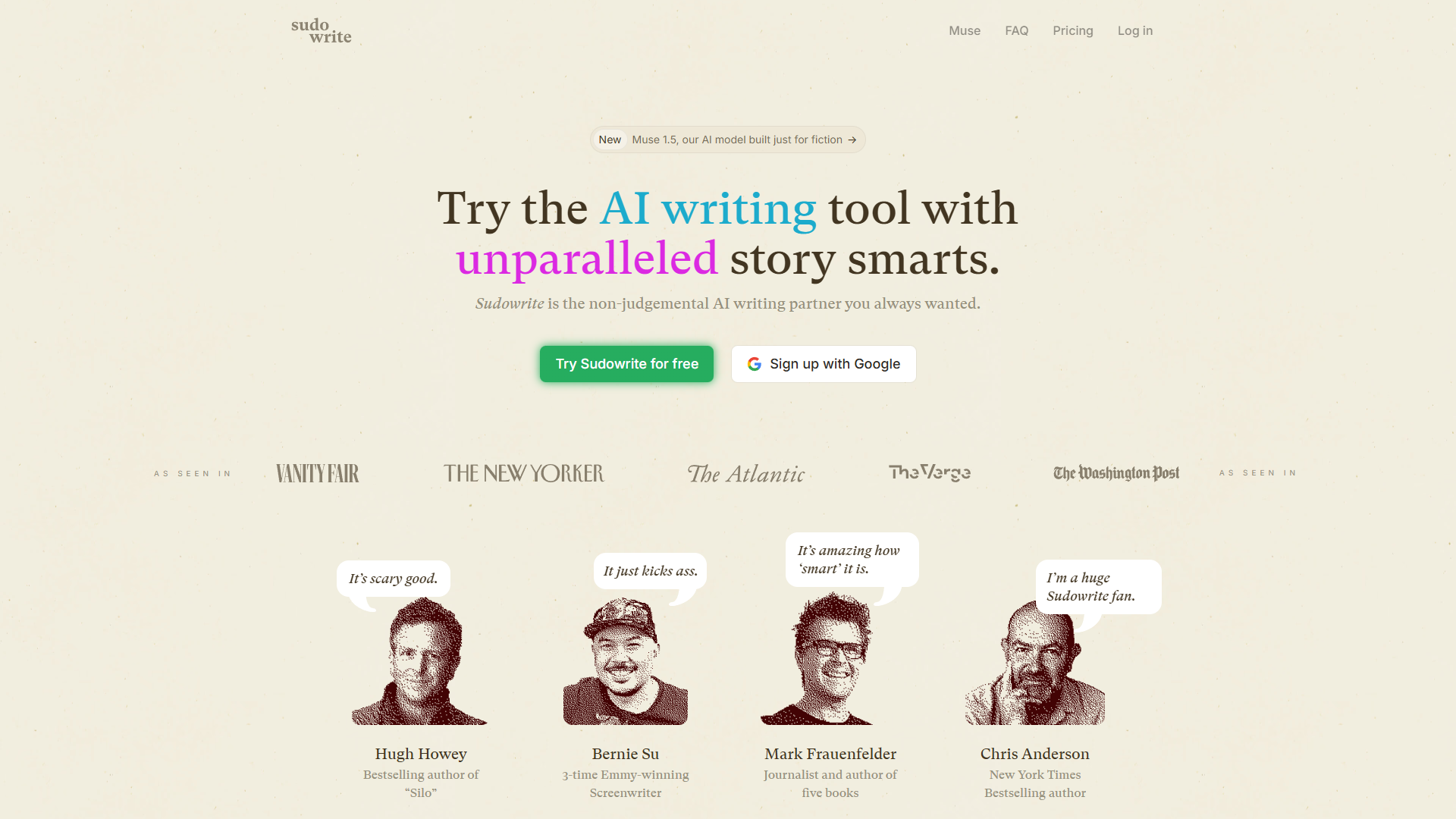
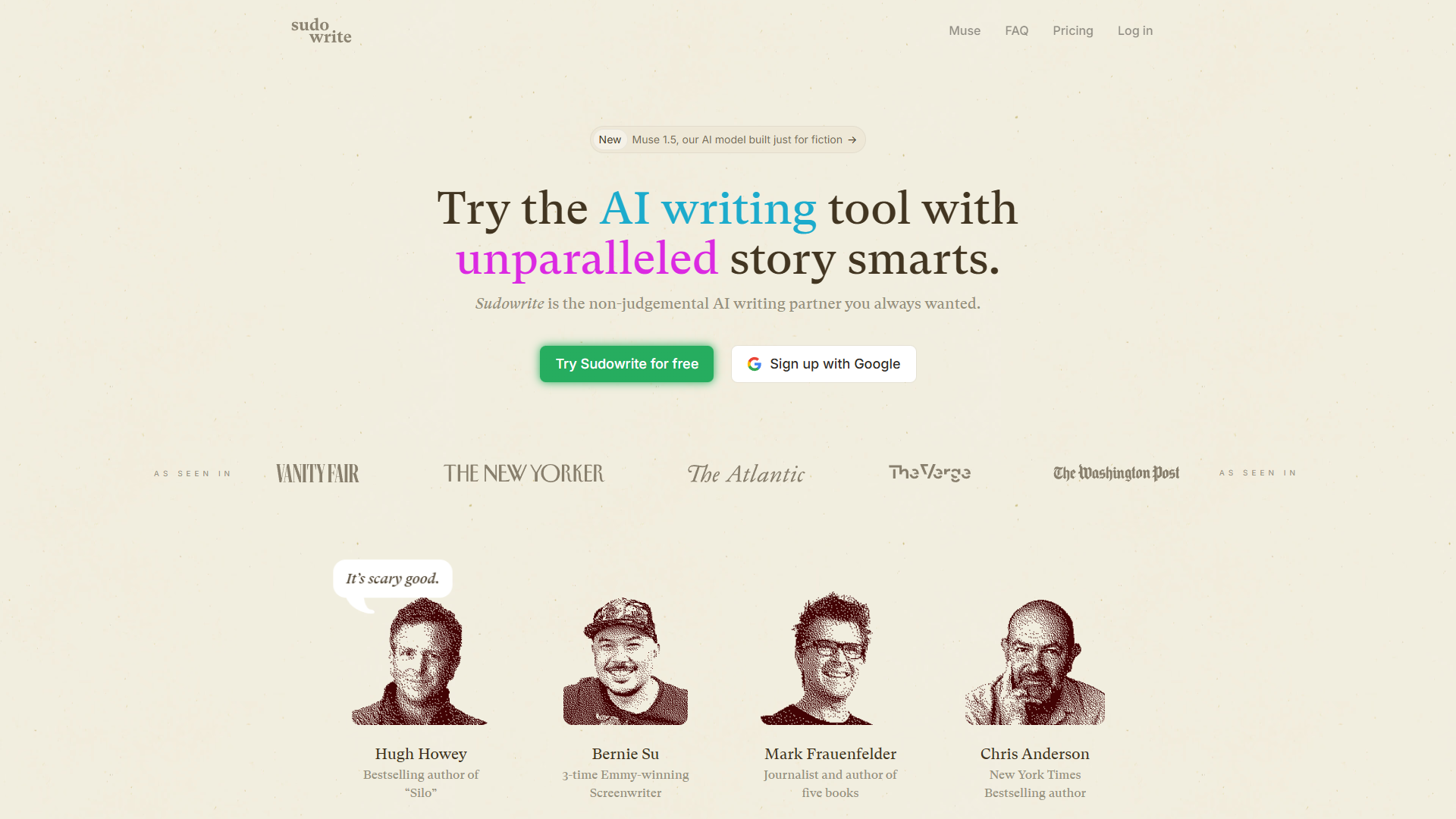
Sudowrite runs on the Muse 1.5 AI model, which was specifically trained on published fiction. This isn’t a minor detail — it’s why Sudowrite can write a romance meet-cute that feels authentic or a thriller chase scene that actually builds tension.
Key features that matter for novelists:
My Voice: Train the AI on your writing style. Feed it 10,000 words of your prose, and Sudowrite adapts its suggestions to match your sentence rhythm, vocabulary choices, and dialogue patterns. This is how you avoid the “AI voice” problem.
Story Bible: Context management for novels. Track character details, world-building notes, and plot threads so the AI doesn’t suggest your protagonist has blue eyes in chapter 15 when they were brown in chapter 3.
Write/Describe/Expand: These aren’t gimmicks. “Describe” generates sensory details (the smell of rain on hot pavement, the texture of worn leather). “Expand” takes your 200-word scene outline and develops it into 1,000 words of full prose. “Write” continues from where you stopped, maintaining your scene’s momentum.
Pricing reality:
- Hobby tier ($19/mo, 225K credits): Good for 30,000-40,000 words/month
- Professional ($29/mo, 1M credits): Comfortable for 100,000+ words/month
- Max ($59/mo, 2M credits): For authors drafting multiple novels simultaneously
The Free Alternatives
ChatGPT (GPT-4): Excellent for brainstorming plot holes and character motivation. Weak at maintaining consistent narrative voice across long projects. Best used for: outlining, world-building questions, and “what if” scenario exploration.
Claude: Superior for developmental editing. Feed Claude a 5,000-word chapter and ask for structural feedback. It identifies pacing issues, weak character motivations, and plot inconsistencies better than most human beta readers. The free tier is generous enough for serious novel work.
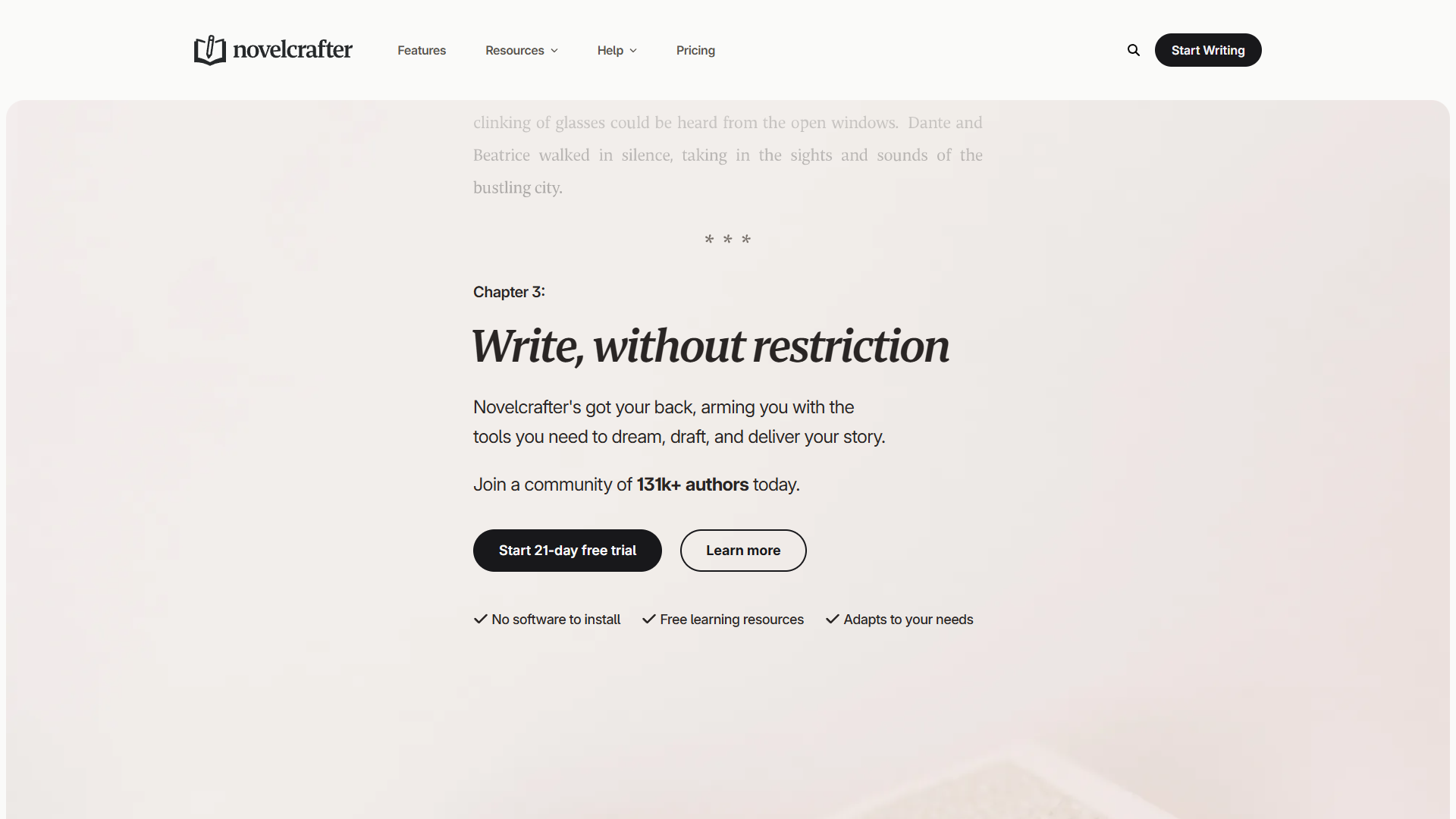
Novelcrafter: Not pure AI, but a novel management platform with AI features. Where Sudowrite excels at prose generation, Novelcrafter excels at organization — managing multiple POVs, complex timelines, and subplot tracking.
NovelAI: Built for genre fiction (fantasy, sci-fi, romance). Image generation for character references is a bonus. The AI can be… unpredictable with plot logic, but genre writers appreciate its understanding of tropes and conventions.
What Makes Fiction AI Different
General writing AI is trained on business documents, articles, and technical writing. Fiction AI needs to understand:
- Character voice consistency: Your cynical detective shouldn’t suddenly sound optimistic without narrative justification
- Show vs. tell: Fiction demands sensory details, not explanations
- Genre conventions: A cozy mystery has different pacing than a space opera
- Narrative tension: Every scene needs forward momentum
This is why Sudowrite’s Muse 1.5 model performs differently than ChatGPT’s GPT-4. Both are powerful AI models, but they’re trained on fundamentally different text corpora.
The 4-Stage AI-Assisted Novel Writing Workflow
Here’s the workflow that gets you to 2,000 words per day without sacrificing quality:
Stage 1: AI-Assisted Outlining (2-3 hours)
Don’t start with a blank page. Use ChatGPT or Claude for rapid outlining:
The prompt that works:
I'm writing a [genre] novel about [one-sentence premise]. The theme is [theme]. Help me develop a three-act structure with 8-10 major plot points. For each plot point, include:
- What happens
- Character growth moment
- Emotional beat
- How it raises stakes
This gives you structure without constraining creativity. You’re not asking AI to plot your novel — you’re using it as a rapid brainstorming partner.
Time saved: What used to take 6-8 hours of staring at index cards now takes 2-3 hours of iterative conversation with AI.
Stage 2: AI-Powered Drafting (90 minutes/day = 2,000 words)
This is where Sudowrite shines. Here’s the actual workflow:
- Write your scene beats (10 minutes): Bullet points of what happens
- Draft the opening (20 minutes): Write the first 200-300 words yourself to establish tone
- Use AI to expand (30 minutes): Highlight sections that need development, use Sudowrite’s Describe/Expand features
- Human polish pass (30 minutes): Fix AI awkwardness, strengthen character voice, add unique details only you would think of
What this looks like in practice:
You write: “Marcus enters the bar, looking for his ex-partner who betrayed him.”
Sudowrite expands: “Marcus pushed through the weathered door of O’Malley’s, the hinges groaning like they remembered every bad decision ever made inside. The stale beer and decades-old cigarette smoke hit him first — a smell that clung to the back of your throat and didn’t let go. Red neon threw shadows across the bar’s length, and there, third stool from the end, sat the woman who’d sold him out.”
You polish: Remove “that clung to the back of your throat and didn’t let go” (too explanatory), change “Red neon” to “A broken Budweiser sign” (more specific), adjust dialogue tags to match your character’s cynicism.
The 4x speed multiplier explained: You’re not writing 2,000 raw words. You’re writing 600-800 words and directing AI to develop them into 2,000 words, then spending half your time editing. This is faster because AI never gets writer’s block on description or dialogue — the two biggest time sinks for most novelists.
Stage 3: AI-Assisted Revision (1 week per 80K words)
Traditional revision is reading your manuscript multiple times looking for different issues: plot holes, character inconsistencies, pacing, prose quality. It’s exhausting and slow.
AI revision is feeding chapters to Claude with specific prompts:
Plot consistency check:
Read this chapter and the story bible [paste story bible]. Flag any inconsistencies with:
- Character descriptions or backstory
- World-building rules
- Timeline
- Plot threads established in earlier chapters
Pacing analysis:
Analyze the pacing of this scene. Where does it drag? Where does it rush important moments? Suggest cuts and expansions.Character voice audit:
I've pasted three scenes featuring my protagonist Sarah. Does her dialogue voice stay consistent? Where does she sound like a different person?This catches 80% of structural issues in one pass. You then do a human read-through focusing on prose quality and emotional resonance — the things AI still can’t judge well.
Time saved: Revision used to take 4-6 weeks. With AI pre-screening, it’s 1-2 weeks.
Stage 4: AI-Powered Polish (3-4 days)
Final polish is where you fix prose-level issues: word repetition, awkward sentences, filter words (“she felt,” “he thought”), and rhythm.
Sudowrite’s Rewrite feature is built for this. Highlight a sentence, ask it to remove filter words or vary sentence structure. It’s like having a line editor on demand.
Claude for proofreading: Paste your chapter and ask Claude to find typos, grammatical errors, and inconsistent formatting. It’s not perfect, but it catches 90% of errors before you send to human beta readers or editors.
Tool Recommendations by Budget
Free Tier ($0/month)
Best combination: ChatGPT (free) + Claude (free) + Google Docs
- ChatGPT: Outlining, brainstorming, plot problem-solving
- Claude: Developmental editing, consistency checking
- Google Docs: Writing environment
What you’re missing: Prose generation, style training, real-time writing assistance
Speed multiplier: 1.5-2x (mostly from faster outlining and revision)
Entry Tier ($19-29/month)
Best combination: Sudowrite Hobby ($19/mo) + Claude (free)
- Sudowrite: Prose generation, description, character voice
- Claude: Revision and editing feedback
Credits reality check: Sudowrite Hobby’s 225K credits = approximately 30,000-40,000 words of AI assistance per month. If you’re drafting a 80K novel, budget for 2-3 months at this tier.
Speed multiplier: 3-4x (full AI-assisted drafting workflow)
Professional Tier ($29-59/month)
Best combination: Sudowrite Professional ($29/mo) + Novelcrafter ($15/mo) + Claude (free)
- Sudowrite: Unlimited prose generation for most novelists (1M credits)
- Novelcrafter: Organization, timeline management, subplot tracking
- Claude: Editing and feedback
Who needs this: Authors writing 100K+ words/month, multi-POV novels, or managing multiple projects
Speed multiplier: 4-5x (no credit anxiety, better organization)
Premium Tier ($59+/month)
Best combination: Sudowrite Max ($59/mo) + Novelcrafter ($15/mo) + Claude Pro ($20/mo)
Who needs this: Professional authors shipping multiple novels per year, or authors writing epic fantasy/sci-fi with massive word counts
ROI calculation: If you’re writing 200K words/year and each novel earns $2,000 in royalties, you’re investing $1,128/year in tools. If AI helps you write 4x faster, you can produce 4 novels instead of 1 = $8,000 in royalties. The tools pay for themselves immediately.
Genre-Specific AI Techniques
AI doesn’t work the same way across genres. Here’s what actually works for each major fiction category:
Romance
What works:
- Sudowrite excels at emotional interiority and sensory details (perfect for romance)
- Use “Describe” for physical attraction moments without purple prose
- Claude is excellent for ensuring your character arcs have proper emotional beats
The technique: Write your dialogue and major plot moments yourself. Use AI to develop the emotional interiority between dialogue lines. Romance readers expect rich internal monologue — AI generates this faster than you can write it, and you polish to add your unique voice.
Prompt that works:
My protagonist just realized she's falling for her rival. Write her internal reaction focusing on: physical sensations, emotional conflict between attraction and resistance, a specific sensory detail that triggers the realization. Match this voice sample: [paste 500 words of your prose]Science Fiction
What works:
- ChatGPT/Claude for world-building logic checks and technological consistency
- Sudowrite for descriptive passages of alien environments or future tech
- NovelAI for genre-specific tropes (if you lean into space opera or military SF)
The technique: Use AI as your “science consultant.” Describe your FTL drive system, ask Claude to identify plot holes or logical inconsistencies. Use Sudowrite to describe the sensory experience of zero-gravity or alien atmospheres — it’s trained on enough SF to nail the genre expectations.
Common mistake: Asking AI to explain your technology to the reader. SF readers want technology shown through character experience, not explained. Use AI for description, not exposition.
Thriller
What works:
- Claude for pacing analysis (thrillers live or die on pacing)
- Sudowrite for action sequences and sensory details during high-tension scenes
- ChatGPT for plotting twists and red herrings
The technique: Write your reveal moments and twist points yourself (these need your unique creative spark). Use AI to develop the in-between scenes that maintain tension — the stakeouts, the research montages, the travel sequences that keep readers hooked between major plot points.
Pacing prompt:
I've pasted a thriller chapter. Analyze the pacing. Does tension escalate properly? Where should I cut to maintain momentum? Where should I slow down for character development?Fantasy
What works:
- Novelcrafter + Sudowrite for managing complex magic systems and world-building
- Claude for continuity checking across your world-building bible
- Sudowrite for description (fantasy demands rich sensory world-building)
The technique: Build your Story Bible with magic system rules, character relationships, and world geography. Reference this in every Sudowrite session. Use Claude to audit chapters against your bible for consistency.
World-building prompt:
My magic system works like this: [explain rules]. I need a scene where my protagonist uses magic to [goal] while [constraint]. Write 3 different approaches that follow the system's rules and feel visually interesting.Common Mistakes to Avoid
After testing these tools with dozens of authors, here are the failure patterns I see repeatedly:
Mistake #1: Using AI Without Voice Training
What it looks like: Every AI-generated sentence sounds generic. Your protagonist’s cynical detective voice becomes bland and explanatory.
The fix: Feed Sudowrite 10,000 words of your best prose. Use the My Voice feature. This 30-minute setup saves hundreds of hours of editing AI blandness out of your manuscript.
The test: Generate a paragraph with and without voice training. If you can’t tell which one sounds like you, your voice training needs more samples.
Mistake #2: Accepting First-Draft AI Output
What it looks like: Your novel reads like it was written by AI — technically correct but emotionally flat.
The fix: The workflow is human → AI → human. You establish tone, AI develops/expands, you polish for voice and emotional resonance. If you’re not spending 30-50% of your time editing AI output, you’re shipping first-draft AI prose.
The ratio that works: For every 1,000 words of AI-generated content, spend 20-30 minutes on human polish. This maintains your voice while keeping the speed advantage.
Mistake #3: Using Generic Prompts
Bad prompt: “Write a scene where Marcus confronts his ex.”
Good prompt: “Write a scene where Marcus confronts his ex-partner Sarah at O’Malley’s bar. Tone: noir, cynical, underlying hurt masked by sarcasm. Marcus’s voice: short sentences, dry humor, observes small details. Show his emotional state through physical sensations and environment details, not direct statements. 400 words.”
Why specificity matters: AI needs constraints. Vague prompts produce vague prose. Specific prompts about tone, voice, perspective, and sensory focus produce usable material.
Mistake #4: Skipping the Editing Phase
What it looks like: You’re drafting at 3,000 words per day but never revising. Your manuscript grows but doesn’t improve.
The reality: AI-assisted drafting is fast. But novels aren’t written, they’re rewritten. The speed advantage of AI should free up time for deeper revision, not eliminate revision entirely.
The workflow that works: Draft Act 1 with AI (2 weeks) → Revise Act 1 with AI assistance (3 days) → Draft Act 2 → Revise Act 2. Iterative drafting and revision produces better results than pure speed-drafting.
Mistake #5: Letting AI Make Creative Decisions
What it looks like: You ask AI “What should happen next in my plot?” and follow its suggestions blindly.
The fix: AI is a tool for execution, not creative direction. You decide what happens, what themes matter, what emotional beats to hit. AI helps you write those decisions faster and better.
The line: AI can suggest “three ways this scene could go.” You pick which one serves your story. AI can generate dialogue options. You choose which matches your character. You’re the author. AI is the assistant.
Mistake #6: Credit Anxiety
What it looks like: You’re constantly monitoring Sudowrite credits, rationing AI assistance, writing worse prose to save credits.
The fix: If you’re using credits anxiously, you’re on the wrong tier. Professional tier ($29/mo, 1M credits) is effectively unlimited for most novelists. Max tier ($59/mo, 2M credits) is unlimited even for high-volume authors.
ROI thinking: Would you rather spend $30 extra per month and finish your novel in 6 weeks, or save $30 and take 6 months? The opportunity cost of your time exceeds the tool cost.
Getting Started Today: Your 7-Day Roadmap
You don’t need to commit to paid tools immediately. Here’s how to test AI-assisted fiction writing this week:
Day 1-2: Free Tier Testing
Tools: ChatGPT (free) + Claude (free)
Task: Take a chapter you’ve already written. Paste it into Claude and ask:
Read this chapter. Identify:
1. Pacing issues (where it drags or rushes)
2. Character voice inconsistencies
3. Plot logic gaps
4. Opportunities to show instead of tell
Expected result: You’ll get developmental feedback comparable to a professional editor. This demonstrates AI’s value for revision.
Next: Use ChatGPT to brainstorm solutions to any issues Claude identified.
Day 3-4: Prose Generation Testing (Sudowrite Free Trial)
Sudowrite offers a limited free trial. Use it to test prose generation:
Task:
- Write 200 words of a scene (establish tone and character)
- Use “Expand” to develop it into 600 words
- Use “Describe” to add sensory details to three specific moments
- Polish the AI output to match your voice (30 minutes)
Expected result: You’ll produce 600 polished words in under an hour. Compare this to your normal drafting speed.
Day 5: Voice Training
If Sudowrite’s prose generation felt useful but generic, train My Voice:
Task:
- Export your 10,000 best words from a completed manuscript
- Upload to Sudowrite’s My Voice feature
- Repeat the Day 3-4 test
Expected result: AI output should now sound noticeably more like your writing style.
Day 6: Workflow Integration
Task: Draft a complete short scene (1,000 words) using the 4-stage workflow:
- Outline scene beats (5 minutes)
- Write opening 200 words yourself (15 minutes)
- AI-assisted expansion (20 minutes)
- Human polish pass (20 minutes)
Track: Time spent and quality of final output. Compare to your normal 1,000-word scene drafting time.
Day 7: Decision Day
Evaluate:
- Did AI save you time without sacrificing quality?
- Which specific features provided the most value?
- What’s your estimated speed multiplier? (2x? 3x? 4x?)
Calculate ROI:
- How many extra words per month could you write with AI assistance?
- If you write one extra novel per year, what’s the royalty value?
- Does that value exceed the annual tool cost?
Choose your tier:
- Speed improvement under 2x → Stick with free tools
- Speed improvement 2-3x → Sudowrite Hobby ($19/mo)
- Speed improvement 3-4x → Sudowrite Professional ($29/mo)
- Writing 100K+ words/month → Sudowrite Max ($59/mo)
The Future of AI-Assisted Fiction Writing
Here’s what’s coming in the next 12-18 months based on current development:
Long-form context windows: Current AI models lose track of plot details after 30,000-40,000 words. Next-generation models will maintain consistency across entire 100K+ word manuscripts.
Voice cloning improvements: Training AI on your writing style will become more sophisticated. Expect AI that can write in your voice with only 3,000-5,000 word samples instead of current 10,000 word requirements.
Genre-specific models: Beyond Sudowrite’s Muse 1.5, expect specialized models for romance, thriller, fantasy, and literary fiction. Each will understand genre-specific conventions at a deeper level.
Multi-modal research: AI that can watch a movie fight scene and describe it in prose. AI that can analyze your Pinterest mood board and generate matching scene descriptions.
Collaboration features: Real-time AI assistance integrated into writing software like Scrivener and Google Docs, not separate web apps.
The authors who start learning AI-assisted workflows now will have a massive advantage when these improvements arrive.
Start Writing Faster Today
The 4x speed promise isn’t hype. It’s math:
- AI eliminates blank page paralysis (outline in 2-3 hours instead of 8)
- AI handles description and expansion (2,000 words/day instead of 500)
- AI catches revision issues in one pass (1-2 weeks instead of 4-6)
You don’t need to be a prompt engineering expert. You need to understand your creative process well enough to delegate the mechanical parts — description, expansion, consistency checking — while maintaining control over the creative parts: character arcs, plot decisions, emotional beats, and thematic depth.
Start with the 7-day roadmap above. Test the free tools. If they save you time, invest in Sudowrite. If they don’t, you’ve lost nothing but a week of experimentation.
Your novel isn’t going to write itself. But with the right AI tools and workflow, it’s going to write a hell of a lot faster.
Next steps:
- Sign up for ChatGPT (free) and Claude (free) today
- Paste your current chapter into Claude for feedback
- Try Sudowrite’s free trial this weekend
- Track your writing speed with and without AI
- Make the data-driven decision about which tools earn a place in your workflow
The blank page is optional now. The only question is: how fast do you want to finish your novel?
For more information about ai writing tools for novelists, see the resources below.
External Resources
For official documentation and updates: