The best AI sales coaching tools can boost win rates by 32% and increase quota attainment by 28%. But with dozens of platforms claiming similar results, how do you choose?
After analyzing conversation intelligence platforms, sales enablement suites, and AI-powered coaching systems, I’ve narrowed it down to four tools that actually deliver: Revenue.io, Highspot, HubSpot, and Salesforce. Each excels in different areas, and this guide will help you match your needs to the right platform.
The stakes are high. Research shows that 84-90% of sales training is forgotten without reinforcement. Modern AI sales coaching tools solve this by providing real-time guidance during calls, automated call scoring, and personalized improvement recommendations. Third-generation platforms now score 100% of calls versus the 5-10% manual review rate of traditional methods.
What Makes Great AI Sales Coaching Software
Before diving into specific tools, let’s establish what separates effective AI sales coaching tools from glorified call recorders.
Conversation Intelligence is the foundation. The platform should transcribe calls in real-time, identify key moments (objections, buying signals, competitor mentions), and surface actionable insights. Basic transcription isn’t enough — you need semantic understanding of sales conversations.
Real-Time Coaching provides live prompts during calls. When a prospect mentions a competitor, the AI should instantly surface your competitive battlecard. When you detect hesitation, it should suggest proven objection-handling frameworks. This real-time guidance is what separates coaching from simple analytics.
Automated Scoring and Analysis evaluates every call against your methodology. Talk-listen ratios, question frequency, next-step clarity — the AI should assess these factors automatically and flag coaching opportunities. Manual review of 5-10% of calls leaves 90% of learning opportunities on the table.
Integration Depth with your CRM determines whether insights translate to action. Call notes, next steps, and opportunity updates should sync bidirectionally. The best platforms are Salesforce-native or offer enterprise-grade integrations with automatic activity logging.
Personalized Coaching Paths adapt to each rep’s strengths and weaknesses. Cookie-cutter training fails because every seller has different gaps. AI should identify patterns (struggles with discovery, weak at closing, rushes through qualification) and recommend targeted coaching content.
The Top 4 AI Sales Coaching Tools for 2026
1. Revenue.io - Best for Salesforce-Native Sales Teams
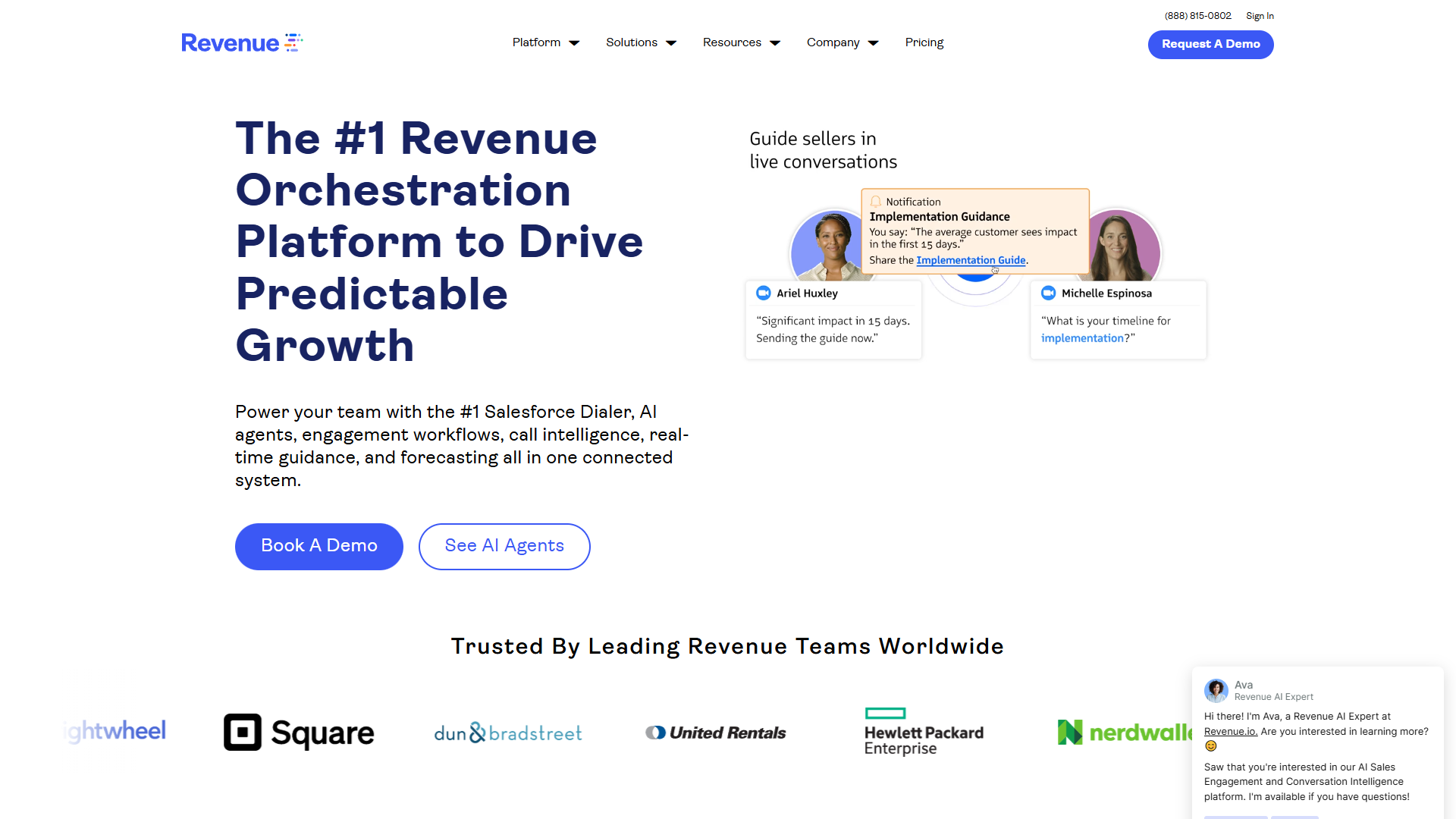
Revenue.io () positions itself as the complete sales engagement platform for Salesforce teams. What sets it apart is the depth of native integration — this isn’t a third-party tool bolted onto Salesforce, it’s built into the platform architecture.
Core Capabilities:
The platform combines three critical functions: the #1 Salesforce-native dialer, AI-powered conversation intelligence, and autonomous AI sales agents. The dialer handles 12,000+ calling minutes per enterprise user with features like voicemail drop (saves hours weekly for SDR teams), local presence dialing (significantly increases connection rates), and click-to-dial with automatic activity logging.
Conversation intelligence provides real-time insights during live calls. When you’re on a discovery call and the prospect mentions budget constraints, Revenue.io surfaces relevant case studies and ROI frameworks instantly. The AI scores calls against your sales methodology — talk-listen ratios, question quality, next-step clarity — and provides automated coaching feedback.
The AI Sales Agents are where Revenue.io gets interesting. These autonomous agents handle time-consuming tasks across the sales cycle: writing follow-up emails based on call transcripts, scoring opportunities for deal health, generating conversation summaries with key insights, and creating coaching recommendations aligned to your methodology.
Pricing:
Revenue.io uses custom pricing starting around $95/user/month. While they don’t publish a standard price sheet (contact sales for quotes), industry data suggests mid-market teams of 20-50 reps typically invest $2,000-4,000/month. Enterprise deployments with advanced features run $5,000-15,000/month depending on user count and integrations.
Best For:
Salesforce-committed organizations where bi-directional sync and native integration are non-negotiable. If your reps live in Salesforce and you need AI coaching that doesn’t require switching contexts, Revenue.io delivers. The platform particularly shines for high-velocity sales teams making 50+ calls daily who benefit from local presence, voicemail drop, and real-time coaching.
Limitations:
The dialer interface can feel clunky — it requires a separate window that frequently needs re-login according to user reviews. Contact search lacks predictive auto-populate functionality found in competitors like Salesloft. Activities log to contact level rather than opportunity level, which frustrates deal-centric workflows. Some users report occasional system freezing and dropped calls during peak usage.
2. Highspot - Best for Comprehensive Sales Enablement
Highspot () takes a broader approach than pure conversation intelligence. It’s an end-to-end sales enablement platform where AI coaching is one component of a larger go-to-market system encompassing content management, training, and analytics.
Core Capabilities:
The platform excels at three things: AI-powered content discovery, adaptive learning with AI Role Play, and comprehensive analytics. Content discovery uses AI to surface the right sales materials at the right time — when you’re on a call with a healthcare prospect, Highspot’s Copilot Agents automatically recommend relevant case studies, competitive battlecards, and ROI calculators specific to that vertical.
AI Role Play is Highspot’s standout coaching feature. Reps practice objection handling, discovery, and closing scenarios with an AI that adapts to their responses. The system scores performance on specific competencies (question quality, value articulation, objection handling) and provides targeted coaching recommendations. This addresses the 84-90% training retention problem by providing ongoing practice between live calls.
Adaptive learning paths personalize training based on rep performance. If the AI detects a rep struggles with technical discovery questions, it automatically assigns relevant training modules and practice scenarios. Skill proficiency scoring gives managers a data-driven view of coaching priorities across the team.
Pricing:
Highspot uses fully customized pricing with no published rates. Based on Vendr data, enterprise deployments average $91,460/year. Licensing is hybrid: full platform licenses for sellers, learning-only licenses (approximately $67/user/year) for teams needing just training, and partner licenses (approximately $183/user/year) for channel teams. This flexible approach saves 31% versus all-full-license deployments.
Implementation costs add $15,000-$45,000, content migration runs $8,000-$25,000, and custom integrations cost $5,000-$15,000 each. Premium support adds $12,000-$25,000 annually. Budget $100,000-$150,000 for a 100-person deployment in year one.
Best For:
Organizations that need more than call coaching — teams wanting integrated content management, training, and enablement in one platform. If you’re struggling with content sprawl (sales materials scattered across SharePoint, Google Drive, and individual hard drives), Highspot solves that while adding AI coaching. The platform particularly suits enterprise teams (100+ sellers) who can justify the investment.
Limitations:
The breadth is both a strength and weakness. Frequent updates cause confusion as features move or change. The learning curve is steep — expect 4-6 weeks for full team adoption. No free trial or free tier makes evaluation difficult. Some users report the mobile experience needs improvement, and certain features feel hidden in the interface.
3. HubSpot - Best for All-in-One CRM Teams
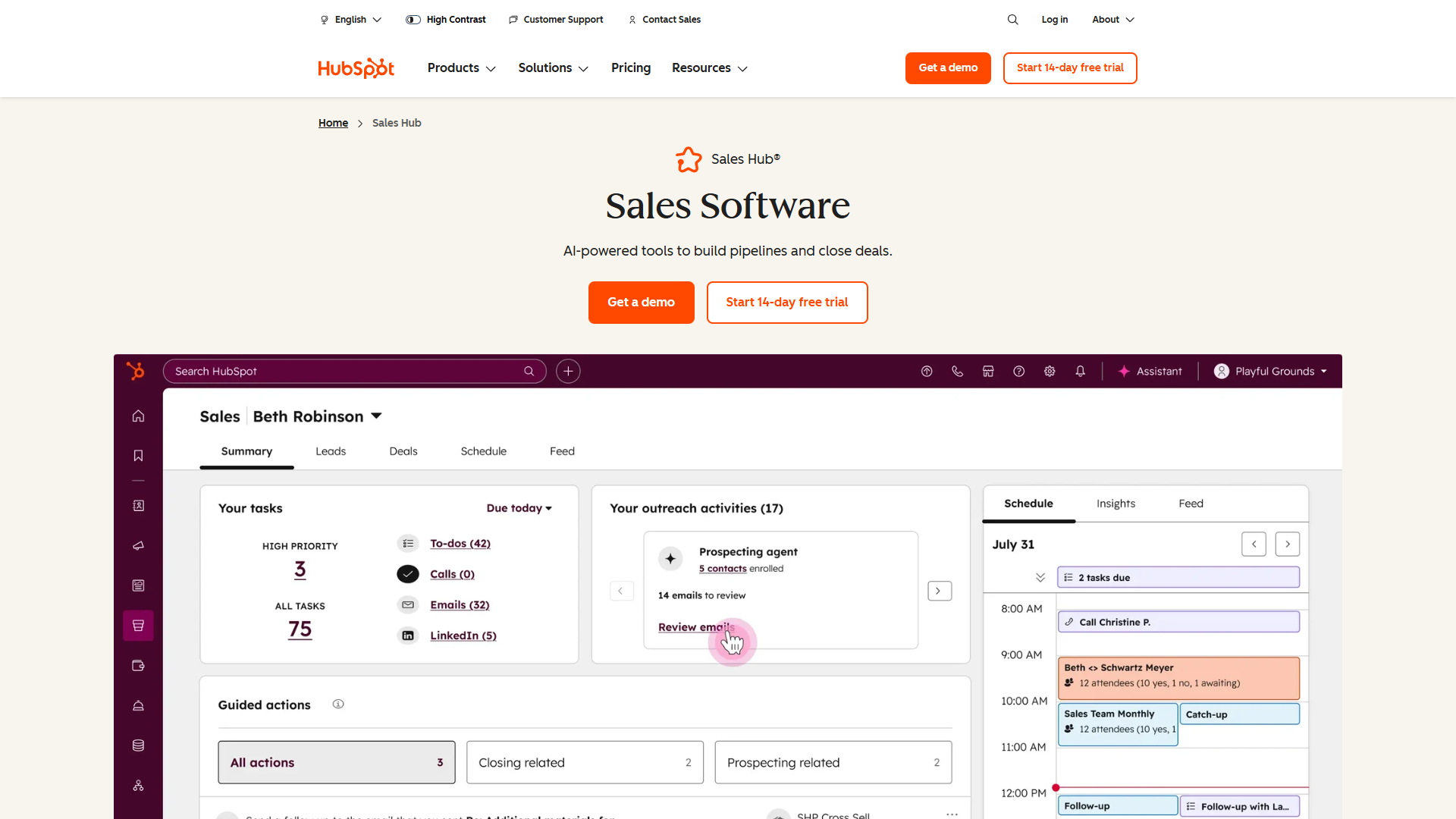
HubSpot () brings AI sales coaching into its broader CRM ecosystem through the Breeze AI Suite. If you’re already using HubSpot for marketing automation or service, adding sales coaching capabilities is seamless. If you’re not, the platform offers an all-in-one alternative to best-of-breed point solutions.
Core Capabilities:
Breeze AI Assistant provides contextual coaching during sales activities. When drafting a follow-up email, it suggests personalized content based on previous interactions, deal stage, and buyer signals. During calls (recorded via integrations with Zoom, Teams, or Google Meet), it surfaces relevant talking points and detects buyer objections.
The Breeze Prospecting Agent automates research and outreach. It enriches contact data, identifies buying signals (job changes, funding rounds, technology adoption), and drafts personalized outreach sequences. For coaching, this means reps spend less time on research and more time having coached conversations.
Sales sequences and lead scoring provide structure. Managers can build best-practice sequences (emails, tasks, calls) that embody your methodology. AI scores leads based on engagement and fit, focusing rep attention on high-potential opportunities where coaching matters most.
Pricing:
HubSpot’s tiered pricing is refreshingly transparent compared to custom-only competitors:
- Free Tools: Basic CRM for 2 users with limited Breeze AI features
- Starter Customer Platform: $15/month ($9/month annual) with basic automation and Breeze AI Assistant
- Professional (Sales Hub): $500/month ($450/month annual) for 3 users with advanced coaching features including Breeze Customer Agent and sales playbooks
- Enterprise (Sales Hub): $1,500/month ($1,350/month annual) for 5 users with full Breeze AI Suite, custom assistants, and advanced automation
Note the onboarding fees: $1,500 for Professional, $3,500 for Enterprise. Factor these into year-one costs.
Best For:
Teams already in the HubSpot ecosystem or those wanting an all-in-one platform instead of integrating multiple point solutions. If you need CRM, marketing automation, customer service, and sales coaching in one system with unified data, HubSpot delivers. The platform particularly suits SMBs and mid-market companies (10-200 employees) who value simplicity and integration over best-of-breed depth.
Limitations:
The coaching capabilities are less sophisticated than dedicated platforms like Revenue.io or Highspot. Real-time call coaching is limited compared to conversation intelligence specialists. Pricing scales rapidly with contact list size — teams with 50,000+ contacts face significant jumps. Onboarding fees feel like a tax on upgrading. Advanced features have a learning curve despite HubSpot’s reputation for ease of use.
4. Salesforce - Best for Enterprise-Scale Operations
Salesforce () is the 900-pound gorilla of CRM. With Agentforce 2.0 and Einstein AI, it’s evolved from a database to an AI-powered sales platform. For organizations already running Salesforce, adding AI coaching through native features or partner integrations (like Revenue.io) makes sense. For those not yet committed, the platform offers enterprise-grade capabilities with corresponding complexity.
Core Capabilities:
Agentforce 2.0 introduces autonomous AI agents that handle sales tasks without human intervention. These aren’t chatbots — they’re goal-driven agents that can qualify leads, schedule meetings, update opportunities, and provide coaching recommendations based on deal analysis. The Atlas Reasoning Engine powers these agents, processing structured CRM data and unstructured sources (emails, call notes, web research) to provide context-aware guidance.
Einstein AI provides the analytical layer. Einstein Lead Scoring identifies high-potential opportunities. Einstein Opportunity Insights flags at-risk deals and suggests actions (send pricing, schedule executive meeting, address competitor objection). Einstein Forecasting uses historical patterns and real-time signals to predict deal closure probability.
The platform’s 9,000+ integrations mean you can layer on specialized coaching tools. Revenue.io, Gong, Chorus.ai, and others integrate natively, combining Salesforce’s data foundation with specialized conversation intelligence.
Pricing:
Salesforce tiers are straightforward but scale quickly:
- Starter Suite: $25/user/month for basics (up to 325 users)
- Pro Suite: $80/user/month for forecasting and process automation
- Enterprise: $165/user/month for advanced customization and workflows
- Unlimited: $330/user/month for 24/7 support and unlimited Einstein AI
- Einstein 1 Sales (with Agentforce): $500/user/month for full AI agent capabilities
A 50-person sales team on Enterprise would pay $8,250/month ($99,000/year). Add specialized coaching tools (Revenue.io at $95/user = $4,750/month) and you’re approaching $156,000 annually for CRM + coaching.
Best For:
Enterprises (500+ employees) with complex sales processes, multiple product lines, and global teams. If you need territory management, advanced forecasting, and customizable workflows, Salesforce provides the foundation. The platform particularly suits organizations with dedicated Salesforce administrators who can configure Einstein AI and Agentforce to your methodology.
Limitations:
Complexity is the tradeoff for power. Expect 3-6 months for full implementation and ongoing admin overhead. Native AI coaching is less sophisticated than specialized tools — many Salesforce customers still add Revenue.io, Gong, or Chorus.ai for conversation intelligence. Pricing at enterprise tiers ($165-500/user/month) is significant before adding specialized coaching tools. The learning curve for reps is steeper than modern SaaS alternatives.
Side-by-Side Comparison
| Feature | Revenue.io | Highspot | HubSpot | Salesforce |
|---|---|---|---|---|
| Starting Price | $95/user/mo | Custom ($91K/yr) | $15/mo | $25/user/mo |
| Real-Time Coaching | Yes | No | Limited | Via partners |
| Call Scoring | Automated | Manual + AI Role Play | Basic | Via partners |
| Native Dialer | Yes (Salesforce) | No | No | Via partners |
| Content Management | No | Yes | Yes | Via partners |
| Training/Learning | AI-generated | AI Role Play + Adaptive | Basic playbooks | Via partners |
| CRM Integration | Salesforce native | All major CRMs | HubSpot CRM | Salesforce native |
| Best For | Salesforce + high-volume calling | Enterprise enablement | All-in-one simplicity | Enterprise scale |
Real-World Use Cases: Which Tool for Your Team?
For High-Velocity SDR Teams (50+ Calls/Day):
Choose Revenue.io. The native Salesforce dialer, local presence functionality, voicemail drop, and real-time coaching deliver ROI within weeks for outbound teams. A 20-person SDR team making 1,000 calls daily would save 10+ hours weekly with voicemail drop alone. Real-time battlecard delivery during competitive objections increases conversion rates by 15-20% according to customer case studies.
For Enterprise Sales Enablement (100+ Sellers):
Choose Highspot. When you need to solve content sprawl, standardize messaging, deliver ongoing training, and coach sellers simultaneously, Highspot’s comprehensive platform justifies the $100,000+ investment. The AI Role Play feature alone addresses the 84-90% training retention problem by providing unlimited practice opportunities. Adaptive learning ensures each seller gets personalized coaching on their specific gaps.
For SMB All-in-One Simplicity (10-50 Employees):
Choose HubSpot. If you’re a growing company that needs CRM, marketing automation, and sales coaching in one unified platform, HubSpot’s integrated approach beats managing multiple point solutions. Starting at $500/month for Professional tier gets you capable coaching plus marketing and service tools. The learning curve is gentler than Salesforce, and you avoid integration headaches.
For Enterprise Salesforce Customers:
Layer Revenue.io onto Salesforce. If you’ve already invested in Salesforce Enterprise or Unlimited ($165-330/user/month), add Revenue.io for specialized conversation intelligence and real-time coaching. This combination provides Salesforce’s enterprise capabilities (territory management, complex workflows, forecasting) plus best-in-class coaching. Total cost for a 50-person team: $12,250/month ($147,000/year) but delivers comprehensive coverage.
For Teams Transitioning from Manual Coaching:
Start with HubSpot Professional. At $500/month with 3 core seats, it’s low-risk for piloting AI coaching. The Breeze AI Assistant provides immediate value (automated email drafting, lead scoring, basic call insights) without overwhelming reps with complexity. After proving value, you can upgrade to Enterprise or migrate to specialized platforms like Revenue.io or Highspot.
ROI Considerations: Justifying the Investment
AI sales coaching tools aren’t cheap, but the math usually works when you account for win rate improvements, quota attainment increases, and time savings.
Win Rate Improvements:
The 32% win rate improvement cited in research translates directly to revenue. If your team closes 20% of qualified opportunities and AI coaching improves that to 26.4% (32% relative increase), you’re closing 6.4 more deals per 100 opportunities. For an enterprise team with $50,000 average deal size, that’s an additional $320,000 in revenue per 100 opportunities.
Quota Attainment:
The 28% quota attainment increase means more reps hitting their numbers. If you have 50 sellers with $1M quotas and 60% currently hit quota, improving to 77% attainment (28% relative increase) adds 8.5 successful reps. That’s $8.5M in additional revenue against a $100,000-150,000 tool investment.
Time Savings:
Automated call scoring, AI-generated summaries, and real-time guidance save 5-10 hours weekly per rep. For a 50-person team, that’s 250-500 hours weekly reinvested in selling. At an average fully-loaded cost of $75/hour, you’re recapturing $975,000-1,950,000 in annual selling capacity.
Reduced Ramp Time:
New reps reach productivity 30-40% faster with AI coaching according to vendor case studies. If your average ramp is 6 months and you hire 10 reps annually, reducing ramp by 2 months accelerates $500,000 in revenue (assuming $100K quota for new reps).
Comparing Total Cost of Ownership:
- Revenue.io: $60,000/year for 50 users (core coaching)
- Highspot: $120,000/year for 50 users (enablement + coaching)
- HubSpot Professional: $6,000/year base + per-user costs = $30,000 for small teams
- Salesforce + Revenue.io: $150,000/year for enterprise platform + coaching
When factoring in implementation costs, training, and ongoing admin, budget 1.5-2x the license cost in year one, then 1.1-1.2x in subsequent years.
How to Choose: A Decision Framework
Start by answering these questions:
-
Are you committed to Salesforce? If yes and you need calling + coaching, Revenue.io is the clear choice. If you’re open to alternatives, HubSpot offers simplicity.
-
Is content management a problem? If sellers can’t find the right materials and you need training + content + coaching, Highspot solves all three. If content is organized, specialized tools like Revenue.io deliver deeper coaching.
-
What’s your team size? Under 20 sellers: HubSpot. 20-100 sellers: Revenue.io or HubSpot. 100+ sellers: Highspot or Salesforce + Revenue.io.
-
What’s broken today? Low connection rates → Revenue.io (local presence, dialer). Poor training retention → Highspot (AI Role Play). Scattered tech stack → HubSpot (all-in-one). Complex enterprise needs → Salesforce.
-
What’s your budget? Under $500/month: HubSpot Starter or Professional. $5,000-10,000/month: Revenue.io for mid-market. $10,000+/month: Highspot or Salesforce + specialized tools.
Competitive Alternatives Worth Considering
While this guide focuses on tools with comprehensive data, several specialized platforms deserve mention:
Gong ($120-250/user/month) pioneered conversation intelligence and remains the market leader for pure analytics and insights. If you don’t need a dialer or content management and want the deepest conversation analytics, Gong delivers. It integrates with Salesforce, HubSpot, and other CRMs.
Chorus.ai ($80-120/user/month, acquired by ZoomInfo) provides strong conversation intelligence with tight ZoomInfo integration. If you’re already using ZoomInfo for prospecting data, the combined workflow is compelling.
Oliv AI is an emerging player focused on real-time coaching during calls. It’s less proven than category leaders but innovative on AI guidance.
Mindtickle specializes in sales readiness and training with coaching components. Like Highspot, it’s comprehensive enablement rather than pure coaching.
These alternatives excel in specific areas but lack the comprehensive tool data of our primary recommendations. Evaluate based on your specific gaps.
Final Recommendations
The Right Choice for Most Teams: Revenue.io
For Salesforce-committed sales teams that need real-time coaching, conversation intelligence, and a native dialer, Revenue.io delivers the best combination of depth and integration. The $95/user/month starting price is justified by time savings (voicemail drop, local presence) and coaching impact (real-time guidance, automated scoring). Best for teams of 20-100 sellers making 30+ calls daily.
The Enterprise Enablement Winner: Highspot
When you need to solve content management, training retention, and sales coaching simultaneously, Highspot’s comprehensive platform justifies the $100,000+ investment for teams of 100+ sellers. The AI Role Play feature and adaptive learning address fundamental enablement challenges beyond coaching.
The All-in-One Value Play: HubSpot
For SMBs and mid-market companies wanting CRM, marketing, and coaching in one platform, HubSpot Professional at $500/month beats assembling point solutions. The coaching depth is less than specialists, but the simplicity and unified data model deliver value for teams under 50 people.
The Enterprise Foundation: Salesforce + Revenue.io
Large enterprises (500+ employees) with complex needs should start with Salesforce Enterprise or Unlimited for the CRM foundation, then layer Revenue.io for specialized coaching. This combination provides enterprise-grade infrastructure plus best-in-class conversation intelligence.
Ready to transform your sales coaching? Start with a free trial of HubSpot to pilot AI coaching concepts, then upgrade to Revenue.io or Highspot as you prove ROI and scale.
External Resources
For official documentation and updates from these tools:
- Revenue.io — Official website
- Highspot — Official website
- HubSpot — Official website
- Salesforce — Official website